towing MINI Countryman 2012 Owner's Manual
[x] Cancel search | Manufacturer: MINI, Model Year: 2012, Model line: Countryman, Model: MINI Countryman 2012Pages: 201, PDF Size: 3.19 MB
Page 29 of 201
CONTROLSOpening and closing
28
Tailgate
To avoid damage, make sure there is
sufficient clearance before opening the
tailgate. <
While driving, sharp objects or objects
with edges may strike against the rear
window and damage th e heating element for
the rear window. Assure that there are no
objects with sharp edge s near the rear win-
dow. <
Opening
In some market-specific versions, the tail-
gate cannot be unlocked using the remote
control unless the vehicle is unlocked first.
Only drive with the tailgate fully closed; other-
wise, the tail lamps will be obscured and driving
safety will be compromised. <
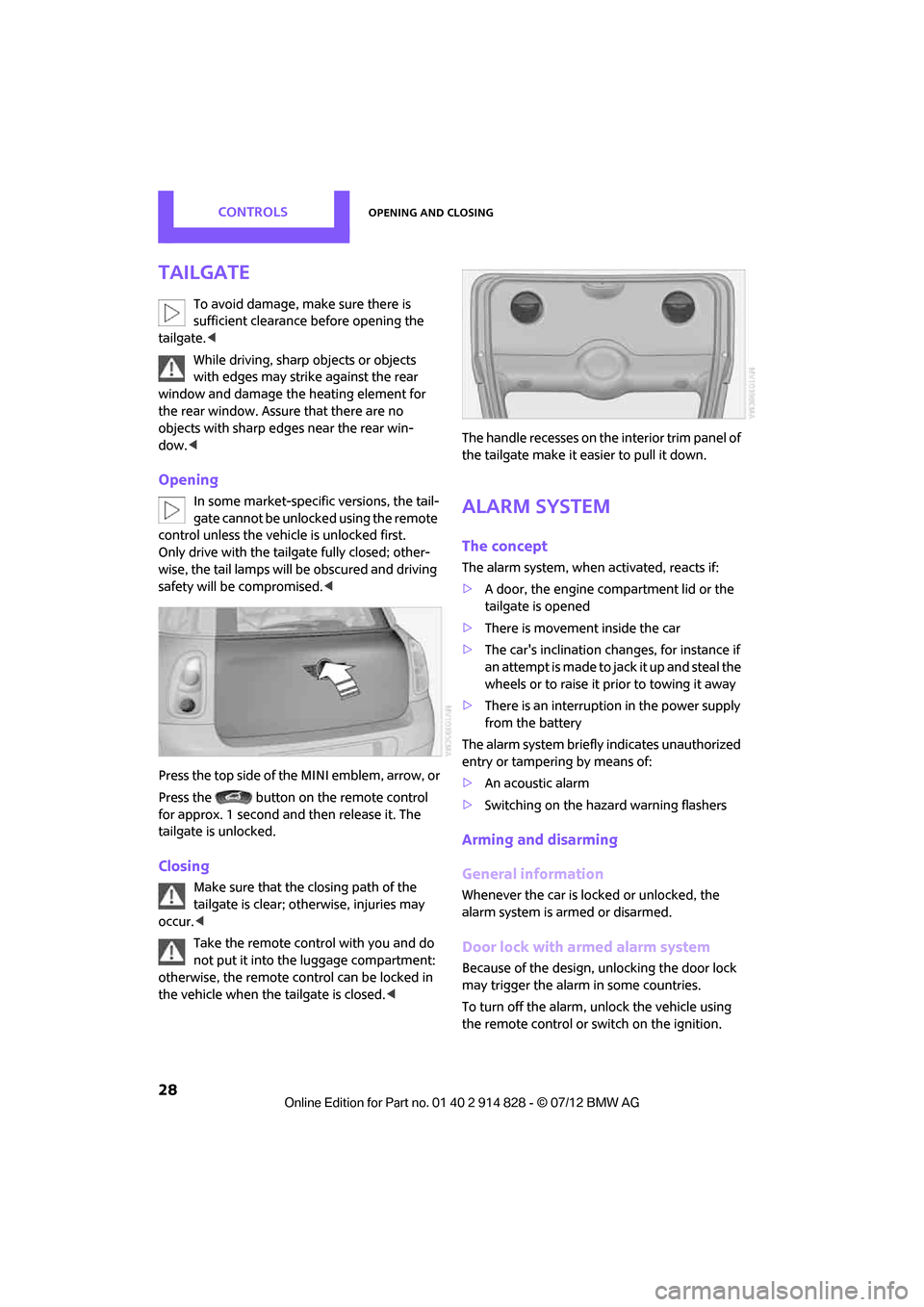
Press the top side of the MINI emblem, arrow, or
Press the button on the remote control
for approx. 1 second and then release it. The
tailgate is unlocked.
Closing
Make sure that the closing path of the
tailgate is clear; otherwise, injuries may
occur. <
Take the remote control with you and do
not put it into the luggage compartment:
otherwise, the remote co ntrol can be locked in
the vehicle when the tailgate is closed.
Alarm system
The concept
The alarm system, when activated, reacts if:
>
A door, the engine compartment lid or the
tailgate is opened
> There is movement inside the car
> The car's inclination changes, for instance if
an attempt is made to ja ck it up and steal the
wheels or to raise it prior to towing it away
> There is an interruption in the power supply
from the battery
The alarm system briefly indicates unauthorized
entry or tampering by means of:
> An acoustic alarm
> Switching on the haza rd warning flashers
Arming and disarming
General information
Whenever the car is locked or unlocked, the
alarm system is armed or disarmed.
Door lock with armed alarm system
Because of the design, unlocking the door lock
may trigger the alarm in some countries.
To turn off the alarm, unlock the vehicle using
the remote control or switch on the ignition.
Online Edition for Part no. 01 40 2 914 828 - \251 07/12 BMW AG
Page 102 of 201

Things to remember when drivingDRIVING TIPS
101
Installing behind the front seats
1.If necessary, remove the cargo area cover.
2. Fold down the rear seat backrests, refer to
Expanding cargo area.
3. Insert each cargo net mounting pin all the
way into its respective front mount in the
headliner, arrow 1, and push it forward.
4. Attach the hook, arrow 2, at the bottom of
each retaining strap to the respective eye on
the vehicle floor.
5. Lash the cargo net se curely. To do so,
tighten the retaining straps at the tensioning
buckles.
Removing
When removing and stowing the cargo net, pro-
ceed in the reverse sequence.
To fold closed, press the release button, arrow.
Bag holders
Holders on the left and right side of the support
for the cargo area cover, arrow, e.g. for hanging
shopping bags or storage bags.
Only hang light shopping bags or suitable
items on the holders. Otherwise, this may
create a hazard due to flying objects, for exam-
ple in the event of braking and evasive maneu-
vers.
Transport heavy luggage only if it is appropri-
ately secured in the cargo area. <
Determining cargo limit
1.Locate the following statement on your
vehicle's placard:
The combined weight of occupants
and cargo should never exceed
XXX kg or YYY lbs. Otherwise, this could
damage the vehicle and produce unstable
vehicle operating conditions. <
2. Determine the combined weight of the
driver and passengers that will be riding in
your vehicle.
3. Subtract the combined weight of the driver
and passengers from XXX pounds or YYY
kilograms.
Online Edition for Part no. 01 40 2 914 828 - \251 07/12 BMW AG
Page 103 of 201

DRIVING TIPSThings to remember when driving
102
4.The resulting figure equals the available
amount of cargo and luggage load capacity.
For example, if the XXX amount equals
1,400 lbs and there will be four 150 lb- pas-
sengers in your vehicle, the amount of avail-
able cargo and luggage load capacity is
650 lbs:
1,400 lbs minus 750 lbs = 650 lbs.
5. Determine the combined weight of luggage
and cargo being loaded on the vehicle. That
weight may not safely exceed the available
cargo and luggage load capacity calculated
in step 4.
6. If your vehicle will be towing a trailer, part of
the load from your trailer will be transferred
to your vehicle. Consult the manual for
transporting a trailer to determine how this
may reduce the available cargo and luggage
load capacity of your vehicle.
Load
4-seater:
5-seater:
The permissible load is the sum of the occu-
pants' weights and the we ight of the cargo. The
greater the weight of the occupants, the less
cargo/luggage can be transported.
Stowing cargo
> Position heavy objects as low and as far for-
ward as possible, ideally directly behind the
rear seat backrests.
> Cover sharp edges and corners.
> For very heavy cargo wh en the rear seat is
not occupied, secure each safety belt in the
respective opposite buckle.
> Do not stack higher than the top edge of the
backrests.
> Use the cargo net, refer to page 100. Ensure
that no objects can penetrate through the
net.
Securing cargo
> Secure smaller and lighter items using
retaining or draw straps.
> Heavy-duty cargo straps for securing larger
and heavier objects are available at your
MINI dealer.
> These cargo straps are fastened using eight
securing eyes.
Two of them are located on the side wall,
arrows 1, of the cargo area.
Two of them are located on the rear wall,
arrows 2, of the cargo area.
Online Edition for Part no. 01 40 2 914 828 - \251 07/12 BMW AG
Page 162 of 201

Replacing componentsMOBILITY
161
4.Unscrew the dust cap from the valve of the
defective wheel and screw the filling hose 2
of the sealant bottle onto the valve.
5. Ensure that the compre ssor is switched off.
6. Insert the plug 5 into the lighter socket/
power socket in the vehicle interior,
page 93.
7. With the engine running:
Switch on the compre ssor and let run for
about 3 to 8 minutes in order to add the
sealant and to achieve an inflation pressure
of about 1.8 bar/26 psi.
When adding sealant, the filling pres-
sure can temporarily increase up to
about 5 bar/73 psi. Do not switch off the
compressor during this phase. <
Do not run the compressor for longer
than 10 minutes; otherwise, the
device will overheat and possibly be
damaged. <
8. Switch off the compressor.
If an inflation pressure of 1.8 bar/26 psi is not
reached:
1. Unscrew the filling hose 2 from the wheel
and drive the vehicle forward and backward
approx. 33 ft/10 m to distribute the liquid
sealant in the tire evenly.
2. Inflate the tire again with the compressor.
If an inflation pressure of 1.8 bar/26 psi
still cannot be reached, then the tire is too
heavily damaged. Please contact the nearest
MINI dealer. <
Stowing Mobility Kit
1.Unscrew filler hose 2 of the sealant bottle
from the wheel.
2. Unscrew connecting hose of the
compressor 6 from the sealant bottle.
3. Connect the filler hose 2 of the sealant
bottle to the unoccupied connection on the
sealant bottle.
This prevents the rest of the sealant from
escaping from the bottle.
4. Wrap the empty sealant bottle in suitable
material to avoid dirtying the cargo area.
5. Stow Mobility Kit back in the vehicle.
Distributing the sealant.
Immediately drive approx. 3.1 miles/5 km so
that the sealant evenly distributes itself.
Do not exceed speeds of 50 mph/
80 km/h.
If possible, do not drop below 10 mph/
20 km/h.<
Correct the tire inflation pressure.
1. After driving approx. 3.1 miles/5 km or
ten minutes, stop at a suitable location.
2. Screw the connection hose 6 of the com-
pressor directly onto the tire valve.
3. Insert the plug 5 into the power socket in
the vehicle interior.
4. Adjust tire pressure to 1.8 bar/26 psi. With
the engine running:
> To increase the inflatio n pressure: switch on
the compressor. To check the current infla-
tion pressure, switch off the compressor.
Do not run the compressor for longer
than 10 minutes; otherwise, the
device will overheat and possibly be
damaged. <
> To decrease the inflat ion pressure: press the
release button 9.
Online Edition for Part no. 01 40 2 914 828 - \251 07/12 BMW AG
Page 167 of 201

MOBILITYGiving and receiving assistance
166
Connecting jumper cables
Connect the jumper cables in the correct
order, so that no sparks which could cause
injury occur.<
1. Open the battery cover in the engine com-
partment to access the positive terminal of
your MINI.
2. Release the tabs on the left and right sides of
the positive terminal cover, arrows 1, and lift
the cover to open, arrow 2.
3. Attach one terminal clamp of the plus/+
jumper cable to the positive terminal of the
battery or to a starting-aid terminal of the
vehicle providing assistance.
4. Attach the second terminal clamp of the
plus/+ jumper cable to the positive terminal
of the battery or a starting-aid terminal of
the vehicle to be started.
5. Attach one terminal clamp of the minus/–
jumper cable to the negative terminal of the
battery or to an engine or body ground of
the assisting vehicle. Body ground in MINI:
6.
Attach the second te rminal clamp of the
minus/– jumper cable to the negative termi-
nal of the battery or to the engine or body
ground of the vehicle to be started.
Starting the engine
1. Start the engine of the donor vehicle and
allow it to run for a few minutes at slightly
increased idle speed.
2. Start the engine of the vehicle to be started
in the usual manner.
If the first start attempt is not successful,
wait a few minutes before another attempt
in order to allow the discharged battery to
recharge.
3. Let the engines run for a few minutes.
4. Disconnect the jumper cables by reversing
the above connecting sequence.
If necessary, have the battery checked and
recharged. Never use spray fluids to start the
engine. <
Tow-starting, towing
away
Observe applicable laws and regulations
for tow-starting and towing. <
Do not transport any passengers other
than the driver in a vehicle that is being
towed. <
Online Edition for Part no. 01 40 2 914 828 - \251 07/12 BMW AG
Page 168 of 201
Giving and receiving assistanceMOBILITY
167
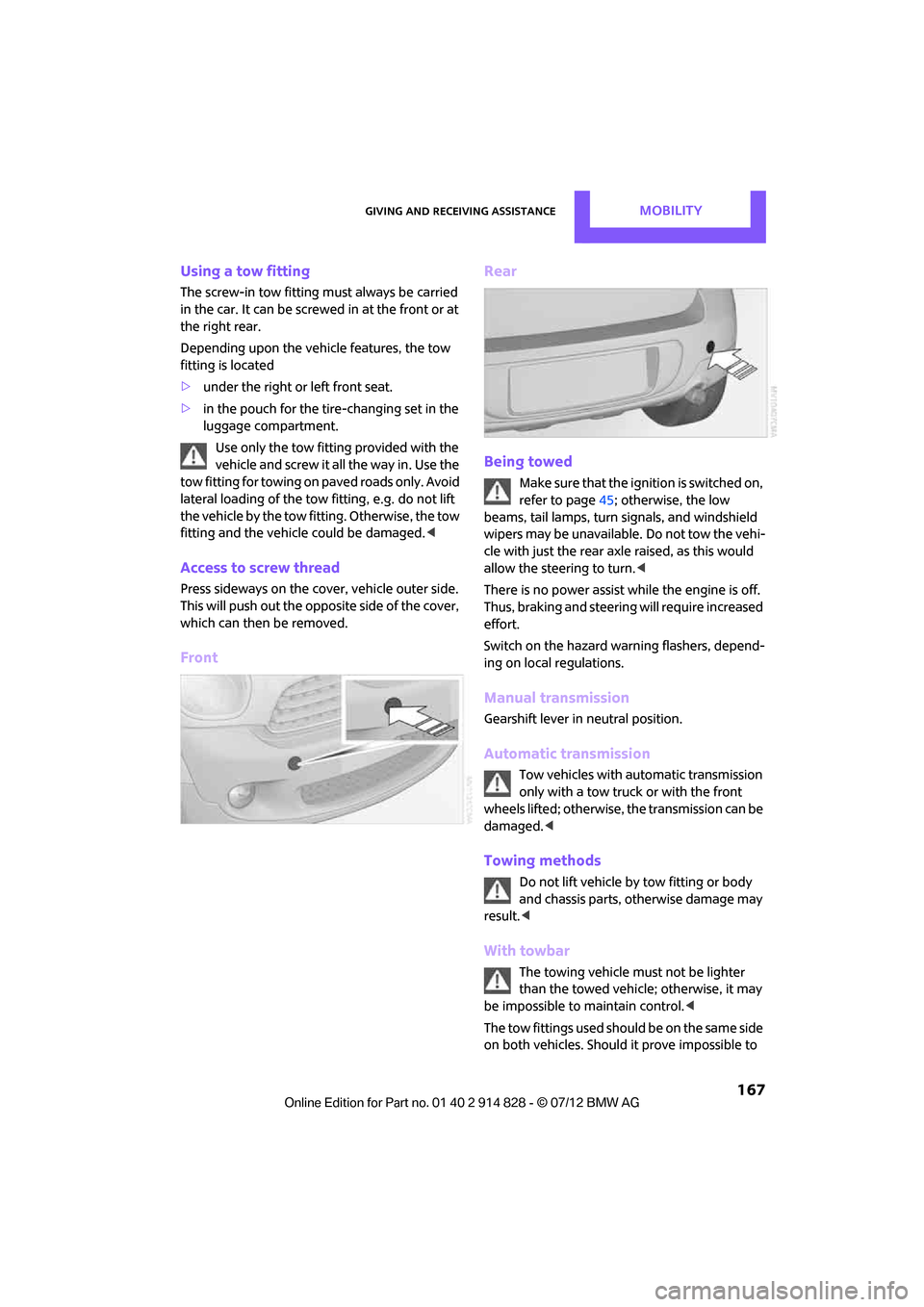
Using a tow fitting
The screw-in tow fitting must always be carried
in the car. It can be screwed in at the front or at
the right rear.
Depending upon the vehicle features, the tow
fitting is located
>under the right or left front seat.
> in the pouch for the tire-changing set in the
luggage compartment.
Use only the tow fitting provided with the
vehicle and screw it all the way in. Use the
tow fitting for towing on paved roads only. Avoid
lateral loading of the tow fitting, e.g. do not lift
the vehicle by the tow fitting. Otherwise, the tow
fitting and the vehicle could be damaged. <
Access to screw thread
Press sideways on the cover, vehicle outer side.
This will push out the oppo site side of the cover,
which can then be removed.
Front Rear
Being towed
Make sure that the ignition is switched on,
refer to page
45; otherwise, the low
beams, tail lamps, turn signals, and windshield
wipers may be unavailable. Do not tow the vehi-
cle with just the rear ax le raised, as this would
allow the steering to turn. <
There is no power assist while the engine is off.
Thus, braking and steering will require increased
effort.
Switch on the hazard warning flashers, depend-
ing on local regulations.
Manual transmission
Gearshift lever in neutral position.
Automatic transmission
Tow vehicles with automatic transmission
only with a tow truck or with the front
wheels lifted; otherwise, the transmission can be
damaged. <
Towing methods
Do not lift vehicle by tow fitting or body
and chassis parts, otherwise damage may
result. <
With towbar
The towing vehicle must not be lighter
than the towed vehicle; otherwise, it may
be impossible to maintain control. <
The tow fittings used should be on the same side
on both vehicles. Should it prove impossible to
Online Edition for Part no. 01 40 2 914 828 - \251 07/12 BMW AG
Page 169 of 201
MOBILITYGiving and receiving assistance
168
avoid mounting the tow bar at an angle, please
observe the following:
>Clearance and maneuver ing capability will
be sharply limited during cornering.
> The tow bar will generate lateral forces if it is
attached offset.
Only attach the tow bar to the tow fittings,
as attachment to other vehicle parts can
lead to damage. <
With tow rope
When starting off in the towing vehicle, make
sure that the tow rope is taut.
To avoid jerking and the associated
stresses on vehicle components when
towing, always use nylon ropes or nylon straps.
Attach the tow rope to the tow fittings only, as
attaching it to other pa rts of the vehicle could
result in damage. <
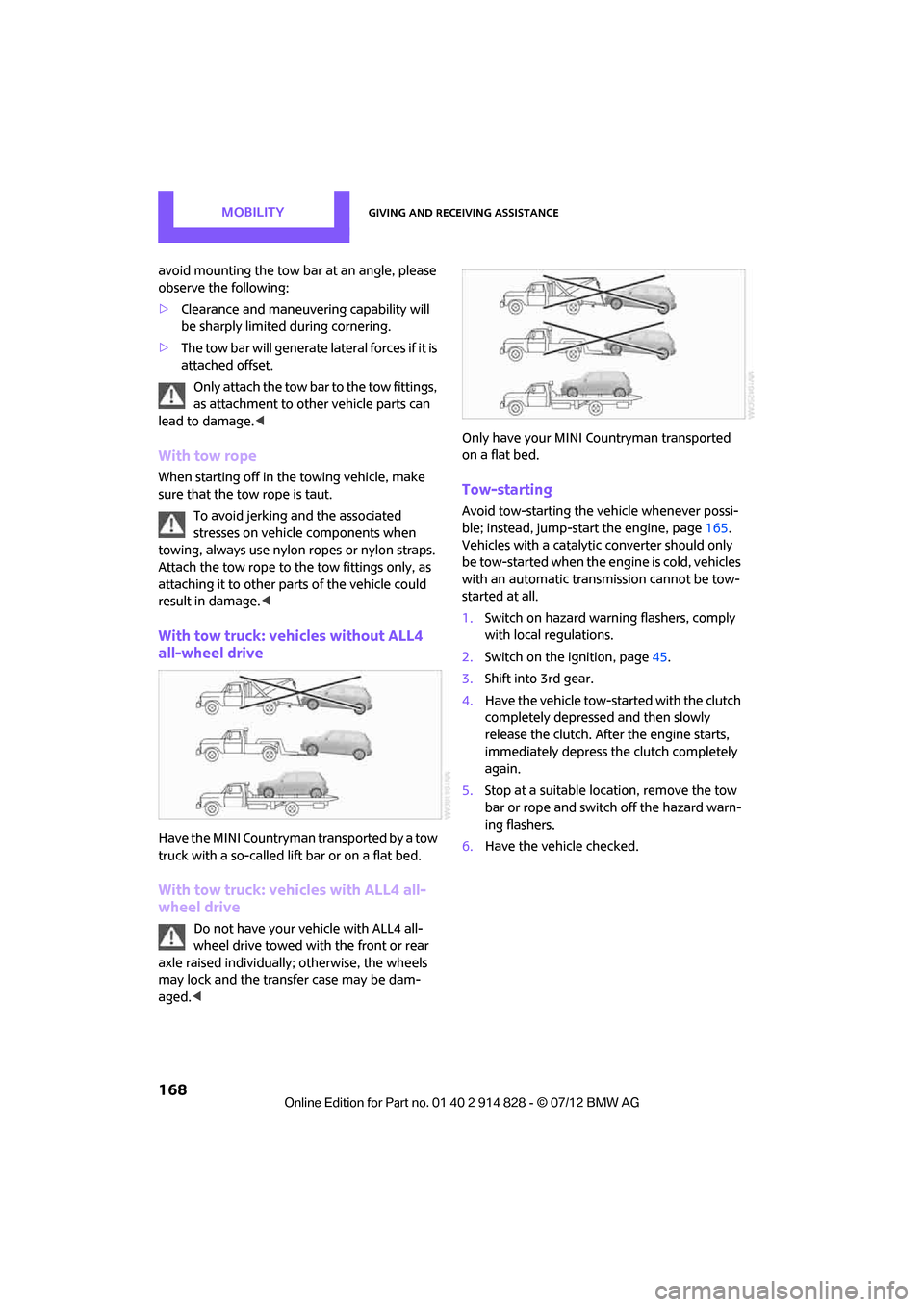
With tow truck: vehicles without ALL4
all-wheel drive
Have the MINI Countryman transported by a tow
truck with a so-called lift bar or on a flat bed.
With tow truck: vehicles with ALL4 all-
wheel drive
Do not have your vehicle with ALL4 all-
wheel drive towed with the front or rear
axle raised individually; otherwise, the wheels
may lock and the transfer case may be dam-
aged. < Only have your MINI Countryman transported
on a flat bed.
Tow-starting
Avoid tow-starting the vehicle whenever possi-
ble; instead, jump-start the engine, page
165.
Vehicles with a catalyti c converter should only
be tow-started when the engine is cold, vehicles
with an automatic transmission cannot be tow-
started at all.
1. Switch on hazard warning flashers, comply
with local regulations.
2. Switch on the ignition, page 45.
3. Shift into 3rd gear.
4. Have the vehicle tow-started with the clutch
completely depressed and then slowly
release the clutch. After the engine starts,
immediately depress the clutch completely
again.
5. Stop at a suitable lo cation, remove the tow
bar or rope and switch off the hazard warn-
ing flashers.
6. Have the vehicle checked.
Online Edition for Part no. 01 40 2 914 828 - \251 07/12 BMW AG
Page 189 of 201
188
REFERENCEEverything from A to Z
Everything from A to Z
Index
A
ABS Antilock Brake System65
Accepting a call 125
Accessories, see Vehicle equipment 4
Acknowledgment signals for locking/unlocking vehicle 24
Activated-charcoa l filter for
automatic climate control 85
Adaptive Light Control 78
Adding engine oil 147
Additives
– coolant 148
– engine oil 147
Adjusting temperature inside the car, refer to Air
conditioner 82
Adjusting temperature inside the car, refer to Automatic
climate control 83
Airbags 73
– sitting safely 34
– warning lamp 75
Air conditioner 81
Air conditioning mode
– air conditioner 82
– automatic cl imate control83
– ventilation 85
Air distribution
– automatic 84
– individual 83
– manual 83
Air flow rate 82,84
– air conditioning system 82
– automatic cl imate control84
– heating, ventilation 82
Airing, refer to Ventilation85
Air outlets, refer to Air vents 81
Air pressure, checking, refer to Tire inflation pressure 136Air recirculation, refer to
Recirculated-air
mode 82,84
Air supply
– air conditioner 82
– automatic climate control 83
– ventilation 85
Air vents 81
AKI, refer to Fuel grade 135
Alarm system 28
ALL4 all-wheel drive system 67
All-season tires, refer to Winter
tires 144
All-wheel drive, refer to ALL4 67
Ambient air, refer to Recirculated-air
mode 82,
84
Am bient li
ghti
ng80
Antenna, care 151
Antifreeze
– coolant 148
– washer fluid 53
Antilock Brake System ABS 65
Anti-theft alarm system, refer to Alarm system 28
Approved axle loads, refer to Weights 186
Approved engine oils 147
Approved gross vehicle weight, refer to Weights 186
Armrest, refer to Center
armrest 90
Ashtray 93
Assistant systems, refer to
– Dynamic Stability Control DSC 65
Audio device, external 90Automatic
– air distribution
84
– air flow rate 84
– cruise control 53
– headlamp control 76
Automatic climate control 81
– automatic air distribution 84
Automatic station search 109
Automatic station storage 110
Automatic transmission with Steptronic 47
– interlock 48
– overriding selector lever lock 49
– shiftlock 48
– sport program 49
AUTO program for automatic climate control 84
Auto radio, refer to Radio MINI Boost CD 108
AUX-In, refer to External audio device 90
AUX-In connection 108
Average fuel consumption 56
– setting the units 59
Average speed 57
Axle loads, refer to Weights 186
B
Background lighting, refer to
Ambient lighting 80
Backrests, refer to Seats 35
Backup lamps
– replacing bulb 158,159
Band-aids, refer to First aid pouch 165
Bar, refer to Tow-starting, towing away 167
Online Edition for Part no. 01 40 2 914 828 - \251 07/12 BMW AG
Page 190 of 201
Everything from A to ZREFERENCE
189
Base plate for telephone or mobile phone
– refer to Snap-in adapter 130
Battery 163
– disposal 31,163
– jump-starting 165
– temporary power failure 164
Battery renewal
– remote control 31
Being towed 167
Belts, refer to Safety belts 37
Belt tensioner, refer to Safety belts 37
Beverage holders, refer to Cupholders 93
Black ice, refer to External
temperature warning 56
Blower, refer to Air flow rate 82,84
Bluetooth, activating/ deactivating 122
Bottle holders, refer to
Cupholders 93
Brake Assist 65
Brake fluid, refer to Service
requirements 61
Brake lamps
– replacing bulbs 159
Brake pads, breaking in 96
Brake rotors 98
– brakes 96
– breaking in 96
Brakes
– ABS 65
– breaking in 96
– MINI Maintenance
System 149
– parking brake 47
– service requirements 61
Brakes, refer to Braking safely 97
Brake system 96
– breaking in 96
– disc brakes 98
– MINI Maintenance
System 149 Breakdown service, refer to
Roadside Assistance 165
Breaking in the clutch 96
Break-in period 96
Bulb changing, refer to Lamps and bulbs 155
Button for starting the
engine 45
Buttons on the steering wheel 11
C
California Proposition 65
warning 5
Call ending 126
Calling, refer to Phone numbers, dialing 126
Can holders, refer to
Cupholders 93
Capacities 187
Car battery, refer to Vehicle
battery 163
Car care 151
Care 151
– car-care products 151
– car washes 151
– CD/DVD drives 154
– high-pressure washers 152
– leather 153
– manual washing 152
– upholstery and fabrics 153
– windows 152
– wiper blades 152
Cargo, securing 102
Cargo area 98
– capacity 186
– Comfort Access 30
– lamp 79
– opening from outside 28
– trunk lid, refer to Tailgate 28
Cargo area, expanding 98
Cargo area lamp 79
Cargo area lid, refer to Tailgate 28
Cargo area partition net, refer to Cargo net 100 Cargo loading
101
– securing cargo 102
– stowing cargo 102
– vehicle 98
Cargo net 100
Car key, refer to Keys/remote controls 22
Carpets, care 153
Car phone
– installation location, refer to
Center armrest 90
Car phone, refer to Telephone 120
Car wash
– before driving in 47
Car wash, care 151
Car washes 151
Catalytic converter, refer to Hot exhaust system 97
CD player 113
– changing the track 113
– fast forward/reverse 113
– playing a track 114
– random order 113
– volume 108
Center armr
est90
Center brake lamp 159
Center console, refer to
Around the center
console 14
Center Rail 91
Center Rail, refer to Storage compartments 91
Central locking system 23
– Comfort Access 30
– from inside 26
– from outside 23
– setting unlocking behavior 23
Changing bulbs 155
Changing wheels 162
Charging the battery 163
Chassis number, refer to Engine compartment 145
Check Control 62
Child restraint fixing system LATCH 42
Online Edition for Part no. 01 40 2 914 828 - \251 07/12 BMW AG
Page 192 of 201
Everything from A to ZREFERENCE
191
Driving notes96
Driving off on inclines, refer to Hill Assist 67
Driving stability control
systems 65
Driving through water 97
Driving tips, refer to Driving
notes 96
Dry air, refer to Cooling function 85
DSC Dynamic Stability Control 65
DTC Dynamic Traction
Control 66
Dynamic Brake Control DBC, refer to Brake Assist 65
Dynamic Stability Control DSC 65
Dynamic Traction Control
DTC 66
E
Eject button 114
Electrical malfunction
– door lock 26
– fuel filler flap 134
Electronic brake-force
distribution 65
Electronic Stability Program
ESP, refer to Dynamic
Stability Control DSC 65
Emergency operation, refer to
Manual operation
– door lock 26
– fuel filler flap 134
– transmission lock, automatic transmission 49
Emergency services, refer to
Roadside Assistance 165
Ending a call 126
Engine
– breaking in 96
– data 184
– overheated, refer to Coolant
temperature 148
– speed 184
– starting, Comfort Access 30Engine compartment
145
Engine coolant, refer to Coolant 148
Engine oil
– additives, refer to Approved engine oils 147
– alternative oil types 147
– approved engine oils 147
– capacity 147
– checking level 146
– dipstick 146
– intervals between changes, refer to Service
requirements 61
– MINI Maintenance System 149
Engine oil level, checking 146
Engine output, refer to Engine data 184
Engine starting, refer to Starting the engine 46
ESP Electronic Stability
Program, refer to Dynamic
Stability Control DSC 65
Exhaust system, refer to Hot
exhaust system 97
Exterior mirrors 39
– adjusting 39
– automatic dimming feature 40
– automatic heating 40
– folding in and out 39
External audio device 90,108
External care 151
External temperature display
– change units of measure 59
– in the onboard computer 59
External tem peratur
e
warning 56
Eyes
– for tow-starting and towing away 167
– for tying down loads 102
F
Failure messages, refer to
Check Control 62
Failure of an electrical consumer 164
Fastening safety be lts, refer to
Safety belts 37
Fast forward
– CD 113
Fault messages, refer to Check
Control 62
Faulty
– tire 69
Filter
– microfilter/activated-
charcoal filter for automatic
climate control 85
– microfilter for air
conditioner 83
Fine wood, care 154
First aid pouch 165
Fixture for remote control, refer to Ignition lock 45
Flash when locking/
unlocking 24
Flat load floor 100
Flat tire
– run-flat tires 143
– Tire Pressure Monitor TPM 70
Flat Tire Monitor FTM 68
– indicating a flat tire 69
– initializing the system 68
– snow chains 68
– system limits 68
Flat tires, refer to Tire
condition 142
Floor mats, care 153
Floor plate, refe r to Flat load
floor 100
Fog lamps
– replacing bulb 157
Folding rear seat backrest 98
Footbrake, refer to Braking safely 97
Footwell lamps 79
For your own safety 4
Online Edition for Part no. 01 40 2 914 828 - \251 07/12 BMW AG