change time MINI Hardtop 4 Door 2016 (Mini Connected) User Guide
[x] Cancel search | Manufacturer: MINI, Model Year: 2016, Model line: Hardtop 4 Door, Model: MINI Hardtop 4 Door 2016Pages: 246, PDF Size: 6.36 MB
Page 139 of 246

15Seat heating, left 51Climate control functions in detail
Switching the system on/off Switching on
Set any air volume.
Switch off Turn wheel for air quantity to the
left until the control switches off.
Temperature Turn the ring to set the desired
temperature.
The automatic climate control reaches this
temperature as quickly as possible, if needed
by increasing the cooling or heating output,
and then keeps it constant.
Do not rapidly switch between different tem‐
perature settings. The automatic climate con‐
trol will not have sufficient time to adjust the
set temperature.
Cooling function The car's interior can only be cooled with the
engine running.
Press button.
The air will be cooled and dehumidi‐
fied and, depending on the temperature set‐
ting, warmed again.
Depending on the weather, the windshield may
fog up briefly when the engine is started.
The cooling function is switched on automati‐
cally with the AUTO program.When using the automatic climate control, con‐
densation water, refer to page 160, develops
that exits underneath the vehicle.
Maximum cooling Press button.
The system is set to the lowest temper‐
ature, optimum air flow and air circulation
mode.
Air flows out of the vents to the upper body re‐
gion. The vents need to be open for this.
The function is available with external tempera‐
tures beyond approx. 32 ℉/0 ℃ and with the
engine running.
Adjust air flow with the program active.
AUTO program Press button.
Air flow, air distribution and tempera‐
ture are controlled automatically.
Depending on the selected temperature, AUTO
intensity and outside influences, the air is di‐
rected to the windshield, side windows, upper
body, and into the footwell.
The cooling function, refer to page 139, and
the automatic recirculation control, refer to
page 140, are automatically also switched on
in the AUTO program.
To switch off the program: press the button
again or manually adjust the air distribution.
Intensity of the AUTO program
With the AUTO program activated, the auto‐
matic intensity control can be changed.
Turn the ring to set the desired
intensity.Seite 139Climate controlCONTROLS139
Online Edition for Part no. 01 40 2 963 334 - VI/15
Page 144 of 246

on the interior rearview mirror flashes. This
erases all programming of the buttons on
the interior rearview mirror.3.Hold the hand-held transmitter for the sys‐
tem to be controlled approx. 1 to 3 in/2.5
to 8 cm away from the buttons of the inte‐
rior rearview mirror. The required distance
depends on the manual transmitter.4.Simultaneously press and hold the button
of the desired function on the hand-held
transmitter and the button to be program‐
med on the interior rearview mirror. The
LED on the interior rearview mirror will be‐
gin flashing slowly.5.Release both buttons as soon as the LED
flashes more rapidly. The LED flashing
faster indicates that the button on the inte‐
rior rearview mirror has been programmed.
If the LED does not flash faster after at least
60 seconds, change the distance between
the interior rearview mirror and the hand-
held transmitter and repeat the step. Sev‐
eral more attempts at different distances
may be necessary. Wait at least 15 seconds
between attempts.
Canada: if programming with the hand-
held transmitter was interrupted, hold
down the interior rearview mirror button
and repeatedly press and release the hand-
held transmitter button for 2 seconds.6.To program other functions on other but‐
tons, repeat steps 3 to 5.
The systems can be controlled using the interior
rearview mirror buttons.
Special feature of the alternating-code
wireless system
If you are unable to operate the system after
repeated programming, please check if the sys‐
tem to be controlled features an alternating-
code system.
Read the system's operating manual, or press
the programmed button on the interior rear‐
view mirror longer. If the LED on the interior
rearview mirror starts flashing rapidly and then
stays lit constantly for 2 seconds, the system
features an alternating-code system. Flashing
and continuous illumination of the LED will re‐
peat for approximately 20 seconds.
For systems with an alternating-code system,
the Universal Integrated Remote Control and
the system also have to be synchronized.
Please read the operating manual to find out
how to synchronize the system.
Synchronizing is easier with the aid of a second
person.
To synchronize:1.Park the vehicle within range of the re‐
mote-controlled system.2.Program the relevant button on the interior
rearview mirror as described.3.Locate and press the synchronizing button
on the system being programmed. You
have approx. 30 seconds for the next step.4.Hold down the programmed button on the
interior rearview mirror for approximately
3 seconds and then release it. If necessary,
repeat this step up to three times in order
to finish synchronization. Once synchroni‐
zation is complete, the programmed func‐
tion will be carried out.
Reprogramming individual buttons
1.Switch on the ignition.2.Press and hold the interior rearview mirror
button to be programmed.3.As soon as the interior rearview mirror LED
starts flashing slowly, hold the hand-held
transmitter for the system to be controlled
approx. 1 to 3 in/2.5 to 8 cm away from the
buttons of the interior rearview mirror. The
required distance depends on the manual
transmitter.Seite 144CONTROLSInterior equipment144
Online Edition for Part no. 01 40 2 963 334 - VI/15
Page 197 of 246
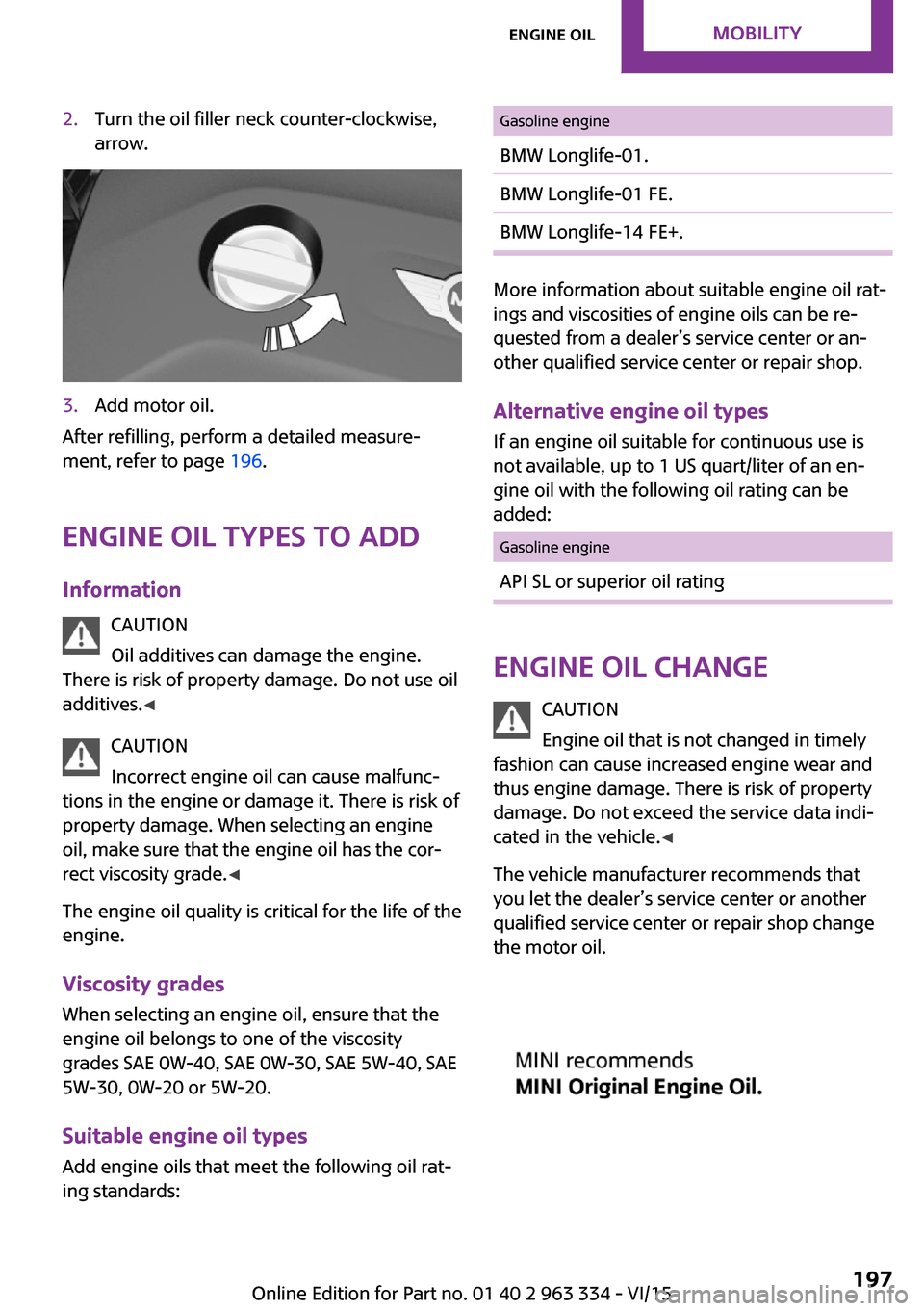
2.Turn the oil filler neck counter-clockwise,
arrow.3.Add motor oil.
After refilling, perform a detailed measure‐
ment, refer to page 196.
Engine oil types to add
Information CAUTION
Oil additives can damage the engine.
There is risk of property damage. Do not use oil
additives. ◀
CAUTION
Incorrect engine oil can cause malfunc‐
tions in the engine or damage it. There is risk of
property damage. When selecting an engine
oil, make sure that the engine oil has the cor‐
rect viscosity grade. ◀
The engine oil quality is critical for the life of the
engine.
Viscosity grades
When selecting an engine oil, ensure that the
engine oil belongs to one of the viscosity
grades SAE 0W-40, SAE 0W-30, SAE 5W-40, SAE
5W-30, 0W-20 or 5W-20.
Suitable engine oil types Add engine oils that meet the following oil rat‐
ing standards:
Gasoline engineBMW Longlife-01.BMW Longlife-01 FE.BMW Longlife-14 FE+.
More information about suitable engine oil rat‐
ings and viscosities of engine oils can be re‐
quested from a dealer’s service center or an‐
other qualified service center or repair shop.
Alternative engine oil types If an engine oil suitable for continuous use is
not available, up to 1 US quart/liter of an en‐
gine oil with the following oil rating can be
added:
Gasoline engineAPI SL or superior oil rating
Engine oil change
CAUTION
Engine oil that is not changed in timely
fashion can cause increased engine wear and
thus engine damage. There is risk of property
damage. Do not exceed the service data indi‐ cated in the vehicle. ◀
The vehicle manufacturer recommends that
you let the dealer’s service center or another
qualified service center or repair shop change
the motor oil.
Seite 197Engine oilMOBILITY197
Online Edition for Part no. 01 40 2 963 334 - VI/15
Page 203 of 246

Then pull the wiper blade free from the
holder of the wiper arm, arrow 2.4.Insert and latch a new wiper blade in re‐
verse order.5.Fold down the wipers.
Replace rear wiper blade
1.Fold up and hold the wiper arm firmly.2.Turn the wiper blade all the way back.3.Continue turning the wiper blade all the
way so that it pops out of the holder.4.Press the new wiper blade into the holder
until you hear it snap into place.5.Fold the wipers in.
Lamp and bulb replace‐
ment
General information Lights and bulbs make an essential contribution
to vehicle safety.
The manufacturer of the vehicle recommends
that you have appropriate work performed by a
dealer’s service center or another qualified
service center or repair shop if you are unfami‐
liar with it or if it has not been described here.
A spare lamp box is available from a dealer’s
service center or another qualified service cen‐
ter or repair shop.
Information
Lights and bulbs WARNING
Bulbs can get hot during operation. Con‐
tact with the bulbs can cause burns. There is
risk of injuries. Only change bulbs after they
have cooled off. ◀
WARNING
Work on switched-on lighting systems
can cause short circuits. There is risk of injuries
or risk of property damage. When working on
the lighting system, switch off the lamps in
question. If necessary, heed the bulb manufac‐
turer's instructions. ◀
CAUTION
Contaminated bulbs reduce their service
life. There is risk of property damage. Do not
hold new bulbs with your bare hands. Use a
clean cloth or something similar, or hold the
bulb by its base. ◀
Light-emitting diodes (LEDs)
Some items of equipment use light-emitting di‐
odes installed behind a cover as a light source.
These light-emitting diodes, which are related
to conventional lasers, are officially designated
as Class 1 light-emitting diodes.
WARNING
Too intensive brightness can irritate or
damage the retina of the eye. There is risk of
injuries. Do not look directly into the headlights
or other light sources for an extended period of
time. Do not remove the LED covers. ◀Seite 203Replacing componentsMOBILITY203
Online Edition for Part no. 01 40 2 963 334 - VI/15
Page 204 of 246

Headlight glass
Condensation can form on the inside of the ex‐
ternal lights in cool or humid weather. When
driving with the lights switched on, the conden‐
sation evaporates after a short time. The head‐
light glass does not need to be changed.
If despite driving with the lights switched on,
increasing humidity forms, e. g. water droplets
in the lamp, the manufacturer of your vehicle
recommends having it checked by a dealer’s
service center or another qualified service cen‐
ter or repair shop.
Front lights, bulb replacement
Overview Halogen headlights1Low beams/high beams2Turn signalLED headlights1Daytime running lights2Low beams/high beams3Turn signal
Bug light
1Parking lights2Daytime running lights3Fog lights
LED bug light
1Parking lights2Fog lightsSeite 204MOBILITYReplacing components204
Online Edition for Part no. 01 40 2 963 334 - VI/15
Page 212 of 246

3.Check tire inflation pressure at the next op‐
portunity and correct as needed.4.Reinitialize the Flat Tire Monitor, refer to
page 106.
Reinitialize the Tire Pressure Monitor, refer
to page 103.5.Check to make sure the lug bolts are tight
with a calibrated torque wrench.
Driving with emergency wheel
WARNING
The emergency wheel has particular di‐
mensions. When driving with an emergency wheel, changed driving properties may occur at
higher speeds, e.g. reduced lane stability when
braking, longer braking distance and changed
self-steering properties in the limit area. There
is risk of an accident. Drive moderately and do
not exceed a speed of 50 mph/80 km/h. ◀
After the trip with emergency wheel
Have the following work performed by a deal‐
er's service center or another qualified service
center or repair shop.
1.Replace the damaged tires as soon as pos‐
sible.2.Replace the emergency wheel with a new
wheel.3.Have the tray with the emergency wheel
installed.
Vehicle battery
Maintenance
The battery is maintenance-free.
The added amount of acid is sufficient for the
service life of the battery.
More information about the battery can be re‐
quested from a dealer’s service center or an‐
other qualified service center or repair shop.
Battery replacement
CAUTION
Vehicle batteries that are not compatible
can damage vehicle systems and impair vehicle
functions.There is risk of property damage. In‐ formation on the compatible vehicle batteries is
available at your dealer's service center. ◀
After a battery replacement, the manufacturer
of your vehicle recommends that the vehicle
battery be registered on the vehicle by a
dealer’s service center or another qualified
service center or repair shop to ensure that all
comfort features are fully available and that
any Check Control messages of these comfort
features are no longer displayed.
Charging the battery
General information Make sure that the battery is always sufficiently
charged to guarantee that the battery remains
usable for its full service life.
The battery may need to be charged in the fol‐
lowing cases:▷When making frequent short-distance
drives.▷If the vehicle is not used for prolonged peri‐
ods, longer than a month.▷Steptronic transmission: when parked for
long periods of time in selector lever posi‐
tion D, R or N.
Information
CAUTION
Battery chargers for the vehicle battery
can work with high voltages and currents, which means that the 12V on-board network
can be overloaded or damaged. There is risk of
property damage. Only connect battery charg‐
ers for the vehicle battery to the starting aid
terminals in the engine compartment. ◀
Seite 212MOBILITYReplacing components212
Online Edition for Part no. 01 40 2 963 334 - VI/15
Page 237 of 246

Camera-based cruise con‐trol 119
Camera lenses, care 223
Camera, rearview cam‐ era 130
Can holder, see Cu‐ pholder 152
Car battery 212
Car care products 221
Care, displays 223
Care, vehicle 221
Cargo area 148
Cargo area, adapting size 153
Cargo area, enlarging 149
Cargo area lid 40
Cargo area, storage compart‐ ments 153
Cargo cover 148
Cargo, securing 162
Cargo straps, securing cargo 162
Car key, see Remote con‐ trol 34
Carpet, care 223
Car wash 220
Catalytic converter, see Hot exhaust system 159
CBS Condition Based Serv‐ ice 200
Center armrest 152
Center console 16
Central instrument cluster, LED ring 88
Central locking system 40
Central screen, refer to Control Display 18
Changes, technical, refer to Own Safety 7
Changing parts 202
Changing wheels 210
Changing wheels/tires 186
Chassis number, see vehicle identification number 10
Check Control 76
Checking the oil level elec‐ tronically 195 Children, seating position 58
Children, transporting safely 58
Child restraint fixing sys‐ tem 58
Child restraint fixing system LATCH 60
Child restraint fixing systems, mounting 59
Child safety locks 61
Child seat, mounting 59
Child seats 58
Chrome parts, care 222
Chrono package, cockpit 92
Cigarette lighter 147
Cleaning, displays 223
Climate control 136, 138
Clock 80
Closing/opening via door lock 39
Closing/opening with remote control 37
Clothes hooks 153
Coasting 168
Coasting with engine decou‐ pled, coasting 168
Coasting with idling en‐ gine 168
Combination switch, see Turn signals 67
Combi switch, see wiper sys‐ tem 68
Comfort Access 41
Compartments in the doors 152
Compass 145
Compressor 188
Condensation on win‐ dows 140
Condensation under the vehi‐ cle 160
Condition Based Service CBS 200
Configuring driving pro‐ gram 118
Confirmation signal 43 Control Display 18
Control Display, settings 87
Controller 19
Control systems, driving stabil‐ ity 115
Convenient opening 38
Coolant 198
Cooling function 137, 139
Cooling, maximum 139
Cooling system 198
Cornering lamp 96
Corrosion on brake discs 160
Cosmetic mirror 147
Courtesy lamps during unlock‐ ing 37
Courtesy lamps with the vehi‐ cle locked 38
Cruise control 124
Cruise control, active 119
Cruising range 81
Cupholder 152
Current fuel consumption 81
D
Damage, tires 186
Damping control, dy‐ namic 117
Data, technical 226
Date 80
Daytime running lights 96
Defrosting, refer to defrosting the windows 137
Defrosting, see Windows, de‐ frosting 140
Defrosting the windows 137
Dehumidifying, air 137, 139
Deleting personal data 24
Deletion of personal data 24
Destination distance 85
Digital clock 80
Digital compass 145
Dimensions 226
Dimmable exterior mirrors 56
Dimmable interior rearview mirror 56 Seite 237Everything from A to ZREFERENCE237
Online Edition for Part no. 01 40 2 963 334 - VI/15
Page 241 of 246
MINI maintenance sys‐tem 200
MINIMALISM Analyser 169
MINIMALISM info 168
Minimum tread, tires 185
Mirrors 55
Mobile communication devi‐ ces in the vehicle 159
Mobility System 188
Mode, GREEN Mode 165
Modifications, technical, refer to Own Safety 7
Moisture in headlight 204
Monitor, refer to Control Dis‐ play 18
Mounting of child restraint systems 59
Multifunction steering wheel, buttons 14
Multimedia, refer to Integrated Owner's Manual
N Navigation, refer to Integrated Owner's Manual
Neck restraints, front, see Head restraints 53
Neck restraints, rear, see Head restraints 54
New wheels and tires 186
Nylon rope for tow-starting/ towing 217
O
OBD Onboard Diagnos‐ tics 201
Obstacle marking, rearview camera 131
Octane rating, see Recom‐ mended fuel grade 176
Odometer 80
Office, refer to Integrated Owner's Manual
Oil 195 Oil, adding 196
Oil additives 197
Oil change 197
Oil change interval, service re‐ quirements 81
Oil filler neck 196
Oil types, alternative 197
Oil types, suitable 197
Old batteries, disposal 213
On-board computer 84
On-board computer, refer to On-board computer 84
Onboard Diagnostics OBD 201
Onboard monitor 18
Onboard monitor operating concept 18
Onboard vehicle tool kit 202
Opening/closing via door lock 39
Opening/closing with remote control 37
Operating menus, onboard monitor 18
Optional equipment, standard equipment 6
Outside air, refer to Automatic recirculated-air control 140
Own safety 7
P
Paint, vehicle 221
Panoramic glass sunroof 46
Parallel parking assistant 132
Park Distance Control PDC 126
Parked-car ventilation 141
Parked vehicle, condensa‐ tion 160
Parking aid, see PDC 126
Parking assistant 132
Parking brake 66
Parking lights 94
Passenger side mirror, tilting downward 55 Pathway lines, rearview cam‐
era 130
PDC Park Distance Con‐ trol 126
Pedestrian warning with city braking function 112
Performance Control 116
Personal Profile 36
Phone, refer to Integrated Owner's Manual
Pinch protection system, glass sunroof 47
Pinch protection system, win‐ dows 45
Plastic, care 222
PostCrash 114
Power failure 213
Power windows 44
Prescribed engine oil types 197
Pressure, tire air pressure 178
Pressure warning, tires 106
Profile, see Personal Pro‐ file 36
Protective function, glass sun‐ roof 47
Protective function, win‐ dows 45
Push-and-turn switch, see Controller 19
R Radiator fluid 198
Radio-operated key, see Re‐ mote control 34
Radio ready state 62
Radio, refer to Integrated Owner's Manual
Rain sensor 68
Rear fog lights 97
Rear lights 206
Rear luggage rack 163
Rearview camera 129
Rearview mirror 55 Seite 241Everything from A to ZREFERENCE241
Online Edition for Part no. 01 40 2 963 334 - VI/15
Page 243 of 246

Steering wheel, adjusting 57
Steptronic Sport transmission, refer to Steptronic transmis‐
sion 71
Steptronic transmission 71
Stopping the engine 63
Storage compartments 151
Storage, tires 187
Storing the vehicle 223
Suitable engine oil types 197
Summer tires, tread 185
Sun visor 147
Supplementary text mes‐ sages 79
Switch for Dynamic Driv‐ ing 117
Switch-on times, parked-car ventilation 141
Switch, see Cockpit 14
Symbols 6
Symbols in the status field 23
T Tachometer 80
Tailgate 40
Tailgate via remote control 38
Tail lights 206
Technical changes, refer to Own Safety 7
Technical data 226
Temperature, air condi‐ tioner 137
Temperature, automatic cli‐ mate control 139
Temperature display for exter‐ nal temperature 80
Temperature, engine 85
Tempomat, see camera-based cruise control 119
Terminal, starting aid 215
Text messages, supplemen‐ tary 79
Theft alarm system, see Alarm system 43
Thigh support 50 Tilt alarm sensor 44
Time of arrival 85
Tire damage 186
Tire identification marks 184
Tire inflation pressure 178
Tire inflation pressure moni‐ tor, refer to FTM 106
Tire Pressure Monitor TPM 102
Tires, changing 186
Tire sealant 188
Tires, everything on wheels and tires 178
Tires, run-flat tires 187
Tire tread 185
Tone, refer to Integrated Owner's Manual
Tools 202
Total vehicle weight 227
Touchpad 21
Tow fitting 218
Towing 216
Tow-starting 216
TPM Tire Pressure Moni‐ tor 102
Traction control 116
TRACTION drive mode, driving dynamics 116
Transmission lock, releasing manually 73
Transmission, manual trans‐ mission 71
Transmission, see Steptronic transmission 71
Transporting children safely 58
Tread, tires 185
Triple turn signal activa‐ tion 67
Trip odometer 80
Trip on-board computer 86
Trip recorder, see Trip odome‐ ter 80
Turning circle lines, rearview camera 131
Turn signal, front 204 Turn signal, side 209
Turn signals, operation 67
Turn signals, rear, bulb re‐ placement 206
U
Unintentional alarm 44
Units of measurement 88
Universal remote control 143
Unlock button, Steptronic transmission 72
Unlocking/locking via door lock 39
Unlocking/locking with re‐ mote control 37
Unlocking, settings 42
Updates made after the edito‐ rial deadline 7
Upholstery care 222
USB interface 148
V
Vanity mirror 147
Vehicle battery 212
Vehicle battery, replacing 212
Vehicle, break-in 158
Vehicle care 221
Vehicle features and op‐ tions 6
Vehicle identification num‐ ber 10
Vehicle jack 210
Vehicle paint 221
Vehicle storage 223
Vehicle wash 220
Ventilation 141
Ventilation, refer to Parked- car ventilation 141
VIN, see vehicle identification number 10
Voice activation system 26 Seite 243Everything from A to ZREFERENCE243
Online Edition for Part no. 01 40 2 963 334 - VI/15