malfunction MITSUBISHI 3000GT 1994 2.G Workshop Manual
[x] Cancel search | Manufacturer: MITSUBISHI, Model Year: 1994, Model line: 3000GT, Model: MITSUBISHI 3000GT 1994 2.GPages: 738, PDF Size: 35.06 MB
Page 166 of 738
Downloaded from www.Manualslib.com manuals search engine CIRCUIT DIAGRAMS - MFI Circuit
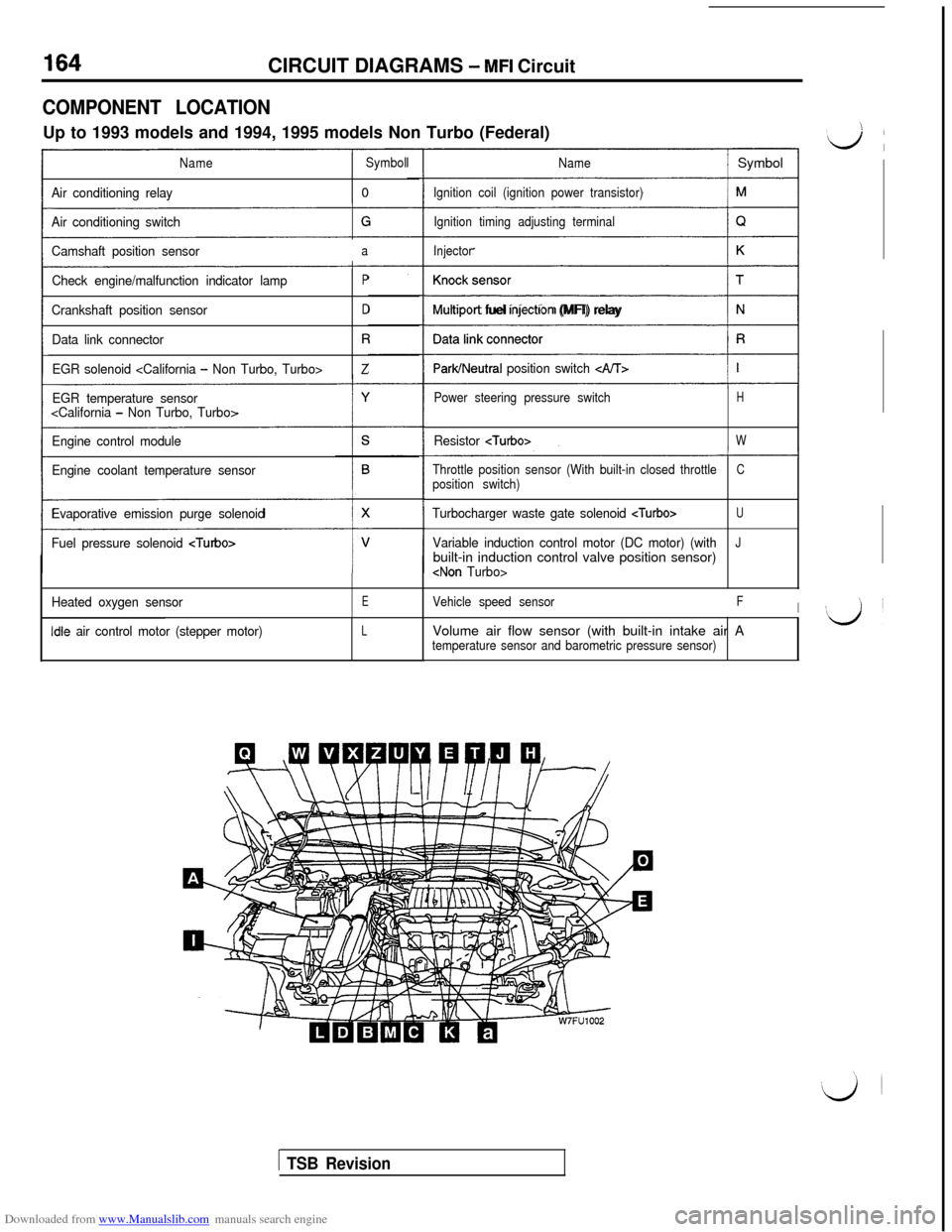
COMPONENT LOCATIONUp to 1993 models and 1994, 1995 models Non Turbo (Federal)
NameSymbol
Air conditioning relay0
Air conditioning switch
Camshaft position sensor
a
Check engine/malfunction indicator lampP
Crankshaft position sensorD
Data link connectorR
EGR solenoid
EGR temperature sensor
Engine control module
Engine coolant temperature sensor
Evaporative emission purge solenoid
Fuel pressure solenoid
Heated oxygen sensorE
idle air control motor (stepper motor)L
Name/ Symbol
Ignition coil (ignition power transistor)
Ignition timing adjusting terminal
Injector
(1
Multrport fuel rnjectron (MFI) relay
ParWNeutral position switch c&T>
Power steering pressure switchH
Resistor
Throttle position sensor (With built-in closed throttleCposition switch)
Turbocharger waste gate solenoid
Variable induction control motor (DC motor) (withJbuilt-in induction control valve position sensor)
Vehicle speed sensorFIVolume air flow sensor (with built-in intake air A
temperature sensor and barometric pressure sensor)
1 TSB Revision
Page 169 of 738
Downloaded from www.Manualslib.com manuals search engine CIRCUIT DIAGRAMS - MFI Circuit167 ~
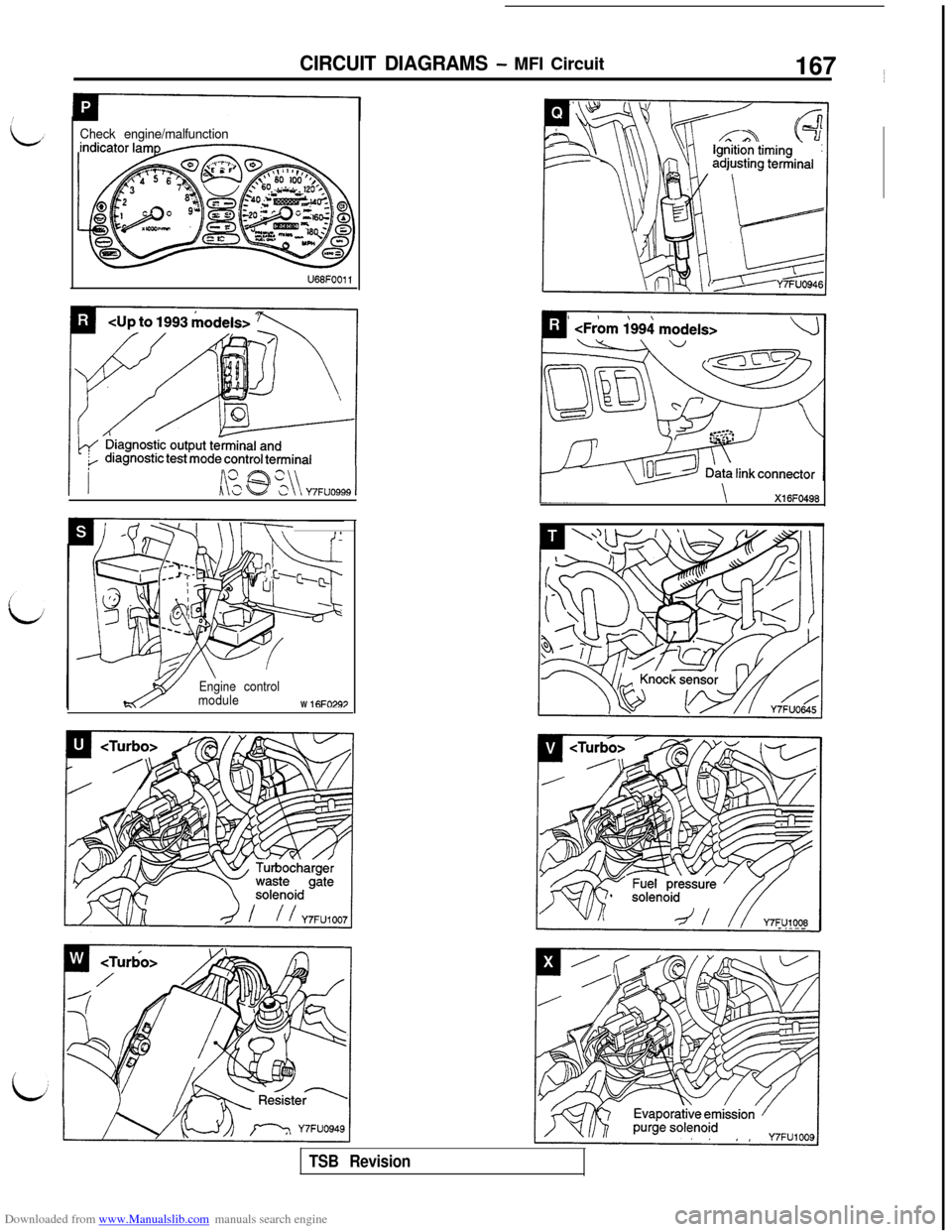
Check engine/malfunction
Lki @ %\\ Y7FUO999 1
\l-T-T-. .
Engine control
moduleW
16FO297
Xl 6FO498
TSB Revision
Page 173 of 738
Downloaded from www.Manualslib.com manuals search engine CIRCUIT DIAGRAMS - MFI Circuit
,’
L
c
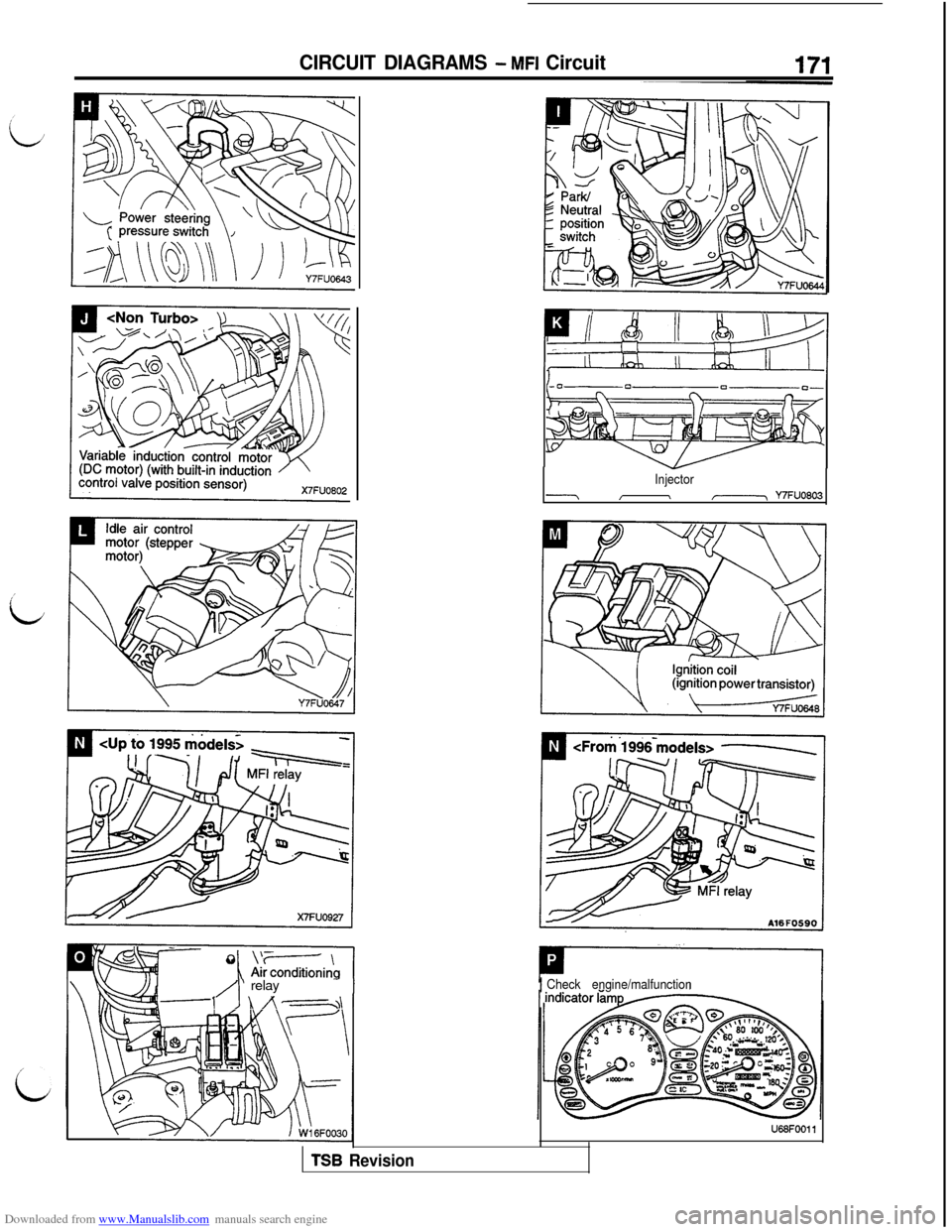
Injector
-I\/-, Y7FUO803
\ R\/1/I‘ relay- 1
I’ I\,?-==,>\ I
1Check engine/malfunction
U68FOOll
TSB Revision
Page 453 of 738
Downloaded from www.Manualslib.com manuals search engine ENGINE ELECTRICAL - Charging System16-7/
L
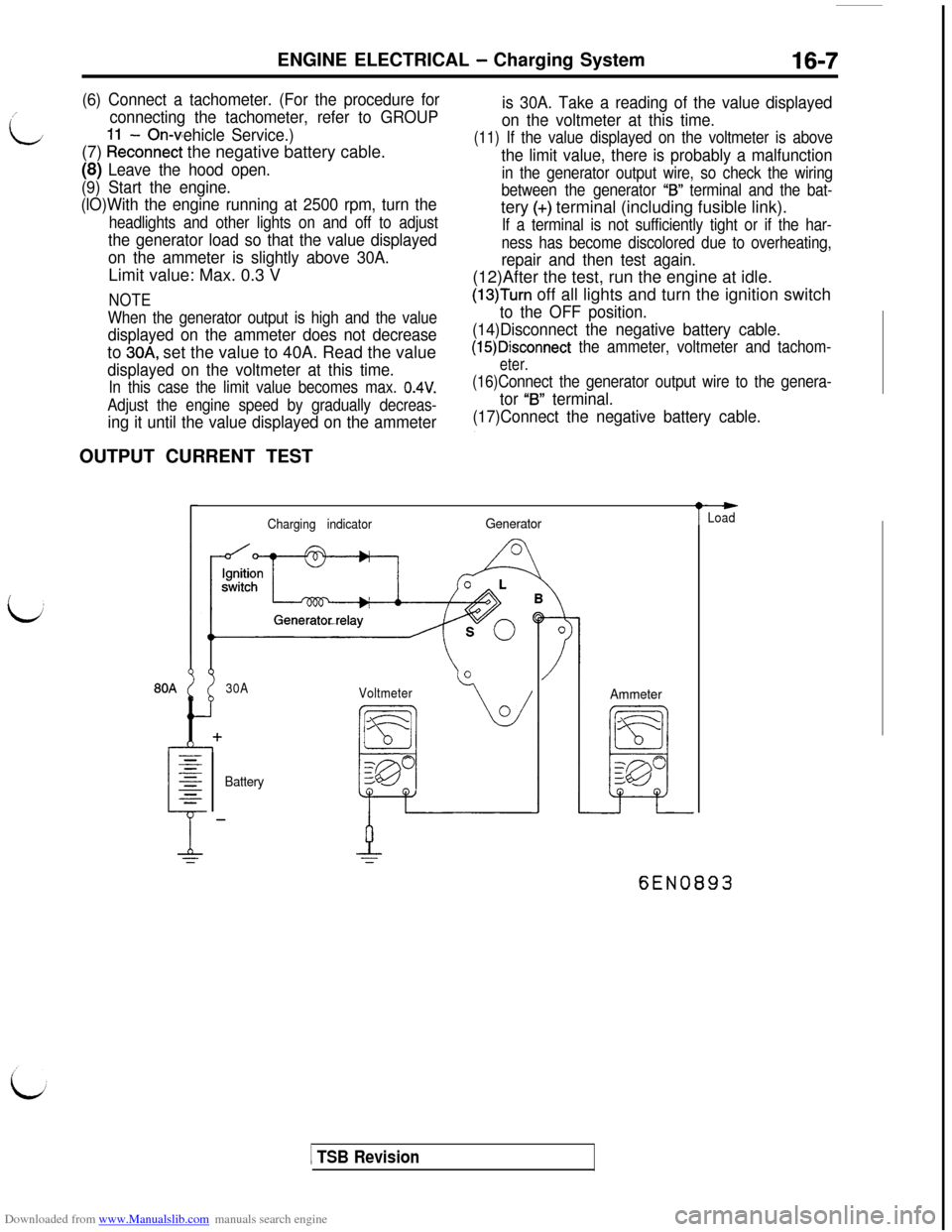
(6) Connect a tachometer. (For the procedure for
connecting the tachometer, refer to GROUP
- On-vehicle Service.)(7)
kkconnect the negative battery cable.
(8) Leave the hood open.
(9) Start the engine.
(lO)With the engine running at 2500 rpm, turn the
headlights and other lights on and off to adjust
the generator load so that the value displayed
on the ammeter is slightly above 30A.Limit value: Max. 0.3 V
NOTE
When the generator output is high and the value
displayed on the ammeter does not decreaseto
30A, set the value to 40A. Read the value
displayed on the voltmeter at this time.
In this case the limit value becomes max. 0.4V.
Adjust the engine speed by gradually decreas-
ing it until the value displayed on the ammeterOUTPUT CURRENT TEST
is 30A. Take a reading of the value displayed
on the voltmeter at this time.
(11) If the value displayed on the voltmeter is above
the limit value, there is probably a malfunction
in the generator output wire, so check the wiring
between the generator
“IS” terminal and the bat-tery
(+) terminal (including fusible link).
If a terminal is not sufficiently tight or if the har-
ness has become discolored due to overheating,
repair and then test again.(12)After the test, run the engine at idle.
(13)Turn off all lights and turn the ignition switch
to the OFF position.
(14)Disconnect the negative battery cable.
(15)Disconnect the ammeter, voltmeter and tachom-
eter.
(16)Connect the generator output wire to the genera-
tor “B” terminal.
(17)Connect the negative battery cable.
Charging indicatorGenerator
30A
Voltmeter
BatteryAmmeter
t
-Load
6EN0893
1 TSB Revision
Page 455 of 738
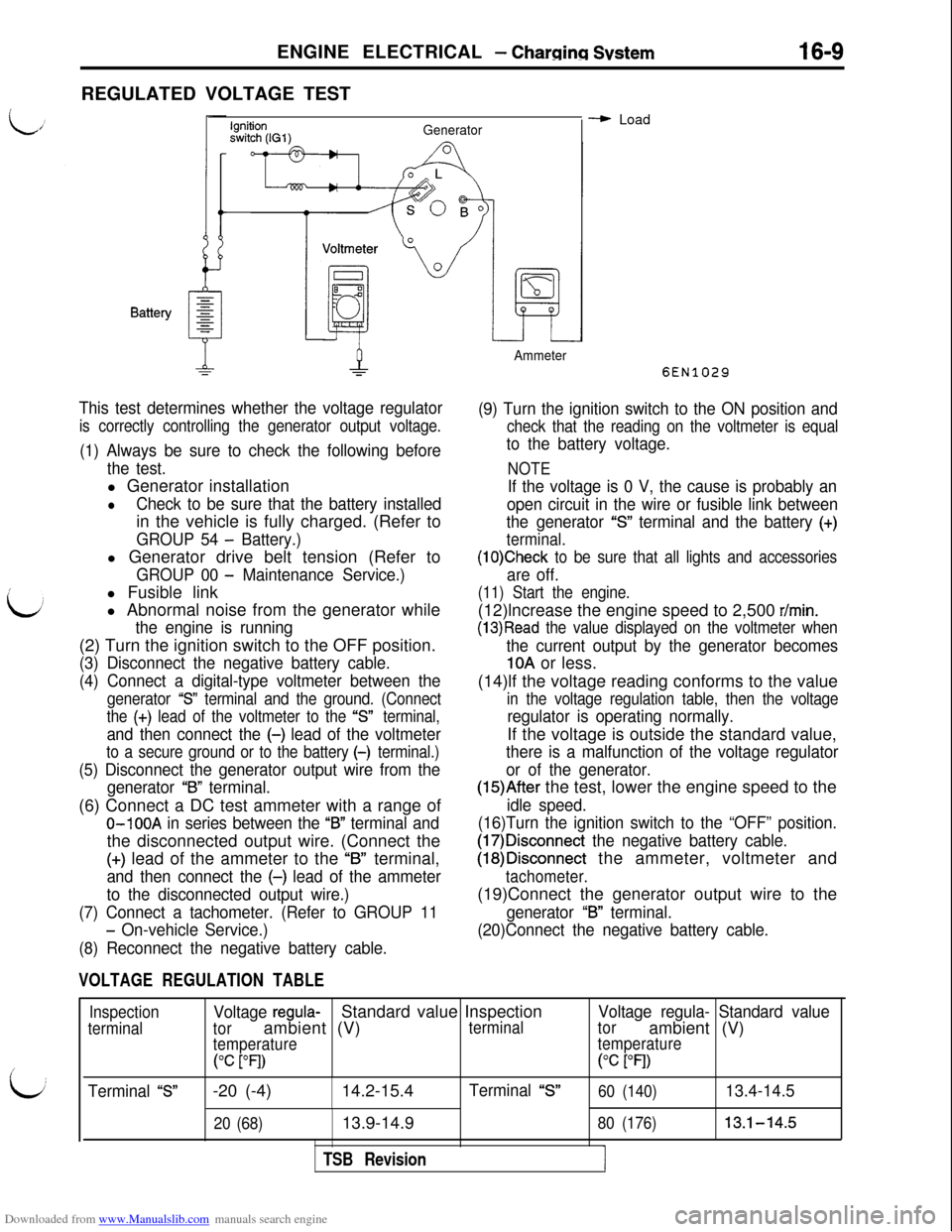
Downloaded from www.Manualslib.com manuals search engine ENGINE ELECTRICAL - Charging Svstem16-9REGULATED VOLTAGE TEST
\:
b
Ignitionswitch (IGl)Generator
This test determines whether the voltage regulator
is correctly controlling the generator output voltage.
(1) Always be sure to check the following before
the test.l Generator installation
lCheck to be sure that the battery installedin the vehicle is fully charged. (Refer to
GROUP 54 - Battery.)l Generator drive belt tension (Refer to
GROUP 00 - Maintenance Service.)l Fusible link
l Abnormal noise from the generator while
the engine is running(2) Turn the ignition switch to the OFF position.
(3) Disconnect the negative battery cable.
(4) Connect a digital-type voltmeter between the
generator “S” terminal and the ground. (Connect
the
(+) lead of the voltmeter to the “s” terminal,
and then connect the (-) lead of the voltmeter
to a secure ground or to the battery (-) terminal.)
(5) Disconnect the generator output wire from the
generator
“B” terminal.(6) Connect a DC test ammeter with a range of
O-100A in series between the “B” terminal andthe disconnected output wire. (Connect the
(+) lead of the ammeter to the “B” terminal,
and then connect the (-) lead of the ammeter
to the disconnected output wire.)
(7) Connect a tachometer. (Refer to GROUP 11
- On-vehicle Service.)
(8) Reconnect the negative battery cable.
VOLTAGE REGULATION TABLE
Ammeter
- Load
6EN1029
(9) Turn the ignition switch to the ON position and
check that the reading on the voltmeter is equal
to the battery voltage.
NOTE
If the voltage is 0 V, the cause is probably an
open circuit in the wire or fusible link between
the generator
“S” terminal and the battery (+)
terminal.
(1O)Check to be sure that all lights and accessories
are off.
(11) Start the engine.(12)lncrease the engine speed to 2,500
r/min.
(13)Read the value displayed on the voltmeter when
the current output by the generator becomes
10A or less.
(14)lf the voltage reading conforms to the value
in the voltage regulation table, then the voltage
regulator is operating normally.If the voltage is outside the standard value,
there is a malfunction of the voltage regulator
or of the generator.
(15)After the test, lower the engine speed to the
idle speed.
(16)Turn the ignition switch to the “OFF” position.
(17)Disconnect the negative battery cable.
(18)Disconnect the ammeter, voltmeter and
tachometer.(19)Connect the generator output wire to the
generator “B” terminal.
(20)Connect the negative battery cable.
Inspection
terminal
Terminal “S”
Voltage regula-Standard value Inspection
torambient (V)terminal
temperature
(“C PI)-20 (-4)14.2-15.4
Terminal “S”
20 (68)13.9-14.9
TSB Revision
Voltage regula- Standard value
torambient (V)
temperature(“c
PI)
60 (140)13.4-14.5
80 (176)13.1-14.5
I
Page 671 of 738
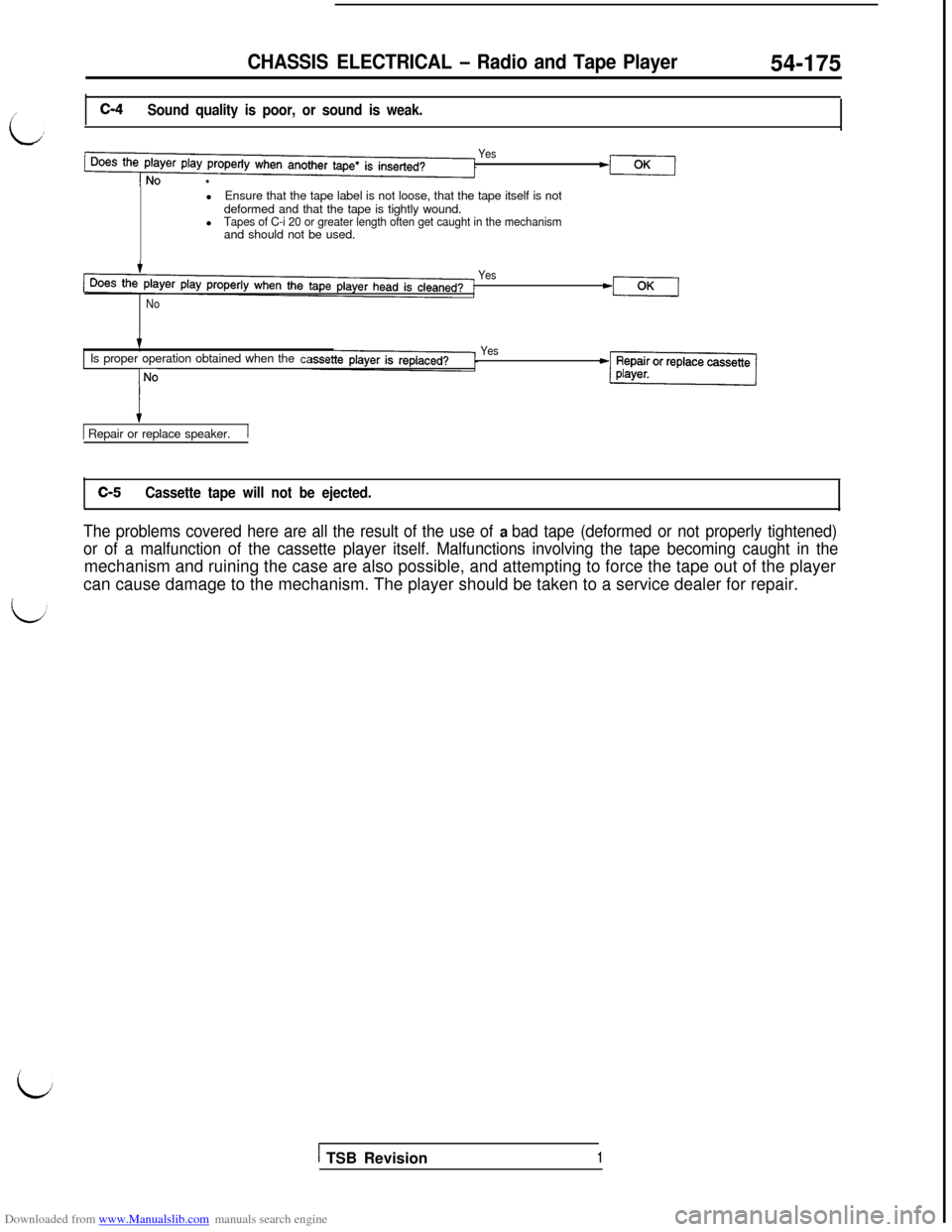
Downloaded from www.Manualslib.com manuals search engine CHASSIS ELECTRICAL - Radio and Tape Player54-175c-4
Sound quality is poor, or sound is weak.
Yes
,/lEnsure that the tape label is not loose, that the tape itself is not
deformed and that the tape is tightly wound.
l
Tapes of C-i 20 or greater length often get caught in the mechanismand should not be used.
Yes
No
ccl
tIs proper operation obtained when thecaYes/No
1 Repair or replace speaker.1c-5
Cassette tape will not be ejected.
The problems covered here are all the result of the use of a bad tape (deformed or not properly tightened)
or of a malfunction of the cassette player itself. Malfunctions involving the tape becoming caught in themechanism and ruining the case are also possible, and attempting to force the tape out of the player
can cause damage to the mechanism. The player should be taken to a service dealer for repair.
1 TSB Revision1
Page 717 of 738
Downloaded from www.Manualslib.com manuals search engine iCHASSIS ELECTRICAL
- Theft-alarm Svstem54-221
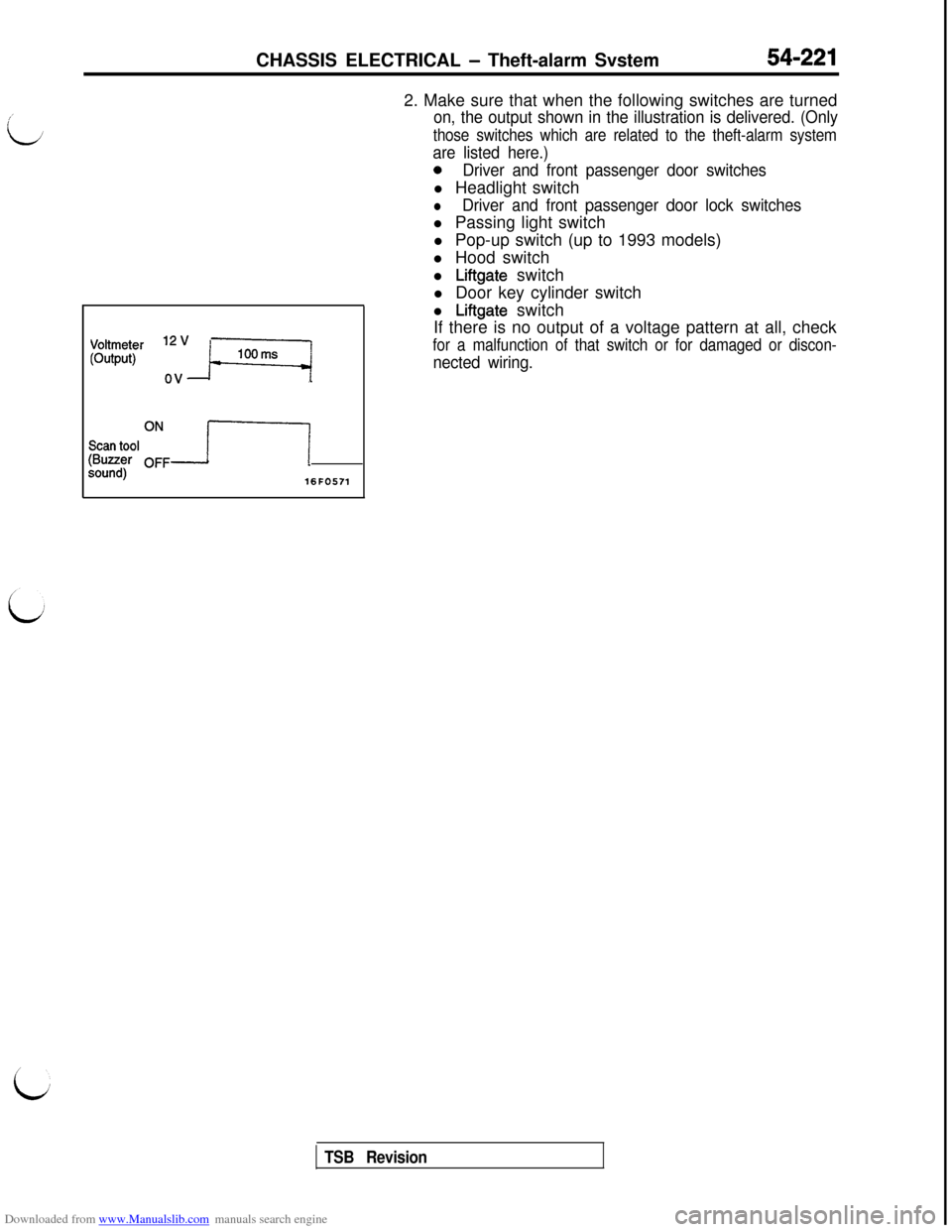
(Output)Voltmeter rvv 1-1
Scan tool(Buzzer %,isound)16FO5712. Make sure that when the following switches are turned
on, the output shown in the illustration is delivered. (Only
those switches which are related to the theft-alarm system
are listed here.)
0Driver and front passenger door switchesl Headlight switch
lDriver and front passenger door lock switchesl Passing light switch
l Pop-up switch (up to 1993 models)
l Hood switch
l
Liftgate switch
l Door key cylinder switch
l
Liftgate switch
If there is no output of a voltage pattern at all, check
for a malfunction of that switch or for damaged or discon-
nected wiring.
TSB Revision
Page 718 of 738
Downloaded from www.Manualslib.com manuals search engine 54-222CHASSIS ELECTRICAL - Theft-alarm System
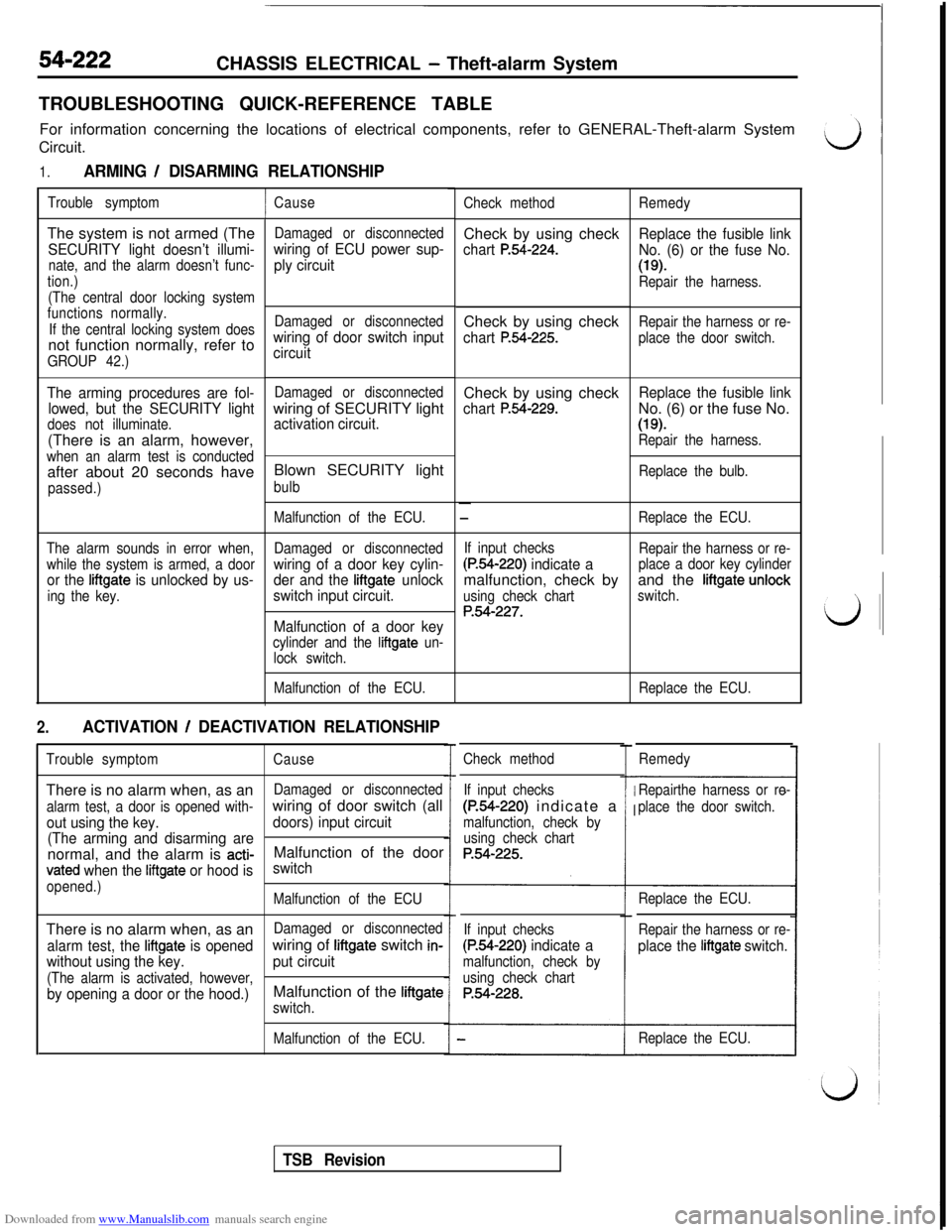
TROUBLESHOOTING QUICK-REFERENCE TABLE
For information concerning the locations of electrical components, refer to GENERAL-Theft-alarm System
Circuit.
1.ARMING / DISARMING RELATIONSHIP
Trouble symptomThe system is not armed (The
SECURITY light doesn’t illumi-
nate, and the alarm doesn’t func-
tion.)
(The central door locking system
functions normally.
If the central locking system doesnot function normally, refer to
GROUP 42.)
The arming procedures are fol-
lowed, but the SECURITY light
does not illuminate.(There is an alarm, however,
when an alarm test is conductedafter about 20 seconds have
passed.)
The alarm sounds in error when,
while the system is armed, a door
or the liftgate is unlocked by us-
ing the key.
ICause
Damaged or disconnected
wiring of ECU power sup-
ply circuit
Damaged or disconnected
wiring of door switch input
circuit
Damaged or disconnectedwiring of SECURITY light
activation circuit.Blown SECURITY light
bulb
Malfunction of the ECU.
Damaged or disconnected
wiring of a door key cylin-
der and the
liftgate unlock
switch input circuit.
Malfunction of a door key
cylinder and the liftgate un-
lock switch.
Malfunction of the ECU.
2.ACTIVATION / DEACTIVATION RELATIONSHIP
Trouble symptomCauseThere is no alarm when, as an
Damaged or disconnected
alarm test, a door is opened with-wiring of door switch (all
out using the key.doors) input circuit
(The arming and disarming arenormal, and the alarm is
acti-Malfunction of the door
vated when the liftgate or hood isswitch
opened.)
Malfunction of the ECUThere is no alarm when, as an
Damaged or disconnected
alarm test, the liftgate is opened
without using the key.wiring of liftgate switch in-
put circuit
(The alarm is activated, however,
by opening a door or the hood.)Malfunction of the liftgate
switch.
Malfunction of the ECU.Check methodCheck by using check
chart P.54-224.Check by using check
chart P.54-225.Check by using check
chart P.54-229.
If input checks
(P.54-220) indicate amalfunction, check by
using check chart
P&f-227.
Check method
If input checks
(P.54-220) indicate a
malfunction, check by
using check chart
P.54-225.
If input checks
(P.54-220) indicate a
malfunction, check by
using check chart
P.54-228.
Remedy
Replace the fusible link
No. (6) or the fuse No.
(19).Repair the harness.
Repair the harness or re-
place the door switch.
Replace the fusible linkNo. (6) or the fuse No.(1%
Repair the harness.
Replace the bulb.
Replace the ECU.
Repair the harness or re-
place a door key cylinderand the
liftgate unlock
switch.
Replace the ECU.
Remedy
Repairthe harness or re-
place the door switch.
Replace the ECU.
Repair the harness or re-
place the liftgate switch.
Replace the ECU.
TSB Revision
Page 719 of 738
Downloaded from www.Manualslib.com manuals search engine CHASSIS ELECTRICAL - Theft-alarm System54-223
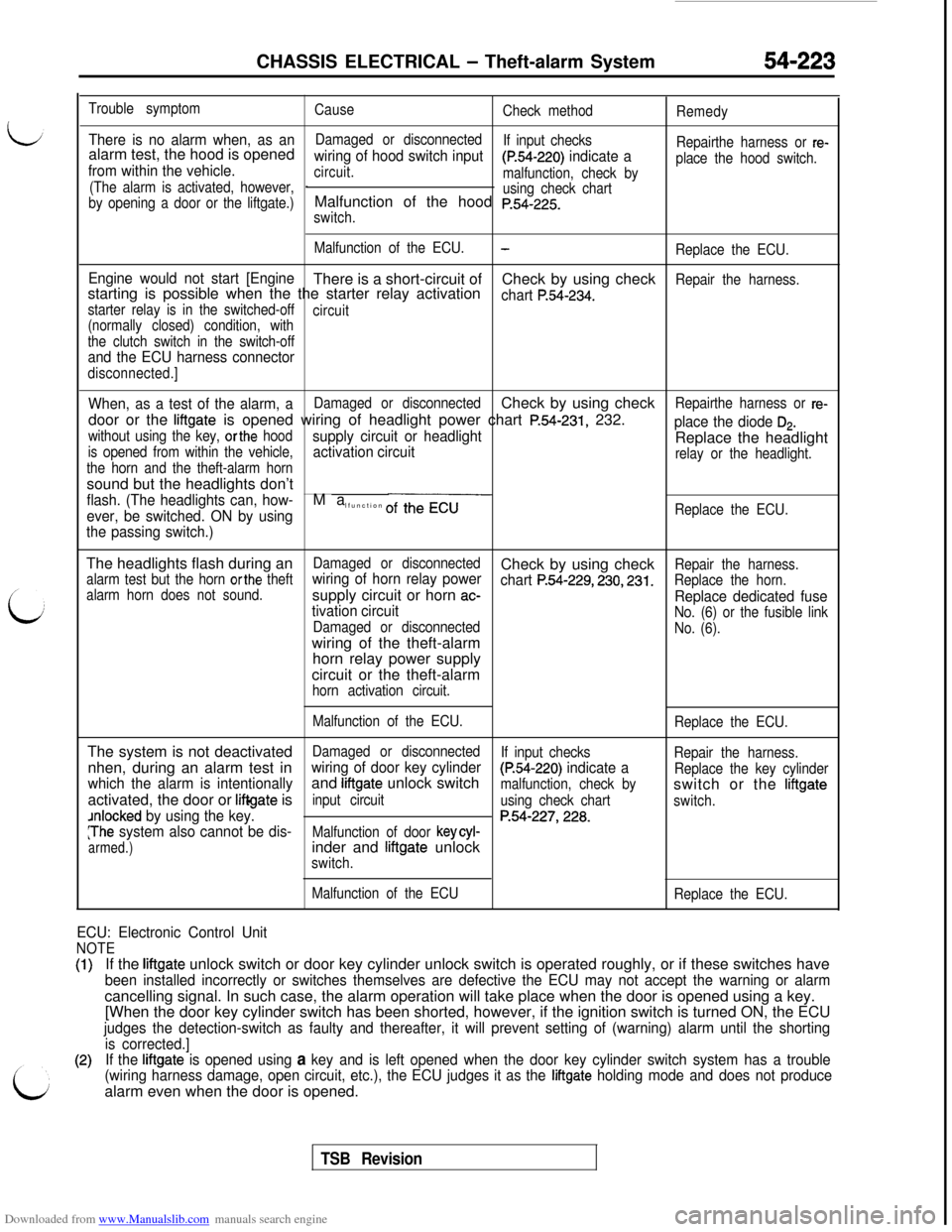
Trouble symptom
Cause
Check method
Remedy
There is no alarm when, as analarm test, the hood is openedDamaged or disconnected
wiring of hood switch input
If input checks
Repairthe harness or re-
from within the vehicle.circuit.
(P.54-220) indicate aplace the hood switch.
(The alarm is activated, however,malfunction, check by
I
by opening a door or the liftgate.)using check chartMalfunction of the hood p.54-225.
switch.
Malfunction of the ECU.
-Replace the ECU.
Engine would not start [EngineThere is a short-circuit of
starting is possible when the the starter relay activationCheck by using check
chart P.54-234.
Repair the harness.
starter relay is in the switched-off
circuit
(normally closed) condition, with
the clutch switch in the switch-off
and the ECU harness connector
disconnected.]
When, as a test of the alarm, aDamaged or disconnectedCheck by using check
door or the
liftgate is opened wiring of headlight power chart P.54-231, 232.
Repairthe harness or re-
without using the key, orthe hood
is opened from within the vehicle,supply circuit or headlightplace the diode Ds.
activation circuitReplace the headlight
the horn and the theft-alarm hornrelay or the headlight.sound but the headlights don’t
flash. (The headlights can, how-
ever, be switched. ON by usingMa
lfunction of the ECUReplace the ECU.
the passing switch.)The headlights flash during an
alarm test but the horn orthe theftDamaged or disconnectedCheck by using checkRepair the harness.
alarm horn does not sound.wiring of horn relay power
chart P.54-229,230,231.supply circuit or horn ac-Replace the horn.
tivation circuitReplace dedicated fuse
Damaged or disconnectedNo. (6) or the fusible linkwiring of the theft-alarmNo. (6).horn relay power supply
circuit or the theft-alarm
horn activation circuit.
Malfunction of the ECU.
Replace the ECU.The system is not deactivated
nhen, during an alarm test in
Damaged or disconnected
If input checks
which the alarm is intentionallywiring of door key cylinder
Repair the harness.activated, the door or
liftgate isand
liftgate unlock switch(P.54-220) indicate a
input circuitmalfunction, check byReplace the key cylinder
Jnlocked by using the key.
using check chartswitch or the
liftgate
switch.
:The system also cannot be dis-P.54-227,228.
armed.)
Malfunction of door keycyl-inder and liftgate unlock
switch.
Malfunction of the ECU
Replace the ECU.
ECU: Electronic Control Unit
NOTEIf the
lifigate unlock switch or door key cylinder unlock switch is operated roughly, or if these switches have
been installed incorrectly or switches themselves are defective the ECU may not accept the warning or alarmcancelling signal. In such case, the alarm operation will take place when the door is opened using a key.
[When the door key cylinder switch has been shorted, however, if the ignition switch is turned ON, the ECU
judges the detection-switch as faulty and thereafter, it will prevent setting of (warning) alarm until the shorting
is corrected.]
If the
liftgate is opened using a key and is left opened when the door key cylinder switch system has a trouble
(wiring harness damage, open circuit, etc.), the ECU judges it as the
liftgate holding mode and does not producealarm even when the door is opened.
TSB Revision
Page 726 of 738
Downloaded from www.Manualslib.com manuals search engine .,i”i, LlNl Q10. HORN ACTIVATION CIRCUIT
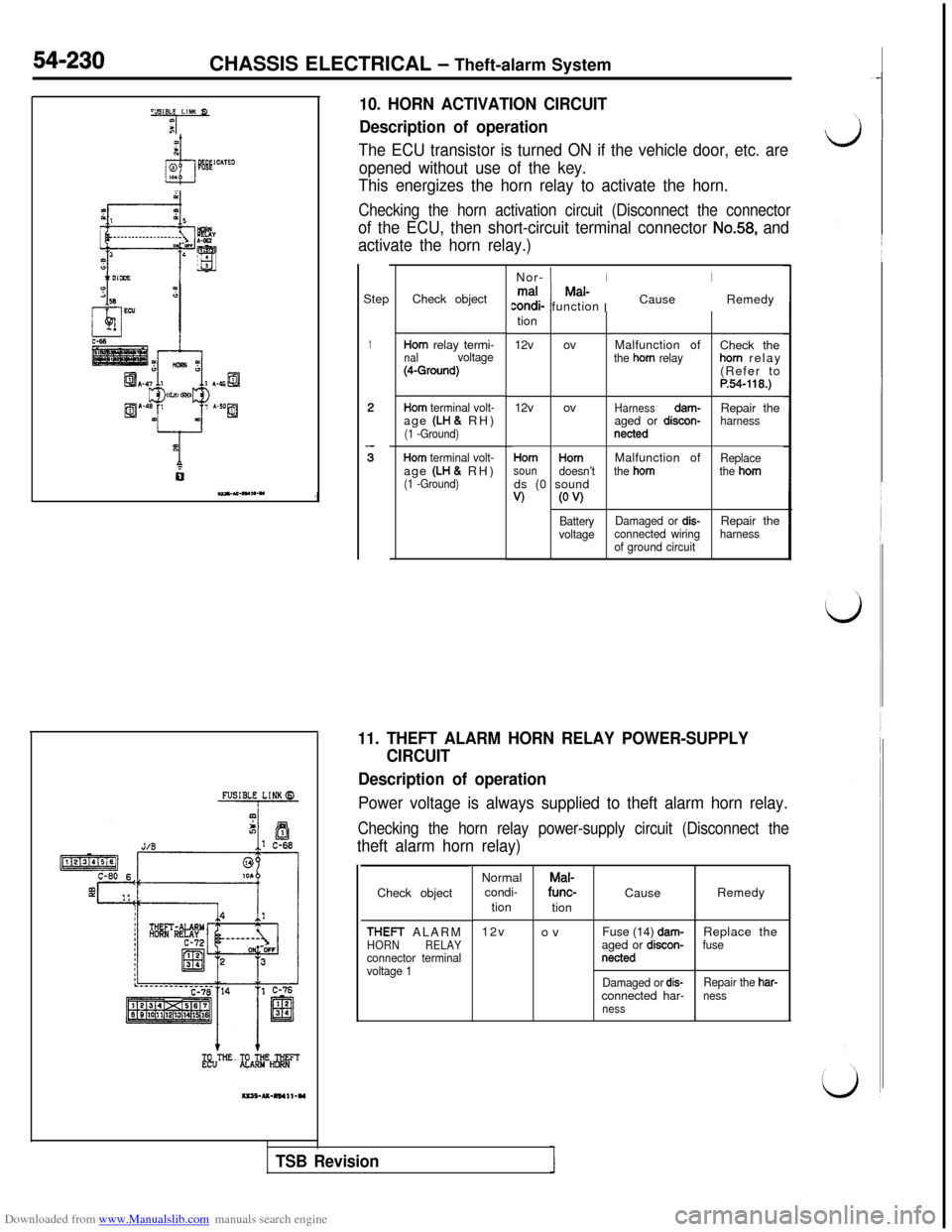
?a/ ;
dl
spored10.
Description of operation
The ECU transistor is turned ON if the vehicle door, etc. are
opened without use of the key.
This energizes the horn relay to activate the horn.
Checking the horn activation circuit (Disconnect the connector
of the ECU, then short-circuit terminal connector No.58, and
activate the horn relay.)
54-230CHASSIS ELECTRICAL - Theft-alarm System
z “2
EL? II A-as ’
I3 Ii3
c!
ig”‘“,1 u~cw ~ I A.,Op+J
x
6IZ)Y.l,.-”Step
1Check objectmatMal-
I Icondi- functionCauseRemedy
Horn relay termi-nalvoltage(4-Ground)12v ovMalfunction of
Check thethe horn relayhorn relay
(Refer to
P.54-118.)
Horn terminal volt-12v ovHarnessdam-age (LH & RH)Repair the
aged or discon-harness(1 -Ground)netted
Horn terminal volt-age (LH & RH)(1 -Ground)Nor-
1IItion
HornHornMalfunction ofReplacesoundoesn’tthe hornthe hornds (0 sound
V)(0 w
BatteryDamaged or dis-Repair thevoltageconnected wiringharness
of ground circuit
11. THEFT ALARM HORN RELAY POWER-SUPPLY
CIRCUIT
Description of operation
Power voltage is always supplied to theft alarm horn relay.
Checking the horn relay power-supply circuit (Disconnect the
theft alarm horn relay)Check object
THEFT ALARMHORNRELAYconnector terminal
voltage 1NormalMal-
condi-func-
CauseRemedy
tion
tion
12v
ovFuse (14)
dam-Replace the
aged or discon-fusenetted
Damaged or dis-Repair the har-connected har-nessness
TSB Revision