diagnostic MITSUBISHI 380 2005 Workshop Manual
[x] Cancel search | Manufacturer: MITSUBISHI, Model Year: 2005, Model line: 380, Model: MITSUBISHI 380 2005Pages: 1500, PDF Size: 47.87 MB
Page 1481 of 1500

AUTOMATIC TRANSMISSION DIAGNOSIS
AUTOMATIC TRANSMISSION23A-22
7 Transmission
range: 3 (on a
flat and straight
road)Transmission range
and vehicle speed
(1) Driving at speed
of 60 km/h in 3rd
gear
(2) Driving at
constant speed of 60
km/h
(3) Release
accelerator pedal
(Speed under 50
km/hData list No.17
(2) 70
99.6%
(3) 70
99.6% to 0%Damper
control
clutch
solenoid
valve duty
%Damper control
clutch solenoid
system
(P.23A-185,
P.23A-201,
P.23A-204).
Data list No.10
(2) 100 to 300 r/min
(3) The value
changes from (2)Damper
control
clutch
amount of
slippage
8 Use the
diagnostic tool
MB991958
(MUT-III sub
assembly) to
stop the
INVECS-II
function
Transmission
range: D (on a
flat and straight
road)(1)Accelerate to 5th
gear at a throttle
position sensor
output of 1.5 V
(accelerator opening
angle of 25%)
(2)Slowly decelerate
to a stop
(3)Accelerate to 5th
gear at a throttle
position sensor
output of 2.5 V
(accelerator opening
angle of 50%)Data list No.11, 6
The shifting points
correspond with the
diagnostic tool
display and the TP
sensor voltage
(opening angle) and
output shaft speed,
which are shown in
the standard shift
patternMalfunction
when
shiftingShift shock and
slipping
(P.23A-236).
Does not
shift
according
to
instructionsEarly or late
shifting in all
gears
(P.23A-239).
Early or late
shifting in some
gears
(P.23A-242).
STEP CONDITION
BEFORE
TEST/OPERATIONTEST/OPERATION STANDARD INSPECTION
ITEMINSPECTION
PROCEDURE
PA G E
Page 1482 of 1500
AUTOMATIC TRANSMISSION DIAGNOSIS
AUTOMATIC TRANSMISSION23A-23
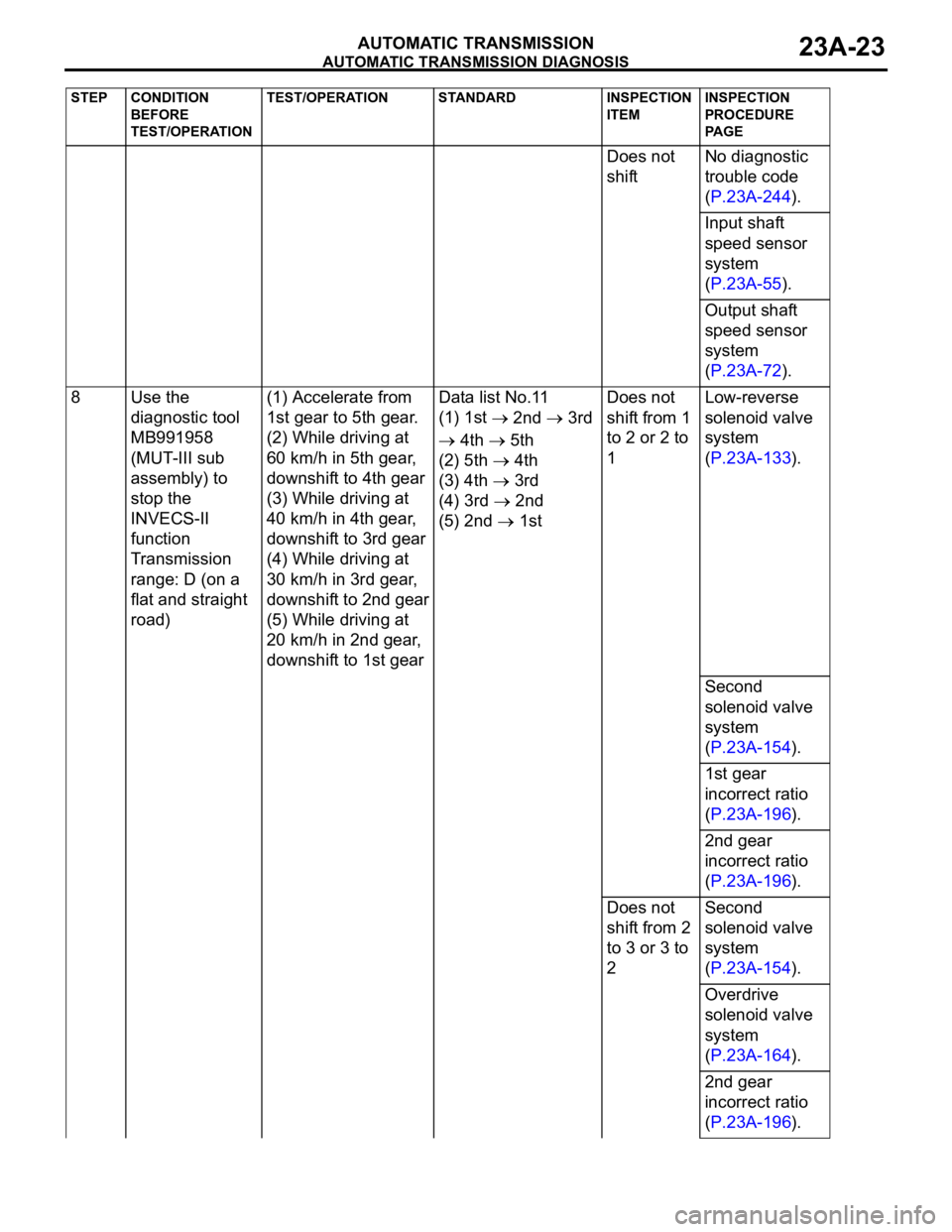
Does not
shiftNo diagnostic
trouble code
(P.23A-244).
Input shaft
speed sensor
system
(P.23A-55).
Output shaft
speed sensor
system
(P.23A-72).
8 Use the
diagnostic tool
MB991958
(MUT-III sub
assembly) to
stop the
INVECS-II
function
Transmission
range: D (on a
flat and straight
road)(1) Accelerate from
1st gear to 5th gear.
(2) While driving at
60 km/h in 5th gear,
downshift to 4th gear
(3) While driving at
40 km/h in 4th gear,
downshift to 3rd gear
(4) While driving at
30 km/h in 3rd gear,
downshift to 2nd gear
(5) While driving at
20 km/h in 2nd gear,
downshift to 1st gearData list No.11
(1) 1st
2nd 3rd
4th 5th
(2) 5th
4th
(3) 4th
3rd
(4) 3rd
2nd
(5) 2nd
1stDoes not
shift from 1
to 2 or 2 to
1Low-reverse
solenoid valve
system
(P.23A-133).
Second
solenoid valve
system
(P.23A-154).
1st gear
incorrect ratio
(P.23A-196).
2nd gear
incorrect ratio
(P.23A-196).
Does not
shift from 2
to 3 or 3 to
2Second
solenoid valve
system
(P.23A-154).
Overdrive
solenoid valve
system
(P.23A-164).
2nd gear
incorrect ratio
(P.23A-196).
STEP CONDITION
BEFORE
TEST/OPERATIONTEST/OPERATION STANDARD INSPECTION
ITEMINSPECTION
PROCEDURE
PA G E
Page 1484 of 1500
AUTOMATIC TRANSMISSION DIAGNOSIS
AUTOMATIC TRANSMISSION23A-25
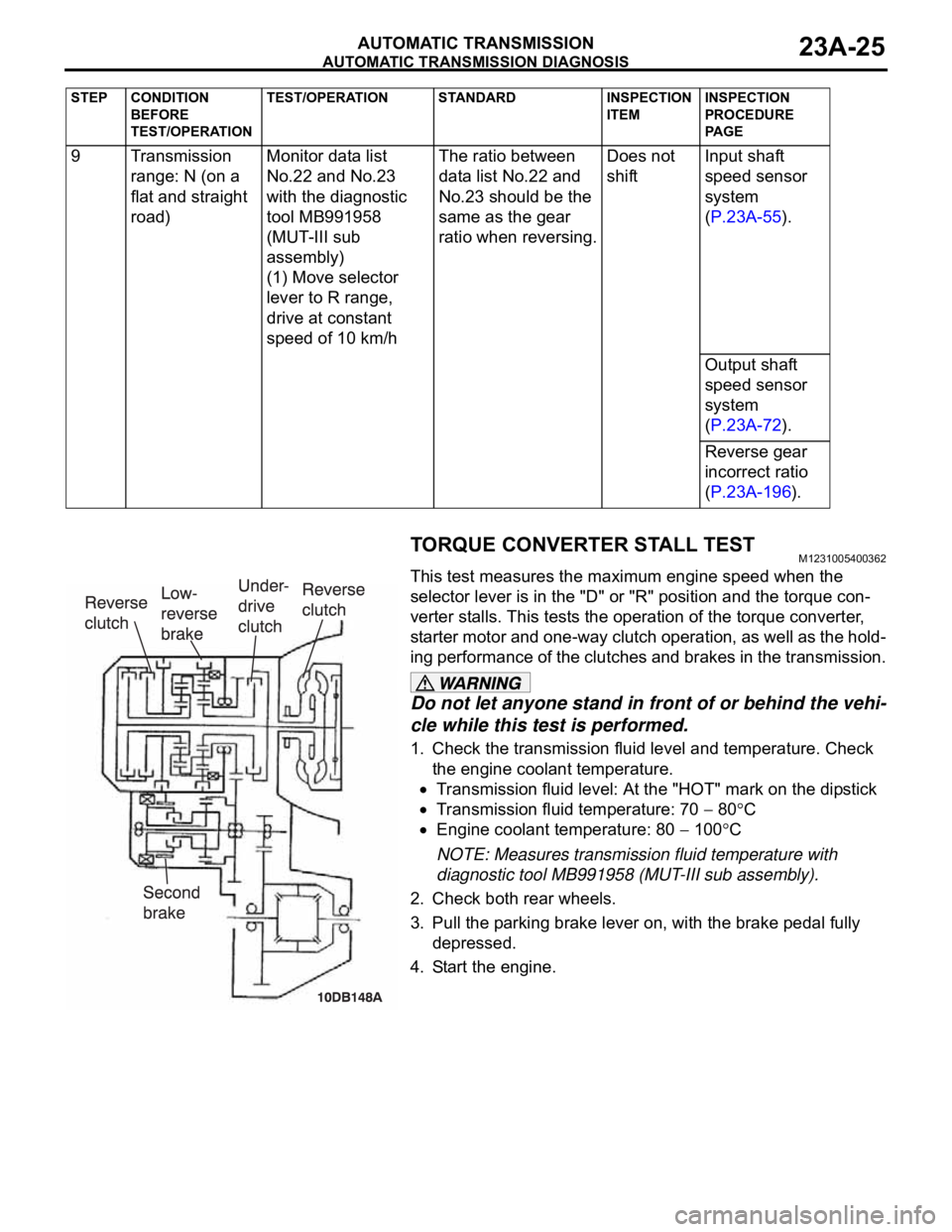
TORQUE CONVERTER STALL TESTM1231005400362
This test measures the maximum engine speed when the
selector lever is in the "D" or "R" position and the torque con-
verter stalls. This tests the operation of the torque converter,
starter motor and one-way clutch operation, as well as the hold-
ing performance of the clutches and brakes in the transmission.
Do not let anyone stand in front of or behind the vehi-
cle while this test is performed.
1. Check the transmission fluid level and temperature. Check
the engine coolant temperature.
Transmission fluid level: At the "HOT" mark on the dipstick
Transmission fluid temperature: 70 80C
Engine coolant temperature: 80 100C
NOTE: Measures transmission fluid temperature with
diagnostic tool MB991958 (MUT-III sub assembly).
2. Check both rear wheels.
3. Pull the parking brake lever on, with the brake pedal fully
depressed.
4. Start the engine. 9 Transmission
range: N (on a
flat and straight
road)Monitor data list
No.22 and No.23
with the diagnostic
tool MB991958
(MUT-III sub
assembly)
(1) Move selector
lever to R range,
drive at constant
speed of 10 km/hThe ratio between
data list No.22 and
No.23 should be the
same as the gear
ratio when reversing.Does not
shiftInput shaft
speed sensor
system
(P.23A-55).
Output shaft
speed sensor
system
(P.23A-72).
Reverse gear
incorrect ratio
(P.23A-196).
STEP CONDITION
BEFORE
TEST/OPERATIONTEST/OPERATION STANDARD INSPECTION
ITEMINSPECTION
PROCEDURE
PA G E
Page 1493 of 1500
AUTOMATIC TRANSMISSION DIAGNOSIS
AUTOMATIC TRANSMISSION23A-34
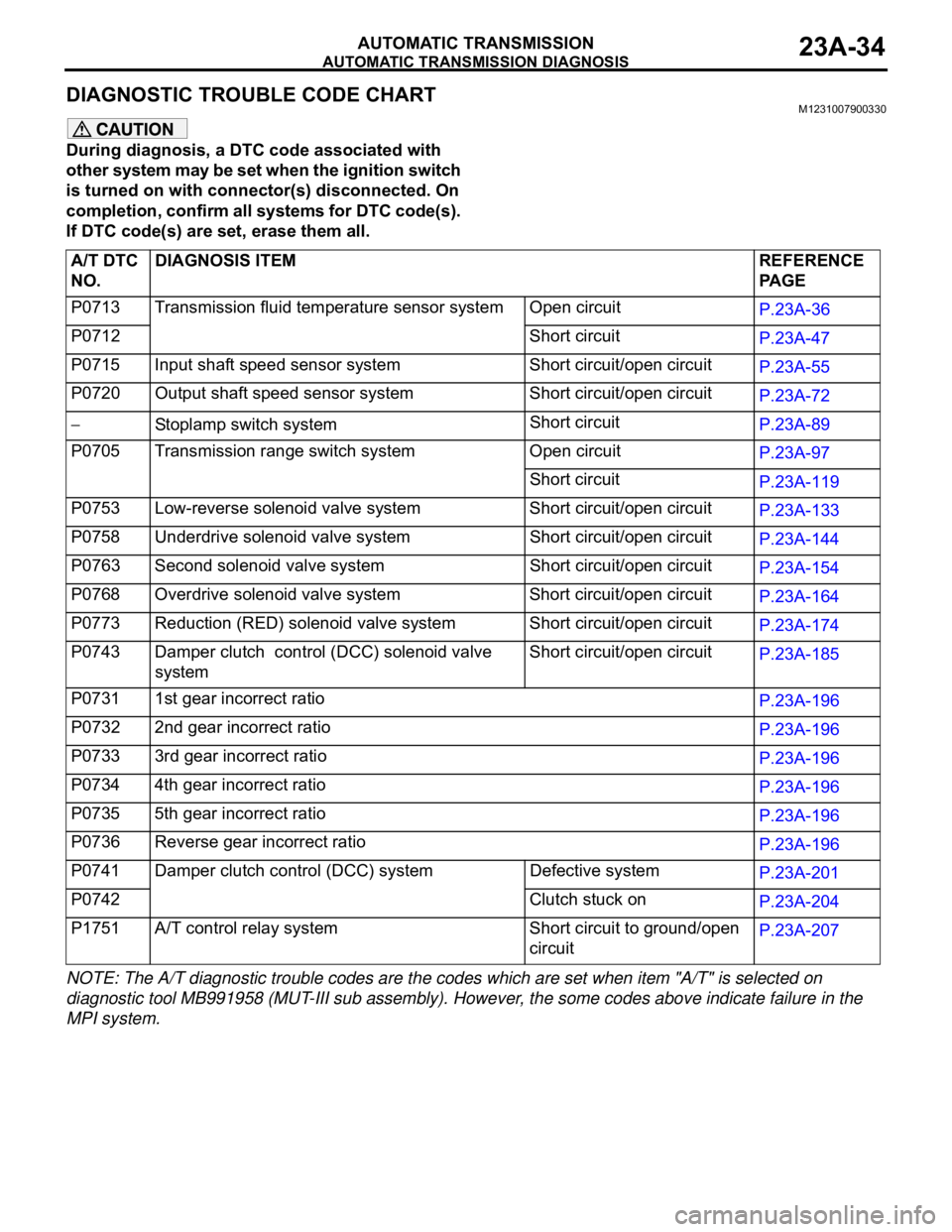
DIAGNOSTIC TROUBLE CODE CHARTM1231007900330
During diagnosis, a DTC code associated with
other system may be set when the ignition switch
is turned on with connector(s) disconnected. On
completion, confirm all systems for DTC code(s).
If DTC code(s) are set, erase them all.
NOTE: The A/T diagnostic trouble codes are the codes which are set when item "A/T" is selected on
diagnostic tool MB991958 (MUT-III sub assembly). However, the some codes above indicate failure in the
MPI system.A/T DTC
NO.DIAGNOSIS ITEM REFERENCE
PA G E
P0713 Transmission fluid temperature sensor system Open circuit
P.23A-36
P0712 Short circuit
P.23A-47
P0715 Input shaft speed sensor system Short circuit/open circuit
P.23A-55
P0720 Output shaft speed sensor system Short circuit/open circuit
P.23A-72
Stoplamp switch systemShort circuit
P.23A-89
P0705 Transmission range switch system Open circuit
P.23A-97
Short circuit
P.23A-119
P0753 Low-reverse solenoid valve system Short circuit/open circuit
P.23A-133
P0758 Underdrive solenoid valve system Short circuit/open circuit
P.23A-144
P0763 Second solenoid valve system Short circuit/open circuit
P.23A-154
P0768 Overdrive solenoid valve system Short circuit/open circuit
P.23A-164
P0773 Reduction (RED) solenoid valve system Short circuit/open circuit
P.23A-174
P0743 Damper clutch control (DCC) solenoid valve
systemShort circuit/open circuit
P.23A-185
P0731 1st gear incorrect ratio
P.23A-196
P0732 2nd gear incorrect ratio
P.23A-196
P0733 3rd gear incorrect ratio
P.23A-196
P0734 4th gear incorrect ratio
P.23A-196
P0735 5th gear incorrect ratio
P.23A-196
P0736 Reverse gear incorrect ratio
P.23A-196
P0741 Damper clutch control (DCC) system Defective system
P.23A-201
P0742 Clutch stuck on
P.23A-204
P1751 A/T control relay system Short circuit to ground/open
circuitP.23A-207
Page 1494 of 1500
AUTOMATIC TRANSMISSION DIAGNOSIS
AUTOMATIC TRANSMISSION23A-35
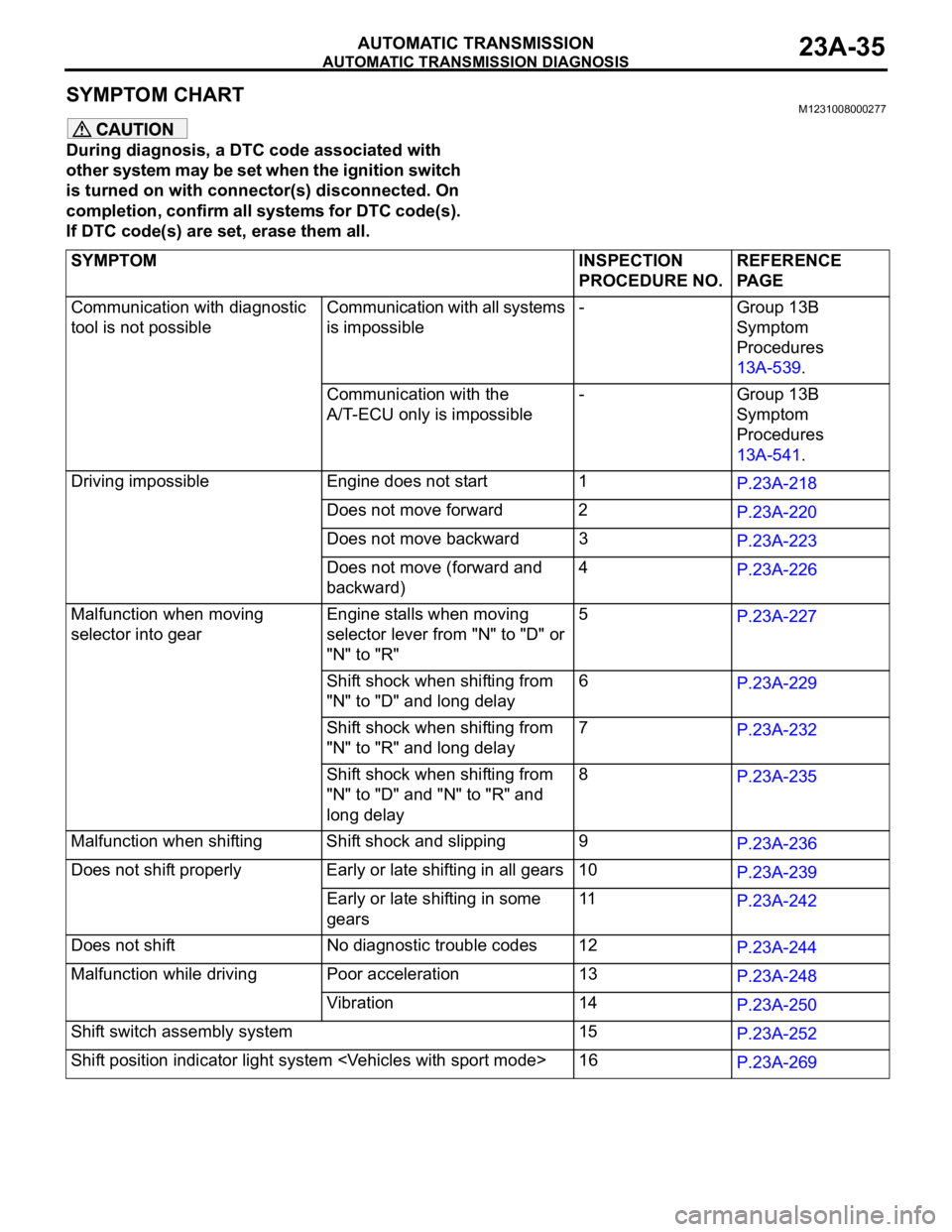
SYMPTOM CHART M1231008000277
During diagnosis, a DTC code associated with
other system may be set when the ignition switch
is turned on with connector(s) disconnected. On
completion, confirm all systems for DTC code(s).
If DTC code(s) are set, erase them all.
SYMPTOM INSPECTION
PROCEDURE NO.REFERENCE
PA G E
Communication with diagnostic
tool is not possibleCommunication with all systems
is impossible- Group 13B
Symptom
Procedures
13A-539.
Communication with the
A/T-ECU only is impossible- Group 13B
Symptom
Procedures
13A-541.
Driving impossible Engine does not start 1
P.23A-218
Does not move forward 2
P.23A-220
Does not move backward 3
P.23A-223
Does not move (forward and
backward)4
P.23A-226
Malfunction when moving
selector into gearEngine stalls when moving
selector lever from "N" to "D" or
"N" to "R"5
P.23A-227
Shift shock when shifting from
"N" to "D" and long delay6
P.23A-229
Shift shock when shifting from
"N" to "R" and long delay 7
P.23A-232
Shift shock when shifting from
"N" to "D" and "N" to "R" and
long delay 8
P.23A-235
Malfunction when shifting Shift shock and slipping 9
P.23A-236
Does not shift properly Early or late shifting in all gears 10
P.23A-239
Early or late shifting in some
gears11
P.23A-242
Does not shift No diagnostic trouble codes 12
P.23A-244
Malfunction while driving Poor acceleration 13
P.23A-248
Vibration 14
P.23A-250
Shift switch assembly system 15
P.23A-252
Shift position indicator light system
P.23A-269
Page 1495 of 1500
AUTOMATIC TRANSMISSION DIAGNOSIS
AUTOMATIC TRANSMISSION23A-36
DIAGNOSTIC TROUBLE CODE PROCEDURES
(P0713): Transmission Fluid Temperature Sensor System (Open Circuit)
.
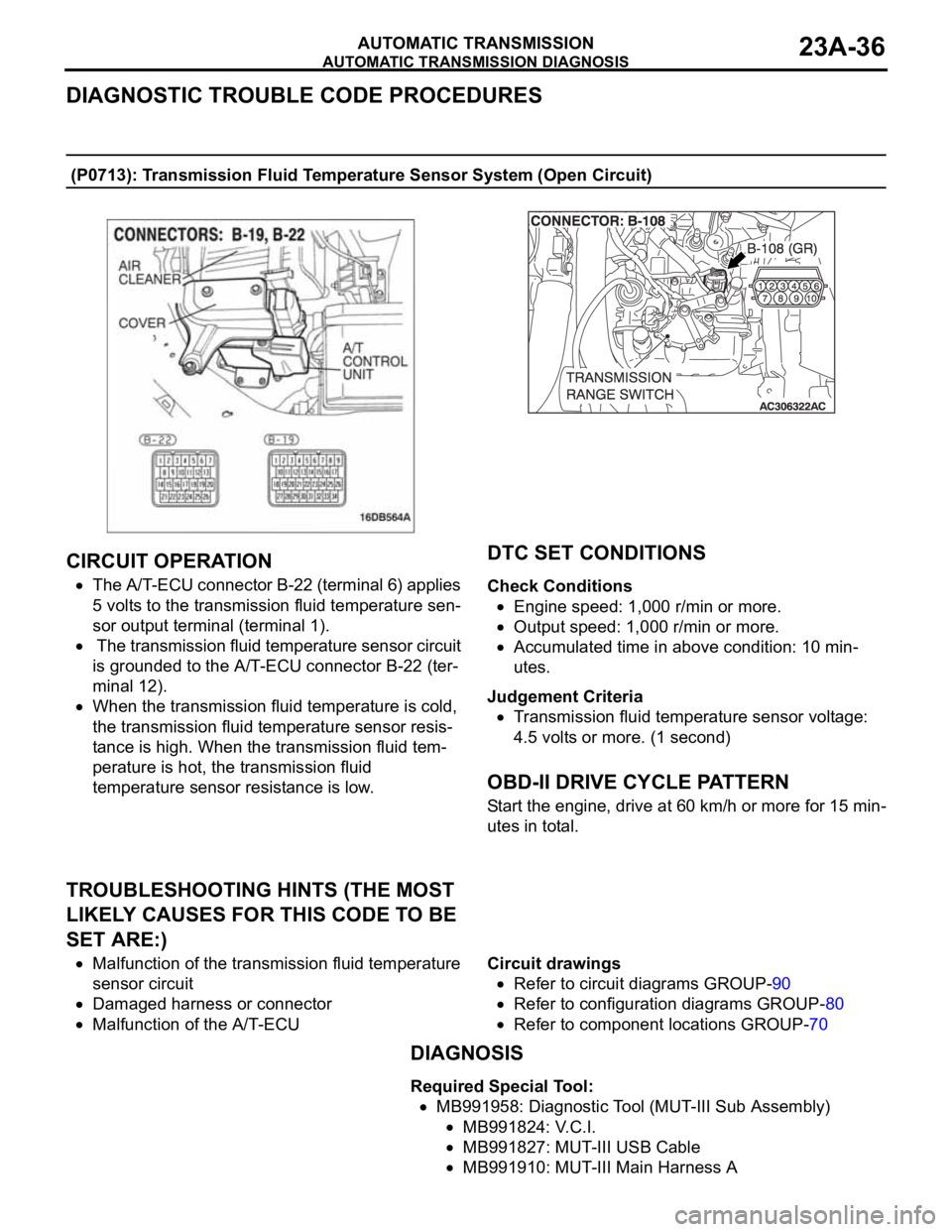
CIRCUIT OPERATION
The A/T-ECU connector B-22 (terminal 6) applies
5 volts to the transmission fluid temperature sen-
sor output terminal (terminal 1).
The transmission fluid temperature sensor circuit
is grounded to the A/T-ECU connector B-22 (ter-
minal 12).
When the transmission fluid temperature is cold,
the transmission fluid temperature sensor resis-
tance is high. When the transmission fluid tem-
perature is hot, the transmission fluid
temperature sensor resistance is low.
.
DTC SET CONDITIONS
Check Conditions
Engine speed: 1,000 r/min or more.
Output speed: 1,000 r/min or more.
Accumulated time in above condition: 10 min-
utes.
Judgement Criteria
Transmission fluid temperature sensor voltage:
4.5 volts or more. (1 second)
.
OBD-II DRIVE CYCLE PATTERN
Start the engine, drive at 60 km/h or more for 15 min-
utes in total.
.
TROUBLESHOOTING HINTS (THE MOST
LIKELY CAUSES FOR THIS CODE TO BE
SET ARE:)
Malfunction of the transmission fluid temperature
sensor circuit
Damaged harness or connector
Malfunction of the A/T-ECUCircuit drawings
Refer to circuit diagrams GROUP-90
Refer to configuration diagrams GROUP-80
Refer to component locations GROUP-70
DIAGNOSIS
Required Special Tool:
MB991958: Diagnostic Tool (MUT-III Sub Assembly)
MB991824: V.C.I.
MB991827: MUT-III USB Cable
MB991910: MUT-III Main Harness A
Page 1496 of 1500
AUTOMATIC TRANSMISSION DIAGNOSIS
AUTOMATIC TRANSMISSION23A-37
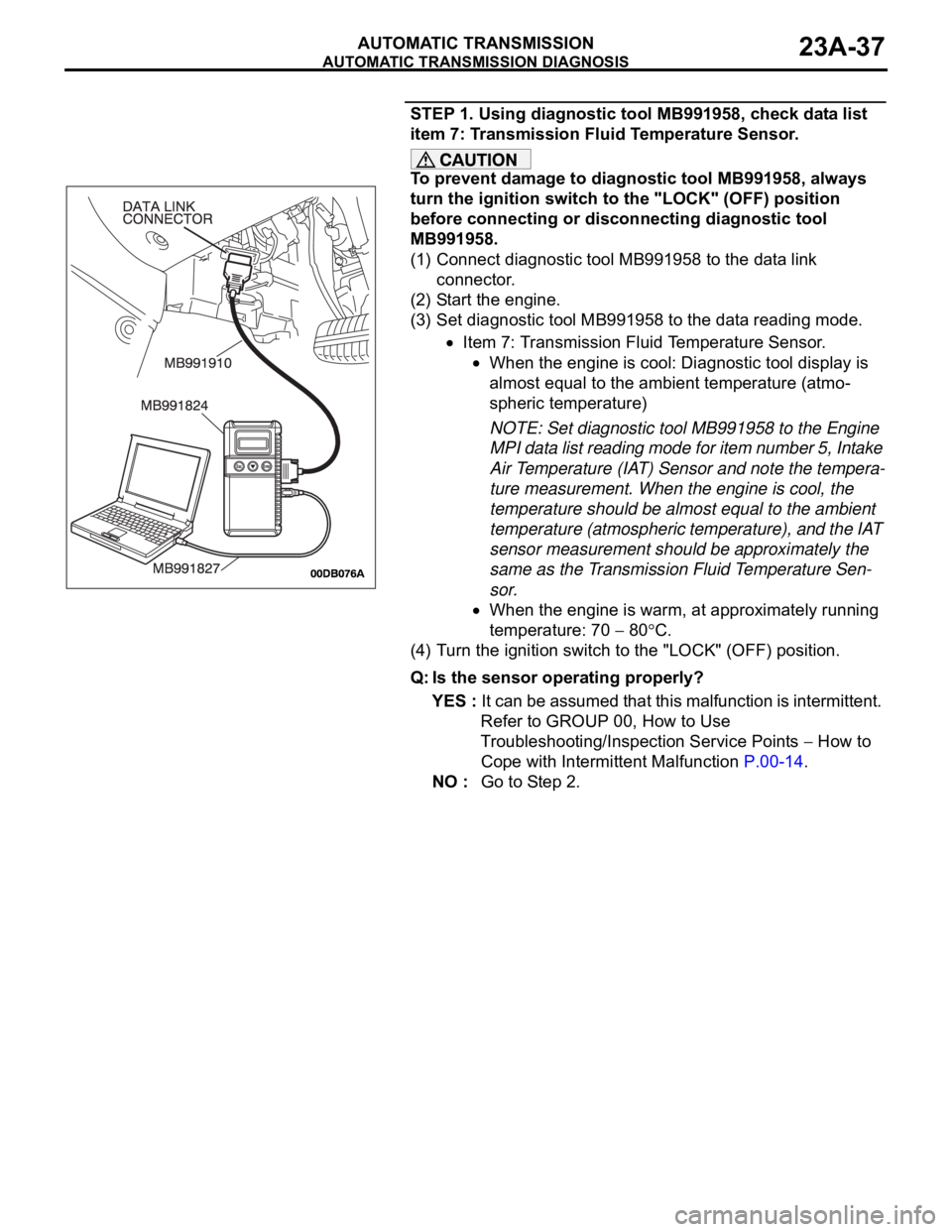
STEP 1. Using diagnostic tool MB991958, check data list
item 7: Transmission Fluid Temperature Sensor.
To prevent damage to diagnostic tool MB991958, always
turn the ignition switch to the "LOCK" (OFF) position
before connecting or disconnecting diagnostic tool
MB991958.
(1) Connect diagnostic tool MB991958 to the data link
connector.
(2) Start the engine.
(3) Set diagnostic tool MB991958 to the data reading mode.
Item 7: Transmission Fluid Temperature Sensor.
When the engine is cool: Diagnostic tool display is
almost equal to the ambient temperature (atmo-
spheric temperature)
NOTE: Set diagnostic tool MB991958 to the Engine
MPI data list reading mode for item number 5, Intake
Air Temperature (IAT) Sensor and note the tempera-
ture measurement. When the engine is cool, the
temperature should be almost equal to the ambient
temperature (atmospheric temperature), and the IAT
sensor measurement should be approximately the
same as the Transmission Fluid Temperature Sen-
sor.
When the engine is warm, at approximately running
temperature: 70
80C.
(4) Turn the ignition switch to the "LOCK" (OFF) position.
Q: Is the sensor operating properly?
YES : It can be assumed that this malfunction is intermittent.
Refer to GROUP 00, How to Use
Troubleshooting/Inspection Service Points
How to
Cope with Intermittent Malfunction P.00-14.
NO : Go to Step 2.
Page 1500 of 1500
AUTOMATIC TRANSMISSION DIAGNOSIS
AUTOMATIC TRANSMISSION23A-41
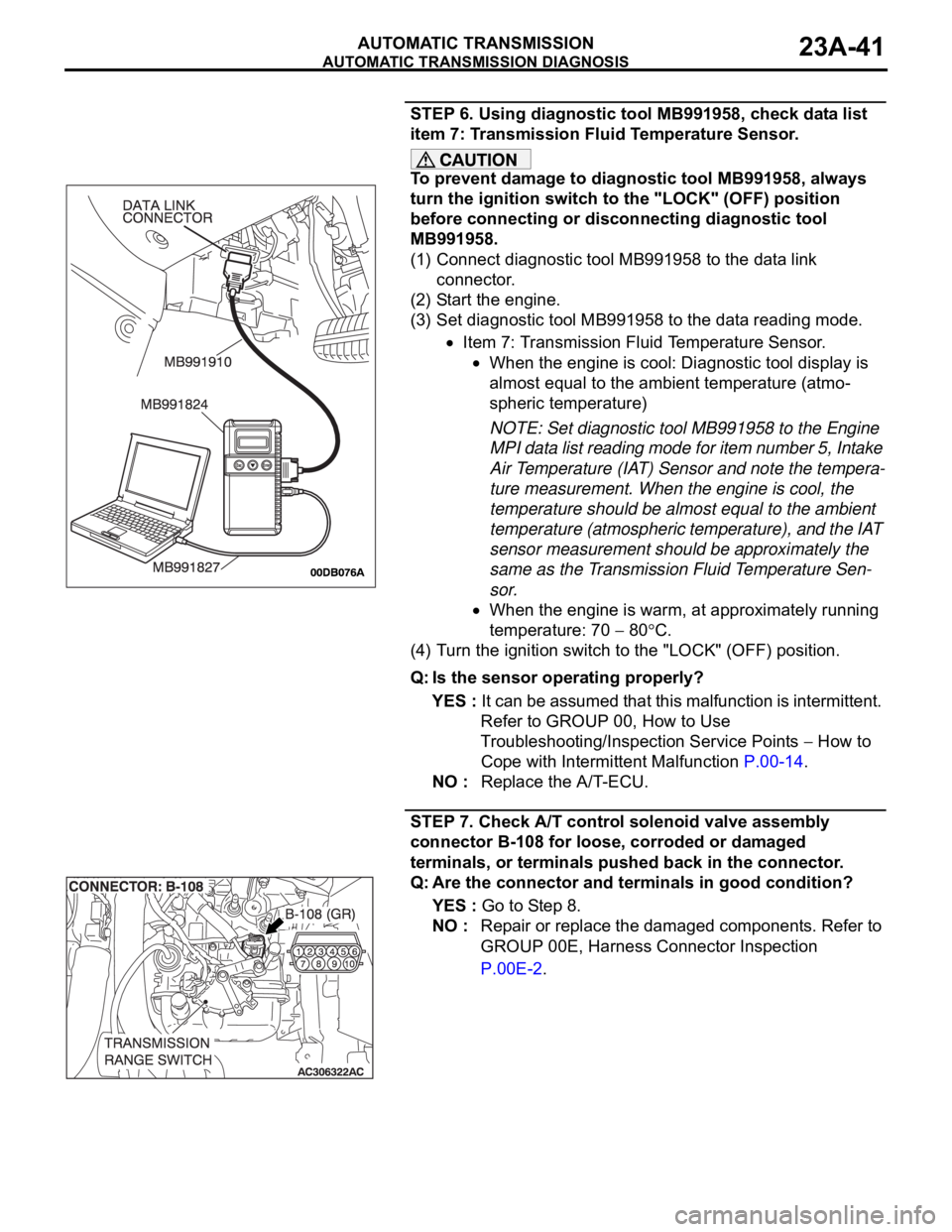
STEP 6. Using diagnostic tool MB991958, check data list
item 7: Transmission Fluid Temperature Sensor.
To prevent damage to diagnostic tool MB991958, always
turn the ignition switch to the "LOCK" (OFF) position
before connecting or disconnecting diagnostic tool
MB991958.
(1) Connect diagnostic tool MB991958 to the data link
connector.
(2) Start the engine.
(3) Set diagnostic tool MB991958 to the data reading mode.
Item 7: Transmission Fluid Temperature Sensor.
When the engine is cool: Diagnostic tool display is
almost equal to the ambient temperature (atmo-
spheric temperature)
NOTE: Set diagnostic tool MB991958 to the Engine
MPI data list reading mode for item number 5, Intake
Air Temperature (IAT) Sensor and note the tempera-
ture measurement. When the engine is cool, the
temperature should be almost equal to the ambient
temperature (atmospheric temperature), and the IAT
sensor measurement should be approximately the
same as the Transmission Fluid Temperature Sen-
sor.
When the engine is warm, at approximately running
temperature: 70
80C.
(4) Turn the ignition switch to the "LOCK" (OFF) position.
Q: Is the sensor operating properly?
YES : It can be assumed that this malfunction is intermittent.
Refer to GROUP 00, How to Use
Troubleshooting/Inspection Service Points
How to
Cope with Intermittent Malfunction P.00-14.
NO : Replace the A/T-ECU.
STEP 7. Check A/T control solenoid valve assembly
connector B-108 for loose, corroded or damaged
terminals, or terminals pushed back in the connector.
Q: Are the connector and terminals in good condition?
YES : Go to Step 8.
NO : Repair or replace the damaged components. Refer to
GROUP 00E, Harness Connector Inspection
P.00E-2.