service MITSUBISHI ASX 2009 1.G Owners Manual
[x] Cancel search | Manufacturer: MITSUBISHI, Model Year: 2009, Model line: ASX, Model: MITSUBISHI ASX 2009 1.GPages: 368, PDF Size: 8.13 MB
Page 311 of 368
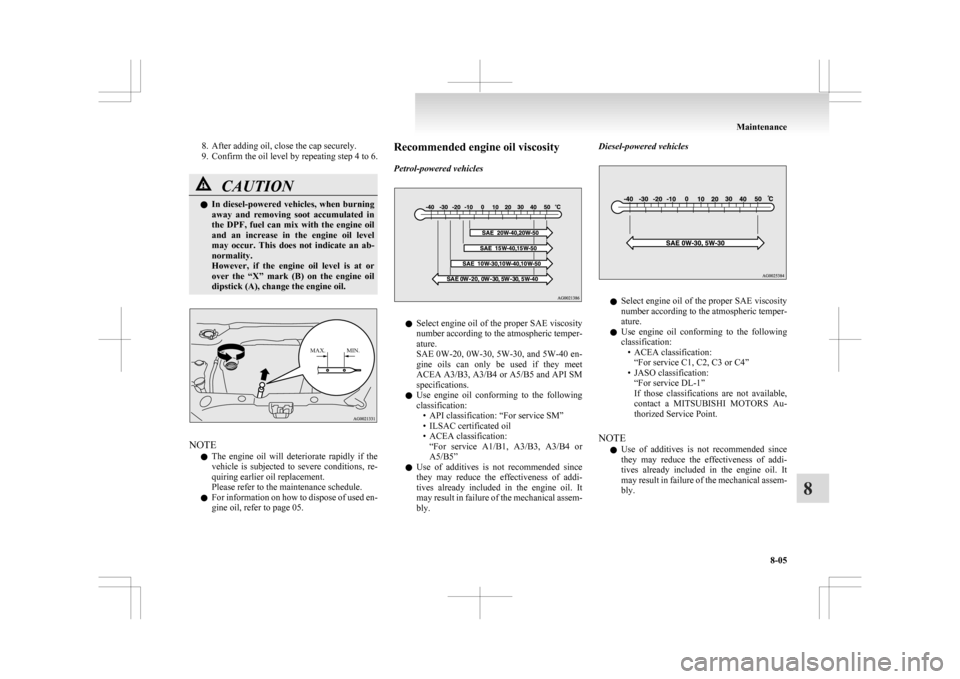
8. After adding oil, close the cap securely.
9.
Confirm the oil level by repeating step 4 to 6. CAUTION
l
In
diesel-powered vehicles, when burning
away and removing soot accumulated in
the DPF, fuel can mix with the engine oil
and an increase in the engine oil level
may occur. This does not indicate an ab-
normality.
However, if the engine oil level is at or
over the “X” mark (B) on the engine oil
dipstick (A), change the engine oil.
MAX. MIN. NOTE
l The
engine oil will deteriorate rapidly if the
vehicle is subjected to severe conditions, re-
quiring earlier oil replacement.
Please refer to the maintenance schedule.
l For information on how to dispose of used en-
gine oil, refer to page 05. Recommended engine oil viscosity
Petrol-powered vehicles
l
Select
engine oil of the proper SAE viscosity
number according to the atmospheric temper-
ature.
SAE 0W-20, 0W-30, 5W-30, and 5W-40 en-
gine oils can only be used if they meet
ACEA A3/B3, A3/B4 or A5/B5 and API SM
specifications.
l Use engine oil conforming to the following
classification:
• API classification: “For service SM”
• ILSAC certificated oil
• ACEA classification:“For service A1/B1, A3/B3, A3/B4 or
A5/B5”
l Use of additives is not recommended since
they may reduce the effectiveness of addi-
tives already included in the engine oil. It
may result in failure of the mechanical assem-
bly. Diesel-powered vehicles
l
Select
engine oil of the proper SAE viscosity
number according to the atmospheric temper-
ature.
l Use engine oil conforming to the following
classification:
• ACEA classification:“For service C1, C2, C3 or C4”
• JASO classification: “For service DL-1”
If those classifications are not available,
contact a MITSUBISHI MOTORS Au-
thorized Service Point.
NOTE l Use of additives is not recommended since
they may reduce the effectiveness of addi-
tives already included in the engine oil. It
may result in failure of the mechanical assem-
bly. Maintenance
8-05 8
Page 320 of 368
*- If the spare tyre wheel differs from the standard
tyre
wheel, do not perform tyre rotation using a
spare wheel. CAUTION
l
A
temporary spare tyre can be fitted tem-
porarily in place of a tyre that has been re-
moved during the tyre rotation. However,
it must not be included in the regular tyre
rotation sequence.
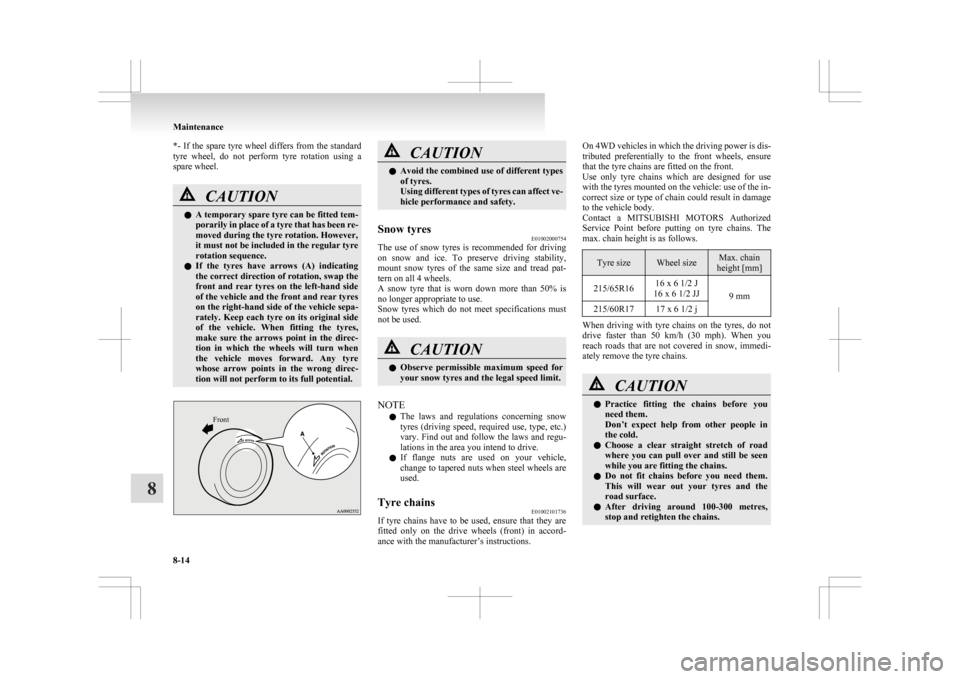
l If the tyres have arrows (A) indicating
the correct direction of rotation, swap the
front and rear tyres on the left-hand side
of the vehicle and the front and rear tyres
on the right-hand side of the vehicle sepa-
rately. Keep each tyre on its original side
of the vehicle. When fitting the tyres,
make sure the arrows point in the direc-
tion in which the wheels will turn when
the vehicle moves forward. Any tyre
whose arrow points in the wrong direc-
tion will not perform to its full potential.
Front CAUTION
l
Avoid
the combined use of different types
of tyres.
Using different types of tyres can affect ve-
hicle performance and safety.
Snow tyres E01002000754
The use of snow tyres is recommended for driving
on
snow and ice. To preserve driving stability,
mount snow tyres of the same size and tread pat-
tern on all 4 wheels.
A snow tyre that is worn down more than 50% is
no longer appropriate to use.
Snow tyres which do not meet specifications must
not be used. CAUTION
l
Observe
permissible maximum speed for
your snow tyres and the legal speed limit.
NOTE l The
laws and regulations concerning snow
tyres (driving speed, required use, type, etc.)
vary. Find out and follow the laws and regu-
lations in the area you intend to drive.
l If flange nuts are used on your vehicle,
change to tapered nuts when steel wheels are
used.
Tyre chains E01002101736
If tyre chains have to be used, ensure that they are
fitted
only on the drive wheels (front) in accord-
ance with the manufacturer’s instructions. On 4WD vehicles in which the driving power is dis-
tributed
preferentially to the front wheels, ensure
that the tyre chains are fitted on the front.
Use only tyre chains which are designed for use
with the tyres mounted on the vehicle: use of the in-
correct size or type of chain could result in damage
to the vehicle body.
Contact a MITSUBISHI MOTORS Authorized
Service Point before putting on tyre chains. The
max. chain height is as follows. Tyre size Wheel size Max. chain
height [mm]
215/65R16 16 x 6 1/2 J
16 x 6 1/2 JJ 9 mm
215/60R17 17 x 6 1/2 j When driving with tyre chains on the tyres, do not
drive
faster than 50 km/h (30 mph). When you
reach roads that are not covered in snow, immedi-
ately remove the tyre chains. CAUTION
l
Practice
fitting the chains before you
need them.
Don’t expect help from other people in
the cold.
l Choose a clear straight stretch of road
where you can pull over and still be seen
while you are fitting the chains.
l Do not fit chains before you need them.
This will wear out your tyres and the
road surface.
l After driving around 100-300 metres,
stop and retighten the chains. Maintenance
8-14
8
Page 321 of 368
CAUTION
l
Drive carefully and do not exceed
50 km/h (30 mph).
Remember that preventing accidents is
not the purpose of tyre chains.
l When tyre chains are installed, take care
that they do not damage the disc wheel or
body.
l Do not install a tyre chain on an emergen-
cy wheel which is compact in size. If one
of the front wheels has punctured, re-
place it with one of the rear wheels and in-
stall the temporary spare wheel in that
place before fitting a tyre chain.
l An aluminium wheel can be damaged by
a tyre chain while driving. When fitting a
tyre chain on an aluminium wheel, take
care that any part of the chain and fitting
cannot be brought into contact with the
wheel.
l Remove the wheel covers before instal-
ling a tyre chain, otherwise they may be
damaged by the tyre chain. (See page
8-14.)
l When installing or removing the tyre
chains, take care that hands and other
parts of your body are not injured by the
sharp edges of the vehicle body.
NOTE l The
laws and regulations concerning the use
of tyre chains vary. Always follow local laws
and regulations.
In most countries, it is prohibited by law to
use tyre chains on roads without snow. Parking brake break-in
E01008300225
Break-in
the parking brake linings whenever the
brake performance of the parking brake is insuffi-
cient or whenever the parking brake linings and/or
discs are replaced, in order to assure the best brake
performance.
This procedure is described in the vehicle service
manual and can be carried out by a MITSUBISHI
MOTORS Authorized Service Point. Wiper blade rubber replacement
E01002600327
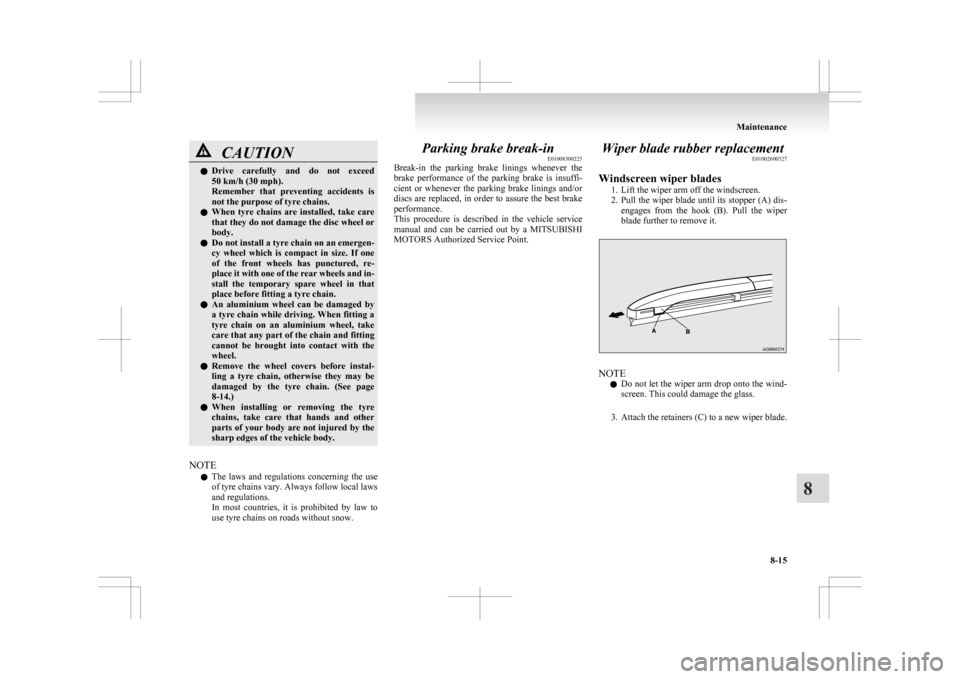
Windscreen wiper blades 1.
Lift the wiper arm off the windscreen.
2. Pull the wiper blade until its stopper (A) dis- engages from the hook (B). Pull the wiper
blade further to remove it. NOTE
l Do
not let the wiper arm drop onto the wind-
screen. This could damage the glass.
3. Attach the retainers (C) to a new wiper blade. Maintenance
8-15 8
Page 323 of 368
General maintenance
E01002700520
Fuel, engine coolant, oil and exhaust
gas leakage
Look
under the body of your vehicle to check for
fuel, engine coolant, oil and exhaust gas leaks. WARNING
l If
you see a suspicious fuel leak or if you
smell fuel, do not operate the vehicle; call
your MITSUBISHI MOTORS Author-
ized Service Point for assistance.
Exterior and interior lamp operation
Operate
the combination lamp switch to check that
all lamps are functioning properly.
If the lamps do not illuminate, the probable cause
is a blown fuse or defective lamp bulb. Check the
fuses first. If there is no blown fuse, check the
lamp bulbs.
For information regarding the inspection and re-
placement of the fuses and the lamp bulbs, refer to
“Fuses” on page 8-18 and “Replacement of lamp
bulbs” on page 8-23.
If the fuses and bulbs are all OK, we recommend
you to have your vehicle checked and repaired.
Meter, gauge and indicator/warning
lamps operation
Start the engine and check the operation of all in-
struments, gauges and indication and warning lamps.
If there is anything wrong, we recommend you to
have your vehicle inspected. Hinges and latches lubrication
Check
all latches and hinges, and, if necessary,
have them lubricated. For cold and snowy weather
E01002800361
Ventilation slots
The
ventilation slots in front of the windscreen
should be kept clear of leaves or brushed clear after
heavy snowfall, so that the operation of the heating
and ventilation systems will not be impaired.
Weatherstripping
To prevent freezing of the weatherstripping on the
doors, bonnet, etc., they should be treated with sili-
cone grease.
Additional equipment
It is a good idea to carry a shovel or a short-han-
dled spade in the vehicle during the winter so that
you can clear away snow if you get stranded. A
small hand-brush for sweeping snow off the vehi-
cle and a plastic scraper for the windscreen and
rear window are also useful. Maintenance
8-17 8
Page 330 of 368
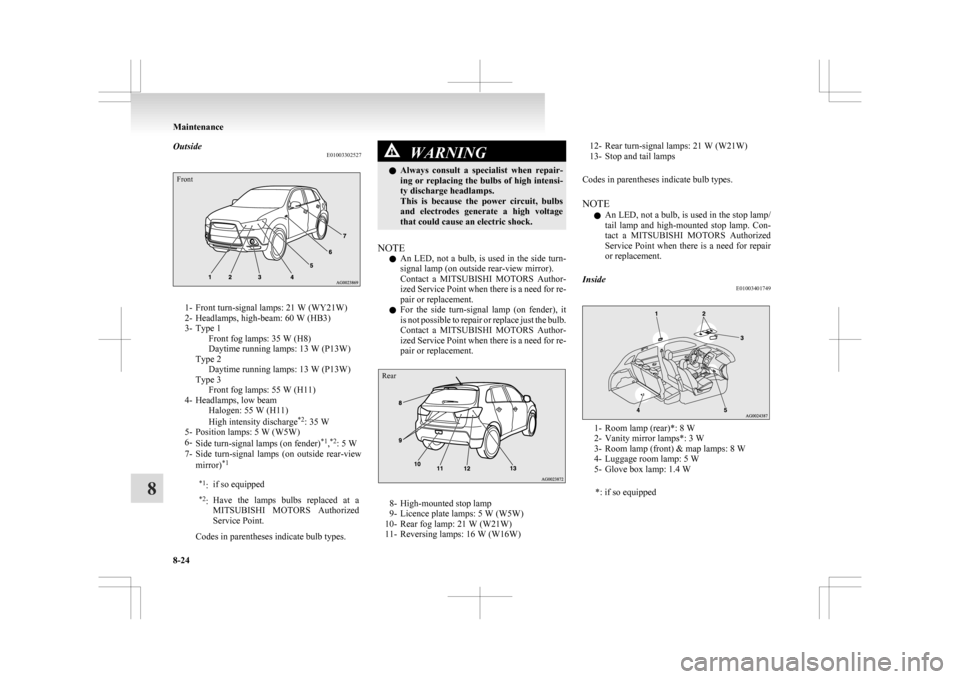
Outside
E01003302527Front1- Front turn-signal lamps: 21 W (WY21W)
2-
Headlamps, high-beam: 60 W (HB3)
3- Type 1 Front fog lamps: 35 W (H8)
Daytime running lamps: 13 W (P13W)
Type 2 Daytime running lamps: 13 W (P13W)
Type 3 Front fog lamps: 55 W (H11)
4- Headlamps, low beam Halogen: 55 W (H11)
High intensity discharge *2
: 35 W
5- Position lamps: 5 W (W5W)
6- Side turn-signal lamps (on fender) *1
,*2
: 5 W
7- Side turn-signal lamps (on outside rear-view
mirror) *1
*1 : if so equipped
*2 : Have the lamps bulbs replaced at a
MITSUBISHI MOTORS
Authorized
Service Point.
Codes in parentheses indicate bulb types. WARNING
l Always
consult a specialist when repair-
ing or replacing the bulbs of high intensi-
ty discharge headlamps.
This is because the power circuit, bulbs
and electrodes generate a high voltage
that could cause an electric shock.
NOTE l An
LED, not a bulb, is used in the side turn-
signal lamp (on outside rear-view mirror).
Contact a MITSUBISHI MOTORS Author-
ized Service Point when there is a need for re-
pair or replacement.
l For the side turn-signal lamp (on fender), it
is not possible to repair or replace just the bulb.
Contact a MITSUBISHI MOTORS Author-
ized Service Point when there is a need for re-
pair or replacement.
Rear 8- High-mounted stop lamp
9-
Licence plate lamps: 5 W (W5W)
10- Rear fog lamp: 21 W (W21W)
11- Reversing lamps: 16 W (W16W) 12- Rear turn-signal lamps: 21 W (W21W)
13-
Stop and tail lamps
Codes in parentheses indicate bulb types.
NOTE l An LED, not a bulb, is used in the stop lamp/
tail lamp and high-mounted stop lamp. Con-
tact a MITSUBISHI MOTORS Authorized
Service Point when there is a need for repair
or replacement.
Inside E01003401749 1- Room lamp (rear)*: 8 W
2-
Vanity mirror lamps*: 3 W
3- Room lamp (front) & map lamps: 8 W
4- Luggage room lamp: 5 W
5- Glove box lamp: 1.4 W
*: if so equipped Maintenance
8-24
8
Page 332 of 368
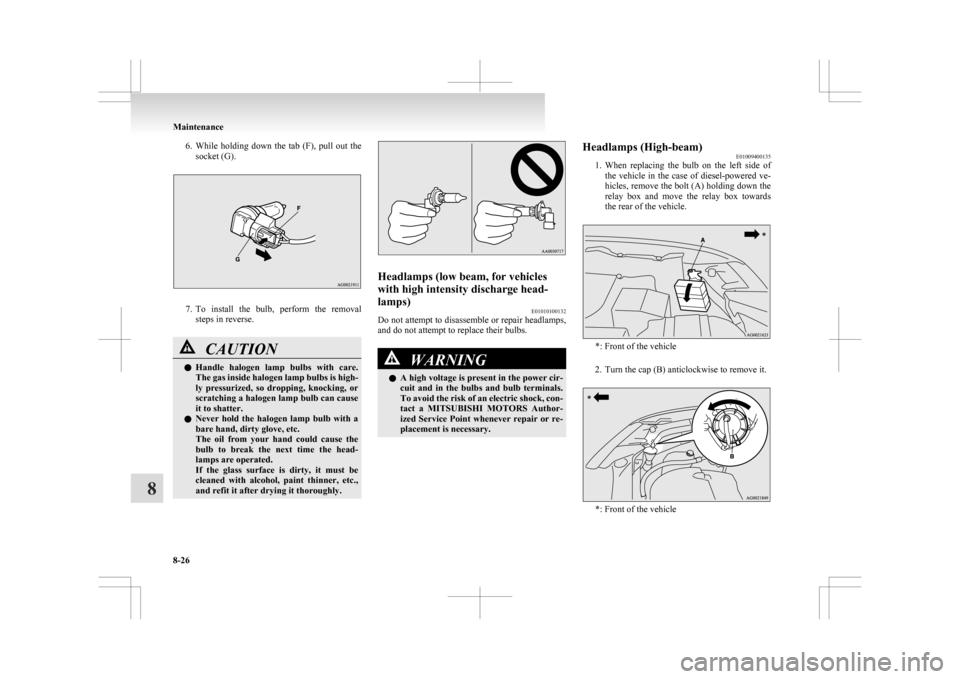
6. While holding down the tab (F), pull out the
socket (G). 7. To
install the bulb, perform the removal
steps in reverse. CAUTION
l
Handle
halogen lamp bulbs with care.
The gas inside halogen lamp bulbs is high-
ly pressurized, so dropping, knocking, or
scratching a halogen lamp bulb can cause
it to shatter.
l Never hold the halogen lamp bulb with a
bare hand, dirty glove, etc.
The oil from your hand could cause the
bulb to break the next time the head-
lamps are operated.
If the glass surface is dirty, it must be
cleaned with alcohol, paint thinner, etc.,
and refit it after drying it thoroughly. Headlamps (low beam, for vehicles
with high intensity discharge head-
lamps)
E01010100132
Do not attempt to disassemble or repair headlamps,
and do not attempt to replace their bulbs. WARNING
l A high voltage is present in the power cir-
cuit
and in the bulbs and bulb terminals.
To avoid the risk of an electric shock, con-
tact a MITSUBISHI MOTORS Author-
ized Service Point whenever repair or re-
placement is necessary. Headlamps (High-beam)
E01009400135
1. When
replacing the bulb on the left side of
the vehicle in the case of diesel-powered ve-
hicles, remove the bolt (A) holding down the
relay box and move the relay box towards
the rear of the vehicle. *: Front of the vehicle
2.
Turn the cap (B) anticlockwise to remove it. *: Front of the vehicleMaintenance
8-26
8
Page 335 of 368
Side turn-signal lamps (on fender)*
E01003900516
NOTE l For
the side turn-signal lamps (on fender), it
is not possible to repair or replace just the bulb.
l Contact a MITSUBISHI MOTORS Author-
ized Service Point when there is a need for re-
pair or replacement.
Side turn-signal lamps (on outside rear-
view mirror)* E01003900529
NOTE l An
LED, not a bulb, is used in the side turn-
signal lamps (on outside rear-view mirror).
Contact a MITSUBISHI MOTORS Author-
ized Service Point when there is a need for re-
pair or replacement.
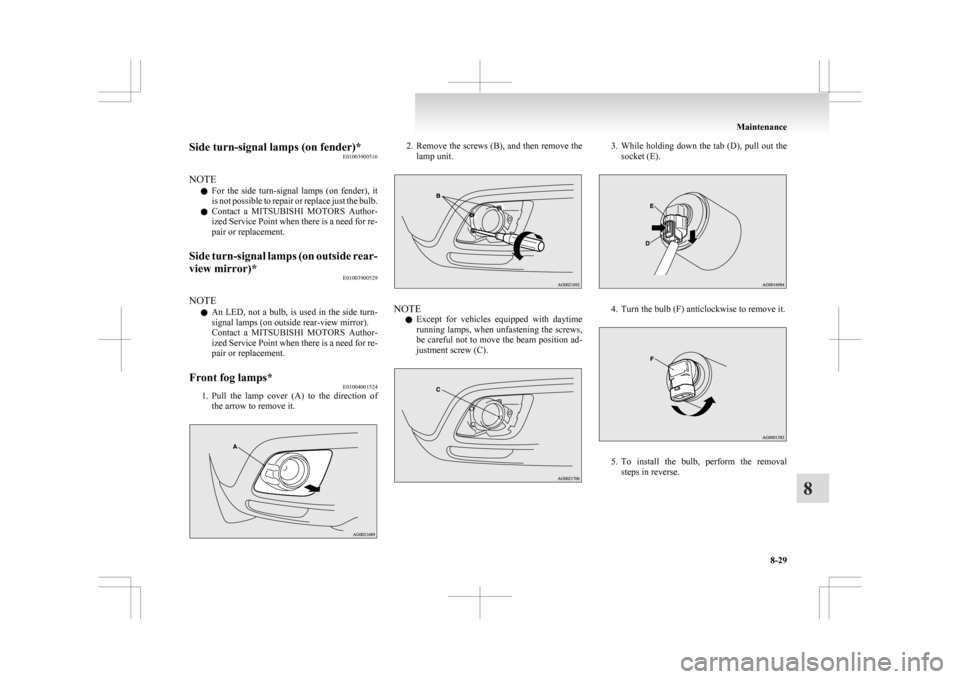
Front fog lamps* E01004001524
1. Pull
the lamp cover (A) to the direction of
the arrow to remove it. 2. Remove
the screws (B), and then remove the
lamp unit. NOTE
l Except
for vehicles equipped with daytime
running lamps, when unfastening the screws,
be careful not to move the beam position ad-
justment screw (C). 3. While
holding down the tab (D), pull out the
socket (E). 4. Turn the bulb (F) anticlockwise to remove it.
5. To
install the bulb, perform the removal
steps in reverse. Maintenance
8-29 8
Page 338 of 368
NOTE
l An
LED, not a bulb, is used in the stop lamp/
tail lamp.
Contact a MITSUBISHI MOTORS Author-
ized Service Point when there is a need for re-
pair or replacement.
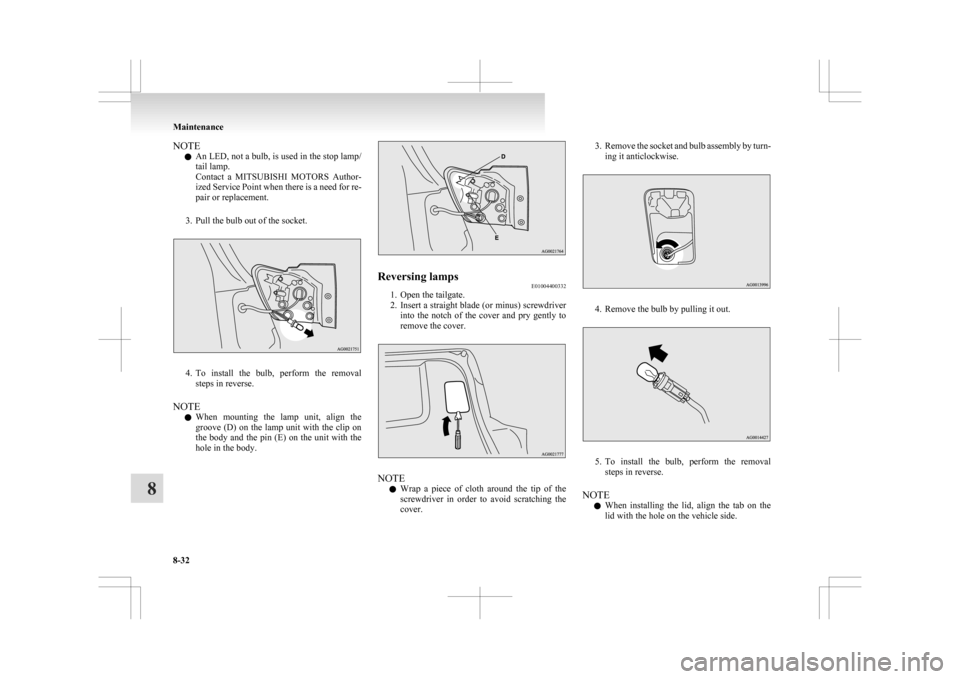
3. Pull the bulb out of the socket. 4. To
install the bulb, perform the removal
steps in reverse.
NOTE l When mounting the lamp unit, align the
groove (D) on the lamp unit with the clip on
the body and the pin (E) on the unit with the
hole in the body. Reversing lamps
E01004400332
1. Open the tailgate.
2. Insert
a straight blade (or minus) screwdriver
into the notch of the cover and pry gently to
remove the cover. NOTE
l Wrap
a piece of cloth around the tip of the
screwdriver in order to avoid scratching the
cover. 3. Remove
the socket and bulb assembly by turn-
ing it anticlockwise. 4. Remove the bulb by pulling it out.
5. To
install the bulb, perform the removal
steps in reverse.
NOTE l When installing the lid, align the tab on the
lid with the hole on the vehicle side. Maintenance
8-32
8
Page 339 of 368
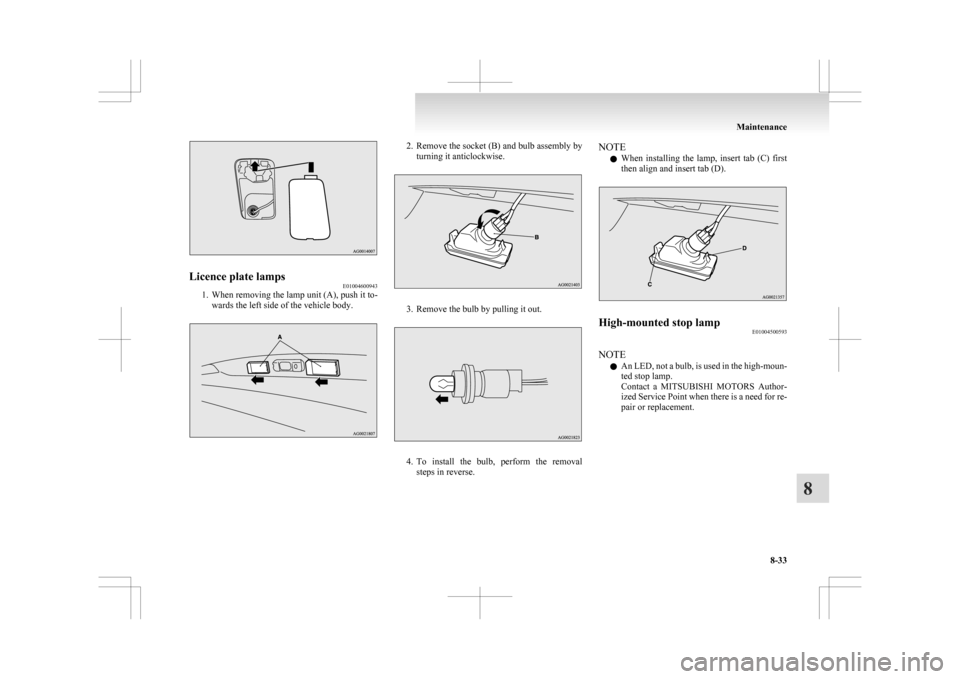
Licence plate lamps
E01004600943
1. When removing the lamp unit (A), push it to-
wards the left side of the vehicle body. 2. Remove the socket (B) and bulb assembly by
turning it anticlockwise. 3. Remove the bulb by pulling it out.
4. To
install the bulb, perform the removal
steps in reverse. NOTE
l When
installing the lamp, insert tab (C) first
then align and insert tab (D). High-mounted stop lamp
E01004500593
NOTE l An
LED, not a bulb, is used in the high-moun-
ted stop lamp.
Contact a MITSUBISHI MOTORS Author-
ized Service Point when there is a need for re-
pair or replacement. Maintenance
8-33 8
Page 351 of 368
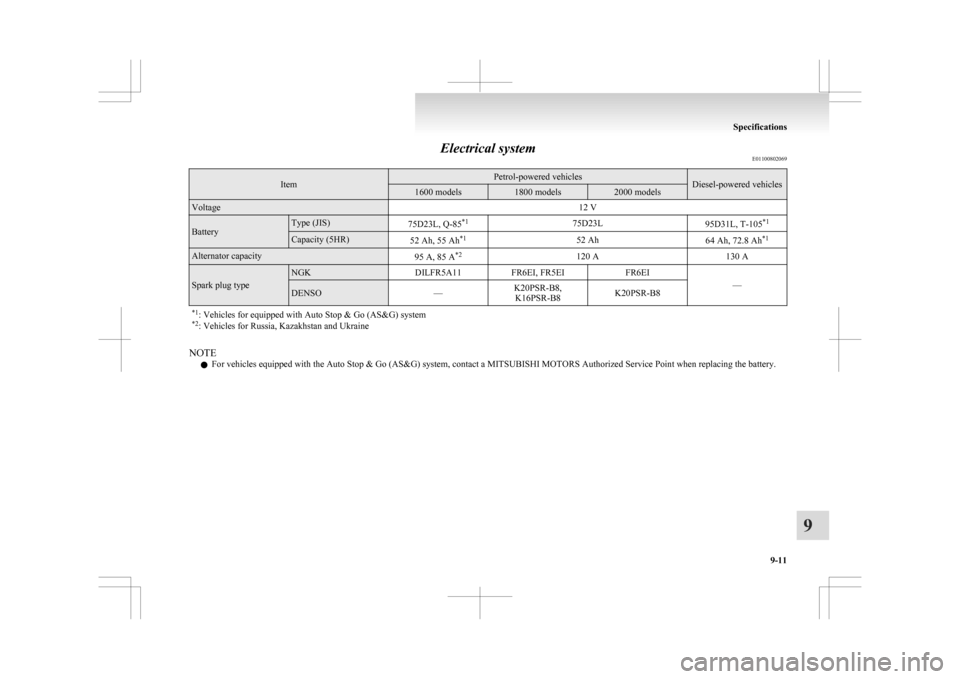
Electrical system
E01100802069Item Petrol-powered vehicles
Diesel-powered vehicles
1600 models 1800 models 2000 models
Voltage
12 VBattery Type (JIS)
75D23L, Q-85*1
75D23L 95D31L, T-105*1 Capacity (5HR)
52 Ah, 55 Ah*1
52 Ah 64 Ah, 72.8 Ah*1Alternator capacity
95 A, 85 A*2
120 A 130 ASpark plug type NGK
DILFR5A11FR6EI, FR5EI FR6EI
— DENSO
—K20PSR-B8,
K16PSR-B8 K20PSR-B8
*1 : Vehicles for equipped with Auto Stop & Go (AS&G) system
*2 : Vehicles for Russia, Kazakhstan and Ukraine NOTE
l For vehicles equipped with the Auto Stop & Go (AS&G) system, contact a
MITSUBISHI MOTORS Authorized Service Point when replacing the battery. Specifications
9-11 9