4WD MITSUBISHI ASX 2009 1.G User Guide
[x] Cancel search | Manufacturer: MITSUBISHI, Model Year: 2009, Model line: ASX, Model: MITSUBISHI ASX 2009 1.GPages: 368, PDF Size: 8.13 MB
Page 183 of 368
4-wheel drive operation
E00606600887
Your
vehicle has been designed primarily for use
on paved roads.
But its unique 4-wheel drive system allows you to
occasionally travel on unpaved roads, to camp-
grounds, picnic sites, and similar locations.
Not only does this ensure better handling on dry,
paved roads but also permits better traction when
driving on slippery, wet or snow-covered roads and
when moving out of mud.
But it is not suitable for heavy off road use or tow-
ing in rough conditions.
It is particularly important to note that 4-wheel
drive may not give sufficient hill climbing ability
and engine braking on steep slopes. You should try
to avoid driving on steep slopes.
Also, you must exercise caution when driving on
sand and mud and when driving through water be-
cause sufficient traction may not be available in cer-
tain circumstances.
Please avoid driving the vehicle through areas
where the tyres may get stuck in deep sand or mud. WARNING
l Do
not over-rely on the 4-wheel drive ve-
hicles. Even 4-wheel drive vehicles have
limits to the system and ability to main-
tain control and traction. Reckless driv-
ing may lead to accidents. Always drive
carefully, taking account of the road con-
ditions.
l Improperly operating this vehicle on or
off-paved roads can cause an accident or
rollover in which you and your passen-
gers could be seriously injured or killed. WARNING
• Follow
all instructions and guidelines in the owner’s manual.
• Keep your speed low and do not drive faster than conditions allow you to.
NOTE l Driving
on rough roads can be hard on a ve-
hicle. Before you leave paved roads, be sure
all scheduled maintenance and service has
been done, and that you have inspected your
vehicle. Pay special attention to the condi-
tion of the tyres, and check the tyre pressures.
l MITSUBISHI MOTORS is not responsible
to the operator for any damage or injury
caused or liability incurred by improper and
negligent operation of a vehicle. All techni-
ques of vehicle operation depend on the skill
and experience of the operator and other par-
ticipating parties. Any deviation from the rec-
ommended operating instructions above is at
their own risk.
l Note that the stopping distance required of a
4-wheel drive vehicle differs very little from
that of a 2-wheel drive vehicle. When driv-
ing on a snow-covered road or a slippery,
muddy surface, make sure that you keep a suf-
ficient distance between your vehicle and the
one ahead of you.
l The driving posture should be more upright;
adjust the seat to a good position for easy
steering and pedal operation. Be sure to wear
the seat belt. l
After
driving on rough roads, check each
part of the vehicle and wash it thoroughly
with water. Refer to the “Inspection and main-
tenance following rough road operation” sec-
tion and “Maintenance” section. CAUTION
l
Setting
the drive mode-selector to “4WD
LOCK” to drive on dry paved road will
increase fuel consumption, with possible
noise generation.
Turning sharp corners
When
turning a sharp corner in “4WD LOCK” po-
sition at low speed, a slight difference in steering
may be experienced similar to as if the brakes were
applied. This is called tight corner braking and re-
sults from each of the 4 tyres being at a different
distance from the corner. The phenomenon is typi-
cal of 4-wheel drive vehicles. If this occurs, either
straighten out the steering wheel, or change to
“2WD” or “4WD AUTO” mode.
On snowy or icy roads
Set the drive mode-selector to “4WD AUTO” or
“4WD LOCK” in accordance with the road condi-
tions, and then gradually depress the accelerator ped-
al for a smooth start.
NOTE
l The use of snow tyres is recommended.
l Maintain a safe distance between vehicles,
avoid sudden braking, and use engine brak-
ing (downshifting). Starting and driving
4-31 4
Page 184 of 368
CAUTION
l
Avoid sudden braking, sudden accelera-
tion and sharp turning. Skidding occurs
and control of the vehicle could be lost.
Driving on sandy or muddy roads
Set
the drive mode-selector to “4WD LOCK” and
then gradually depress the accelerator pedal for a
smooth start. Keep the pressure on the accelerator
pedal as constant as possible, and drive at low speed. CAUTION
l
Do
not force the vehicle or drive reckless-
ly on sandy surfaces. In comparison with
normal road surfaces, the engine and oth-
er drive-system components are put un-
der excessive strain when driving on such
a surface. This could lead to accidents.
l If the engine coolant temperature display flashes on the information screen in
the
multi-information display or the en-
gine power drops suddenly while the vehi-
cle is being driven, park your vehicle im-
mediately in a safe place.
Refer to “Engine overheating” on page
6-04 for details and take the required meas-
ures. WARNING
l When attempting to rock your vehicle out
of
a stuck position, be sure that the area
around the vehicle is clear of people and
physical objects. The rocking motion may
cause the vehicle to suddenly launch for-
ward or backward, causing injury or dam-
age to nearby people or objects.
NOTE l Avoid
sudden braking, sudden acceleration
and sharp turning; such operations could re-
sult in the vehicle becoming stuck.
l If the vehicle becomes stuck in sandy or mud-
dy roads, it can often be moved with a rock-
ing motion. Move the gearshift lever alter-
nately between the 1 st
and “R” (Reverse) po-
sitions (M/T), the “D” (DRIVE) and “R” (RE-
VERSE) positions (CVT), while pressing
lightly on the accelerator pedal.
l Driving on rough roads can cause rust on the
vehicle; wash the vehicle thoroughly as soon
as possible after such use.
Climbing/descending sharp grades
Your vehicle may not provide sufficient hill climb-
ing ability and engine braking on steep slopes.
Avoid driving on steep slopes even though the vehi-
cle is a 4-wheel drive vehicle.
Driving through water E00618900076
If the electrical circuits become wet, further opera-
tion
of the vehicle will be impossible; therefore,
avoid driving through water unless absolutely nec-
essary. If driving through water is unavoidable, use
the following procedure:
Check
the depth of the water and the terrain before
attempting to drive through it. Drive slowly to
avoid creating excessive water splashing. CAUTION
l
Never
drive through water that is deep
enough to cover wheel hubs, axles or ex-
haust pipe. Do not change the gearshift
lever position (M/T) or the selector lever
position (CVT) while driving through wa-
ter.
Frequent driving through water can ad-
versely affect the life span of the vehicle;
we recommend you to take the necessary
measures to prepare, inspect, and repair
the vehicle.
l After driving through water, apply the
brakes to be sure they are functioning
properly. If the brakes are wet and not
functioning properly, dry them out by
driving slowly while lightly depressing
the brake pedal. Inspect each part of the
vehicle carefully. Starting and driving
4-32
4
Page 297 of 368
Towing
E00801503187
If your vehicle needs to be towed
If
you need to tow your vehicle, we recommend
that you contact a MITSUBISHI MOTORS Author-
ized Service Point or tow truck company.
In the following cases, transport the vehicle using a
tow truck.
l The engine runs but the vehicle does not
move or abnormal noise is produced.
l Inspection of the vehicle’s underside reveals
that oil or some other fluid is leaking.
If a wheel gets stuck in a ditch, do not try to tow
the vehicle.
Please contact your MITSUBISHI MOTORS Au-
thorized Service Point or a commercial tow truck
service for assistance.
Only when you cannot receive a towing service
from a MITSUBISHI MOTORS Authorized Serv-
ice Point or commercial tow truck service, tow
your vehicle carefully in accordance with the in-
structions given in “Emergency towing” in this part. The regulations concerning towing may differ from
country
to country. It is recommended that you
obey the regulations of the area where you are driv-
ing your vehicle.
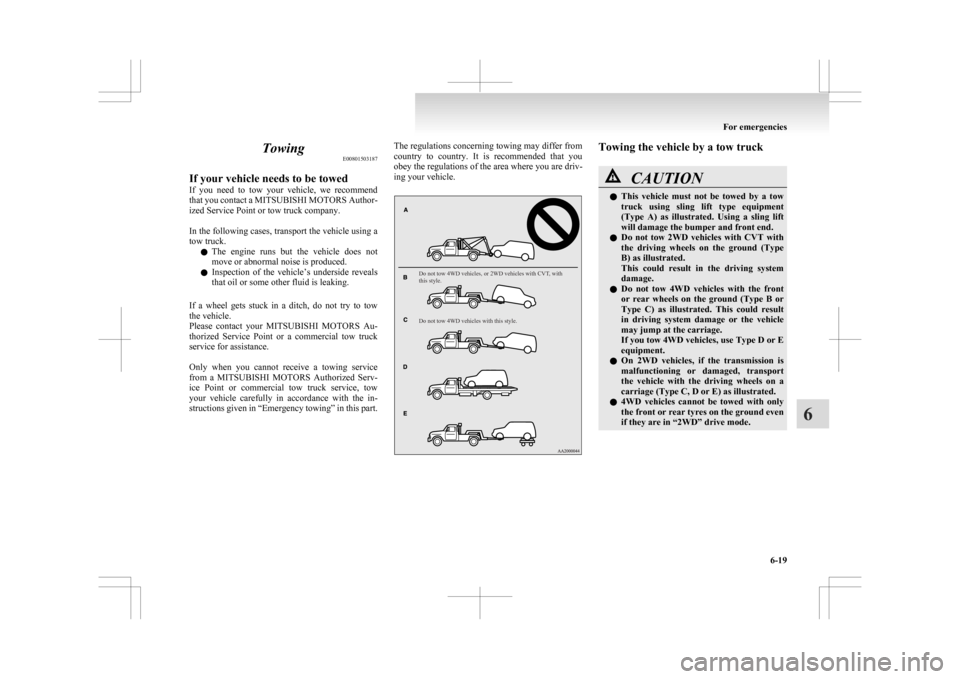
Do not tow 4WD vehicles, or 2WD vehicles with CVT, with
this style.
Do not tow 4WD vehicles with this style. Towing the vehicle by a tow truck
CAUTION
l
This
vehicle must not be towed by a tow
truck using sling lift type equipment
(Type A) as illustrated. Using a sling lift
will damage the bumper and front end.
l Do not tow 2WD vehicles with CVT with
the driving wheels on the ground (Type
B) as illustrated.
This could result in the driving system
damage.
l Do not tow 4WD vehicles with the front
or rear wheels on the ground (Type B or
Type C) as illustrated. This could result
in driving system damage or the vehicle
may jump at the carriage.
If you tow 4WD vehicles, use Type D or E
equipment.
l On 2WD vehicles, if the transmission is
malfunctioning or damaged, transport
the vehicle with the driving wheels on a
carriage (Type C, D or E) as illustrated.
l 4WD vehicles cannot be towed with only
the front or rear tyres on the ground even
if they are in “2WD” drive mode. For emergencies
6-19 6
Page 320 of 368
*- If the spare tyre wheel differs from the standard
tyre
wheel, do not perform tyre rotation using a
spare wheel. CAUTION
l
A
temporary spare tyre can be fitted tem-
porarily in place of a tyre that has been re-
moved during the tyre rotation. However,
it must not be included in the regular tyre
rotation sequence.
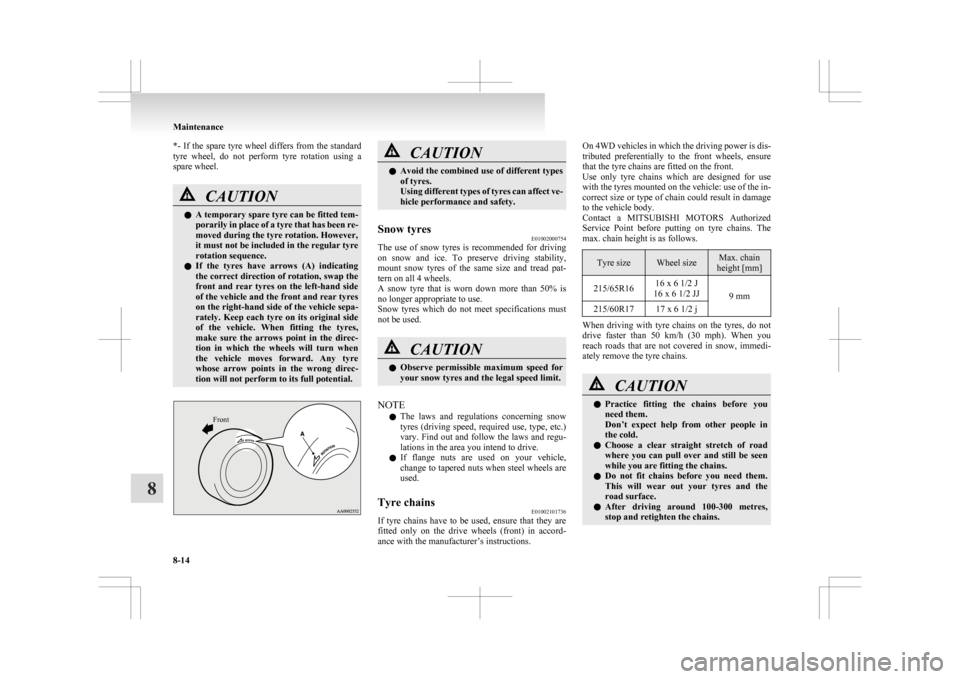
l If the tyres have arrows (A) indicating
the correct direction of rotation, swap the
front and rear tyres on the left-hand side
of the vehicle and the front and rear tyres
on the right-hand side of the vehicle sepa-
rately. Keep each tyre on its original side
of the vehicle. When fitting the tyres,
make sure the arrows point in the direc-
tion in which the wheels will turn when
the vehicle moves forward. Any tyre
whose arrow points in the wrong direc-
tion will not perform to its full potential.
Front CAUTION
l
Avoid
the combined use of different types
of tyres.
Using different types of tyres can affect ve-
hicle performance and safety.
Snow tyres E01002000754
The use of snow tyres is recommended for driving
on
snow and ice. To preserve driving stability,
mount snow tyres of the same size and tread pat-
tern on all 4 wheels.
A snow tyre that is worn down more than 50% is
no longer appropriate to use.
Snow tyres which do not meet specifications must
not be used. CAUTION
l
Observe
permissible maximum speed for
your snow tyres and the legal speed limit.
NOTE l The
laws and regulations concerning snow
tyres (driving speed, required use, type, etc.)
vary. Find out and follow the laws and regu-
lations in the area you intend to drive.
l If flange nuts are used on your vehicle,
change to tapered nuts when steel wheels are
used.
Tyre chains E01002101736
If tyre chains have to be used, ensure that they are
fitted
only on the drive wheels (front) in accord-
ance with the manufacturer’s instructions. On 4WD vehicles in which the driving power is dis-
tributed
preferentially to the front wheels, ensure
that the tyre chains are fitted on the front.
Use only tyre chains which are designed for use
with the tyres mounted on the vehicle: use of the in-
correct size or type of chain could result in damage
to the vehicle body.
Contact a MITSUBISHI MOTORS Authorized
Service Point before putting on tyre chains. The
max. chain height is as follows. Tyre size Wheel size Max. chain
height [mm]
215/65R16 16 x 6 1/2 J
16 x 6 1/2 JJ 9 mm
215/60R17 17 x 6 1/2 j When driving with tyre chains on the tyres, do not
drive
faster than 50 km/h (30 mph). When you
reach roads that are not covered in snow, immedi-
ately remove the tyre chains. CAUTION
l
Practice
fitting the chains before you
need them.
Don’t expect help from other people in
the cold.
l Choose a clear straight stretch of road
where you can pull over and still be seen
while you are fitting the chains.
l Do not fit chains before you need them.
This will wear out your tyres and the
road surface.
l After driving around 100-300 metres,
stop and retighten the chains. Maintenance
8-14
8
Page 346 of 368
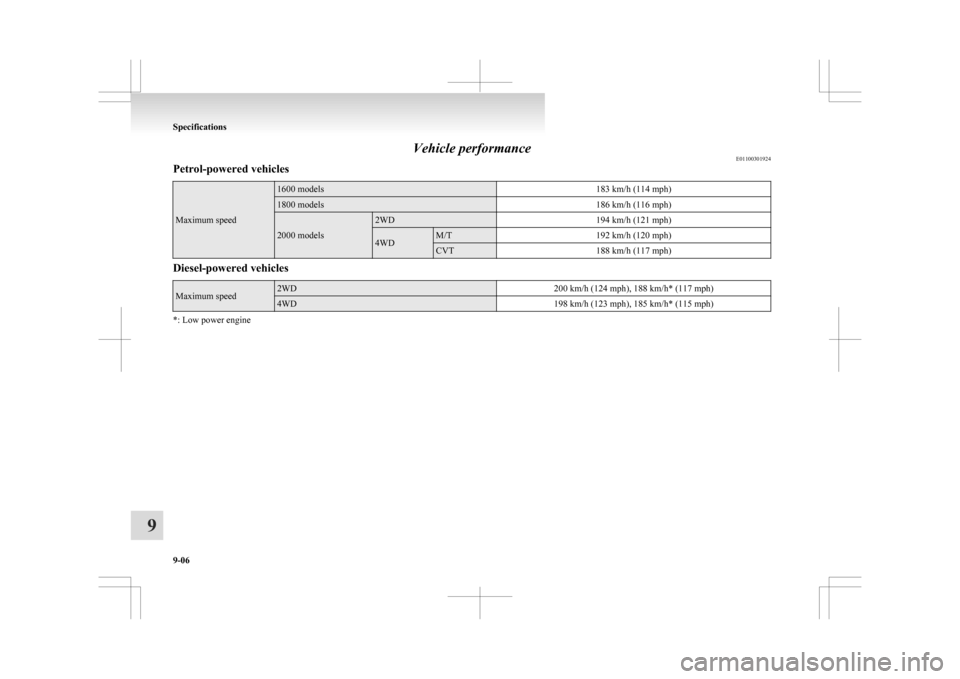
Vehicle performance
E01100301924
Petrol-powered vehicles Maximum speed 1600 models
183 km/h (114 mph)1800 models
186 km/h (116 mph)2000 models 2WD
194 km/h (121 mph) 4WD M/T
192 km/h (120 mph) CVT
188 km/h (117 mph)Diesel-powered vehicles
Maximum speed 2WD
200 km/h (124 mph), 188 km/h* (117 mph)4WD
198 km/h (123 mph), 185 km/h* (115 mph)*: Low power engineSpecifications
9-06
9
Page 348 of 368
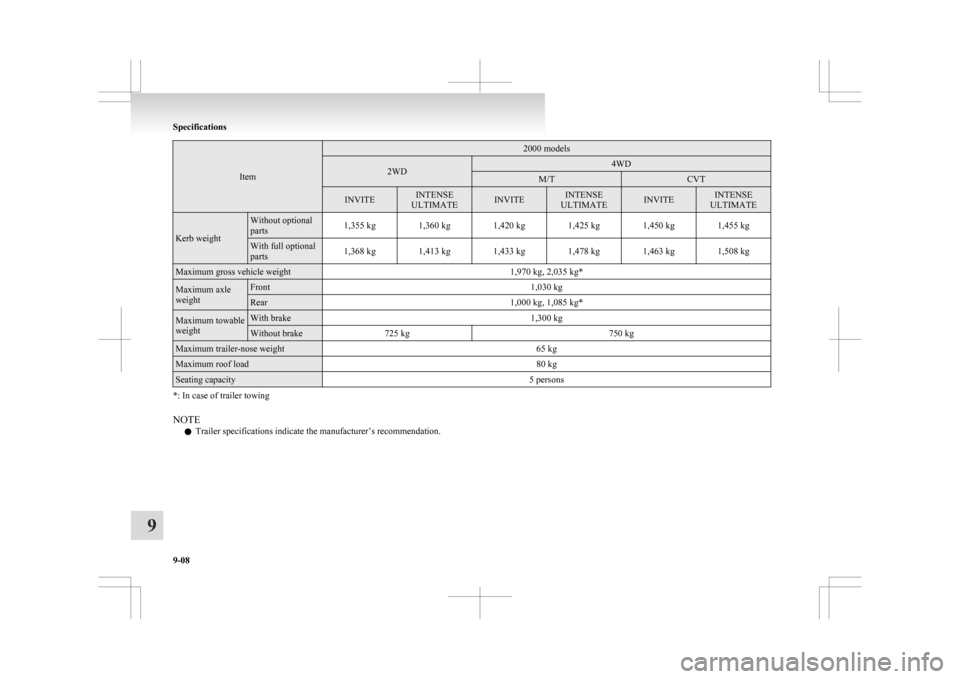
Item 2000 models
2WD 4WD
M/T CVT
INVITE INTENSE
ULTIMATE INVITE INTENSE
ULTIMATE INVITE INTENSE
ULTIMATE Kerb weight Without optional
parts
1,355 kg 1,360 kg 1,420 kg 1,425 kg 1,450 kg 1,455 kg With full optional
parts
1,368 kg 1,413 kg 1,433 kg 1,478 kg 1,463 kg 1,508 kgMaximum gross vehicle weight
1,970 kg, 2,035 kg*Maximum axle
weight Front
1,030 kgRear
1,000 kg, 1,085 kg*Maximum towable
weight With brake
1,300 kgWithout brake
725 kg 750 kgMaximum trailer-nose weight
65 kgMaximum roof load
80 kgSeating capacity
5 persons*: In case of trailer towing
NOTE
l Trailer specifications indicate the manufacturer’s recommendation. Specifications
9-08
9
Page 349 of 368
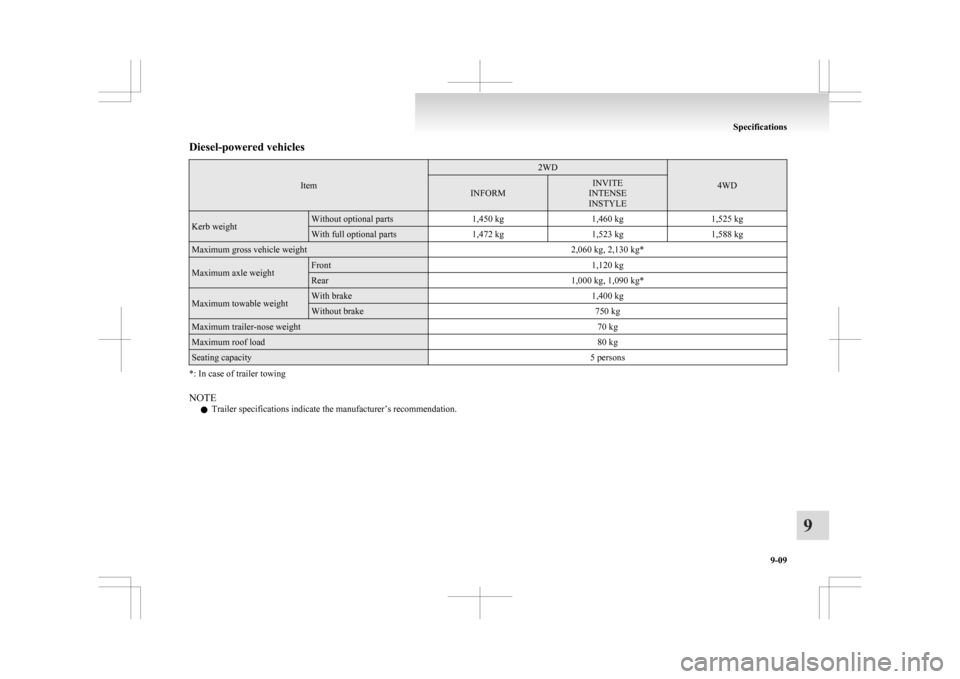
Diesel-powered vehicles
Item 2WD
4WD
INFORM INVITE
INTENSE
INSTYLE Kerb weight Without optional parts
1,450 kg1,460 kg1,525 kg With full optional parts
1,472 kg1,523 kg1,588 kgMaximum gross vehicle weight
2,060 kg, 2,130 kg*Maximum axle weight Front
1,120 kgRear
1,000 kg, 1,090 kg*Maximum towable weight With brake
1,400 kgWithout brake
750 kgMaximum trailer-nose weight
70 kgMaximum roof load
80 kgSeating capacity
5 persons*: In case of trailer towing
NOTE
l Trailer specifications indicate the manufacturer’s recommendation. Specifications
9-09 9
Page 353 of 368
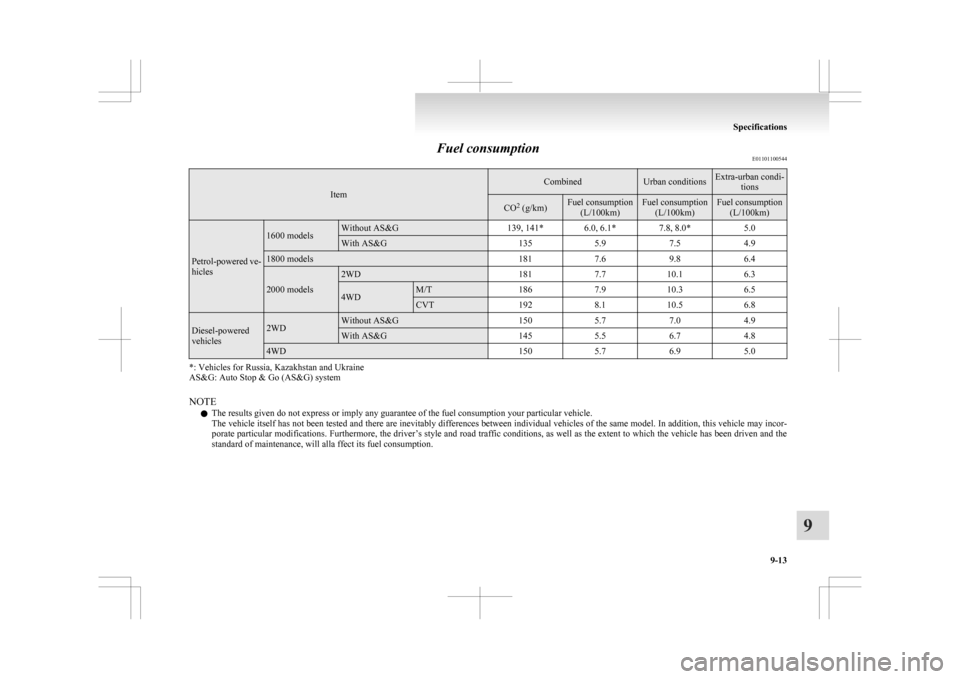
Fuel consumption
E01101100544Item Combined Urban conditions Extra-urban condi-
tions CO
2
(g/km) Fuel consumption
(L/100km) Fuel consumption
(L/100km) Fuel consumption
(L/100km) Petrol-powered ve-
hicles 1600 models Without AS&G
139, 141* 6.0, 6.1* 7.8, 8.0* 5.0With AS&G
1355.97.54.9 1800 models
1817.69.86.4 2000 models 2WD
1817.710.1 6.3 4WD M/T
1867.910.3 6.5 CVT
1928.110.5 6.8Diesel-powered
vehicles 2WD Without AS&G
1505.77.04.9 With AS&G
1455.56.74.8 4WD
1505.76.95.0*: Vehicles for Russia, Kazakhstan and Ukraine
AS&G: Auto Stop & Go (AS&G) system
NOTE
l The results given do not express or imply any guarantee of the fuel consumption your particular vehicle.
The
vehicle itself has not been tested and there are inevitably differences between individual vehicles of the same model. In addition, this vehicle may incor-
porate particular modifications. Furthermore, the driver’s style and road traffic conditions, as well as the extent to which the vehicle has been driven and the
standard of maintenance, will alla ffect its fuel consumption. Specifications
9-13 9
Page 357 of 368

4
4-wheel drive operation 4-31
AAccessory (Installation) 04
Accessory socket 5-61
Active stability control (ASC)
4-40
Additional equipment 8-17
Air conditioning 5-03 Important operation tips for the air condition-
ing 5-09
Air purifier 5-10
Airbag 2-24
Antenna 5-39
Anti-lock brake system (ABS) 4-38 Display 4-38
Warning lamp 4-38
Ashtray 5-60
Assist grips 5-70
Audio 5-10 Error codes 5-35
External audio input function 5-32
Handling of compact discs 5-38
Steering wheel audio remote control
switches 5-33
Auto Stop & Go (AS&G) system 4-17
Automatic transmission Fluid 9-14
Selector lever operation 4-24
Selector lever position 4-25
Sports mode 4-26
BBattery 8-08
Charge warning lamp 3-42 Discharged battery (Emergency starting) 6-02
Disposal information for used batteries
06
Specification 9-11
Bluetooth® 2.0 interface 5-41
Bonnet 8-03
Bottle holder 5-69
Brake assist system 4-36
Brake Anti-lock brake 4-38
Braking 4-34
Fluid 8-07,9-14
Parking brake 4-06
Bulb capacity 8-23
C Capacities 9-14
Card holder 5-59,5-66
Cargo loads 4-52
Catalytic converter
8-02
Cautions on handling of 4-wheel drive vehi-
cles 4-33
Central door locks 1-22
Charge warning lamp 3-42
Chassis number 9-02
Check engine warning lamp 3-41
Child restraint 2-15
Child-protection rear doors 1-25
Cigarette lighter 5-60
Cleaning Exterior of your vehicle 7-03
Interior of your vehicle 7-02
Clock 5-39
Clutch Fluid 8-07
Coat hook 5-70
Combination headlamps and dipper switch 3-44
Coolant (engine) 8-06,9-14
Cruise control 4-43 Cup holder 5-68
D Daytime running lamps
Bulb capacity
8-24
Replacement 8-30
Demister (rear window) 3-57
Diesel particulate filter (DPF) 4-15
Dimensions 9-04
Dipper (High/Low beam change) 3-47
Doors Central door locks 1-22
Child-protection 1-25
Dead Lock System 1-23
Lock and unlock 1-21
Driving, alcohol and drugs 4-02
E Economical driving 4-02
Electric power steering system (EPS)
4-40
Electric window control 1-34
Electrical system 9-11
Electronic immobilizer (Anti-theft starting sys-
tem) 1-03
Electronically controlled 4WD system 4-29
Emergency starting 6-02
Emergency stop signal system 4-37
Engine specifications 9-10
Engine switch 1-11
Engine Coolant 8-06,9-14
Number 9-02
Oil 8-04
Oil and filter 9-14
Overheating 6-04
Specifications 9-10 Alphabetical index
1