airbag off MITSUBISHI ASX 2012 Owner's Manual (in English)
[x] Cancel search | Manufacturer: MITSUBISHI, Model Year: 2012, Model line: ASX, Model: MITSUBISHI ASX 2012Pages: 378, PDF Size: 18.2 MB
Page 4 of 378
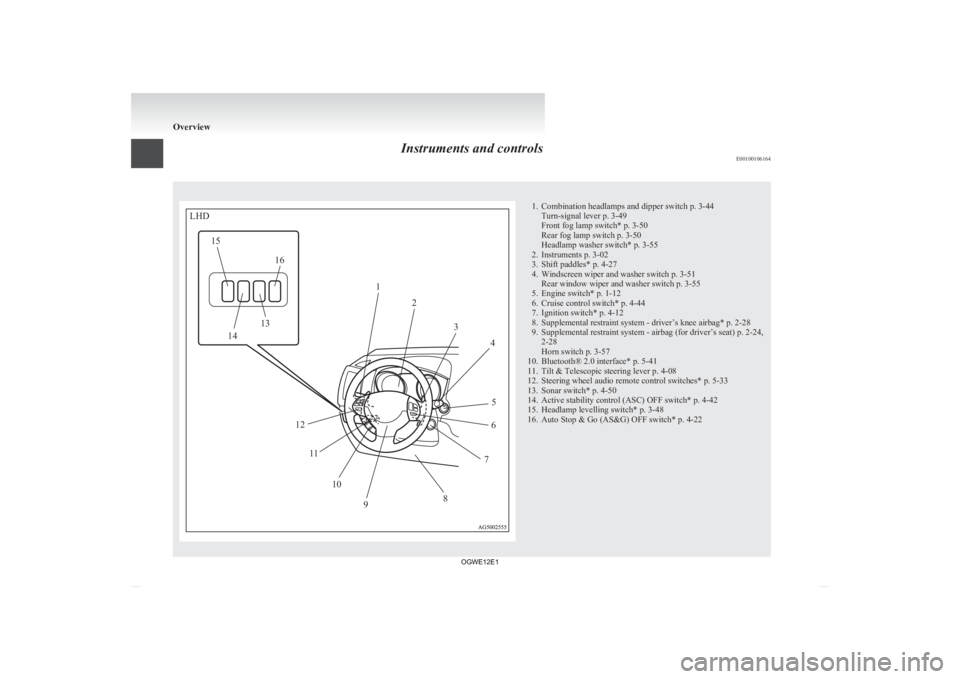
Instruments and controls
E00100106164 1. Combination headlamps and dipper switch p. 3-44
Turn-signal lever p. 3-49
Front fog lamp switch* p. 3-50
Rear fog lamp switch p. 3-50
Headlamp washer switch* p. 3-55
2.
Instruments p. 3-02
3. Shift paddles* p. 4-27
4. Windscreen wiper and washer switch p. 3-51 Rear window wiper and washer switch p. 3-55
5. Engine switch* p. 1-12
6. Cruise control switch* p. 4-44
7. Ignition switch* p. 4-12
8. Supplemental restraint system - driver’s knee airbag* p. 2-28
9. Supplemental restraint system - airbag (for driver’s seat) p. 2-24, 2-28
Horn switch p. 3-57
10. Bluetooth® 2.0 interface* p. 5-41
11. Tilt & Telescopic steering lever p. 4-08
12. Steering wheel audio remote control switches* p. 5-33
13. Sonar switch* p. 4-50
14. Active stability control (ASC) OFF switch* p. 4-42
15. Headlamp levelling switch* p. 3-48
16. Auto Stop & Go (AS&G) OFF switch* p. 4-22 OverviewLHD12
34
5
6
7
8
9
10
11
12
13
14
15
16
OGWE12E1
Page 5 of 378
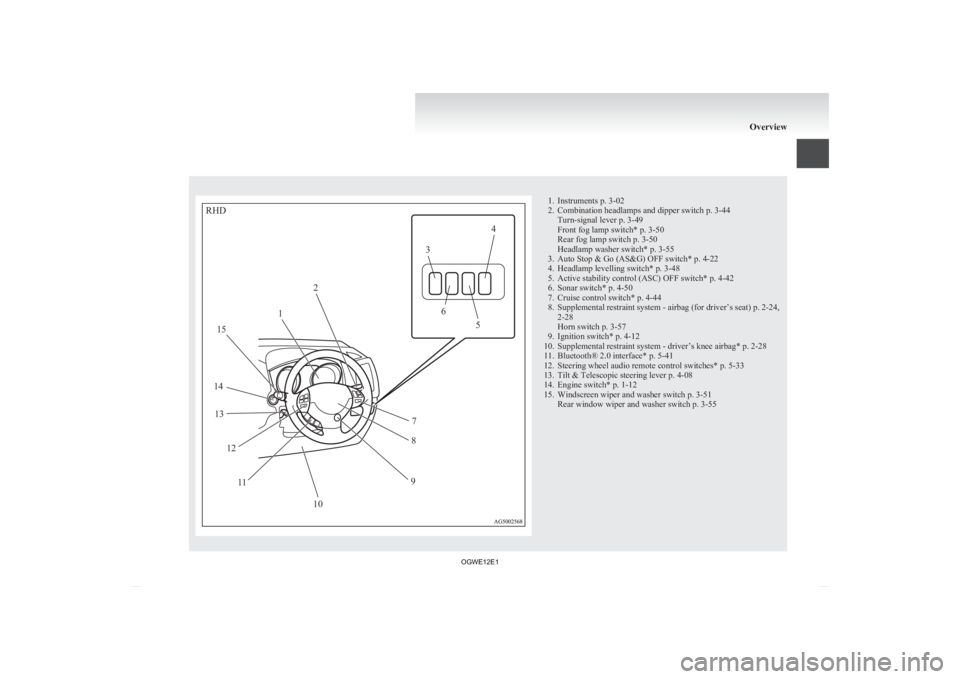
1. Instruments p. 3-02
2.
Combination headlamps and dipper switch p. 3-44Turn-signal lever p. 3-49
Front fog lamp switch* p. 3-50
Rear fog lamp switch p. 3-50
Headlamp washer switch* p. 3-55
3. Auto Stop & Go (AS&G) OFF switch* p. 4-22
4. Headlamp levelling switch* p. 3-48
5. Active stability control (ASC) OFF switch* p. 4-42
6. Sonar switch* p. 4-50
7. Cruise control switch* p. 4-44
8. Supplemental restraint system - airbag (for driver’s seat) p. 2-24, 2-28
Horn switch p. 3-57
9. Ignition switch* p. 4-12
10. Supplemental restraint system - driver’s knee airbag* p. 2-28
11. Bluetooth® 2.0 interface* p. 5-41
12. Steering wheel audio remote control switches* p. 5-33
13. Tilt & Telescopic steering lever p. 4-08
14. Engine switch* p. 1-12
15. Windscreen wiper and washer switch p. 3-51 Rear window wiper and washer switch p. 3-55 OverviewRHD12 3
4
5
6
7
8
9
10
11
12
13
14 15
OGWE12E1
Page 6 of 378
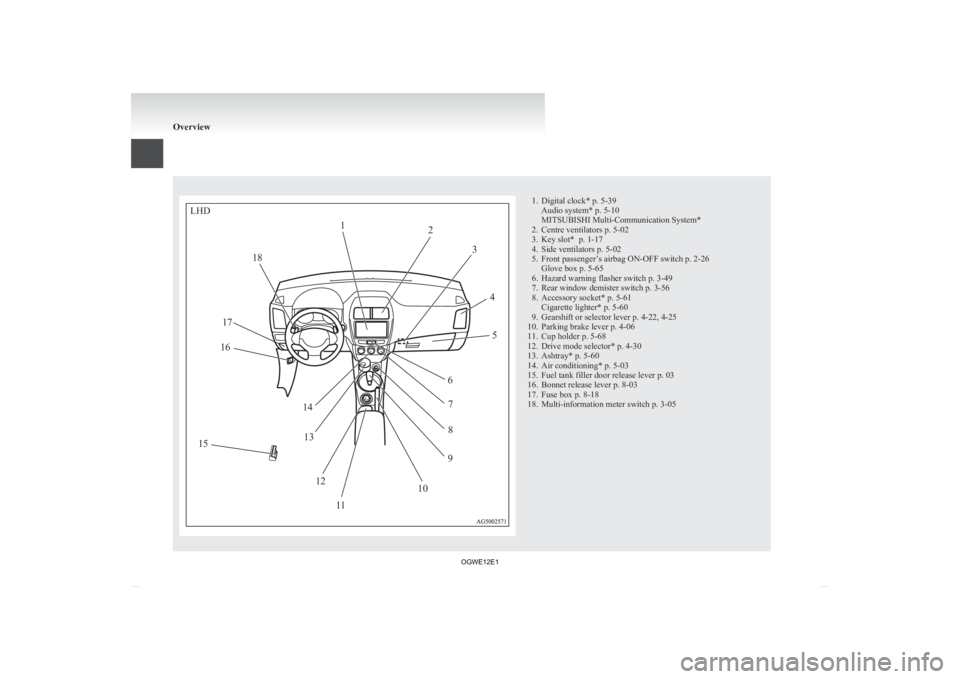
1. Digital clock* p. 5-39
Audio system* p. 5-10
MITSUBISHI Multi-Communication System*
2.
Centre ventilators p. 5-02
3. Key slot* p. 1-17
4. Side ventilators p. 5-02
5. Front passenger’s airbag ON-OFF switch p. 2-26 Glove box p. 5-65
6. Hazard warning flasher switch p. 3-49
7. Rear window demister switch p. 3-56
8. Accessory socket* p. 5-61 Cigarette lighter* p. 5-60
9. Gearshift or selector lever p. 4-22, 4-25
10. Parking brake lever p. 4-06
11. Cup holder p. 5-68
12. Drive mode selector* p. 4-30
13. Ashtray* p. 5-60
14. Air conditioning* p. 5-03
15. Fuel tank filler door release lever p. 03
16. Bonnet release lever p. 8-03
17. Fuse box p. 8-18
18. Multi-information meter switch p. 3-05 OverviewLHD12
3
45
6 7
8
9
10
11
12
13
14
15 16
17 18
OGWE12E1
Page 7 of 378
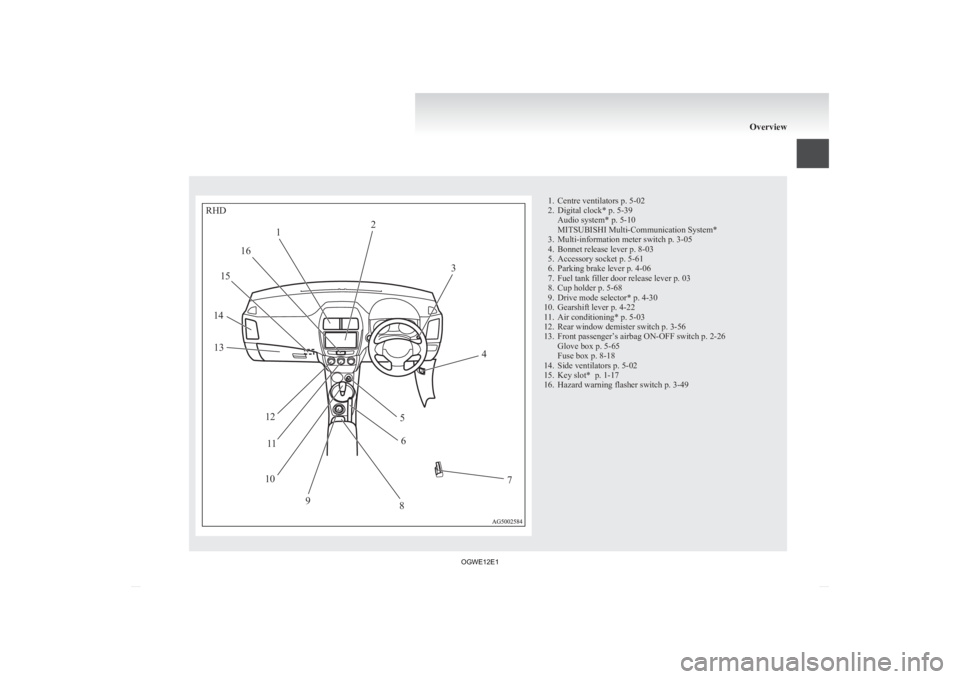
1. Centre ventilators p. 5-02
2.
Digital clock* p. 5-39Audio system* p. 5-10
MITSUBISHI Multi-Communication System*
3. Multi-information meter switch p. 3-05
4. Bonnet release lever p. 8-03
5. Accessory socket p. 5-61
6. Parking brake lever p. 4-06
7. Fuel tank filler door release lever p. 03
8. Cup holder p. 5-68
9. Drive mode selector* p. 4-30
10. Gearshift lever p. 4-22
11. Air conditioning* p. 5-03
12. Rear window demister switch p. 3-56
13. Front passenger’s airbag ON-OFF switch p. 2-26 Glove box p. 5-65
Fuse box p. 8-18
14. Side ventilators p. 5-02
15. Key slot* p. 1-17
16. Hazard warning flasher switch p. 3-49 OverviewRHD1 2
3
4
5 6
7
8
9
10 11
12
13
14 15
16
OGWE12E1
Page 77 of 378
Force limiter system
E00406000209
In
the event of a collision, each force limiter sys-
tem will effectively absorb the load applied to the
seat belt to minimize the impact to the passenger. Child restraint
E00406401806
When
transporting children in your vehicle, some
type of child restraint system should always be
used according to the size of the child. This is re-
quired by law in most countries.
The regulations concerning driving with children in
the front seat may differ from country to country.
You are advised to comply with the relevant regula-
tions. WARNING
l When
possible, put children in the rear
seat. Accident statistics indicate that chil-
dren of all sizes and ages are safer when
properly restrained in the rear seat rath-
er than in the front seat.
l Holding a child in your arms is no substi-
tute for a restraint system. Failure to use
a proper restraint system can result in se-
vere or fatal injury to the child.
l Each child restraint device or fixing is to
be used only by one child.
l When attaching a child restraint to the
rear seat, place the front seatbacks in the
upright position.
Otherwise, the child could be seriously in-
jured in the event of hard braking or a col-
lision. Caution for installing the child re-
straint on vehicles with a front passen-
ger airbag
The
label shown here is attached on vehicles with a
front passenger airbag. WARNING
l Extreme Hazard!
Do
not use a rearward facing child re-
straint on a seat protected by an airbag in
front of it!
NOTE l The
labels may be in different positions de-
pending on the vehicle model.
Use rearward facing child restraints in the
rear seat or turn off the front passenger’s air-
bag ON-OFF switch (if so equipped). (Refer
to “To turn an airbag off” on page 2-27.) Seat and seat belts
2-15 2
OGWE12E1
Page 78 of 378
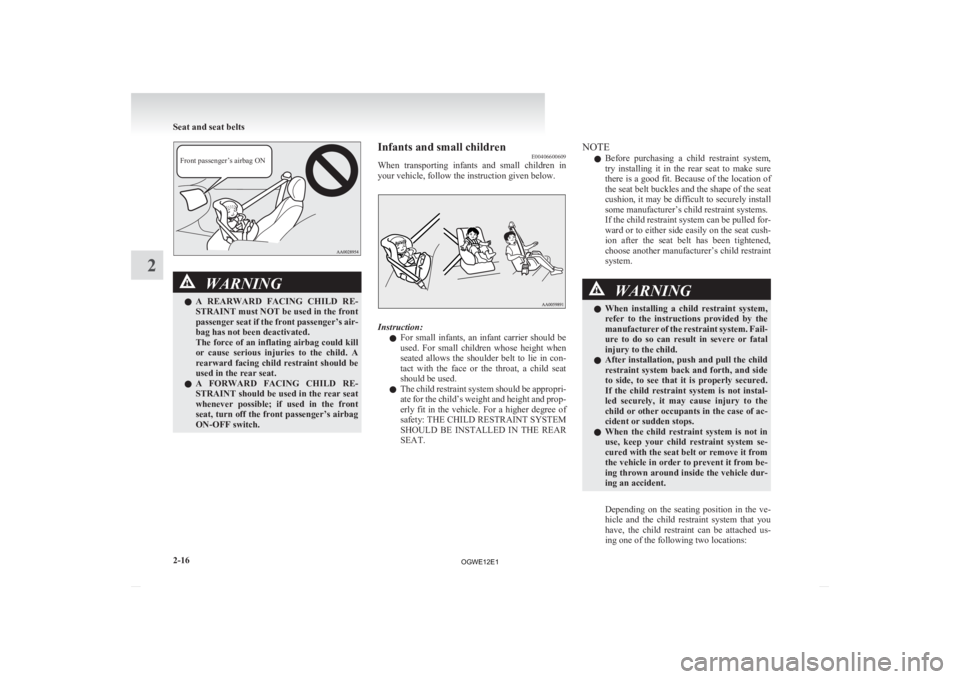
Front passenger’s airbag ONWARNING
l A
REARWARD FACING CHILD RE-
STRAINT must NOT be used in the front
passenger seat if the front passenger’s air-
bag has not been deactivated.
The force of an inflating airbag could kill
or cause serious injuries to the child. A
rearward facing child restraint should be
used in the rear seat.
l A FORWARD FACING CHILD RE-
STRAINT should be used in the rear seat
whenever possible; if used in the front
seat, turn off the front passenger’s airbag
ON-OFF switch. Infants and small children
E00406600609
When
transporting infants and small children in
your vehicle, follow the instruction given below. Instruction:
l For
small infants, an infant carrier should be
used. For small children whose height when
seated allows the shoulder belt to lie in con-
tact with the face or the throat, a child seat
should be used.
l The child restraint system should be appropri-
ate for the child’s weight and height and prop-
erly fit in the vehicle. For a higher degree of
safety: THE CHILD RESTRAINT SYSTEM
SHOULD BE INSTALLED IN THE REAR
SEAT. NOTE
l Before
purchasing a child restraint system,
try installing it in the rear seat to make sure
there is a good fit. Because of the location of
the seat belt buckles and the shape of the seat
cushion, it may be difficult to securely install
some manufacturer’s child restraint systems.
If the child restraint system can be pulled for-
ward or to either side easily on the seat cush-
ion after the seat belt has been tightened,
choose another manufacturer’s child restraint
system. WARNING
l When
installing a child restraint system,
refer to the instructions provided by the
manufacturer of the restraint system. Fail-
ure to do so can result in severe or fatal
injury to the child.
l After installation, push and pull the child
restraint system back and forth, and side
to side, to see that it is properly secured.
If the child restraint system is not instal-
led securely, it may cause injury to the
child or other occupants in the case of ac-
cident or sudden stops.
l When the child restraint system is not in
use, keep your child restraint system se-
cured with the seat belt or remove it from
the vehicle in order to prevent it from be-
ing thrown around inside the vehicle dur-
ing an accident.
Depending on the seating position in the ve-
hicle
and the child restraint system that you
have, the child restraint can be attached us-
ing one of the following two locations: Seat and seat belts
2-16
2
OGWE12E1
Page 82 of 378
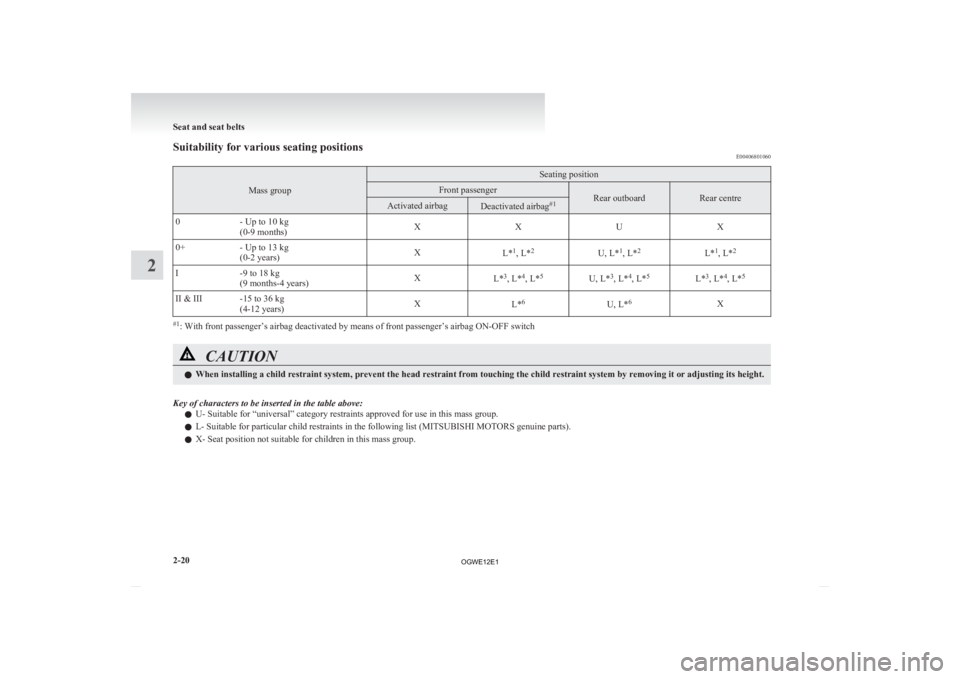
Suitability for various seating positions
E00406801060Mass group Seating position
Front passenger
Rear outboard Rear centre
Activated airbag
Deactivated airbag
#1
0 - Up to 10 kg
(0-9 months) X
XUX
0+ - Up to 13 kg
(0-2 years) X
L*1
, L* 2
U, L*1
, L* 2
L*1
, L* 2
I -9 to 18 kg
(9 months-4 years) X
L*3
, L* 4
, L* 5
U, L*3
, L* 4
, L* 5
L*3
, L* 4
, L* 5
II & III -15 to 36 kg (4-12 years) X
L*6
U, L*6
X#1
: With front passenger’s airbag deactivated by means of front passenger’s airbag ON-OFF switch CAUTION
l
When installing a child restraint system, prevent the head restraint from touching the child restraint system by removing it or adjusting its height.
Key of characters to be inserted in the table above: l U- Suitable for “universal” category restraints approved for use in this mass group.
l L- Suitable for particular child restraints in the following list (
MITSUBISHI MOTORS genuine parts).
l X- Seat position not suitable for children in this mass group. Seat and seat belts
2-20
2
OGWE12E1
Page 86 of 378
Seat belt inspection
E00406300475
l Check
the belts for cuts, worn or frayed web-
bing and for cracked or deformed metallic
parts. Replace the belt assembly if it is defec-
tive.
l A dirty belt should be cleaned with neutral de-
tergent in warm water. After rinsing in water,
let it dry in the shade. Do not attempt to
bleach or re-dye the belts because this will af-
fect their characteristics. WARNING
l We
recommend you to have all seat belt
assemblies including retractors and at-
taching hardware inspected after any col-
lision. We recommend that seat belt as-
semblies in use during a collision be re-
placed unless the collision was minor and
the belts show no damage and continue to
operate properly.
l Do not attempt to repair or replace any
part of the seat belt assemblies; we recom-
mend you to have this work done by a
MITSUBISHI MOTORS Authorized
Service Point. Incorrect repair or replace-
ment could reduce the effectiveness of the
belts and could result in serious injury in
the event of a collision.
l Once the pretensioner has been activated,
it cannot be re-used.
It must be replaced together with the re-
tractor. Supplemental restraint system
(SRS) - airbag E00407201944
The
information for SRS airbags includes impor-
tant information concerning the driver’s and front
passenger’s airbags, the driver’s knee airbag, the
side airbags and the curtain airbags.
The SRS airbags are designed to supplement the pri-
mary protection of the driver and front passenger
side seat belt systems by providing those occupants
with protection against head and chest injuries in
certain moderate-to-severe frontal collisions.
The SRS driver’s knee airbag (if so equipped) is de-
signed to supplement the primary protection of the
driver’s seat belt system. It can reduce the forward
movement of the driver’s lower legs and provide in-
creased overall body protection in certain moderate-
to-severe frontal collisions.
The SRS side airbags (if so equipped) are designed
to supplement properly worn seat belts and provide
the driver and front passenger with protection
against chest and abdomen injuries in certain mod-
erate-to-severe side impact collisions.
The SRS curtain airbags (if so equipped) are de-
signed to supplement properly worn seat belts and
provide the driver and passenger with protection
against head injuries in certain moderate-to-severe
side impact collisions.
The SRS is NOT a substitute for the seat belts. To
ensure the maximum protection during all types of
collisions and accidents, all occupants, including
the passengers as well as the driver, must wear
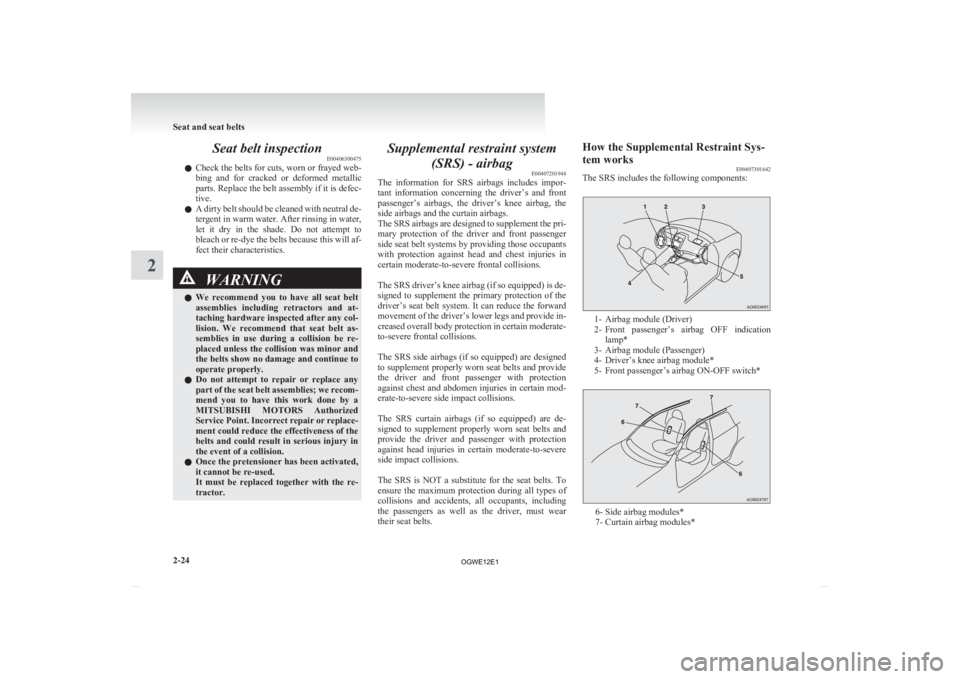
their seat belts. How the Supplemental Restraint Sys-
tem works
E00407301642
The SRS includes the following components: 1- Airbag module (Driver)
2- Front
passenger’s airbag OFF indication
lamp*
3- Airbag module (Passenger)
4- Driver’s knee airbag module*
5- Front passenger’s airbag ON-OFF switch* 6- Side airbag modules*
7- Curtain airbag modules*Seat and seat belts
2-24
2
OGWE12E1
Page 88 of 378
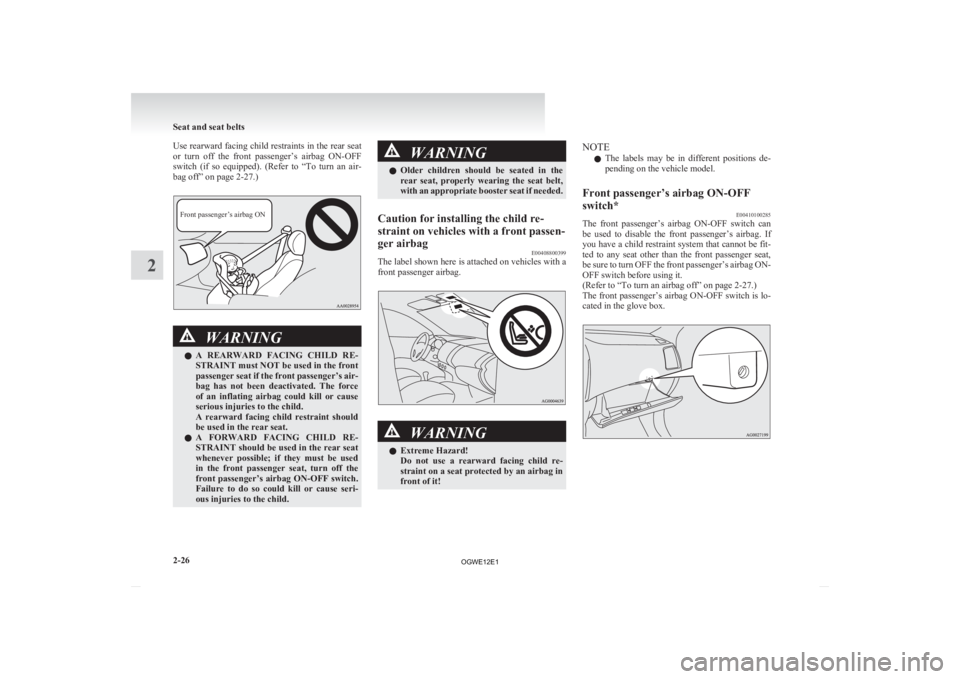
Use rearward facing child restraints in the rear seat
or
turn off the front passenger’s airbag ON-OFF
switch (if so equipped). (Refer to “To turn an air-
bag off” on page 2-27.)
Front passenger’s airbag ON WARNING
l A
REARWARD FACING CHILD RE-
STRAINT must NOT be used in the front
passenger seat if the front passenger’s air-
bag has not been deactivated. The force
of an inflating airbag could kill or cause
serious injuries to the child.
A rearward facing child restraint should
be used in the rear seat.
l A FORWARD FACING CHILD RE-
STRAINT should be used in the rear seat
whenever possible; if they must be used
in the front passenger seat, turn off the
front passenger’s airbag ON-OFF switch.
Failure to do so could kill or cause seri-
ous injuries to the child. WARNING
l Older
children should be seated in the
rear seat, properly wearing the seat belt,
with an appropriate booster seat if needed.
Caution for installing the child re-
straint on vehicles with a front passen-
ger airbag E00408800399
The label shown here is attached on vehicles with a
front passenger airbag. WARNING
l Extreme Hazard!
Do
not use a rearward facing child re-
straint on a seat protected by an airbag in
front of it! NOTE
l The
labels may be in different positions de-
pending on the vehicle model.
Front passenger’s airbag ON-OFF
switch* E00410100285
The front passenger’s airbag ON-OFF switch can
be
used to disable the front passenger’s airbag. If
you have a child restraint system that cannot be fit-
ted to any seat other than the front passenger seat,
be sure to turn OFF the front passenger’s airbag ON-
OFF switch before using it.
(Refer to “To turn an airbag off” on page 2-27.)
The front passenger’s airbag ON-OFF switch is lo-
cated in the glove box. Seat and seat belts
2-26
2
OGWE12E1
Page 89 of 378
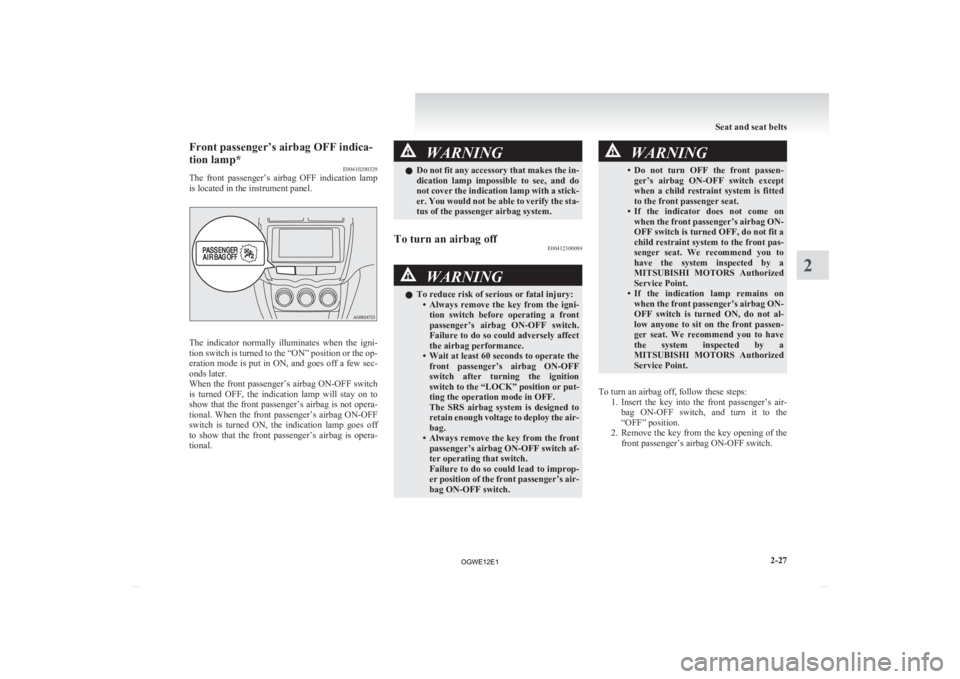
Front passenger’s airbag OFF indica-
tion lamp*
E00410200329
The
front passenger’s airbag OFF indication lamp
is located in the instrument panel. The indicator normally illuminates when the igni-
tion
switch is turned to the “ON” position or the op-
eration mode is put in ON, and goes off a few sec-
onds later.
When the front passenger’s airbag ON-OFF switch
is turned OFF, the indication lamp will stay on to
show that the front passenger’s airbag is not opera-
tional. When the front passenger’s airbag ON-OFF
switch is turned ON, the indication lamp goes off
to show that the front passenger’s airbag is opera-
tional. WARNING
l Do
not fit any accessory that makes the in-
dication lamp impossible to see, and do
not cover the indication lamp with a stick-
er. You would not be able to verify the sta-
tus of the passenger airbag system.
To turn an airbag off E00412300089 WARNING
l To reduce risk of serious or fatal injury:
• Always
remove the key from the igni-
tion switch before operating a front
passenger’s airbag ON-OFF switch.
Failure to do so could adversely affect
the airbag performance.
• Wait at least 60 seconds to operate the front passenger’s airbag ON-OFF
switch after turning the ignition
switch to the “LOCK” position or put-
ting the operation mode in OFF.
The SRS airbag system is designed to
retain enough voltage to deploy the air-
bag.
• Always remove the key from the front passenger’s airbag ON-OFF switch af-
ter operating that switch.
Failure to do so could lead to improp-
er position of the front passenger’s air-
bag ON-OFF switch. WARNING
• Do
not turn OFF the front passen- ger’s airbag ON-OFF switch except
when a child restraint system is fitted
to the front passenger seat.
• If the indicator does not come on when the front passenger’s airbag ON-
OFF switch is turned OFF, do not fit a
child restraint system to the front pas-
senger seat. We recommend you to
have the system inspected by a
MITSUBISHI MOTORS Authorized
Service Point.
• If the indication lamp remains on when the front passenger’s airbag ON-
OFF switch is turned ON, do not al-
low anyone to sit on the front passen-
ger seat. We recommend you to have
the system inspected by a
MITSUBISHI MOTORS Authorized
Service Point.
To turn an airbag off, follow these steps: 1. Insert
the key into the front passenger’s air-
bag ON-OFF switch, and turn it to the
“OFF” position.
2. Remove the key from the key opening of the front passenger’s airbag ON-OFF switch. Seat and seat belts
2-27 2
OGWE12E1