ac drain MITSUBISHI ASX 2014 Owner's Manual (in English)
[x] Cancel search | Manufacturer: MITSUBISHI, Model Year: 2014, Model line: ASX, Model: MITSUBISHI ASX 2014Pages: 418, PDF Size: 14.02 MB
Page 22 of 418
Protect the environment
It is illegal to pollute drains, water coursesand soil. Use authorized waste collection fa-cilities, including civic amenity sites and ga- rages providing facilities for disposal of used
oil and used oil filters. If in doubt, contact your local authority for advice on disposal.
Disposal information for
used batteries E00201300032Your vehicle contains batter-
ies and/or accumulators.
Do not mix with general household waste.
For proper treatment, recov-
ery and recycling of used bat-
teries, please take them to ap- plicable collection points, in accordance with your nation-
al legislation and the Direc- tives 2006/66/EC.
By disposing of these batter- ies correctly, you will help to
save valuable resources and
prevent any potential nega-
tive effects on human health and the environment which could otherwise arise frominappropriate waste handling.Auto Stop & Go (AS&G)
system* E00201500021This paragraph summarizes the major itemsof the Auto Stop & Go (AS&G) system
such as the characteristics, operating proce- dures, etc. For details, refer to “Auto Stop &
Go (AS&G) system” on page 6-18.
The Auto Stop & Go (AS&G) system re- duces the emission of exhaust gases and in- creases fuel efficiency.
The Auto Stop & Go (AS&G) system auto- matically stops and restarts the engine with-
out the use of the ignition switch or the en- gine switch when the vehicle is stopped, such
as at traffic lights or in a traffic jam.
Activation
E00201600051
The Auto Stop & Go (AS&G) system is auto- matically activated when the ignition switch is turned to the “ON” position or the opera-
tion mode is put in ON.
Deactivation
E00201700065
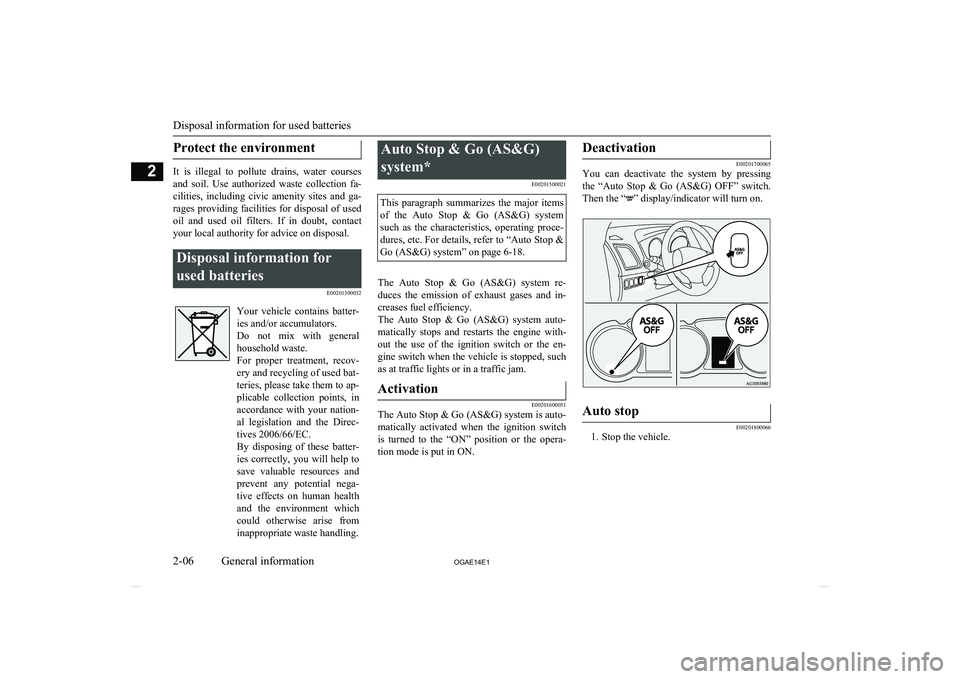
You can deactivate the system by pressing
the “Auto Stop & Go (AS&G) OFF” switch.
Then the “
” display/indicator will turn on.
Auto stop
E00201800066
1. Stop the vehicle.
Disposal information for used batteries
2-06 OGAE14E1General information2
Page 208 of 418
lCarefully wash the vehicle with water.
Drive the vehicle slowly while lightly depressing the brake pedal in order to
dry out the brakes. If the brakes still do not function properly, we recommend
you to have the brakes checked as soon as possible.
l Remove the insects, dried grass, etc.
clogging the radiator core.
l After driving through water, check the
engine, transmission and differential oil. If the oil or grease is milky or cloudy be-
cause of water contamination, it must be
replaced with new oil or grease.
l Check the inside of the vehicle. If water
entry is found, dry the carpet etc.
l Inspect the headlamps, If the headlamp
bulb is flooded with water, we recom-
mend you to have it drained.Cautions on handling of 4-
wheel drive vehicles E00606800818
Tyres and wheels
Since the driving torque can be applied to the
4 wheels, the driving performance of the ve- hicle when operating in 4-wheel drive is
greatly affected by the condition of the tyres.
Pay close attention to the tyres.
l Install only the specified tyres on all
wheels. Refer to “Tyres and wheels” on page 11-12.
l Be sure all 4 tyres and wheels are the
same size and type.
When it is necessary to replace any of
the tyres or wheels, replace all 4 tyres.
l All tyres should be rotated before the
wear difference between the front and
rear tyres is recognizable.
Good vehicle performance cannot be expec- ted if there is a difference in wear between tyres. Refer to “Tyre rotation” on page 10-14.
l Check the tyre inflation pressure regular-
ly.CAUTIONl Always use tyres of the same size, same
type, and same brand, and which have no wear differences. Using tyres of differentsize, type, brands or degree of wear, will in-
crease the differential oil temperature, result-
ing in possible damage to the driving sys-
tem. Further, the drive train will be subjec- ted to excessive loading possibly leading tooil leakage, component seizure, or other seri-
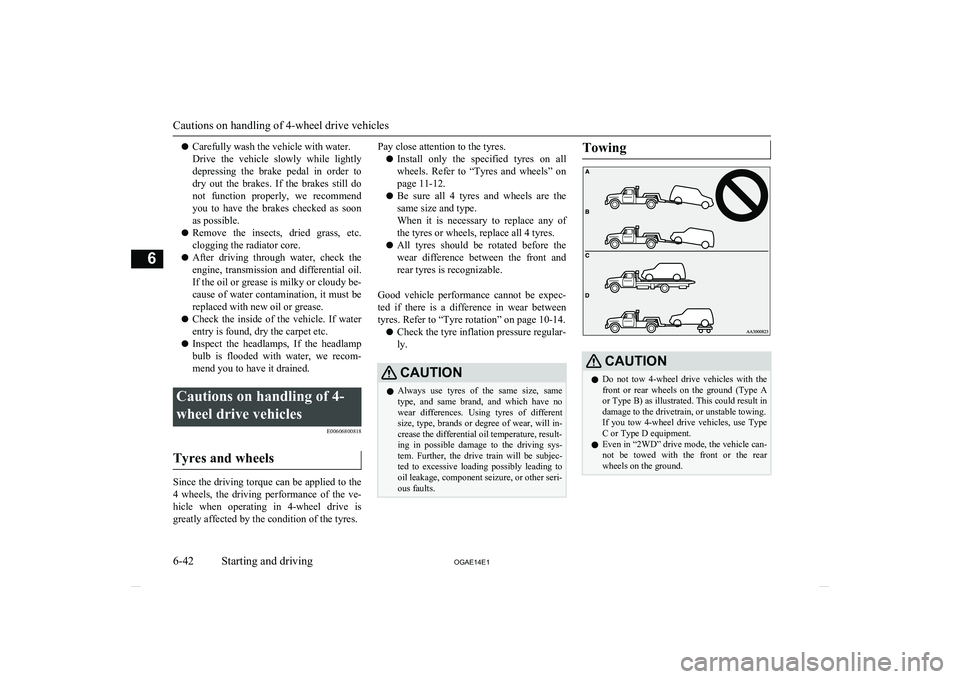
ous faults.TowingCAUTIONl Do not tow 4-wheel drive vehicles with the
front or rear wheels on the ground (Type Aor Type B) as illustrated. This could result in
damage to the drivetrain, or unstable towing.
If you tow 4-wheel drive vehicles, use Type C or Type D equipment.
l Even in “2WD” drive mode, the vehicle can-
not be towed with the front or the rear wheels on the ground.
Cautions on handling of 4-wheel drive vehicles
6-42 OGAE14E1Starting and driving6
Page 245 of 418
Introduction of outside air(Heater/Manual air condition- ing)
E00702200408
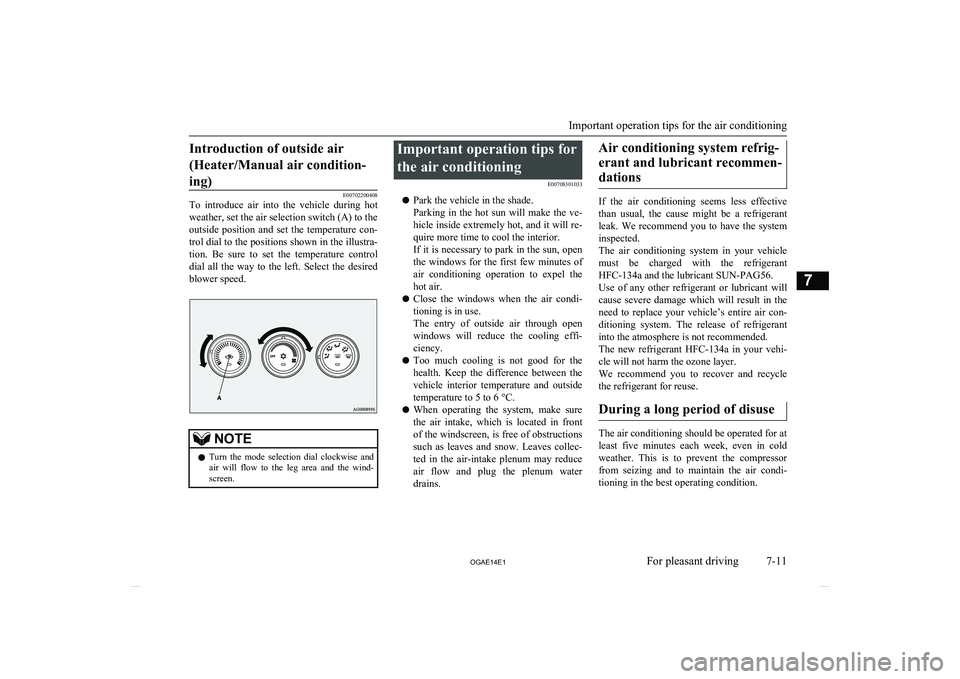
To introduce air into the vehicle during hot
weather, set the air selection switch (A) to the
outside position and set the temperature con-
trol dial to the positions shown in the illustra- tion. Be sure to set the temperature control dial all the way to the left. Select the desiredblower speed.
NOTEl Turn the mode selection dial clockwise and
air will flow to the leg area and the wind-
screen.Important operation tips for
the air conditioning E00708301033
l Park the vehicle in the shade.
Parking in the hot sun will make the ve-
hicle inside extremely hot, and it will re-
quire more time to cool the interior.
If it is necessary to park in the sun, open the windows for the first few minutes of
air conditioning operation to expel the
hot air.
l Close the windows when the air condi-
tioning is in use.
The entry of outside air through open
windows will reduce the cooling effi- ciency.
l Too much cooling is not good for the
health. Keep the difference between the
vehicle interior temperature and outside
temperature to 5 to 6 °C.
l When operating the system, make sure
the air intake, which is located in front
of the windscreen, is free of obstructions such as leaves and snow. Leaves collec- ted in the air-intake plenum may reduce
air flow and plug the plenum water
drains.Air conditioning system refrig-
erant and lubricant recommen- dations
If the air conditioning seems less effective than usual, the cause might be a refrigerant
leak. We recommend you to have the system inspected.
The air conditioning system in your vehicle must be charged with the refrigerant
HFC-134a and the lubricant SUN-PAG56.
Use of any other refrigerant or lubricant will
cause severe damage which will result in the need to replace your vehicle’s entire air con-
ditioning system. The release of refrigerant into the atmosphere is not recommended.
The new refrigerant HFC-134a in your vehi-
cle will not harm the ozone layer.
We recommend you to recover and recycle the refrigerant for reuse.
During a long period of disuse
The air conditioning should be operated for at
least five minutes each week, even in cold
weather. This is to prevent the compressor from seizing and to maintain the air condi-
tioning in the best operating condition.
Important operation tips for the air conditioning
7-11
OGAE14E1For pleasant driving7