height MITSUBISHI COLT 2009 10.G User Guide
[x] Cancel search | Manufacturer: MITSUBISHI, Model Year: 2009, Model line: COLT, Model: MITSUBISHI COLT 2009 10.GPages: 273, PDF Size: 17.28 MB
Page 54 of 273
Downloaded from www.Manualslib.com manuals search engine Instruction:l For small infants, an infant carrier should be
used. For small children whose height when
seated allows the shoulder belt to lie in con-
tact with the face or the throat, a child seat
should be used.
l The child restraint system should be appropri-
ate for the child’s weight and height and prop-
erly fit in the vehicle. For a higher degree of
safety: THE CHILD RESTRAINT SYSTEM
SHOULD BE INSTALLED IN THE REAR
SEAT.
l Before purchasing a child restraint system,
try installing it in the rear seat to make sure
there is a good fit. Because of the location of
the seat belt buckles and the shape of the seat
cushion, it may be difficult to securely install
some manufacturer’s child restraint systems.
If the child restraint system can be pulled for-
ward or to either side easily on the seat cush-
ion after the seat belt has been tightened,
choose another manufacturer’s child restraint
system.WARNINGl When installing a child restraint system,
refer to the instructions provided by the
manufacturer of the restraint system. Fail-
ure to do so can result in severe or fatal
injury to your child.
l After installation, push and pull the child
restraint system back and forth, and side
to side, to see that it is positively secured.
If the child restraint system is not instal-
led securely, it may cause injury to the
child or other occupants in the case of ac-
cident or sudden stops.WARNINGl When the child restraint system is not in
use, keep your child or infant seat se-
cured with the seat belt or remove it from
the vehicle in order to prevent injury to
your child.
NOTE
l Depending on the seating position in the ve-
hicle and the child restraint system that you
have, the child restraint can be attached us-
ing one of the following two locations: •To the lower anchorage in the rear seat
ONLY if the child restraint has ISOFIX
mountings (See page 2-20).
• To the seat belt (See page 2-21).
Older children E00406700248
Children who have outgrown the child restraint sys-
tem should be seated in the rear seat and wear com-
bination lap shoulder belt.
The lap portion of the belt should be snug and posi-
tioned low on the abdomen so that it is below the
top of the hip-bone. Otherwise, the belt could in-
trude into the child’s abdomen during an accident
and cause injury.
CAUTIONl Children who are not buckled up can be
thrown out of the vehicle in an accident.
l Children who are not buckled up can
strike other people in the vehicle in an ac-
cident.CAUTIONl A child should never be left unattended
in your vehicle. When you leave the vehi-
cle, take the child with you.
Seat and seat belts
2-15
2
Page 104 of 273
Downloaded from www.Manualslib.com manuals search engine Economical driving.......................................................................4-02
Driving, alcohol and drugs ........................................................... 4-02
Safe driving techniques ................................................................ 4-03
Running-in recommendations.......................................................4-04
Parking brake ................................................................................ 4-06
Parking .......................................................................................... 4-07
Steering wheel height adjustment .................................................4-07
Inside rear-view mirror ................................................................. 4-08
Outside rear-view mirrors ............................................................. 4-08
Ignition switch .............................................................................. 4-10
Steering wheel lock ...................................................................... 4-11
Starting..........................................................................................4-11
Auto Stop & Go (AS&G) system* ...............................................4-13
Manual transmission ..................................................................... 4-16
Automated manual transmission ..................................................4-19
How to drive a vehicle with an automated manual trans- mission......................................................................................4-22
Braking ......................................................................................... 4-25
Emergency stop signal system ...................................................... 4-26
Brake assist system ....................................................................... 4-27
Anti-lock brake system (ABS) ..................................................... 4-27
Electric power steering system ..................................................... 4-29
Traction control system (TCL)/Active stability control system (ASC)* ......................................................................... 4-30
Cruise control* ............................................................................. 4-32
Cargo loads ................................................................................... 4-36
Trailer towing ............................................................................... 4-36Starting and driving4
Page 106 of 273
Downloaded from www.Manualslib.com manuals search engine Safe driving techniquesE00600300390
Driving safety and protection against injury cannot
be fully ensured. However, we recommend that
you pay extra attention to the following:
Seat belts
Before starting the vehicle, make sure that you and
your passengers have fastened your seat belts.
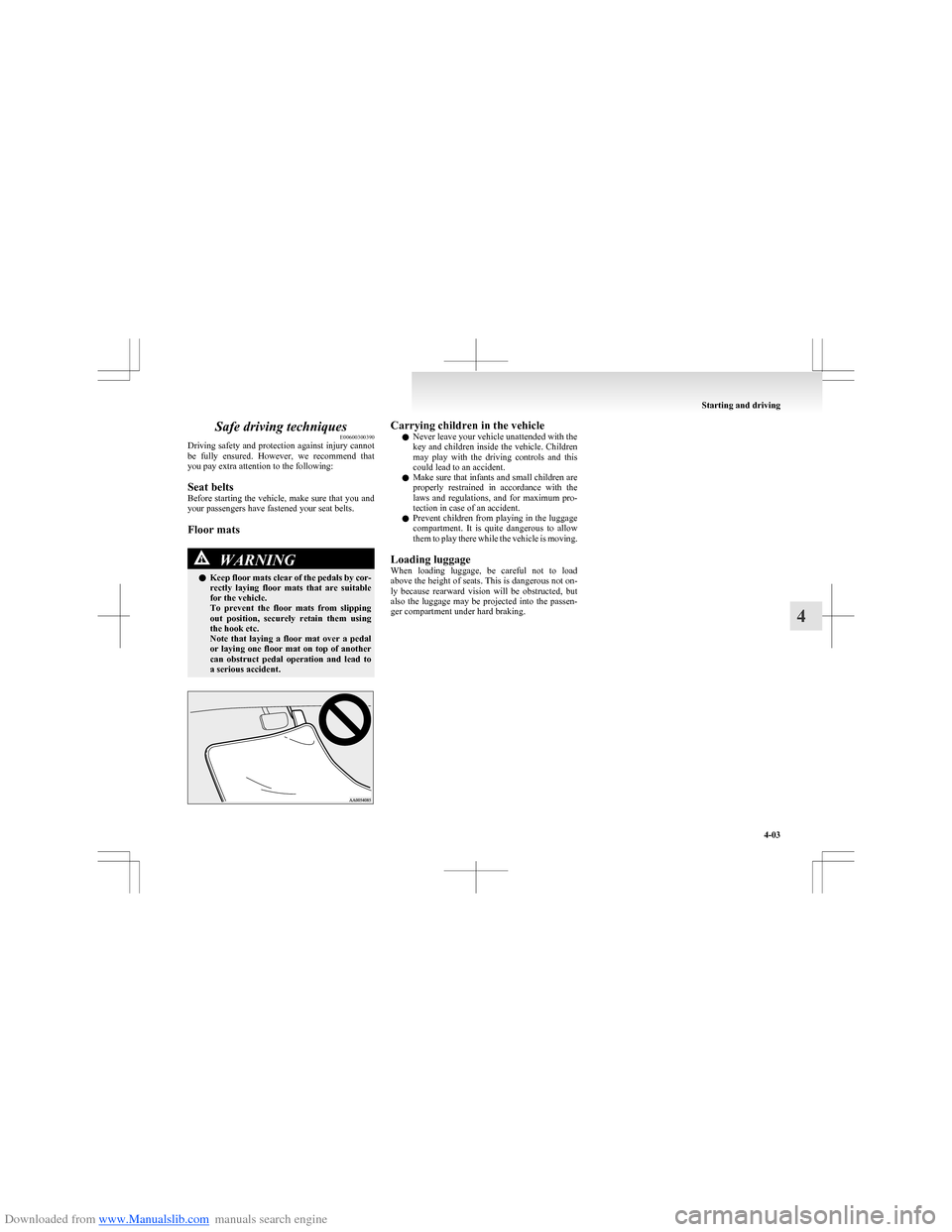
Floor matsWARNINGl Keep floor mats clear of the pedals by cor-
rectly laying floor mats that are suitable
for the vehicle.
To prevent the floor mats from slipping
out position, securely retain them using
the hook etc.
Note that laying a floor mat over a pedal
or laying one floor mat on top of another
can obstruct pedal operation and lead to
a serious accident.Carrying children in the vehicle
l Never leave your vehicle unattended with the
key and children inside the vehicle. Children
may play with the driving controls and this
could lead to an accident.
l Make sure that infants and small children are
properly restrained in accordance with the
laws and regulations, and for maximum pro-
tection in case of an accident.
l Prevent children from playing in the luggage
compartment. It is quite dangerous to allow
them to play there while the vehicle is moving.
Loading luggage
When loading luggage, be careful not to load
above the height of seats. This is dangerous not on-
ly because rearward vision will be obstructed, but
also the luggage may be projected into the passen-
ger compartment under hard braking.
Starting and driving
4-03
4
Page 110 of 273
Downloaded from www.Manualslib.com manuals search engine ParkingE00600601521
Parking on a hill
To prevent the vehicle from rolling, follow these
procedures:
Parking on a downhill slope
Turn the front wheels towards the kerb and move
the vehicle forward until the kerb side wheel gently
touches the kerb.
Apply the parking brake and place the gearshift lev-
er into the “R” (Reverse) position (with manual
transmission) or the allshift lever into the “R” (Re-
verse) position (with automated manual transmis-
sion).
If necessary, apply chocks to wheels.
Parking on an uphill slope
Turn the front wheels away from the kerb and
move the vehicle back until the kerb side wheel gen-
tly touches the kerb.
Apply the parking brake and place the gearshift lev-
er into the 1 st
position (with manual transmission)
or the allshift lever into the “S” (Stand by) position
(with automated manual transmission).
If necessary, apply chocks to wheels.
NOTE l If your vehicle has an automated manual trans-
mission, place the allshift lever in the “S”
(Stand by) position or “R” (Reverse) position
before stopping the engine.
If you move the allshift lever after stopping
the engine, a gearshift will not take place.Parking with the engine running
Never leave the engine running while you take a
short sleep/rest. Also, never leave the engine run-
ning in a closed or poorly ventilated place.WARNINGl Leaving the engine running risks injury
or death from accidentally moving the
gearshift lever (manual transmission) or
the allshift lever (automated manual trans-
mission) or the accumulation of toxic ex-
haust fumes on the passenger compart-
ment.
Where you park
Your front bumper can be damaged if you scrape it
over kerbs or parking stop blocks. Be careful when
travelling up or down steep slopes where your bump-
er can scrape the road.
WARNINGl Do not park your vehicle in areas where
combustible materials such as dry grass
or leaves can come in contact with a hot
exhaust, since a fire could occur.
When leaving the vehicle
Always remove the key from the ignition switch
and lock all doors and the tailgate when leaving the
vehicle unattended.
Always try to park your vehicle in a well lit area.
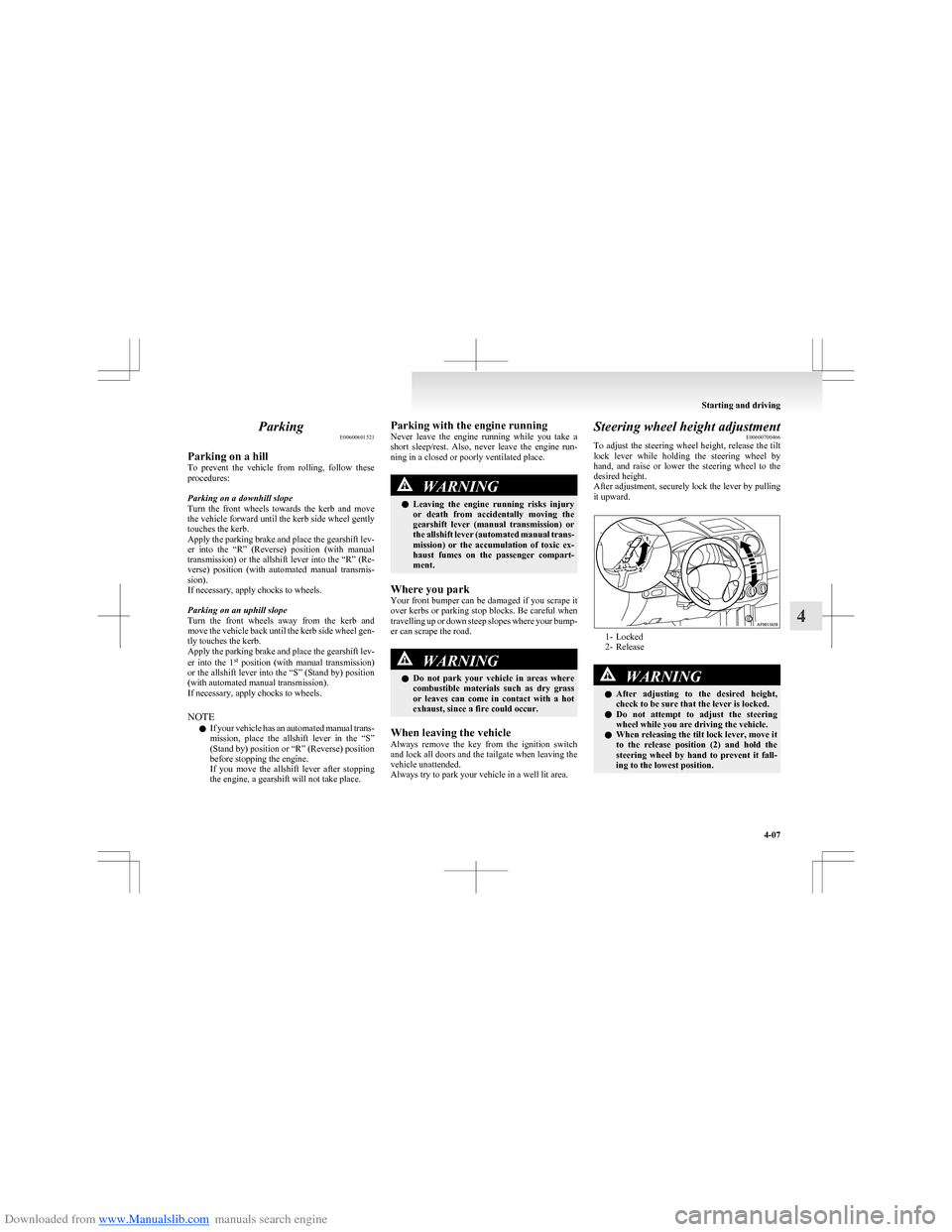
Steering wheel height adjustment E00600700466
To adjust the steering wheel height, release the tilt
lock lever while holding the steering wheel by
hand, and raise or lower the steering wheel to the
desired height.
After adjustment, securely lock the lever by pulling
it upward.
1- Locked
2- Release
WARNINGl After adjusting to the desired height,
check to be sure that the lever is locked.
l Do not attempt to adjust the steering
wheel while you are driving the vehicle.
l When releasing the tilt lock lever, move it
to the release position (2) and hold the
steering wheel by hand to prevent it fall-
ing to the lowest position.
Starting and driving
4-07
4
Page 130 of 273
Downloaded from www.Manualslib.com manuals search engine Brake assist systemE00627000262
The brake assist system is a device assisting drivers
who cannot depress the brake pedal firmly when it
is necessary to do so (such as in emergency stop sit-
uations) and provides greater braking force.
If the brake pedal is depressed suddenly, the brakes
will be applied with more force than usual.CAUTIONl The brake assist system is not a device de-
signed to exercise braking force greater
than its capacity. Make sure to always
keep a sufficient distance between vehi-
cles in front of you without relying too
much on the brake assist system.
NOTE
l Once the brake assist system is operational,
it maintains great braking force even if the
brake pedal is lightly released.
To stop its operation, completely remove
your foot from the brake pedal.
l The brake assist system may become opera-
tional when the brake pedal is fully de-
pressed even if it has not been depressed sud-
denly.
l When the brake assist system is in use, you
may feel as if the depressed brake pedal is
soft, the pedal moves in small motions in con-
junction with the sound of the ABS opera-
tion, or the vehicle body and the steering
wheel vibrate. This occurs when the brake as-
sist system is operating normally and does
not indicate faulty operation. Continue to
firmly depress the brake pedal.
l You may hear an operation noise when the
brake pedal is depressed suddenly while sta-
tionary. This does not indicate a malfunction
and the brake assist system is operating nor-
mally.Anti-lock brake system (ABS) E00607100791
Environmental conditions can have an effect on
braking. During sudden braking when there is
snow, ice, oil, water etc. on the road surface, a skid
may occur. In this situation, steering control and
braking effectiveness is reduced and the stopping
distance is increased. The vehicle may also go into
an uncontrolled spin.
The ABS helps prevent the wheels from locking dur-
ing braking, thus maintaining directional stability,
ensuring controllability and providing optimum
braking force.
Driving hints l When using the anti-lock brake system (sud-
den braking), steering is slightly different
from normal driving conditions. Use the steer-
ing wheel carefully.
l Always maintain the same distance from the
vehicle in front of you as you would for a ve-
hicle not equipped with ABS.
Compared with vehicles not fitted with ABS,
your vehicle may require a longer stopping
distance in the following cases: • Driving on gravel or snow-covered roads.
• Driving with tyre chains installed.
• Driving on roads where the road surface
is pitted or has other differences in sur-
face height.
• Driving on bumpy roads or other poor driv-
ing surfaces.
Starting and driving
4-27
4
Page 181 of 273
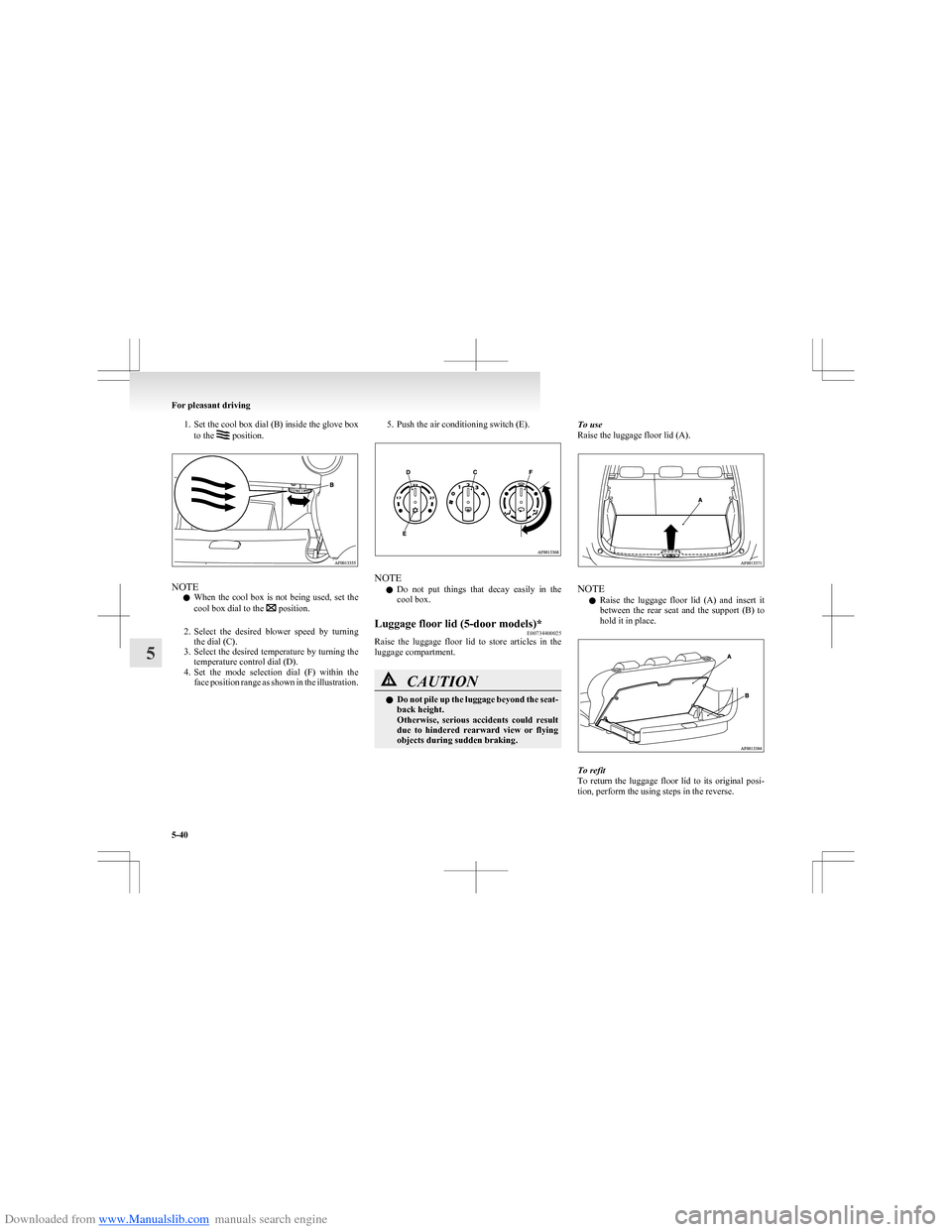
Downloaded from www.Manualslib.com manuals search engine 1.Set the cool box dial (B) inside the glove box
to the position.
NOTE
l When the cool box is not being used, set the
cool box dial to the
position.
2. Select the desired blower speed by turning
the dial (C).
3. Select the desired temperature by turning the
temperature control dial (D).
4. Set the mode selection dial (F) within the
face position range as shown in the illustration.
5. Push the air conditioning switch (E).
NOTE
l Do not put things that decay easily in the
cool box.
Luggage floor lid (5-door models)* E00734400025
Raise the luggage floor lid to store articles in the
luggage compartment.
CAUTIONl Do not pile up the luggage beyond the seat-
back height.
Otherwise, serious accidents could result
due to hindered rearward view or flying
objects during sudden braking.To use
Raise the luggage floor lid (A).
NOTE
l Raise the luggage floor lid (A) and insert it
between the rear seat and the support (B) to
hold it in place.
To refit
To return the luggage floor lid to its original posi-
tion, perform the using steps in the reverse.
For pleasant driving
5-40
5
Page 199 of 273
Downloaded from www.Manualslib.com manuals search engine CAUTIONlThe compact spare tyre should not be
used on any other wheels, nor should
standard tyres, snow tyres, wheel covers
or trim rings be used with the compact
spare wheel. If such use is attempted, dam-
age to these items or other vehicle compo-
nents may occur.
l Upon installation of the compact spare
tyre, the overall vehicle height is lowered
slightly as the tyre is smaller in diameter
than the standard tyre. When passing
over the projections on the road, take
care not to drive the vehicle with the
same feeling as used in driving with the
standard tyre on.
l Do not install more than one compact
spare wheel at the same time.
l When the tread wear indicators appear,
the tyre must be replaced.
Refer to “Wheel condition” on page 8-13.To remove
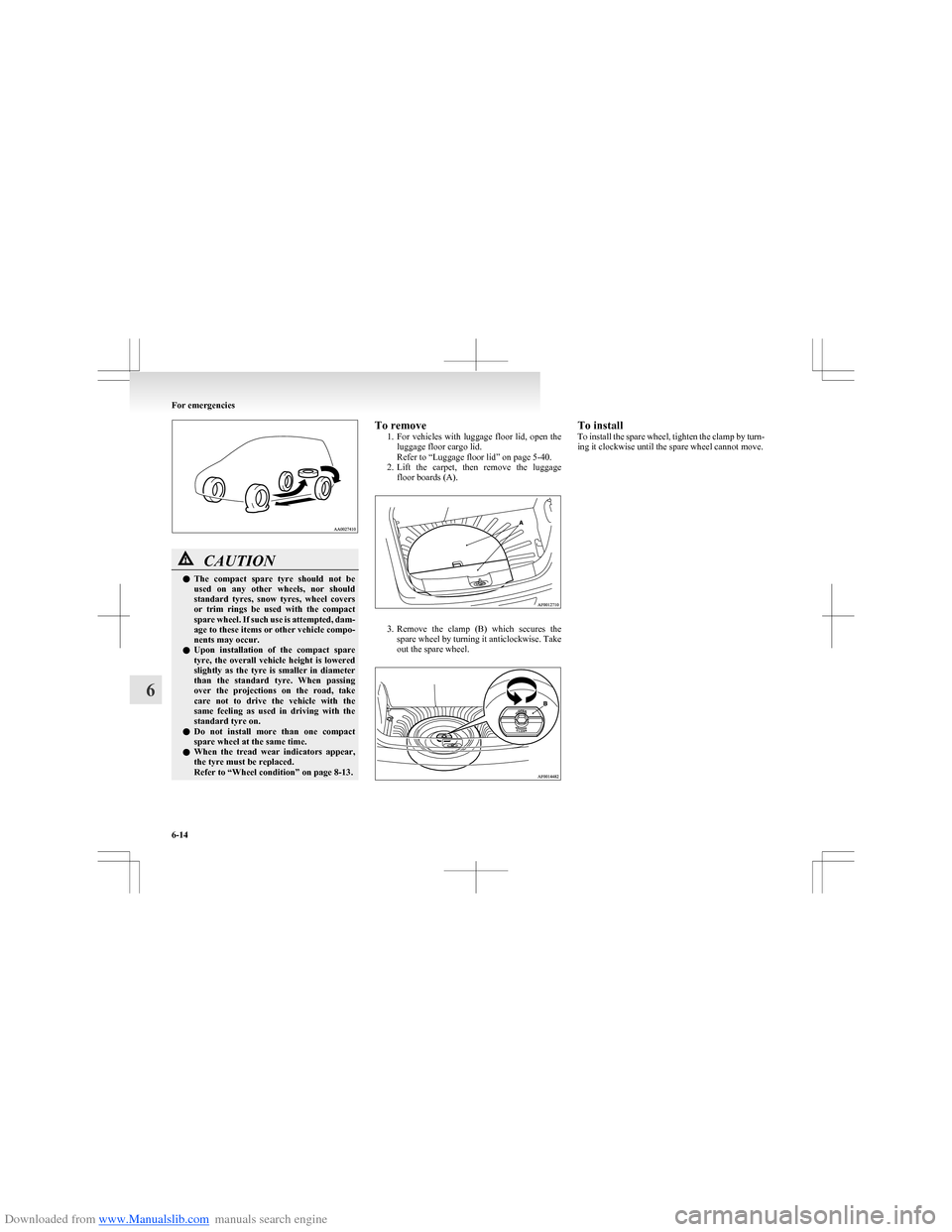
1.For vehicles with luggage floor lid, open the
luggage floor cargo lid.
Refer to “Luggage floor lid” on page 5-40.
2. Lift the carpet, then remove the luggage
floor boards (A).
3. Remove the clamp (B) which secures the
spare wheel by turning it anticlockwise. Take
out the spare wheel.
To install
To install the spare wheel, tighten the clamp by turn-
ing it clockwise until the spare wheel cannot move.
For emergencies
6-14
6
Page 227 of 273
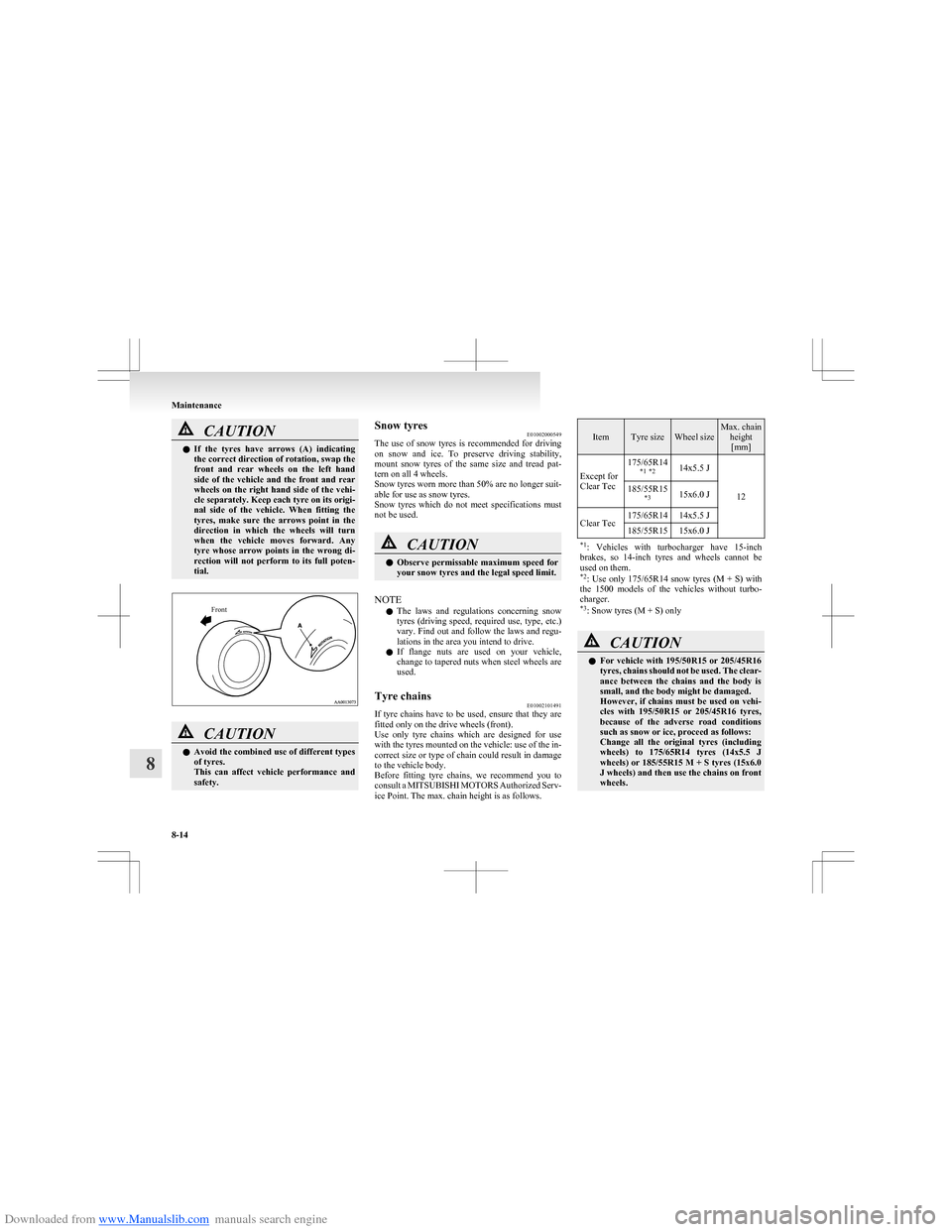
Downloaded from www.Manualslib.com manuals search engine CAUTIONlIf the tyres have arrows (A) indicating
the correct direction of rotation, swap the
front and rear wheels on the left hand
side of the vehicle and the front and rear
wheels on the right hand side of the vehi-
cle separately. Keep each tyre on its origi-
nal side of the vehicle. When fitting the
tyres, make sure the arrows point in the
direction in which the wheels will turn
when the vehicle moves forward. Any
tyre whose arrow points in the wrong di-
rection will not perform to its full poten-
tial.Front
CAUTIONl Avoid the combined use of different types
of tyres.
This can affect vehicle performance and
safety.Snow tyres E01002000549
The use of snow tyres is recommended for driving
on snow and ice. To preserve driving stability,
mount snow tyres of the same size and tread pat-
tern on all 4 wheels.
Snow tyres worn more than 50% are no longer suit-
able for use as snow tyres.
Snow tyres which do not meet specifications must
not be used.CAUTIONl Observe permissable maximum speed for
your snow tyres and the legal speed limit.
NOTE
l The laws and regulations concerning snow
tyres (driving speed, required use, type, etc.)
vary. Find out and follow the laws and regu-
lations in the area you intend to drive.
l If flange nuts are used on your vehicle,
change to tapered nuts when steel wheels are
used.
Tyre chains E01002101491
If tyre chains have to be used, ensure that they are
fitted only on the drive wheels (front).
Use only tyre chains which are designed for use
with the tyres mounted on the vehicle: use of the in-
correct size or type of chain could result in damage
to the vehicle body.
Before fitting tyre chains, we recommend you to
consult a MITSUBISHI MOTORS Authorized Serv-
ice Point. The max. chain height is as follows.
ItemTyre sizeWheel sizeMax. chain height[mm]
Except for
Clear Tec
175/65R14 *1 *214x5.5 J
12
185/55R15
*315x6.0 JClear Tec175/65R1414x5.5 J185/55R1515x6.0 J*1: Vehicles with turbocharger have 15-inch
brakes, so 14-inch tyres and wheels cannot be
used on them.
*2 : Use only 175/65R14 snow tyres (M + S) with
the 1500 models of the vehicles without turbo-
charger.
*3 : Snow tyres (M + S) onlyCAUTIONl For vehicle with 195/50R15 or 205/45R16
tyres, chains should not be used. The clear-
ance between the chains and the body is
small, and the body might be damaged.
However, if chains must be used on vehi-
cles with 195/50R15 or 205/45R16 tyres,
because of the adverse road conditions
such as snow or ice, proceed as follows:
Change all the original tyres (including
wheels) to 175/65R14 tyres (14x5.5 J
wheels) or 185/55R15 M + S tyres (15x6.0
J wheels) and then use the chains on front
wheels.
Maintenance
8-14
8
Page 249 of 273
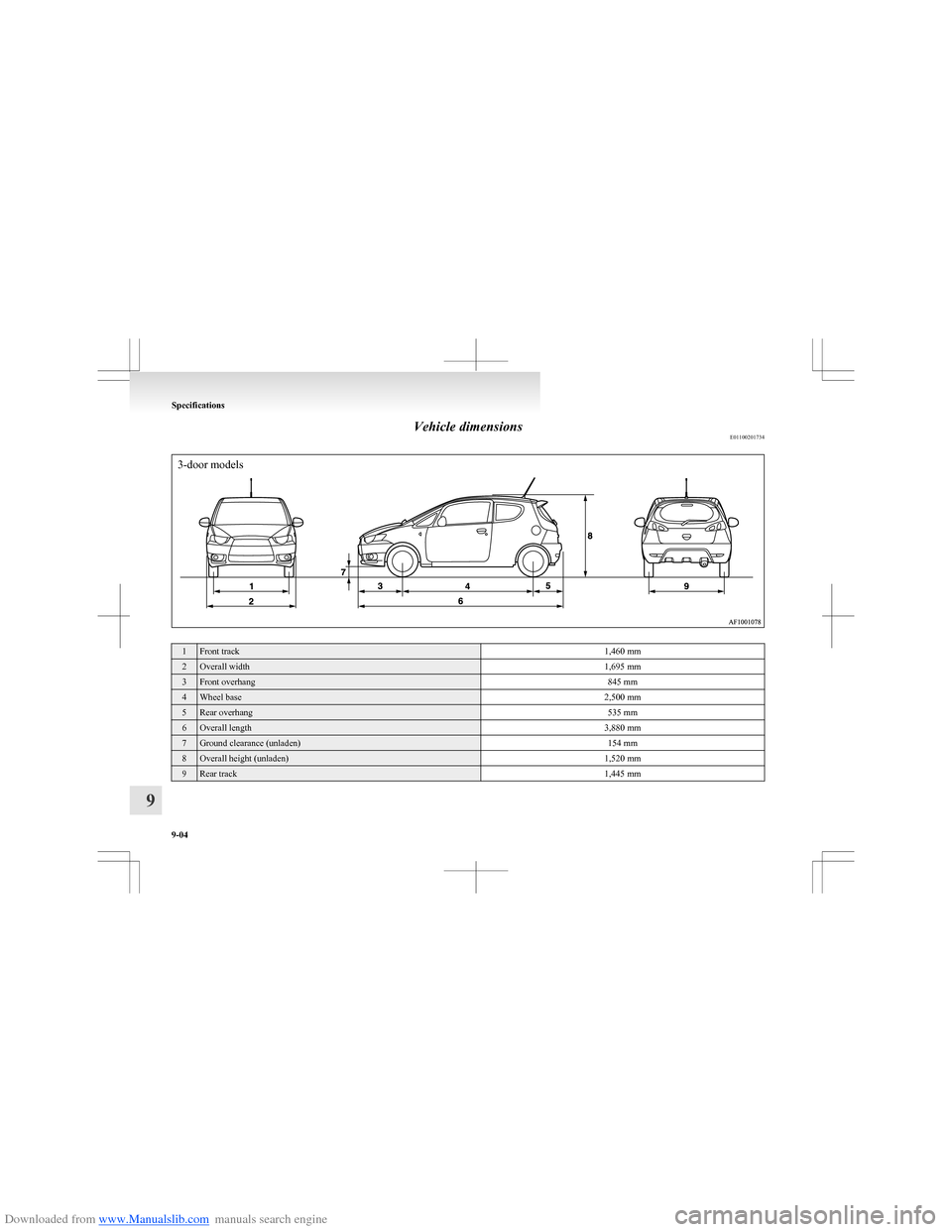
Downloaded from www.Manualslib.com manuals search engine Vehicle dimensionsE01100201734
3-door models1Front track1,460 mm2Overall width1,695 mm3Front overhang845 mm4Wheel base2,500 mm5Rear overhang535 mm6Overall length3,880 mm7Ground clearance (unladen)154 mm8Overall height (unladen)1,520 mm9Rear track1,445 mm
Specifications
9-04
9
Page 250 of 273
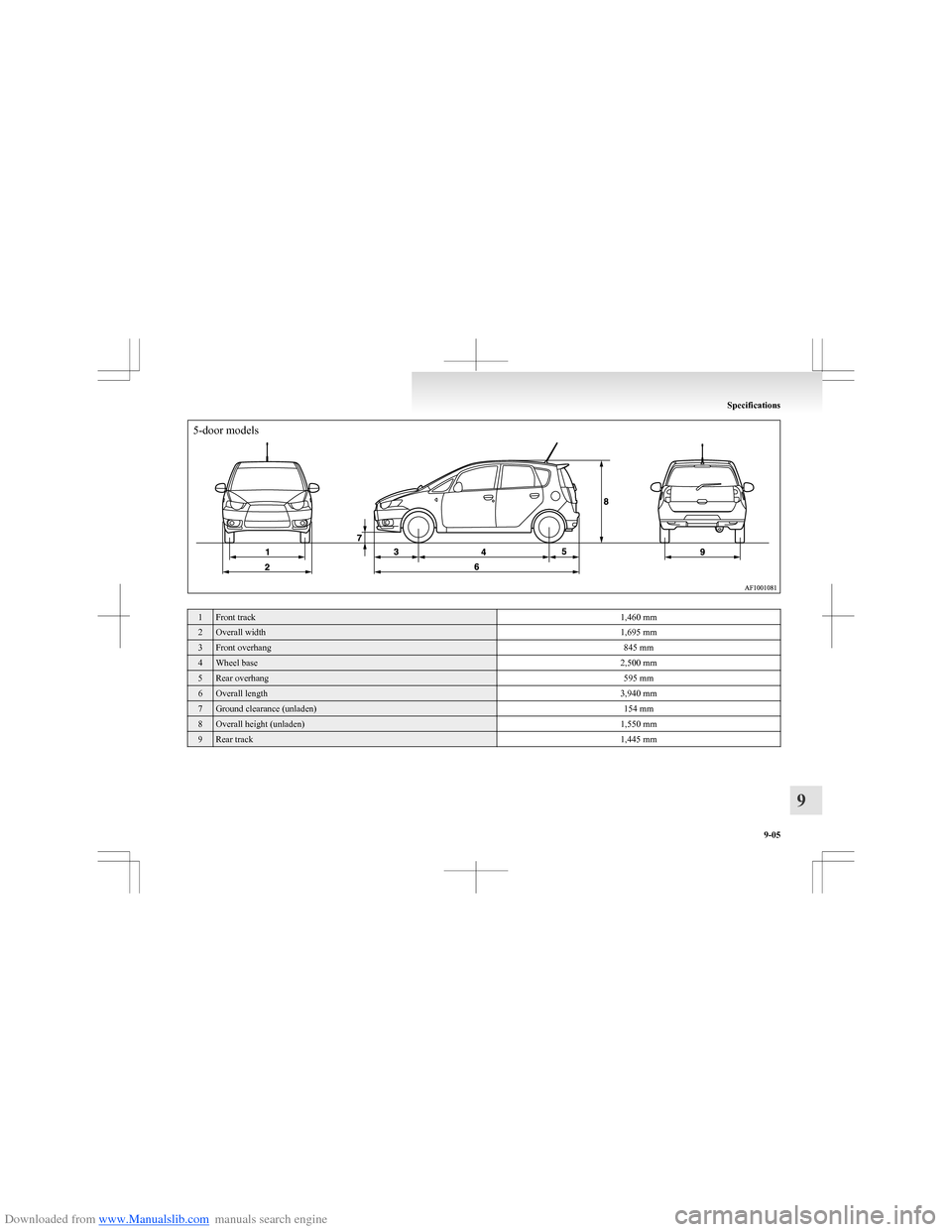
Downloaded from www.Manualslib.com manuals search engine 5-door models1Front track1,460 mm2Overall width1,695 mm3Front overhang845 mm4Wheel base2,500 mm5Rear overhang595 mm6Overall length3,940 mm7Ground clearance (unladen)154 mm8Overall height (unladen)1,550 mm9Rear track1,445 mm
Specifications
9-05
9