seats MITSUBISHI COLT 2009 10.G User Guide
[x] Cancel search | Manufacturer: MITSUBISHI, Model Year: 2009, Model line: COLT, Model: MITSUBISHI COLT 2009 10.GPages: 273, PDF Size: 17.28 MB
Page 46 of 273
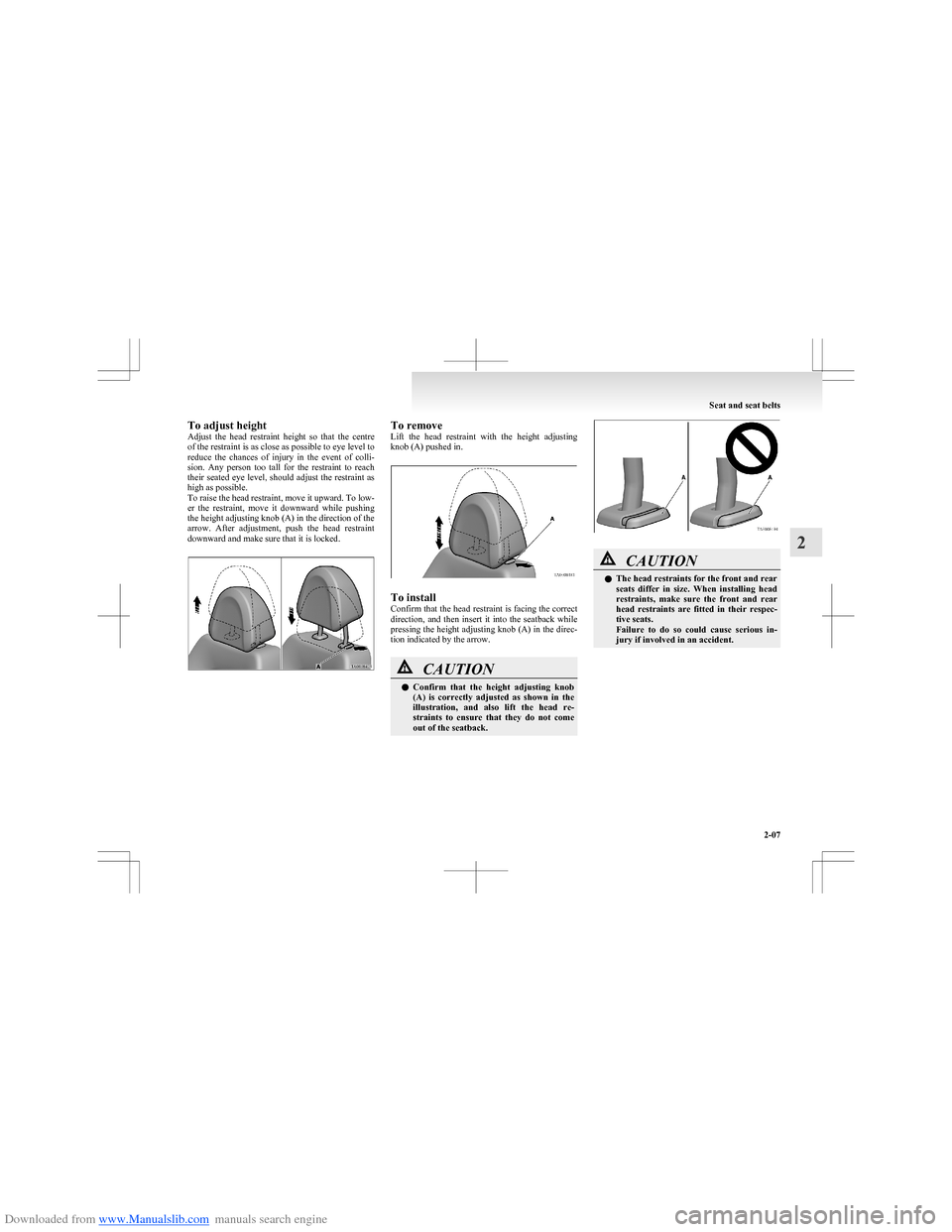
Downloaded from www.Manualslib.com manuals search engine To adjust height
Adjust the head restraint height so that the centre
of the restraint is as close as possible to eye level to
reduce the chances of injury in the event of colli-
sion. Any person too tall for the restraint to reach
their seated eye level, should adjust the restraint as
high as possible.
To raise the head restraint, move it upward. To low-
er the restraint, move it downward while pushing
the height adjusting knob (A) in the direction of the
arrow. After adjustment, push the head restraint
downward and make sure that it is locked.To remove
Lift the head restraint with the height adjusting
knob (A) pushed in.
To install
Confirm that the head restraint is facing the correct
direction, and then insert it into the seatback while
pressing the height adjusting knob (A) in the direc-
tion indicated by the arrow.
CAUTIONl Confirm that the height adjusting knob
(A) is correctly adjusted as shown in the
illustration, and also lift the head re-
straints to ensure that they do not come
out of the seatback.CAUTIONl The head restraints for the front and rear
seats differ in size. When installing head
restraints, make sure the front and rear
head restraints are fitted in their respec-
tive seats.
Failure to do so could cause serious in-
jury if involved in an accident.
Seat and seat belts
2-07
2
Page 50 of 273
Downloaded from www.Manualslib.com manuals search engine CAUTIONlThe seat belts must not be twisted when
worn.
3. Pull the belt slightly to adjust slackness as de-
sired.
To unfasten
Hold the latch plate and push the button on the buck-
le.
NOTE
l As the belt retracts automatically, keep hold-
ing the latch plate while retracting so that the
belt stows slowly. Failure to do this could
damage the vehicle.
Seat belt reminder/warning lamp E00409800497
A tone and warning lamp are used to remind the
driver and front passenger to fasten the seat belt.
NOTE
l For the front passenger seat, the warning func-
tion works only while a person is sitting on
the seat.
When the ignition key is turned to the “ON” posi-
tion, the warning lamp will come on and a tone
will sound for about 6 seconds. If the front seat belt
remains unfastened approximately 1 minute later,
the warning lamp will flash and the tone sound in-
termittently (each 12 times) when the vehicle is driv-
en. If the passenger subsequently unfastens the seat
belt while driving, the warning lamp and tone will
issue further warnings. And if the seat belt remains
unfastened, the warning lamp and tone will issue
further warnings each time the vehicle starts mov-
ing from a stop. When the seat belt is fastened, the
warnings will stop.
WARNINGl In order to reduce the risk of serious or fa-
tal injury in an accident, always wear
your own seat belt. Do not allow anyone
to ride in your vehicle unless he or she is
also seated and wearing a seat belt. Chil-
dren should additionally be restrained in
a secure child restraint system.
NOTE
l When luggage is placed on the front passen-
ger seat, a sensor in the seat cushion may, de-
pending on the weight and position of the lug-
gage, cause the warning tone to sound and
the warning lamp to come on.
Adjustable seat belt anchor (front
seats) E00405000055
The seat belt anchor height can be adjusted.
Move the seat belt anchor down with the lock knob
(A) depressed. To move the anchor up, slide it with-
out depressing the lock knob (A).
Anchor downAnchor up
Seat and seat belts
2-11
2
Page 59 of 273
Downloaded from www.Manualslib.com manuals search engine Installing a child restraint system to
the lower anchorage (ISOFIX child re-
straint mountings) and tether anchor-
age E00408900462
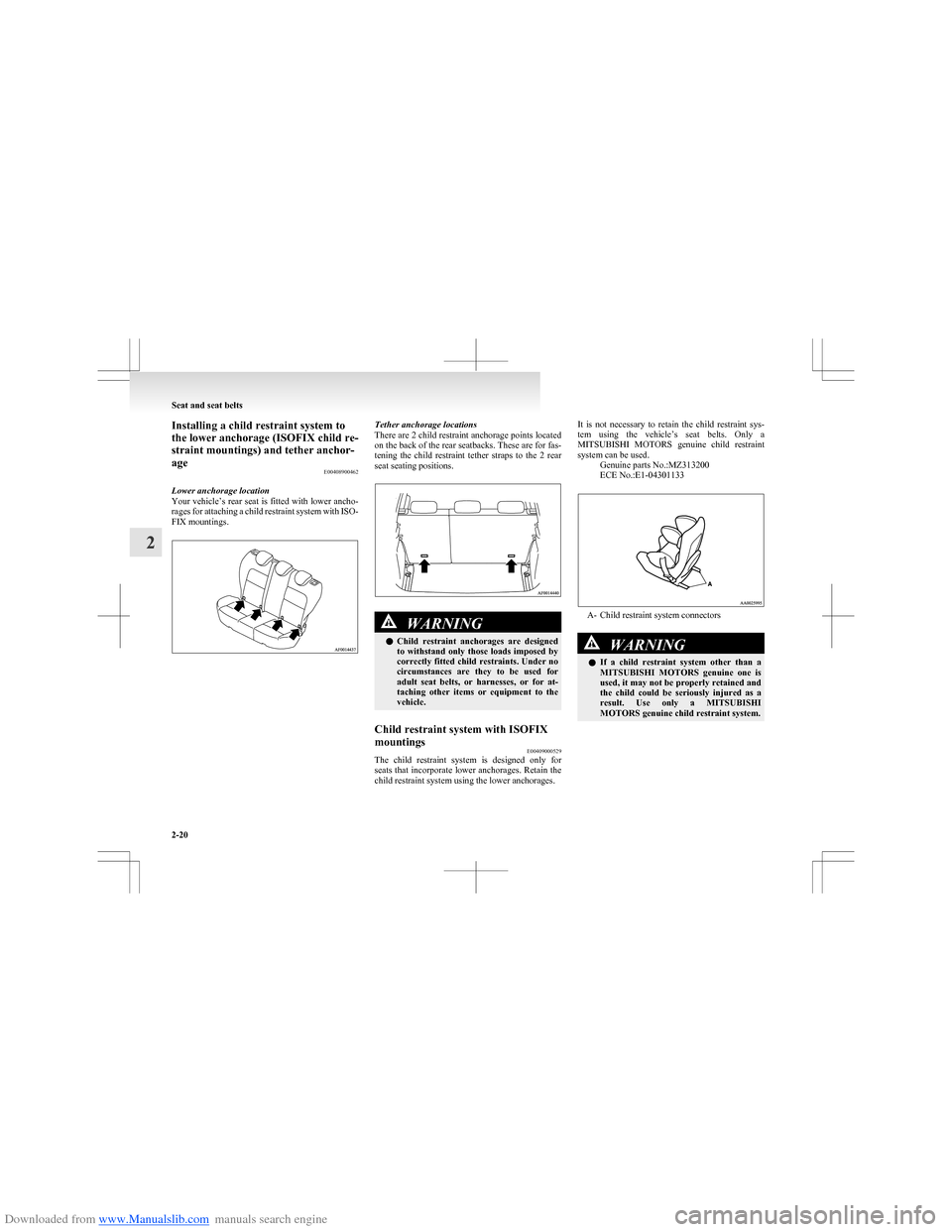
Lower anchorage location
Your vehicle’s rear seat is fitted with lower ancho-
rages for attaching a child restraint system with ISO-
FIX mountings.Tether anchorage locations
There are 2 child restraint anchorage points located
on the back of the rear seatbacks. These are for fas-
tening the child restraint tether straps to the 2 rear
seat seating positions.WARNINGl Child restraint anchorages are designed
to withstand only those loads imposed by
correctly fitted child restraints. Under no
circumstances are they to be used for
adult seat belts, or harnesses, or for at-
taching other items or equipment to the
vehicle.Child restraint system with ISOFIX
mountings E00409000529
The child restraint system is designed only for
seats that incorporate lower anchorages. Retain the
child restraint system using the lower anchorages.
It is not necessary to retain the child restraint sys-
tem using the vehicle’s seat belts. Only a
MITSUBISHI MOTORS genuine child restraint
system can be used. Genuine parts No.:MZ313200
ECE No.:E1-04301133
A- Child restraint system connectors
WARNINGl If a child restraint system other than a
MITSUBISHI MOTORS genuine one is
used, it may not be properly retained and
the child could be seriously injured as a
result. Use only a MITSUBISHI
MOTORS genuine child restraint system.
Seat and seat belts
2-20
2
Page 71 of 273
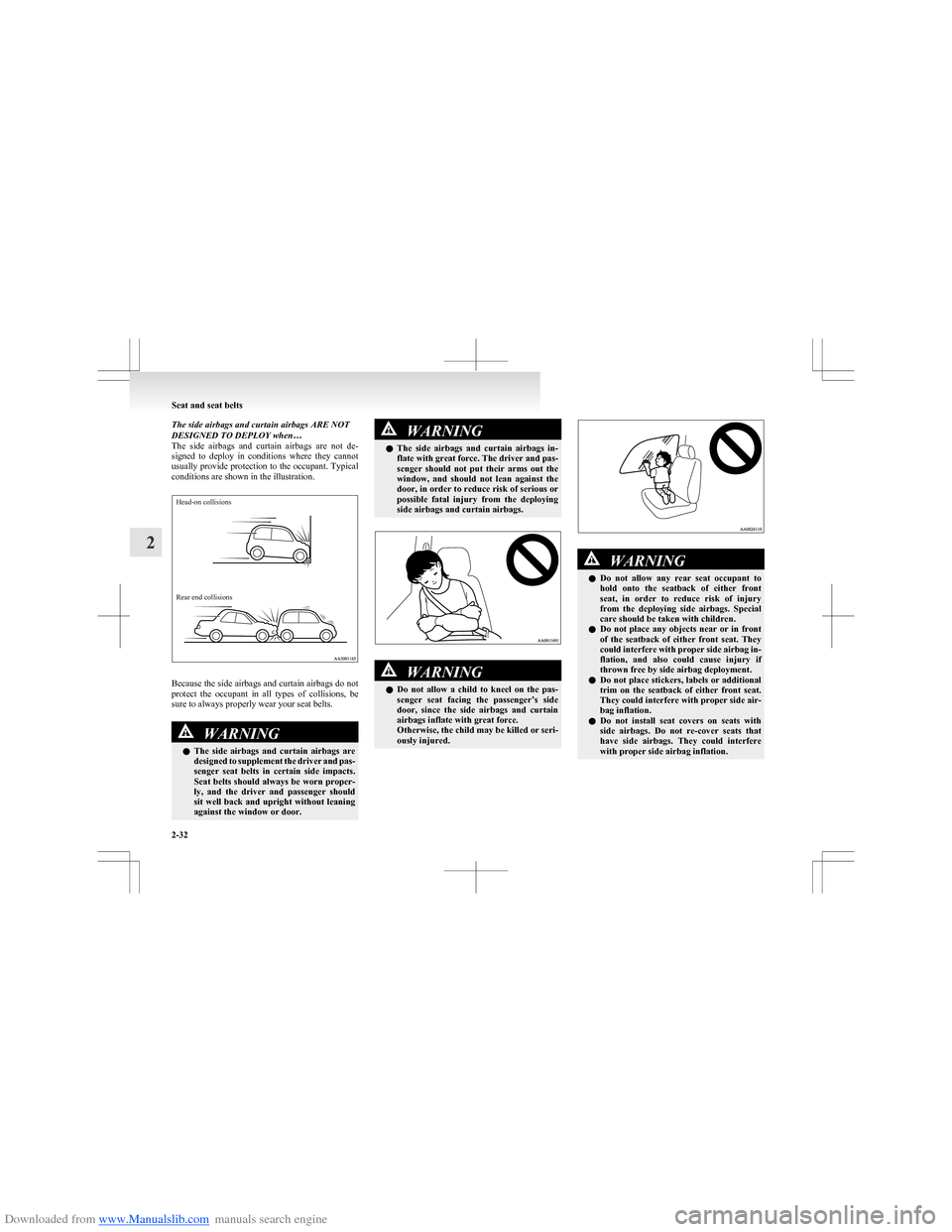
Downloaded from www.Manualslib.com manuals search engine The side airbags and curtain airbags ARE NOT
DESIGNED TO DEPLOY when…
The side airbags and curtain airbags are not de-
signed to deploy in conditions where they cannot
usually provide protection to the occupant. Typical
conditions are shown in the illustration.Head-on collisionsRear end collisions
Because the side airbags and curtain airbags do not
protect the occupant in all types of collisions, be
sure to always properly wear your seat belts.
WARNINGl The side airbags and curtain airbags are
designed to supplement the driver and pas-
senger seat belts in certain side impacts.
Seat belts should always be worn proper-
ly, and the driver and passenger should
sit well back and upright without leaning
against the window or door.WARNINGl The side airbags and curtain airbags in-
flate with great force. The driver and pas-
senger should not put their arms out the
window, and should not lean against the
door, in order to reduce risk of serious or
possible fatal injury from the deploying
side airbags and curtain airbags.WARNINGl Do not allow a child to kneel on the pas-
senger seat facing the passenger’s side
door, since the side airbags and curtain
airbags inflate with great force.
Otherwise, the child may be killed or seri-
ously injured.WARNINGl Do not allow any rear seat occupant to
hold onto the seatback of either front
seat, in order to reduce risk of injury
from the deploying side airbags. Special
care should be taken with children.
l Do not place any objects near or in front
of the seatback of either front seat. They
could interfere with proper side airbag in-
flation, and also could cause injury if
thrown free by side airbag deployment.
l Do not place stickers, labels or additional
trim on the seatback of either front seat.
They could interfere with proper side air-
bag inflation.
l Do not install seat covers on seats with
side airbags. Do not re-cover seats that
have side airbags. They could interfere
with proper side airbag inflation.
Seat and seat belts
2-32
2
Page 73 of 273
Downloaded from www.Manualslib.com manuals search engine WARNINGlIf any of the following conditions occurs,
the SRS and/or seat belt pretensioners
are not working properly, and we recom-
mend you to have it inspected by a
MITSUBISHI MOTORS Authorized
Service Point immediately. •The SRS warning lamp does not illu-
minate when you start the vehicle.
• The SRS warning lamp does not go
out after several seconds.
• The SRS warning lamp illuminates
while driving.SRS servicing E00407900784WARNINGlWe recommend any maintenance per-
formed on or near the components of the
SRS to be performed by a MITSUBISHI
MOTORS Authorized Service Point.
Improper work on the SRS components
or wiring could result in inadvertent de-
ployment of the airbags, or could render
the SRS inoperative; either situation
could result in serious injury.
l Do not modify your steering wheel, seat
belt retractor or any other SRS compo-
nents. For example, replacement of the
steering wheel, or modifications to the
front bumper or body structure can ad-
versely affect SRS performance and lead
to possible injury.WARNINGl If your vehicle has received any damage,
we recommend you to have the SRS in-
spected to ensure it is in proper working
order.
l On vehicles with the side airbags, do not
modify your front seats, centre pillar and
centre console.
It can adversely affect SRS performance
and lead to possible injury.
Also, if you have found any tear or open
seam in the seat fabric at the portion near
the side airbag, we recommend you to
have the seat inspected.
l On vehicles with the curtain airbags, if
you have found any scratch, crack or dam-
age to the portion of the front and rear pil-
lars and roof side rail, we recommend
you to have the SRS inspected by a
MITSUBISHI MOTORS Authorized
Service Point.
NOTE
l When you transfer ownership of the vehicle
to some other person, we urge you to alert
the new owner that it is equipped with the
SRS and refer that owner to the applicable
section in this owner’s manual.
l If you junk or scrap the vehicle, we urge you
to first take the vehicle to a MITSUBISHI
MOTORS Authorized Service Point so that
the SRS can be rendered safe.
Seat and seat belts
2-34
2
Page 106 of 273
Downloaded from www.Manualslib.com manuals search engine Safe driving techniquesE00600300390
Driving safety and protection against injury cannot
be fully ensured. However, we recommend that
you pay extra attention to the following:
Seat belts
Before starting the vehicle, make sure that you and
your passengers have fastened your seat belts.
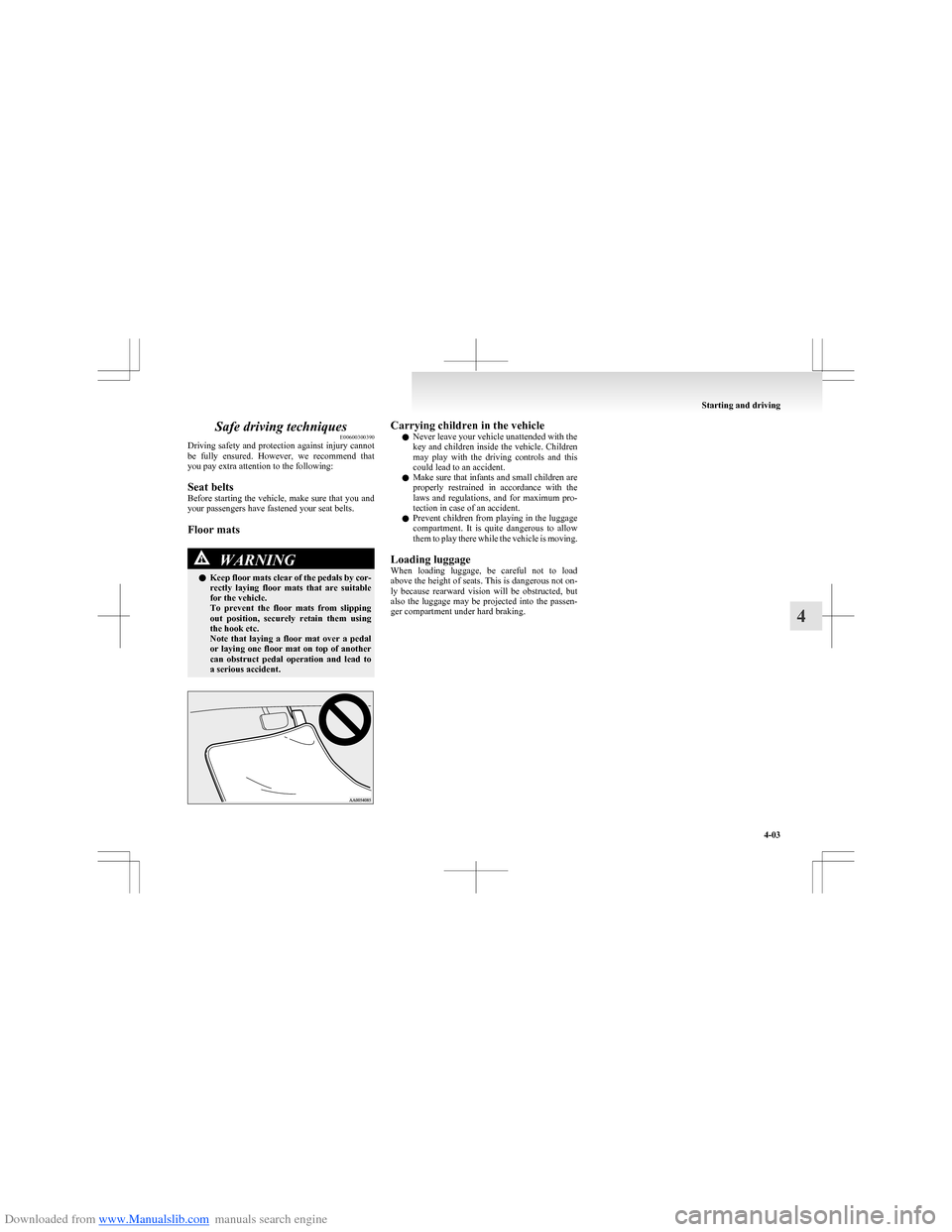
Floor matsWARNINGl Keep floor mats clear of the pedals by cor-
rectly laying floor mats that are suitable
for the vehicle.
To prevent the floor mats from slipping
out position, securely retain them using
the hook etc.
Note that laying a floor mat over a pedal
or laying one floor mat on top of another
can obstruct pedal operation and lead to
a serious accident.Carrying children in the vehicle
l Never leave your vehicle unattended with the
key and children inside the vehicle. Children
may play with the driving controls and this
could lead to an accident.
l Make sure that infants and small children are
properly restrained in accordance with the
laws and regulations, and for maximum pro-
tection in case of an accident.
l Prevent children from playing in the luggage
compartment. It is quite dangerous to allow
them to play there while the vehicle is moving.
Loading luggage
When loading luggage, be careful not to load
above the height of seats. This is dangerous not on-
ly because rearward vision will be obstructed, but
also the luggage may be projected into the passen-
ger compartment under hard braking.
Starting and driving
4-03
4
Page 139 of 273
Downloaded from www.Manualslib.com manuals search engine l“CRUISE” indication lamp is turned OFF.Cargo loads
E00609901240
Cargo loads precautionsCAUTIONl When loading luggage, be careful to the
following. •Stow cargo and luggage in the luggage
compartment whenever possible.
• Distribute cargo or luggage evenly not
to be unbalanced in weight of a load.
• Do not place cargo or luggage on the
instrument panel.
Also, do not stack up cargo or luggage
on the front passenger’s seat or the
rear seats.
Having the driver’s vision blocked,
and your cargo being thrown inside
the cabin if you suddenly have to
brake can cause a serious accident or
injury.Trailer towing E00610000488
In order to tow a trailer with your vehicle, have a
trailer towing device that meets all relevant regula-
tions in your area, mounted consult a
MITSUBISHI MOTORS Authorized Service Point.
The regulations concerning the towing of a trailer
may differ from country to country. You are ad-
vised to obey the regulations in each area.CAUTIONl Danger of Accident!
A towing bar should be fitted according
to MITSUBISHI MOTORS guidelines.
NOTE
l If you are going to tow a trailer, pay careful
attention to the following points.
Maximum towable weight with brake
and maximum trailer-nose weight
Never exceed the maximum towable weight with
brake and the maximum trailer-nose weight as lis-
ted in the specifications.
(Refer to page 9-07.)
If you tow a trailer at an altitude of more than
1,000 m above sea-level, reduce your weight by
10 % of the gross combination weight for every in-
crease of 1,000 m above sea-level, as the engine out-
put is lowered owing to decrease in atmospheric
pressure.
Starting and driving
4-36
4
Page 201 of 273
Downloaded from www.Manualslib.com manuals search engine WARNINGlMount the spare wheel with the valve
stem (F) facing outboard. If you cannot
see the valve stem (F), you have installed
the wheel backwards.
Operating the vehicle with the spare
wheel installed backwards can cause vehi-
cle damage and result in an accident.
11. Finger-tighten the wheel nuts. (Turn them
clockwise.)
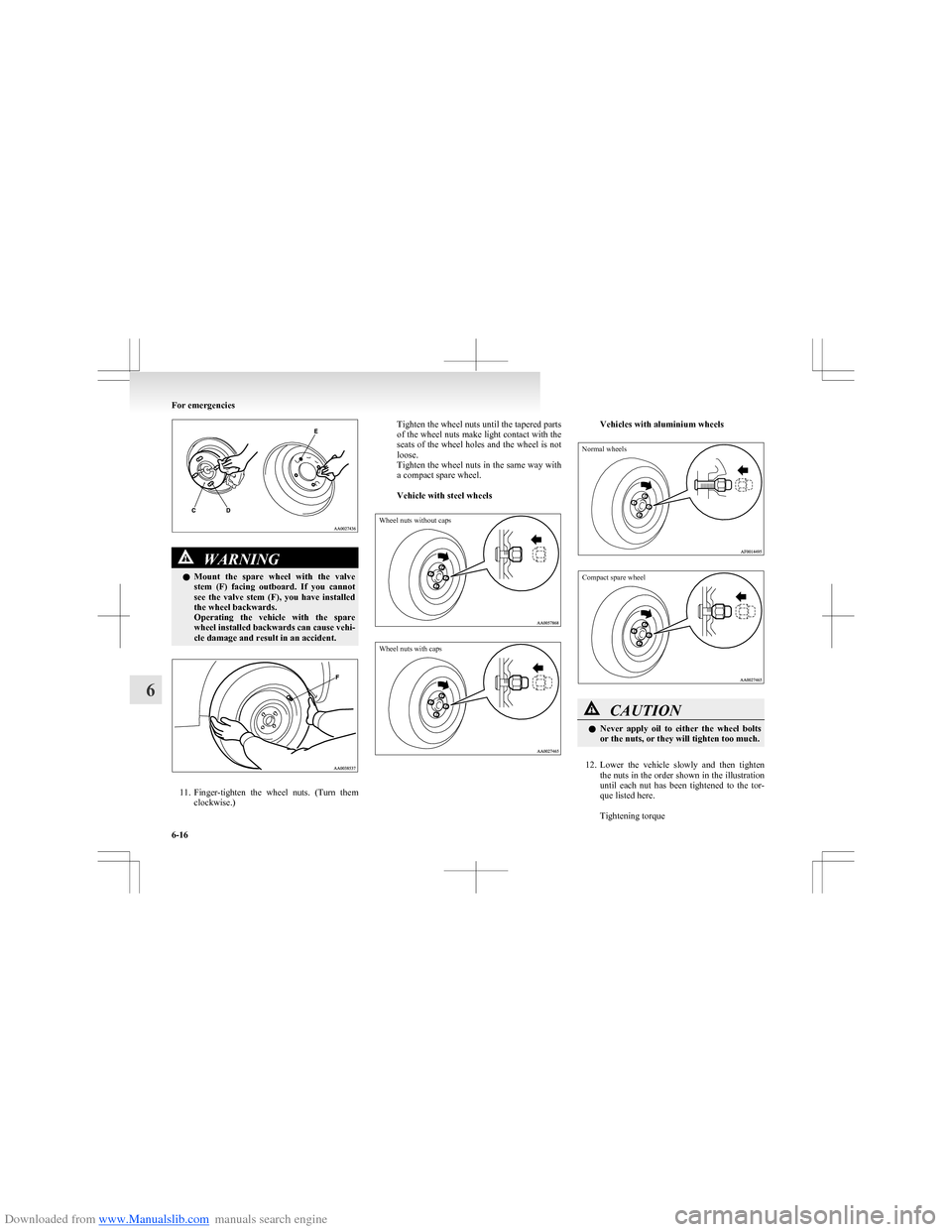
Tighten the wheel nuts until the tapered parts
of the wheel nuts make light contact with the
seats of the wheel holes and the wheel is not
loose.
Tighten the wheel nuts in the same way with
a compact spare wheel.
Vehicle with steel wheelsWheel nuts without capsWheel nuts with capsVehicles with aluminium wheelsNormal wheelsCompact spare wheel
CAUTIONl Never apply oil to either the wheel bolts
or the nuts, or they will tighten too much.
12. Lower the vehicle slowly and then tighten
the nuts in the order shown in the illustration
until each nut has been tightened to the tor-
que listed here.
Tightening torque
For emergencies
6-16
6
Page 209 of 273
Downloaded from www.Manualslib.com manuals search engine Vehicle care precautionsE00900100665
In order to maintain the value of your vehicle, it is
necessary to perform regular maintenance using the
proper procedures. Always maintain your vehicle
in compliance with environmental pollution control
regulations. Carefully select the materials used for
washing, etc., to be sure that they do not contain cor-
rosives. If in doubt, we recommend you to consult
a specialist for selection of these materials.CAUTIONl Cleaning products can be dangerous.
Some are poisonous. Others can burst in-
to flame if you strike a match or drop
them on a hot part of the vehicle. Some
are dangerous if you breathe their fumes
in a closed space. When you use anything
in a container to clean your vehicle, al-
ways follow the instructions and always
open your vehicle doors or windows when
you’re cleaning the inside. Never use the
following to clean your vehicle: • Petrol
• Paint Thinner
• Benzine
• Kerosene
• Turpentine
• Naphtha
• Lacquer Thinner
• Carbon Tetrachloride
• Nail Polish Remover
• Acetone
l These are all dangerous, and can damage
your vehicle.Cleaning the interior of your
vehicle E00900200347
After cleaning the interior of your vehicle with wa-
ter, cleaner or similar, wipe and dry in a shady, well-
ventilated area.CAUTIONl Do not use organic substances (solvents,
benzine, kerosene, alcohol, petrol, etc.) or
alkaline or acidic solutions.
These chemicals can cause discolouring,
staining or cracking of the surface.
If you use cleaners or polishing agents,
make sure their ingredients do not in-
clude the substances mentioned above.
NOTE
l Always read the instructions on the cleaner la-
bel.
Plastic, vinyl leather, fabric and
flocked parts E00900300045
1.Gently wipe off with gauze or other soft
cloth soaked with a 3 % aqueous solution of
neutral detergent.
2. Dip cloth in fresh water and wring out well.
Using this cloth, wipe off the detergent thor-
oughly.
NOTE
l Do not use cleaners, conditioners, and protec-
tants containing silicons or wax.
Such products may cause annoying reflec-
tions and obscure vision.Upholstery E00900500135
1.To maintain the value of your new vehicle,
handle the upholstery carefully and keep the
interior clean.
Use a vacuum cleaner and brush to clean the
seats. If stained, vinyl and synthetic leather
should be cleaned with an appropriate clean-
er, and cloth fabrics can be cleaned with ei-
ther upholstery cleaner or a 3 % solution of
neutral detergent in lukewarm water.
2. Clean the carpeting with a vacuum cleaner
and remove any stains with carpet cleaner.
Oil and grease can be removed by lightly dab-
bing with a clean colourfast cloth and stain re-
mover.
Genuine leather* E00900600569
1.Lightly wipe off with gauze or other soft
cloth soaked with a 5 % aqueous solution of
neutral detergent.
2. Dip cloth in fresh water and wring it out
well. Using this cloth, wipe off the detergent
thoroughly.
3. Apply leather protecting agent to the genuine
leather surface.
Vehicle care
7-02
7
Page 265 of 273
Downloaded from www.Manualslib.com manuals search engine F
Fluid capacities and lubricants 9-16
Fluid Brake fluid 8-09,9-16
Clutch fluid 8-09,9-16
Engine coolant 8-07,9-16
Washer fluid 8-09,9-16
For cold and snowy weather 8-18
Front fog lamps Bulb capacity 8-24
Indication lamp 3-17
Replacement 8-26
Switch 3-24
Front passenger’s airbag ON-OFF switch 2-25
Front seat 2-04
Front turn-signal lamps Bulb capacity 8-24
Replacement 8-26
Frozen road warning 3-10
Fuel consumption 9-14
Fuel Filling the fuel tank 02
Fuel selection 02
Fuel tank filler door release lever 03
Modification/alterations to the electrical or fuel
systems 05
Tank capacity 03
Fuse load capacity 8-19
Fuse replacement 8-21
Fuses 8-19
Fusible links 8-19
G
Gauges 3-02,3-16
General maintenance 8-18
Genuine parts 05
Glove box 5-39
H
Handling of compact discs 5-32
Hazard warning flasher switch 3-23
Hazard warning indication lamps 3-17
Head restraints 2-06
Headlamp levelling switch 3-22
Headlamps Bulb capacity 8-23
Headlamp flasher 3-21
Replacement 8-25
Switch 3-20
Heated mirror 4-09
Heated seats 2-06
Heater 5-04
High coolant temperature warning lamp 3-19
High-beam indication lamp 3-17
High-mounted stop lamp Bulb capacity 8-24
High-mounted stop lamps Replacement 8-30
Hinges and latches lubrication 8-18
Horn switch 3-30
How to drive a vehicle with an automated manual
transmission 4-22
I
If the vehicle breaks down 6-02
Ignition switch 4-10
Indication and warning lamps 3-16
Indication lamps 3-17
Inside rear-view mirror 4-08
Installation of accessories 04
Instruments 3-02
Interior lamps 5-38
J
Jacking up the vehicle 6-12
Jack 6-11 Storage 6-06
Jump starting (Emergency starting) 6-02
K
Keyless entry system 1-03
Keys 1-02
L
Labeling 9-02
Lamp monitor buzzer 3-21
Leakage (Fuel, engine coolant, oil and exhaust
gas) 8-18
Licence plate lamps Bulb capacity 8-24
Replacement 8-31
Lubricants 9-16
Luggage compartment lamp 5-38 Bulb capacity 8-24
Replacement 8-32
Luggage floor boxes 5-41
Luggage floor cargo 5-40
LW/MW/FM electronic tuning radio with CD play-
er 5-12
M
Manual transmission 4-16Oil 9-16
Map lamps 5-38
Mirror Inside rear-view mirror 4-08
Outside rear-view mirrors 4-08
Alphabetical index
2