Transmission MITSUBISHI COLT 2009 10.G Owner's Manual
[x] Cancel search | Manufacturer: MITSUBISHI, Model Year: 2009, Model line: COLT, Model: MITSUBISHI COLT 2009 10.GPages: 273, PDF Size: 17.28 MB
Page 207 of 273
Downloaded from www.Manualslib.com manuals search engine Operation under adverse drivingconditions E00801701840
If your vehicle becomes stuck in sand,
mud or snow
If the vehicle becomes stuck in snow, sand, or
mud, it can often be moved by a rocking motion.
For vehicle with manual transmission, move the
gearshift lever alternately between 1 st
and Reverse,
while applying slight pressure to the accelerator ped-
al.
With an automated manual transmission vehicle,
place the allshift lever in the “A” (automatic mode)
position to select automatic mode or select 1 st
or
2 nd
gear in the manual mode or place the allshift lev-
er in the “R” (Reverse) position for reverse. Con-
firm that there is an “A”, “1”, “2” or “R” in the all-
shift indicator display, then gently press the acceler-
ator pedal. Do not press the accelerator pedal while
moving the allshift lever.
Avoid racing the engine or spinning the wheels. Pro-
longed efforts to free a stuck vehicle may result in
overheating and transmission failure. Allow the en-
gine to idle for a few minutes to let the transmis-
sion cool between rocking attempts.
If the vehicle remains stuck after several rocking at-
tempts, seek other assistance.WARNINGl When attempting to rock your vehicle out
of a stuck position, be sure that the area
around the vehicle is clear of people and
physical objects. The rocking motion may
cause the vehicle to suddenly launch for-
ward or backward, causing injury or dam-
age to nearby people or objects.
On a flooded road
l Avoid flooded roads. Water could enter the
brake discs, resulting in temporarily ineffec-
tive brakes. In such cases, lightly depress the
brake pedal to see if the brakes operate prop-
erly. If they do not, lightly depress the pedal
several times while driving in order to dry
the brake pads.
l When driving in rain or on a road with many
puddles a layer of water may form between
the tyres and the road surface.
This reduces a tyre’s frictional resistance on
the road, resulting in loss of steering stability
and braking capability.
To cope with this, observe the following items:
(a)Drive your vehicle at slow speed. (b)Do not drive on worn tyres. Always
maintain the specified tyre inflation
pressures.
On a snow-covered or frozen road
l When driving on a snow-covered or frozen
road, it is recommended that you use snow
tyres or tyre chains.
Refer to the “Snow tyres” and “Tyre chains”
sections.
l Avoid high-speed operation, sudden acceler-
ation, abrupt brake application and sharp cor-
nering.
l Depressing the brake pedal during travel on
snowy or icy roads may cause tyre slippage
and skidding. When traction between the
tyres and the road is reduced the wheels may
skid and the vehicle cannot readily be
brought to a stop by conventional braking
techniques. Braking will differ, depending
upon whether you have anti-lock brake sys-
tem (ABS). As your vehicle is equipped with
anti-lock brake system (ABS), brake by press-
ing the brake pedal hard, and keeping it press-
ed.
l Allow extra distance between your vehicle
and the vehicle in front of you, and avoid sud-
den braking.
On a bumpy or rutted road l Drive as slow as possible when driving on
bumpy or rutted roads.CAUTIONl The impact on tyres and/or wheels when
driving on a bumpy or rutted road can
damage the tyre and/or wheel.
For emergencies
6-22
6
Page 223 of 273
Downloaded from www.Manualslib.com manuals search engine BatteryE01001202160
The condition of the battery is very important for
quick starting of the engine and proper functioning
of the vehicle’s electrical system. Regular inspec-
tion and care are especially important in cold weath-
er.
Checking battery electrolyte level
The inside of the battery is divided into several com-
partments.
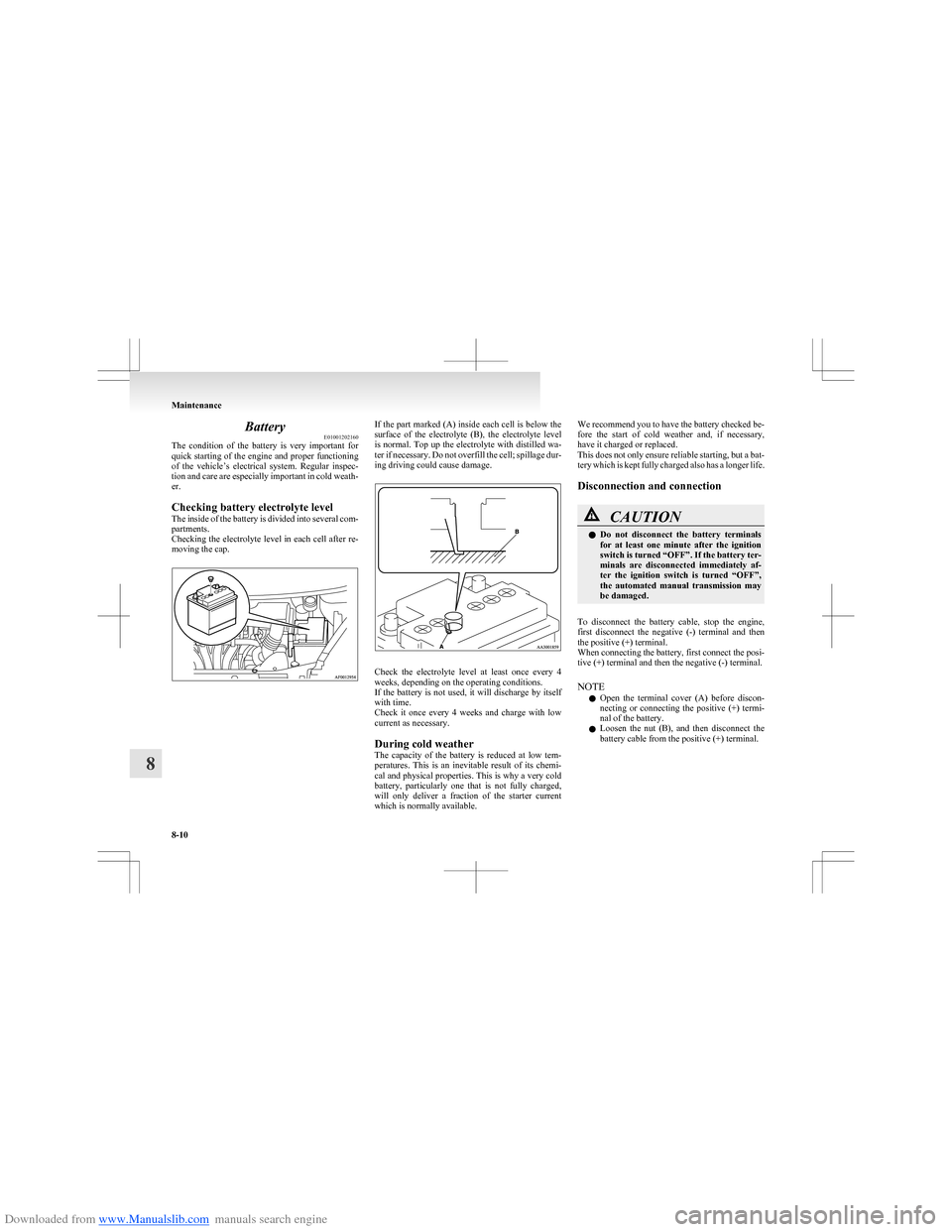
Checking the electrolyte level in each cell after re-
moving the cap.If the part marked (A) inside each cell is below the
surface of the electrolyte (B), the electrolyte level
is normal. Top up the electrolyte with distilled wa-
ter if necessary. Do not overfill the cell; spillage dur-
ing driving could cause damage.
Check the electrolyte level at least once every 4
weeks, depending on the operating conditions.
If the battery is not used, it will discharge by itself
with time.
Check it once every 4 weeks and charge with low
current as necessary.
During cold weather
The capacity of the battery is reduced at low tem-
peratures. This is an inevitable result of its chemi-
cal and physical properties. This is why a very cold
battery, particularly one that is not fully charged,
will only deliver a fraction of the starter current
which is normally available.
We recommend you to have the battery checked be-
fore the start of cold weather and, if necessary,
have it charged or replaced.
This does not only ensure reliable starting, but a bat-
tery which is kept fully charged also has a longer life.
Disconnection and connectionCAUTIONl Do not disconnect the battery terminals
for at least one minute after the ignition
switch is turned “OFF”. If the battery ter-
minals are disconnected immediately af-
ter the ignition switch is turned “OFF”,
the automated manual transmission may
be damaged.
To disconnect the battery cable, stop the engine,
first disconnect the negative (-) terminal and then
the positive (+) terminal.
When connecting the battery, first connect the posi-
tive (+) terminal and then the negative (-) terminal.
NOTE l Open the terminal cover (A) before discon-
necting or connecting the positive (+) termi-
nal of the battery.
l Loosen the nut (B), and then disconnect the
battery cable from the positive (+) terminal.
Maintenance
8-10
8
Page 246 of 273
Downloaded from www.Manualslib.com manuals search engine Vehicle labeling............................................................................ 9-02
Vehicle dimensions.......................................................................9-04
Vehicle performance.....................................................................9-06
Vehicle weight .............................................................................. 9-07
Engine specifications .................................................................... 9-09
Transmission specifications .......................................................... 9-10
Electrical system ........................................................................... 9-11
Tyres and wheels .......................................................................... 9-12
Other specifications ...................................................................... 9-13
Fuel consumption ......................................................................... 9-14
Refill capacities ............................................................................ 9-16Specifications9
Page 247 of 273
Downloaded from www.Manualslib.com manuals search engine Vehicle labelingE01100102831
Vehicle identification number: (VIN)
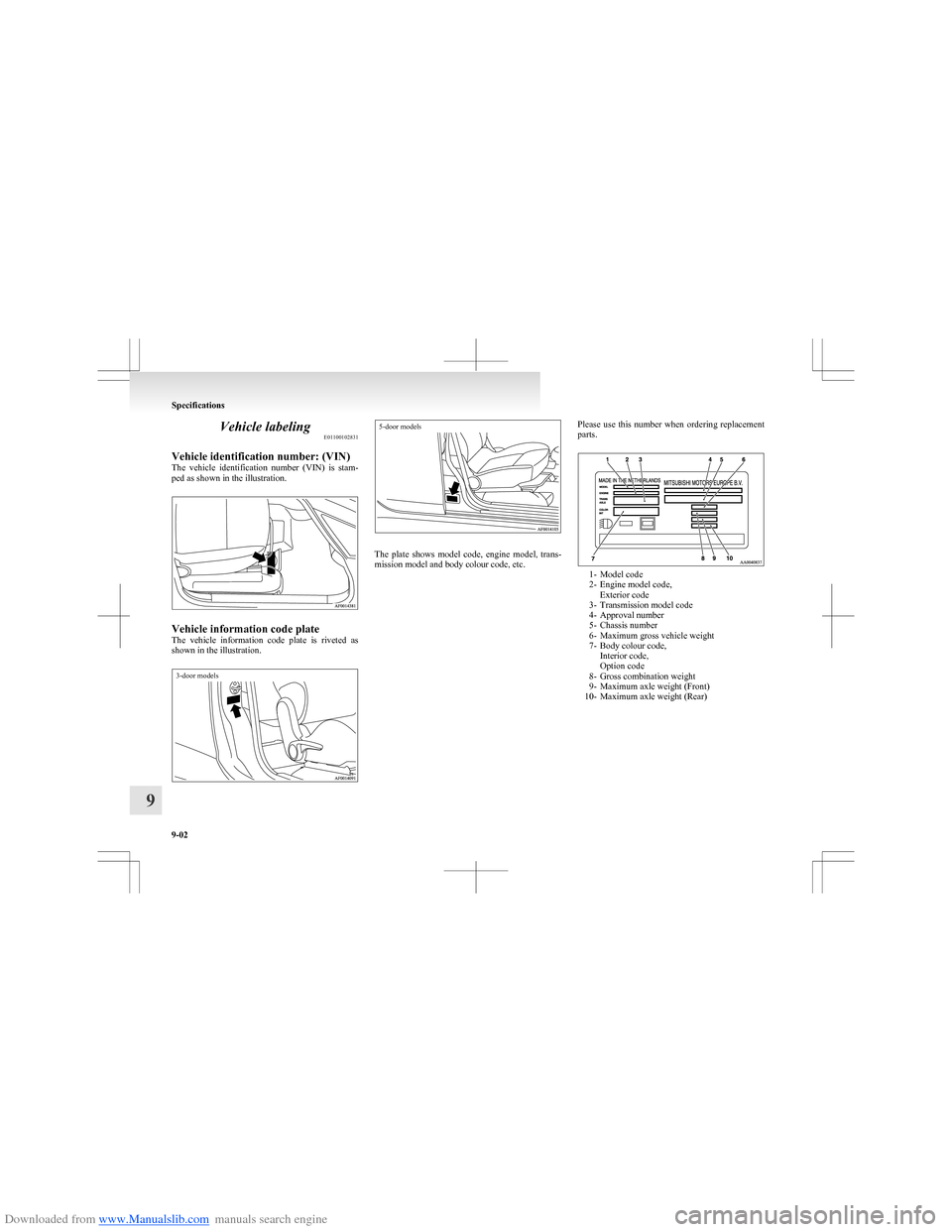
The vehicle identification number (VIN) is stam-
ped as shown in the illustration.
Vehicle information code plate
The vehicle information code plate is riveted as
shown in the illustration.
3-door models5-door models
The plate shows model code, engine model, trans-
mission model and body colour code, etc.
Please use this number when ordering replacement
parts.
1- Model code
2- Engine model code, Exterior code
3- Transmission model code
4- Approval number
5- Chassis number
6- Maximum gross vehicle weight
7- Body colour code, Interior code,
Option code
8- Gross combination weight
9- Maximum axle weight (Front)
10- Maximum axle weight (Rear)
Specifications
9-02
9
Page 252 of 273
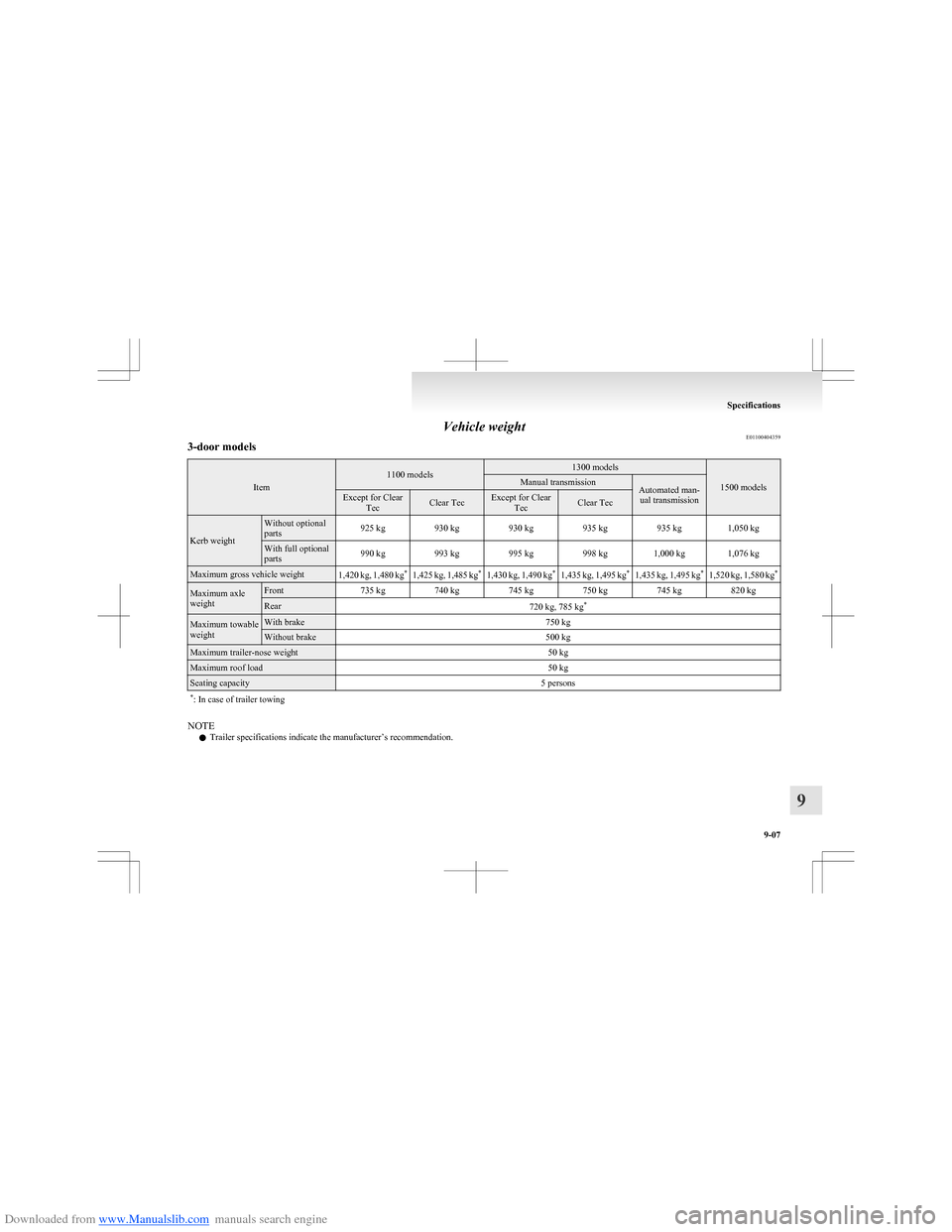
Downloaded from www.Manualslib.com manuals search engine Vehicle weightE011004043593-door models
Item
1100 models1300 models
1500 models
Manual transmissionAutomated man-
ual transmissionExcept for Clear TecClear TecExcept for ClearTecClear Tec
Kerb weight
Without optional
parts925 kg930 kg930 kg935 kg935 kg1,050 kgWith full optional
parts990 kg993 kg995 kg998 kg1,000 kg1,076 kgMaximum gross vehicle weight1,420 kg, 1,480 kg *1,425 kg, 1,485 kg*1,430 kg, 1,490 kg*1,435 kg, 1,495 kg*1,435 kg, 1,495 kg*1,520 kg, 1,580 kg*Maximum axle
weightFront735 kg740 kg745 kg750 kg745 kg820 kgRear720 kg, 785 kg *Maximum towable
weightWith brake750 kgWithout brake500 kgMaximum trailer-nose weight50 kgMaximum roof load50 kgSeating capacity5 persons* : In case of trailer towing
NOTE
l Trailer specifications indicate the manufacturer’s recommendation.
Specifications
9-07
9
Page 253 of 273
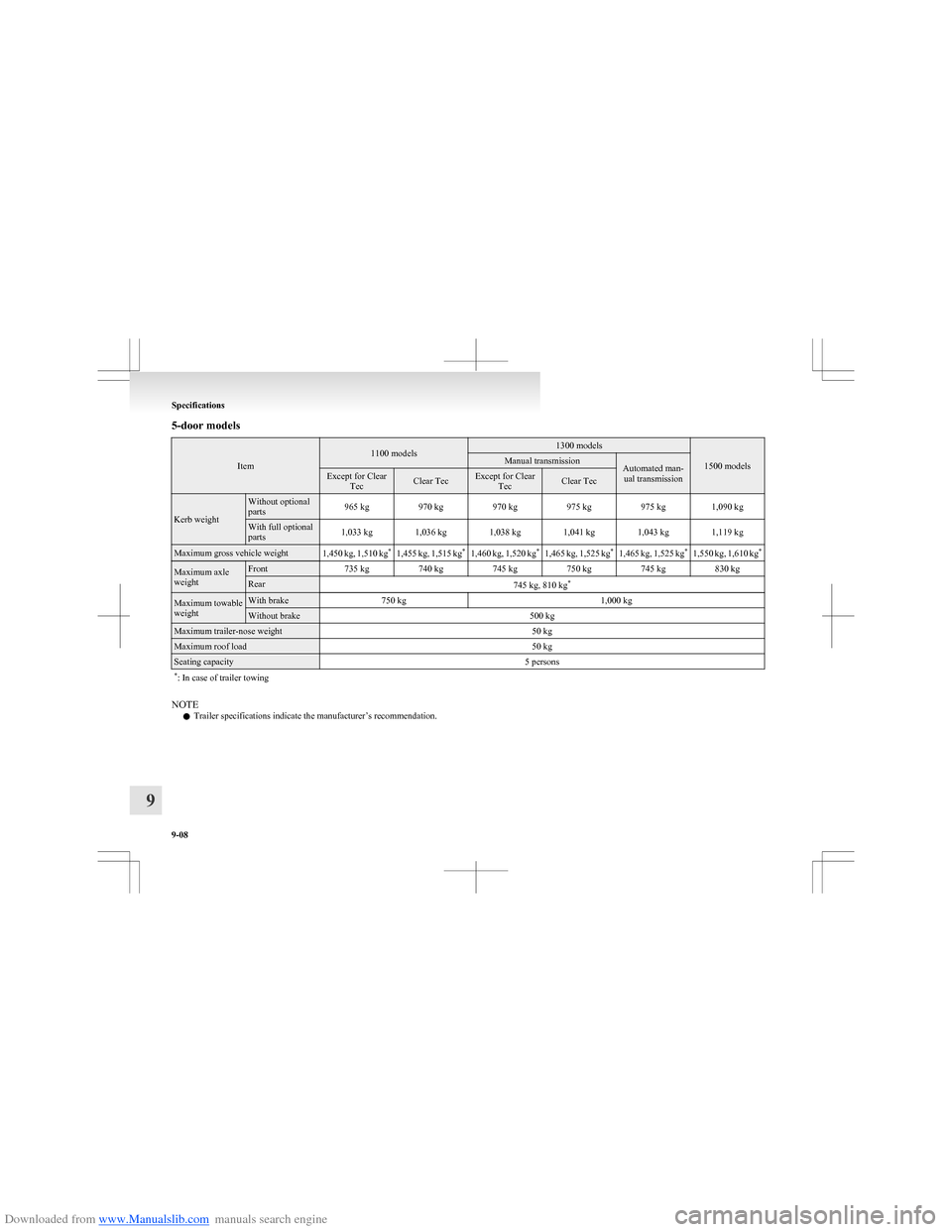
Downloaded from www.Manualslib.com manuals search engine 5-door models
Item
1100 models1300 models
1500 models
Manual transmissionAutomated man-ual transmissionExcept for Clear TecClear TecExcept for ClearTecClear Tec
Kerb weight
Without optional
parts965 kg970 kg970 kg975 kg975 kg1,090 kgWith full optional
parts1,033 kg1,036 kg1,038 kg1,041 kg1,043 kg1,119 kgMaximum gross vehicle weight1,450 kg, 1,510 kg *1,455 kg, 1,515 kg*1,460 kg, 1,520 kg*1,465 kg, 1,525 kg*1,465 kg, 1,525 kg*1,550 kg, 1,610 kg*Maximum axle
weightFront735 kg740 kg745 kg750 kg745 kg830 kgRear745 kg, 810 kg *Maximum towable
weightWith brake750 kg1,000 kgWithout brake500 kgMaximum trailer-nose weight50 kgMaximum roof load50 kgSeating capacity5 persons* : In case of trailer towing
NOTE
l Trailer specifications indicate the manufacturer’s recommendation.
Specifications
9-08
9
Page 255 of 273
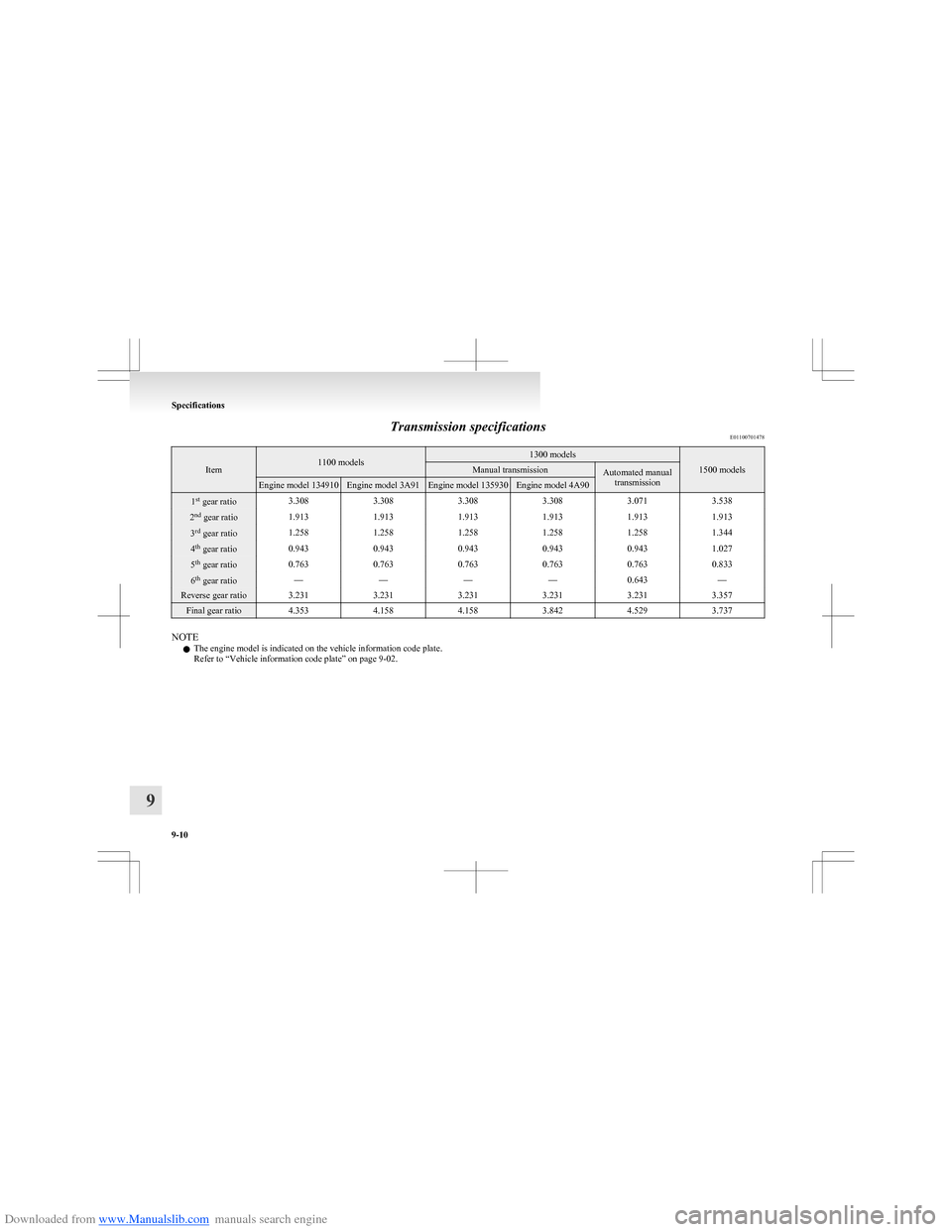
Downloaded from www.Manualslib.com manuals search engine Transmission specificationsE01100701478
Item1100 models1300 models
1500 models
Manual transmissionAutomated manual
transmissionEngine model 134910Engine model 3A91Engine model 135930Engine model 4A901st
gear ratio3.3083.3083.3083.3083.0713.5382nd
gear ratio1.9131.9131.9131.9131.9131.9133rd
gear ratio1.2581.2581.2581.2581.2581.3444th
gear ratio0.9430.9430.9430.9430.9431.0275th
gear ratio0.7630.7630.7630.7630.7630.8336th
gear ratio————0.643—Reverse gear ratio3.2313.2313.2313.2313.2313.357Final gear ratio4.3534.1584.1583.8424.5293.737
NOTE
l The engine model is indicated on the vehicle information code plate.
Refer to “Vehicle information code plate” on page 9-02.
Specifications
9-10
9
Page 262 of 273
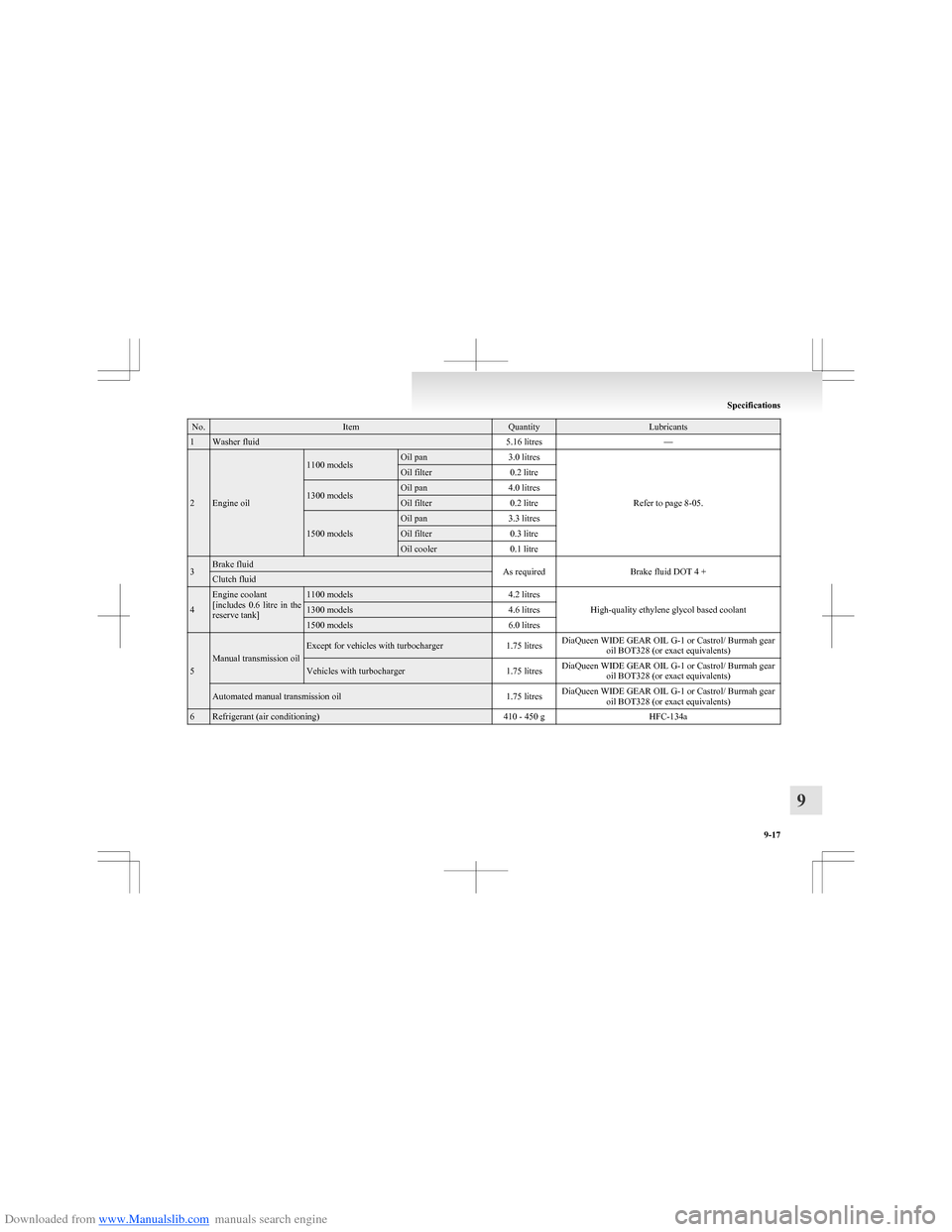
Downloaded from www.Manualslib.com manuals search engine No.ItemQuantityLubricants1Washer fluid5.16 litres—
2Engine oil
1100 modelsOil pan3.0 litres
Refer to page 8-05.
Oil filter0.2 litre1300 modelsOil pan4.0 litresOil filter0.2 litre
1500 models
Oil pan3.3 litresOil filter0.3 litreOil cooler0.1 litre3Brake fluidAs requiredBrake fluid DOT 4 +Clutch fluid
4
Engine coolant
[ includes 0.6 litre in the
reserve tank]1100 models4.2 litres
High-quality ethylene glycol based coolant
1300 models4.6 litres1500 models6.0 litres
5
Manual transmission oil
Except for vehicles with turbocharger1.75 litresDiaQueen WIDE GEAR OIL G-1 or Castrol/ Burmah gear oil BOT328 (or exact equivalents)Vehicles with turbocharger1.75 litresDiaQueen WIDE GEAR OIL G-1 or Castrol/ Burmah gearoil BOT328 (or exact equivalents)Automated manual transmission oil1.75 litresDiaQueen WIDE GEAR OIL G-1 or Castrol/ Burmah gearoil BOT328 (or exact equivalents)6Refrigerant (air conditioning)410 - 450 gHFC-134a
Specifications
9-17
9
Page 264 of 273
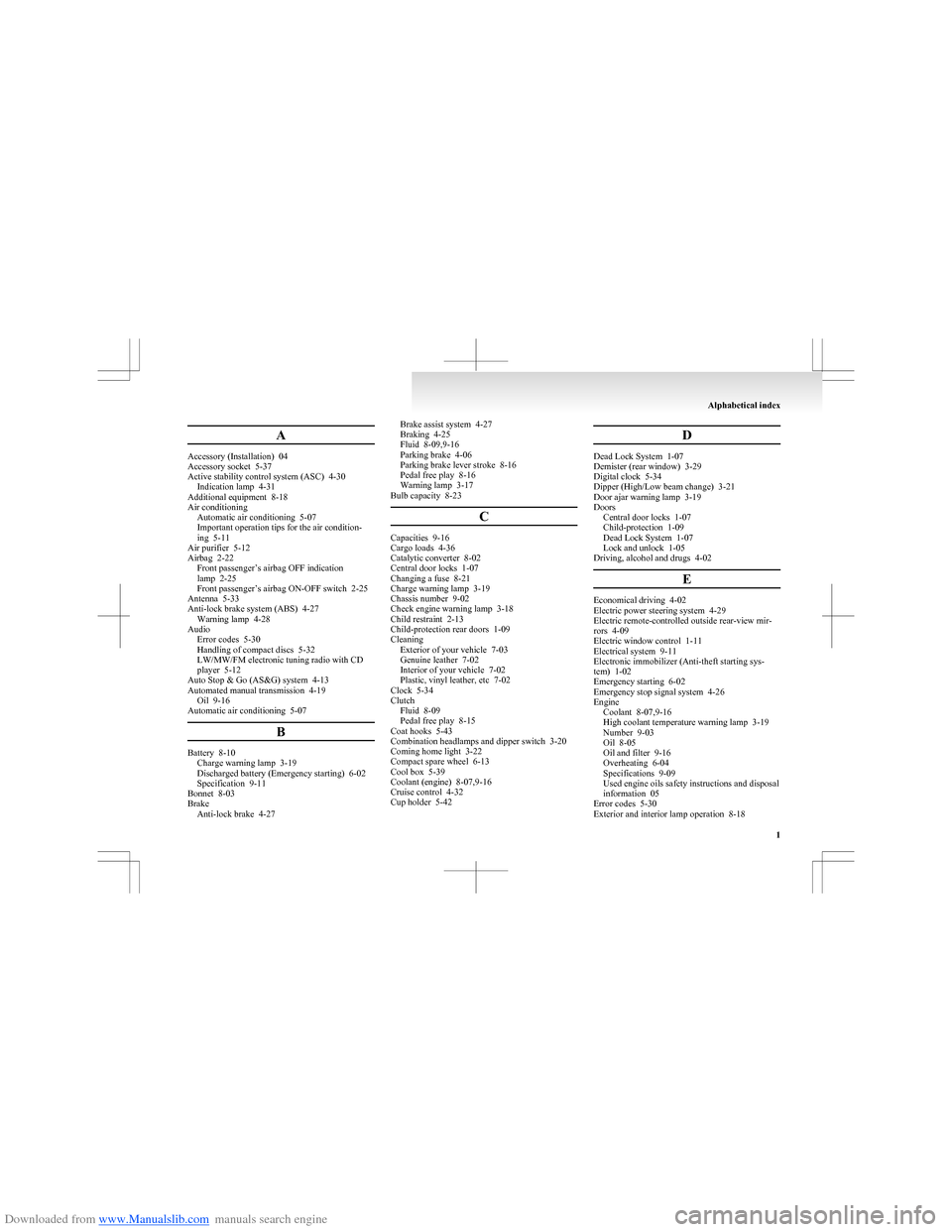
Downloaded from www.Manualslib.com manuals search engine A
Accessory (Installation) 04
Accessory socket 5-37
Active stability control system (ASC) 4-30 Indication lamp 4-31
Additional equipment 8-18
Air conditioning Automatic air conditioning 5-07
Important operation tips for the air condition-
ing 5-11
Air purifier 5-12
Airbag 2-22
Front passenger’s airbag OFF indication
lamp 2-25
Front passenger’s airbag ON-OFF switch 2-25
Antenna 5-33
Anti-lock brake system (ABS) 4-27 Warning lamp 4-28
Audio Error codes 5-30
Handling of compact discs 5-32
LW/MW/FM electronic tuning radio with CD
player 5-12
Auto Stop & Go (AS&G) system 4-13
Automated manual transmission 4-19 Oil 9-16
Automatic air conditioning 5-07
B
Battery 8-10Charge warning lamp 3-19
Discharged battery (Emergency starting) 6-02
Specification 9-11
Bonnet 8-03
Brake Anti-lock brake 4-27
Brake assist system 4-27
Braking 4-25
Fluid 8-09,9-16
Parking brake 4-06
Parking brake lever stroke 8-16
Pedal free play 8-16
Warning lamp 3-17
Bulb capacity 8-23
C
Capacities 9-16
Cargo loads 4-36
Catalytic converter 8-02
Central door locks 1-07
Changing a fuse 8-21
Charge warning lamp 3-19
Chassis number 9-02
Check engine warning lamp 3-18
Child restraint 2-13
Child-protection rear doors 1-09
Cleaning Exterior of your vehicle 7-03
Genuine leather 7-02
Interior of your vehicle 7-02
Plastic, vinyl leather, etc 7-02
Clock 5-34
Clutch Fluid 8-09
Pedal free play 8-15
Coat hooks 5-43
Combination headlamps and dipper switch 3-20
Coming home light 3-22
Compact spare wheel 6-13
Cool box 5-39
Coolant (engine) 8-07,9-16
Cruise control 4-32
Cup holder 5-42
D
Dead Lock System 1-07
Demister (rear window) 3-29
Digital clock 5-34
Dipper (High/Low beam change) 3-21
Door ajar warning lamp 3-19
Doors Central door locks 1-07
Child-protection 1-09
Dead Lock System 1-07
Lock and unlock 1-05
Driving, alcohol and drugs 4-02
E
Economical driving 4-02
Electric power steering system 4-29
Electric remote-controlled outside rear-view mir-
rors 4-09
Electric window control 1-11
Electrical system 9-11
Electronic immobilizer (Anti-theft starting sys-
tem) 1-02
Emergency starting 6-02
Emergency stop signal system 4-26
Engine
Coolant 8-07,9-16
High coolant temperature warning lamp 3-19
Number 9-03
Oil 8-05
Oil and filter 9-16
Overheating 6-04
Specifications 9-09
Used engine oils safety instructions and disposal
information 05
Error codes 5-30
Exterior and interior lamp operation 8-18
Alphabetical index
1
Page 265 of 273
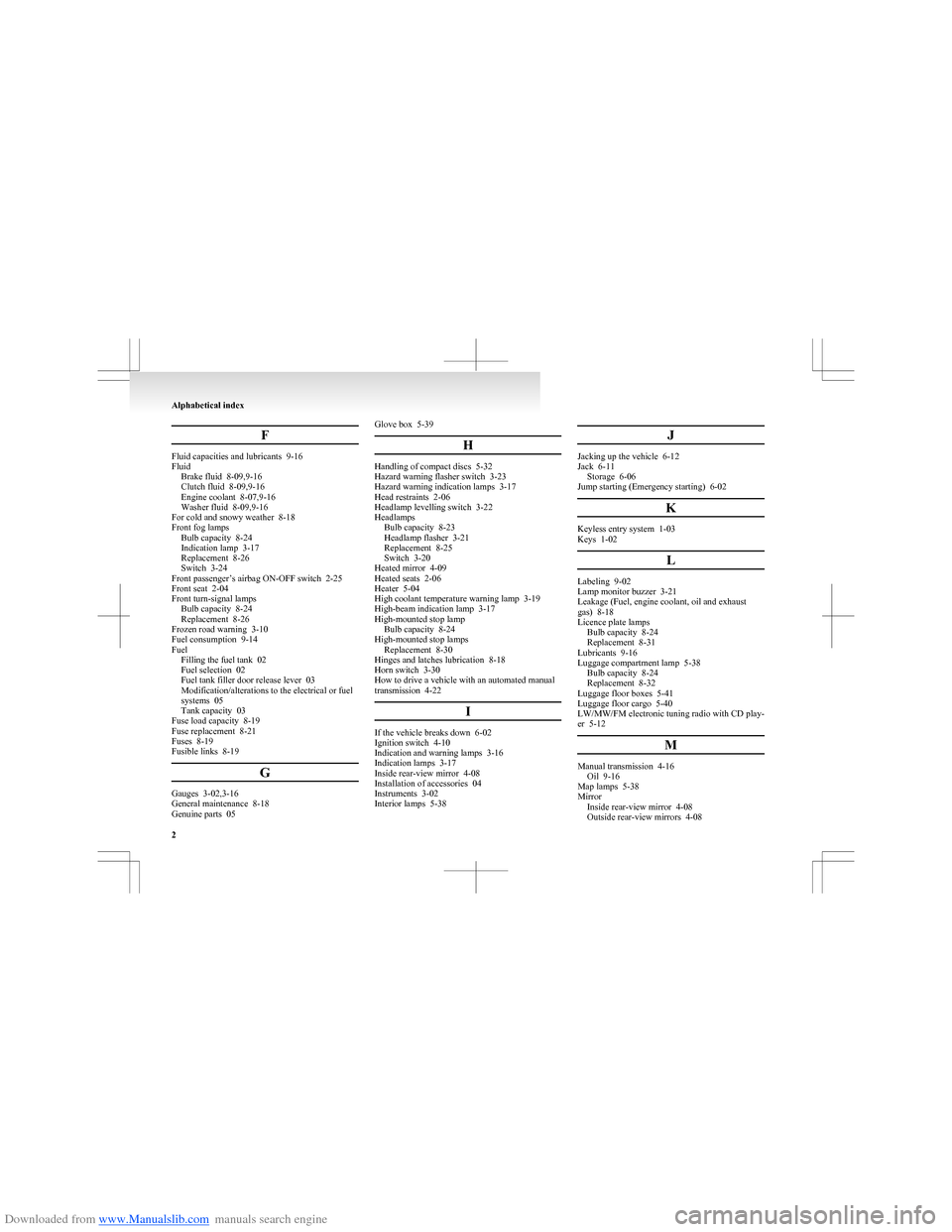
Downloaded from www.Manualslib.com manuals search engine F
Fluid capacities and lubricants 9-16
Fluid Brake fluid 8-09,9-16
Clutch fluid 8-09,9-16
Engine coolant 8-07,9-16
Washer fluid 8-09,9-16
For cold and snowy weather 8-18
Front fog lamps Bulb capacity 8-24
Indication lamp 3-17
Replacement 8-26
Switch 3-24
Front passenger’s airbag ON-OFF switch 2-25
Front seat 2-04
Front turn-signal lamps Bulb capacity 8-24
Replacement 8-26
Frozen road warning 3-10
Fuel consumption 9-14
Fuel Filling the fuel tank 02
Fuel selection 02
Fuel tank filler door release lever 03
Modification/alterations to the electrical or fuel
systems 05
Tank capacity 03
Fuse load capacity 8-19
Fuse replacement 8-21
Fuses 8-19
Fusible links 8-19
G
Gauges 3-02,3-16
General maintenance 8-18
Genuine parts 05
Glove box 5-39
H
Handling of compact discs 5-32
Hazard warning flasher switch 3-23
Hazard warning indication lamps 3-17
Head restraints 2-06
Headlamp levelling switch 3-22
Headlamps Bulb capacity 8-23
Headlamp flasher 3-21
Replacement 8-25
Switch 3-20
Heated mirror 4-09
Heated seats 2-06
Heater 5-04
High coolant temperature warning lamp 3-19
High-beam indication lamp 3-17
High-mounted stop lamp Bulb capacity 8-24
High-mounted stop lamps Replacement 8-30
Hinges and latches lubrication 8-18
Horn switch 3-30
How to drive a vehicle with an automated manual
transmission 4-22
I
If the vehicle breaks down 6-02
Ignition switch 4-10
Indication and warning lamps 3-16
Indication lamps 3-17
Inside rear-view mirror 4-08
Installation of accessories 04
Instruments 3-02
Interior lamps 5-38
J
Jacking up the vehicle 6-12
Jack 6-11 Storage 6-06
Jump starting (Emergency starting) 6-02
K
Keyless entry system 1-03
Keys 1-02
L
Labeling 9-02
Lamp monitor buzzer 3-21
Leakage (Fuel, engine coolant, oil and exhaust
gas) 8-18
Licence plate lamps Bulb capacity 8-24
Replacement 8-31
Lubricants 9-16
Luggage compartment lamp 5-38 Bulb capacity 8-24
Replacement 8-32
Luggage floor boxes 5-41
Luggage floor cargo 5-40
LW/MW/FM electronic tuning radio with CD play-
er 5-12
M
Manual transmission 4-16Oil 9-16
Map lamps 5-38
Mirror Inside rear-view mirror 4-08
Outside rear-view mirrors 4-08
Alphabetical index
2