warning MITSUBISHI COLT 2009 10.G Owner's Manual
[x] Cancel search | Manufacturer: MITSUBISHI, Model Year: 2009, Model line: COLT, Model: MITSUBISHI COLT 2009 10.GPages: 273, PDF Size: 17.28 MB
Page 54 of 273
Downloaded from www.Manualslib.com manuals search engine Instruction:l For small infants, an infant carrier should be
used. For small children whose height when
seated allows the shoulder belt to lie in con-
tact with the face or the throat, a child seat
should be used.
l The child restraint system should be appropri-
ate for the child’s weight and height and prop-
erly fit in the vehicle. For a higher degree of
safety: THE CHILD RESTRAINT SYSTEM
SHOULD BE INSTALLED IN THE REAR
SEAT.
l Before purchasing a child restraint system,
try installing it in the rear seat to make sure
there is a good fit. Because of the location of
the seat belt buckles and the shape of the seat
cushion, it may be difficult to securely install
some manufacturer’s child restraint systems.
If the child restraint system can be pulled for-
ward or to either side easily on the seat cush-
ion after the seat belt has been tightened,
choose another manufacturer’s child restraint
system.WARNINGl When installing a child restraint system,
refer to the instructions provided by the
manufacturer of the restraint system. Fail-
ure to do so can result in severe or fatal
injury to your child.
l After installation, push and pull the child
restraint system back and forth, and side
to side, to see that it is positively secured.
If the child restraint system is not instal-
led securely, it may cause injury to the
child or other occupants in the case of ac-
cident or sudden stops.WARNINGl When the child restraint system is not in
use, keep your child or infant seat se-
cured with the seat belt or remove it from
the vehicle in order to prevent injury to
your child.
NOTE
l Depending on the seating position in the ve-
hicle and the child restraint system that you
have, the child restraint can be attached us-
ing one of the following two locations: •To the lower anchorage in the rear seat
ONLY if the child restraint has ISOFIX
mountings (See page 2-20).
• To the seat belt (See page 2-21).
Older children E00406700248
Children who have outgrown the child restraint sys-
tem should be seated in the rear seat and wear com-
bination lap shoulder belt.
The lap portion of the belt should be snug and posi-
tioned low on the abdomen so that it is below the
top of the hip-bone. Otherwise, the belt could in-
trude into the child’s abdomen during an accident
and cause injury.
CAUTIONl Children who are not buckled up can be
thrown out of the vehicle in an accident.
l Children who are not buckled up can
strike other people in the vehicle in an ac-
cident.CAUTIONl A child should never be left unattended
in your vehicle. When you leave the vehi-
cle, take the child with you.
Seat and seat belts
2-15
2
Page 59 of 273
Downloaded from www.Manualslib.com manuals search engine Installing a child restraint system to
the lower anchorage (ISOFIX child re-
straint mountings) and tether anchor-
age E00408900462
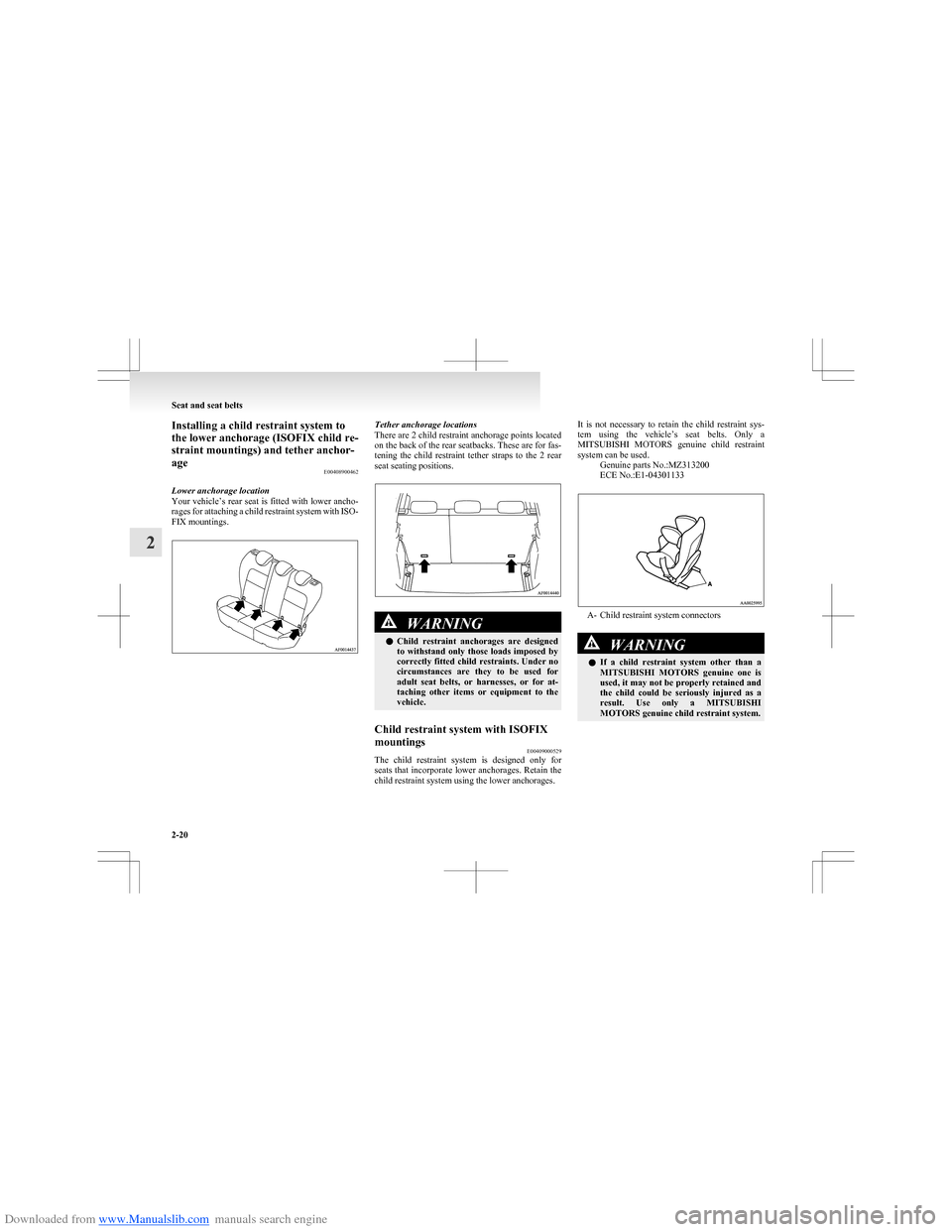
Lower anchorage location
Your vehicle’s rear seat is fitted with lower ancho-
rages for attaching a child restraint system with ISO-
FIX mountings.Tether anchorage locations
There are 2 child restraint anchorage points located
on the back of the rear seatbacks. These are for fas-
tening the child restraint tether straps to the 2 rear
seat seating positions.WARNINGl Child restraint anchorages are designed
to withstand only those loads imposed by
correctly fitted child restraints. Under no
circumstances are they to be used for
adult seat belts, or harnesses, or for at-
taching other items or equipment to the
vehicle.Child restraint system with ISOFIX
mountings E00409000529
The child restraint system is designed only for
seats that incorporate lower anchorages. Retain the
child restraint system using the lower anchorages.
It is not necessary to retain the child restraint sys-
tem using the vehicle’s seat belts. Only a
MITSUBISHI MOTORS genuine child restraint
system can be used. Genuine parts No.:MZ313200
ECE No.:E1-04301133
A- Child restraint system connectors
WARNINGl If a child restraint system other than a
MITSUBISHI MOTORS genuine one is
used, it may not be properly retained and
the child could be seriously injured as a
result. Use only a MITSUBISHI
MOTORS genuine child restraint system.
Seat and seat belts
2-20
2
Page 60 of 273
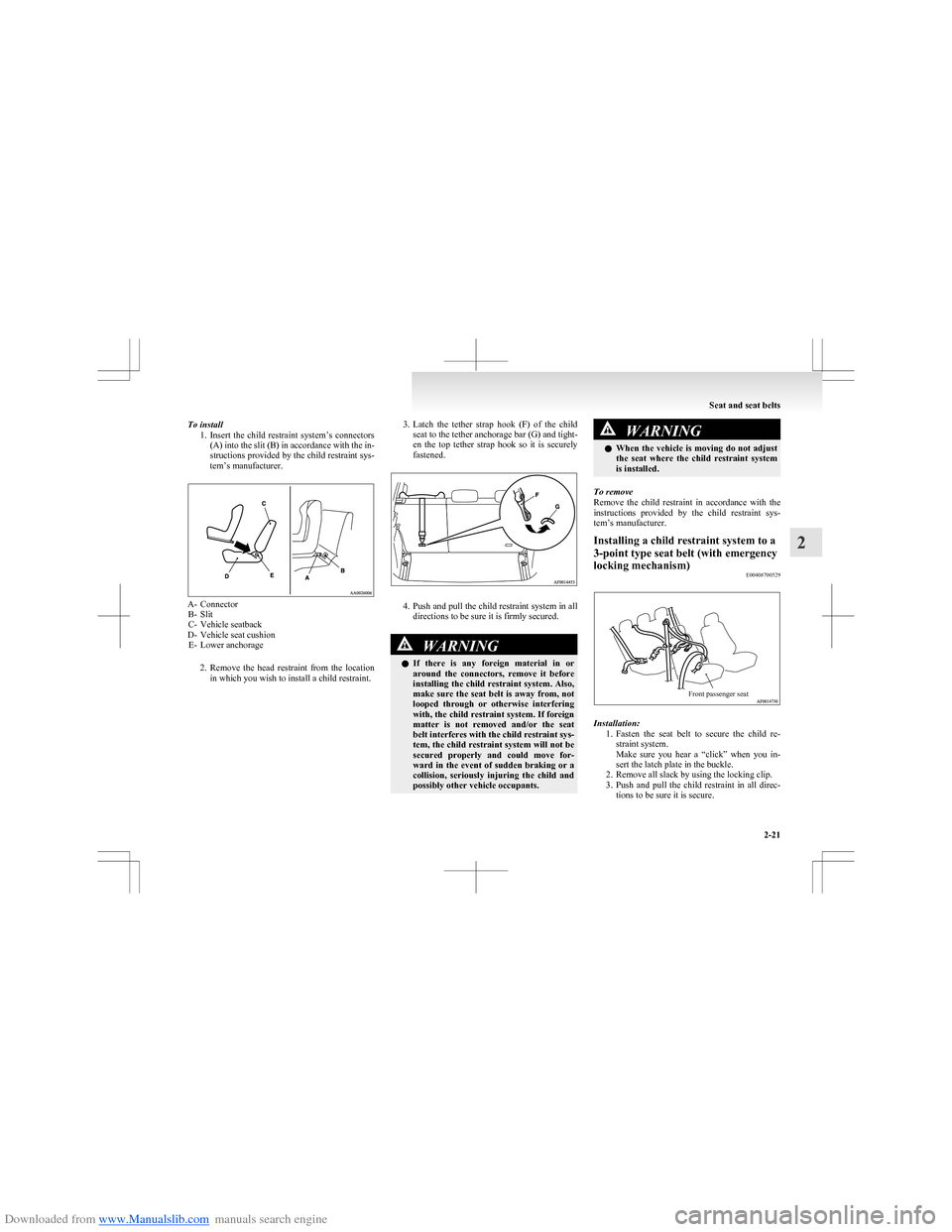
Downloaded from www.Manualslib.com manuals search engine To install1.Insert the child restraint system’s connectors
(A) into the slit (B) in accordance with the in-
structions provided by the child restraint sys-
tem’s manufacturer.
A- Connector B- Slit
C- Vehicle seatback
D- Vehicle seat cushion E- Lower anchorage
2.Remove the head restraint from the location
in which you wish to install a child restraint.
3. Latch the tether strap hook (F) of the child
seat to the tether anchorage bar (G) and tight-
en the top tether strap hook so it is securely
fastened.
4. Push and pull the child restraint system in all
directions to be sure it is firmly secured.
WARNINGl If there is any foreign material in or
around the connectors, remove it before
installing the child restraint system. Also,
make sure the seat belt is away from, not
looped through or otherwise interfering
with, the child restraint system. If foreign
matter is not removed and/or the seat
belt interferes with the child restraint sys-
tem, the child restraint system will not be
secured properly and could move for-
ward in the event of sudden braking or a
collision, seriously injuring the child and
possibly other vehicle occupants.WARNINGl When the vehicle is moving do not adjust
the seat where the child restraint system
is installed.
To remove
Remove the child restraint in accordance with the
instructions provided by the child restraint sys-
tem’s manufacturer.
Installing a child restraint system to a
3-point type seat belt (with emergency
locking mechanism) E00408700529Front passenger seat
Installation:
1.Fasten the seat belt to secure the child re-
straint system.
Make sure you hear a “click” when you in-
sert the latch plate in the buckle.
2. Remove all slack by using the locking clip.
3. Push and pull the child restraint in all direc-
tions to be sure it is secure.
Seat and seat belts
2-21
2
Page 61 of 273
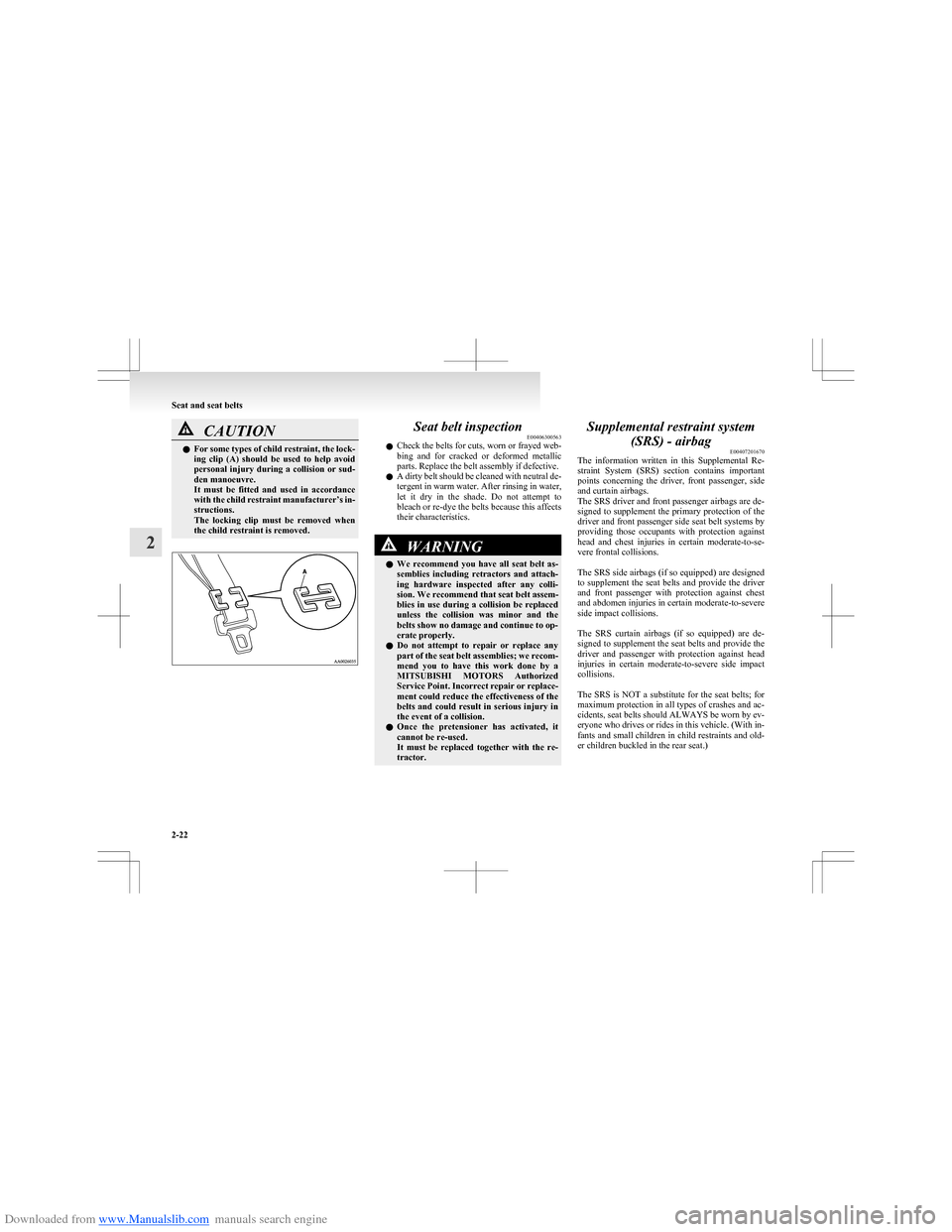
Downloaded from www.Manualslib.com manuals search engine CAUTIONlFor some types of child restraint, the lock-
ing clip (A) should be used to help avoid
personal injury during a collision or sud-
den manoeuvre.
It must be fitted and used in accordance
with the child restraint manufacturer’s in-
structions.
The locking clip must be removed when
the child restraint is removed.Seat belt inspection E00406300563
l Check the belts for cuts, worn or frayed web-
bing and for cracked or deformed metallic
parts. Replace the belt assembly if defective.
l A dirty belt should be cleaned with neutral de-
tergent in warm water. After rinsing in water,
let it dry in the shade. Do not attempt to
bleach or re-dye the belts because this affects
their characteristics.WARNINGl We recommend you have all seat belt as-
semblies including retractors and attach-
ing hardware inspected after any colli-
sion. We recommend that seat belt assem-
blies in use during a collision be replaced
unless the collision was minor and the
belts show no damage and continue to op-
erate properly.
l Do not attempt to repair or replace any
part of the seat belt assemblies; we recom-
mend you to have this work done by a
MITSUBISHI MOTORS Authorized
Service Point. Incorrect repair or replace-
ment could reduce the effectiveness of the
belts and could result in serious injury in
the event of a collision.
l Once the pretensioner has activated, it
cannot be re-used.
It must be replaced together with the re-
tractor.Supplemental restraint system
(SRS) - airbag E00407201670
The information written in this Supplemental Re-
straint System (SRS) section contains important
points concerning the driver, front passenger, side
and curtain airbags.
The SRS driver and front passenger airbags are de-
signed to supplement the primary protection of the
driver and front passenger side seat belt systems by
providing those occupants with protection against
head and chest injuries in certain moderate-to-se-
vere frontal collisions.
The SRS side airbags (if so equipped) are designed
to supplement the seat belts and provide the driver
and front passenger with protection against chest
and abdomen injuries in certain moderate-to-severe
side impact collisions.
The SRS curtain airbags (if so equipped) are de-
signed to supplement the seat belts and provide the
driver and passenger with protection against head
injuries in certain moderate-to-severe side impact
collisions.
The SRS is NOT a substitute for the seat belts; for
maximum protection in all types of crashes and ac-
cidents, seat belts should ALWAYS be worn by ev-
eryone who drives or rides in this vehicle. (With in-
fants and small children in child restraints and old-
er children buckled in the rear seat.)
Seat and seat belts
2-22
2
Page 62 of 273
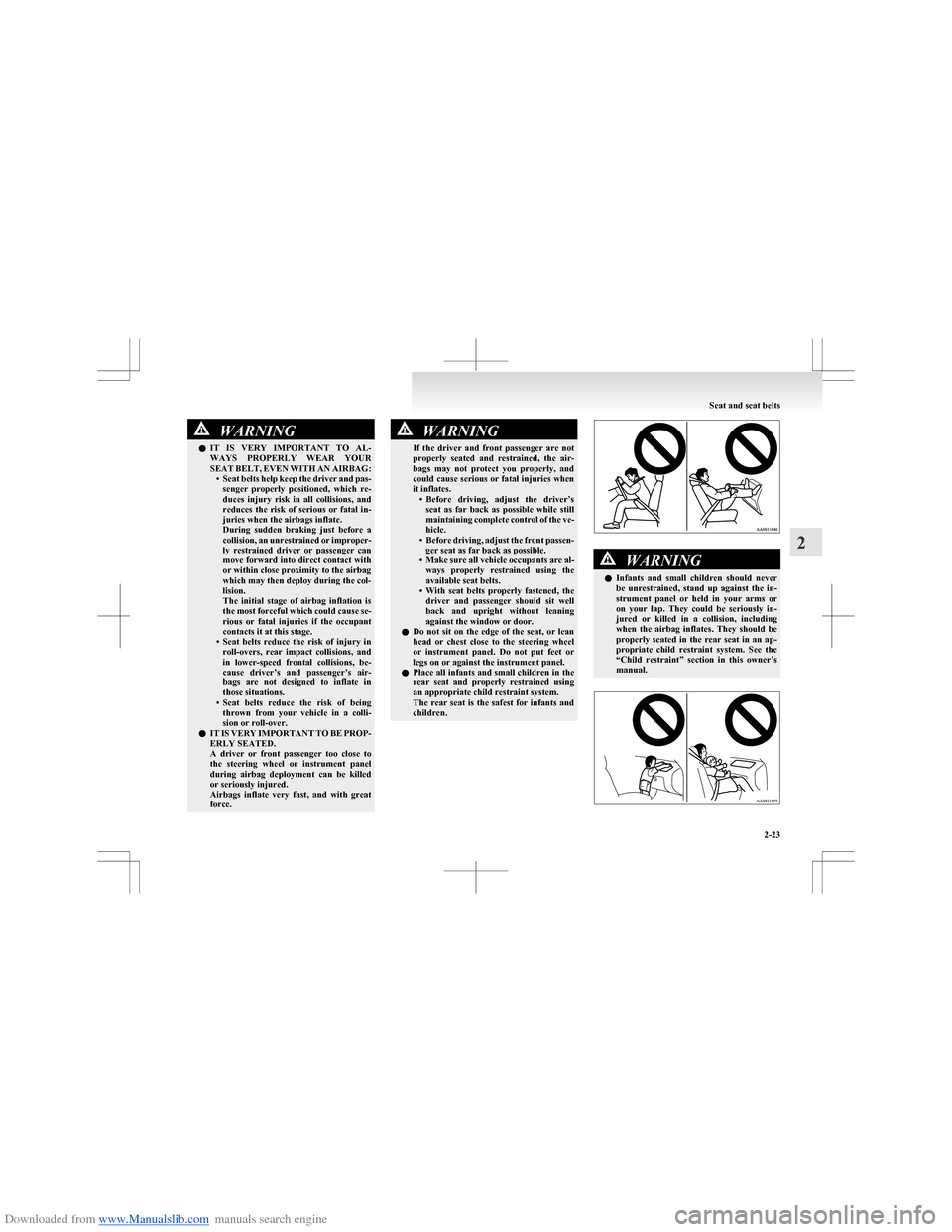
Downloaded from www.Manualslib.com manuals search engine WARNINGlIT IS VERY IMPORTANT TO AL-
WAYS PROPERLY WEAR YOUR
SEAT BELT, EVEN WITH AN AIRBAG: •Seat belts help keep the driver and pas-
senger properly positioned, which re-
duces injury risk in all collisions, and
reduces the risk of serious or fatal in-
juries when the airbags inflate.
During sudden braking just before a
collision, an unrestrained or improper-
ly restrained driver or passenger can
move forward into direct contact with
or within close proximity to the airbag
which may then deploy during the col-
lision.
The initial stage of airbag inflation is
the most forceful which could cause se-
rious or fatal injuries if the occupant
contacts it at this stage.
• Seat belts reduce the risk of injury in
roll-overs, rear impact collisions, and
in lower-speed frontal collisions, be-
cause driver’s and passenger’s air-
bags are not designed to inflate in
those situations.
• Seat belts reduce the risk of being
thrown from your vehicle in a colli-
sion or roll-over.
l IT IS VERY IMPORTANT TO BE PROP-
ERLY SEATED.
A driver or front passenger too close to
the steering wheel or instrument panel
during airbag deployment can be killed
or seriously injured.
Airbags inflate very fast, and with great
force.WARNINGIf the driver and front passenger are not
properly seated and restrained, the air-
bags may not protect you properly, and
could cause serious or fatal injuries when
it inflates. •Before driving, adjust the driver’s
seat as far back as possible while still
maintaining complete control of the ve-
hicle.
• Before driving, adjust the front passen-
ger seat as far back as possible.
• Make sure all vehicle occupants are al-
ways properly restrained using the
available seat belts.
• With seat belts properly fastened, the
driver and passenger should sit well
back and upright without leaning
against the window or door.
l Do not sit on the edge of the seat, or lean
head or chest close to the steering wheel
or instrument panel. Do not put feet or
legs on or against the instrument panel.
l Place all infants and small children in the
rear seat and properly restrained using
an appropriate child restraint system.
The rear seat is the safest for infants and
children.WARNINGl Infants and small children should never
be unrestrained, stand up against the in-
strument panel or held in your arms or
on your lap. They could be seriously in-
jured or killed in a collision, including
when the airbag inflates. They should be
properly seated in the rear seat in an ap-
propriate child restraint system. See the
“Child restraint” section in this owner’s
manual.
Seat and seat belts
2-23
2
Page 63 of 273
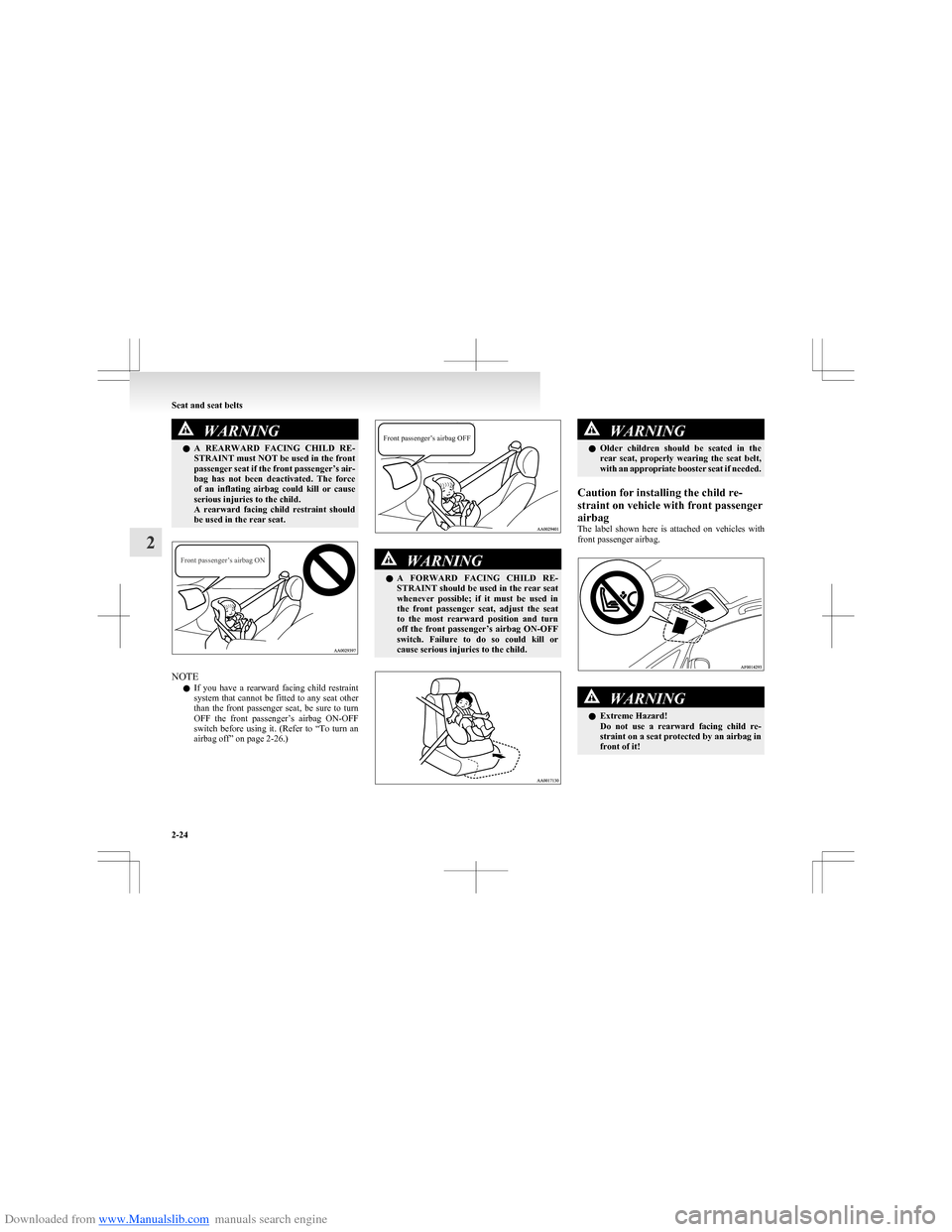
Downloaded from www.Manualslib.com manuals search engine WARNINGlA REARWARD FACING CHILD RE-
STRAINT must NOT be used in the front
passenger seat if the front passenger’s air-
bag has not been deactivated. The force
of an inflating airbag could kill or cause
serious injuries to the child.
A rearward facing child restraint should
be used in the rear seat.Front passenger’s airbag ON
NOTE
l If you have a rearward facing child restraint
system that cannot be fitted to any seat other
than the front passenger seat, be sure to turn
OFF the front passenger’s airbag ON-OFF
switch before using it. (Refer to “To turn an
airbag off” on page 2-26.)
Front passenger’s airbag OFF
WARNINGl A FORWARD FACING CHILD RE-
STRAINT should be used in the rear seat
whenever possible; if it must be used in
the front passenger seat, adjust the seat
to the most rearward position and turn
off the front passenger’s airbag ON-OFF
switch. Failure to do so could kill or
cause serious injuries to the child.WARNINGl Older children should be seated in the
rear seat, properly wearing the seat belt,
with an appropriate booster seat if needed.
Caution for installing the child re-
straint on vehicle with front passenger
airbag
The label shown here is attached on vehicles with
front passenger airbag.
WARNINGl Extreme Hazard!
Do not use a rearward facing child re-
straint on a seat protected by an airbag in
front of it!
Seat and seat belts
2-24
2
Page 65 of 273
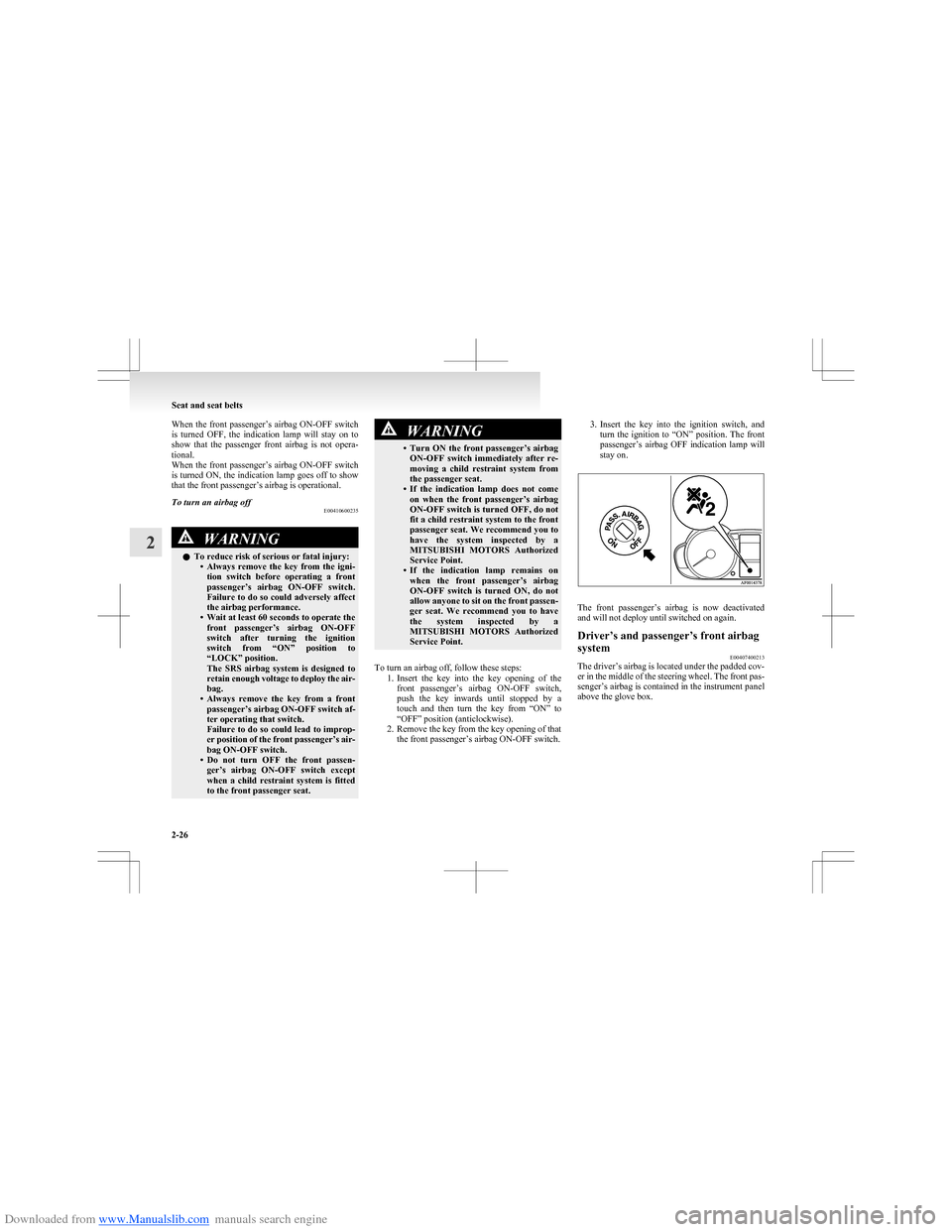
Downloaded from www.Manualslib.com manuals search engine When the front passenger’s airbag ON-OFF switch
is turned OFF, the indication lamp will stay on to
show that the passenger front airbag is not opera-
tional.
When the front passenger’s airbag ON-OFF switch
is turned ON, the indication lamp goes off to show
that the front passenger’s airbag is operational.To turn an airbag off E00410600235WARNINGlTo reduce risk of serious or fatal injury:
•Always remove the key from the igni-
tion switch before operating a front
passenger’s airbag ON-OFF switch.
Failure to do so could adversely affect
the airbag performance.
• Wait at least 60 seconds to operate the
front passenger’s airbag ON-OFF
switch after turning the ignition
switch from “ON” position to
“LOCK” position.
The SRS airbag system is designed to
retain enough voltage to deploy the air-
bag.
• Always remove the key from a front
passenger’s airbag ON-OFF switch af-
ter operating that switch.
Failure to do so could lead to improp-
er position of the front passenger’s air-
bag ON-OFF switch.
• Do not turn OFF the front passen-
ger’s airbag ON-OFF switch except
when a child restraint system is fitted
to the front passenger seat.WARNING• Turn ON the front passenger’s airbag
ON-OFF switch immediately after re-
moving a child restraint system from
the passenger seat.
• If the indication lamp does not come
on when the front passenger’s airbag
ON-OFF switch is turned OFF, do not
fit a child restraint system to the front
passenger seat. We recommend you to
have the system inspected by a
MITSUBISHI MOTORS Authorized
Service Point.
• If the indication lamp remains on
when the front passenger’s airbag
ON-OFF switch is turned ON, do not
allow anyone to sit on the front passen-
ger seat. We recommend you to have
the system inspected by a
MITSUBISHI MOTORS Authorized
Service Point.
To turn an airbag off, follow these steps: 1.Insert the key into the key opening of the
front passenger’s airbag ON-OFF switch,
push the key inwards until stopped by a
touch and then turn the key from “ON” to
“OFF” position (anticlockwise).
2. Remove the key from the key opening of that the front passenger’s airbag ON-OFF switch.
3.Insert the key into the ignition switch, and
turn the ignition to “ON” position. The front
passenger’s airbag OFF indication lamp will
stay on.
The front passenger’s airbag is now deactivated
and will not deploy until switched on again.
Driver’s and passenger’s front airbag
system E00407400213
The driver’s airbag is located under the padded cov-
er in the middle of the steering wheel. The front pas-
senger’s airbag is contained in the instrument panel
above the glove box.
Seat and seat belts
2-26
2
Page 68 of 273
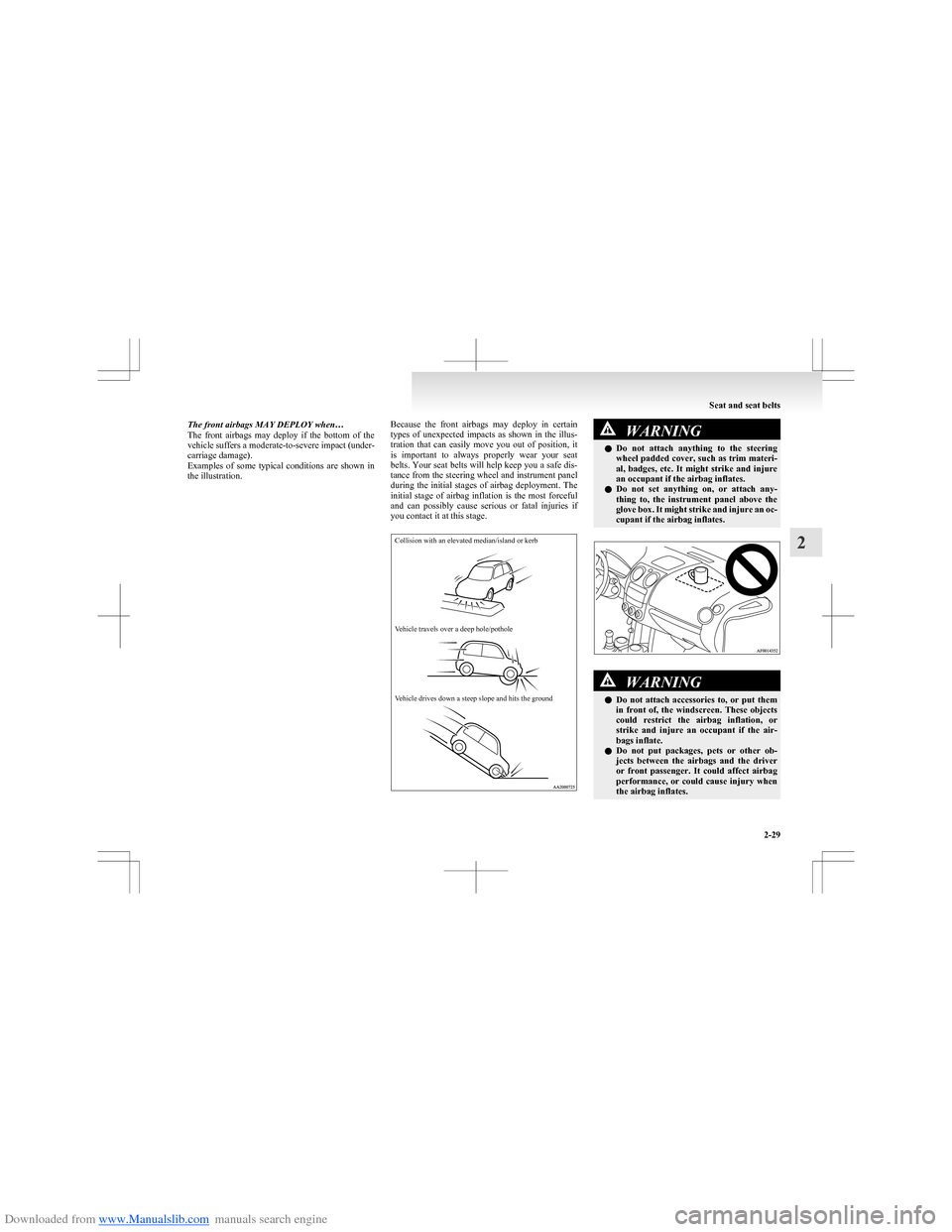
Downloaded from www.Manualslib.com manuals search engine The front airbags MAY DEPLOY when…
The front airbags may deploy if the bottom of the
vehicle suffers a moderate-to-severe impact (under-
carriage damage).
Examples of some typical conditions are shown in
the illustration.
Because the front airbags may deploy in certain
types of unexpected impacts as shown in the illus-
tration that can easily move you out of position, it
is important to always properly wear your seat
belts. Your seat belts will help keep you a safe dis-
tance from the steering wheel and instrument panel
during the initial stages of airbag deployment. The
initial stage of airbag inflation is the most forceful
and can possibly cause serious or fatal injuries if
you contact it at this stage.Collision with an elevated median/island or kerbVehicle travels over a deep hole/potholeVehicle drives down a steep slope and hits the ground
WARNINGl Do not attach anything to the steering
wheel padded cover, such as trim materi-
al, badges, etc. It might strike and injure
an occupant if the airbag inflates.
l Do not set anything on, or attach any-
thing to, the instrument panel above the
glove box. It might strike and injure an oc-
cupant if the airbag inflates.WARNINGl Do not attach accessories to, or put them
in front of, the windscreen. These objects
could restrict the airbag inflation, or
strike and injure an occupant if the air-
bags inflate.
l Do not put packages, pets or other ob-
jects between the airbags and the driver
or front passenger. It could affect airbag
performance, or could cause injury when
the airbag inflates.
Seat and seat belts
2-29
2
Page 69 of 273
Downloaded from www.Manualslib.com manuals search engine WARNINGlRight after the airbag inflation, several
airbag system components will be hot. Do
not touch them; you could be burned.
l The airbag system is designed to work on-
ly once. Once the airbags have deployed,
they will not work again. They must
promptly be replaced, and we recom-
mend you to have the entire airbag sys-
tem inspected by a MITSUBISHI
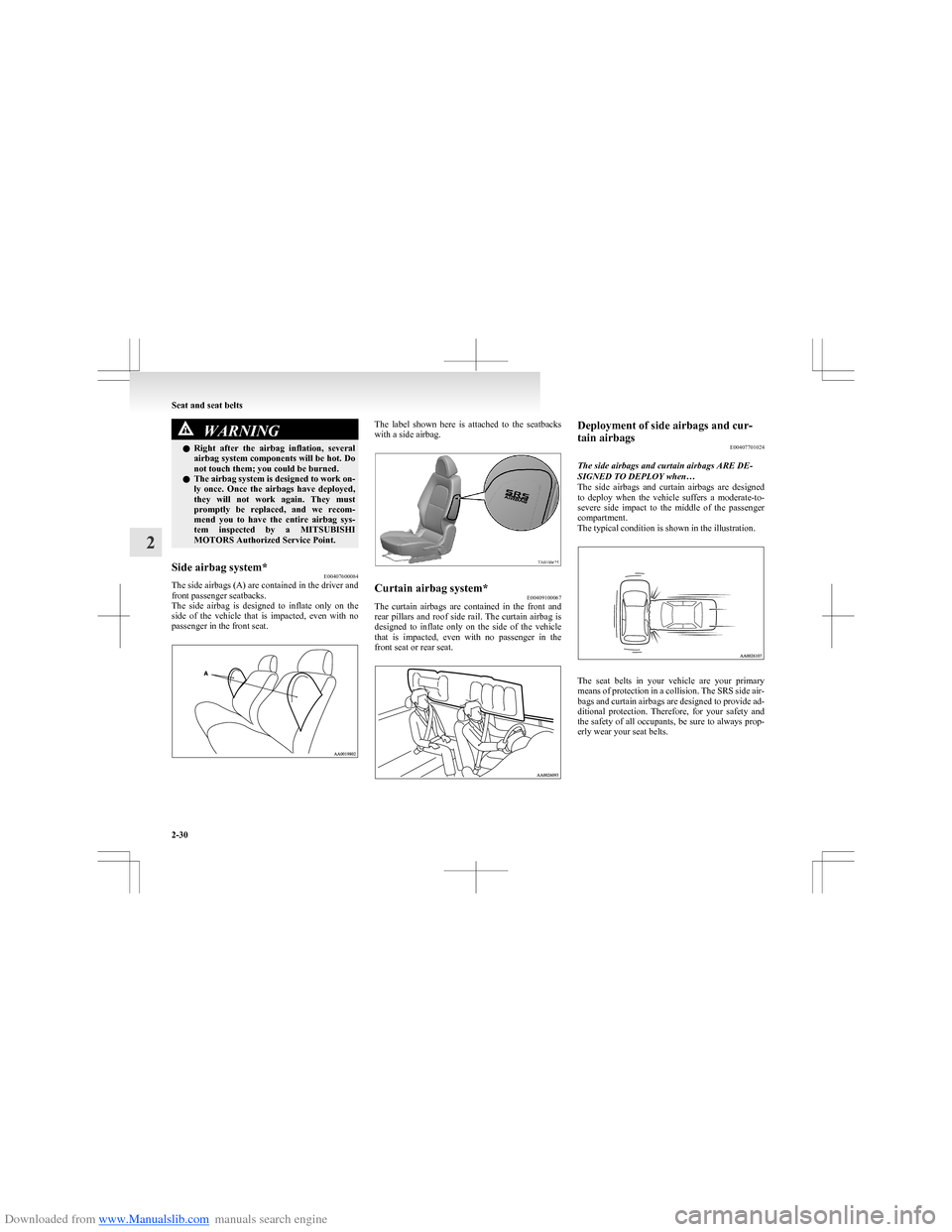
MOTORS Authorized Service Point.Side airbag system* E00407600084
The side airbags (A) are contained in the driver and
front passenger seatbacks.
The side airbag is designed to inflate only on the
side of the vehicle that is impacted, even with no
passenger in the front seat.
The label shown here is attached to the seatbacks
with a side airbag.Curtain airbag system* E00409100067
The curtain airbags are contained in the front and
rear pillars and roof side rail. The curtain airbag is
designed to inflate only on the side of the vehicle
that is impacted, even with no passenger in the
front seat or rear seat.
Deployment of side airbags and cur-
tain airbags E00407701024
The side airbags and curtain airbags ARE DE-
SIGNED TO DEPLOY when…
The side airbags and curtain airbags are designed
to deploy when the vehicle suffers a moderate-to-
severe side impact to the middle of the passenger
compartment.
The typical condition is shown in the illustration.
The seat belts in your vehicle are your primary
means of protection in a collision. The SRS side air-
bags and curtain airbags are designed to provide ad-
ditional protection. Therefore, for your safety and
the safety of all occupants, be sure to always prop-
erly wear your seat belts.
Seat and seat belts
2-30
2
Page 71 of 273
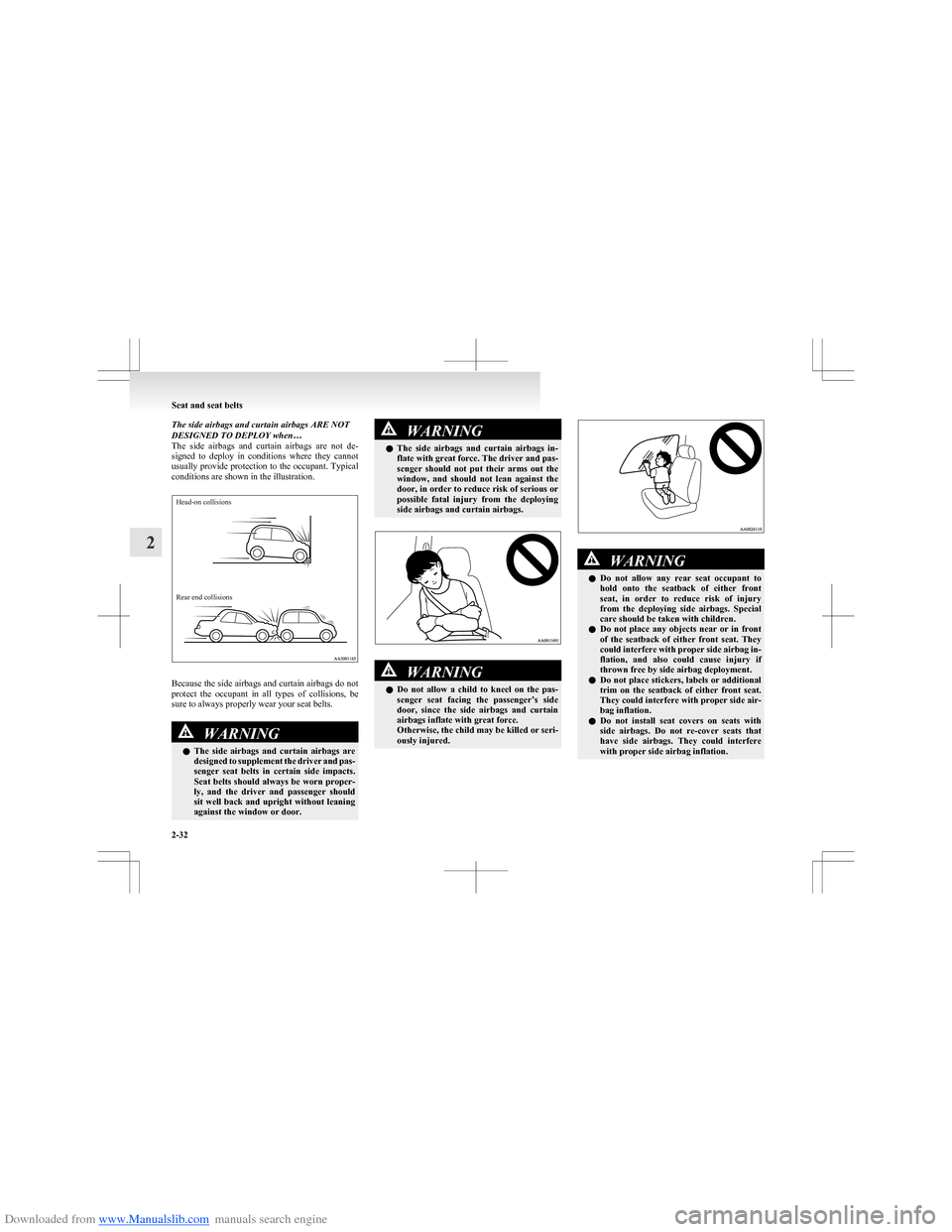
Downloaded from www.Manualslib.com manuals search engine The side airbags and curtain airbags ARE NOT
DESIGNED TO DEPLOY when…
The side airbags and curtain airbags are not de-
signed to deploy in conditions where they cannot
usually provide protection to the occupant. Typical
conditions are shown in the illustration.Head-on collisionsRear end collisions
Because the side airbags and curtain airbags do not
protect the occupant in all types of collisions, be
sure to always properly wear your seat belts.
WARNINGl The side airbags and curtain airbags are
designed to supplement the driver and pas-
senger seat belts in certain side impacts.
Seat belts should always be worn proper-
ly, and the driver and passenger should
sit well back and upright without leaning
against the window or door.WARNINGl The side airbags and curtain airbags in-
flate with great force. The driver and pas-
senger should not put their arms out the
window, and should not lean against the
door, in order to reduce risk of serious or
possible fatal injury from the deploying
side airbags and curtain airbags.WARNINGl Do not allow a child to kneel on the pas-
senger seat facing the passenger’s side
door, since the side airbags and curtain
airbags inflate with great force.
Otherwise, the child may be killed or seri-
ously injured.WARNINGl Do not allow any rear seat occupant to
hold onto the seatback of either front
seat, in order to reduce risk of injury
from the deploying side airbags. Special
care should be taken with children.
l Do not place any objects near or in front
of the seatback of either front seat. They
could interfere with proper side airbag in-
flation, and also could cause injury if
thrown free by side airbag deployment.
l Do not place stickers, labels or additional
trim on the seatback of either front seat.
They could interfere with proper side air-
bag inflation.
l Do not install seat covers on seats with
side airbags. Do not re-cover seats that
have side airbags. They could interfere
with proper side airbag inflation.
Seat and seat belts
2-32
2