vehicle care MITSUBISHI ECLIPSE CROSS 2018 Owner's Manual (in English)
[x] Cancel search | Manufacturer: MITSUBISHI, Model Year: 2018, Model line: ECLIPSE CROSS, Model: MITSUBISHI ECLIPSE CROSS 2018Pages: 417, PDF Size: 74.06 MB
Page 2 of 417
Table of contents
123456789101112
Overview Quick indexGeneral information Seat and restraint systems Features and controlsDriving safetyComfort controlsFor emergenciesVehicle care and maintenance Customer assistance/
Reporting Safety Defects
Specifications Alphabetical index
BK0252700US.bo
ok 1 ページ 2017年10月4日 水曜日 午後4時54分
Page 14 of 417
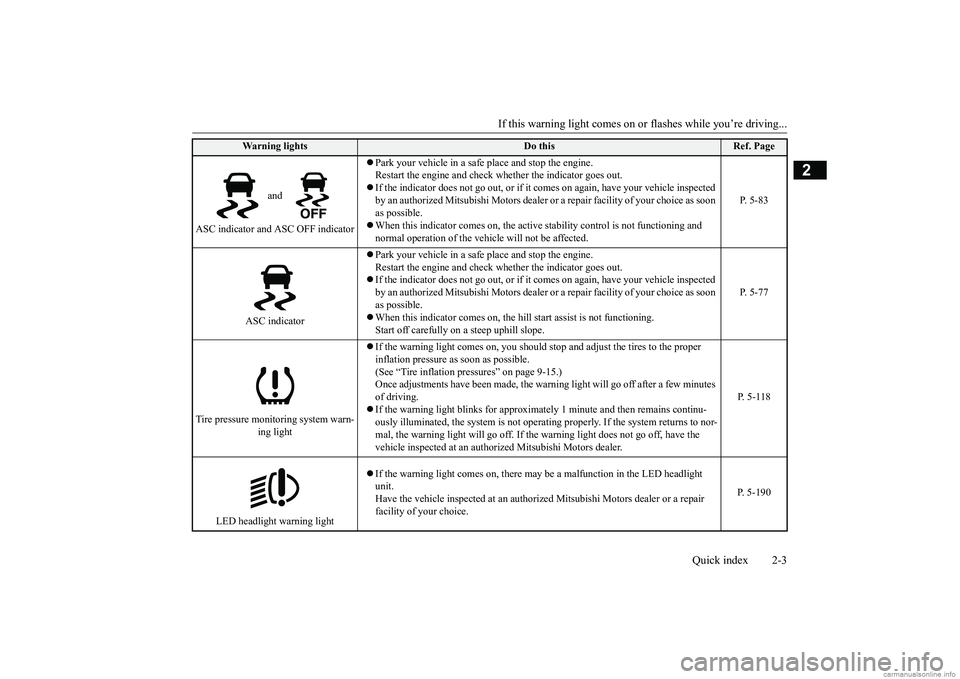
If this warning light comes on or
flashes while you’re driving...
Quick index 2-3
2
and
ASC indicator and ASC OFF indicator
Park your vehicle in a safe place and stop the engine. Restart the engine and check whether the indicator goes out. If the indicator does not go out, or if it
comes on again, have your vehicle inspected
by an authorized Mitsubishi Motors dealer or
a repair facility of your choice as soon
as possible. When this indicator comes on, the active
stability control is not functioning and
normal operation of the vehicle will not be affected.
P. 5-83
ASC indicator
Park your vehicle in a safe place and stop the engine. Restart the engine and check whether the indicator goes out. If the indicator does not go out, or if it
comes on again, have your vehicle inspected
by an authorized Mitsubishi Motors dealer or
a repair facility of your choice as soon
as possible. When this indicator comes on, the hi
ll start assist is not functioning.
Start off carefully on a steep uphill slope.
P. 5-77
Tire pressure monitoring system warn-
ing light
If the warning light comes on, you should stop and adjust the tires to the proper inflation pressure as soon as possible. (See “Tire inflation pressures” on page 9-15.)Once adjustments have been made, the warning light will go off after a few minutes of driving. If the warning light blinks for approxim
ately 1 minute and then remains continu-
ously illuminated, the system is not operatin
g properly. If the system returns to nor-
mal, the warning light will go off. If
the warning light does not go off, have the
vehicle inspected at an authori
zed Mitsubishi Motors dealer.
P. 5-118
LED headlight warning light
If the warning light comes on, there may be
a malfunction in the LED headlight
unit. Have the vehicle inspected at an authorized
Mitsubishi Motors dealer or a repair
facility of your choice.
P. 5-190
Wa r n i n g l i g h t s
Do this
Ref. Page
BK0252700US.bo
ok 3 ページ 2017年10月4日 水曜日 午後4時54分
Page 17 of 417
If this problem occurs... 2-6 Quick index
2
Problem
Do this
Ref. Page
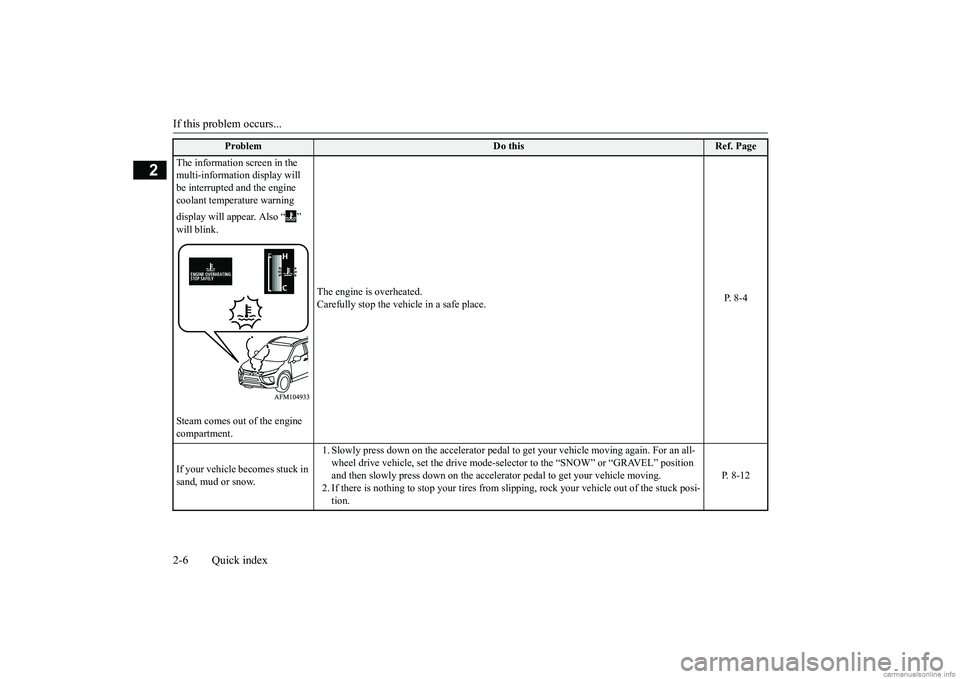
The information screen in the multi-information display will be interrupted and the engine coolant temperature warning display will appear. Also “ ” will blink. Steam comes out of the engine compartment.
The engine is overheated. Carefully stop the vehicle in a safe place.
P. 8-4
If your vehicle becomes stuck in sand, mud or snow.
1. Slowly press down on the accelerator pedal to
get your vehicle moving again. For an all-
wheel drive vehicle, set the drive mode-sel
ector to the “SNOW” or “GRAVEL” position
and then slowly press down on the accelerat
or pedal to get your vehicle moving.
2. If there is nothing to stop your tires from sli
pping, rock your vehicle out of the stuck posi-
tion.
P. 8-12
BK0252700US.bo
ok 6 ページ 2017年10月4日 水曜日 午後4時54分
Page 23 of 417
Filling the fuel tank 3-4 General information
3
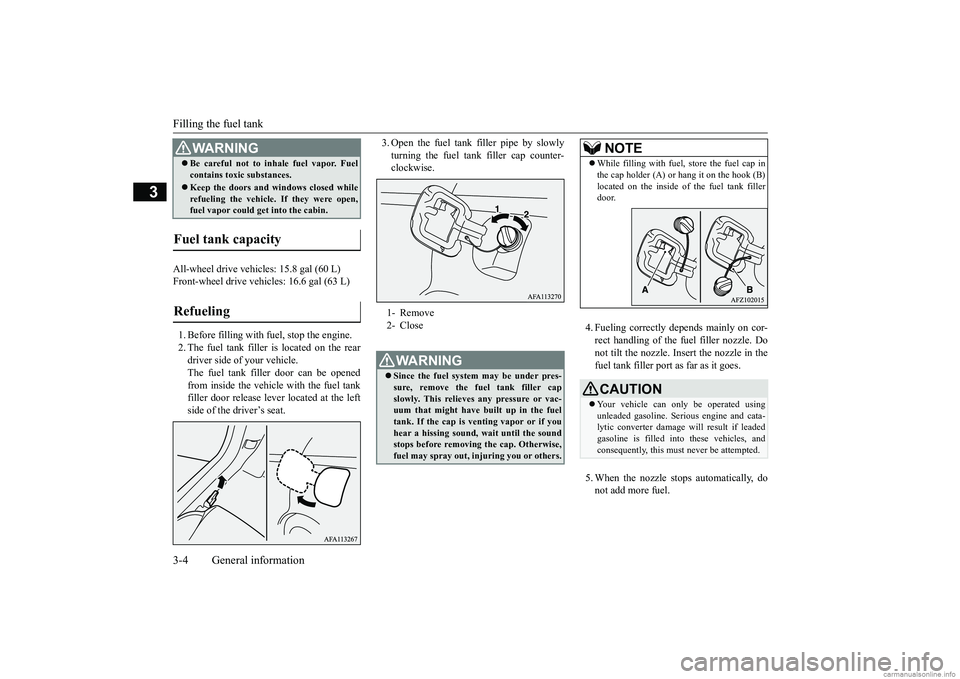
All-wheel drive vehicles: 15.8 gal (60 L) Front-wheel drive vehicles: 16.6 gal (63 L) 1. Before filling with fuel, stop the engine. 2. The fuel tank filler is located on the rear driver side of your vehicle. The fuel tank filler door can be openedfrom inside the vehicle with the fuel tank filler door release le
ver located at the left
side of the driver’s seat.
3. Open the fuel tank filler pipe by slowly turning the fuel tank filler cap counter- clockwise.
4. Fueling correctly depends mainly on cor- rect handling of the fuel filler nozzle. Do not tilt the nozzle. Insert the nozzle in thefuel tank filler port as far as it goes. 5. When the nozzle stops automatically, do not add more fuel.
Be careful not to inhale fuel vapor. Fuel contains toxic substances. Keep the doors and windows closed while refueling the vehicle. If they were open,fuel vapor could get into the cabin.
Fuel tank capacity Refueling
WA R N I N G
1- Remove 2- CloseWA R N I N G Since the fuel system may be under pres- sure, remove the fuel tank filler cap slowly. This relieves any pressure or vac- uum that might have built up in the fueltank. If the cap is venting vapor or if you hear a hissing sound, wait until the sound stops before removing the cap. Otherwise,fuel may spray out, injuring you or others.
NOTE
While filling with fuel, store the fuel cap in the cap holder (A) or hang it on the hook (B) located on the inside of the fuel tank filler door.CAUTION Your vehicle can only be operated using unleaded gasoline. Serious engine and cata- lytic converter damage will result if leadedgasoline is filled into these vehicles, and consequently, this must never be attempted.
BK0252700US.bo
ok 4 ページ 2017年10月4日 水曜日 午後4時54分
Page 30 of 417
Telematics Control Unit (TCU) (if so equipped)
General information 3-11
3
Geo-fence If the specified area is set beforehand using the smartphone app, an alert is sent to the smartphone using a short messageservice (SMS), e-mail, or push notifica- tion when the vehicle enters or leaves that area. Curfew If the specified time of day is set before- hand using the smartphone app, an alert issent to the smartphone using a short mes-sage service (SMS), e-mail, or push noti- fication when the curfew is violated. Vehicle settings You can change settings of items such as “Auto Fold Mirrors” and “Headlight Timeout when Exiting Vehicle” from thesmartphone app.
Model name: LE920A4-NA Auto FCC ID: RI7LE920A4NAYour TCU operates on a radio frequency sub-ject to Federal Communications Commission (FCC) Rules (for vehicles sold in U.S.A.). This device complies with Part 15 of the FCCRules. Operation is subject to the following two conditions: This device may not cause harmful inter- ference. This device must accept any interference received, including interference that may cause undesired operation.
FCC Notice: This equipment has been tested and found to comply with the limits for a Class B digital device, pursuant to part 15 of
WA R N I N G Do not use the TCU if children, persons in need of care, pets, etc., are in the vehicle. Even if the remote climate control is used, the cabin may become too hot or cold if the system stops automatically or due tosome other reason. The cabin temperature may quickly rise in sunshine, which poses a risk of heat stroke and dehydration. Incold weather, on the other hand, the cabin temperature may quickly drop. Either of which could lead to death in the worstcase. In addition, children can activate switches and controls, resulting in an injury orfatal accident.CAUTION When using the remote climate control, do not use a car cover.NOTE
Air conditioning performance may deterio- rate under the following conditions: • In extremely hot weather • In hot sunshine • In extremely cold weather The remote climate control turns off auto- matically after approximately 10 minutes.The remote climate control can be operated up to two times consecutively.
Use the remote climate control according to the state or local regulations regarding idling vehicles.
General information
CAUTION Changes or modifications made to this equipment not expressly approved by themanufacturer may void the FCC authoriza- tion to operate this equipment.NOTE
BK0252700US.bo
ok 11 ページ 2017年10月4日 水曜日 午後4時54分
Page 33 of 417
Break-in recommendations 3-14 General information
3
However, you can add to the future perfor- mance and economy of your vehicle by observing the follow
ing precautions during
the first 300 miles (500 km).Drive your vehicle at moderate speeds during the break-in period. Avoid revving the engine. Avoid rough driving such as sudden starts, sudden acceleration, prolonged high- speed driving and sudden braking. These actions would have a detrimental effect onthe engine and lead to increased fuel andoil consumption; this could ultimately result in the malfunction of engine com- ponents. Be particularly careful to avoidfull acceleration while in low shift posi- tion (low gears). Do not overload the vehicle. Stay within the seating capacity. Refer to “Cargo load precautions” on page 6-10. Refrain from towing a trailer or other vehicle. Refer to “Trailer towing” on page 6-11.
BK0252700US.bo
ok 14 ページ 2017年10月4日 水曜日 午後4時54分
Page 36 of 417
Seats and restraint systems
Seat and restraint systems 4-3
4
N00401601277
Your vehicle has seat belts and other safety
features that help protect you and your pas-
sengers in an accident.
Seat belts are the most important safety
device. When worn properly, seat belts can
reduce the chance of serious injury or death
in various types of crashes. For added protec-
tion during a severe frontal collision, your
vehicle has a Supplemental Restraint System
(SRS) with airbags for the driver and passen-
gers. The seats, head restraints, and door
locks also are safety equipment, which must
be used correctly.
Always check the following before you drive: That everyone in your vehicle is properly
wearing their seat belt.
That infants and small children are prop-
erly secured in an appropriate child
restraint system in the rear seat.
That all doors are fully closed and locked.
That seatbacks are upright, with head
restraints properly adjusted.
Safety equipment cannot prevent injury or
death in all motor vehicle accidents. How-
ever, you can help reduce the risk of injury or
death, by following the instructions in this
manual.
N00401801484
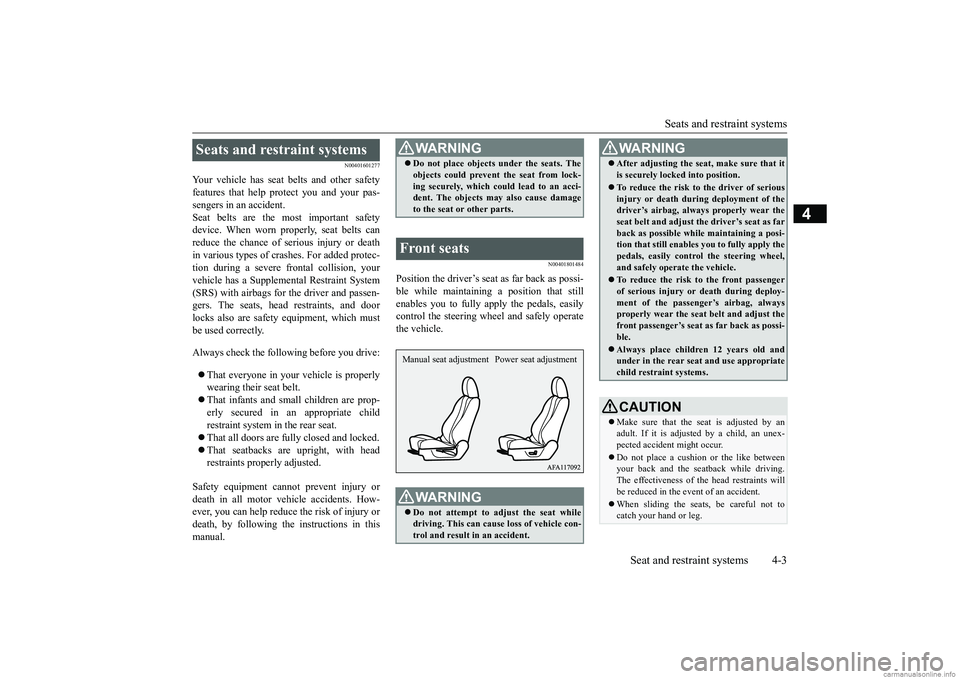
Position the driver’s seat as far back as possi-
ble while maintaining a position that still
enables you to fully apply the pedals, easily
control the steering wheel and safely operate
the vehicle.
Seats and restraint systems
WA R N I N G Do not place objects under the seats. The
objects could prevent the seat from lock-
ing securely, which could lead to an acci-
dent. The objects ma y also cause damage
to the seat or other parts.Front seats
WA R N I N G Do not attempt to adjust the seat while
driving. This can cause loss of vehicle con-
trol and result in an accident.Manual seat adjustment Power seat adjustment
After adjusting the seat, make sure that it
is securely locked into position.To reduce the risk to the driver of serious
injury or death during deployment of the
driver’s airbag, always properly wear the
seat belt and adjust th e driver’s seat as far
back as possible while maintaining a posi-
tion that still enables you to fully apply the
pedals, easily control the steering wheel,
and safely operate the vehicle. To reduce the risk to the front passenger
of serious injury or death during deploy-
ment of the passenger’s airbag, always
properly wear the seat belt and adjust the
front passenger’s seat as far back as possi-
ble.Always place children 12 years old and
under in the rear seat and use appropriate
child restraint systems.CAUTIONMake sure that the seat is adjusted by an
adult. If it is adjusted by a child, an unex-
pected accident might occur.Do not place a cushion or the like between
your back and the seatback while driving.
The effectiveness of the head restraints will
be reduced in the event of an accident.When sliding the seats, be careful not to
catch your hand or leg.WA R N I N G
BK0252700US.book 3 ページ 2017年10月5日 木曜日 午後6時49分
Page 37 of 417
Front seats 4-4 Seat and restraint systems
4
N00401901397
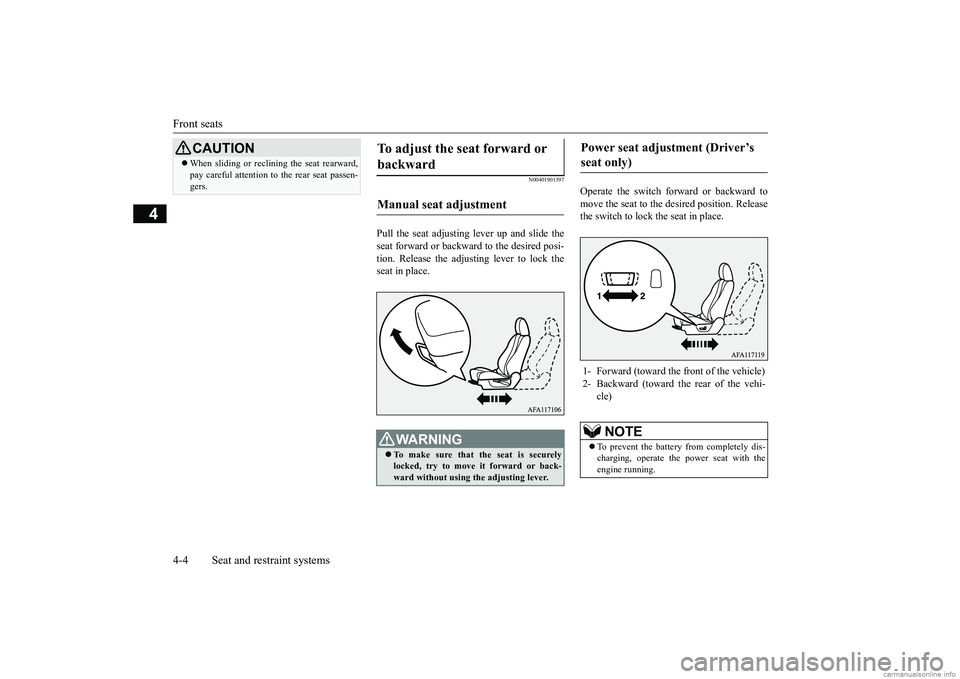
Pull the seat adjusting lever up and slide the seat forward or backward to the desired posi- tion. Release the adjusting lever to lock the seat in place.
Operate the switch forward or backward to move the seat to the desired position. Release the switch to lock the seat in place.
When sliding or reclining the seat rearward, pay careful attention to the rear seat passen- gers.CAUTION
To adjust the seat forward or backward Manual seat adjustment
WA R N I N G To make sure that the seat is securely locked, try to move it forward or back- ward without using the adjusting lever.
Power seat adjustment (Driver’s seat only) 1- Forward (toward the front of the vehicle) 2- Backward (toward the rear of the vehi-
cle)NOTE
To prevent the battery from completely dis- charging, operate the power seat with theengine running.
BK0252700US.bo
ok 4 ページ 2017年10月4日 水曜日 午後4時54分
Page 45 of 417
Making a cargo area 4-12 Seat and restraint systems
4
N00405501131
N00405701162
The rear seatbacks can be folded forward to create an additional cargo area. 1. When folding the left side rear seat, store the seat belt for the
center seating position
of the rear seat. Refer to “Detachable rear center seat belt” on page 4-17.
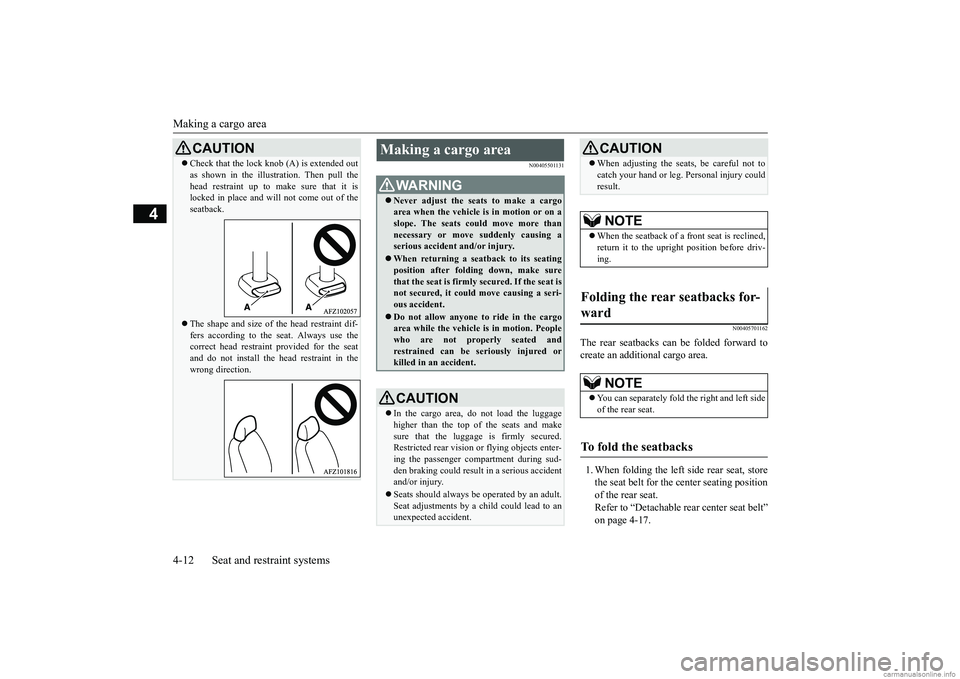
CAUTION Check that the lock knob (A) is extended out as shown in the illustration. Then pull the head restraint up to make sure that it is locked in place and will not come out of the seatback. The shape and size of the head restraint dif- fers according to the seat. Always use the correct head restraint provided for the seatand do not install the head restraint in the wrong direction.
Making a cargo area
WA R N I N G Never adjust the seats to make a cargo area when the vehicle is in motion or on a slope. The seats could move more than necessary or move suddenly causing aserious accident and/or injury. When returning a seatback to its seating position after folding down, make sure that the seat is firmly secured. If the seat is not secured, it could move causing a seri-ous accident. Do not allow anyone to ride in the cargo area while the vehicle is in motion. People who are not properly seated and restrained can be seriously injured orkilled in an accident.CAUTION In the cargo area, do not load the luggage higher than the top of the seats and makesure that the luggage is firmly secured. Restricted rear vision or flying objects enter- ing the passenger compartment during sud- den braking could result in a serious accident and/or injury. Seats should always be operated by an adult. Seat adjustments by a child could lead to anunexpected accident.
When adjusting the seats, be careful not to catch your hand or leg. Personal injury could result.NOTE
When the seatback of a front seat is reclined, return it to the upright position before driv- ing.
Folding the rear seatbacks for- ward
NOTE
You can separately fold the right and left side of the rear seat.
To fold the seatbacks
CAUTION
BK0252700US.bo
ok 12 ページ 2017年10月4日 水曜日 午後4時54分
Page 46 of 417
Seat belts
Seat and restraint systems 4-13
4
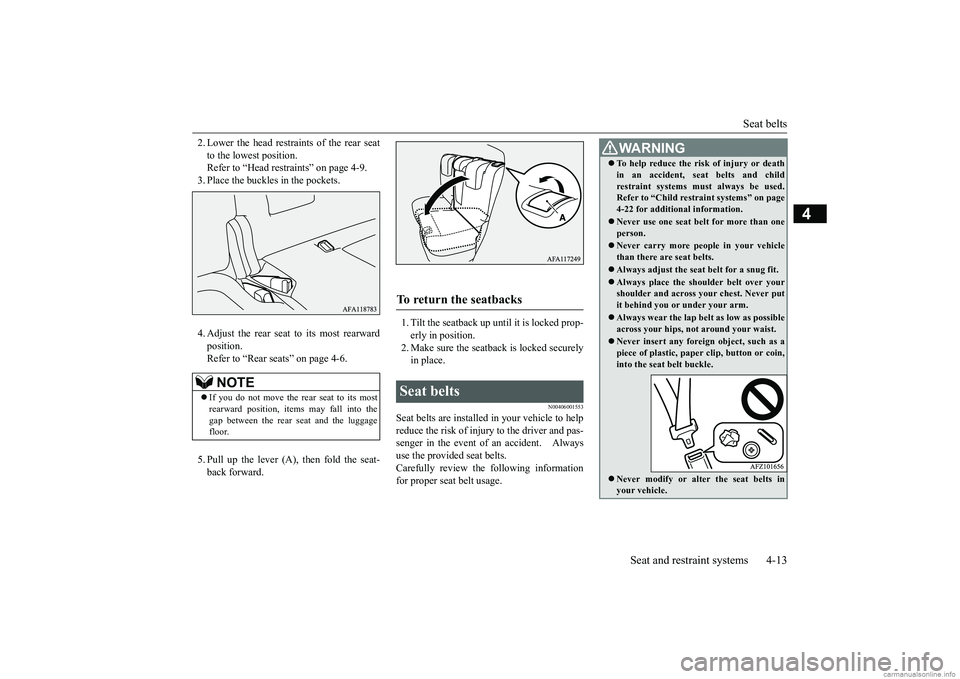
2. Lower the head restraints of the rear seat to the lowest position. Refer to “Head restraints” on page 4-9. 3. Place the buckles in the pockets. 4. Adjust the rear seat to its most rearward position. Refer to “Rear seats” on page 4-6. 5. Pull up the lever (A), then fold the seat- back forward.
1. Tilt the seatback up until it is locked prop- erly in position.2. Make sure the seatback is locked securely in place.
N00406001553
Seat belts are installed in your vehicle to help reduce the risk of injury to the driver and pas- senger in the event of an accident. Always use the provided seat belts.Carefully review the following information for proper seat belt usage.
NOTE
If you do not move the rear seat to its most rearward position, items may fall into the gap between the rear seat and the luggagefloor.
To return the seatbacks Seat belts
WA R N I N G To help reduce the risk of injury or death in an accident, seat belts and child restraint systems must always be used. Refer to “Child restraint systems” on page 4-22 for additional information. Never use one seat belt for more than one person. Never carry more people in your vehicle than there are seat belts. Always adjust the seat belt for a snug fit.Always place the shoulder belt over your shoulder and across your chest. Never put it behind you or under your arm. Always wear the lap belt as low as possible across your hips, not around your waist. Never insert any foreign object, such as a piece of plastic, paper clip, button or coin,into the seat belt buckle. Never modify or alter the seat belts in your vehicle.
BK0252700US.bo
ok 13 ページ 2017年10月4日 水曜日 午後4時54分