engine MITSUBISHI ENDEAVOR 2004 Service User Guide
[x] Cancel search | Manufacturer: MITSUBISHI, Model Year: 2004, Model line: ENDEAVOR, Model: MITSUBISHI ENDEAVOR 2004Pages: 3870, PDF Size: 98.47 MB
Page 732 of 3870
2. If the brake pedal play is not within the standard value, check the following,
and adjust or replace if necessary:
Excessive play between the brake pedal and the clevis pin, or between the
clevis pin and the brake booster operating rod Brake pedal height Installation position of the stop light switch, etc.
CLEARANCE BETWEEN BRAKE PEDAL AND DASH PANEL 1. Turn up the carpet, etc. under the brake pedal.
2. Start the engine, depress the brake pedal with approximately 500 N (112
pounds) of force, and measure the clearance between the brake pedal and the
dash panel.
Standard value: 110 mm (4.33 inches) or more [From the surface of dash
panel to the face of
pedal
pad]
2004 Mitsubishi Endeavor LS
2004 BRAKES Basic Brake System - Endeavor
Page 734 of 3870
3. If the clearance is outside the standard value, check for air trapped in the brake
line and thickness of the disc brake pad. And then adjust and replace defective
parts as required.
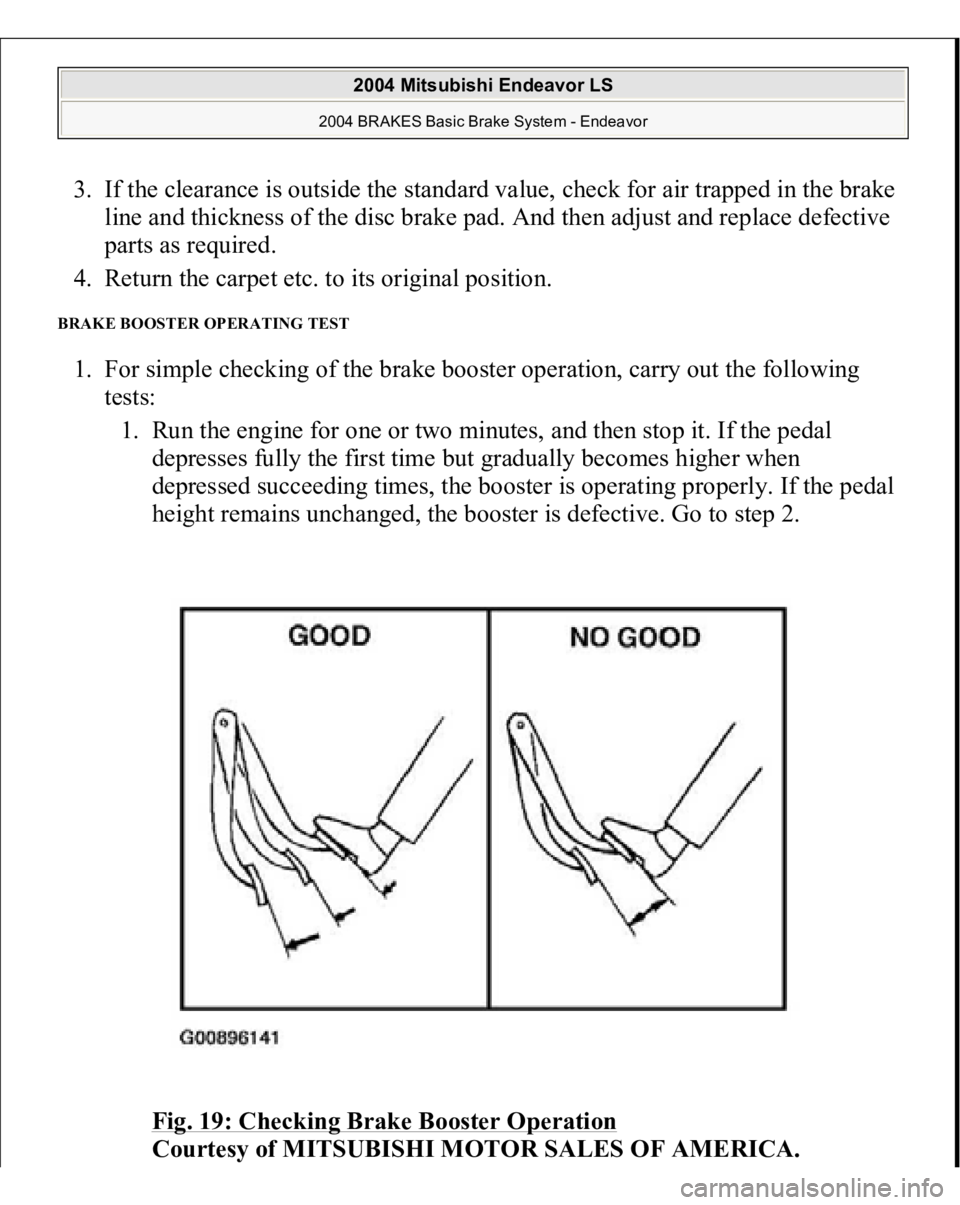
4. Return the carpet etc. to its original position. BRAKE BOOSTER OPERATING TEST 1. For simple checking of the brake booster operation, carry out the following
tests:
1. Run the engine for one or two minutes, and then stop it. If the pedal
depresses fully the first time but gradually becomes higher when
depressed succeeding times, the booster is operating properly. If the pedal
height remains unchanged, the booster is defective. Go to step 2.
Fig. 19: Checking Brake Booster Operation
Courtesy of MITSUBISHI MOTOR SALES OF AMERICA.
2004 Mitsubishi Endeavor LS
2004 BRAKES Basic Brake System - Endeavor
Page 735 of 3870
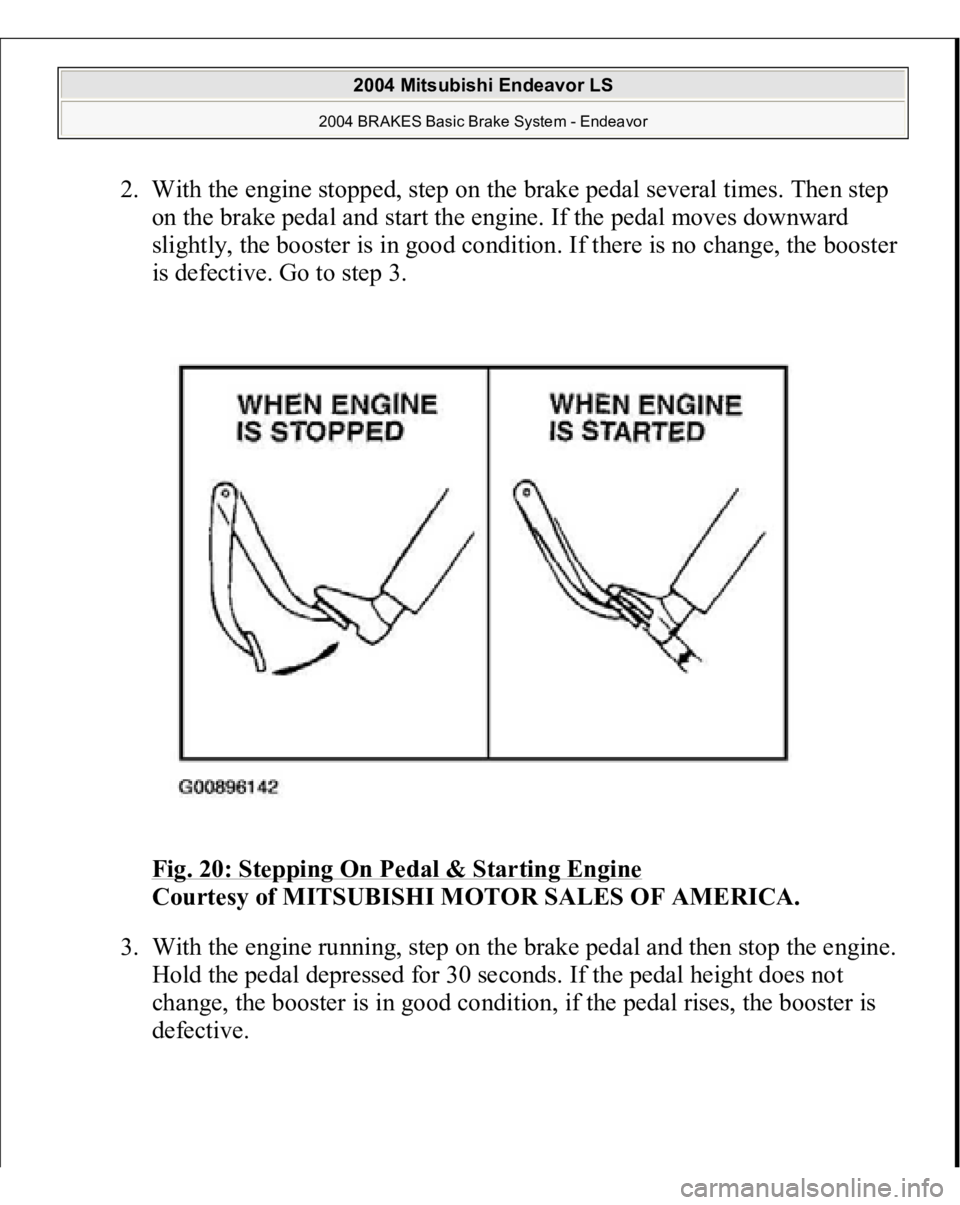
2. With the engine stopped, step on the brake pedal several times. Then step
on the brake pedal and start the engine. If the pedal moves downward
slightly, the booster is in good condition. If there is no change, the booster
is defective. Go to step 3.
Fig. 20: Stepping On Pedal & Starting Engine
Courtesy of MITSUBISHI MOTOR SALES OF AMERICA.
3. With the engine running, step on the brake pedal and then stop the engine.
Hold the pedal depressed for 30 seconds. If the pedal height does not
change, the booster is in good condition, if the pedal rises, the booster is
defective.
2004 Mitsubishi Endeavor LS
2004 BRAKES Basic Brake System - Endeavor
Page 736 of 3870
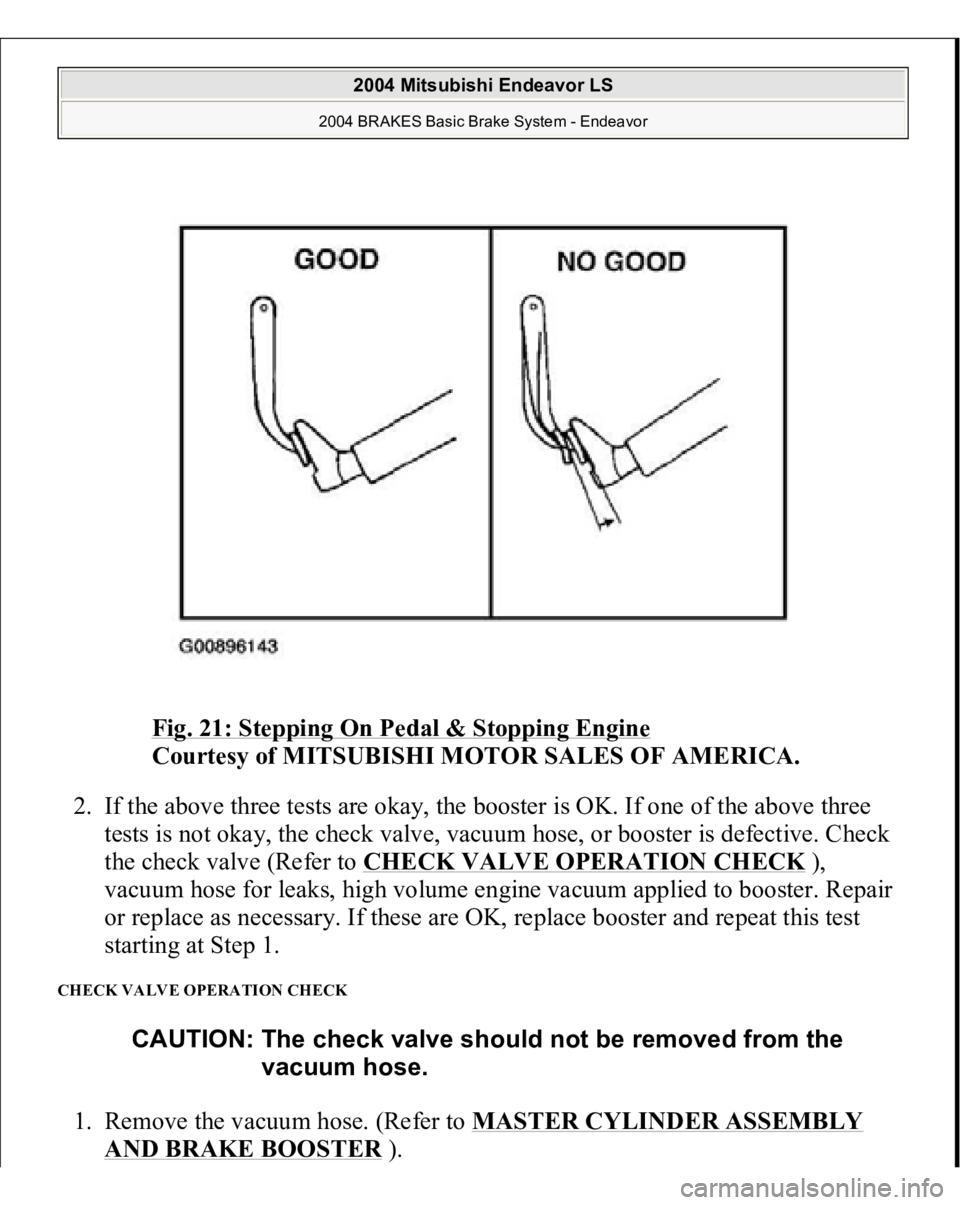
Fig. 21: Stepping On Pedal & Stopping Engine
Courtesy of MITSUBISHI MOTOR SALES OF AMERICA.
2. If the above three tests are okay, the booster is OK. If one of the above three
tests is not okay, the check valve, vacuum hose, or booster is defective. Check
the check valve (Refer to CHECK VALVE OPERATION CHECK
),
vacuum hose for leaks, high volume engine vacuum applied to booster. Repair
or replace as necessary. If these are OK, replace booster and repeat this test
starting at Step 1.
CHECK VALVE OPERATION CHECK 1. Remove the vacuum hose. (Refer to MASTER CYLINDER ASSEMBLY
AND BRAKE BOOSTE
R).
CAUTION: The check valve should not be removed from the
vacuum hose.
2004 Mitsubishi Endeavor LS
2004 BRAKES Basic Brake System - Endeavor
Page 776 of 3870
![MITSUBISHI ENDEAVOR 2004 Service User Guide 1. Start the engine and hold the brake pedal down for 5 seconds. [Pedal
depression force: approximately 200 N (45 pound)]
2. Stop the engine.
3. Turn the brake disc forward 10 times.
4. Use a s](/img/19/57105/w960_57105-775.png "MITSUBISHI ENDEAVOR 2004 Service User Guide 1. Start the engine and hold the brake pedal down for 5 seconds. [Pedal
depression force: approximately 200 N (45 pound)]
2. Stop the engine.
3. Turn the brake disc forward 10 times.
4. Use a s")
1. Start the engine and hold the brake pedal down for 5 seconds. [Pedal
depression force: approximately 200 N (45 pound)]
2. Stop the engine.
3. Turn the brake disc forward 10 times.
4. Use a spring scale to measure the hub torque with pads installed in the
same direction as earlier.
5. Calculate the drag force of the disc brake [difference between hub torque
with pads installed and hub torque with pads removed].
Standard value: 68 N (15 pounds) or less
Fig. 54: Measuring Drag Force
Courtes
y of MITSUBISHI MOTOR SALES OF AMERICA
.
2004 Mitsubishi Endeavor LS
2004 BRAKES Basic Brake System - Endeavor
Page 792 of 3870
2004 ENGINE COOLING
Electric Cooling Fans - Endeavor
DESCRIPTION & OPERATION The fan control module is powered from fusible link No. 2. See Fig. 1
. The PCM
judges the required revolution speed of radiator fan motor and condenser fan motor
using input signals transmitted from the A/C switch, automatic compressor
controller, vehicle speed sensor and engine coolant temperature sensor. The PCM
activates the fan control module to drive the radiator fan motor and condenser fan
motor. COMPONENT LOCATIONS COMPONENT LOCATIONS Component
Location
Condenser Fan
(1) Behind Radiator
Fan Control Module
(1) Integrated With Radiator Fan Motor
Fan Control Relay
In Engine Compartment Fuse/Relay
Box
Fusible Link No. 2
(2) In Engine Compartment Fuse/Relay
Box
Multi-Port Fuel Injection (MFI) Relay
In Engine Compartment Fuse/Relay
Box
Radiator Fan
(1) Behind Radiator
(1)
See Fig. 13
.
(2)
See Fig. 1
.
2004 Mitsubishi Endeavor Limited
2004 ENGINE COOLING Electric Cooling Fans - Endeavor
2004 Mitsubishi Endeavor Limited
2004 ENGINE COOLING Electric Cooling Fans - Endeavor
Page 793 of 3870
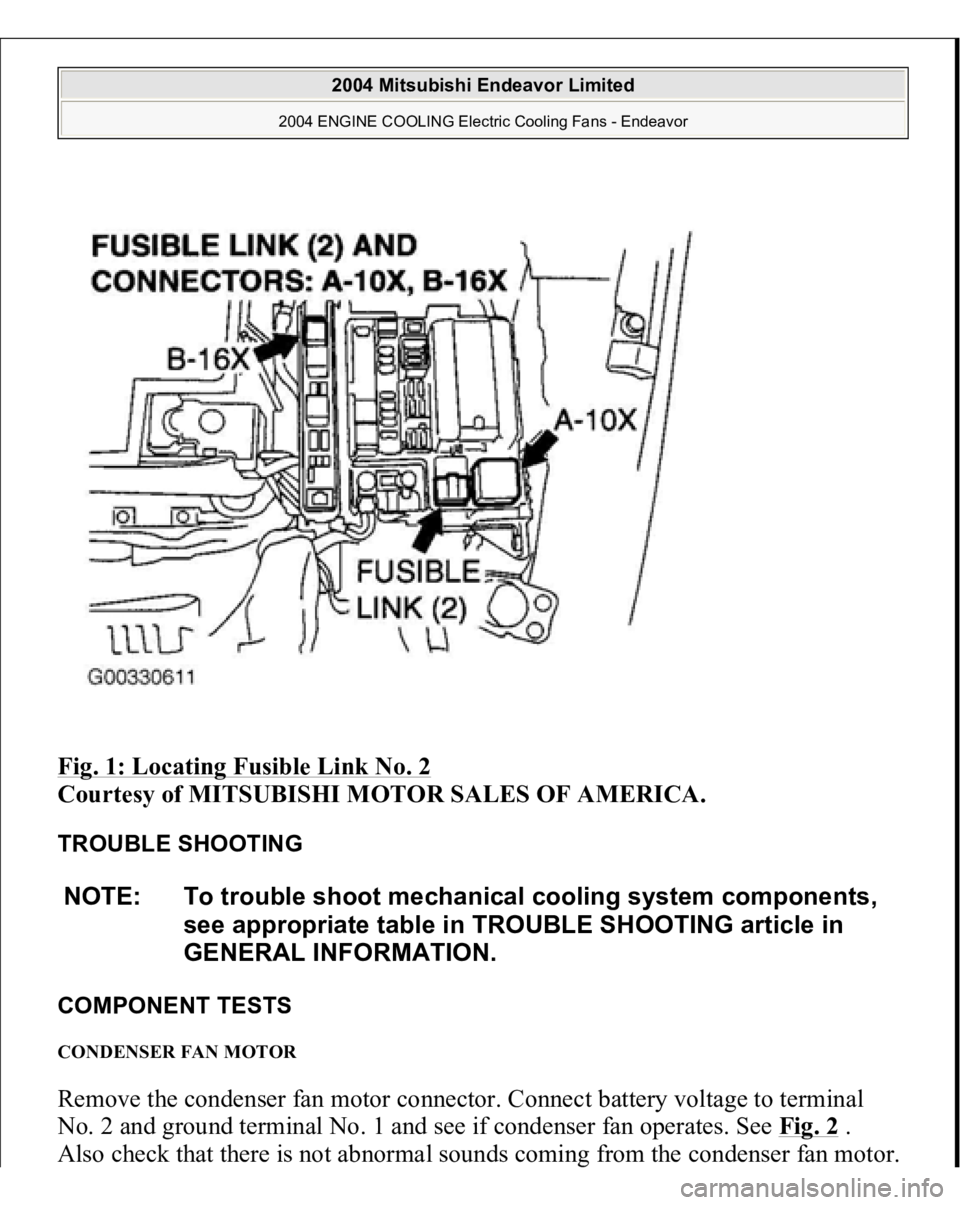
Fig. 1: Locating Fusible Link No. 2
Courtesy of MITSUBISHI MOTOR SALES OF AMERICA.
TROUBLE SHOOTING
COMPONENT TESTS CONDENSER FAN MOTOR Remove the condenser fan motor connector. Connect battery voltage to terminal No. 2 and ground terminal No. 1 and see if condenser fan operates. See Fig. 2
.
Also check that there is not abnormal sounds comin
g from the condenser fan motor.
NOTE: To trouble shoot mechanical cooling system components,
see appropriate table in TROUBLE SHOOTING article in
GENERAL INFORMATION.
2004 Mitsubishi Endeavor Limited
2004 ENGINE COOLING Electric Cooling Fans - Endeavor
Page 794 of 3870
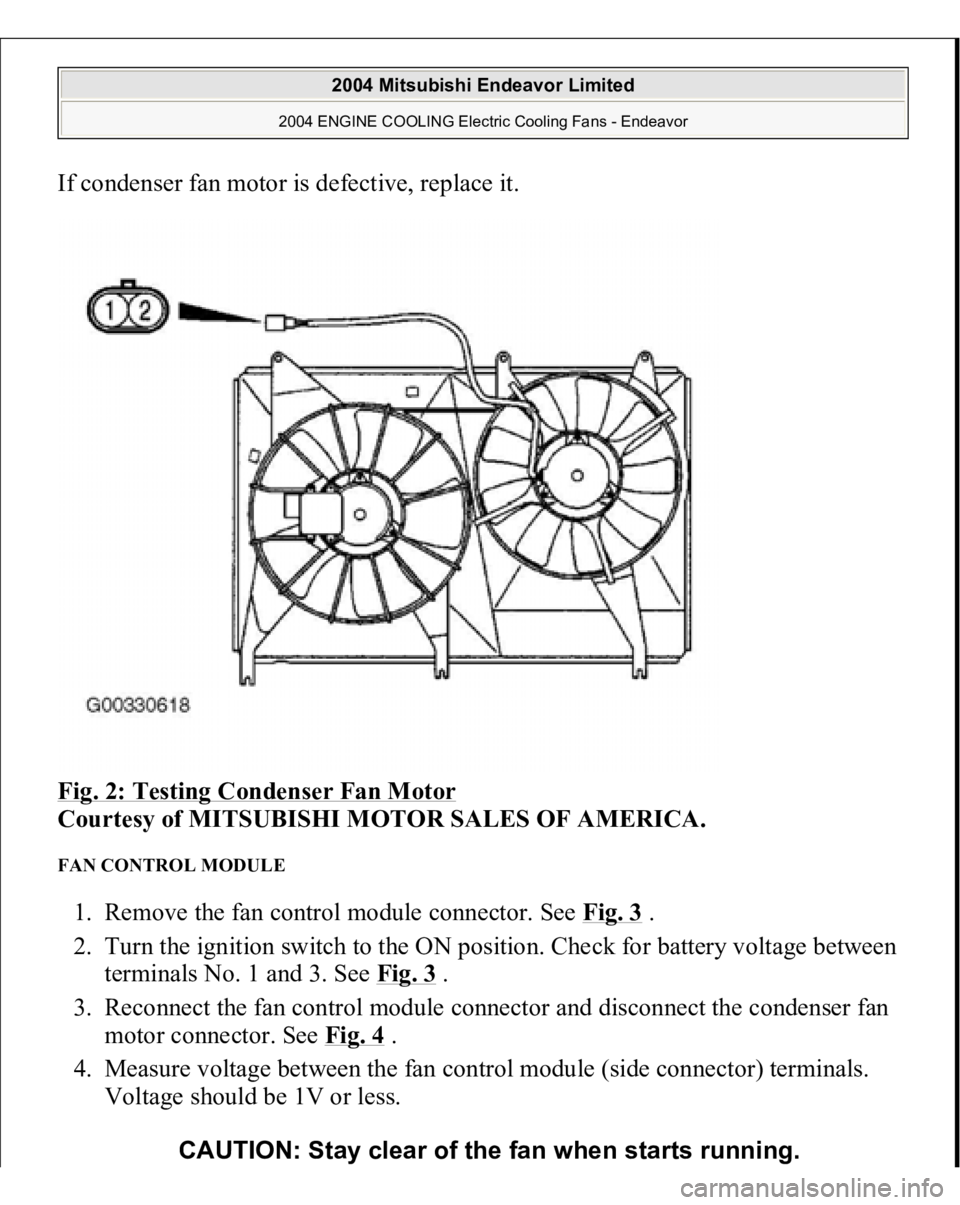
If condenser fan motor is defective, replace it.
Fig. 2: Testing Condenser Fan Motor
Courtesy of MITSUBISHI MOTOR SALES OF AMERICA.
FAN CONTROL MODULE 1. Remove the fan control module connector. See Fig. 3
.
2. Turn the ignition switch to the ON position. Check for battery voltage between
terminals No. 1 and 3. See Fig. 3
.
3. Reconnect the fan control module connector and disconnect the condenser fan
motor connector. See Fig. 4
.
4. Measure voltage between the fan control module (side connector) terminals.
Voltage should be 1V or less.
CAUTION: Stay clear of the fan when starts running.
2004 Mitsubishi Endeavor Limited
2004 ENGINE COOLING Electric Cooling Fans - Endeavor
Page 795 of 3870
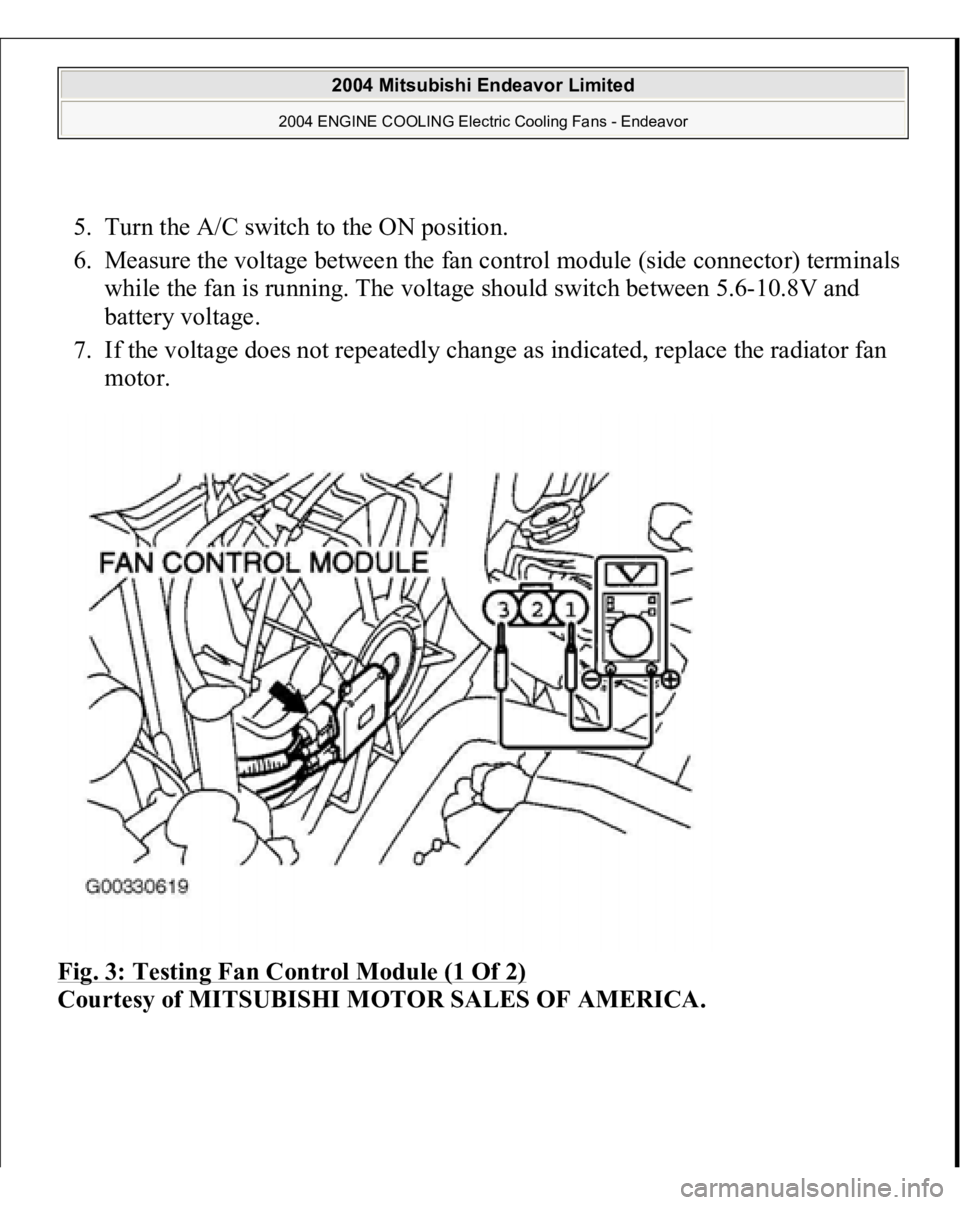
5. Turn the A/C switch to the ON position.
6. Measure the voltage between the fan control module (side connector) terminals
while the fan is running. The voltage should switch between 5.6-10.8V and
battery voltage.
7. If the voltage does not repeatedly change as indicated, replace the radiator fan
motor.
Fig. 3: Testing Fan Control Module (1 Of 2)
Courtesy of MITSUBISHI MOTOR SALES OF AMERICA.
2004 Mitsubishi Endeavor Limited
2004 ENGINE COOLING Electric Cooling Fans - Endeavor
Page 796 of 3870
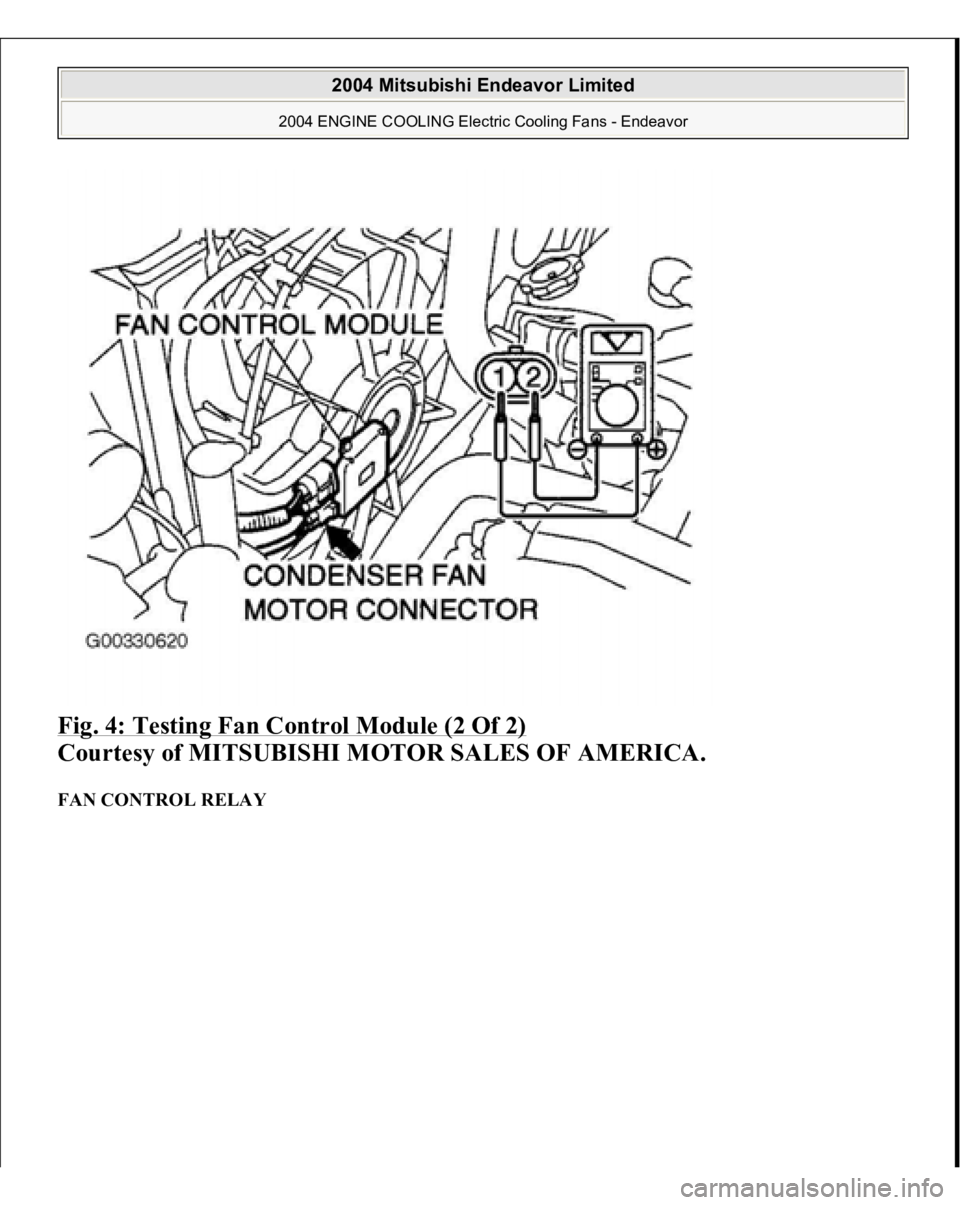
Fig. 4: Testing Fan Control Module (2 Of 2)
Courtesy of MITSUBISHI MOTOR SALES OF AMERICA.
FAN CONTROL RELAY
2004 Mitsubishi Endeavor Limited
2004 ENGINE COOLING Electric Cooling Fans - Endeavor