door lock MITSUBISHI iMiEV 2016 1.G Owners Manual
[x] Cancel search | Manufacturer: MITSUBISHI, Model Year: 2016, Model line: iMiEV, Model: MITSUBISHI iMiEV 2016 1.GPages: 296, PDF Size: 7.79 MB
Page 4 of 296
Interior 1-3 Overview
1
N00100302369
Interior
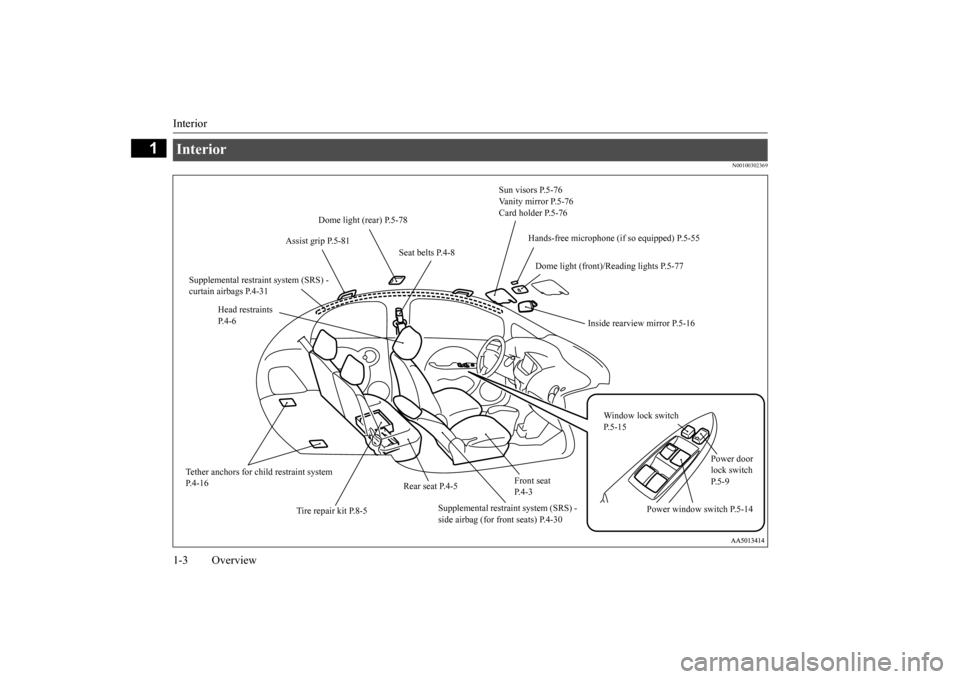
Sun visors P.5-76 Vanity mirror P.5-76 Card holder P.5-76
Dome light (rear) P.5-78
Assist grip P.5-81
Seat belts P.4-8
Supplemental restraint system (SRS) - curtain airbags P.4-31
Dome light (front)/Reading lights P.5-77
Head restraints P. 4 - 6
Inside rearview mirror P.5-16
Window lock switch P.5-15
Power door lock switch P. 5 - 9
Tether anchors for ch
ild restraint system
P.4-16
Front seat P. 4 - 3
Rear seat P.4-5
Power window switch P.5-14
Supplemental restraint system (SRS) - side airbag (for front seats) P.4-30
Tire repair kit P.8-5
Hands-free microphone (if so equipped) P.5-55
BK0220401US.book 3 ページ 2015年6月3日 水曜日 午前7時42分
Page 29 of 296
Precautions during Charging the
Main Drive Lithium-ion Battery
General information/Charging 3-15
3
N01202601051
Precautions during Charg- ing the Main Drive Lithium-ion Battery
WA R N I N G Improper charging can result in a fire, property damage, and serious injury ordeath. Read the instructions described below carefully and follow them. Also read andfollow the instructions for “Regular charging (charging method with rated AC 120V outlet)” on page 3-16, Regularcharging (using 240V
Electric Vehicle
Supply Equipment)
on page 3-26 and
“Quick charging (c
harging method with
quick charger)” on p
age 3-27 before using
the charging device.• Do not touch regular charge port, regu-lar charge connecto
r, plug and outlet
with wet hands.• Keep away from wate
r when connecting
the regular charge port, regular chargeconnector, plug and outlet.• Do not perform charging outdoors inadverse weather, su
ch as heavy rain,
heavy snow or strong winds, or when adverse weather is expected.
• Never charge or to
uch the vehicle when
lightning or thunde
r is observed or
expected. A lightning strike may backfeed into the regular charger causing damage and possible
personal injury or
death. If lightnin
g or thunder begins
during regular charging, do not touch the vehicle or the EV
charging cable and
turn off the breaker.• Make sure there is no water or foreignmaterials in the char
ge port, charge con-
nector or plug, and that they are not damaged or affected by rust or corro- sion. If any of these conditions are notice-able, do not charge
the main drive
lithium-ion battery.• Never touch the metal contacts of thecharge port, charge
connector or plug.
• Never disassemble or modify the charge port or charging cable.• If you notice unus
ual odor or smoke
coming from the vehicle, charging cable or plug, or if the ch
arging cable or plug
becomes hot to the touch, stop charging immediately.
Keep away from the cooling fan under the hood during charging. During charging, the cooling fan m
ay automatically be
operated even if the electric motor switch is in the “LOCK” position. WA R N I N G
Some public regular chargers may not be compatible with your vehicle. If necessary,consult an administrator or the maker ofthe regular charger to determine whether the charger is compat
ible with
your vehi-
cle before using it. Also be sure to use theregular charger acco
rding to operating
procedures indicated on the body of the regular charger.CAUTION Do not place the select
or lever in any posi-
tion other than the “P” (PARK) positionwhile the regular charger is connected. If the selector lever is plac
ed in a position other
than the “P” position, the vehicle could acci-dentally move resulting in damage to the reg- ular charge connector. If
the selector lever is
placed in any position other than “P” posi-tion while the regular charge connector is still connected and the
electric motor switch
is the “ON” position,
a warning buzzer will
sound. To prevent damage to the charging equip- ment:• Do not close the charge port lid withoutclosing the cap.• Do not subject the charging equipment toimpact.• Do not pull or twist the charge cable.• Do not drag the charge cable.WA R N I N G
BK0220401US.book 15 ページ 2015年6月3日 水曜日 午前7時42分
Page 31 of 296
Regular charging (charging method with rated AC 120 V outlet)
General information/Charging 3-17
3
N01216200019
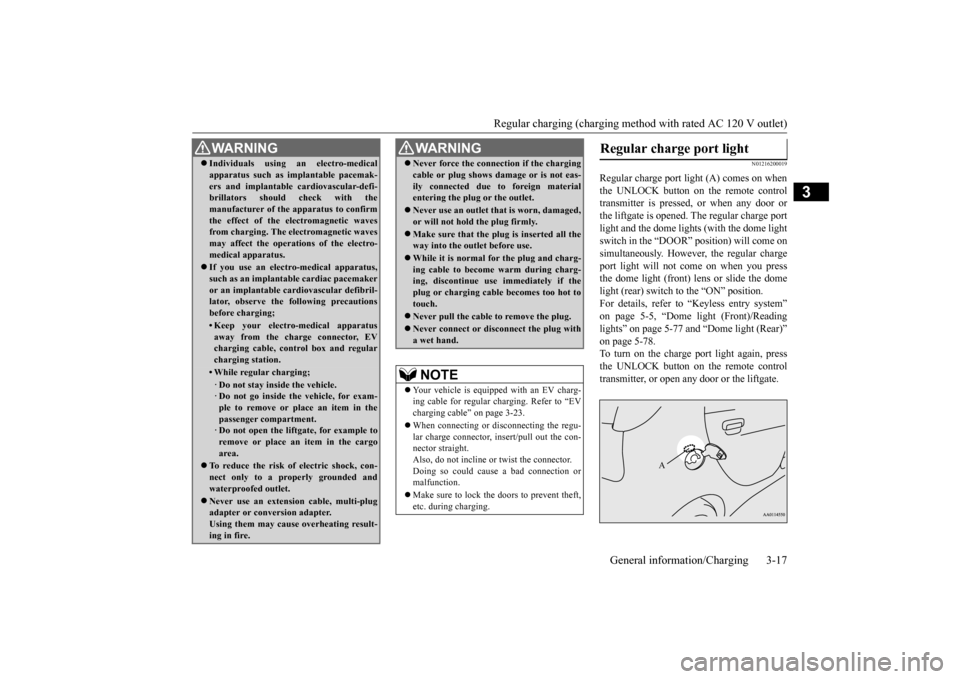
Regular charge port light (A) comes on when the UNLOCK button on the remote control transmitter is pressed, or when any door orthe liftgate is opened.
The regular charge port
light and the dome light
s (with the dome light
switch in the “DOOR” position) will come onsimultaneously. However, the regular charge port light will not
come on when you press
the dome light (front) lens or slide the dome light (rear) switch to the “ON” position. For details, refer to
“Keyless entry system”
on page 5-5, “Dome
light (Front)/Reading
lights” on page 5-77 a
nd “Dome light (Rear)”
To turn on the charge port light again, press the UNLOCK button on the remote control transmitter, or open any
door or the liftgate.
Individuals using an
electro-medical
apparatus such as implantable pacemak-ers and implantable
cardiovascular-defi-
brillators should
check with the
manufacturer of the apparatus to confirm the effect of the el
ectromagnetic waves
from charging. The el
ectromagnetic waves
may affect the operations of the electro- medical apparatus. If you use an electro-medical apparatus, such as an implanta
ble cardiac pacemaker
or an implantable ca
rdiovascular
defibril-
lator, observe the following precautions before charging;• Keep your electro-medical apparatusaway from the charge connector, EVcharging cable, control box and regular charging station.• While regular charging;· Do not stay inside the vehicle. · Do not go inside the vehicle, for exam- ple to remove or place an item in the passenger compartment.· Do not open the liftgate, for example to remove or place an item in the cargo area.
To reduce the risk of electric shock, con- nect only to a prop
erly grounded and
waterproofed outlet. Never use an extension cable, multi-plug adapter or conversion adapter. Using them may cause overheating result- ing in fire.WA R N I N G
Never force the connection if the charging cable or plug shows damage or is not eas-ily connected due to foreign materialentering the plug or the outlet. Never use an outlet that is worn, damaged, or will not hold the plug firmly. Make sure that the plug is inserted all the way into the outlet before use. While it is normal fo
r the plug and charg-
ing cable to become warm during charg- ing, discontinue use immediately if the plug or charging cable becomes too hot totouch. Never pull the cable to remove the plug.Never connect or disconnect the plug with a wet hand.NOTE
Your vehicle is equipped with an EV charg- ing cable for regular charging. Refer to “EVcharging cable” on page 3-23. When connecting or
disconnecting the regu-
lar charge connector, in
sert/pull out the con-
nector straight. Also, do not incline or twist the connector.Doing so could cause a bad connection ormalfunction. Make sure to lock the doors to prevent theft, etc. during charging.WA R N I N G
Regular charge port light
A
BK0220401US.book 17 ページ 2015年6月3日 水曜日 午前7時42分
Page 42 of 296
Quick charging (charging method with quick charger) 3-28 General information/Charging
3
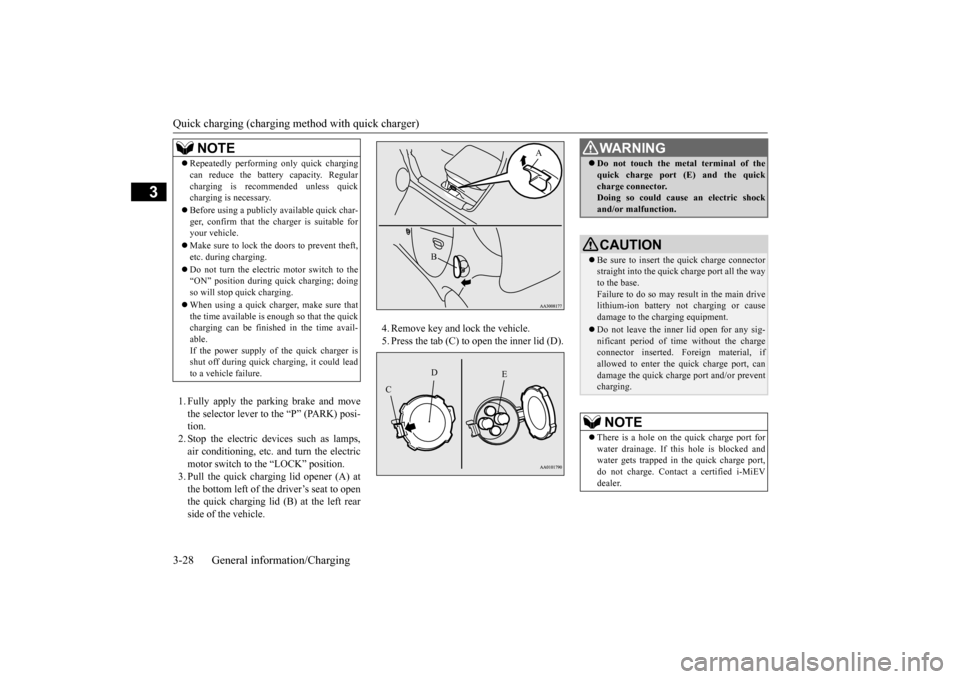
1. Fully apply the parking brake and move the selector lever to the “P” (PARK) posi- tion.2. Stop the electric devices such as lamps, air conditioning, etc.
and turn the electric
motor switch to the “LOCK” position.3. Pull the quick charging lid opener (A) at the bottom left of the driver’s seat to open the quick charging lid (B) at the left rearside of the vehicle.
4. Remove key and lock the vehicle. 5. Press the tab (C) to open the inner lid (D).
NOTE
Repeatedly performi
ng only quick charging
can reduce the battery capacity. Regularcharging is recommended unless quickcharging is necessary. Before using a publicly available quick char- ger, confirm that the charger is suitable for your vehicle. Make sure to lock the doors to prevent theft, etc. during charging. Do not turn the electric motor switch to the “ON” position during
quick charging; doing
so will stop quick charging. When using a quick charger, make sure that the time available is
enough so that the quick
charging can be finished in the time avail- able. If the power supply of the quick charger isshut off during quick ch
arging, it could lead
to a vehicle failure.
A
B
E
D
C
WA R N I N G Do not touch the metal terminal of the quick charge port (E) and the quickcharge connector.Doing so could cause an electric shock and/or malfunction.CAUTION Be sure to insert the quick charge connector straight into the quick charge port all the wayto the base. Failure to do so may result in the main drive lithium-ion battery not charging or causedamage to the charging equipment. Do not leave the inner lid open for any sig- nificant period of ti
me without the charge
connector inserted.
Foreign material, if
allowed to enter the quick charge port, candamage the quick charge port and/or prevent charging.NOTE
There is a hole on the quick charge port for water drainage. If this
hole is blocked and
water gets trapped in the quick charge port,do not charge. Contac
t a certified i-MiEV
dealer.
BK0220401US.book 28 ページ 2015年6月3日 水曜日 午前7時42分
Page 49 of 296
High-Voltage components
General information/Charging 3-35
3
N01205800031
A crash or impact significant enough to require an emergency response for conven- tional vehicles would
also require the same
response for electric vehicles. Also follow the instru
ctions described below
to avoid severe burns a
nd electrical shock that
may result in serious injury or death. 10- Quick charge portIn case of a collision
WA R N I N G If your vehicle is dri
vable, pull your vehi-
cle off the road to a safe, nearby locationand remain on the scene. Also, if possible, do the following opera- tions and stay out of the way of anyoncoming traffic while awaiting the arrival of emerge
ncy responders.
• Apply chocks to the wheels.• Move the selector
lever to the “P”
• Apply the parking brake.• Open the windows,
doors and liftgate.
• Turn the electric motor switch to the “LOCK” position.• Turn on the hazard warning flashers.• Move the key away from the vehicle to prevent unintended start-up of the sys- tem by inadvertent co
ntact with a switch
or impact from the crash.
Never touch high-voltage wiring, connec- tors, and other high-vol
tage parts, such as
the inverter unit and main drive lithium-ion battery. An electric shock may occur if exposed electric wires are visible when viewed from inside
or outside of your
vehicle. For their locations, see “High- voltage components” on page 3-34. If the vehicle receives a strong impact to the floor while driving, stop the vehicle in a safe place and check the floor. Leaks or damage to the main drive lith- ium-ion battery may result in a fire. If youdiscover them, contact emergency services immediately. Since the fluid leak may be lithium manganite from the Lithium-ionbattery, never touch any fluid leaking from the inside or outs
ide of the vehicle. If
the fluid contacts you
r skin or eyes, wash
it off immediately with a large amount of water and receive immediate medical attention to help
avoid serious injury.
If you are unable to safely assess the vehi- cle due to vehicle damage, do not touchthe vehicle. Leave the vehicle and contact emergency services. Advise emergency responders that this is
an electric vehicle.
WA R N I N G
If a fire occurs in th
is vehicle,
leave the
vehicle as soon as possible and contactemergency services. Do not attempt toextinguish a fire by yourself. If the fire involves a lithium-ion battery, it will require large, sustained volumes of waterfor extinguishment.
Using a small amount
of water or the incorrect fire extinguisher can result in serious injury or death fromelectrical shock. When you leave the ve
hicle, if possible,
open the windows,
doors and liftgate to
prevent accumulation of poisonous/com- bustible gasses. This will also assist in therescue and fire fighting process. As with any vehicle fi
re, the byproducts of
combustion can be toxic. Do not inhale smoke, vapors, or gas
from the vehicle.
Move to a safe distan
ce upwind and uphill
from the vehicle fire
and out of the way of
any oncoming traffic
while awaiting the
arrival of emerge
ncy responders.
If you detect leaking
fluids, sparks, smoke,
flames, gurgling, popp
ing or hissing noises
originating from the
high voltage battery
compartment, contact emergency services immediately. This may result in a fire. Physical damage to the vehicle or high voltage battery may result in immediate ordelayed release of t
oxic and/or flammable
gases and fire.WA R N I N G
BK0220401US.book 35 ページ 2015年6月3日 水曜日 午前7時42分
Page 62 of 296
MiEV Remote System 3-48 General information/Charging
3
N01204301036
The following conditi
ons must be met to
operate the Remote Climate Control. Selector lever:
P (PARK) position.
Electric motor switch: LOCK position. EV charging cable (regular charger): Con- nected. Quick charging: Not used. Main Drive Lithium-ion Battery Level Indicator: Shows one bar or more. Refer to “Main Drive Lithium-ion Battery LevelIndicator” on page 3-50. All doors and the liftgate: Closed. 1. Start charging. Refer to “Regular charging (charging method with rated AC 120 V outlet)” on page 3-16.
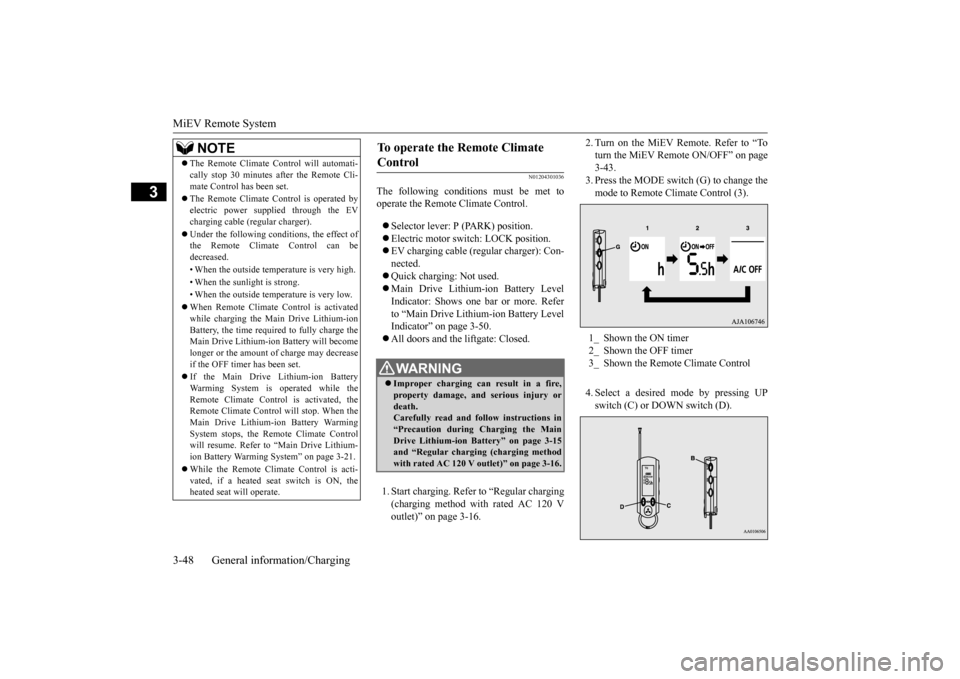
2. Turn on the MiEV Remote. Refer to “To turn the MiEV Remote ON/OFF” on page3-43. 3. Press the MODE switch (G) to change the mode to Remote Climate Control (3). 4. Select a desired
mode by pressing UP
switch (C) or DOWN switch (D).
The Remote Climate Control will automati- cally stop 30 minutes after the Remote Cli-mate Control has been set. The Remote Climate Control is operated by electric power s
upplied through the EV
charging cable (regular charger). Under the following conditions, the effect of the Remote Climate Control can be decreased. • When the outside temp
erature is very high.
• When the sunlight is strong.• When the outside temperature is very low. When Remote Climate Control is activated while charging the Main Drive Lithium-ion Battery, the time required to fully charge theMain Drive Lithium-ion Battery will become longer or the amount of charge may decrease if the OFF timer has been set. If the Main Drive Lithium-ion Battery Warming System is operated while theRemote Climate Control is activated, the Remote Climate Control
will stop. When the
Main Drive Lithium-ion Battery WarmingSystem stops, the Remote Climate Control will resume. Refer to “Main Drive Lithium- ion Battery Warming System” on page 3-21. While the Remote Climate Control is acti- vated, if a heated seat switch is ON, theheated seat
will operate.
NOTE
To operate the Remote Climate Control
WA R N I N G Improper charging ca
n result in a fire,
property damage, and serious injury ordeath. Carefully read and follow instructions in “Precaution during Charging the MainDrive Lithium-ion Battery” on page 3-15 and “Regular chargi
ng (charging method
with rated AC 120 V outlet)” on page 3-16.
1_ Shown the ON timer 2_ Shown the OFF timer3_ Shown the Remote Climate Control
BK0220401US.book 48 ページ 2015年6月3日 水曜日 午前7時42分
Page 74 of 296
Seats 4-2 Seat and restraint systems
4
N00408400495
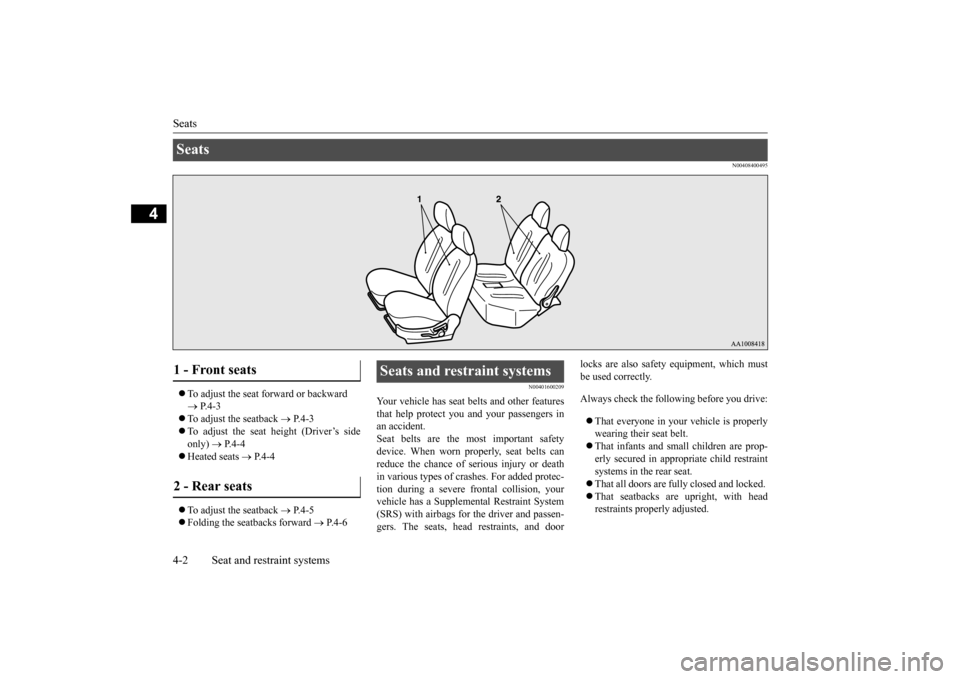
To adjust the seat forward or backward P.4-3
To adjust the seatback
P.4-3
To adjust the seat
height (Driver’s side
only)
P.4-4
Heated seats
P. 4 - 4
To adjust the seatback
P.4-5
Folding the seatbacks forward
P.4-6
N00401600209
Your vehicle has seat belts and other features that help protect you and your passengers in an accident.Seat belts are the most important safety device. When worn properly, seat belts can reduce the chance of serious injury or deathin various types of cras
hes. For added protec-
tion during a severe fr
ontal collision, your
vehicle has a Supplemen
tal Restraint System
(SRS) with airbags for the driver and passen- gers. The seats, head restraints, and door
locks are also safety equipment, which must be used correctly. Always check the following before you drive: That everyone in your vehicle is properly wearing their seat belt. That infants and small children are prop- erly secured in appropriate child restraintsystems in the rear seat. That all doors are fully closed and locked. That seatbacks are upright, with head restraints properly adjusted.
Seats 1 - Front seats 2 - Rear seats
Seats and restraint systems
BK0220401US.book 2 ページ 2015年6月3日 水曜日 午前7時42分
Page 109 of 296
5
Features and controlsBreak-in recommendations ..............................................................5-2 Keys .................................................................................................5-2 Electronic immobilizer (Anti-theft starting system) ........................5-2Keyless entry system .......................................................................5-5 Door locks ........................................................................................5-8 Power door locks ........
...........
...........
...........
...........
...........
.........
.....5-9
Child safety locks for rear door ..........
...........
.........
.........
.........
.....5-10
Liftgate ........................................................................................... 5-11 Theft-alarm system ........................................................................5-12Power window control ...................................................................5-14 Parking brake .................................................................................5-16 Inside rearview mirror ...................................................................5-16Outside rearview mirrors ...............................................................5-17 Electric motor switch .....................................................................5-18 Steering wheel lock ........................................................................5-20Starting the electric motor unit ......................................................5-20 Selector lever .................................................................................5-21 Acoustic vehicle alerting system (AVAS) ......................................5-23Service brake .................................................................................5-24 Brake assist system ........................................................................5-25 Anti-lock braking system ...............................................................5-25Electric power steering system (EPS) ............................................5-27 Active stability control (ASC) .......................................................5-28 Tire pressure monitoring system ....................................................5-30Rear-view camera (if so equipped) .................................................5-34 Instrument cluster ..........................................................................5-36 Indicator and warning light package ..............................................5-43Indicators .......................................................................................5-44
Warning lights ................................................................................ 5-44 Combination headlights and dimmer switch ................................. 5-46 Turn signal lever ............................................................................ 5-49Hazard warning flasher switch ...................................................... 5-49 Front fog light switch .................................................................... 5-50 Wiper and washer switch ............................................................... 5-50Electric rear window defogger switch ....
...........
...........
...........
...... 5-52
Horn switch ................................................................................... 5-53 Link System (if so equipped) ......................................................... 5-53 Bluetooth
® 2.0 interface (if so equipped)....................................... 5-53
USB input terminal (if so equipped) .......
...........
...........
...........
...... 5-73
Sun visors ...................................................................................... 5-7612 V power outlet .......................................................................... 5-76 Interior lights ................................................................................. 5-77 Storage spaces ................................................................................ 5-79Cup holder ..................................................................................... 5-80 Assist grip ...................................................................................... 5-81
BK0220401US.book 1 ページ 2015年6月3日 水曜日 午前7時42分
Page 113 of 296
Keyless entry system
Features and controls 5-5
5
Rules. Operation is subject to the following two conditions. This device may not
cause harmful inter-
ference. This device must ac
cept any interference
received, including interference that maycause undesired operation.
This digital apparatu
s does not exceed the
Class A limits for radi
o noise emissions from
digital apparatus set out in the Radio Interfer- ence Regulations of th
e Canadian Department
of Communications.
N00509000910
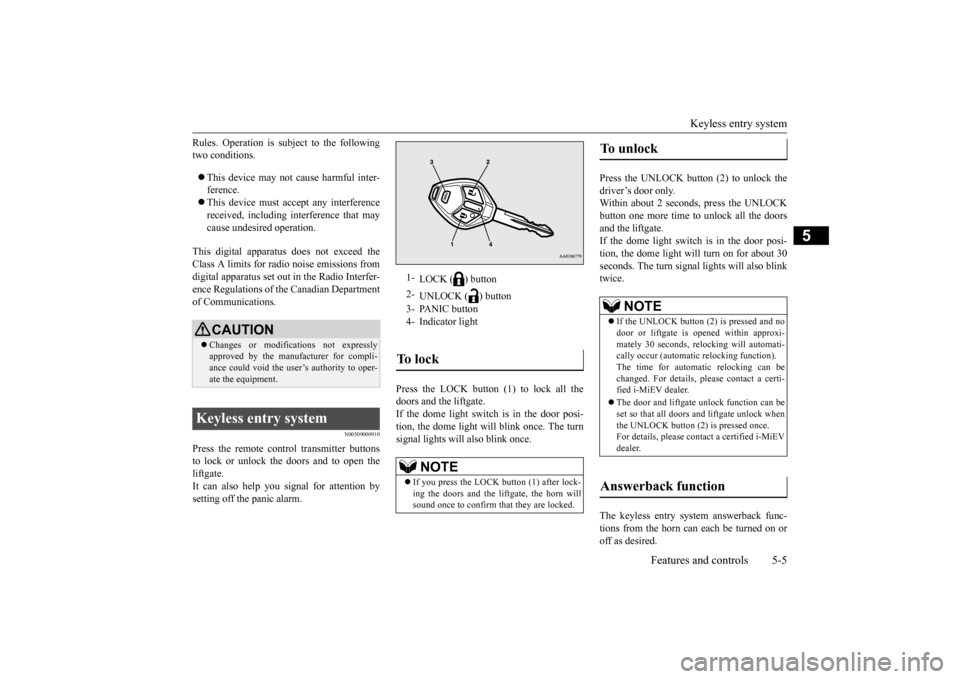
Press the remote control transmitter buttonsto lock or unlock the doors and to open the liftgate. It can also help you
signal for attention by
setting off the panic alarm.
Press the LOCK button (1) to lock all the doors and the liftgate. If the dome light switch is in the door posi- tion, the dome light w
ill blink once. The turn
signal lights will also blink once.
Press the UNLOCK button (2) to unlock the driver’s door only. Within about 2 seconds, press the UNLOCKbutton one more time to unlock all the doors and the liftgate. If the dome light switch is in the door posi-tion, the dome light will turn on for about 30 seconds. The turn signal
lights will also blink
twice. The keyless entry system answerback func- tions from the horn can each be turned on or off as desired.
CAUTION Changes or modifica
tions not expressly
approved by the manufacturer for compli- ance could void the user’s authority to oper-ate the equipment.
Keyless entry system
1-
LOCK ( ) button
2-
UNLOCK ( ) button
3- PANIC button 4- Indicator lightTo l o c k
NOTE
If you press the LOCK button (1) after lock- ing the doors and the liftgate, the horn will sound once to confirm that they are locked.
To unlock
NOTE
If the UNLOCK button (2) is pressed and no door or liftgate is opened within approxi- mately 30 seconds, relocking will automati- cally occur (automatic
relocking function).
The time for automatic relocking can be changed. For details,
please contact a certi-
fied i-MiEV dealer. The door and liftgate unlock function can be set so that all doors and liftgate unlock whenthe UNLOCK button (2) is pressed once. For details, please c
ontact a certified i-MiEV
dealer.
Answerback function
BK0220401US.book 5 ページ 2015年6月3日 水曜日 午前7時42分
Page 114 of 296

Keyless entry system 5-6 Features and controls
5
The horn answerback function can be set to the following three conditions. Each time the horn answerback function isset, a chime will sound to tell you the condi- tion of the answerback function. 1. Remove the key from the electric motor switch.2. Open the driver’s door and turn the com- bination headlights and dimmer switch to the “OFF” position.3. Press the LOCK button (1) for 4 to 10 sec- onds and press the UNLOCK button (2) during this time.4. Release in sequence the UNLOCK and LOCK buttons within 10 seconds of pressing the UNLOCK button in step 3.
The turn signal lights answerback function can be changed. If you want to change the answerback func- tion, please contact a
certified i-MiEV dealer
for details.
N00543600105
The door and liftgate unlock function can be set so that all doors and liftgate unlock when the UNLOCK button (2) is pressed once.For details, please contact a certified i-MiEV dealer.
N00543700050
If you are near your vehicle and feel threat-ened, you may activate th
e alarm to call atten-
tion as follows: 1. Press the PANIC button (3) for more than 1 second. 2. The headlights will blink on and off and the horn will sound intermittently forabout 3 minutes. 3. To turn off the alarm, press any button on the remote control transmitter.
N00543800077
Only remote control transmitters pro-grammed with the vehicle’s electronics canlock or unlock all doors. If you lose the remote control transmitter, you can order a remote cont
rol transmitter from a
certified i-MiEV deal
er by referring to the
key number. To prevent vehicle theft, the ID codes for allthe remote control transmitters except the one for the lost key must be programmed again. Take your vehicle and all the remainingremote control transmitters to a certified i- MiEV dealer to have your ID codes pro- grammed again.
N00543900065
To add a remote control transmitter, you mustalready have one registered remote control transmitter. Registering the ID code can be done by your-self or by a certified i-MiEV dealer. For you to register the ID code yourself, follow the “Customer remote control transmitter pro-gramming” procedure below.
Horn deactivation/reactivation Number of chimes
Condition
One chime The horn will not sound. Two chimes The horn will sound. Three chimes
The horn will sound if the auto light switch is ON (if so equipped).
Four chimes
The horn will sound if the LOCK button is pressed twice quickly.
Changing the setting of the turn signal lights answerback function Setting of door unlock function Using the panic alarm
Replacement remote control transmitters Additional remote control transmitters
BK0220401US.book 6 ページ 2015年6月3日 水曜日 午前7時42分