charging MITSUBISHI iMiEV 2017 1.G User Guide
[x] Cancel search | Manufacturer: MITSUBISHI, Model Year: 2017, Model line: iMiEV, Model: MITSUBISHI iMiEV 2017 1.GPages: 296, PDF Size: 7.79 MB
Page 19 of 296
Familiarizing yourself with i-MiEV
General information/Charging 3-5
3
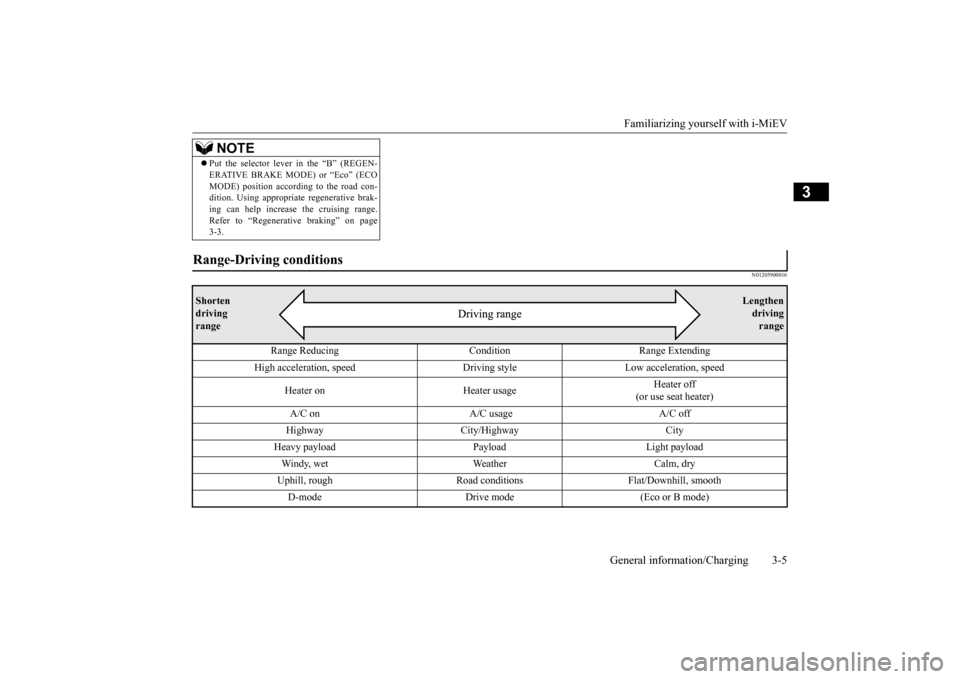
N01205900016
Put the selector lever in the “B” (REGEN- ERATIVE BRAKE MODE) or “Eco” (ECOMODE) position according to the road con-dition. Using appropriate regenerative brak- ing can help increase
the cruising range.
Refer to “Regenerative braking” on page3-3.NOTE
Range-Driving conditions Shorten driving range
Lengthen
driving range
Range Reducing Condition Range Extending
High acceleration, speed Driving
style Low acceleration, speed
Heater on Heater usage
Heater off
(or use seat heater)
A/C on A/C usage A/C off Highway City/Highway City
Heavy payload Payload Light payload Windy, wet Weather Calm, dry Uphill, rough Road conditio
ns Flat/Downhill, smooth
D-mode Drive mode (Eco or B mode)
BK0220401US.book 5 ページ 2015年6月3日 水曜日 午前7時42分
Page 20 of 296
Modifications to and racing of your vehicle 3-6 General information/Charging
3
N01206300020
While charging, even if the electric motor switch is in the “LOCK” position, you mayhear operating sounds such as sounds from the cooling fan and air conditioning compres- sor when operating the main drive lithium-ionbattery cooling system
or Remote Climate
Control. This is normal. Refer to “Remote Climate Control” on page 3-36, 3-47.
N01206400021
N01200500017
This vehicle should not be modified with non-Mitsubishi Motors genuine parts. Mitsubishi Motors designs and manufactures
Operating sound under charg- ing or Remote Climate Control
For persons with electro-medi-cal apparatus such as implant-able cardiac pacemaker or implantable cardiovascular defibrillator
WA R N I N G Before charging, read the instructions described below carefully and follow them. Also read and follow the instruc-tions for “Regular charging (charging method with rated AC 120 V outlet)” on page 3-16, “Regular
charging (using 240 V
Electric Vehicle Supply Equipment)” on page 3-26, and “Quick
charging (charging
method with quick
charger)” on page
3-27. Before charging, indivi
duals using an elec-
tro-medical apparatu
s such as implant-
able pacemakers and implantable cardiovascular-defibril
lators should check
with the manufacturer of the apparatus to confirm the effect of the electromagnetic waves from charging
. The electromagnetic
waves may affect the operations of the electro-medical apparatus.
When performing re
gular charging, keep
your electro-medical apparatus, such asimplantable cardiac pacemaker orimplantable cardiovas
cular defibrillator,
away from the charge connector, EV charging cable, control box or regularcharging station. Do not perform quick charging and keep away from a quick ch
arger. Electromag-
netic waves produced
by a quick charger
may affect the operation of your electric-medical apparatus. If you have acciden- tally approached a qu
ick charger, walk
away from the quick
charger immediately.
If quick charging is necessary, ask some- one for help. While charging;• Do not stay inside the vehicle.• Do not go inside the vehicle, for example to remove or place an item in the passen-ger compartment.• Do not open the liftgate, for example toremove or place an item in the cargo area.
Modifications to and racing of your vehicle
WA R N I N G
BK0220401US.book 6 ページ 2015年6月3日 水曜日 午前7時42分
Page 21 of 296
Modifications to and racing of your vehicle
General information/Charging 3-7
3
high quality vehicles
with an emphasis on
safety and durability. Modifications usingnon-Mitsubishi Motors genuine parts may affect the performance,
safety and/or durabil-
ity of your vehicle, a
nd may violate applica-
ble state and/or fe
deral regulations.
DAMAGE OR PERFORMANCE PROB- LEMS RESULTING FROM MODIFICA- TIONS TO OR RACING OF YOURVEHICLE ARE NOT COVERED UNDER WARRANTY. Examples of modifications to your vehicle that can cause damage or performance prob- lems include the following: Failure to use Mits
ubishi Motors genuine
parts Failure to use requi
red fluids (refer to
“Refill capacities” on page 11-7) Failure to use proper
size tires and wheels
Modification of the
suspension, electric
motor, drive train, batteries (main drive lithium-ion battery a
nd 12V starter bat-
tery), charging systems or electrical wir- ing systems Modification of any onboard com- puter/control module, including repro- gramming, or replac
ing/adding chips to
any onboard computer/control module
Review the Warranty and Maintenance Man- ual for further details
regarding warranty cov-
erage.
N01200600018
The installation of
accessories
, optional
parts, etc., should only be carried out within the limits prescribed by law in thedriving area and in accordance with the guidelines and warnin
gs contained within
the documents accompanying this vehicle.Only Mitsubishi Motors approved acces- sories should be fitt
ed to your vehicle.
Improper installation of
electrical parts
could cause fire. Refer to the “Modifica- tion/alterations to the electrical systems” Tires and wheels which do not meet spec- ifications must not be used. Refer to the “Specifi
cations” section for
information regarding wheel and tire sizes.
Due to the large number of accessory and replacement parts provided by different man- ufacturers in the market, it is not always pos- sible for a certified i-MiEV dealer to checkwhether the attachment
or installation of non-
Mitsubishi Motors genuine parts will affect the driving safety of your Mitsubishi-vehicle.
N01200700019
Mitsubishi Motors manufactures high qualityvehicles with an em
phasis on safety. It is
important to consult a
certified i-MiEV dealer
before installation of
any accessory which
Installation of accessories
CAUTIONBefore any electrical or electronic accesso- ries are installed, consult a certified i-MiEV dealer.
WA R N I N G If you choose to use a
cellular phone while
driving, you must not allow that usage todistract you in the sa
fe operation of your
vehicle. Anything, including cellular phone usage, that distracts you from the safe operation of you
r vehicle increases
your risk of an accident. Refer to and follow all local laws in your area regarding cellul
ar phone usage while
driving.
Important point! Modification/alterations to the electrical systems
BK0220401US.book 7 ページ 2015年6月3日 水曜日 午前7時42分
Page 22 of 296
Mitsubishi Motors genuine parts 3-8 General information/Charging
3
may involve m
odification of the electrical
systems.
N01200800010
Mitsubishi Motors Genuine Parts are designed and manufacture
d to meet high stan-
dards of performance, and are recommendedfor all of your maintenance needs. Also avail- able from a certified i-MiEV dealer are a wide variety of acce
ssories to personalize
your new vehicle. Ea
ch Mitsubishi vehicle
has a selection of Mi
tsubishi Motors autho-
rized accessories to c
hoose from to tailor your
new vehicle to your own personal preference. A certified i-MiEV de
aler’s Parts Manager
has information on va
rious audio systems,
protection items, as well
as interior and exte-
rior accessories available for your specificmodel.
N01200900011
Certain components of th
is vehicle, such as
airbag modules, seat belt pretensioners, and button cell batteries,
may contain perchlorate
materials. Special handling may a
pply. For additional
information, see www
.dtsc.ca.gov/hazardous-
waste/perchlorate.
N01201001045
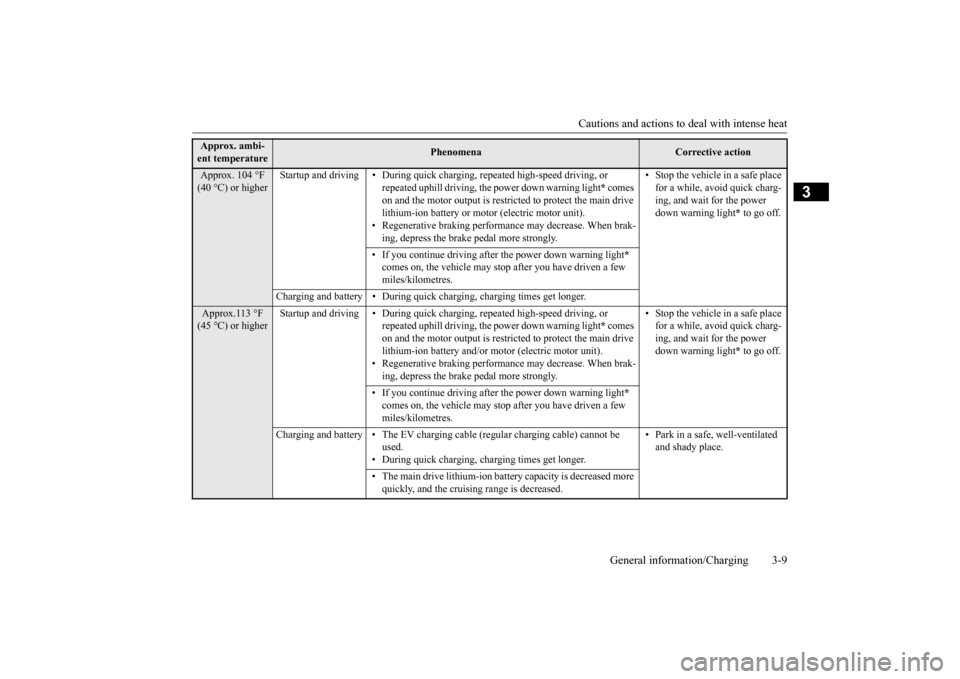
When the vehicle is driven in a high ambi
ent temperature, its air-conditioner performan
ce can be insufficient. Also, using the
air conditioner
will reduce the vehicle’s cruising range. When the ambient temperature is approximately 104 °F (40 °C) or
higher, the phenomena described be
low may occur. Please take th
e
described actions. Even if the ambient temperature is approx
imately 104 °F (40 °C) or lower, when perfo
rming quick charging,
driving at high-speed
and uphill
repeatedly, the phenomena described below may
occur. Please take the described actions.
CAUTIONPlease consult a certif
ied i-MiEV dealer con-
cerning any such accessory fitment or modi- fication. If the wires interfere
with the vehicle body or
improper installation me
thods are used (pro-
tective fuses not included, etc.), electronic devices may be adversel
y affected, resulting
in a fire, vehicle dama
ge, or other accident.
Mitsubishi Motors genuine parts
California Perchlorate Materials Requirements
Cautions and actions to deal with intense heat BK0220401US.book 8 ページ 2015年6月3日 水曜日 午前7時42分
Page 23 of 296
Cautions and actions to deal with intense heat
General information/Charging 3-9
3
Approx. ambi- ent temperature
Phenomena
Corrective action
Approx. 104 °F (40 °C) or higher
Startup and driving •
ed high-speed driving, or
repeated uphill driving, th
e power down warning light
* comes
on and the motor output is restricted to protect the main drive lithium-ion battery or motor (electric motor unit).Regenerative braking performa
nce may decrease. When brak-
ing, depress the brak
e pedal more strongly.
• Stop the vehicle in a safe place for a while, avoid quick charg- ing, and wait for the power down warning light
* to go off.
• If you continue driving afte
r the power down warning light
*
comes on, the vehicl
e may stop after you have driven a few
miles/kilometres.
Charging and battery • During quick ch
arging, charging times get longer.
Approx.113 °F (45 °C) or higher
Startup and driving •
ed high-speed driving, or
repeated uphill driving, th
e power down warning light
* comes
on and the motor output is restricted to protect the main drive lithium-ion battery and/or motor (electric motor unit). Regenerative braking performa
nce may decrease. When brak-
ing, depress the brak
e pedal more strongly.
• Stop the vehicle in a safe place for a while, avoid quick charg-ing, and wait for the power down warning light
* to go off.
• If you continue driving afte
r the power down warning light
*
comes on, the vehicl
e may stop after you have driven a few
miles/kilometres.
Charging and battery •
charging cable) cannot be
used. During quick charging, charging times get longer.
• Park in a safe, well-ventilated and shady place.
• The main drive lithium-ion batte
ry capacity is decreased more
quickly, and the cruisi
ng range is decreased.
BK0220401US.book 9 ページ 2015年6月3日 水曜日 午前7時42分
Page 24 of 296
Cautions and actions to deal with intense cold 3-10 General information/Charging
3
N01201101033
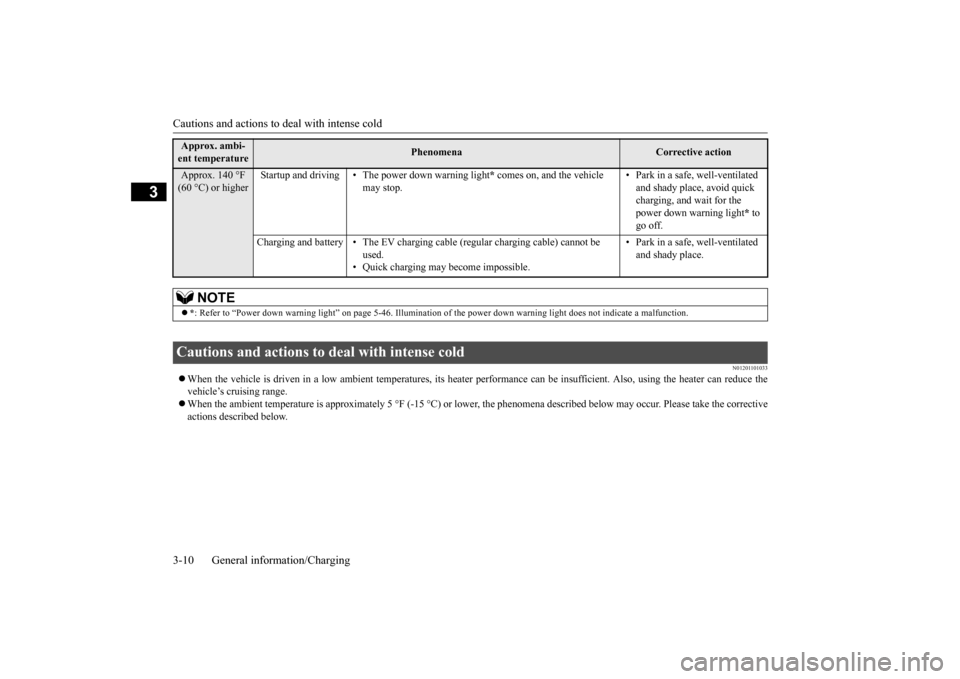
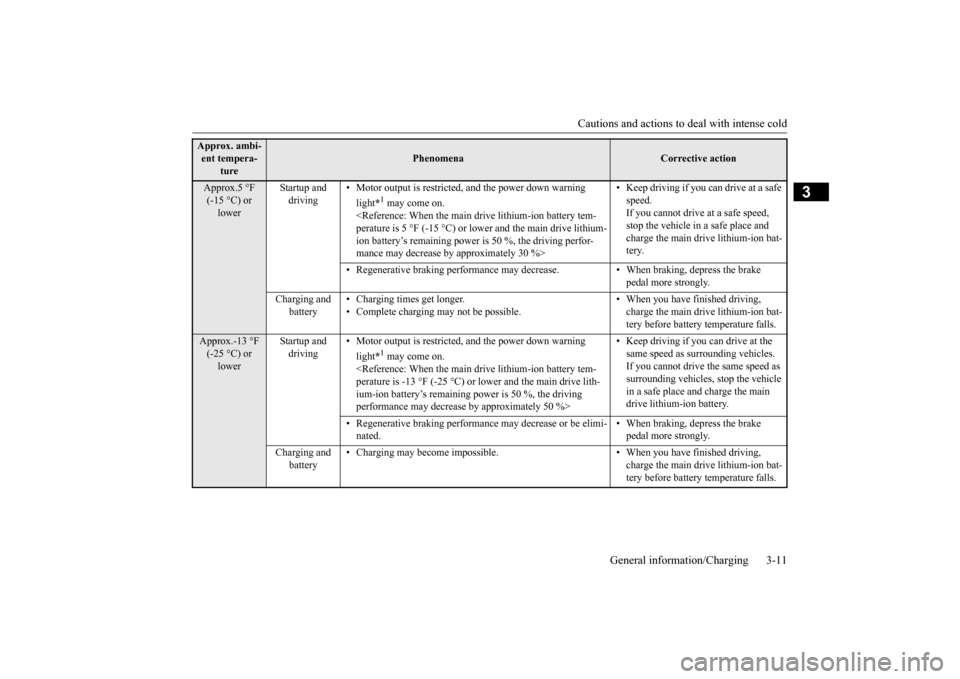
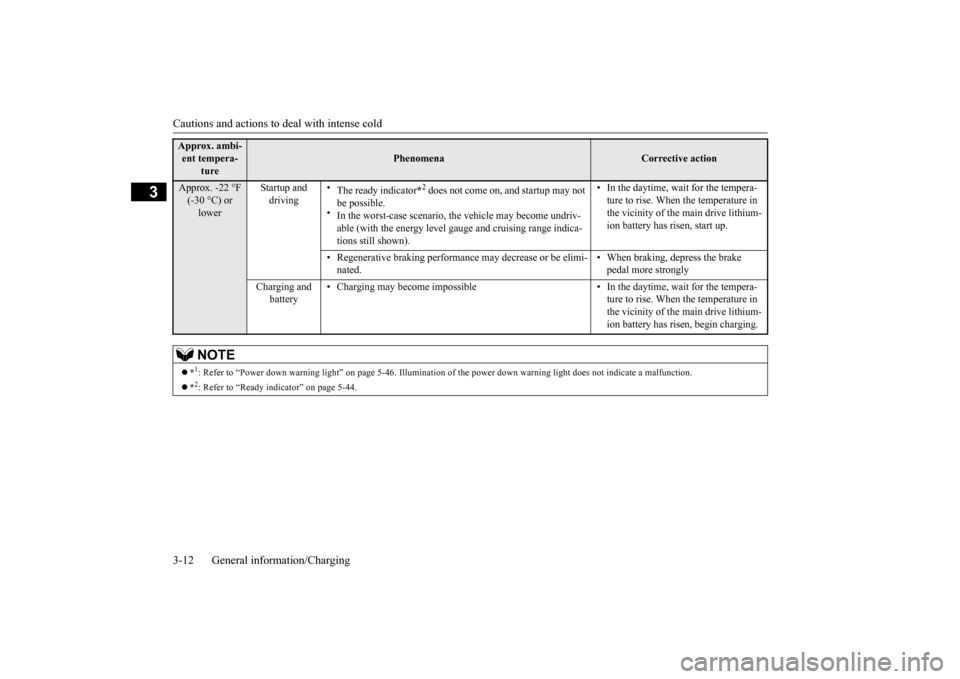
When the vehicle is driven in a low ambient temperatures, its he
ater performance can be insuffic
ient. Also, using the heater ca
n reduce the
vehicle’s cruising range. When the ambient temperature is approximately 5 °F (-15 °C) or
lower, the phenomena de
scribed below may occu
r. Please take the
corrective
actions described below.Approx. 140 °F (60 °C) or higher
Startup and driving • The power down warning light
* comes on, and the vehicle
may stop.
• Park in a safe, well-ventilated and shady place, avoid quick charging, and wait for the power down warning light
* to
go off.
Charging and battery •
used.Quick charging may become impossible.
• Park in a safe, well-ventilated and shady place.
NOTE
*: Refer to “Power down warning light” on pa
ge 5-46. Illumination of the power down wa
rning light does not i
ndicate a malfunctio
n.
Cautions and actions to deal with intense cold Approx. ambi- ent temperature
Phenomena
Corrective action
BK0220401US.book 10 ページ 2015年6月3日 水曜日 午前7時42分
Page 25 of 296
Cautions and actions to deal with intense cold
General information/Charging 3-11
3
Approx. ambi- ent tempera-
ture
Phenomena
Corrective action
Approx.5 °F (-15 °C) or lower
Startup and driving
• Motor output is restricted
, and the power down warning
light
*1 may come on.
• Keep driving if you can drive at a safe speed. If you cannot drive at a safe speed, stop the vehicle in
a safe place and
charge the main drive lithium-ion bat- tery.
• Regenerative braking performance may decr
ease. • When braking, depress the brake
pedal more strongly.
Charging and
battery
• • Charging times get longer. Complete charging may not be possible.
• When you have finished driving, charge the main drive lithium-ion bat- tery before battery temperature falls.
Approx.-13 °F (-25 °C) or lower
Startup and driving
• Motor output is restricted
, and the power down warning
light
*1 may come on.
ium-ion battery’s remaining power is 50 %, the driving performance may decrease by approximately 50 %>
• Keep driving if you can drive at the same speed as su
rrounding vehicles.
If you cannot drive the same speed as surrounding vehicles, stop the vehicle in a safe place and charge the main drive lithium-ion battery.
• Regenerative braking performan
ce may decrease or be elimi-
nated.
• When braking, depress the brake pedal more strongly.
Charging and
battery
• Charging may become impossible. • W
hen you have finished driving, charge the main drive lithium-ion bat- tery before battery temperature falls.
BK0220401US.book 11 ページ 2015年6月3日 水曜日 午前7時42分
Page 26 of 296
Cautions and actions to deal with intense cold 3-12 General information/Charging
3
Approx. -22 °F (-30 °C) or lower
Startup and driving
• • The ready indicator
*2 does not come on, and startup may not
be possible. In the worst-case scenario,
the vehicle may become undriv-
able (with the energy level ga
uge and cruising range indica-
tions still shown).
• In the daytime, wait for the tempera- ture to rise. When the temperature in the vicinity of the main drive lithium-ion battery has risen, start up.
• Regenerative braking performance
may decrease or be elimi-
nated.
• When braking, depress the brake pedal more strongly
Charging and
battery
• Charging may become impossible • In the daytime, wait for the tempera-
ture to rise. When the temperature in the vicinity of the main drive lithium- ion battery has rise
n, begin charging.
NOTE
*1: Refer to “Power down warning light” on pa
ge 5-46. Illumination of th
e power down warning light doe
s not indicate a malfunctio
n.
*2: Refer to “Ready indicator” on page 5-44.
Approx. ambi- ent tempera-
ture
Phenomena
Corrective action
BK0220401US.book 12 ページ 2015年6月3日 水曜日 午前7時42分
Page 27 of 296
Charging
General information/Charging 3-13
3
N01201201047
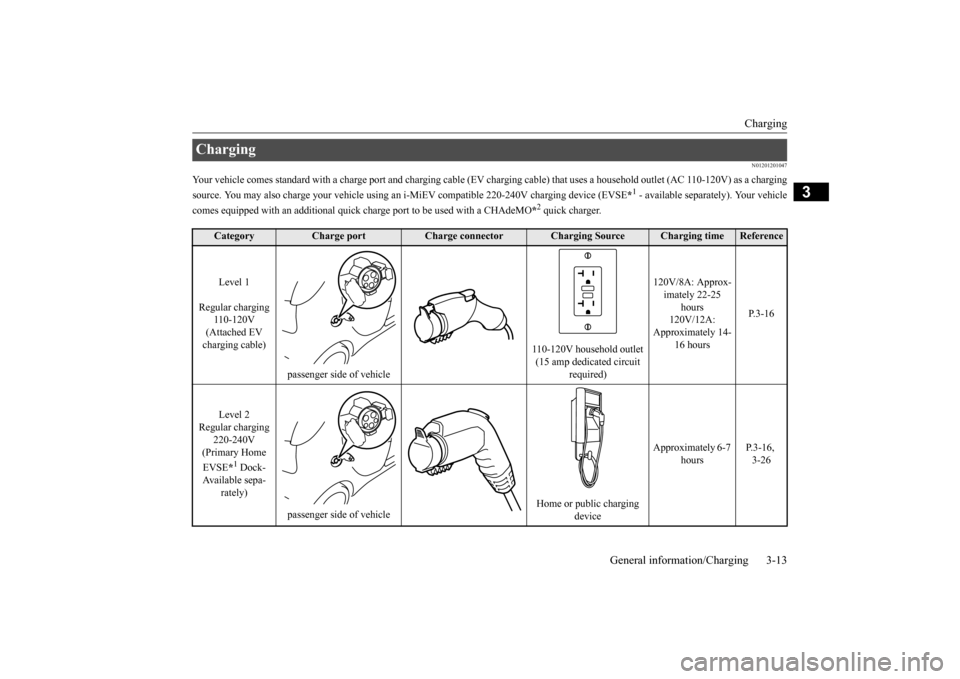
Your vehicle comes standard with a charge
port and charging cable (EV charging cable)
that uses a household outlet (AC 110-120V
) as a charging
source. You may also charge your vehicle using an
i-MiEV compatible 220-240V charging device (EVSE
*1 - available separate
ly). Your vehicle
comes equipped with an add
itional quick charge port to
be used with a CHAdeMO
*2 quick charger.
Charging
Category
Charge port
Charge connector
Charging Source
Charging time
Reference
Level 1
Regular charging
110-120V (Attached EV charging cable)
passenger side of vehicle
110-120V household outlet (15 amp dedicated circuit
required)
120V/8A: Approx- imately 22-25
hours
120V/12A:
Approximately 14-
16 hours
P. 3 - 1 6
Level 2
Regular charging
220-240V (Primary Home EVSE
*1 Dock-
Available sepa-
rately)
passenger side of vehicle
Home or public charging
device
Approximately 6-7
hours
P.3-16, 3-26
BK0220401US.book 13 ページ 2015年6月3日 水曜日 午前7時42分
Page 28 of 296
Charging 3-14 General information/Charging
3
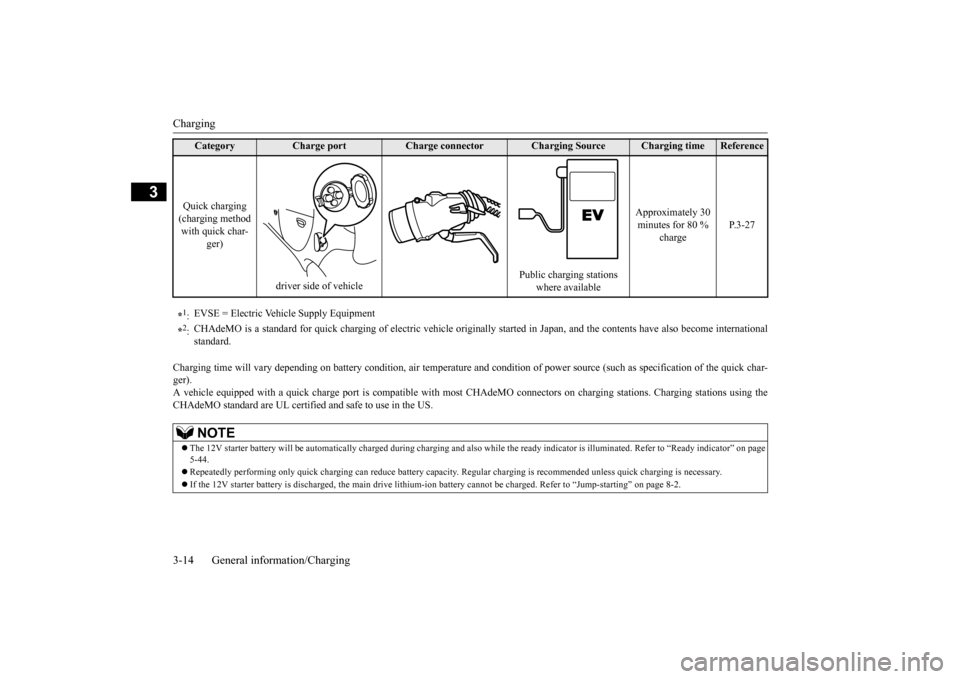
Charging time will vary depending on battery
condition, air temperature and condition of
power source (such
as specification of
the quick char-
ger).A vehicle equipped with a quick charge port
is compatible with most CHAdeMO connecto
rs on charging stations. Charging stations
using the
CHAdeMO standard are UL certifie
d and safe to use in the US.
Quick charging (charging method with quick char-
ger)
driver side of vehicle
Public charging stations
where available
Approximately 30 minutes for 80 %
charge
P.3-27
*1: EVSE = Electric Vehi
cle Supply Equipment
*2: CHAdeMO is a standard for quick charging of
electric vehicle originally started in Japa
n, and the contents ha
ve also become int
ernational
standard. NOTE
The 12V starter battery wi
ll be automatically char
ged during charging and also while the re
ady indicator is illuminated. Refer
to “Ready indicator” on page
5-44. Repeatedly performing only quick
charging can reduce battery ca
pacity. Regular charging is re
commended unless quick charging is
necessary.
If the 12V starter battery
is discharged, the main drive lithium-ion battery
cannot be charged. Refer
to “Jump-starting” on pag
e 8-2.
Category
Charge port
Charge connector
Charging Source
Charging time
Reference
BK0220401US.book 14 ページ 2015年6月3日 水曜日 午前7時42分