climate control MITSUBISHI iMiEV 2017 1.G User Guide
[x] Cancel search | Manufacturer: MITSUBISHI, Model Year: 2017, Model line: iMiEV, Model: MITSUBISHI iMiEV 2017 1.GPages: 296, PDF Size: 7.79 MB
Page 64 of 296
MiEV Remote System 3-50 General information/Charging
3
2. Turn off the MiEV Remote. Refer to “To turn the MiEV Remote ON/OFF” on page3-43.
N01204500015
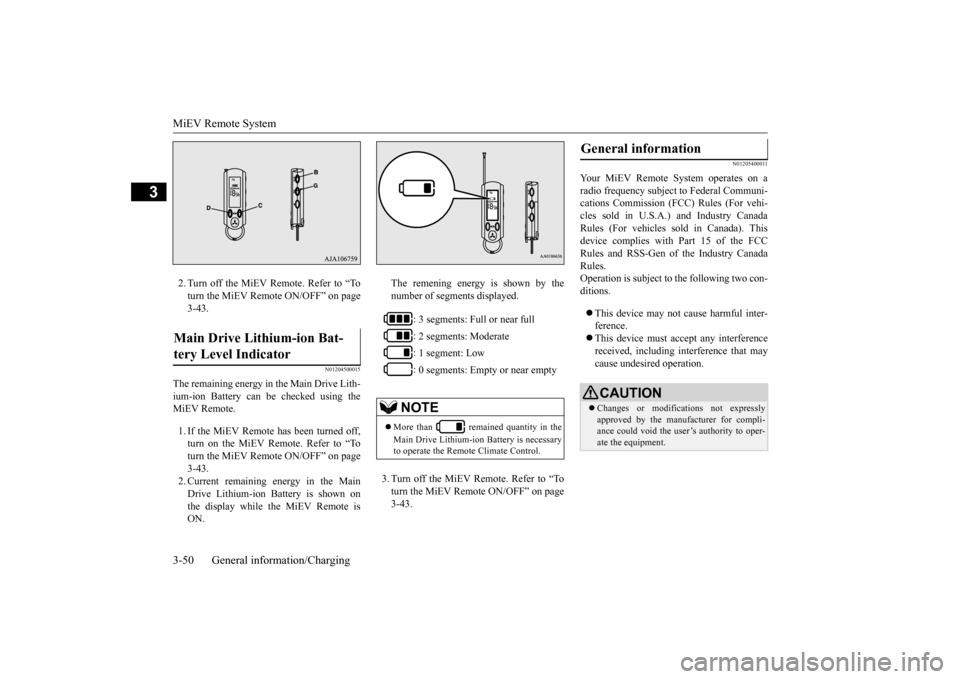
The remaining energy in the Main Drive Lith- ium-ion Battery can be checked using the MiEV Remote. 1. If the MiEV Remote has been turned off, turn on the MiEV Remote. Refer to “To turn the MiEV Remote ON/OFF” on page 3-43.2. Current remaining energy in the Main Drive Lithium-ion Battery is shown on the display while the MiEV Remote isON.
The remening energy is shown by the number of segments displayed. 3. Turn off the MiEV Remote. Refer to “To turn the MiEV Remote ON/OFF” on page 3-43.
N01205400011
Your MiEV Remote
System operates on a
radio frequency subject
to Federal Communi-
cations Commission (FCC) Rules (For vehi-cles sold in U.S.A.) and Industry Canada Rules (For vehicles so
ld in Canada). This
device complies with
Part 15 of the FCC
Rules and RSS-Gen of the Industry Canada Rules. Operation is subject to
the following two con-
ditions. This device may not
cause harmful inter-
ference. This device must ac
cept any interference
received, including interference that may cause undesired operation.
Main Drive Lithium-ion Bat- tery Level Indicator
: 3 segments: Full or near full : 2 segments: Moderate : 1 segment: Low : 0 segments: Empty or near empty
NOTE
More than remained quantity in the Main Drive Lithium-ion Battery is necessary to operate the Remote Climate Control.
General information
CAUTION Changes or modifica
tions not expressly
approved by the manufacturer for compli- ance could void the user’s authority to oper-ate the equipment.
BK0220401US.book 50 ページ 2015年6月3日 水曜日 午前7時42分
Page 69 of 296

MiEV Remote System
General information/Charging 3-55
3
Charging Timer is not possible.
The system is charged although the ON timer is being set.
Backup charging for the Main Drive Lith- ium-ion Battery Wa
rming System has
been operated.
This is not a malfunction.Charging will be termi- nated when the system has been charged enough for the Main Drive Lithium-ion Battery Warming Sys- tem.
Charging is preset, but the specified charging level is not satisfied. The charging level is not expected amount. Is not charged. Is not charged at the preset time.
The timer is cancelled or the preset time is changed by using anot
her MiEV Remote.
Check whether another person has operated his or her MiEV Remote.
The electric motor switch has been oper- ated before the system is charged.
Check whether the electric motor switch has been operated before the system is charged.
The temperature of the Main Drive Lith- ium-ion Battery has exceeded about 140 °F (60 °C).
Allow the temperature of the Main Drive Lithium- ion Battery to reach norm
al operating temperature.
Refer to “Cautions and acti
on to deal with intense
heat” on page 3-8.
Charging Timer is not preset correct
ly. Preset the timed charging again.
Although the charging is preset, too much time is needed to charge the sys- tem fully.
The Remote Climate Control has been activated.
Check whether the Remote Climate Control has been activated.
The Main Drive Lithium-ion Battery Warming System ha
s been operated.
Move the vehicle to a warmer location.
Temperature of the Main Drive Lithium- ion Battery is low.
Refer to “Cautions and acti
on to deal with intense
cold” on page 3-10.
Charging Timer is not possible.
It is not fully charged. If the charging unit is equipped with the
timer function, the power supply to the unit has been cut off.
Preset the Charging Timer while the charging unit with timer function is powered on.
Phenomena
Cause
Remedy
BK0220401US.book 55 ページ 2015年6月3日 水曜日 午前7時42分
Page 71 of 296

MiEV Remote System
General information/Charging 3-57
3
N01203600019
1. Gently wipe with gauze or a
nother soft cloth soaked with a mild soap and water solution.
2. Wipe off all the detergent with a soft clot
h dipped in fresh water and thoroughly wrung out.
3. Wipe all moisture off and dry in
a shaded, well-ventilated area.
The Remote Cli- mate Control can-not be activated.
After the power/commu- nication switch is pressed, the following symbol blinks in several seconds. ERROR symbol
Any of the door or liftgate is ope
n. Close all the door
s and liftgate.
The selector lever is
at the position other
than P (PARK).
Place the selector lever to P (PARK) position.
Quick charging is in progress. (The symbol will illuminate.)
quick charging completes.
The temperature of the Main Drive Lith- ium-ion Battery has exceeded about 140 °F (60 °C).
Allow the temperature of the Main Drive Lithium- ion Battery to reach norm
al operating temperature.
Refer to “Cautions and acti
on to deal with intense
heat” on page 3-8.
The Remote Climate Control is not activated.
The electric motor switch has been oper- ated before the system is charged.
Check whether the electric motor switch has been operated before the system is charged.
The temperature of the Main Drive Lith- ium-ion Battery has exceeded about 140 °F (60 °C).
Allow the temperature of the Main Drive Lithium- ion Battery to reach norm
al operating temperature.
Refer to “Cautions and acti
on to deal with intense
heat” on page 3-8.
The Remote Cli- mate Control can- not be activated.
The heated seat is not powered on.
The heated seat switch is turned off. Turn on the heated seat switch.
The heated seat becomes hot while the air condi- tioning (cooling) is acti- vated.
The heated seat switch is turned on. Turn off the heated seat switch.
Cleaning the MiEV Remote
Phenomena
Cause
Remedy
BK0220401US.book 57 ページ 2015年6月3日 水曜日 午前7時42分
Page 77 of 296
Rear seats
Seat and restraint systems 4-5
4
The indicator light (C) will illuminate while the heater is on.
N00402500218
N00402800022
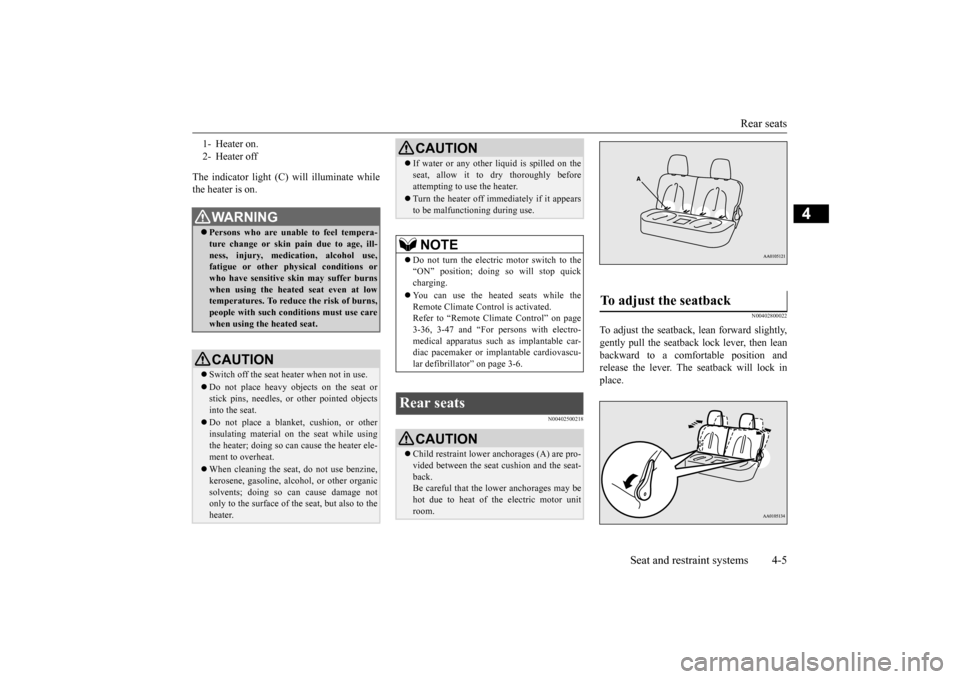
To adjust the seatback,
lean forward slightly,
gently pull the seatback lock lever, then lean backward to a comfortable position and release the lever. The seatback will lock inplace.
1- Heater on. 2- Heater offWA R N I N G Persons who are unable to feel tempera- ture change or skin
pain due to age, ill-
ness, injury, medication, alcohol use, fatigue or other phys
ical conditions or
who have sensitive sk
in may suffer burns
when using the heated seat even at low temperatures. To reduce the risk of burns,people with such conditions must use care when using the heated seat.CAUTION Switch off the seat heater when not in use.Do not place heavy objects on the seat or stick pins, needles, or
other pointed objects
into the seat. Do not place a blanket,
cushion, or other
insulating material on the seat while usingthe heater; doing so can
cause the heater ele-
ment to overheat. When cleaning the seat, do not use benzine, kerosene, gasoli
ne, alcohol, or other organic
solvents; doing so can cause damage not only to the surface of the seat, but also to theheater.
If water or any other li
quid is spilled on the
seat, allow it to dry thoroughly beforeattempting to use the heater. Turn the heater off immediately if it appears to be malfunctioning during use.NOTE
Do not turn the electric motor switch to the “ON” position; doing
so will stop quick
charging. You can use the heated seats while the Remote Climate Control is activated. Refer to “Remote Climate Control” on page 3-36, 3-47 and “For persons with electro-medical apparatus such
as implantable car-
diac pacemaker or im
plantable cardiovascu-
lar defibrillator” on page 3-6.
Rear seats
CAUTION Child restraint lower anchorages (A) are pro- vided between the seat
cushion and the seat-
back. Be careful that the lower anchorages may be hot due to heat of th
e electric motor unit
room.CAUTION
To adjust the seatback
BK0220401US.book 5 ページ 2015年6月3日 水曜日 午前7時42分
Page 161 of 296
Horn switch
Features and controls 5-53
5
N00523800172
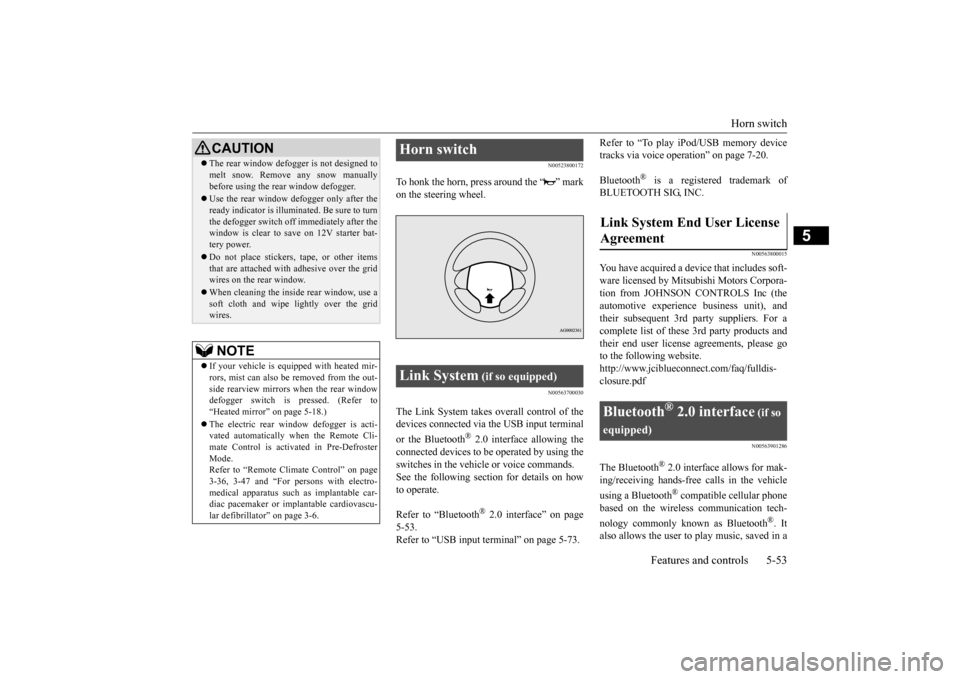
To honk the horn, press around the “ ” mark on the steering wheel.
N00563700030
The Link System takes ove
rall control of the
devices connected via the USB input terminal or the Bluetooth
® 2.0 interface allowing the
connected devices to be operated by using theswitches in the vehicl
e or voice commands.
See the following sect
ion for details on how
to operate. Refer to “Bluetooth
® 2.0 interface” on page
5-53. Refer to “USB input terminal” on page 5-73.
Refer to “To play iPod/USB memory device tracks via voice operation” on page 7-20. Bluetooth
® is a registered trademark of
BLUETOOTH SIG, INC.
N00563800015
You have acquired a devi
ce that includes soft-
ware licensed by Mitsub
ishi Motors Corpora-
tion from JOHNSON CONTROLS Inc (the automotive experience business unit), and their subsequent 3rd
party suppliers. For a
complete list of these
3rd party products and
their end user license
agreements, please go
to the following website.http://www.jciblueconne
ct.com/faq/fulldis-
closure.pdf
N00563901286
The Bluetooth
® 2.0 interface allows for mak-
ing/receiving ha
nds-free calls in the vehicle
using a Bluetooth
® compatible cellular phone
based on the wireless communication tech- nology commonly known as Bluetooth
®. It
also allows the user to play music, saved in a
CAUTION The rear window defogge
r is not designed to
melt snow. Remove
any snow manually
before using the rear window defogger. Use the rear window de
fogger only after the
ready indicator is illuminated. Be sure to turnthe defogger switch off immediately after the window is clear to sa
ve on 12V starter bat-
tery power. Do not place stickers,
tape, or other items
that are attached with adhesive over the gridwires on the rear window. When cleaning the inside
rear window, use a
soft cloth and wipe lightly over the grid wires.NOTE
If your vehicle is equi
pped with heated mir-
rors, mist can also be removed from the out-side rearview mirrors when the rear window defogger switch is pressed. (Refer to “Heated mirror”
on page 5-18.)
vated automatically when the Remote Cli-mate Control is activated in Pre-DefrosterMode. Refer to “Remote Climate Control” on page 3-36, 3-47 and “For persons with electro-medical apparatus such
as implantable car-
diac pacemaker or im
plantable cardiovascu-
lar defibrillator” on page 3-6.
Horn switch Link System
(if so equipped)
Agreement
Bluetooth
® 2.0 interface
(if so
equipped)
BK0220401US.book 53 ページ 2015年6月3日 水曜日 午前7時42分
Page 203 of 296
7
Comfort controlsVents ................................................................................................7-2 Air conditioning ..........
...........
...........
...........
...........
...........
.........
.....7-4
Important air conditioning operating tips ..
...........
...........
.........
.....7-10
Air purifier ..................................................................................... 7-11 Remote Climate Control ................................................................ 7-11 AM/FM electronically tune
d radio with CD player
(if so equipped) .......................................................................... 7-11 To play iPod/USB memory devi
ce tracks via
voice operation
(vehicles with Bluetooth
® 2.0 interface) ...................................7-20
Steering wheel audio remote control
switch (if so equipped) ........7-22
Error codes .....................................................................................7-24 Handling of compact discs .............................................................7-25Antenna ..........................................................................................7-27 Clock (if so equipped) ....................................................................7-27 General information about your radio .....
...........
...........
...........
.....7-28
BK0220401US.book 1 ページ 2015年6月3日 水曜日 午前7時42分
Page 213 of 296
Air purifier
Comfort controls 7-11
7
The air conditioning should be operated for at least five minutes each week, even in cold weather. This includes the quick defrostingmode. Operating the
air condition system
weekly maintains lubrication of the compres- sor internal parts and maintains the air condi-tioning in the best operating condition.
N00733800177
The air conditioning system is equipped with an air filter to reduc
e pollen and dust entering
the cabin.The air filter’s ability to collect pollen and dust will be reduced as
it becomes dirty, so
replace it periodically. For the maintenanceinterval, refer to the “WARRANTY AND MAINTENANCE MANUAL”.
N00766601026
You can run the air conditioning in advanceof using the vehicle. For details, refer to “Remote Climate Cont
rol” on page 3-36,
3-47.
N00734301062
The audio system can only be used when theelectric motor switch is in the “ON” or“ACC” position.
CAUTION The air conditioning system in your vehicle must be charged with the refrigerant HFC-134a and the lubricant POE MA68EV.Use of any other refrigerant or lubricant will cause severe damage a
nd may require replac-
ing your vehicle’s en
tire air conditioning
system. The release of refrigerant into the atmo- sphere is not recommended.The new refrigerant HFC-134a in your vehi- cle is designed not to harm the earth’s ozone layer. However, it may contribute slightly toglobal warming. It is recommended that the old refrigerant be saved and recycled for future use.
During a long period of disuse
Air purifier
NOTE
Operation in certain conditions such as driv- ing on a dusty road or frequent use of the air conditioning can reduce
the service life of
the filter. When you feel that the air flow is lower than normal or when the windshield or windows start to fog up easily, replace the airfilter. Contact a certified i-MiEV dealer for assis- tance.
Remote Climate Control
AM/FM electronically tuned radio with CD player
(if so
equipped)
NOTE
To listen to the audio system while the elec- tric motor unit is not running, turn the elec-tric motor switch to the “ACC” position. If the electric motor switch is in the “ACC”cally turn off after a certain period of time and you will no longer be able to use the audio system. The accessory power comeson again if the electric motor switch is turned from the “ACC” position. Refer to “ACC power auto-cutout f
unction” on page 5-19.
If a cellular phone is
used inside the vehicle,
it may create noise in the audio equipment.This does not mean that anything is wrong with your audio equipment. In such a case, use the cellular phone at
a place as
far away
as possible from the audio equipment.
BK0220401US.book 11 ページ 2015年6月3日 水曜日 午前7時42分
Page 259 of 296

Tires
Vehicle care and maintenance 9-13
9
code may only be on one side. Look for the TIN on the outboard side of tires as mounted on the vehicle. If the TIN is not found on the outboard sidethen you will find it on the inboard side of the tire. EXAMPLE: DOT MA L9 ABCD 1504
The treadwear grade is a comparative rating based on the wear rate of the tire when testedunder controlled conditions on a specified government test course
. For example, a tire
graded 150 would wear one and one-half (11/2) times as well on the government course
as a tire graded 100. The relative performance of tires depends upon the actual conditions of their use, however, and may depart signifi-cantly from the norm due to variations in driving habits, service practices and differ- ences in road characteristics and climate. The traction grades, from highest to lowest, are AA, A, B and C. Those grades represent the tire’s ability to stop on wet pavement as measured under contro
lled conditions on
specified government te
st surfaces of asphalt
and concrete. A tire marked C may have poor traction performance. The temperature grades are A (the highest), B and C, representing the ti
re’s resistance to the
generation of heat and it
s ability to dissipate
heat when tested u
nder controlled conditions
on a specified indoor
laboratory test wheel.
Sustained high temperature can cause the material of the tire to
degenerate and reduce
tire life, and excessive temperature can lead to sudden tire failure. The grade C corre-sponds to a level of
performance which all
passenger car tires must
meet under the Fed-
eral Motor Vehicle Safety Standard No. 109.Grades B and A represent higher levels of performance on the laboratory test wheel than the minimum required by law.
N00939300873
Proper tire inflation pre
ssure is essential for
the safe and satisfac
tory operation of your
vehicle. The wrong tire pressure will cause problems in three major areas: Safety
DOT
Department of Transporta- tion This symbol certifies that the tire is in compliance with the U.S.
Department
of Transportation tire safety standards, and is approved for highway use.
MA
Code representing the tire manufacturing location. (2 digits)
L9 ABCD
Code representing the tire size. (2 digits)Code used by tire manufac- turer. (1 to 4 digits)
15
Number representing the week in which the tire was manufactured. (2 digits)
04
Number representing the year in which the tire was manufactured. (2 digits)
ature Grades Treadwear Tr a c t i o n
TemperatureTire inflation pressures
BK0220401US.book 13 ページ 2015年6月3日 水曜日 午前7時42分
Page 280 of 296
Consumer information (For vehicles sold in U.S.A.) 10-2 Customer assistance/Re
porting Safety Defects
10
N01047100171
This information is provided in compliance with the requirements of the National High- way Traffic Safety Ad
ministration, Depart-
ment of Transportation. It provides the purchasers and/or prospective purchasers with information on repor
ting safety defects.
DOT quality grades - Al
l passenger vehicle
tires must conform to
Federal Safety Require-
ments in addition to these grades. The spe- cific grade rating in each grade category isshown on the side wall of the tires on your vehicle. The treadwear grade is a comparative rating based on the wear rate of
the tire when tested
under controlled conditions on a specifiedgovernment test course
. For example, a tire
graded 150 would wear one and one-half (11/2) times as well on the government course
as a tire graded 100.
The relative performance
of tires depends upon the actual conditions of
their use, however, and may depart signifi- cantly from the norm due to variations indriving habits, service practices and differ- ences in road characteristics and climate. The traction grades, from highest to lowest, are AA, A, B and C. Those grades represent the tire’s ability to
stop on wet pavement as
measured under controlled conditions on specified government te
st surfaces of asphalt
and concrete. A tire marked C may have poor traction performance. The temperature grades are A (the highest), B and C, representing the ti
re’s resistance to the
generation of heat and it
s ability to dissipate
heat when tested un
der controlled conditions
on a specified indoor
laboratory test wheel.
Sustained high temperature can cause the
material of the tire to
degenerate and reduce
tire life, and excessive temperature can leadto sudden tire failure. The grade C corre- sponds to a level of performance which all passenger car tires must meet under the Fed-eral Motor Vehicle Safety Standard No. 109. Grades B and A represent higher levels of performance on the labora
tory test wheel than
the minimum required by law.
N01047201515
If you believe that your vehicle has a defect which could cause a crash or could cause injury or death, you should immediately inform theNational Highway Traffic Safety Administration (NHTSA) in addi- tion to notifying Mitsubishi MotorsCorporation.
Consumer information (For vehicles sold in U.S.A.) Uniform tire quality grading Treadwear
Traction AA, A, B, C
WA R N I N G The traction grade assi
gned to this tire is
based on straight-ahead braking tractiontests, and does not include acceleration, cornering, hydroplani
ng, or peak traction
characteristics.
Temperature A, B, C
WA R N I N G The temperature grade for this tire is established for a tire that is properlyinflated and not overloaded. Excessive speed, underinflation
, or excessive load-
ing, either separately
or in combination,
can cause heat buildup and possible tire failure.
Reporting Safety Defects
BK0220401US.book 2 ページ 2015年6月3日 水曜日 午前7時42分
Page 294 of 296

Alphabetical index 12-4
12
Operation under adverse driving conditions
...
8-13 Outside rearview mirrors
.....................
5-17
Outside temperature display
........
5-37
, 5-41
P
Parking
................................................
6-6
Parking brake
.................................
5-16
Parking brake lever stroke
...............
9-16
Parking lights
Bulb capacity
.................................
9-22
Polishing
............................................
9-31
Power brakes
......................................
5-24
Power door locks
..................................
5-9
Power down warning light
...................
5-46
Power outlet
.......................................
5-76
Power windows
..................................
5-14
Precautions during Charging the Main Drive Lithium-ion Battery
..........................
3-15
Q
Quick charging
...................................
3-27
R
Radio
General information about your radio 7-28
Ready indicator
..................................
5-44
Rear combination lights
Bulb capacity
..................................
9-22
Replacement
...................................
9-25
Rear side-marker lights
Bulb capacity
..................................
9-22
Replacement
...................................
9-26
Rear turn signal lights
Bulb capacity
..................................
9-22
Replacement
...................................
9-25
Rear window defogger switch
..............
5-52
Rear-view camera
...............................
5-34
Rearview mirror
Inside
.............................................
5-16
Outside
..........................................
5-17
Refill capacities
..................................
11-7
Regenerative brake system indicator
.....
5-44
Regenerative braking
............................
3-3
Regular charging
........................
3-16
, 3-26
Remote Climate Control
....
3-36
, 3-47
, 7-11
Replacement of light bulbs
...................
9-21
Replacing tires and wheels
...................
9-14
Reporting Safety Defects
.....................
10-2
Reservoir cap
.......................................
9-6
S
Safe driving techniques
.........................
6-4
Seat
....................................................
4-2
Front seats
.......................................
4-3
Heated seat
......................................
4-4
Rear seats
........................................
4-5
Seats and restraint systems
................
4-2
Seat belt
...............................................
4-8
Adjustable seat belt shoulder anchor
.4-11
Child restraint
................................
4-13
Driver’s seat belt
reminder/warning light
..
4-10 Force limiter
..................................
4-13
Front passenger seat belt warning light
.....
4-11 Maintenance and inspection
.............
4-20
Pre-tensioner
..................................
4-12
Seat belt extender
...........................
4-12
Seat belt
instructions
.........................
4-9
Seat belt use
during pregnancy
.........
4-12
Selector lever
.....................................
5-21
Selector lever operation
...................
5-21
Selector lever po
sition indicator
.......
5-21
Selector le
ver positions
...................
5-22
Service brake
......................................
5-24
Service precautions
...............................
9-2
Service reminder
........................
5-37
, 5-38
Skid control function
...........................
5-29
Snow tires
..........................................
9-15
Speedometer
......................................
5-36
Steering
Wheel lock
.....................................
5-20
Stop lights
BK0220401US.book 4 ページ 2015年6月3日 水曜日 午前7時42分