flat tire MITSUBISHI iMiEV 2017 1.G User Guide
[x] Cancel search | Manufacturer: MITSUBISHI, Model Year: 2017, Model line: iMiEV, Model: MITSUBISHI iMiEV 2017 1.GPages: 296, PDF Size: 7.79 MB
Page 197 of 296
Loading information Driving safety 6-7
6
It is important to famil
iarize yourself with the
following terms before loading your vehicle: Vehicle maximum load on the tire: load on an individual tire that is determined bydistributing to each axle its share of the maximum loaded vehicle weight and dividing by two. Vehicle normal load on the tire: load on an individual tire that is determined by dis- tributing to each axle its share of the curbweight, accessory weight, and normal occupant weight and dividing by two. Maximum loaded vehicle weight: the sum of - (a) Curb weight; (b) Accessory weight;(c) Vehicle capacity weight; and (d) Production options weight. Curb weight: the weight of a motor vehi- cle with standard e
quipment including the
maximum capacity of oil, and coolant.
Accessory weight: the combined weight (in excess of those st
andard items which
may be replaced) of automatic transmis- sion, power steering, power brakes, power windows, power seats,
radio, and heater,
to the extent that these items are available as factory- installe
d equipment (whether
installed or not). Vehicle capacity weight: the rated cargo and luggage load plus 150 lbs (68 kg)
*
times the vehicle’s designated seating capacity. Production options weight: the combined weight of those installed regular produc- tion options weighing over 5 lbs (2.3 kg) in excess of those standard items whichthey replace, not prev
iously considered in
curb weight or accessory weight, includ- ing heavy duty brakes,
ride levelers, roof
rack, heavy duty battery, and special trim. Normal occupant weight: 150 lbs (68 kg)
*
times the number of specified occupants.(In your vehicle the number is 2) Occupant distributi
on: distribution of
occupants in a vehicle as specified. (Inyour vehicle the distribution is 2 in front seat)
N00630100370
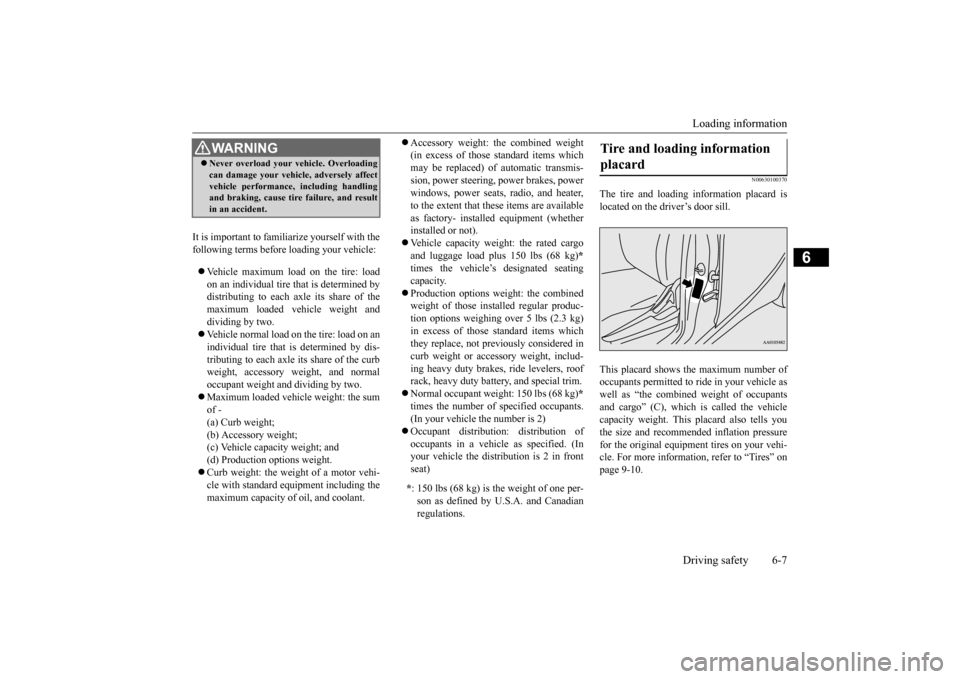
The tire and loading information placard is located on the driver’s door sill. This placard shows the maximum number of occupants permitted to
ride in your vehicle as
well as “the combined
weight of occupants
and cargo” (C), which
is called the vehicle
capacity weight. This
placard also tells you
the size and recomme
nded inflation pressure
for the original equipment tires on your vehi-cle. For more information, refer to “Tires” on page 9-10.
WA R N I N G Never overload your ve
hicle. Overloading
can damage your vehicl
e, adversely affect
vehicle performance, including handlingand braking, cause tire failure, and result in an accident.
* : 150 lbs (68 kg) is the weight of one per- son as defined by U.S.A. and Canadian regulations.
Tire and loading information placard
BK0220401US.book 7 ページ 2015年6月3日 水曜日 午前7時42分
Page 237 of 296
Tire repair kit
For emergencies 8-5
8
If you drive your vehicle with a low battery charge, after the electric motor unit has beenstarted by using jumper
cables, it can cause
the anti-lock braking sy
stem warning light to
illuminate. This is only due to the low batteryvoltage. It is not a problem with the brake system. If this happens, fully charge the 12V starter battery and ensure the charging system is operating properly.
N00836600366
This vehicle is equipped
with a tire repair kit
which can be used to repair a minor puncture in tread area caused by
a nail, screw or simi-
lar object. A spare tire
is not provided with
this vehicle.
N00837701026
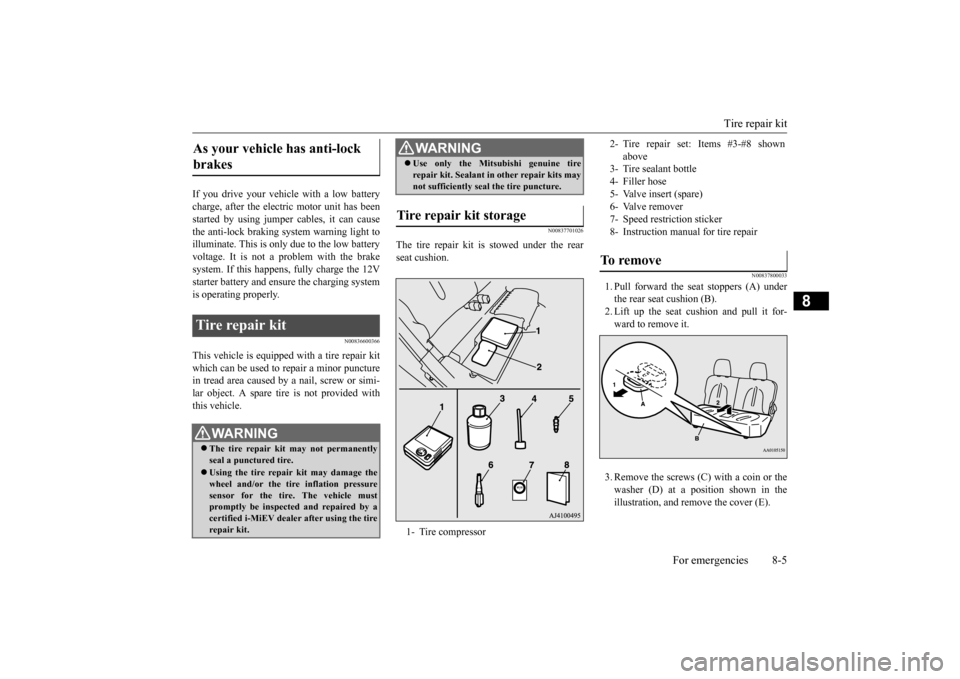
The tire repair kit is
stowed under the rear
seat cushion.
N00837800033
1. Pull forward the seat stoppers (A) underthe rear seat cushion (B). 2. Lift up the seat
cushion and pull it for-
ward to remove it. 3. Remove the screws (C) with a coin or the washer (D) at a position shown in the illustration, and re
move the cover (E).
As your vehicle has anti-lock brakes Tire repair kit
WA R N I N G The tire repair kit may not permanently seal a punctured tire. Using the tire repair
kit may damage the
wheel and/or the tire inflation pressuresensor for the tire. The vehicle must promptly be inspected and repaired by a certified i-MiEV dealer after using the tirerepair kit.
Use only the Mitsubishi genuine tire repair kit. Sealant in other repair kits maynot sufficiently seal the tire puncture.
Tire repair kit storage 1- Tire compressorWA R N I N G
2- Tire repair set: Items #3-#8 shown
above
3- Tire sealant bottle4- Filler hose 5- Valve insert (spare)7- Speed restriction sticker 8- Instruction manual for tire repairTo remove
BK0220401US.book 5 ページ 2015年6月3日 水曜日 午前7時42分
Page 238 of 296
Tire repair kit 8-6 For emergencies
8
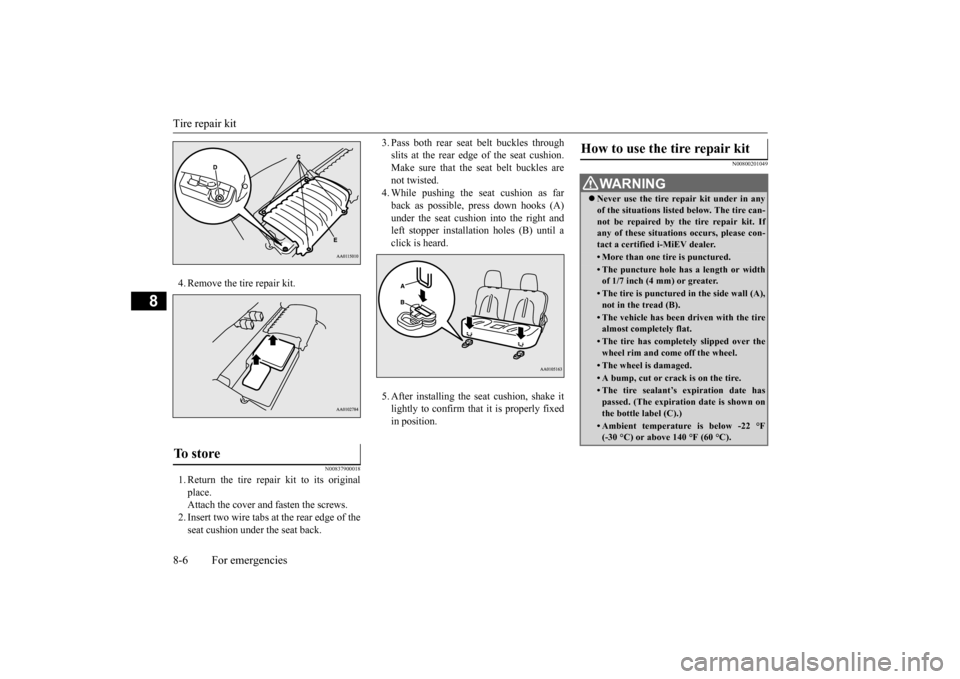
4. Remove the tire repair kit.
N00837900018
1. Return the tire repair kit to its original place. Attach the cover and fasten the screws.2. Insert two wire tabs at
the rear edge of the
seat cushion under the seat back.
3. Pass both rear seat
belt buckles through
slits at the rear edge of the seat cushion.Make sure that the seat belt buckles are not twisted. 4. While pushing the seat cushion as farback as possible, press down hooks (A) under the seat cushion into the right and left stopper installa
tion holes (B) until a
click is heard. 5. After installing the seat cushion, shake it lightly to confirm that it is properly fixedin position.
N00800201049
To store
How to use the tire repair kit
WA R N I N G Never use the tire repair kit under in any of the situations listed below. The tire can-not be repaired by the tire repair kit. If any of these situations occurs, please con- tact a certified i-MiEV dealer.• More than one tire is punctured.• The puncture hole has a length or width of 1/7 inch (4 mm) or greater.• The tire is punctured in the side wall (A),not in the tread (B).• The vehicle has been driven with the tirealmost completely flat.• The tire has completely slipped over thewheel rim and come off the wheel.• The wheel is damaged.• A bump, cut or crack is on the tire.• The tire sealant’s expiration date has passed. (The expiration date is shown onthe bottle label (C).)(-30 °C) or above 140 °F (60 °C).
BK0220401US.book 6 ページ 2015年6月3日 水曜日 午前7時42分
Page 239 of 296
Tire repair kit
For emergencies 8-7
8
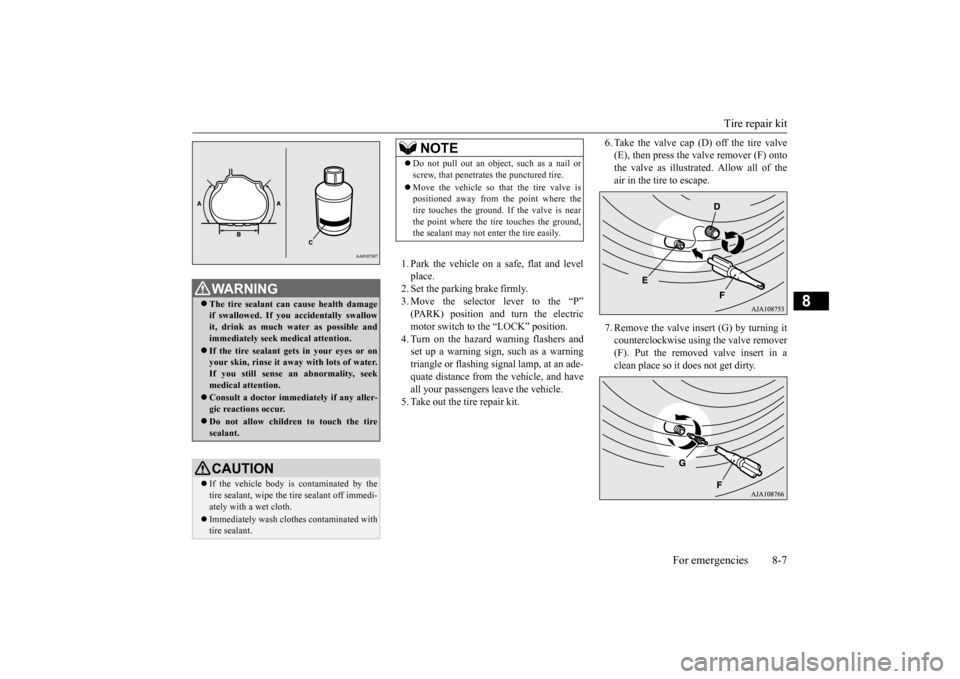
1. Park the vehicle on a
safe, flat and level
place. 2. Set the parking brake firmly. 3. Move the selector
lever to the “P”
motor switch to the “LOCK” position. 4. Turn on the hazard warning flashers andset up a warning sign, such as a warning triangle or flashing signal lamp, at an ade- quate distance from the vehicle, and haveall your passengers leave the vehicle. 5. Take out the tire repair kit.
6. Take the valve cap (D) off the tire valve (E), then press the valve remover (F) ontothe valve as illustrated. Allow all of the air in the tire to escape. 7. Remove the valve insert (G) by turning it counterclockwise using the valve remover(F). Put the removed valve insert in a clean place so it does not get dirty.
WA R N I N G The tire sealant can
cause health damage
if swallowed. If you
accidentally swallow
it, drink as much water as possible and immediately seek medical attention. If the tire sealant gets in your eyes or on your skin, rinse it away with lots of water. If you still sense an
abnormality, seek
medical attention. Consult a doctor immediately if any aller- gic reactions occur. Do not allow children to touch the tire sealant.CAUTION If the vehicle body is contaminated by the tire sealant, wipe the tire sealant off immedi- ately with a wet cloth. Immediately wash clothes contaminated with tire sealant.
NOTE
Do not pull out an object, such as a nail or screw, that penetrat
es the punctured tire.
Move the vehicle so that the tire valve is positioned away from the point where the tire touches the ground. If the valve is nearthe point where the tire touches the ground, the sealant may not enter the tire easily.
BK0220401US.book 7 ページ 2015年6月3日 水曜日 午前7時42分
Page 241 of 296
Tire repair kit
For emergencies 8-9
8
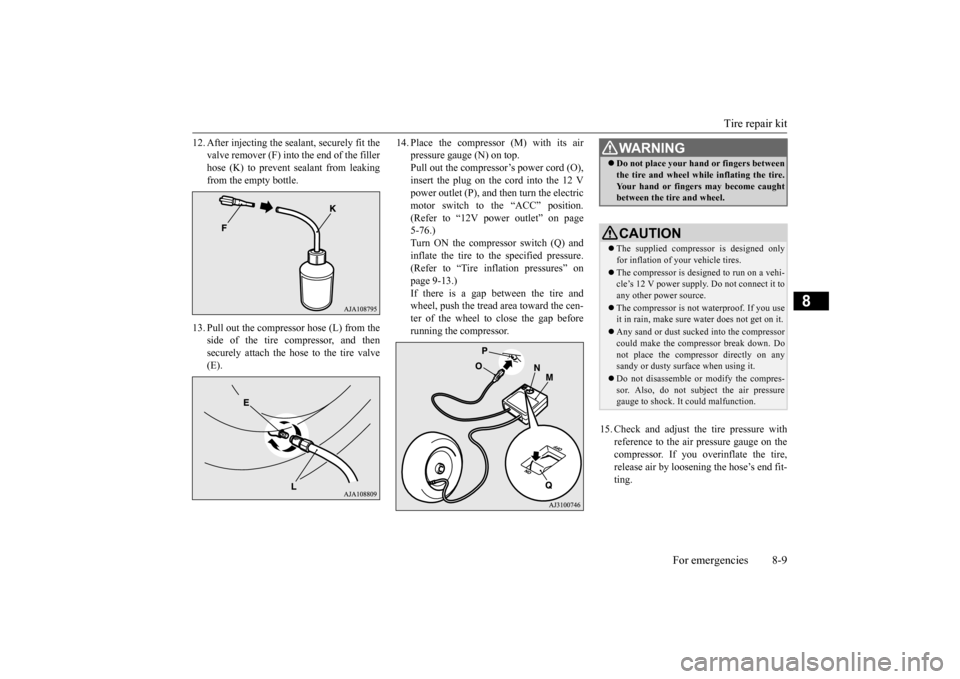
12. After injecting the sealant, securely fit the
valve remover (F) into
the end of the filler
hose (K) to prevent sealant from leaking from the empty bottle.
13. Pull out the compressor hose (L) from the
side of the tire compressor, and thensecurely attach the hose to the tire valve (E).
14. Place the compressor (M) with its air
pressure gauge (N) on top.Pull out the compressor’s power cord (O), insert the plug on the cord into the 12 V power outlet (P), and then turn the electricmotor switch to the “ACC” position. (Refer to “12V power outlet” on page 5-76.)Turn ON the compressor switch (Q) and inflate the tire to the specified pressure. (Refer to “Tire inflation pressures” on page 9-13.) If there is a gap between the tire andwheel, push the tread area toward the cen- ter of the wheel to close the gap before running the compressor.
15. Check and adjust the tire pressure with
reference to the air pressure gauge on the compressor. If you overinflate the tire,release air by loosening the hose’s end fit- ting.WA R N I N G Do not place your hand or fingers between the tire and wheel while inflating the tire.Your hand or fingers may become caughtbetween the tire and wheel.CAUTION The supplied compressor is designed only for inflation of
your vehicle tires.
The compressor is designed to run on a vehi- cle’s 12 V power supply.
Do not connect it to
any other power source. The compressor is not waterproof. If you use it in rain, make sure wa
ter does not get on it.
Any sand or dust sucked into the compressor could make the compressor break down. Donot place the compressor directly on any sandy or dusty surface when using it. Do not disassemble or modify the compres- sor. Also, do not subject the air pressure gauge to shock. It
could malfunction.
BK0220401US.book 9 ページ 2015年6月3日 水曜日 午前7時42分
Page 242 of 296
Tire repair kit 8-10 For emergencies
8
If there is a gap between the tire and wheel because the tire has moved inwardfrom the wheel rim, press the tire tread towards the wheel to close the gap before running the compressor. (With no gaps,the tire pressure will rise.) pull the power cord plug out of the 12 V power outlet.
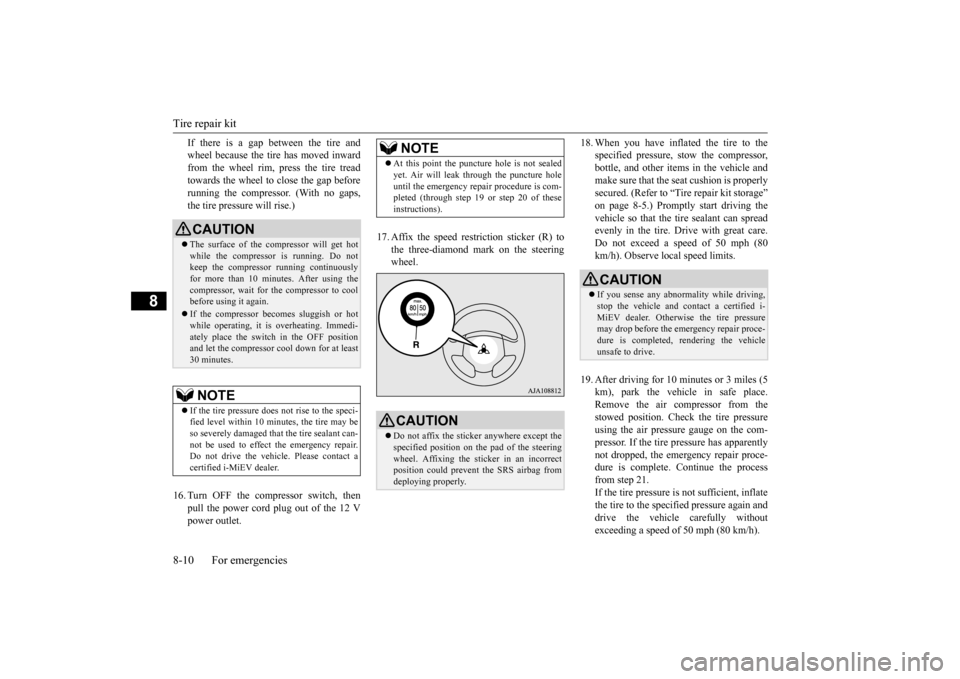
17. Affix the speed restriction sticker (R) to
the three-diamond mark on the steering wheel.
18. When you have inflated the tire to the
specified pressure, stow the compressor,bottle, and other items
in the vehicle and
make sure that the seat cushion is properly secured. (Refer to “Tire repair kit storage” vehicle so that the tire sealant can spread evenly in the tire. Drive with great care.Do not exceed a speed of 50 mph (80 km/h). Observe local speed limits.
19. After driving for 10 minutes or 3 miles (5
km), park the vehi
cle in safe place.
Remove the air compressor from the stowed position. Check the tire pressure using the air pressure gauge on the com-pressor. If the tire pressure has apparently not dropped, the emergency repair proce- dure is complete. Continue the processfrom step 21. If the tire pressure is
not sufficient, inflate
the tire to the specified pressure again anddrive the vehicle carefully without exceeding a speed of 50 mph (80 km/h).
CAUTION The surface of the compressor will get hot while the compressor is running. Do not keep the compressor running continuously for more than 10 minutes. After using thecompressor, wait for the compressor to cool before using it again. If the compressor becomes sluggish or hot while operating, it is
overheating. Immedi-
ately place the switch in the OFF positionand let the compressor cool down for at least 30 minutes.NOTE
If the tire pressure does not rise to the speci- fied level within 10 mi
nutes, the tire may be
so severely damaged that the tire sealant can- not be used to effect the emergency repair. Do not drive the vehicl
e. Please contact a
certified i-MiEV dealer.
NOTE
At this point the punctu
re hole is
not sealed
yet. Air will leak through the puncture holeuntil the emergency repa
ir procedure is com-
pleted (through step 19 or step 20 of these instructions).CAUTION Do not affix the sticke
r anywhere except the
specified position on th
e pad of the steering
wheel. Affixing the sticker in an incorrect position could prevent the SRS airbag fromdeploying properly.
CAUTION If you sense any abnorma
lity while driving,
stop the vehicle and c
ontact a certified i-
MiEV dealer. Otherwise the tire pressure may drop before the emergency repair proce- dure is completed,
rendering the vehicle
unsafe to drive.
BK0220401US.book 10 ページ 2015年6月3日 水曜日 午前7時42分
Page 243 of 296
Towing
For emergencies 8-11
8
Before driving, stow the compressor and make sure that the rear seat cushion isproperly secured.
20. After driving for 10 minutes or 3 miles (5
km) again, check the tire pressure usingthe air pressure gauge on the compressor. If the tire pressure has apparently not dropped, the emergency repair procedureis complete. Before driving, make sure that the compressor is stowed and the seat cushion is properly secured. You muststill not exceed a speed of 50 mph (80 km/h). Observe local speed limits.
21. Immediately drive with great care to a
certified i-MiEV de
aler and have tire
repair/replacement performed.
N00837001931
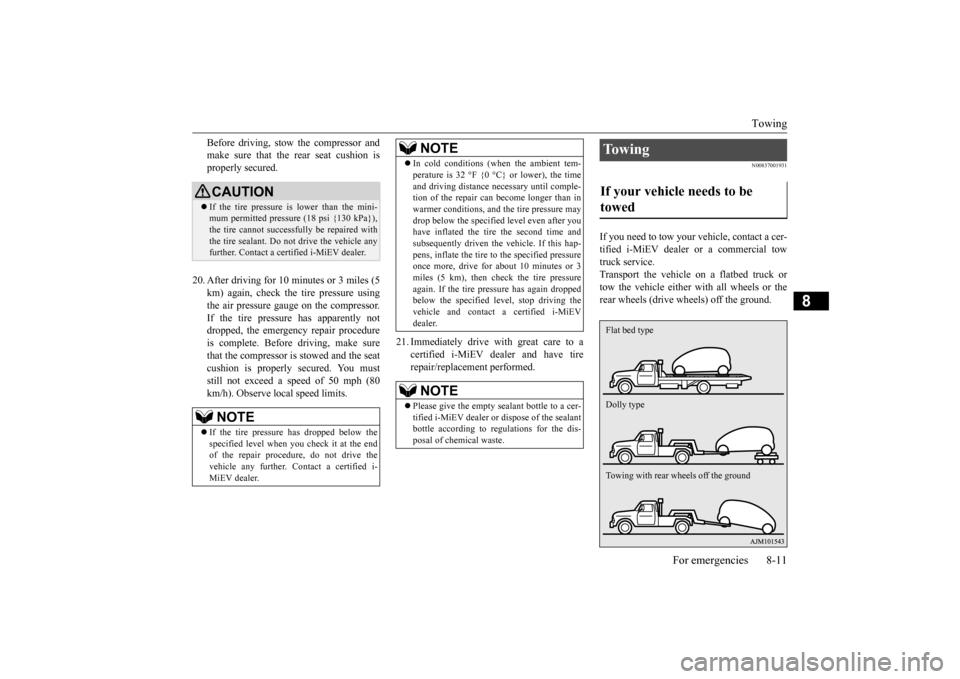
If you need to tow your
vehicle, contact a cer-
tified i-MiEV dealer or a commercial towtruck service. Transport the vehicle on a flatbed truck or tow the vehicle either with all wheels or the rear wheels (drive wheels) off the ground.
CAUTION If the tire pressure is lower than the mini- mum permitted pressure (18 psi {130 kPa}), the tire cannot successf
ully be repaired with
the tire sealant. Do not drive the vehicle anyfurther. Contact a cert
ified i-MiEV dealer.
NOTE
If the tire pressure has dropped below the specified level when you check it at the endof the repair procedure, do not drive the vehicle any further.
Contact a certified i-
MiEV dealer.
In cold conditions (when the ambient tem- perature is 32 °F {0 °C} or lower), the timeand driving distance ne
cessary until comple-
tion of the repair can
become longer than in
warmer conditions, and the tire pressure may drop below the specified level even after youhave inflated the tire the second time and subsequently driven the vehicle. If this hap- pens, inflate the tire to the specified pressureonce more, drive for about 10 minutes or 3 miles (5 km), then check the tire pressure again. If the tire pressure has again droppedbelow the specified level, stop driving the vehicle and contact
a certified i-MiEV
dealer.NOTE
Please give the empty
sealant bottle to a cer-
tified i-MiEV dealer or
dispose of the sealant
bottle according to re
gulations for the dis-
posal of chemical waste.NOTE
To w i n g If your vehicle needs to be towed Towing with rear wheels off the ground Dolly type Flat bed type
BK0220401US.book 11 ページ 2015年6月3日 水曜日 午前7時42分
Page 245 of 296
Operation under adverse driving conditions
For emergencies 8-13
8
N00837200747
If your vehicle becomes stuck in snow, sand, or mud, it can often be moved by a rocking motion. Rock your vehicle back and forth tofree it. Do not spin the wheels. Constant efforts to free a stuck vehicle can cause transmissionfailure. If your vehicle is still
stuck after several rock-
ing attempts, call for a commercial tow truckservice.
When driving on a road covered with snow or ice, use snow tires. Tire chains cannot be used on your vehicle. Theremay be state or local regulations about using snow tires. Always check the regu- lations in your local area before usingthem. Refer to the section entitled “Snow tires” on page 9-15 and “Tire chains” on page 9-16. Drive slowly. Do not make sudden starts or stops, sharp turns, or slam on the brakes. Allow extra distance between your vehi- cle and the vehicle in front of you, and avoid sudden braking. If a skid occurs when the accelerator pedal is depressed, take your foot off the pedal. Steer gently in the direction of theskid. Your vehicle is equippe
d with an anti-lock
braking system (ABS), hold the brakepedal down firmly and
keep it depressed.
Do not pump the brake pedal which will result in reduced braking performance.
CAUTION If the transmission or the steering system has a problem or damage,
transport the vehicle
on a flatbed truck or to
w the vehicle with the
all wheels off the ground. If the electric motor switch is in the “ON”
lting in an accident.
Make sure the electric motor switch is in the“ACC” position before towing.
Operation under adverse driving conditions If your vehicle becomes stuck in sand, mud or snow
WA R N I N G When trying to rock
your vehicle out of a
stuck position, make sure that there are nopeople nearby. The
rocking motion can
make your vehicle suddenly lurch forward or backward, and inju
re any bystanders.
On wet roads
CAUTIONDo not drive on a flooded road. If you drive on a flooded road, not only the electric motorunit stops but also a fail
ure like electric leak-
age or short circuit may occur. If you inevitably had to run on a floodedroad and the vehicle was exposed to water, be sure to have your vehicle inspected by a certified i-MiEV dealer. When driving in rain, on water-covered roads, or through a car wash, water could getinto the brake discs and make them fail tem- porarily. In such cases, lightly press the brake pedal to see if they are working prop-erly. If they are not, press the pedal lightlyseveral times while driv
ing to dry the brake
pads or linings, then check them again. When driving in rain, a layer of water may form between the tires and the road surface (aquaplaning). This l
oosens your tires’ grip
on the road, making it difficult to steer or brake properly. When driving on a wet road:• Drive your vehicle at a safe speed.
• Do not drive on worn tires.• Always keep the tires at the correct infla- tion pressures.
On snowy or icy roads
CAUTION
BK0220401US.book 13 ページ 2015年6月3日 水曜日 午前7時42分
Page 246 of 296
Operation under adverse driving conditions 8-14 For emergencies
8
After parking on snowy or icy road, it may be difficult to move your vehicle dueto freeze-up of the brake. Depress the accelerator pedal little by little to move the vehicle after confirming safety of thevehicle. Drive as slow as possible when driving on bumpy or rutted roads or over potholes etc.CAUTION Do not depress the acce
lerator pedal rapidly.
The vehicle could start moving when itbreaks free from the ic
e, possibly resulting in
an accident.
On a bumpy or rutted road
CAUTION Driving on bumpy, rutted roads or over pot- holes can damage the tires and wheels. Wheels with low-profiles tires or under-inflated tires are especi
ally at risk for dam-
age. The vehicle’s body, bumper, muffler and other parts may be dama
ged if the vehicle is:
• driven over a step (for example, at the entrance or exit of a parking lot);
• parked too closely against a curb or parkingblock, or by the side of a road with curb-stones;• driven on a steep slope.CAUTION
BK0220401US.book 14 ページ 2015年6月3日 水曜日 午前7時42分
Page 256 of 296
Tires 9-10 Vehicle care and maintenance
9
N00939201619
It is important to familiarize yourself with the following terms: Cold tire pressure: • The measured pressure after the vehiclehas been parked for
at least three hours,
or • The measured pressure when the vehicleis driven less than 1 mile (1.6 km) after having been parked for three hours.
Maximum inflation pressure: the maxi- mum permissible cold
tire inflation pres-
sure for this tire. Recommended inflation pressure: the inflation pressure for optimum tire perfor- mance.
WA R N I N G Open doors and wind
ows in any closed
space where you may be charging orworking with the 12V starter battery. Always wear protective clothing and gog- gles when working wi
th the 12V starter
battery, or have a sk
illed automobile tech-
nician do it. If you are quick-charging your 12V starter battery, first disconnect the 12V starter battery cables. In order to prevent a short circuit, be sure to disconnect the negative (-) terminalfirst, and reconnect it last. If the electrolyte level
is very low, have the
12V starter battery checked at a certified i-MiEV dealer. 12V starter battery te
rminals and related
accessories contain
lead and lead com-
pounds. Wash hands after handling. CAUTION When replacing the
12V starter battery,
remove the connected
positive (+) and nega-
tive (-) terminals after turning the electric motor switch to the “LOCK” position andwaiting at least 1 minut
e. If the 12V starter
battery terminal is removed just after the electric motor switch is turned to the “LOCK” position, this
may cause damage to
components of the electric motor unit.
NOTE
Before cleaning the 12V starter battery, tighten all the filler port
caps to keep dirt and
moisture out. Check each 12V starter battery terminal for corrosion. If necessary, clean the terminalswith a solution of baking soda and water. Grease the posts and cl
amps after cleaning or
tightening them. Check to see that the 12V starter battery is securely installed and
cannot be moved. Also
check each terminal for tightness. If you will not be driv
ing your vehicle for a
long period of time, re
move the 12V starter
battery and store it in a place where the 12V starter battery fluid wi
ll not freeze. Memory
data for settings made by the user may be erased when the 12V starter battery is removed. If this happens, reset the settingsagain using the releva
nt procedures. The
12V starter battery
only should be stored
with a full charge.
Tires
WA R N I N G Driving with tires that are worn, damaged or improperly inflated is dangerous.These type tire conditions will adversely affect vehicle performance. These type tire conditions can also cause atread separation or blowout which may result in an accide
nt causing serious
injury or death. Tires degrade over ti
me with age even
when they are not being used. It is recom-mended that tires ove
r 6 years generally
be replaced even if
damage is not obvious.
BK0220401US.book 10 ページ 2015年6月3日 水曜日 午前7時42分