tires MITSUBISHI iMiEV 2017 1.G User Guide
[x] Cancel search | Manufacturer: MITSUBISHI, Model Year: 2017, Model line: iMiEV, Model: MITSUBISHI iMiEV 2017 1.GPages: 296, PDF Size: 7.79 MB
Page 241 of 296
Tire repair kit
For emergencies 8-9
8
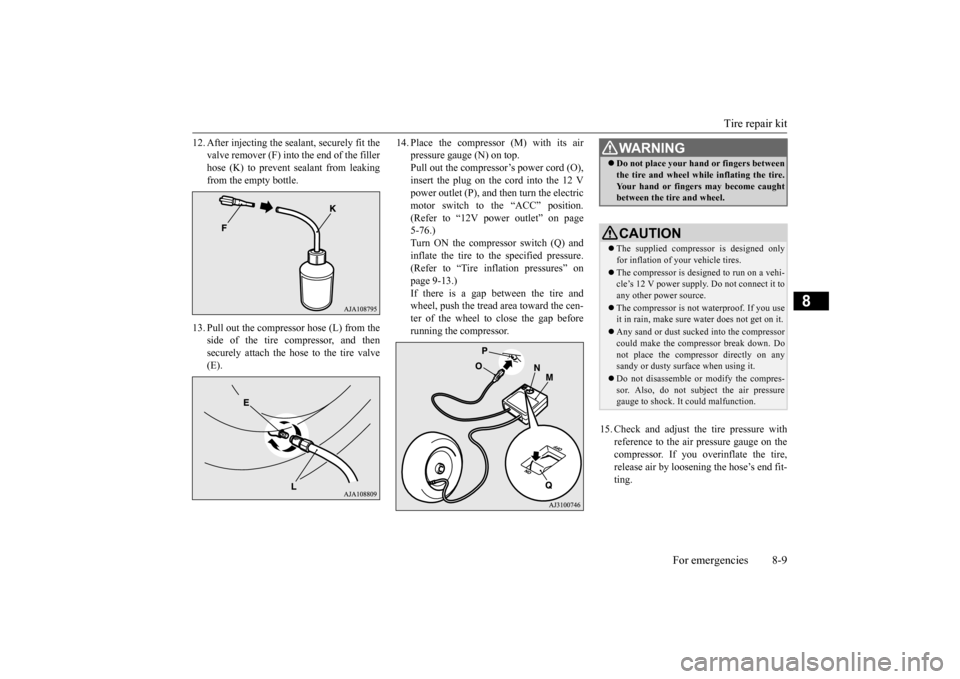
12. After injecting the sealant, securely fit the
valve remover (F) into
the end of the filler
hose (K) to prevent sealant from leaking from the empty bottle.
13. Pull out the compressor hose (L) from the
side of the tire compressor, and thensecurely attach the hose to the tire valve (E).
14. Place the compressor (M) with its air
pressure gauge (N) on top.Pull out the compressor’s power cord (O), insert the plug on the cord into the 12 V power outlet (P), and then turn the electricmotor switch to the “ACC” position. (Refer to “12V power outlet” on page 5-76.)Turn ON the compressor switch (Q) and inflate the tire to the specified pressure. (Refer to “Tire inflation pressures” on page 9-13.) If there is a gap between the tire andwheel, push the tread area toward the cen- ter of the wheel to close the gap before running the compressor.
15. Check and adjust the tire pressure with
reference to the air pressure gauge on the compressor. If you overinflate the tire,release air by loosening the hose’s end fit- ting.WA R N I N G Do not place your hand or fingers between the tire and wheel while inflating the tire.Your hand or fingers may become caughtbetween the tire and wheel.CAUTION The supplied compressor is designed only for inflation of
your vehicle tires.
The compressor is designed to run on a vehi- cle’s 12 V power supply.
Do not connect it to
any other power source. The compressor is not waterproof. If you use it in rain, make sure wa
ter does not get on it.
Any sand or dust sucked into the compressor could make the compressor break down. Donot place the compressor directly on any sandy or dusty surface when using it. Do not disassemble or modify the compres- sor. Also, do not subject the air pressure gauge to shock. It
could malfunction.
BK0220401US.book 9 ページ 2015年6月3日 水曜日 午前7時42分
Page 245 of 296
Operation under adverse driving conditions
For emergencies 8-13
8
N00837200747
If your vehicle becomes stuck in snow, sand, or mud, it can often be moved by a rocking motion. Rock your vehicle back and forth tofree it. Do not spin the wheels. Constant efforts to free a stuck vehicle can cause transmissionfailure. If your vehicle is still
stuck after several rock-
ing attempts, call for a commercial tow truckservice.
When driving on a road covered with snow or ice, use snow tires. Tire chains cannot be used on your vehicle. Theremay be state or local regulations about using snow tires. Always check the regu- lations in your local area before usingthem. Refer to the section entitled “Snow tires” on page 9-15 and “Tire chains” on page 9-16. Drive slowly. Do not make sudden starts or stops, sharp turns, or slam on the brakes. Allow extra distance between your vehi- cle and the vehicle in front of you, and avoid sudden braking. If a skid occurs when the accelerator pedal is depressed, take your foot off the pedal. Steer gently in the direction of theskid. Your vehicle is equippe
d with an anti-lock
braking system (ABS), hold the brakepedal down firmly and
keep it depressed.
Do not pump the brake pedal which will result in reduced braking performance.
CAUTION If the transmission or the steering system has a problem or damage,
transport the vehicle
on a flatbed truck or to
w the vehicle with the
all wheels off the ground. If the electric motor switch is in the “ON”
lting in an accident.
Make sure the electric motor switch is in the“ACC” position before towing.
Operation under adverse driving conditions If your vehicle becomes stuck in sand, mud or snow
WA R N I N G When trying to rock
your vehicle out of a
stuck position, make sure that there are nopeople nearby. The
rocking motion can
make your vehicle suddenly lurch forward or backward, and inju
re any bystanders.
On wet roads
CAUTIONDo not drive on a flooded road. If you drive on a flooded road, not only the electric motorunit stops but also a fail
ure like electric leak-
age or short circuit may occur. If you inevitably had to run on a floodedroad and the vehicle was exposed to water, be sure to have your vehicle inspected by a certified i-MiEV dealer. When driving in rain, on water-covered roads, or through a car wash, water could getinto the brake discs and make them fail tem- porarily. In such cases, lightly press the brake pedal to see if they are working prop-erly. If they are not, press the pedal lightlyseveral times while driv
ing to dry the brake
pads or linings, then check them again. When driving in rain, a layer of water may form between the tires and the road surface (aquaplaning). This l
oosens your tires’ grip
on the road, making it difficult to steer or brake properly. When driving on a wet road:• Drive your vehicle at a safe speed.
• Do not drive on worn tires.• Always keep the tires at the correct infla- tion pressures.
On snowy or icy roads
CAUTION
BK0220401US.book 13 ページ 2015年6月3日 水曜日 午前7時42分
Page 246 of 296
Operation under adverse driving conditions 8-14 For emergencies
8
After parking on snowy or icy road, it may be difficult to move your vehicle dueto freeze-up of the brake. Depress the accelerator pedal little by little to move the vehicle after confirming safety of thevehicle. Drive as slow as possible when driving on bumpy or rutted roads or over potholes etc.CAUTION Do not depress the acce
lerator pedal rapidly.
The vehicle could start moving when itbreaks free from the ic
e, possibly resulting in
an accident.
On a bumpy or rutted road
CAUTION Driving on bumpy, rutted roads or over pot- holes can damage the tires and wheels. Wheels with low-profiles tires or under-inflated tires are especi
ally at risk for dam-
age. The vehicle’s body, bumper, muffler and other parts may be dama
ged if the vehicle is:
• driven over a step (for example, at the entrance or exit of a parking lot);
• parked too closely against a curb or parkingblock, or by the side of a road with curb-stones;• driven on a steep slope.CAUTION
BK0220401US.book 14 ページ 2015年6月3日 水曜日 午前7時42分
Page 247 of 296

9
Vehicle care and maintenanceService precautions ..........................................................................9-2 Hood .............
............
...........
...........
...........
...........
...........
...........
.....9-3
View under the hood and electric motor unit room .........................9-4Coolant/Hot water heater fluid ........................................................9-4 Washer fluid .....................................................................................9-7 Brake fluid .......................................................................................9-712V starter battery ...........................................................................9-7 Tires ...............................................................................................9-10 Brake pedal free play .....................................................................9-16Parking brake lever stroke .............................................................9-16 Wiper blades ..................................................................................9-16 General maintenance .....................................................................9-17For cold and snowy weather ..........................................................9-18 Fusible links ...................................................................................9-18 Fuses ..............................................................................................9-18Replacement of light bulbs ............................................................9-21 Vehicle care precautions ................................................................9-28 Cleaning the inside of your vehicle .......
...........
...........
...........
.......9-28
Cleaning the outside of your vehicle .....
...........
...........
...........
.......9-30
BK0220401US.book 1 ページ 2015年6月3日 水曜日 午前7時42分
Page 256 of 296
Tires 9-10 Vehicle care and maintenance
9
N00939201619
It is important to familiarize yourself with the following terms: Cold tire pressure: • The measured pressure after the vehiclehas been parked for
at least three hours,
or • The measured pressure when the vehicleis driven less than 1 mile (1.6 km) after having been parked for three hours.
Maximum inflation pressure: the maxi- mum permissible cold
tire inflation pres-
sure for this tire. Recommended inflation pressure: the inflation pressure for optimum tire perfor- mance.
WA R N I N G Open doors and wind
ows in any closed
space where you may be charging orworking with the 12V starter battery. Always wear protective clothing and gog- gles when working wi
th the 12V starter
battery, or have a sk
illed automobile tech-
nician do it. If you are quick-charging your 12V starter battery, first disconnect the 12V starter battery cables. In order to prevent a short circuit, be sure to disconnect the negative (-) terminalfirst, and reconnect it last. If the electrolyte level
is very low, have the
12V starter battery checked at a certified i-MiEV dealer. 12V starter battery te
rminals and related
accessories contain
lead and lead com-
pounds. Wash hands after handling. CAUTION When replacing the
12V starter battery,
remove the connected
positive (+) and nega-
tive (-) terminals after turning the electric motor switch to the “LOCK” position andwaiting at least 1 minut
e. If the 12V starter
battery terminal is removed just after the electric motor switch is turned to the “LOCK” position, this
may cause damage to
components of the electric motor unit.
NOTE
Before cleaning the 12V starter battery, tighten all the filler port
caps to keep dirt and
moisture out. Check each 12V starter battery terminal for corrosion. If necessary, clean the terminalswith a solution of baking soda and water. Grease the posts and cl
amps after cleaning or
tightening them. Check to see that the 12V starter battery is securely installed and
cannot be moved. Also
check each terminal for tightness. If you will not be driv
ing your vehicle for a
long period of time, re
move the 12V starter
battery and store it in a place where the 12V starter battery fluid wi
ll not freeze. Memory
data for settings made by the user may be erased when the 12V starter battery is removed. If this happens, reset the settingsagain using the releva
nt procedures. The
12V starter battery
only should be stored
with a full charge.
Tires
WA R N I N G Driving with tires that are worn, damaged or improperly inflated is dangerous.These type tire conditions will adversely affect vehicle performance. These type tire conditions can also cause atread separation or blowout which may result in an accide
nt causing serious
injury or death. Tires degrade over ti
me with age even
when they are not being used. It is recom-mended that tires ove
r 6 years generally
be replaced even if
damage is not obvious.
BK0220401US.book 10 ページ 2015年6月3日 水曜日 午前7時42分
Page 257 of 296
Tires
Vehicle care and maintenance 9-11
9
Intended outboard sidewall: • The sidewall that c
ontains a whitewall,
bears white letteri
ng or bears manufac-
turer, brand, and/or model name molding that is higher or deeper than the samemolding on the other sidewall of the tire, or • The outward facing si
dewall of an asym-
metrical tire that has a particular side that must always face outward when mounted on a vehicle.
Passenger car tire: a
tire intended for use
on passenger cars, multipurpose passen-ger vehicles, and trucks, that have a gross vehicle weight rati
ng (GVWR) of 10,000
pounds or less. Light truck (LT) tire: a tire designated by its manufacturer as primarily intended for use on lightweight truc
ks or multipurpose
passenger vehicles. Tread: portion of a tire that comes into contact with the road. Tread rib: a tread se
ction running circum-
ferentially around a tire. Tread separation: pulling away of the tread from the tire carcass. Carcass: the tire structure, except tread and sidewall rubber which, when inflated,bears the load. Sidewall: portion of
a tire between the
tread and bead.
Section width: the line
ar distance between
the exteriors of the sidewalls of aninflated tire, excluding elevations due to labeling, decoration, or protective bands. Bead: the part of the tire that is made of steel wires, wrapped
or reinforced by ply
cords and that is shaped to fit the rim. Ply: a layer of rubber-coated parallel cords. Cord: the strands forming the plies in the tire. Rim: a metal support for a tire or a tire and tube assembly upon which the tirebeads are seated. Rim diameter: nominal diameter of the bead seat. Groove: the space between two adjacent tread ribs.
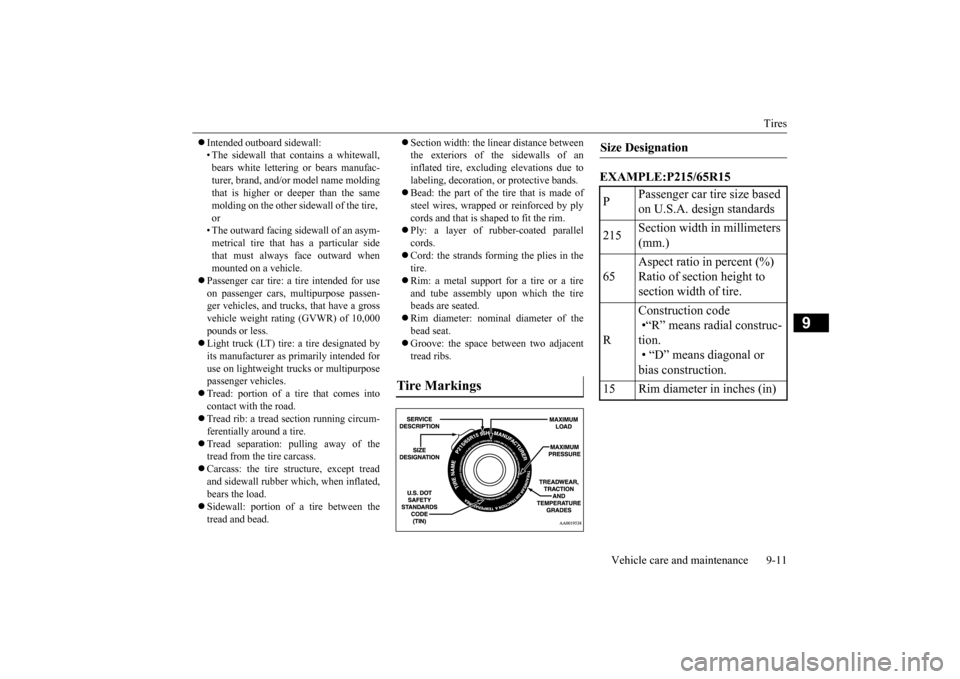
EXAMPLE:P215/65R15
Tire Markings
Size Designation P
Passenger car tire size based on U.S.A. design standards
215
Section width in millimeters (mm.)
65
Aspect ratio in percent (%) Ratio of section height to section width of tire.
R
Construction code •“R” means radial construc- tion.
• “D” means diagonal or bias construction.
15 Rim diameter in inches (in)
BK0220401US.book 11 ページ 2015年6月3日 水曜日 午前7時42分
Page 258 of 296
Tires 9-12 Vehicle care and maintenance
9
EXAMPLE: 95H
Maximum load indicates the maxi- mum load this tire is designed to carry. Maximum Pressure indicates the maximum permissible cold tire infla-tion pressure for this tire. The TIN may be found on one or both sides of the tire but the date
NOTE
European/Japanese metric tire sizing is based on European/Jap- anese design standards. Tires designed to these standards havethe tire size molded into the sidewall beginning with the sec- tion width. The letter “P” isabsent from this tire size desig- nation. Example: 215/65R15 96H.LT (Light Truck) -metric tiresizing is based on U.S.A. designstandards. The size designation for LT-metric tires is the same as for P-metric tires except for theletters “LT” that are molded into the sidewall preceding the size designation. Example:LT235/85R16.
Service Description 95
Load index A numerical code associ- ated with the maximum load a tire can carry.
H
Speed symbol A symbol indicating the range of speeds at which a tire can carry a load corre- sponding to its
load index
under certain operating con-ditions.The maximum speed corre- sponding to the speed sym- bol should only be achieved under specified operating conditions. (i.e. tire pressure, vehicle loading, road condi-tions and posted speed lim- its)
WA R N I N GOverloading of your tire is dangerous. Overloading cancause tire failure, affect vehi- cle handling, and increase your stopping distance. Usetires of the recommended load capacity for your vehicle. Never overload them.
Maximum Pressure Tire Identification Number (TIN)
BK0220401US.book 12 ページ 2015年6月3日 水曜日 午前7時42分
Page 259 of 296

Tires
Vehicle care and maintenance 9-13
9
code may only be on one side. Look for the TIN on the outboard side of tires as mounted on the vehicle. If the TIN is not found on the outboard sidethen you will find it on the inboard side of the tire. EXAMPLE: DOT MA L9 ABCD 1504
The treadwear grade is a comparative rating based on the wear rate of the tire when testedunder controlled conditions on a specified government test course
. For example, a tire
graded 150 would wear one and one-half (11/2) times as well on the government course
as a tire graded 100. The relative performance of tires depends upon the actual conditions of their use, however, and may depart signifi-cantly from the norm due to variations in driving habits, service practices and differ- ences in road characteristics and climate. The traction grades, from highest to lowest, are AA, A, B and C. Those grades represent the tire’s ability to stop on wet pavement as measured under contro
lled conditions on
specified government te
st surfaces of asphalt
and concrete. A tire marked C may have poor traction performance. The temperature grades are A (the highest), B and C, representing the ti
re’s resistance to the
generation of heat and it
s ability to dissipate
heat when tested u
nder controlled conditions
on a specified indoor
laboratory test wheel.
Sustained high temperature can cause the material of the tire to
degenerate and reduce
tire life, and excessive temperature can lead to sudden tire failure. The grade C corre-sponds to a level of
performance which all
passenger car tires must
meet under the Fed-
eral Motor Vehicle Safety Standard No. 109.Grades B and A represent higher levels of performance on the laboratory test wheel than the minimum required by law.
N00939300873
Proper tire inflation pre
ssure is essential for
the safe and satisfac
tory operation of your
vehicle. The wrong tire pressure will cause problems in three major areas: Safety
DOT
Department of Transporta- tion This symbol certifies that the tire is in compliance with the U.S.
Department
of Transportation tire safety standards, and is approved for highway use.
MA
Code representing the tire manufacturing location. (2 digits)
L9 ABCD
Code representing the tire size. (2 digits)Code used by tire manufac- turer. (1 to 4 digits)
15
Number representing the week in which the tire was manufactured. (2 digits)
04
Number representing the year in which the tire was manufactured. (2 digits)
ature Grades Treadwear Tr a c t i o n
TemperatureTire inflation pressures
BK0220401US.book 13 ページ 2015年6月3日 水曜日 午前7時42分
Page 260 of 296
Tires 9-14 Vehicle care and maintenance
9
Too little pressure increases flexing in the tire and can cause tire failure. Too muchpressure can cause a tire to lose its ability to cushion shock. Objects on the road and potholes could then cause tire damage thatmay result in tire failure. Economy The wrong tire pressure can cause unevenwear patterns in the tire tread. These abnormal wear patterns will reduce the tread life, and the tire will have to be replaced sooner. Too little pressure also makes it harder forthe tire to roll, and this uses up more power. Ride comfort and vehicle stability The superior riding
experience built into
your vehicle partly depends on the correct tire pressure. Too mu
ch pressure gives an
uncomfortable and ja
rring ride. Too little
pressure feels as if your vehicle is slow to respond.Unequal tire pressures can make steering your vehicle uneven and unpredictable.
The correct tire pressure for your vehicle is listed on the placard attached to the sill of thedriver’s door. (Refer to “Tire and loading information plac- ard” on page 11-3.)The recommended inflation pressures should be used for the tires listed below.
Tire pressures should be checked, and adjusted if necessary, at least once a month.Pressures should be checked more often whenever weather temperatures change severely, becaus
e tire pressures change with
outdoor temperatures. The pressures listed on the placard are always
“cold inflation pres-
sure”.Cold inflation pressure is measured after the vehicle has been parked
for at least three
hours or is driven less than 1 mile (1.6 km)after having been parked for three hours. Cold inflation pressure must not go above the maximum values molded into the tire side-wall. After driving se
veral miles, your tire
inflation pressure may increase 14 to 41 KPA, 2 to 6 PSI from the cold inflation pressure.Do not let air out of the tires to get back to the specified cold pressure, or your tire pressure will be too low.You should also take the following safety pre- cautions:
Keep your tires inflated to the recom- mended pressures. (See the tire and load-ing information placard attached to the sill of the driver’s door.) Stay within the recommended load limits. Make sure that the weight of any load in your vehicle is evenly distributed. Drive at safe speeds. After filling your tires to the correct pres- sure, check them for damage and air leaks. Be sure to reinstall the caps on the valve stems.
N00939600427
Tire size
Front
Rear
145/65R15
72H
250 KPA, 36 PSI
—
175/60R15
81H
—
250 KPA, 36 PSI
Replacing tires and wheels
CAUTION Avoid using different size tires and wheels from the ones listed, and avoid the combined use of different types
of tires and wheels.
Using different size or
type tires and wheels
may affect driving safety. Refer to “Tires and wheels” on page 11-6. Even if a wheel has the same rim size and offset as the specifie
d type of wheel, its
shape may prevent it
from being fitted cor-
rectly. Consult a certified i-MiEV dealer before
using wheels that you
have.
BK0220401US.book 14 ページ 2015年6月3日 水曜日 午前7時42分
Page 261 of 296
Tires
Vehicle care and maintenance 9-15
9
N00939700170
The following maintenance steps are recom- mended: Check tire pressures regularly. Have regular maintenance done on the wheel balance and front
and rear suspen-
sion alignment.
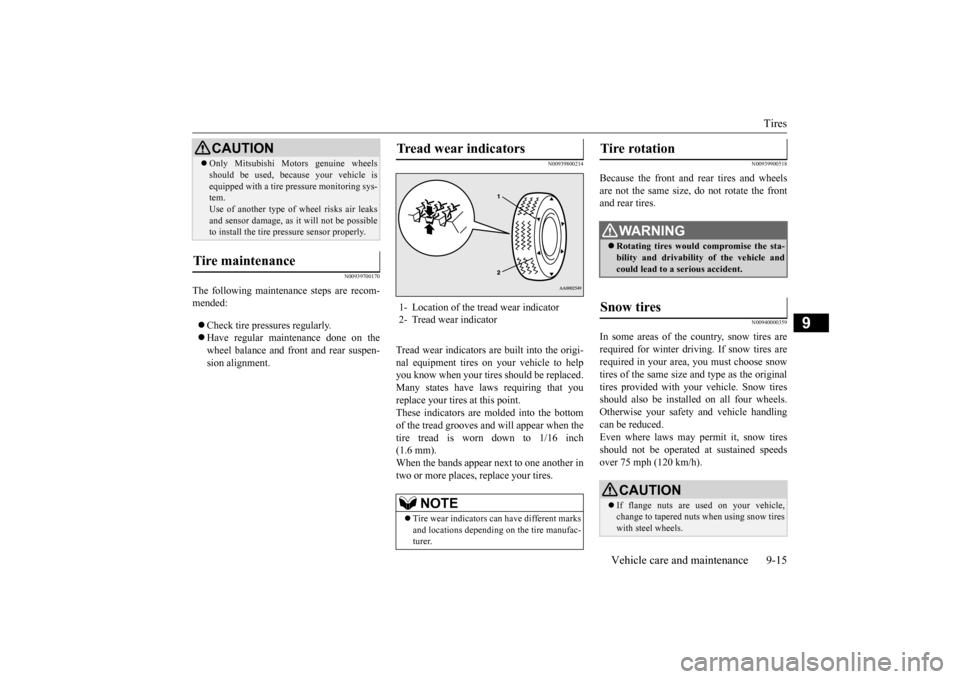
N00939800214
Tread wear indicators are built into the origi-nal equipment tires on your vehicle to helpyou know when your tires should be replaced. Many states have la
ws requiring that you
replace your tires at this point.These indicators are molded into the bottom of the tread grooves and will appear when the tire tread is worn down to 1/16 inch(1.6 mm). When the bands appear next to one another in two or more places,
replace your tires.
N00939900518
Because the front and
rear tires and wheels
are not the same size, do not rotate the front and rear tires.
N00940000359
In some areas of the country, snow tires arerequired for winter driving. If snow tires arerequired in your area, you must choose snow tires of the same size
and type as the original
tires provided with your
vehicle. Snow tires
should also be
installed on all four wheels.
Otherwise your safety
and vehicle handling
can be reduced.Even where laws may permit it, snow tires should not be operated
at sustained speeds
over 75 mph (120 km/h).
Only Mitsubishi Motors genuine wheels should be used, beca
use your vehicle is
equipped with a tire pr
essure monitoring sys-
tem. Use of another type of wheel risks air leaks and sensor damage, as it
will not be possible
to install the tire pressure sensor properly.
Tire maintenance
CAUTION
Tread wear indicators 1- Location of the tread wear indicator 2- Tread wear indicator
NOTE
Tire wear indicators ca
n have different marks
and locations depending on the tire manufac- turer.
Tire rotation
WA R N I N G Rotating tires would compromise the sta- bility and drivabilit
y of the vehicle and
could lead to a
serious accident.
Snow tires
CAUTIONIf flange nuts are used on your vehicle, change to tapered nuts
when using snow tires
with steel wheels.
BK0220401US.book 15 ページ 2015年6月3日 水曜日 午前7時42分