brake light MITSUBISHI iMiEV 2017 1.G Owner's Manual
[x] Cancel search | Manufacturer: MITSUBISHI, Model Year: 2017, Model line: iMiEV, Model: MITSUBISHI iMiEV 2017 1.GPages: 296, PDF Size: 7.79 MB
Page 153 of 296
Warning lights
Features and controls 5-45
5
N00573500028
This light will illuminate when there is a problem with the charging system for the 12Vstarter battery. Normally, when the electric motor switch is turned to the “ON” position, this light will
illuminate. Then, when the electric motor unit is started and the ready indicator illuminates,the light will go out.
N00520900316
This light comes on when any door or liftgate is open or not completely closed. When the vehicle is moving at more than 5mph (8 km/h) and any door or liftgate is open or ajar, a tone will sound 16 times and the warning light will fl
ash 16 times to inform
the driver that a door or liftgate is not prop- erly shut.
N00573600029
This warning light will illuminate when there is a problem with a high voltage component. Refer to “Service prec
autions” on page 9-2.
• The brake warning light does not come on when the electric motor switch isturned to the “ON” position.• The brake warning light does not illumi-nate while the parking brake is appliedand the electric motor switch is in the “ON” position. • The brake warning
light stays on when
the parking brake is not applied.NOTE
When the brake warning light illuminates, the warning buzzer may also sound. When the brake pedal has been repeatedly depressed over a short period of time, the brake warning light may come on and thebrake warning buzzer may sound. The ser- vice brake system is working normally, if the warning light goes out and the buzzer stopssounding in a few seconds.
12V starter battery charging system warning light
WA R N I N G
CAUTION If the warning light stays on after the ready indicator illuminates, there may be a prob-lem with the charging system for the 12V starter battery.• Immediately park your
vehicle in a safe
place and contact a cert
ified i-MiEV dealer.
• Do not charge the
12V starter battery.
Door-ajar warning light and buzzer
CAUTION Before driving, make sure that the door-ajar warning light is off.
NOTE
The flashing of the warning light and the buzzer can be disabled.For further details, plea
se contact a certified
i-MiEV dealer. When the driver’s door is open, the door-ajar warning buzzer does not sound because the electric motor reminder sounds instead.
Electric motor unit warning light
CAUTION If this light illuminates while driving, imme- diately park your vehicle in a safe place andcontact a certified i-MiEV dealer.
BK0220401US.book 45 ページ 2015年6月3日 水曜日 午前7時42分
Page 155 of 296
Combination headlights and dimmer switch
Features and controls 5-47
5
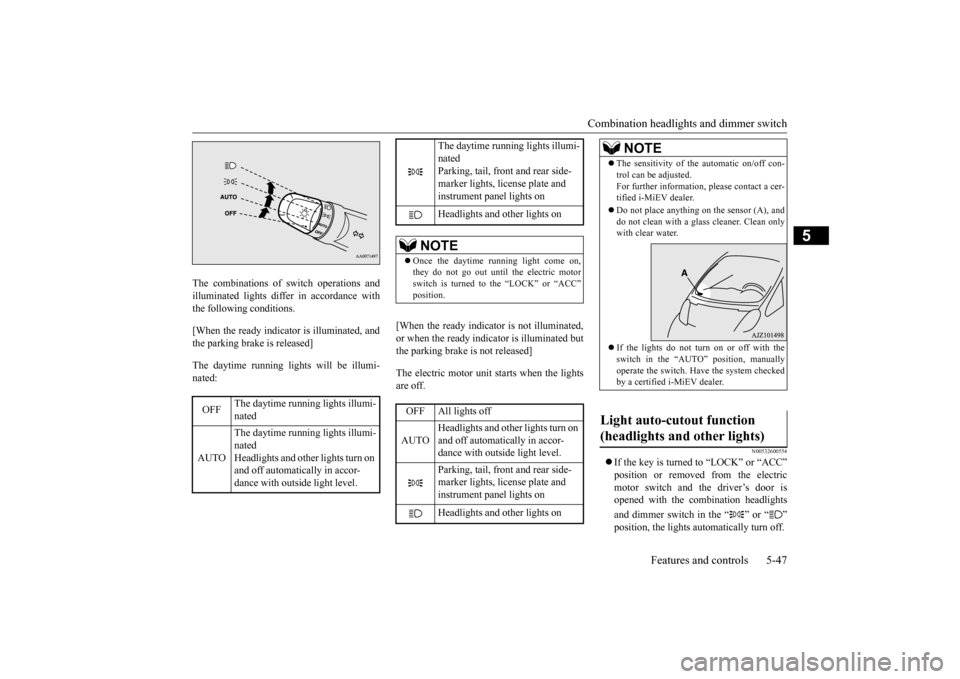
The combinations of switch operations and illuminated lights differ in accordance withthe following conditions. [When the ready indicato
r is illuminated, and
the parking brake is released] The daytime running light
s will be illumi-
nated:
[When the ready indicator is not illuminated, or when the ready indicator is illuminated but the parking brake is not released] The electric motor unit starts when the lights are off.
N00532600554
If the key is turned to “LOCK” or “ACC”
from the electric
motor switch and the driver’s door is opened with the combination headlights and dimmer switch in the “ ” or “ ”
OFF
The daytime running lights illumi- nated
AUTO
The daytime running lights illumi- nated Headlights and other lights turn on and off automatically in accor-dance with outsi
de light level.
The daytime running lights illumi- nated Parking, tail, front and rear side- marker lights, license plate and instrument panel lights on Headlights and other lights on
NOTE
Once the daytime running light come on, they do not go out until the electric motorswitch is turned to the “LOCK” or “ACC”OFF All lights off AUTO
Headlights and other lights turn on and off automatically in accor-dance with outside light level. Parking, tail, front and rear side- marker lights, license plate and instrument panel lights on Headlights and other lights on
NOTE
The sensitivity of the automatic on/off con- trol can be adjusted.For further information,
please contact a cer-
tified i-MiEV dealer. Do not place anything on
the sensor (A), and
do not clean with a glas
s cleaner. Clean only
with clear water. If the lights do not turn on or off with the switch in the “AUTO” operate the switch. Have
the system checked
by a certified i-MiEV dealer.
Light auto-cutout function (headlights and other lights)
BK0220401US.book 47 ページ 2015年6月3日 水曜日 午前7時42分
Page 194 of 296
Safe driving techniques 6-4 Driving safety
6
Move the driver’s seat as far backward as possible, while still
keeping good visibil-
ity, and good control of the steering wheel, brakes, accele
rator, and controls.
Check the instrument panel indicators forany possible problem. Move the front passe
nger seat as far back
as possible. Make sure that infa
nts and small children
are properly restrained in accordance with all laws and regulations.
Check these by selecti
ng the defroster mode,
and set the blower swit
ch on high. You should
be able to feel the air blowing against the windshield. (Refer to “Defrosting or defogging the wind- shield and door windows” on page 7-9.) Check all the tires for heavy tread wear or uneven wear patterns.
Look for stones, nails,
glass, or other objects
stuck in the tread. Look
for any tread cuts or sidewall cracks. Check the wheel nuts for tightness, and the tires for proper pressures. Replace your tires beforethey are heavily worn out.
As your vehicle is equi
pped with a tire pres-
sure monitoring system, there is a risk ofdamage to the tire inflation pressure sensors when the tire is replaced on the rim. Tire replacement should, th
erefore, be performed
only by a certified i-MiEV dealer. Have someone watch while you turn all the exterior lights on and off. Also check the turn signal indicators and
high-beam indicators on
the instrument panel. Check the ground under the vehicle after parking overnight, for wa
ter, oil, or other
leaks. Make sure all the fluid levels are cor- rect.
N00629200124
Even this vehicle’s safety equipment, andyour safest driving, cannot guarantee that youcan avoid an accident or injury. However, if you give extra attention to the following areas, you can better protect yourself andyour passengers:
Drive defensively. Be aware of traffic, road and weather conditions. Leave plentyof stopping distance between your vehicle and the vehicle ahead. Before changing lanes, check your mir- rors and use your turn signal light. While driving, watch the behavior of other drivers, bicyc
lists, and pedestrians.
Always obey applicable
laws and regula-
tions. Be a polite and alert driver. Always leave room for unexpected events, such as sudden braking.
N00629400416
Check the 12V starter battery, including terminals and cables. During extremely cold weather, the 12V starter battery willnot be as strong and
its power level may
drop. Before driving the vehicle, check to see ifthe headlights are as bright as normal. Charge or replace the 12V starter battery if necessary. During extreme coldweather, it is possibl
e that a very low 12V
starter battery could freeze.
Defrosters Tires
Lights Fluid leaks Safe driving techniques
Driving during cold weather
BK0220401US.book 4 ページ 2015年6月3日 水曜日 午前7時42分
Page 195 of 296
Braking
Driving safety 6-5
6
Check the antifreeze. If there is not enough coolant because of aleak, add high-quality ethylene glycol antifreeze and water. Use Mitsubishi Motors Genuine Super Long Life CoolantPremium or an equivalent. The recom- mended blend is abou
t 50 % water and 50
% anti-freeze. Use a
higher concentration
(not over 60 %) when the outside temper- ature is -31 °F (-35 °C) or lower. When the electric motor unit is working veryhard (for example, during mountain driv- ing and/or when the outside temperature is high), use a 50 %
concentration. This
blend will provide
adequate protection
from corrosion and boiling.
N00629501531
All the parts of the brake system are criticalto safety. Have the vehicle serviced by a certi- fied i-MiEV dealer at regular intervalsaccording to the “WARRANTY AND MAINTENANCE MANUAL”. Check the brake system while driving at a low speed immediately
after starting, espe-
cially when the brakes are wet, to confirm they work normally. A film of water can be formed on the brakediscs and prevent normal braking after driv- ing in heavy rain or through large puddles, or after the vehicle is washed. If this occurs, drythe brakes out by driving slowly while lightly depressing the brake pedal. On snowy roads, ice can form on the braking system, making the brak
es less effective.
While driving in such conditions, pay closeattention to preceding
and following vehicles
and to the condition of the road surface. From time to time, lightly
depress the brake pedal
and check how effective the brakes are.
Put the selector lever to “B” (REGENERA- TIVE BRAKE MODE) or “ECO” (ECO MODE) position according to the grade ofthe slope and vehicle sp
eed. This will allow
effective use of the regenerative brake and prevent the service brake from overheating.If the brake pedal is continuously or fre- quently depressed on downhill roads, the ser- vice brake could overheat and the brake performance will be reduced.
WA R N I N G The 12V starter batter
y gives off explosive
hydrogen gas. Any spark or flame cancause the 12V starter battery to explode,which could cause serious injury or death. Always wear protecti
ve clothes and a face
mask when working wi
th your 12V starter
battery, or let a skil
led mechanic do it.
WA R N I N GNever open the coolan
t reservoir cap while
it is hot. You could be seriously burned.
Braking When brakes are wet When driving in cold weather
When driving downhill
NOTE
When the main drive lithium-ion battery level is full or nearly full, or the main drivelithium-ion battery temp
erature is too high or
too low, the regenerative braking force may be reduced. Refer to “Regenerative braking”on page 3-3. If the red needle in the energy usage indica- tor does not move to the left of the neutral point (A) while the
accelerator pedal is
released, the regenerative brake will notwork. Refer to “Ener
gy usage indicator” on
page 5-37. In the such
case, before approach-
ing a long downhill
road, reduce speed to
prevent the service brake from overheating.
BK0220401US.book 5 ページ 2015年6月3日 水曜日 午前7時42分
Page 234 of 296
If the vehicle breaks down 8-2 For emergencies
8
N00836301243
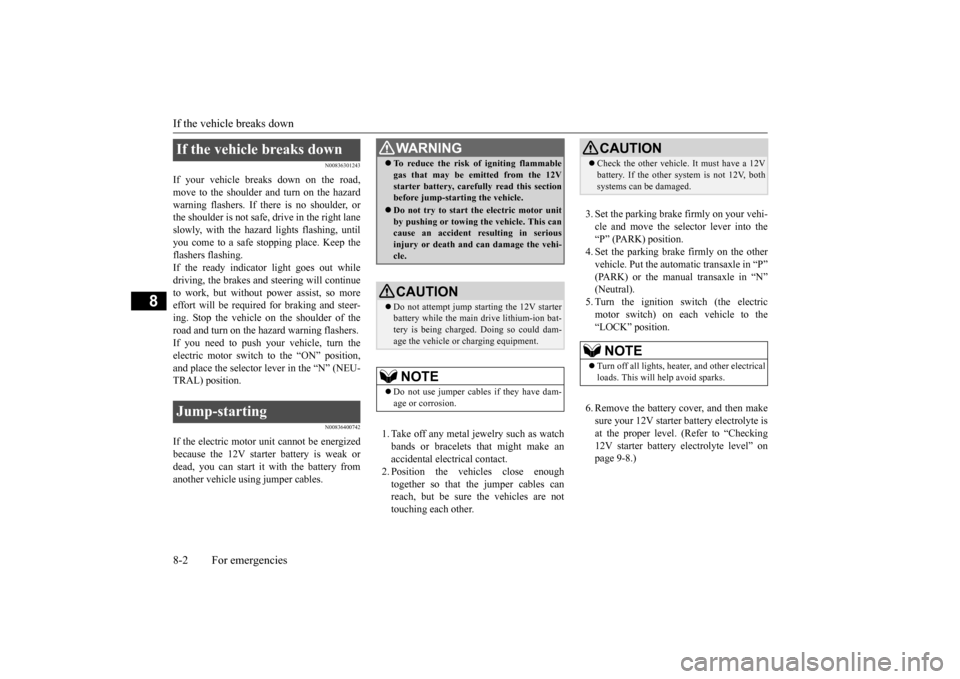
If your vehicle breaks down on the road, move to the shoulder and turn on the hazard warning flashers. If there is no shoulder, orthe shoulder is not safe, drive in the right lane slowly, with the hazard lights flashing, until you come to a safe stopping place. Keep theflashers flashing. If the ready indicator light goes out while driving, the brakes a
nd steering will continue
to work, but without power assist, so more effort will be required
for braking and steer-
ing. Stop the vehicle on the shoulder of the road and turn on the hazard warning flashers. If you need to push your vehicle, turn theelectric motor switch to the “ON” position, and place the selector lever in the “N” (NEU- TRAL) position.
N00836400742
If the electric motor unit cannot be energizedbecause the 12V starter battery is weak ordead, you can start it with the battery from another vehicle using jumper cables.
1. Take off any metal jewelry such as watch bands or bracelets
that might make an
accidental electrical contact. 2. Position the vehi
cles close enough
together so that the jumper cables can reach, but be sure the vehicles are nottouching each other.
3. Set the parking brake firmly on your vehi- cle and move the selector lever into the “P” (PARK) position. 4. Set the parking brake firmly on the othervehicle. Put the automatic transaxle in “P”5. Turn the ignition switch (the electric motor switch) on each vehicle to the “LOCK” position. 6. Remove the battery
cover, and then make
sure your 12V starter
battery electrolyte is
at the proper level. (Refer to “Checking 12V starter battery electrolyte level” onpage 9-8.)
If the vehicle breaks down Jump-starting
WA R N I N G To reduce the risk of igniting flammable gas that may be em
itted from the 12V
starter battery, carefully read this sectionbefore jump-starting the vehicle. Do not try to start the electric motor unit by pushing or towing the vehicle. This can cause an accident re
sulting in serious
injury or death and
can damage the vehi-
cle.CAUTION Do not attempt jump st
arting the 12V starter
battery while the main
drive lithium-ion bat-
tery is being charged. Doing so could dam-age the vehicle or charging equipment.NOTE
Do not use jumper cables if they have dam- age or corrosion.
CAUTION Check the other vehicle.
It must have a 12V
battery. If the other system is not 12V, bothsystems can be damaged.NOTE
Turn off all lights, heat
er, and othe
r electrical
loads. This will
help avoid sparks.
BK0220401US.book 2 ページ 2015年6月3日 水曜日 午前7時42分
Page 237 of 296
Tire repair kit
For emergencies 8-5
8
If you drive your vehicle with a low battery charge, after the electric motor unit has beenstarted by using jumper
cables, it can cause
the anti-lock braking sy
stem warning light to
illuminate. This is only due to the low batteryvoltage. It is not a problem with the brake system. If this happens, fully charge the 12V starter battery and ensure the charging system is operating properly.
N00836600366
This vehicle is equipped
with a tire repair kit
which can be used to repair a minor puncture in tread area caused by
a nail, screw or simi-
lar object. A spare tire
is not provided with
this vehicle.
N00837701026
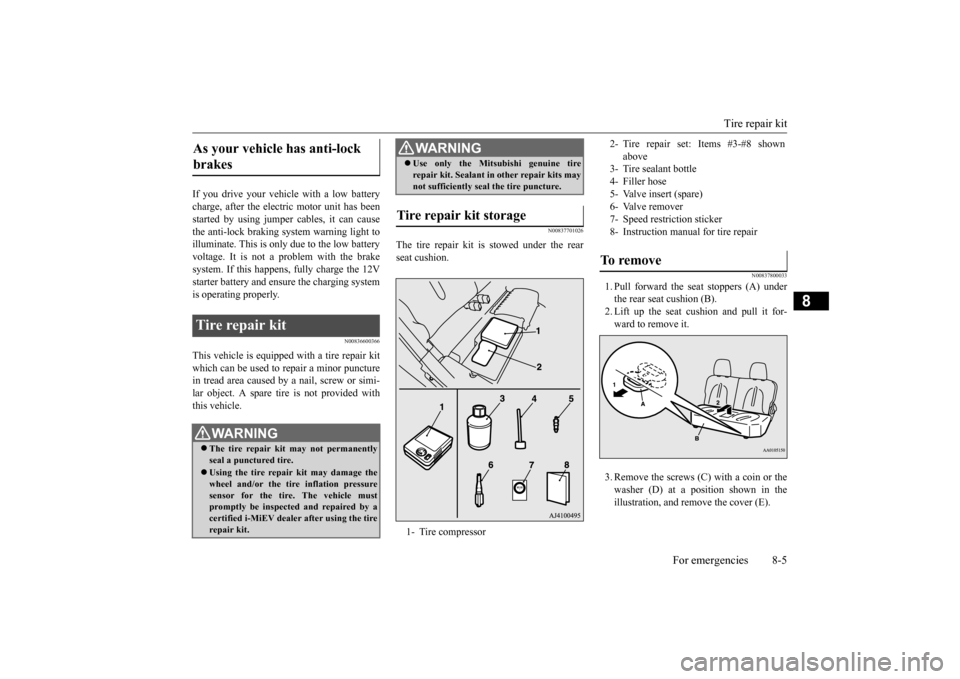
The tire repair kit is
stowed under the rear
seat cushion.
N00837800033
1. Pull forward the seat stoppers (A) underthe rear seat cushion (B). 2. Lift up the seat
cushion and pull it for-
ward to remove it. 3. Remove the screws (C) with a coin or the washer (D) at a position shown in the illustration, and re
move the cover (E).
As your vehicle has anti-lock brakes Tire repair kit
WA R N I N G The tire repair kit may not permanently seal a punctured tire. Using the tire repair
kit may damage the
wheel and/or the tire inflation pressuresensor for the tire. The vehicle must promptly be inspected and repaired by a certified i-MiEV dealer after using the tirerepair kit.
Use only the Mitsubishi genuine tire repair kit. Sealant in other repair kits maynot sufficiently seal the tire puncture.
Tire repair kit storage 1- Tire compressorWA R N I N G
2- Tire repair set: Items #3-#8 shown
above
3- Tire sealant bottle4- Filler hose 5- Valve insert (spare)7- Speed restriction sticker 8- Instruction manual for tire repairTo remove
BK0220401US.book 5 ページ 2015年6月3日 水曜日 午前7時42分
Page 245 of 296
Operation under adverse driving conditions
For emergencies 8-13
8
N00837200747
If your vehicle becomes stuck in snow, sand, or mud, it can often be moved by a rocking motion. Rock your vehicle back and forth tofree it. Do not spin the wheels. Constant efforts to free a stuck vehicle can cause transmissionfailure. If your vehicle is still
stuck after several rock-
ing attempts, call for a commercial tow truckservice.
When driving on a road covered with snow or ice, use snow tires. Tire chains cannot be used on your vehicle. Theremay be state or local regulations about using snow tires. Always check the regu- lations in your local area before usingthem. Refer to the section entitled “Snow tires” on page 9-15 and “Tire chains” on page 9-16. Drive slowly. Do not make sudden starts or stops, sharp turns, or slam on the brakes. Allow extra distance between your vehi- cle and the vehicle in front of you, and avoid sudden braking. If a skid occurs when the accelerator pedal is depressed, take your foot off the pedal. Steer gently in the direction of theskid. Your vehicle is equippe
d with an anti-lock
braking system (ABS), hold the brakepedal down firmly and
keep it depressed.
Do not pump the brake pedal which will result in reduced braking performance.
CAUTION If the transmission or the steering system has a problem or damage,
transport the vehicle
on a flatbed truck or to
w the vehicle with the
all wheels off the ground. If the electric motor switch is in the “ON”
lting in an accident.
Make sure the electric motor switch is in the“ACC” position before towing.
Operation under adverse driving conditions If your vehicle becomes stuck in sand, mud or snow
WA R N I N G When trying to rock
your vehicle out of a
stuck position, make sure that there are nopeople nearby. The
rocking motion can
make your vehicle suddenly lurch forward or backward, and inju
re any bystanders.
On wet roads
CAUTIONDo not drive on a flooded road. If you drive on a flooded road, not only the electric motorunit stops but also a fail
ure like electric leak-
age or short circuit may occur. If you inevitably had to run on a floodedroad and the vehicle was exposed to water, be sure to have your vehicle inspected by a certified i-MiEV dealer. When driving in rain, on water-covered roads, or through a car wash, water could getinto the brake discs and make them fail tem- porarily. In such cases, lightly press the brake pedal to see if they are working prop-erly. If they are not, press the pedal lightlyseveral times while driv
ing to dry the brake
pads or linings, then check them again. When driving in rain, a layer of water may form between the tires and the road surface (aquaplaning). This l
oosens your tires’ grip
on the road, making it difficult to steer or brake properly. When driving on a wet road:• Drive your vehicle at a safe speed.
• Do not drive on worn tires.• Always keep the tires at the correct infla- tion pressures.
On snowy or icy roads
CAUTION
BK0220401US.book 13 ページ 2015年6月3日 水曜日 午前7時42分
Page 247 of 296
9
Vehicle care and maintenanceService precautions ..........................................................................9-2 Hood .............
............
...........
...........
...........
...........
...........
...........
.....9-3
View under the hood and electric motor unit room .........................9-4Coolant/Hot water heater fluid ........................................................9-4 Washer fluid .....................................................................................9-7 Brake fluid .......................................................................................9-712V starter battery ...........................................................................9-7 Tires ...............................................................................................9-10 Brake pedal free play .....................................................................9-16Parking brake lever stroke .............................................................9-16 Wiper blades ..................................................................................9-16 General maintenance .....................................................................9-17For cold and snowy weather ..........................................................9-18 Fusible links ...................................................................................9-18 Fuses ..............................................................................................9-18Replacement of light bulbs ............................................................9-21 Vehicle care precautions ................................................................9-28 Cleaning the inside of your vehicle .......
...........
...........
...........
.......9-28
Cleaning the outside of your vehicle .....
...........
...........
...........
.......9-30
BK0220401US.book 1 ページ 2015年6月3日 水曜日 午前7時42分
Page 250 of 296
View under the hood and
electric motor unit room
9-4 Vehicle care and maintenance
9
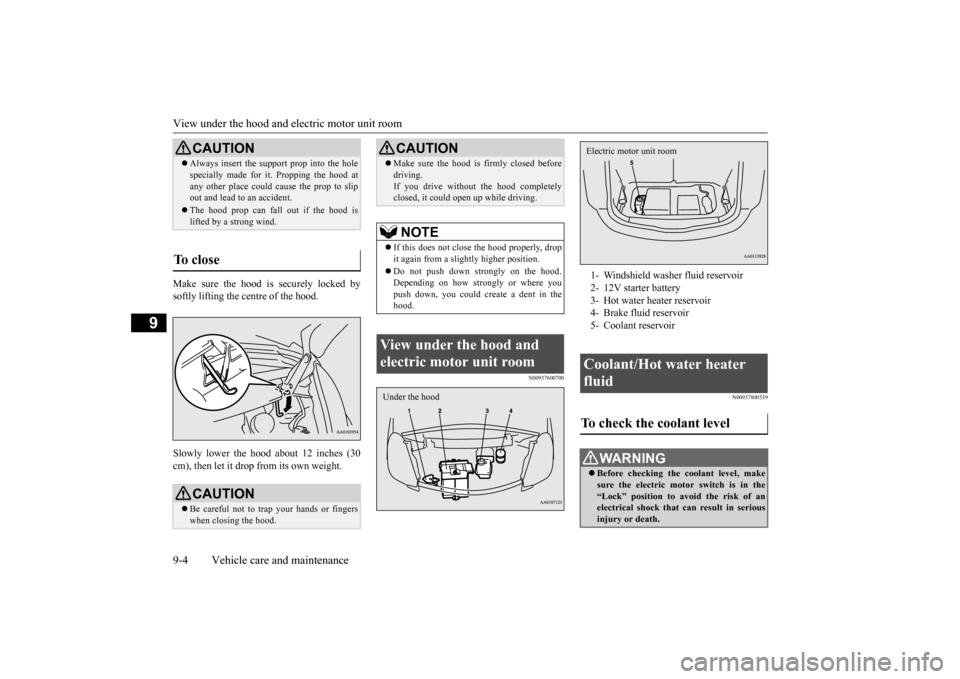
Make sure the hood is securely locked by softly lifting the centre of the hood. Slowly lower the hood about 12 inches (30 cm), then let it drop from its own weight.
N00937600700
N00937800539
CAUTION Always insert the support prop into the hole specially made for
it. Propping the hood at
any other place could
cause the prop to slip
out and lead to
an accident.
The hood prop can fall out if the hood is lifted by a strong wind.
To close
CAUTION Be careful not to trap your hands or fingers when closing the hood.
Make sure the hood is firmly closed before driving.If you drive without the hood completelyclosed, it could open up while driving.NOTE
If this does not close the hood properly, drop it again from a slightly higher position. Do not push down strongly on the hood. Depending on how strongly or where you push down, you could create a dent in the hood.
View under the hood and electric motor unit room
CAUTION
Under the hood
1- Windshield washer fluid reservoir 2- 12V starter battery 3- Hot water heater reservoir 4- Brake fluid reservoir5- Coolant reservoirCoolant/Hot water heater fluid To check the coolant level
WA R N I N G Before checking the
coolant level, make
sure the electric motor switch is in the“Lock” position to
avoid the risk of an
electrical shock that can result in serious injury or death.Electric motor unit room
BK0220401US.book 4 ページ 2015年6月3日 水曜日 午前7時42分
Page 253 of 296
Washer fluid
Vehicle care and maintenance 9-7
9
N00938600303
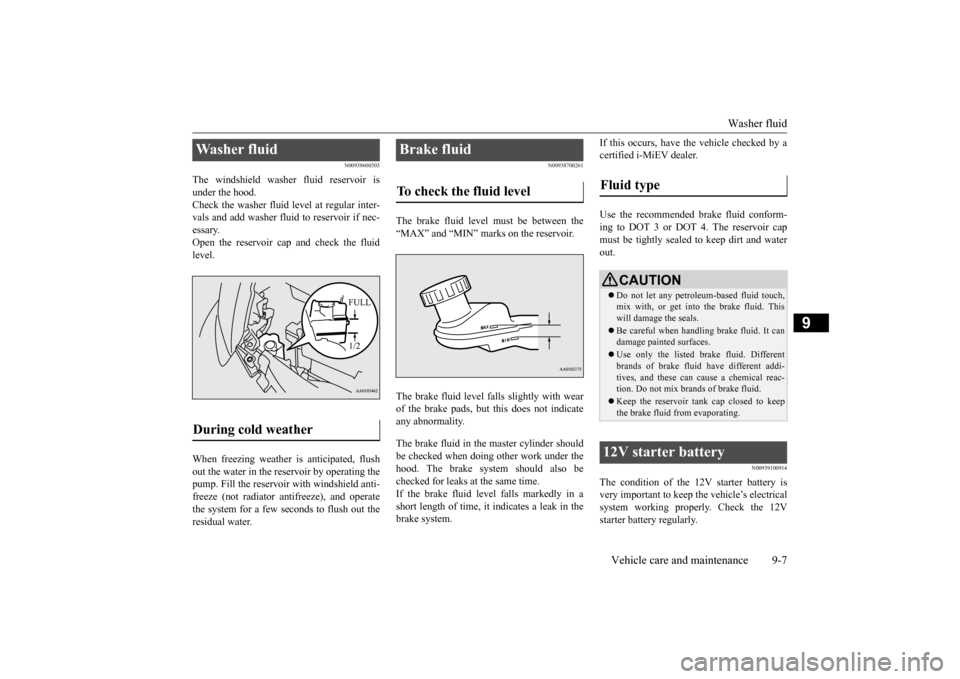
The windshield washer fluid reservoir is under the hood. Check the washer fluid level at regular inter-vals and add washer fluid to reservoir if nec- essary. Open the reservoir cap and check the fluidlevel. When freezing weather is anticipated, flush out the water in the reservoir by operating the pump. Fill the reservoir with windshield anti-freeze (not radiator
antifreeze), and operate
the system for a few se
conds to flush out the
residual water.
N00938700261
The brake fluid level must be between the “MAX” and “MIN” marks on the reservoir. The brake fluid level fa
lls slightly with wear
of the brake pads, but
this does not indicate
any abnormality. The brake fluid in the master cylinder should be checked when doing other work under the hood. The brake system should also bechecked for leaks at the same time. If the brake fluid level falls markedly in a short length of time, it indicates a leak in thebrake system.
If this occurs, have the vehicle checked by a certified i-MiEV dealer. Use the recommended brake fluid conform- ing to DOT 3 or DOT 4. The reservoir capmust be tightly sealed
to keep dirt and water
out.
N00939100914
The condition of the 12V starter battery is very important to keep the vehicle’s electricalsystem working properly. Check the 12V starter battery regularly.
Washer fluid During cold weather
FULL 1/2
Brake fluid To check the fluid level
Fluid type
CAUTION Do not let any petrol
eum-based fluid touch,
mix with, or get into the brake fluid. This will damage the seals. Be careful when handling brake fluid. It can damage painted surfaces. Use only the listed brake fluid. Different brands of brake fluid have different addi-tives, and these can cause a chemical reac- tion. Do not mix brands of brake fluid. Keep the reservoir ta
nk cap closed to keep
the brake fluid from evaporating.
12V starter battery
BK0220401US.book 7 ページ 2015年6月3日 水曜日 午前7時42分