wheel MITSUBISHI iMiEV 2017 1.G Service Manual
[x] Cancel search | Manufacturer: MITSUBISHI, Model Year: 2017, Model line: iMiEV, Model: MITSUBISHI iMiEV 2017 1.GPages: 296, PDF Size: 7.79 MB
Page 244 of 296
Towing 8-12 For emergencies
8
If a wheel gets stuck in
a ditch, do not try to
tow the vehicle. Please contact a certifie
d i-MiEV dealer or a
commercial tow truck service for assistance. There may be local re
gulations concerning
towing in your area. Obey the regulations inthe area where you are driving your vehicle.
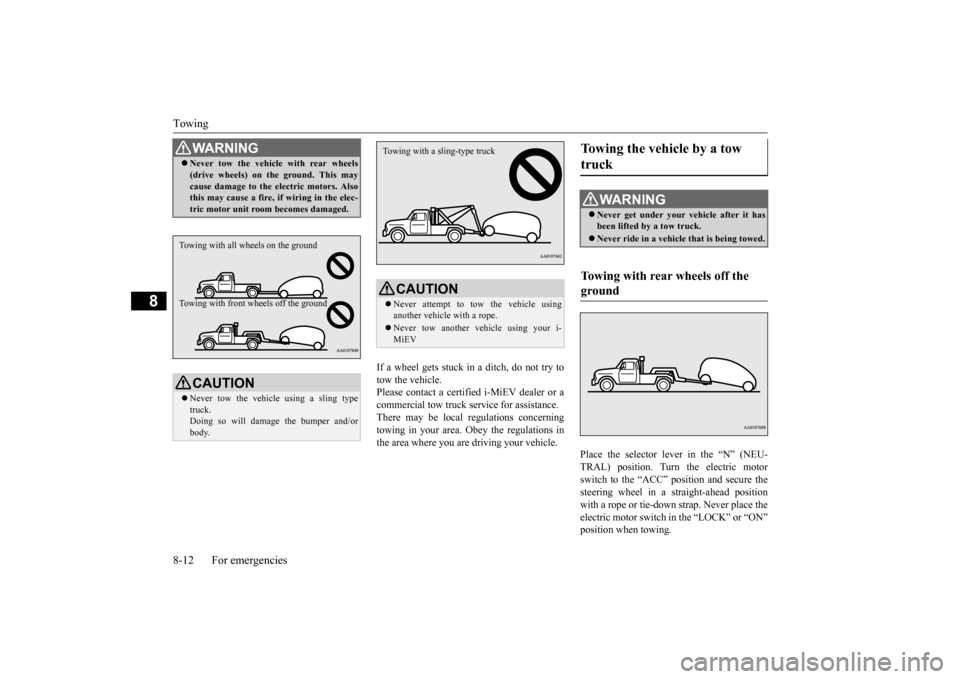
Place the selector lever in the “N” (NEU- TRAL) position. Turn the electric motor switch to the “ACC” position and secure thesteering wheel in a st
raight-ahead position
with a rope or tie-down strap. Never place the electric motor switch in the “LOCK” or “ON”
WA R N I N G Never tow the vehicle with rear wheels (drive wheels) on th
e ground. This may
cause damage to the electric motors. Alsothis may cause a fire, if wiring in the elec- tric motor unit room becomes damaged.CAUTION Never tow the vehicl
e using a sling type
truck. Doing so will damage the bumper and/or body.Towing with all wheels on the ground Towing with front wheels off the ground
CAUTION Never attempt to tow the vehicle using another vehicle with a rope. Never tow another ve
hicle using your i-
MiEVTowing with a sling-type truck
Towing the vehicle by a tow truck
WA R N I N G Never get under your vehicle after it has been lifted by a tow truck. Never ride in a vehicl
e that is being towed.
Towing with rear wheels off the ground
BK0220401US.book 12 ページ 2015年6月3日 水曜日 午前7時42分
Page 245 of 296
Operation under adverse driving conditions
For emergencies 8-13
8
N00837200747
If your vehicle becomes stuck in snow, sand, or mud, it can often be moved by a rocking motion. Rock your vehicle back and forth tofree it. Do not spin the wheels. Constant efforts to free a stuck vehicle can cause transmissionfailure. If your vehicle is still
stuck after several rock-
ing attempts, call for a commercial tow truckservice.
When driving on a road covered with snow or ice, use snow tires. Tire chains cannot be used on your vehicle. Theremay be state or local regulations about using snow tires. Always check the regu- lations in your local area before usingthem. Refer to the section entitled “Snow tires” on page 9-15 and “Tire chains” on page 9-16. Drive slowly. Do not make sudden starts or stops, sharp turns, or slam on the brakes. Allow extra distance between your vehi- cle and the vehicle in front of you, and avoid sudden braking. If a skid occurs when the accelerator pedal is depressed, take your foot off the pedal. Steer gently in the direction of theskid. Your vehicle is equippe
d with an anti-lock
braking system (ABS), hold the brakepedal down firmly and
keep it depressed.
Do not pump the brake pedal which will result in reduced braking performance.
CAUTION If the transmission or the steering system has a problem or damage,
transport the vehicle
on a flatbed truck or to
w the vehicle with the
all wheels off the ground. If the electric motor switch is in the “ON”
lting in an accident.
Make sure the electric motor switch is in the“ACC” position before towing.
Operation under adverse driving conditions If your vehicle becomes stuck in sand, mud or snow
WA R N I N G When trying to rock
your vehicle out of a
stuck position, make sure that there are nopeople nearby. The
rocking motion can
make your vehicle suddenly lurch forward or backward, and inju
re any bystanders.
On wet roads
CAUTIONDo not drive on a flooded road. If you drive on a flooded road, not only the electric motorunit stops but also a fail
ure like electric leak-
age or short circuit may occur. If you inevitably had to run on a floodedroad and the vehicle was exposed to water, be sure to have your vehicle inspected by a certified i-MiEV dealer. When driving in rain, on water-covered roads, or through a car wash, water could getinto the brake discs and make them fail tem- porarily. In such cases, lightly press the brake pedal to see if they are working prop-erly. If they are not, press the pedal lightlyseveral times while driv
ing to dry the brake
pads or linings, then check them again. When driving in rain, a layer of water may form between the tires and the road surface (aquaplaning). This l
oosens your tires’ grip
on the road, making it difficult to steer or brake properly. When driving on a wet road:• Drive your vehicle at a safe speed.
• Do not drive on worn tires.• Always keep the tires at the correct infla- tion pressures.
On snowy or icy roads
CAUTION
BK0220401US.book 13 ページ 2015年6月3日 水曜日 午前7時42分
Page 246 of 296
Operation under adverse driving conditions 8-14 For emergencies
8
After parking on snowy or icy road, it may be difficult to move your vehicle dueto freeze-up of the brake. Depress the accelerator pedal little by little to move the vehicle after confirming safety of thevehicle. Drive as slow as possible when driving on bumpy or rutted roads or over potholes etc.CAUTION Do not depress the acce
lerator pedal rapidly.
The vehicle could start moving when itbreaks free from the ic
e, possibly resulting in
an accident.
On a bumpy or rutted road
CAUTION Driving on bumpy, rutted roads or over pot- holes can damage the tires and wheels. Wheels with low-profiles tires or under-inflated tires are especi
ally at risk for dam-
age. The vehicle’s body, bumper, muffler and other parts may be dama
ged if the vehicle is:
• driven over a step (for example, at the entrance or exit of a parking lot);
• parked too closely against a curb or parkingblock, or by the side of a road with curb-stones;• driven on a steep slope.CAUTION
BK0220401US.book 14 ページ 2015年6月3日 水曜日 午前7時42分
Page 259 of 296

Tires
Vehicle care and maintenance 9-13
9
code may only be on one side. Look for the TIN on the outboard side of tires as mounted on the vehicle. If the TIN is not found on the outboard sidethen you will find it on the inboard side of the tire. EXAMPLE: DOT MA L9 ABCD 1504
The treadwear grade is a comparative rating based on the wear rate of the tire when testedunder controlled conditions on a specified government test course
. For example, a tire
graded 150 would wear one and one-half (11/2) times as well on the government course
as a tire graded 100. The relative performance of tires depends upon the actual conditions of their use, however, and may depart signifi-cantly from the norm due to variations in driving habits, service practices and differ- ences in road characteristics and climate. The traction grades, from highest to lowest, are AA, A, B and C. Those grades represent the tire’s ability to stop on wet pavement as measured under contro
lled conditions on
specified government te
st surfaces of asphalt
and concrete. A tire marked C may have poor traction performance. The temperature grades are A (the highest), B and C, representing the ti
re’s resistance to the
generation of heat and it
s ability to dissipate
heat when tested u
nder controlled conditions
on a specified indoor
laboratory test wheel.
Sustained high temperature can cause the material of the tire to
degenerate and reduce
tire life, and excessive temperature can lead to sudden tire failure. The grade C corre-sponds to a level of
performance which all
passenger car tires must
meet under the Fed-
eral Motor Vehicle Safety Standard No. 109.Grades B and A represent higher levels of performance on the laboratory test wheel than the minimum required by law.
N00939300873
Proper tire inflation pre
ssure is essential for
the safe and satisfac
tory operation of your
vehicle. The wrong tire pressure will cause problems in three major areas: Safety
DOT
Department of Transporta- tion This symbol certifies that the tire is in compliance with the U.S.
Department
of Transportation tire safety standards, and is approved for highway use.
MA
Code representing the tire manufacturing location. (2 digits)
L9 ABCD
Code representing the tire size. (2 digits)Code used by tire manufac- turer. (1 to 4 digits)
15
Number representing the week in which the tire was manufactured. (2 digits)
04
Number representing the year in which the tire was manufactured. (2 digits)
ature Grades Treadwear Tr a c t i o n
TemperatureTire inflation pressures
BK0220401US.book 13 ページ 2015年6月3日 水曜日 午前7時42分
Page 260 of 296
Tires 9-14 Vehicle care and maintenance
9
Too little pressure increases flexing in the tire and can cause tire failure. Too muchpressure can cause a tire to lose its ability to cushion shock. Objects on the road and potholes could then cause tire damage thatmay result in tire failure. Economy The wrong tire pressure can cause unevenwear patterns in the tire tread. These abnormal wear patterns will reduce the tread life, and the tire will have to be replaced sooner. Too little pressure also makes it harder forthe tire to roll, and this uses up more power. Ride comfort and vehicle stability The superior riding
experience built into
your vehicle partly depends on the correct tire pressure. Too mu
ch pressure gives an
uncomfortable and ja
rring ride. Too little
pressure feels as if your vehicle is slow to respond.Unequal tire pressures can make steering your vehicle uneven and unpredictable.
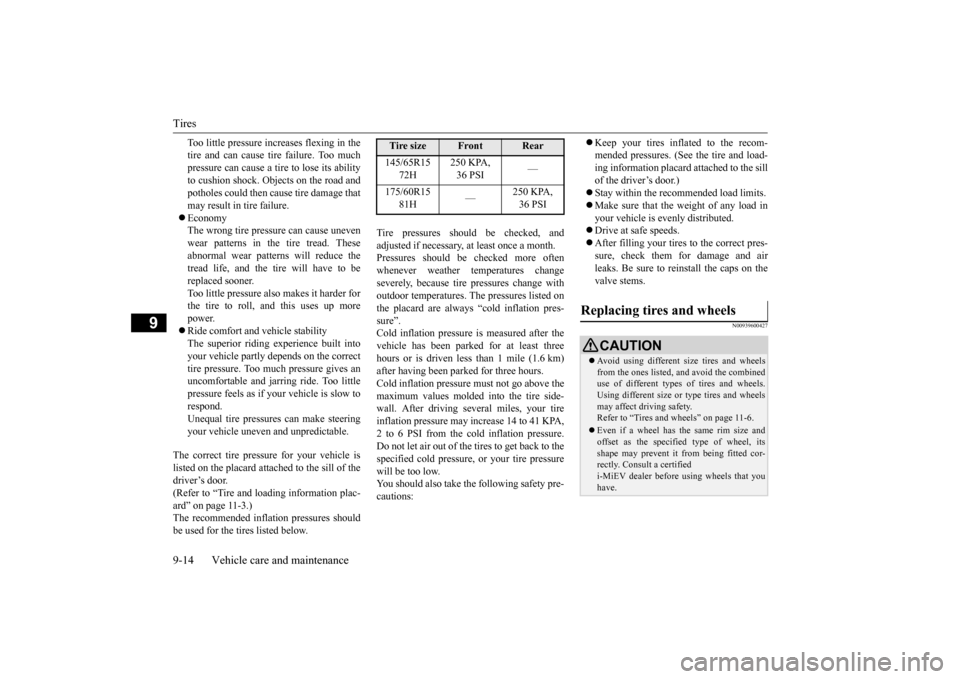
The correct tire pressure for your vehicle is listed on the placard attached to the sill of thedriver’s door. (Refer to “Tire and loading information plac- ard” on page 11-3.)The recommended inflation pressures should be used for the tires listed below.
Tire pressures should be checked, and adjusted if necessary, at least once a month.Pressures should be checked more often whenever weather temperatures change severely, becaus
e tire pressures change with
outdoor temperatures. The pressures listed on the placard are always
“cold inflation pres-
sure”.Cold inflation pressure is measured after the vehicle has been parked
for at least three
hours or is driven less than 1 mile (1.6 km)after having been parked for three hours. Cold inflation pressure must not go above the maximum values molded into the tire side-wall. After driving se
veral miles, your tire
inflation pressure may increase 14 to 41 KPA, 2 to 6 PSI from the cold inflation pressure.Do not let air out of the tires to get back to the specified cold pressure, or your tire pressure will be too low.You should also take the following safety pre- cautions:
Keep your tires inflated to the recom- mended pressures. (See the tire and load-ing information placard attached to the sill of the driver’s door.) Stay within the recommended load limits. Make sure that the weight of any load in your vehicle is evenly distributed. Drive at safe speeds. After filling your tires to the correct pres- sure, check them for damage and air leaks. Be sure to reinstall the caps on the valve stems.
N00939600427
Tire size
Front
Rear
145/65R15
72H
250 KPA, 36 PSI
—
175/60R15
81H
—
250 KPA, 36 PSI
Replacing tires and wheels
CAUTION Avoid using different size tires and wheels from the ones listed, and avoid the combined use of different types
of tires and wheels.
Using different size or
type tires and wheels
may affect driving safety. Refer to “Tires and wheels” on page 11-6. Even if a wheel has the same rim size and offset as the specifie
d type of wheel, its
shape may prevent it
from being fitted cor-
rectly. Consult a certified i-MiEV dealer before
using wheels that you
have.
BK0220401US.book 14 ページ 2015年6月3日 水曜日 午前7時42分
Page 261 of 296
Tires
Vehicle care and maintenance 9-15
9
N00939700170
The following maintenance steps are recom- mended: Check tire pressures regularly. Have regular maintenance done on the wheel balance and front
and rear suspen-
sion alignment.
N00939800214
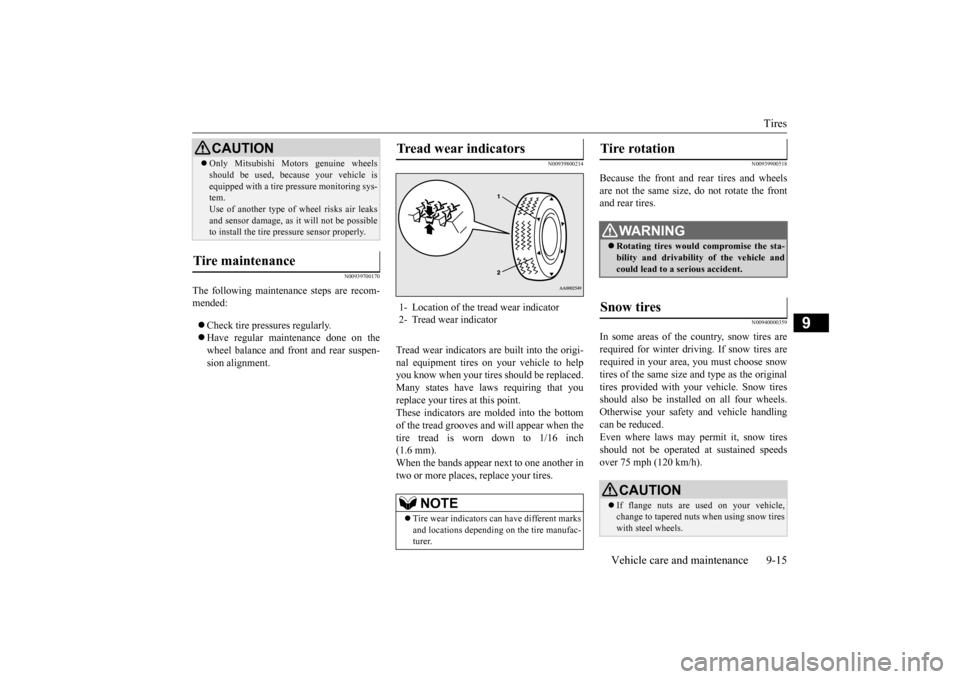
Tread wear indicators are built into the origi-nal equipment tires on your vehicle to helpyou know when your tires should be replaced. Many states have la
ws requiring that you
replace your tires at this point.These indicators are molded into the bottom of the tread grooves and will appear when the tire tread is worn down to 1/16 inch(1.6 mm). When the bands appear next to one another in two or more places,
replace your tires.
N00939900518
Because the front and
rear tires and wheels
are not the same size, do not rotate the front and rear tires.
N00940000359
In some areas of the country, snow tires arerequired for winter driving. If snow tires arerequired in your area, you must choose snow tires of the same size
and type as the original
tires provided with your
vehicle. Snow tires
should also be
installed on all four wheels.
Otherwise your safety
and vehicle handling
can be reduced.Even where laws may permit it, snow tires should not be operated
at sustained speeds
over 75 mph (120 km/h).
Only Mitsubishi Motors genuine wheels should be used, beca
use your vehicle is
equipped with a tire pr
essure monitoring sys-
tem. Use of another type of wheel risks air leaks and sensor damage, as it
will not be possible
to install the tire pressure sensor properly.
Tire maintenance
CAUTION
Tread wear indicators 1- Location of the tread wear indicator 2- Tread wear indicator
NOTE
Tire wear indicators ca
n have different marks
and locations depending on the tire manufac- turer.
Tire rotation
WA R N I N G Rotating tires would compromise the sta- bility and drivabilit
y of the vehicle and
could lead to a
serious accident.
Snow tires
CAUTIONIf flange nuts are used on your vehicle, change to tapered nuts
when using snow tires
with steel wheels.
BK0220401US.book 15 ページ 2015年6月3日 水曜日 午前7時42分
Page 262 of 296
Brake pedal free play 9-16 Vehicle care and maintenance
9
N00940100129 N00940300310
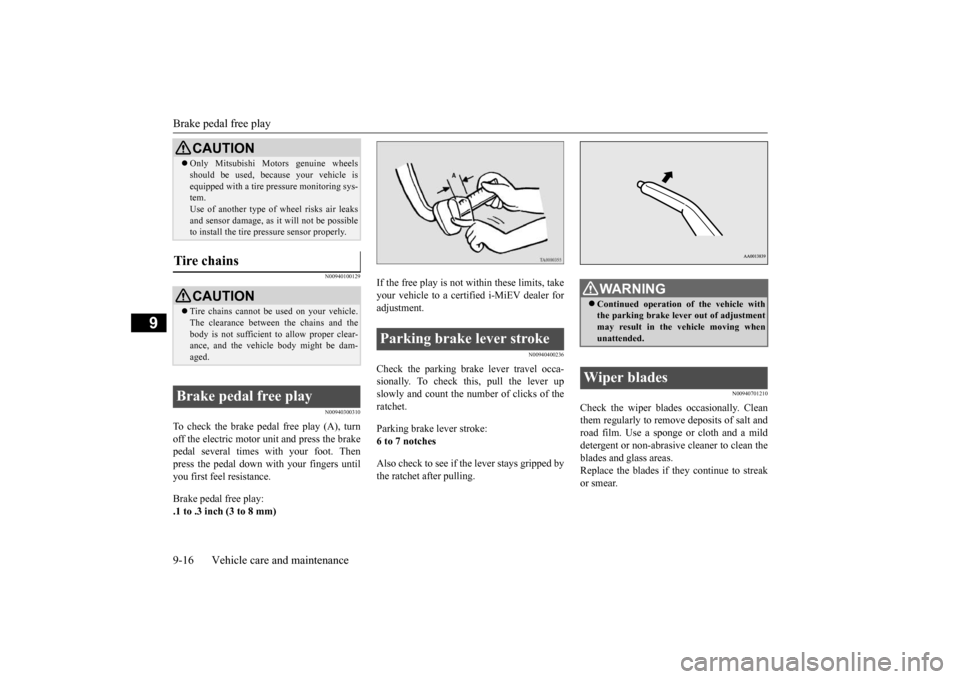
To check the brake pedal free play (A), turn off the electric motor unit and press the brakepedal several times
with your foot. Then
press the pedal down wi
th your fingers until
you first feel resistance. Brake pedal free play: .1 to .3 inch (3 to 8 mm)
If the free play is not within these limits, take your vehicle to a certified i-MiEV dealer for adjustment.
N00940400236
Check the parking brake lever travel occa- sionally. To check this, pull the lever upslowly and count the number of clicks of the ratchet. Parking brake lever stroke: 6 to 7 notches Also check to see if the lever stays gripped by the ratchet after pulling.
N00940701210
Check the wiper blades occasionally. Cleanthem regularly to remove
deposits of salt and
road film. Use a sponge or cloth and a mild detergent or non-abrasive
cleaner to clean the
blades and glass areas. Replace the blades if th
ey continue to streak
or smear.
Only Mitsubishi Motors genuine wheels should be used, beca
use your vehicle is
equipped with a tire pr
essure monitoring sys-
tem. Use of another type of
wheel risks air leaks
and sensor damage, as
it will not be possible
to install the tire pressure sensor properly.
Tire chains
CAUTION Tire chains cannot be used on your vehicle. The clearance between
the chains and the
body is not sufficient to allow proper clear- ance, and the vehicle body might be dam- aged.
Brake pedal free play
CAUTION
Parking brake lever stroke
WA R N I N G Continued operation
of the vehicle with
the parking brake leve
r out of adjustment
may result in the
vehicle moving when
unattended.
Wiper blades
BK0220401US.book 16 ページ 2015年6月3日 水曜日 午前7時42分
Page 263 of 296
General maintenance
Vehicle care and maintenance 9-17
9
If the blades are frozen to the windshield or rear window, do not operate the wipers until the ice has melted and the blades are freed,otherwise the wiper mo
tor may be damaged.
N00941500289
The next pages list th
e maintenance service
recommended by Mitsubishi Motors Corpo- ration. In addition to the general maintenancethat needs to be performed at the times listed, there are other parts which do not usually need regular maintenance.But, if any of these parts stops working prop- erly, your vehicle performance could suffer. Have these items checked if you notice a problem with them. See a certified i-MiEV dealer for assistance, if you have any questions.
N00941600033
Good brakes are essential to safe driving. Check the brake pads and brake linings for wear and check the rear wheel cylinders forleaks. For good braking performance, replace the brake pads with the same type pads as the originals.
N00941700047
Brake hoses and tubing should be checked for: Severe surface cracki
ng, scuffing or worn
spots. If the fabric casing of the hose isshowing through any cracks or worn spots in the rubber hose cover, the hose should be replaced. The brakes can fail if the hose wears through. Improper installation may cause twisting, or wheel, tire or
chassis interference.
N00941800077
Check the following parts for damage and grease leaks: Ball joint boots of the front suspension and steering linkage Bellows on both ends of the drive shaft
N00942500114
The hood lock release mechanism and hood safety catch should be
checked, cleaned, and
oiled when needed for easy movement and to
NOTE
Do not run the wipers on dry glass for a long time. This wears out the rubber and canscratch the glass.
During cold weather
NOTE
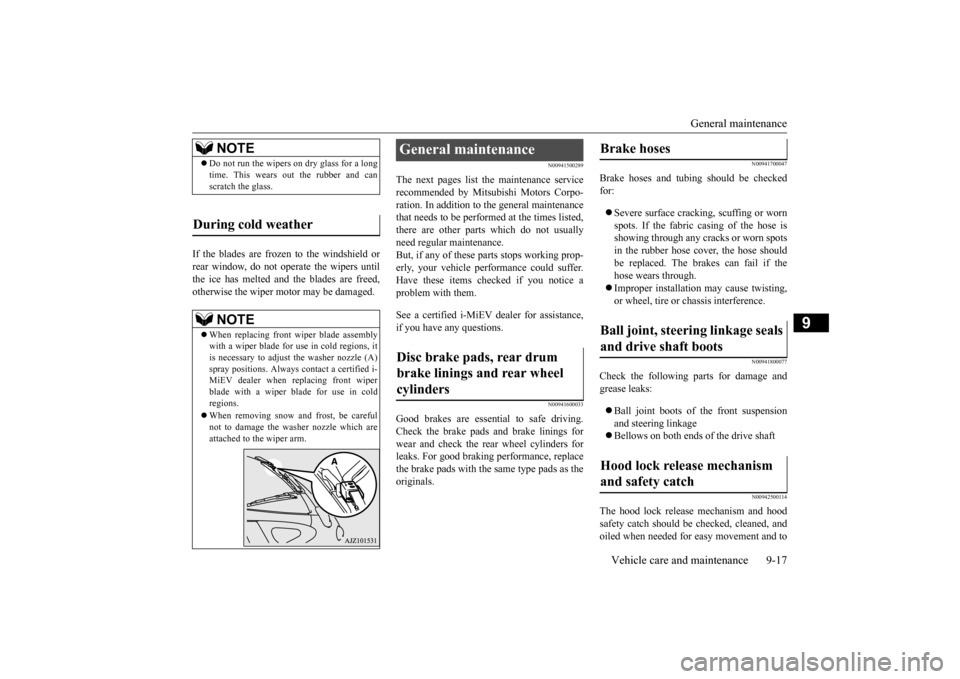
When replacing front wiper blade assembly with a wiper blade for use in cold regions, it is necessary to adjust the washer nozzle (A)
contact a certified i-
MiEV dealer when re
placing front wiper
blade with a wiper blade for use in cold regions. When removing snow and frost, be careful not to damage the wash
er nozzle which are
attached to the wiper arm.
General maintenance Disc brake pads, rear drum brake linings and rear wheel cylinders
Brake hoses Ball joint, steering linkage seals and drive shaft boots Hood lock release mechanism and safety catch
BK0220401US.book 17 ページ 2015年6月3日 水曜日 午前7時42分
Page 270 of 296
Replacement of light bulbs 9-24 Vehicle care and maintenance
9
4. To install the bulb, perform the removal steps in reverse.
N00943401407
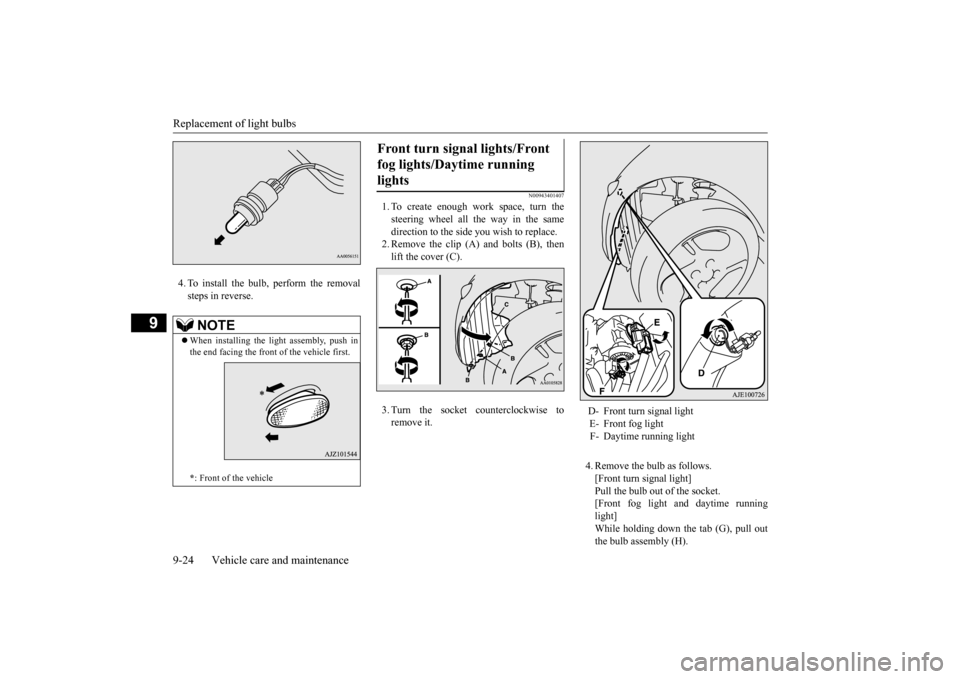
1. To create enough work space, turn thesteering wheel all the way in the same direction to the side
you wish to replace.
2. Remove the clip (A) and bolts (B), thenlift the cover (C). 3. Turn the socket counterclockwise to remove it.
4. Remove the bulb as follows. [Front turn signal light] Pull the bulb out of the socket.[Front fog light
and daytime running
light] While holding down the tab (G), pull outthe bulb assembly (H).
NOTE
When installing the light assembly, push in the end facing the front of the vehicle first. * : Front of the vehicle
Front turn signal lights/Front fog lights/Daytime running lights
D- Front turn signal light E- Front fog light F- Daytime running light
BK0220401US.book 24 ページ 2015年6月3日 水曜日 午前7時42分
Page 276 of 296
Cleaning the outside of your vehicle 9-30 Vehicle care and maintenance
9
N00945700061
To protect your vehicle’s finish, wash it often and thoroughly. If desired, you may wax your vehicle using a nonabras
ive automobile wax.
N00945800046
Industrial pollution, road tar, bird droppings, tree sap, insect remain
s, sea water and other
foreign matters can damage the finish on your vehicle.Generally, the longer any foreign material stays on the finish, the worse the damage. Wash your vehicle as soon as possible when-ever the finish gets soiled.
N00945900627
Chemicals cont
ained in the dirt and dust
picked up from air, rain, snow or road sur- faces can damage the paint and body of your vehicle if left on.Frequent washing and wa
xing is the best way
to protect your vehicl
e from this damage.
Do not wash the vehicle in direct sunlight.Park the vehicle in the shade and spray it with water to remove dust.
Next, using plenty of
clean water and a car washing mitt or sponge, wash the vehicle from top to bottom.Use a mild car washing soap if necessary. Rinse thoroughly and wipe
dry with a cham-
ois or soft cloth. Af
ter washing the vehicle,
carefully clean the join
ts and flanges of the
doors, hood, etc., wher
e dirt is likely to
remain.
Cleaning the outside of your vehicle Foreign material Wa s h i n g
WA R N I N G Do not wash the vehicle while charging the main drive lithium-ion battery. Doing so could cause a fire or an electric shock. Before washing the vehicle, make sure that the charging lid and the inner lid arecompletely closed. If the lid is open, the charging unit is exposed to water, resulting in a fire or anelectric shock. Do not pour water inside the electric motor unit room. Doing so could cause a fire or an el
ectric shock.
CAUTIONWhen washing the vehicle, turn the electric motor switch to the “LOCK” position. Do not use a high pressure washing machine to clean the underneath of the vehicle. Doing so might cause th
e electric motor unit
problem or malfunction.
When washing the underside of your vehicle or the wheels, wear a pair of gloves to pro-tect your hands. Never spray or splash
water on the electrical
parts in under the hood. This may damagethem. Be careful also when washing the underbody. Do not spray water up under the hood. Avoid automatic car washers that use rotat- ing brushes. These br
ushes may scratch the
paint surface and make it dull. Scratches are more not
iceable on darker col-
ored vehicles. Some hot water wash
ing equipment uses
high pressure and heat
to clean your vehicle.
This heated water ma
y damage your vehi-
cle’s resin parts. It
can flood the interior of
the vehicle. Therefore,
be sure of the follow-
ing:• Keep the washing nozzle at least 28 inches(70 cm) away from the vehicle body.• When washing around the door glass, holdthe nozzle at a distance of more than 28 inches (70 cm) and at right angles to the glass surface.
Make sure to do the following when using an automatic car wash, with help from eitherthis manual or the car wash operator, to avoid damaging your vehicle:• Fold the outside mirrors.• Remove the antenna.• Tape the wiper arm assembly.CAUTION
BK0220401US.book 30 ページ 2015年6月3日 水曜日 午前7時42分