automatic transmission MITSUBISHI L200 2011 (in English) Owner's Guide
[x] Cancel search | Manufacturer: MITSUBISHI, Model Year: 2011, Model line: L200, Model: MITSUBISHI L200 2011Pages: 330, PDF Size: 22.34 MB
Page 157 of 330
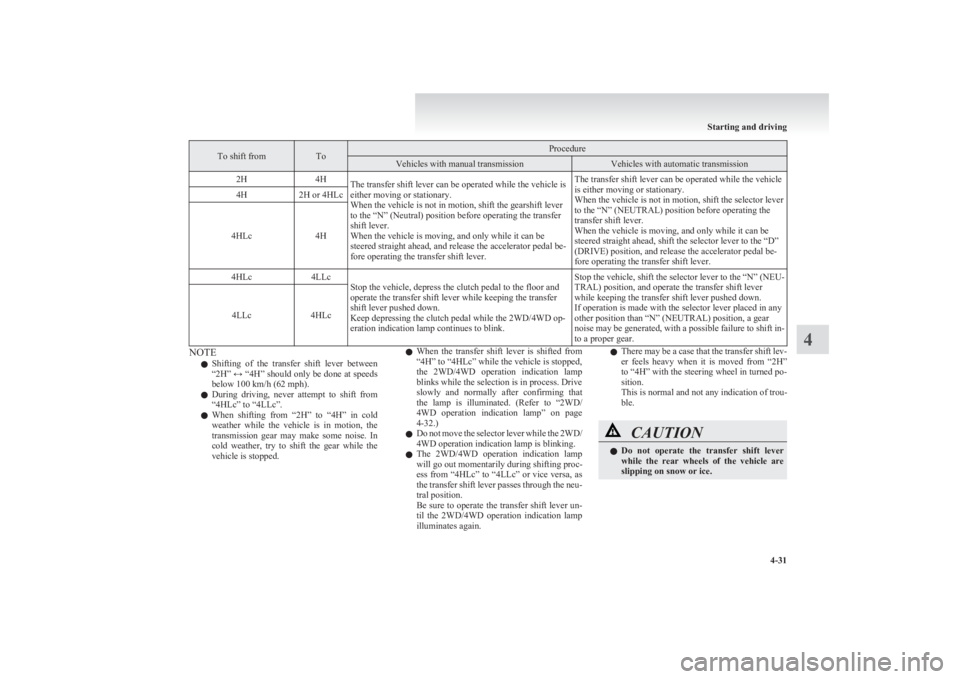
To shift fromToProcedureVehicles with manual transmissionVehicles with automatic transmission2H4HThe transfer shift lever can be operated while the vehicle is
either moving or stationary.
When the vehicle is not in motion, shift the gearshift lever
to the “N” (Neutral) position before operating the transfer
shift lever.
When the vehicle is moving, and only while it can be
steered straight ahead, and release the accelerator pedal be-
fore operating the transfer shift lever.The transfer shift lever can be operated while the vehicle
is either moving or stationary.
When the vehicle is not in motion, shift the selector lever
to the “N” (NEUTRAL) position before operating the
transfer shift lever.
When the vehicle is moving, and only while it can be
steered straight ahead, shift the selector lever to the “D”
(DRIVE) position, and release the accelerator pedal be-
fore operating the transfer shift lever.4H2H or 4HLc
4HLc4H
4HLc4LLcStop the vehicle, depress the clutch pedal to the floor and
operate the transfer shift lever while keeping the transfer
shift lever pushed down.
Keep depressing the clutch pedal while the 2WD/4WD op-
eration indication lamp continues to blink.Stop the vehicle, shift the selector lever to the “N” (NEU-
TRAL) position, and operate the transfer shift lever
while keeping the transfer shift lever pushed down.
If operation is made with the selector lever placed in any
other position than “N” (NEUTRAL) position, a gear
noise may be generated, with a possible failure to shift in-
to a proper gear.
4LLc4HLc
NOTE
l Shifting of the transfer shift lever between
“2H” ↔ “4H” should only be done at speeds
below 100 km/h (62 mph).
l During driving, never attempt to shift from
“4HLc” to “4LLc”.
l When shifting from “2H” to “4H” in cold
weather while the vehicle is in motion, the
transmission gear may make some noise. In
cold weather, try to shift the gear while the
vehicle is stopped.l When the transfer shift lever is shifted from
“4H” to “4HLc” while the vehicle is stopped,
the 2WD/4WD operation indication lamp
blinks while the selection is in process. Drive
slowly and normally after confirming that
the lamp is illuminated. (Refer to “2WD/
4WD operation indication lamp” on page
4-32.)
l Do not move the selector lever while the 2WD/
4WD operation indication lamp is blinking.
l The 2WD/4WD operation indication lamp
will go out momentarily during shifting proc-
ess from “4HLc” to “4LLc” or vice versa, as
the transfer shift lever passes through the neu-
tral position.
Be sure to operate the transfer shift lever un-
til the 2WD/4WD operation indication lamp
illuminates again.l There may be a case that the transfer shift lev-
er feels heavy when it is moved from “2H”
to “4H” with the steering wheel in turned po-
sition.
This is normal and not any indication of trou-
ble.CAUTIONl Do not operate the transfer shift lever
while the rear wheels of the vehicle are
slipping on snow or ice.
Starting and driving
4-31
4
Page 164 of 330
4-wheel drive operationE00606600920
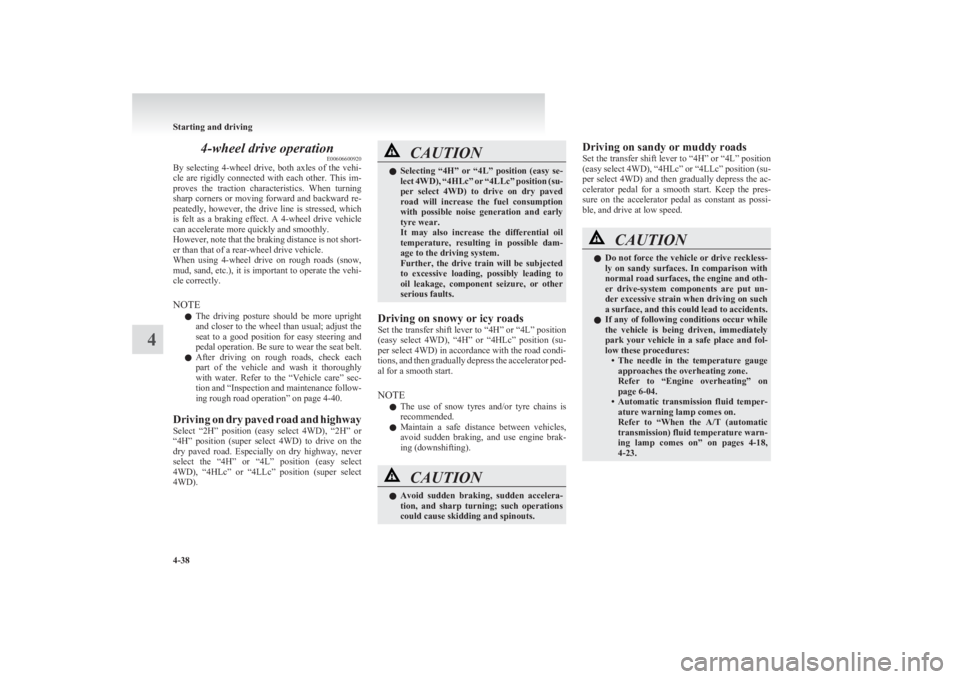
By selecting 4-wheel drive, both axles of the vehi-
cle are rigidly connected with each other. This im-
proves the traction characteristics. When turning
sharp corners or moving forward and backward re-
peatedly, however, the drive line is stressed, which
is felt as a braking effect. A 4-wheel drive vehicle
can accelerate more quickly and smoothly.
However, note that the braking distance is not short-
er than that of a rear-wheel drive vehicle.
When using 4-wheel drive on rough roads (snow,
mud, sand, etc.), it is important to operate the vehi-
cle correctly.
NOTE l The driving posture should be more upright
and closer to the wheel than usual; adjust the
seat to a good position for easy steering and
pedal operation. Be sure to wear the seat belt.
l After driving on rough roads, check each
part of the vehicle and wash it thoroughly
with water. Refer to the “Vehicle care” sec-
tion and “Inspection and maintenance follow-
ing rough road operation” on page 4-40.
Driving on dry paved road and highway
Select “2H” position (easy select 4WD), “2H” or
“4H” position (super select 4WD) to drive on the
dry paved road. Especially on dry highway, never
select the “4H” or “4L” position (easy select
4WD), “4HLc” or “4LLc” position (super select
4WD).CAUTIONl Selecting “4H” or “4L” position (easy se-
lect 4WD), “4HLc” or “4LLc” position (su-
per select 4WD) to drive on dry paved
road will increase the fuel consumption
with possible noise generation and early
tyre wear.
It may also increase the differential oil
temperature, resulting in possible dam-
age to the driving system.
Further, the drive train will be subjected
to excessive loading, possibly leading to
oil leakage, component seizure, or other
serious faults.
Driving on snowy or icy roads
Set the transfer shift lever to “4H” or “4L” position
(easy select 4WD), “4H” or “4HLc” position (su-
per select 4WD) in accordance with the road condi-
tions, and then gradually depress the accelerator ped-
al for a smooth start.
NOTE l The use of snow tyres and/or tyre chains is
recommended.
l Maintain a safe distance between vehicles,
avoid sudden braking, and use engine brak-
ing (downshifting).
CAUTIONl Avoid sudden braking, sudden accelera-
tion, and sharp turning; such operations
could cause skidding and spinouts.Driving on sandy or muddy roads
Set the transfer shift lever to “4H” or “4L” position
(easy select 4WD), “4HLc” or “4LLc” position (su-
per select 4WD) and then gradually depress the ac-
celerator pedal for a smooth start. Keep the pres-
sure on the accelerator pedal as constant as possi-
ble, and drive at low speed.CAUTIONl Do not force the vehicle or drive reckless-
ly on sandy surfaces. In comparison with
normal road surfaces, the engine and oth-
er drive-system components are put un-
der excessive strain when driving on such
a surface, and this could lead to accidents.
l If any of following conditions occur while
the vehicle is being driven, immediately
park your vehicle in a safe place and fol-
low these procedures: •The needle in the temperature gauge
approaches the overheating zone.
Refer to “Engine overheating” on
page 6-04.
• Automatic transmission fluid temper-
ature warning lamp comes on.
Refer to “When the A/T (automatic
transmission) fluid temperature warn-
ing lamp comes on” on pages 4-18,
4-23.
Starting and driving
4-38
4
Page 174 of 330
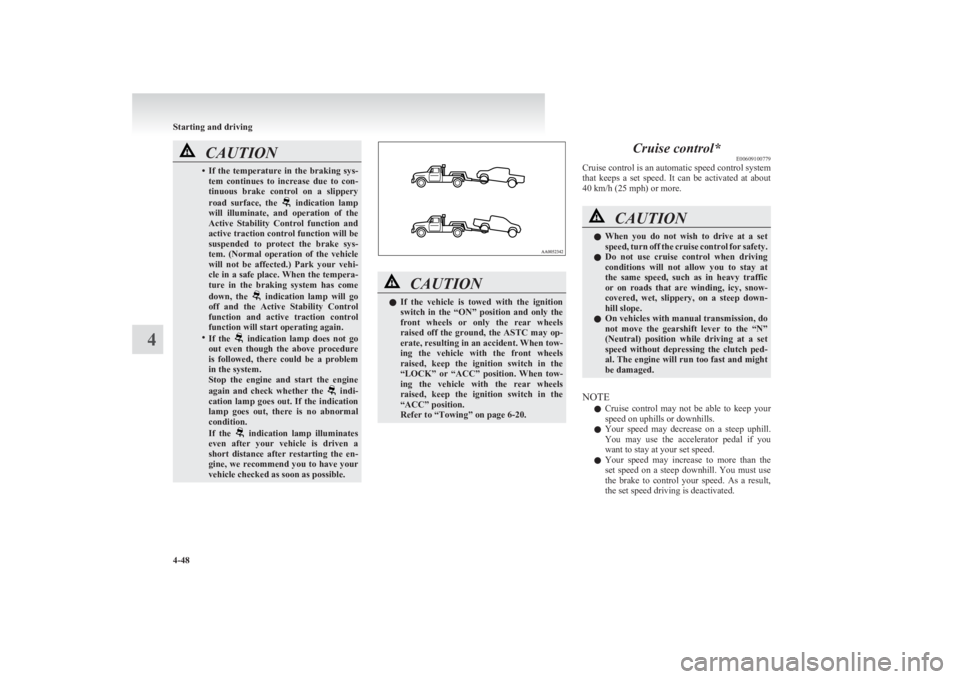
CAUTION•If the temperature in the braking sys-
tem continues to increase due to con-
tinuous brake control on a slippery
road surface, the
indication lamp
will illuminate, and operation of the
Active Stability Control function and
active traction control function will be
suspended to protect the brake sys-
tem. (Normal operation of the vehicle
will not be affected.) Park your vehi-
cle in a safe place. When the tempera-
ture in the braking system has come
down, the
indication lamp will go
off and the Active Stability Control
function and active traction control
function will start operating again.
• If the
indication lamp does not go
out even though the above procedure
is followed, there could be a problem
in the system.
Stop the engine and start the engine
again and check whether the
indi-
cation lamp goes out. If the indication
lamp goes out, there is no abnormal
condition.
If the
indication lamp illuminates
even after your vehicle is driven a
short distance after restarting the en-
gine, we recommend you to have your
vehicle checked as soon as possible.
CAUTIONl If the vehicle is towed with the ignition
switch in the “ON” position and only the
front wheels or only the rear wheels
raised off the ground, the ASTC may op-
erate, resulting in an accident. When tow-
ing the vehicle with the front wheels
raised, keep the ignition switch in the
“LOCK” or “ACC” position. When tow-
ing the vehicle with the rear wheels
raised, keep the ignition switch in the
“ACC” position.
Refer to “Towing” on page 6-20.Cruise control* E00609100779
Cruise control is an automatic speed control system
that keeps a set speed. It can be activated at about
40 km/h (25 mph) or more.CAUTIONl When you do not wish to drive at a set
speed, turn off the cruise control for safety.
l Do not use cruise control when driving
conditions will not allow you to stay at
the same speed, such as in heavy traffic
or on roads that are winding, icy, snow-
covered, wet, slippery, on a steep down-
hill slope.
l On vehicles with manual transmission, do
not move the gearshift lever to the “N”
(Neutral) position while driving at a set
speed without depressing the clutch ped-
al. The engine will run too fast and might
be damaged.
NOTE
l Cruise control may not be able to keep your
speed on uphills or downhills.
l Your speed may decrease on a steep uphill.
You may use the accelerator pedal if you
want to stay at your set speed.
l Your speed may increase to more than the
set speed on a steep downhill. You must use
the brake to control your speed. As a result,
the set speed driving is deactivated.
Starting and driving
4-48
4
Page 181 of 330
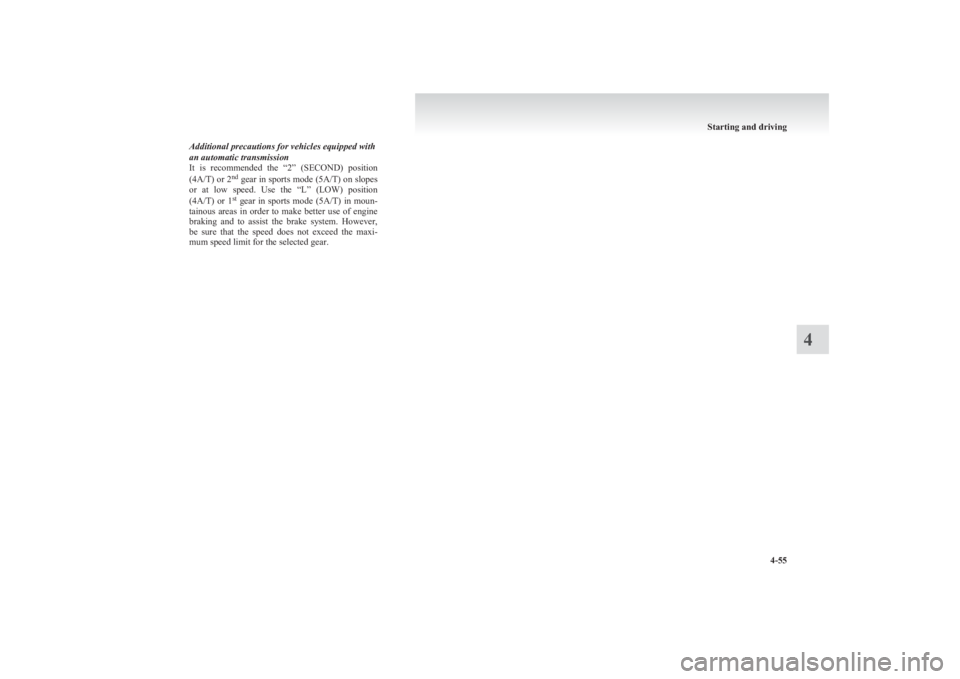
Additional precautions for vehicles equipped with
an automatic transmission
It is recommended the “2” (SECOND) position
(4A/T ) or 2nd
gear in sports mode ( 5A/T) on slopes
or at low speed. Use the “L” (LOW) position
(4A/T ) or 1st
gear in sports mode ( 5A/T) in moun-
tainous areas in order to make better use of engine
braking and to assist the brake system. However,
be sure that the speed does not exceed the maxi-
mum speed limit for the selected gear.
Starting and driving
4-55
4
Page 232 of 330
If the vehicle breaks downE00800101166
If the vehicle breaks down on the road, move it to
the shoulder and use the hazard warning flashers and/
or the warning triangle etc.
Refer to “Hazard warning flasher switch” on page
3-34.
If the engine stops/fails
Vehicle operation and control are affected if the en-
gine stops.
Before moving the vehicle to a safe area, be aware
of the following:
l The brake booster becomes inoperative and
the pedal effort will increase. Press down the
brake pedal harder than usual.
l Since the power steering pump is no longer
operative, the steering wheel feels heavy
when turning it.Emergency starting E00800502112
If the engine cannot be started because the battery
is weak or dead, the battery from another vehicle
can be used with jumper cables to start the engine.WARNINGl To start the engine using jumper cables
connected from another vehicle, perform
the correct procedures according to the in-
struction manual. Incorrect procedures
could result in a fire or explosion or dam-
age to the vehicles.
1. Get the vehicles close enough so the jumper
cables can reach, but be sure the vehicles
aren’t touching each other.
If they are, it could cause a ground connec-
tion you don’t want. The vehicle will not
start, and the bad grounding could damage
the electrical systems.
CAUTIONl Check the other vehicle. It must have a 12-
volt battery.
If the other system isn’t 12-volt, shorting
can damage both vehicles.
2. You could be injured if the vehicles move.
Set the parking brake firmly on each vehicle.
Put an automatic transmission in “P”
(PARK) or a manual transmission in “N”
(Neutral). Turn off the ignition switch.
WARNINGl Turn off the ignition on both vehicles be-
forehand.
Make sure that the cables or your clothes
cannot be caught by the fan or drive belt.
Personal injury could result.
NOTE
l Turn off all lamps, heater and other electrical
loads. This will avoid sparks and help save
both batteries.
3. Make sure battery electrolyte is at the proper
level.
Refer to “Battery” on page 8-09.
WARNINGl If electrolyte fluid is not visible, or ap-
pears to be frozen, Do Not Attempt Jump
Starting!
A battery might rupture or explode if the
temperature is below the freezing point
or if it is not filled to the proper level.
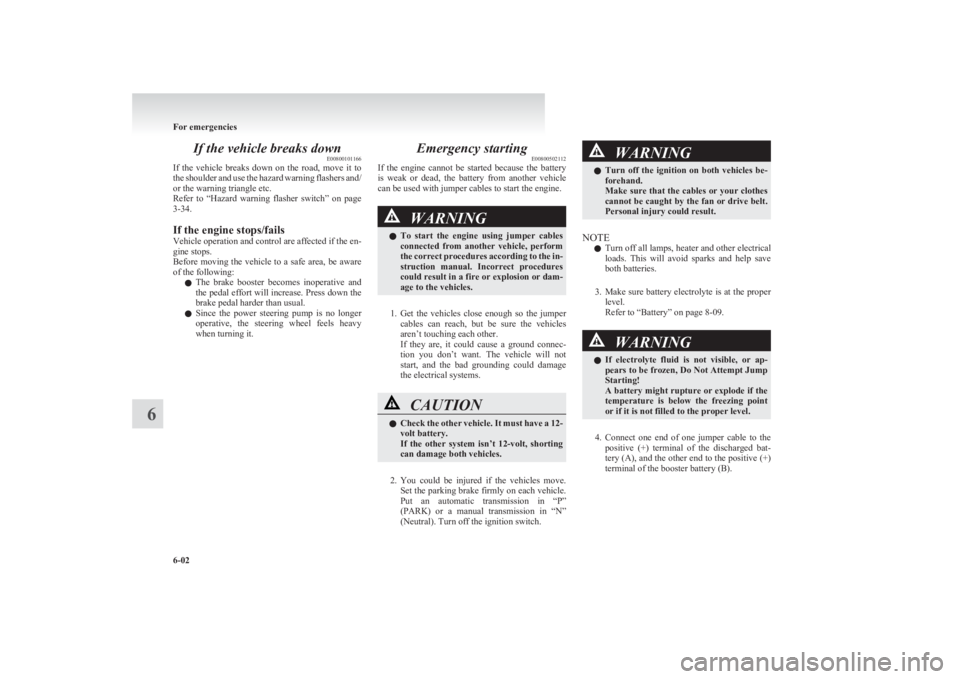
4. Connect one end of one jumper cable to the
positive (+) terminal of the discharged bat-
tery (A), and the other end to the positive (+)
terminal of the booster battery (B).
For emergencies
6-02
6
Page 243 of 330
Jacking up the vehicleE00801001436
1. Park the vehicle on level and stable ground.
2. Set the parking brake firmly.
3. On vehicles with manual transmission, turn
the ignition key to the “LOCK” position,
move the gearshift lever to the “R” (Reverse)
position.
On vehicles with automatic transmission,
move the selector lever to the “P” (PARK) po-
sition, turn the ignition key to the “LOCK”
position.
4. Turn on the hazard warning flashers and set
up a warning triangle, flashing signal lamp,
etc., at an adequate distance from the vehi-
cle, and have all your passengers leave the ve-
hicle.
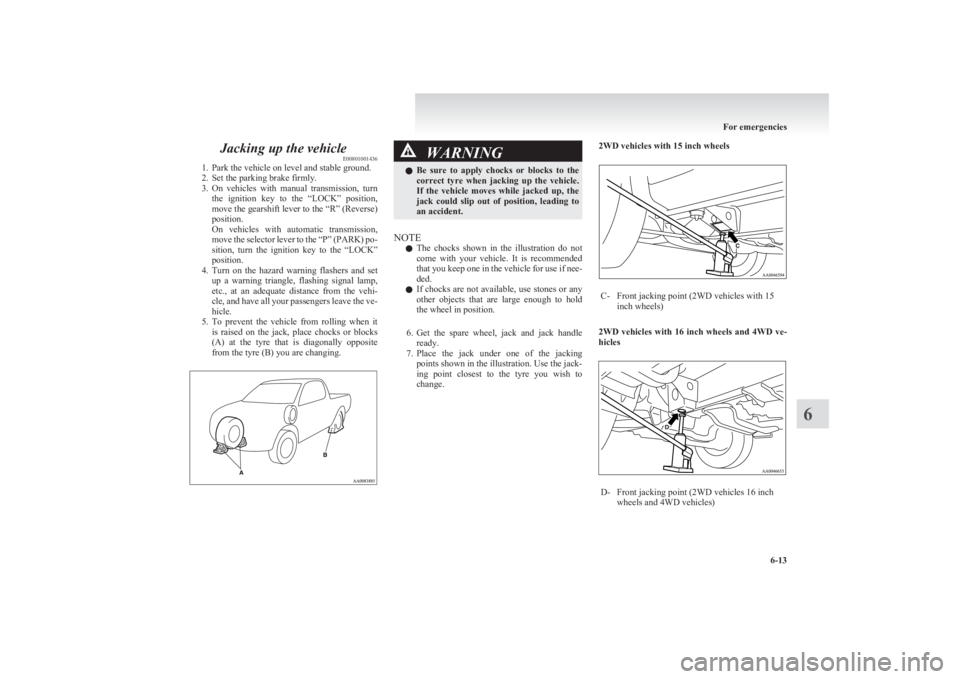
5. To prevent the vehicle from rolling when it
is raised on the jack, place chocks or blocks
(A) at the tyre that is diagonally opposite
from the tyre (B) you are changing.WARNINGl Be sure to apply chocks or blocks to the
correct tyre when jacking up the vehicle.
If the vehicle moves while jacked up, the
jack could slip out of position, leading to
an accident.
NOTE
l The chocks shown in the illustration do not
come with your vehicle. It is recommended
that you keep one in the vehicle for use if nee-
ded.
l If chocks are not available, use stones or any
other objects that are large enough to hold
the wheel in position.
6. Get the spare wheel, jack and jack handle
ready.
7. Place the jack under one of the jacking
points shown in the illustration. Use the jack-
ing point closest to the tyre you wish to
change.
2WD vehicles with 15 inch wheelsC-Front jacking point (2WD vehicles with 15
inch wheels)
2WD vehicles with 16 inch wheels and 4WD ve-
hicles
D-Front jacking point (2WD vehicles 16 inch
wheels and 4WD vehicles)
For emergencies
6-13
6
Page 247 of 330
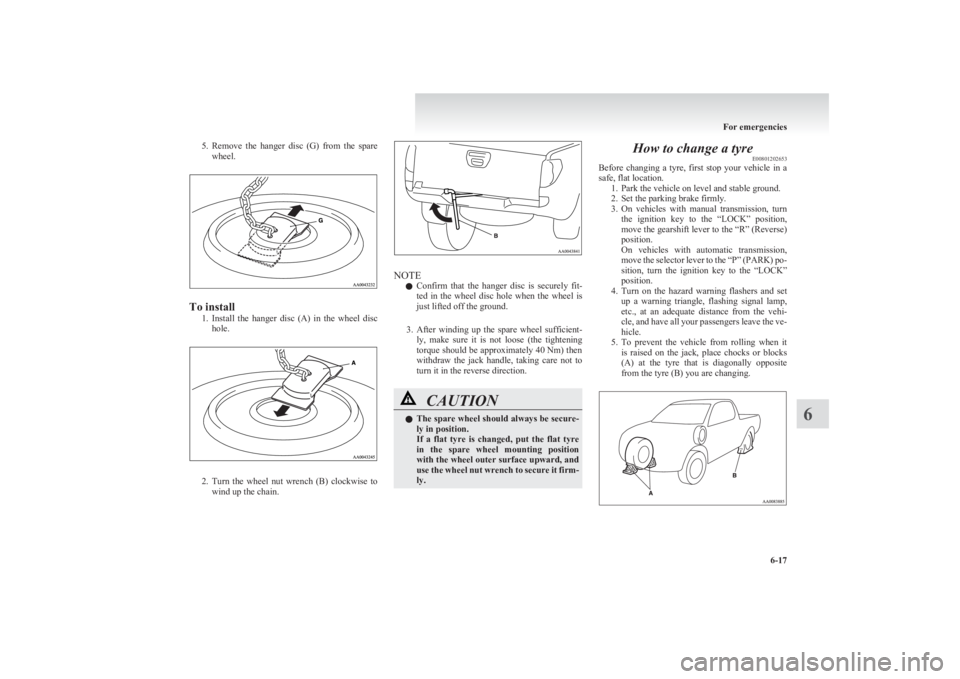
5.Remove the hanger disc (G) from the spare
wheel.
To install
1.Install the hanger disc (A) in the wheel disc
hole.
2. Turn the wheel nut wrench (B) clockwise to
wind up the chain.
NOTE
l Confirm that the hanger disc is securely fit-
ted in the wheel disc hole when the wheel is
just lifted off the ground.
3. After winding up the spare wheel sufficient-
ly, make sure it is not loose (the tightening
torque should be approximately 40 Nm) then
withdraw the jack handle, taking care not to
turn it in the reverse direction.
CAUTIONl The spare wheel should always be secure-
ly in position.
If a flat tyre is changed, put the flat tyre
in the spare wheel mounting position
with the wheel outer surface upward, and
use the wheel nut wrench to secure it firm-
ly.How to change a tyre E00801202653
Before changing a tyre, first stop your vehicle in a
safe, flat location. 1. Park the vehicle on level and stable ground.
2. Set the parking brake firmly.
3. On vehicles with manual transmission, turn
the ignition key to the “LOCK” position,
move the gearshift lever to the “R” (Reverse)
position.
On vehicles with automatic transmission,
move the selector lever to the “P” (PARK) po-
sition, turn the ignition key to the “LOCK”
position.
4. Turn on the hazard warning flashers and set
up a warning triangle, flashing signal lamp,
etc., at an adequate distance from the vehi-
cle, and have all your passengers leave the ve-
hicle.
5. To prevent the vehicle from rolling when it
is raised on the jack, place chocks or blocks
(A) at the tyre that is diagonally opposite
from the tyre (B) you are changing.
For emergencies
6-17
6
Page 251 of 330
The regulations concerning towing may differ from
country to country. It is recommended that you
obey the regulations of the area where you are driv-
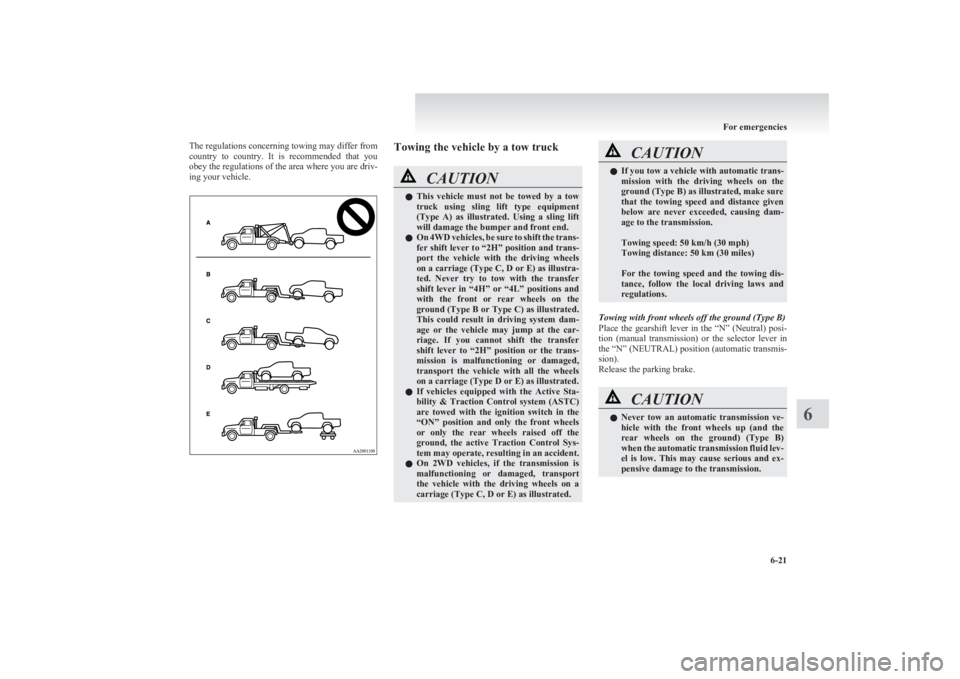
ing your vehicle.Towing the vehicle by a tow truckCAUTIONl This vehicle must not be towed by a tow
truck using sling lift type equipment
(Type A) as illustrated. Using a sling lift
will damage the bumper and front end.
l On 4WD vehicles, be sure to shift the trans-
fer shift lever to “2H” position and trans-
port the vehicle with the driving wheels
on a carriage (Type C, D or E) as illustra-
ted. Never try to tow with the transfer
shift lever in “4H” or “4L” positions and
with the front or rear wheels on the
ground (Type B or Type C) as illustrated.
This could result in driving system dam-
age or the vehicle may jump at the car-
riage. If you cannot shift the transfer
shift lever to “2H” position or the trans-
mission is malfunctioning or damaged,
transport the vehicle with all the wheels
on a carriage (Type D or E) as illustrated.
l If vehicles equipped with the Active Sta-
bility & Traction Control system (ASTC)
are towed with the ignition switch in the
“ON” position and only the front wheels
or only the rear wheels raised off the
ground, the active Traction Control Sys-
tem may operate, resulting in an accident.
l On 2WD vehicles, if the transmission is
malfunctioning or damaged, transport
the vehicle with the driving wheels on a
carriage (Type C, D or E) as illustrated.CAUTIONl If you tow a vehicle with automatic trans-
mission with the driving wheels on the
ground (Type B) as illustrated, make sure
that the towing speed and distance given
below are never exceeded, causing dam-
age to the transmission.
Towing speed: 50 km/h (30 mph)
Towing distance: 50 km (30 miles)
For the towing speed and the towing dis-
tance, follow the local driving laws and
regulations.
Towing with front wheels off the ground (Type B)
Place the gearshift lever in the “N” (Neutral) posi-
tion (manual transmission) or the selector lever in
the “N” (NEUTRAL) position (automatic transmis-
sion).
Release the parking brake.
CAUTIONl Never tow an automatic transmission ve-
hicle with the front wheels up (and the
rear wheels on the ground) (Type B)
when the automatic transmission fluid lev-
el is low. This may cause serious and ex-
pensive damage to the transmission.
For emergencies
6-21
6
Page 252 of 330
Towing with rear wheels off the ground (Type C)
Place the gearshift lever in the “N” (Neutral) posi-
tion (manual transmission) or the selector lever in
the “N” (NEUTRAL) position (automatic transmis-
sion). Turn the ignition key to the “ACC” position
and secure the steering wheel in a straight-ahead po-
sition with a rope or tie-down strap. Never place
the ignition switch in the “LOCK” position when
towing.
Emergency towing
If towing service is not available in an emergency,
your vehicle may be temporarily towed by a cable
or chain secured to the towing hook.
If your vehicle is to be towed by another vehicle,
pay careful attention to the following points.
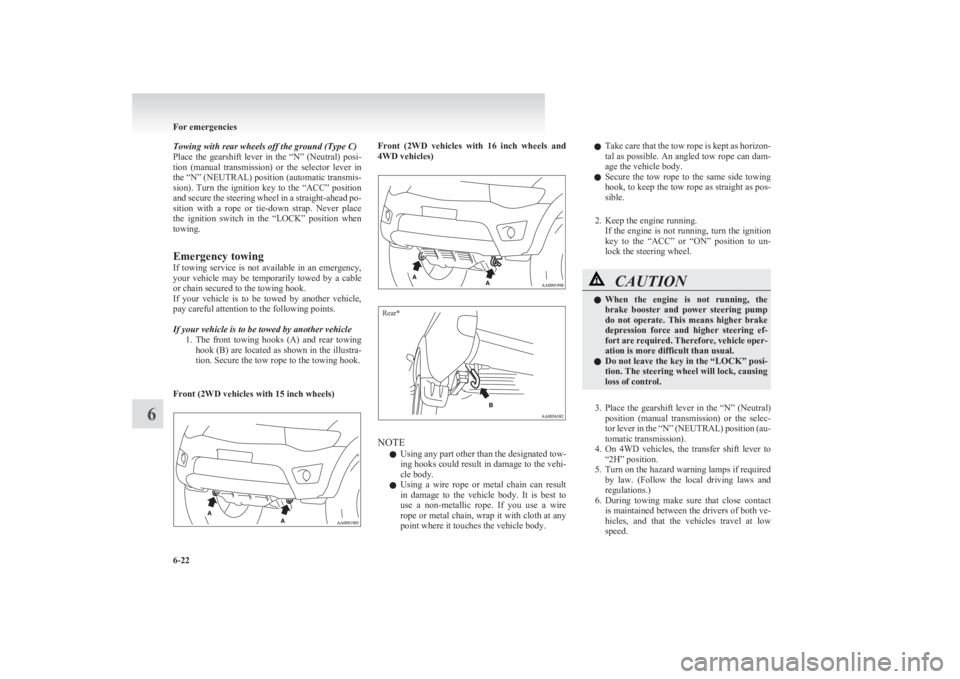
If your vehicle is to be towed by another vehicle 1.The front towing hooks (A) and rear towing
hook (B) are located as shown in the illustra-
tion. Secure the tow rope to the towing hook.
Front (2WD vehicles with 15 inch wheels)Front (2WD vehicles with 16 inch wheels and
4WD vehicles)Rear*
NOTE
l Using any part other than the designated tow-
ing hooks could result in damage to the vehi-
cle body.
l Using a wire rope or metal chain can result
in damage to the vehicle body. It is best to
use a non-metallic rope. If you use a wire
rope or metal chain, wrap it with cloth at any
point where it touches the vehicle body.
l Take care that the tow rope is kept as horizon-
tal as possible. An angled tow rope can dam-
age the vehicle body.
l Secure the tow rope to the same side towing
hook, to keep the tow rope as straight as pos-
sible.
2. Keep the engine running. If the engine is not running, turn the ignition
key to the “ACC” or “ON” position to un-
lock the steering wheel.CAUTIONl When the engine is not running, the
brake booster and power steering pump
do not operate. This means higher brake
depression force and higher steering ef-
fort are required. Therefore, vehicle oper-
ation is more difficult than usual.
l Do not leave the key in the “LOCK” posi-
tion. The steering wheel will lock, causing
loss of control.
3. Place the gearshift lever in the “N” (Neutral)
position (manual transmission) or the selec-
tor lever in the “N” (NEUTRAL) position (au-
tomatic transmission).
4. On 4WD vehicles, the transfer shift lever to
“2H” position.
5. Turn on the hazard warning lamps if required by law. (Follow the local driving laws and
regulations.)
6. During towing make sure that close contact
is maintained between the drivers of both ve-
hicles, and that the vehicles travel at low
speed.
For emergencies
6-22
6
Page 253 of 330
WARNINGlTo prevent entry of exhaust gas from the
towing vehicle, set your air selection lever
to the recirculation position.CAUTIONl Avoid sudden braking, sudden accelera-
tion and sharp turning; such operation
could cause damage to the towing hooks
or the tow rope.
People in the vicinity could be injured as
a result.
l When towing or being towed down a long
slope, the brakes may overheat reducing
the effectiveness. In this situation, have
your vehicle transported by a tow truck.
l When the vehicle with automatic trans-
mission is to be towed by another vehicle
with the all wheels on the ground, make
sure that the towing speed and distance
given below are never exceeded, causing
damage to the transmission.
Towing speed: 50 km/h (30 mph)
Towing distance: 50 km (30 miles)
For the towing speed and the towing dis-
tance, follow the local driving laws and
regulations.
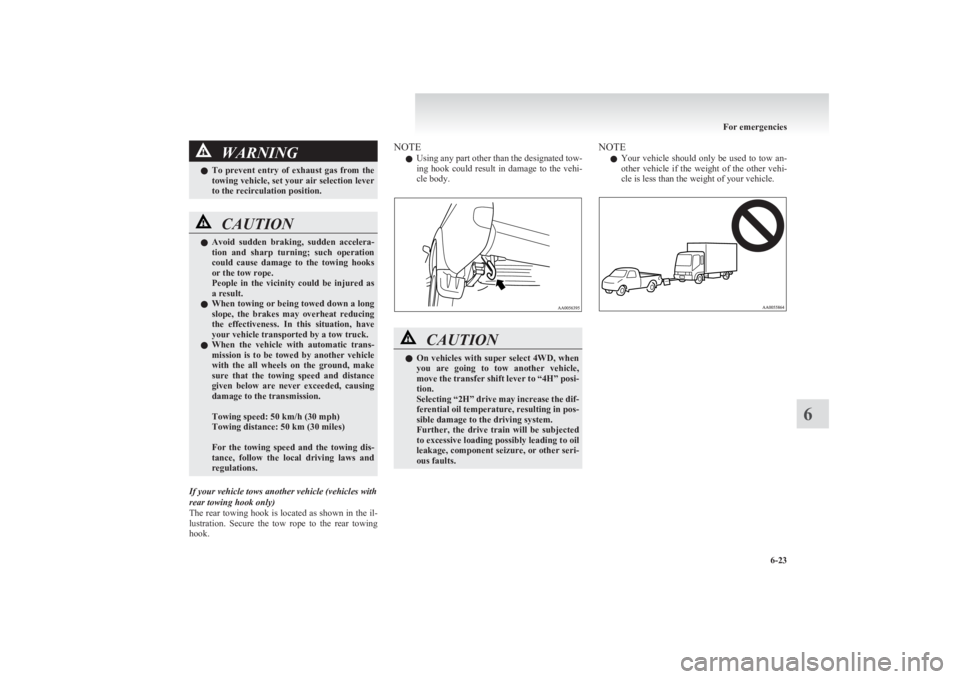
If your vehicle tows another vehicle (vehicles with
rear towing hook only)
The rear towing hook is located as shown in the il-
lustration. Secure the tow rope to the rear towing
hook.
NOTE
l Using any part other than the designated tow-
ing hook could result in damage to the vehi-
cle body.CAUTIONl On vehicles with super select 4WD, when
you are going to tow another vehicle,
move the transfer shift lever to “4H” posi-
tion.
Selecting “2H” drive may increase the dif-
ferential oil temperature, resulting in pos-
sible damage to the driving system.
Further, the drive train will be subjected
to excessive loading possibly leading to oil
leakage, component seizure, or other seri-
ous faults.NOTE
l Your vehicle should only be used to tow an-
other vehicle if the weight of the other vehi-
cle is less than the weight of your vehicle.
For emergencies
6-23
6