tyre pressure MITSUBISHI L200 2014 (in English) User Guide
[x] Cancel search | Manufacturer: MITSUBISHI, Model Year: 2014, Model line: L200, Model: MITSUBISHI L200 2014Pages: 362, PDF Size: 20.97 MB
Page 302 of 362
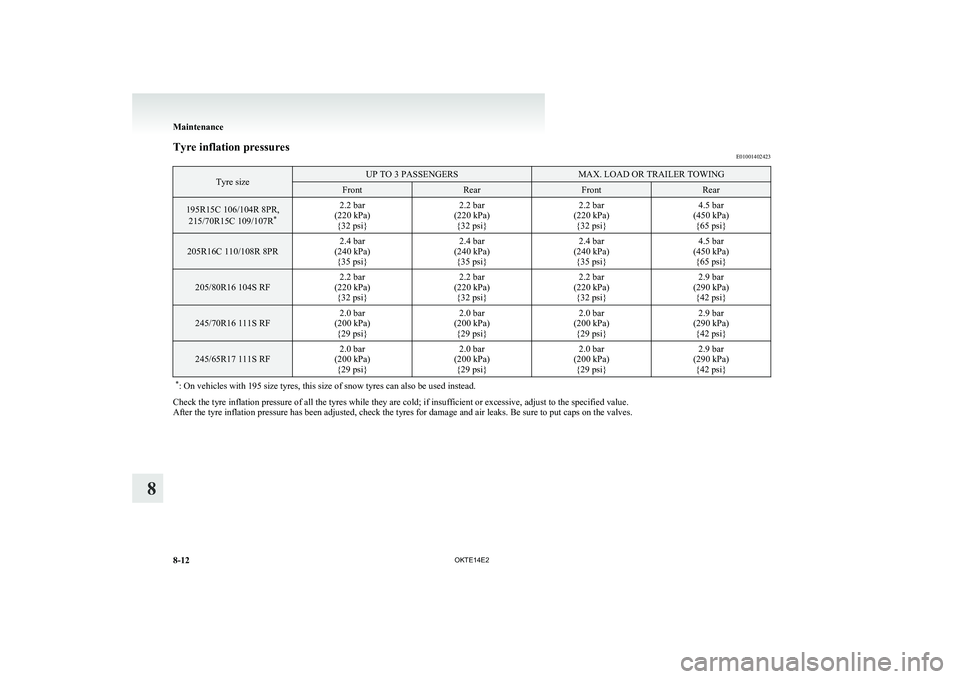
Tyre inflation pressuresE01001402423Tyre sizeUP TO 3 PASSENGERSMAX. LOAD OR TRAILER TOWINGFrontRearFrontRear195R15C 106/104R 8PR,
215/70R15C 109/107R *2.2 bar
(220 kPa) {32 psi}2.2 bar
(220 kPa) {32 psi}2.2 bar
(220 kPa) {32 psi}4.5 bar
(450 kPa) {65 psi}205R16C 110/108R 8PR2.4 bar
(240 kPa) {35 psi}2.4 bar
(240 kPa) {35 psi}2.4 bar
(240 kPa) {35 psi}4.5 bar
(450 kPa) {65 psi}205/80R16 104S RF2.2 bar
(220 kPa) {32 psi}2.2 bar
(220 kPa) {32 psi}2.2 bar
(220 kPa) {32 psi}2.9 bar
(290 kPa) {42 psi}245/70R16 111S RF2.0 bar
(200 kPa) {29 psi}2.0 bar
(200 kPa) {29 psi}2.0 bar
(200 kPa) {29 psi}2.9 bar
(290 kPa) {42 psi}245/65R17 111S RF2.0 bar
(200 kPa) {29 psi}2.0 bar
(200 kPa) {29 psi}2.0 bar
(200 kPa) {29 psi}2.9 bar
(290 kPa) {42 psi}* : On vehicles with 195 size tyres, this size of snow tyres can also be used instead.
Check the tyre inflation pressure of all the tyres while they are cold; if insufficient or excessive, adjust to the specified value.
After the tyre inflation pressure has been adjusted, check the tyres for damage and air leaks. Be sure to put caps on the valves.
Maintenance
8-12 OKTE14E2
8
Page 304 of 362
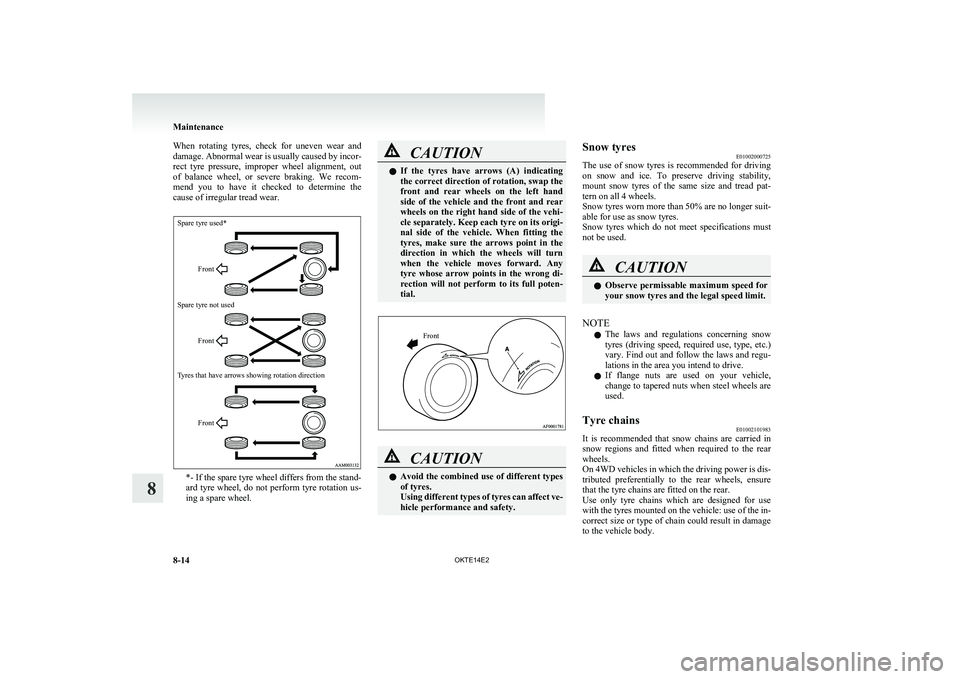
When rotating tyres, check for uneven wear and
damage. Abnormal wear is usually caused by incor-
rect tyre pressure, improper wheel alignment, out
of balance wheel, or severe braking. We recom-
mend you to have it checked to determine the
cause of irregular tread wear.Spare tyre used*Spare tyre not usedFrontFrontFrontTyres that have arrows showing rotation direction
*- If the spare tyre wheel differs from the stand-
ard tyre wheel, do not perform tyre rotation us-
ing a spare wheel.
CAUTIONl If the tyres have arrows (A) indicating
the correct direction of rotation, swap the
front and rear wheels on the left hand
side of the vehicle and the front and rear
wheels on the right hand side of the vehi-
cle separately. Keep each tyre on its origi-
nal side of the vehicle. When fitting the
tyres, make sure the arrows point in the
direction in which the wheels will turn
when the vehicle moves forward. Any
tyre whose arrow points in the wrong di-
rection will not perform to its full poten-
tial.Front
CAUTIONl Avoid the combined use of different types
of tyres.
Using different types of tyres can affect ve-
hicle performance and safety.Snow tyres E01002000725
The use of snow tyres is recommended for driving
on snow and ice. To preserve driving stability,
mount snow tyres of the same size and tread pat-
tern on all 4 wheels.
Snow tyres worn more than 50% are no longer suit-
able for use as snow tyres.
Snow tyres which do not meet specifications must
not be used.CAUTIONl Observe permissable maximum speed for
your snow tyres and the legal speed limit.
NOTE
l The laws and regulations concerning snow
tyres (driving speed, required use, type, etc.)
vary. Find out and follow the laws and regu-
lations in the area you intend to drive.
l If flange nuts are used on your vehicle,
change to tapered nuts when steel wheels are
used.
Tyre chains E01002101983
It is recommended that snow chains are carried in
snow regions and fitted when required to the rear
wheels.
On 4WD vehicles in which the driving power is dis-
tributed preferentially to the rear wheels, ensure
that the tyre chains are fitted on the rear.
Use only tyre chains which are designed for use
with the tyres mounted on the vehicle: use of the in-
correct size or type of chain could result in damage
to the vehicle body.
Maintenance
8-14 OKTE14E2
8
Page 352 of 362
Heated seats 2-06
Rear seat 2-07
Secret box 5-78
Service precaution
8-02
Side airbag system 2-34
Side turn-signal lamps
Bulb capacity 8-24
Replacement 8-28 Snow tyres 8-14
Spare wheel 6-16
Spark plug 9-16
Specifications 9-02
Speedometer 3-03
Starting 4-12
Steering
Power steering fluid 8-09,9-21
Power steering system 4-42
Steering wheel height adjustment 4-08
Steering wheel lock 4-12
Steering wheel remote control switch 5-41 Stop lamps
Bulb capacity 8-23
Replacement 8-30 Storage spaces 5-76
Sun visors 5-70
Sunglasses holder 5-78
Sunroof 1-13
Safety mechanism 1-14
Sunshade 1-14
Switch 1-13 Super select 4WD 4-26
Supplemental restraint system 2-26
How the Supplemental Restraint System
works 2-28
Servicing 2-38
Warning lamp 2-37 TTachometer 3-03
Tail lamps
Bulb capacity
8-24
Replacement 8-30 Tank capacity 02
Ticket holder 5-70
Tools 6-09
Storage 6-07 Towing 6-20
Trailer towing 4-49
Transfer oil 9-21
Transmission
Automatic transmission Sports Mode 4A/T, 5A/
T 4-17
Fluid 8-07,9-21
Manual transmission 4-14
Specifications 9-15 Tripmeter 3-03
Turn-signal indication lamps 3-07
Turn-signals lever 3-33
Tyres 8-11
How to change a tyre 6-17
Inflation pressures 8-12
Rotation 8-13
Size (tyre and wheel) 9-17
Snow tyres 8-14
Tyre chains 8-14
Wheel condition 8-13
U USB input terminal 5-68
How to connect an iPod 5-68 USB input terminal
How to connect a USB memory device
5-68Used engine oils safety instructions and disposal
information 05
Utility box 5-78
V Vanity mirror 5-71
Vehicle care precautions
7-02
Vehicle dimensions 9-03
Vehicle identification number 9-02
Vehicle identification number plate 9-02
Vehicle information code plate 9-02
Vehicle labeling 9-02
Vehicle performance 9-09
Vehicle weight 9-10
Ventilators 5-02
W Warning lamps 3-08
Washer
Fluid 8-08,9-21
Switch 3-36,3-39 Washing 7-03
Water temperature gauge
3-05
Waxing 7-04
Weatherstripping 8-19
Weight 9-10
Wheel condition 8-13
Wheel
Specification 9-17 Wiper
Switch 3-36
Wiper blade rubber replacement 8-17
Wiper blades 8-17 Alphabetical index
4 OKTE14E2