child lock MITSUBISHI LANCER 2014 8.G User Guide
[x] Cancel search | Manufacturer: MITSUBISHI, Model Year: 2014, Model line: LANCER, Model: MITSUBISHI LANCER 2014 8.GPages: 434, PDF Size: 57.5 MB
Page 68 of 434

5
Features and controlsBreak-in recommendation
s ...............................................................5-3
Keys .....................................................
.............................................5-3
Electronic immobilizer (Anti-theft starting system) .........................5-4 Keyless entry system (if so equipped) ..............................................5-7Free-hand Advanced Security Transmitter (F.A.S.T.-key) (if so equipped)................................
.....................................................5-12
Door locks........................
...............................................................5-36
Power door locks .............
...............................................................5-38
“Child safety locks” for
rear door...................................................5-40
Trunk lid ....................................
.....................................................5-40
Inside emergency trunk lid
release .................................................5-42
Theft-alarm system ..........
...............................................................5-42
Power windows................
...............................................................5-45
Sunroof (if so equipped
) .........................................
........................5-47
Parking brake ...................
...............................................................5-49
Steering wheel tilt lock lever ..........................................................5-51Inside day/night rearview
mirror ....................................................5-51
Outside rearview mirr
ors ................................................................5-53
Ignition switch .................
...............................................................5-54
Steering wheel lock..........
...............................................................5-56
Starting and stopping the e
ngine ....................................................5-56
Turbocharger operation (if so equipped) ........................................5-60Manual transaxle (if so equipped) ..................................................5-60Continuously variable transmissi
on (CVT) (if so equipped)..........5-62
Twin Clutch SST (Sportronic Shif
t Transmission) (if so equipped)
...................................................................
..................................5-71
ACD (Active center differential system) (if so equipped)..............5-83 Electronically controlled 4WD system (if so equipped).................5-85
All-wheel driving opera
tion ........................................................... 5-87
Cautions on handling of all-wheel drive vehicles ......................... 5-89 Limited-slip differential (i
f so equipped) ....................................... 5-90
Service brake ..................
.................................................
............... 5-90
Brake assist system
................................................
......................... 5-91
Hill start assist (vehicles with
Twin Clutch SST) ........................... 5-91
Anti-lock braking syst
em ......................................
......................... 5-92
Active Stability Control (ASC
) (if so equipped) ............................ 5-95
Power steering system
...........................................
......................... 5-98
Cruise control (if so eq
uipped) ....................................................... 5-99
Tire pressure monitoring
system .................................................. 5-104
Rear-view camera (if so
equipped)..............
................................. 5-108
Instrument cluster ..........
.............................................................. 5-110
Multi-information display ............................................................ 5-112 Indicator light, warning light, and information screen display list
.................................................................
................................. 5-133
Indicators ..................................
.................................................... 5-145
Warning lights.................
.................................................
............. 5-146
Information screen disp
lay ....................................
....................... 5-147
Combination headlights and dimmer switch ................................ 5-149 Headlight leveling switch (if
so equipped)................................... 5-154
Turn signal lever ...
.................................................
....................... 5-154
Hazard warning flasher
switch ..................................................... 5-155
Front fog light switch (if so
equipped) ......................................... 5-156
Wiper and washer swit
ch ......................................
....................... 5-156
Electric rear window def
ogger switch .......................................... 5-160
Horn switch ..............................
.................................................... 5-161
Link System (if so equi
pped) ....................................................... 5-161
Page 103 of 434
Door locks 5-36 Features and controls
5
N00509200491
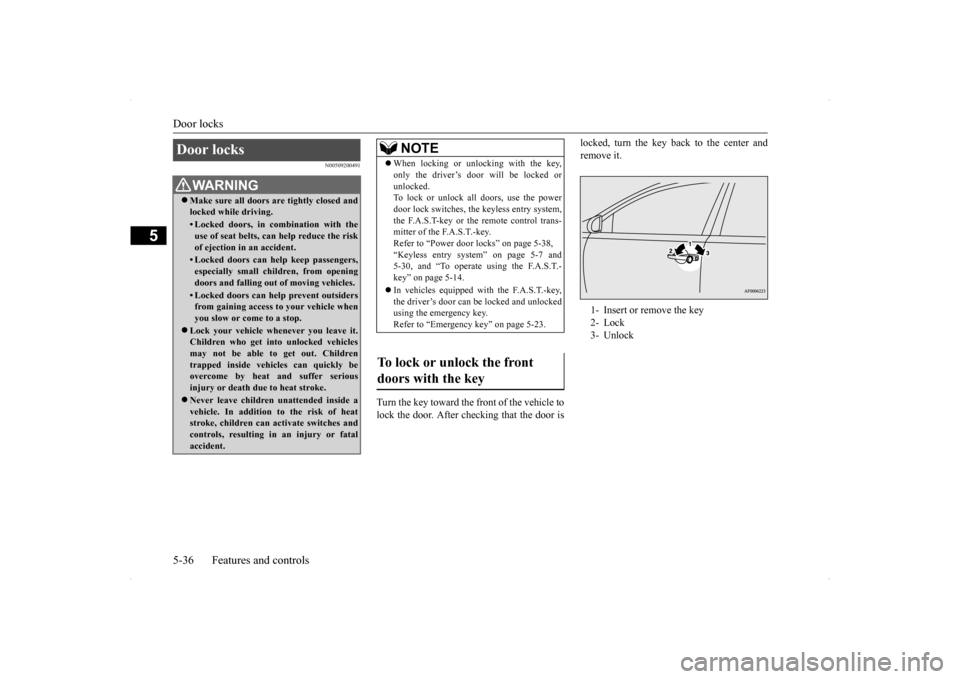
Turn the key toward the front of the vehicle to lock the door. After checking that the door is
locked, turn the key back to the center and remove it.
Door locks
WA R N I N G Make sure all doors are tightly closed and locked while driving.• Locked doors, in combination with theuse of seat belts, can help reduce the risk of ejection in an accident.• Locked doors can help keep passengers,especially small chil
dren, from opening
doors and falling out of moving vehicles.• Locked doors can help prevent outsidersfrom gaining access to your vehicle whenyou slow or come to a stop.
Lock your vehicle whenever you leave it. Children who get into unlocked vehicles may not be able to get out. Children trapped inside vehicles can quickly beovercome by heat and suffer serious injury or death due to heat stroke. Never leave children unattended inside a vehicle. In addition to the risk of heat stroke, children can activate switches andcontrols, resulting in an injury or fatal accident.
NOTE
When locking or unlocking with the key, only the driver’s door will be locked or unlocked. To lock or unlock all doors, use the power door lock switches, the keyless entry system,the F.A.S.T-key or the remote control trans- mitter of the F.A.S.T.-key. Refer to “Power door locks” on page 5-38, “Keyless entry system” on page 5-7 and 5-30, and “To operate using the F.A.S.T.- key” on page 5-14. In vehicles equipped with the F.A.S.T.-key, the driver’s door can be locked and unlockedusing the emergency key. Refer to “Emergency key” on page 5-23.
To lock or unlock the front doors with the key
1- Insert or remove the key 2- Lock 3- Unlock
Page 107 of 434
“Child safety locks” for rear door 5-40 Features and controls
5
N00509400190
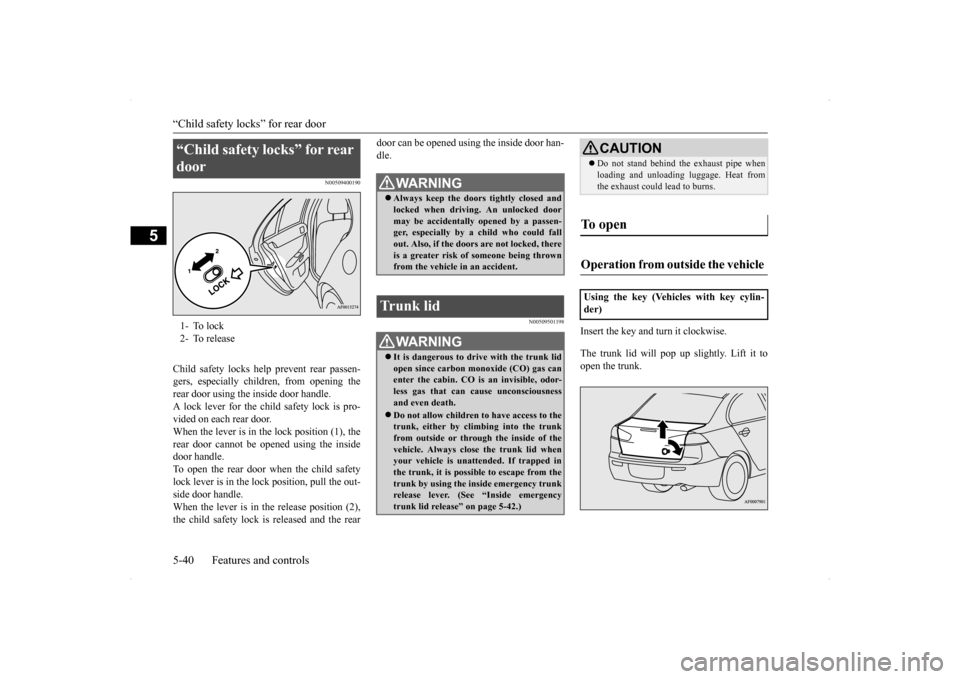
Child safety locks help prevent rear passen- gers, especially children, from opening the rear door using the inside door handle. A lock lever for the child safety lock is pro- vided on each rear door. When the lever is in the lock position (1), therear door cannot be opened using the inside door handle. To open the rear door when the child safetylock lever is in the lock position, pull the out- side door handle. When the lever is in the release position (2),the child safety lock is released and the rear
door can be opened using the inside door han- dle.
N00509501198
Insert the key and turn it clockwise. The trunk lid will pop up
slightly. Lift it to
open the trunk.
“Child safety locks” for rear door 1- To lock 2- To release
WA R N I N G Always keep the doors tightly closed and locked when driving. An unlocked door may be accidentally opened by a passen-ger, especially by a child who could fall out. Also, if the doors are not locked, there is a greater risk of someone being thrownfrom the vehicle in an accident.
Trunk lid
WA R N I N G It is dangerous to drive with the trunk lid open since carbon monoxide (CO) gas canenter the cabin. CO is an invisible, odor- less gas that can cause unconsciousness and even death. Do not allow children to have access to the trunk, either by climbing into the trunkfrom outside or through the inside of the vehicle. Always close the trunk lid when your vehicle is unattended. If trapped in the trunk, it is possible to escape from the trunk by using the inside emergency trunkrelease lever. (See “Inside emergency trunk lid release” on page 5-42.)
CAUTION Do not stand behind the exhaust pipe when loading and unloading luggage. Heat from the exhaust could lead to burns.
To open Operation from outside the vehicle Using the key (Vehicles with key cylin- der)
Page 109 of 434
Inside emergency trunk lid release 5-42 Features and controls
5
N00509800165
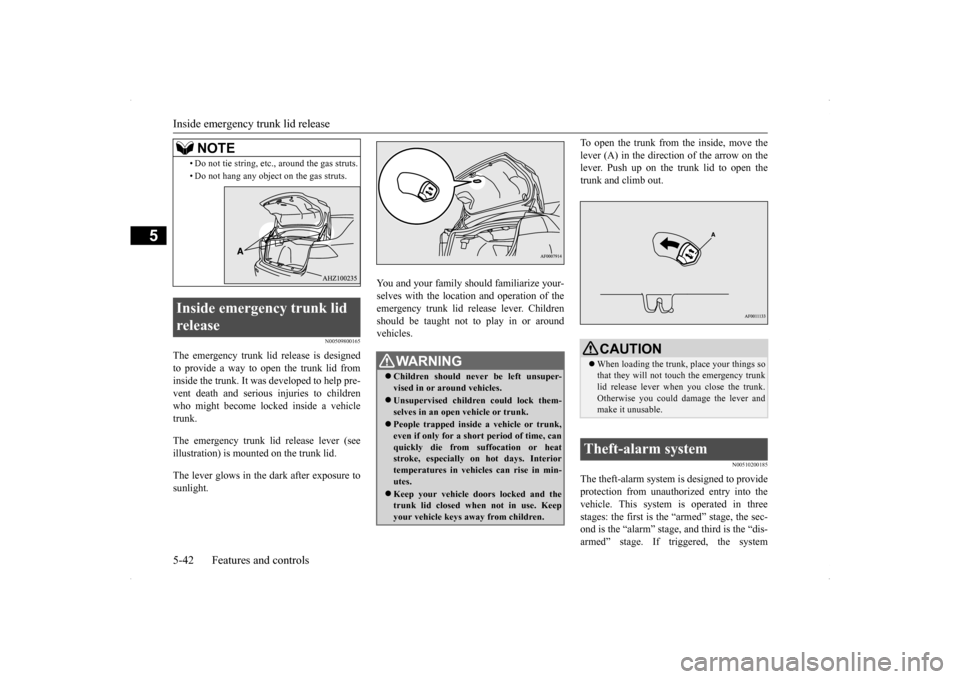
The emergency trunk lid release is designed to provide a way to open the trunk lid from inside the trunk. It was developed to help pre-vent death and serious injuries to children who might become locked inside a vehicle trunk. The emergency trunk lid release lever (see illustration) is mounted on the trunk lid. The lever glows in the dark after exposure to sunlight.
You and your family should familiarize your- selves with the location and operation of theemergency trunk lid release lever. Children should be taught not to play in or around vehicles.
To open the trunk from the inside, move the lever (A) in the direction of the arrow on the lever. Push up on the trunk lid to open the trunk and climb out.
N00510200185
The theft-alarm system is designed to provideprotection from unauthorized entry into thevehicle. This system is operated in three stages: the first is the “armed” stage, the sec- ond is the “alarm” stage, and third is the “dis-armed” stage. If triggered, the system
• Do not tie string, etc., around the gas struts. • Do not hang any object on the gas struts.
Inside emergency trunk lid release
NOTE
WA R N I N G Children should never be left unsuper- vised in or around vehicles. Unsupervised children could lock them- selves in an open vehicle or trunk. People trapped inside a vehicle or trunk, even if only for a short period of time, canquickly die from suffocation or heat stroke, especially on hot days. Interior temperatures in vehicles can rise in min-utes. Keep your vehicle doors locked and the trunk lid closed when not in use. Keep your vehicle keys away from children.
CAUTION When loading the trunk, place your things so that they will not touch the emergency trunk lid release lever when you close the trunk. Otherwise you could damage the lever andmake it unusable.
Theft-alarm system
Page 112 of 434
Power windows
Features and controls 5-45
5
N00510601128
Use the following procedure to test the sys- tem: 1. Lower the driver’s window. 2. Arm the system as explained in “Armed stage”. 3. Make sure that the theft-alarm indicatorcomes on and flashes for approximately 20 seconds. 4. Wait a few seconds and then unlock thedriver’s side door by using the inside door lock knob and open the door. 5. Check to be sure that the horn soundsintermittently and the headlights blink on and off when a door is opened. 6. Disarm the system by unlocking all doorsby the remote control transmitter or the F. A . S . T. - k e y.
N00510800367
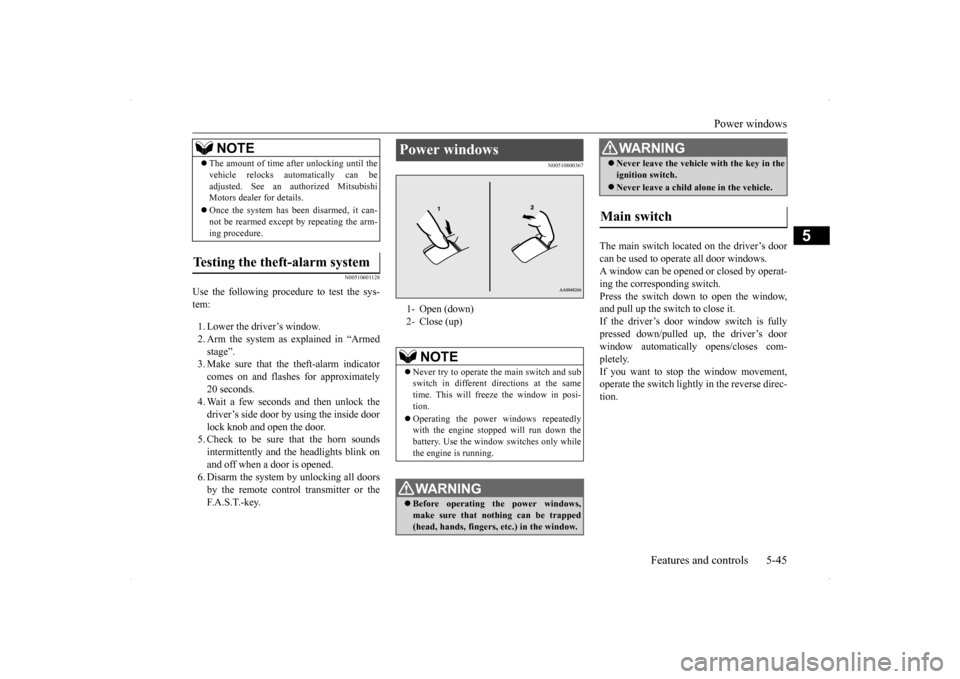
The main switch located on the driver’s doorcan be used to operate all door windows. A window can be opened or closed by operat-ing the corresponding switch.Press the switch down to open the window, and pull up the switch to close it. If the driver’s door window switch is fullypressed down/pulled up, the driver’s door window automatically opens/closes com- pletely.If you want to stop the window movement, operate the switch lightly in the reverse direc- tion.
The amount of time after unlocking until the vehicle relocks automatically can be adjusted. See an authorized Mitsubishi Motors dealer for details. Once the system has been disarmed, it can- not be rearmed except by repeating the arm- ing procedure.
Testing the theft-alarm system
NOTE
Power windows 1- Open (down) 2- Close (up)
NOTE
Never try to operate the main switch and sub switch in different directions at the sametime. This will freeze the window in posi- tion. Operating the power windows repeatedly with the engine stopped will run down the battery. Use the window switches only whilethe engine is running. WA R N I N G Before operating the power windows, make sure that nothing can be trapped(head, hands, fingers, etc.) in the window.
Never leave the vehicle with the key in the ignition switch. Never leave a child alone in the vehicle.
Main switch
WA R N I N G
Page 114 of 434
Sunroof (if so equipped)
Features and controls 5-47
5
N00549000127
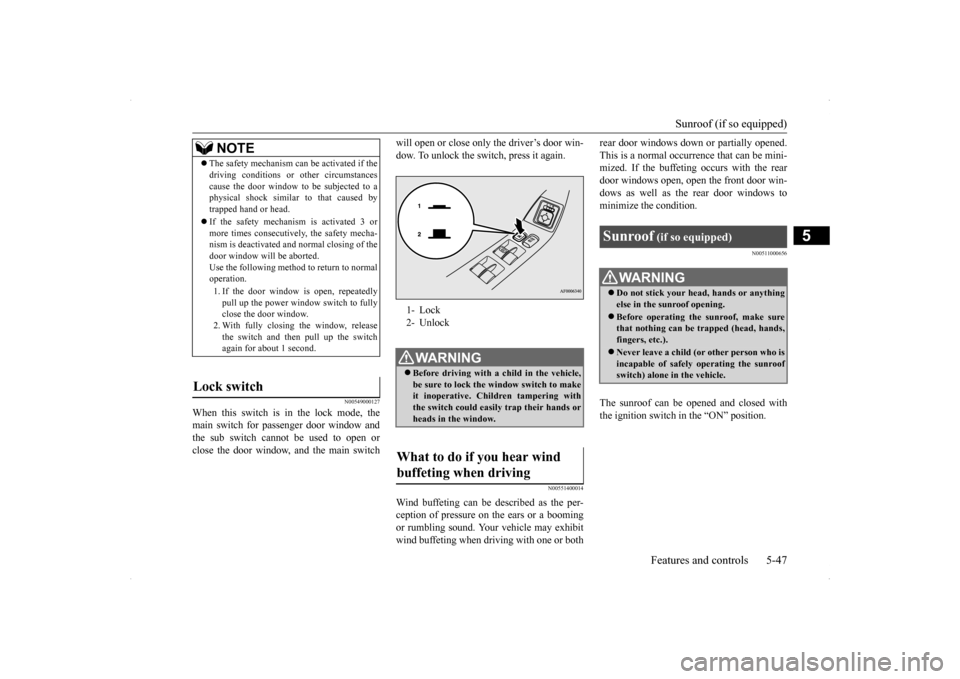
When this switch is in the lock mode, the main switch for passenger door window and the sub switch cannot be used to open orclose the door window, and the main switch
will open or close only the driver’s door win- dow. To unlock the switch, press it again.
N00551400014
Wind buffeting can be described as the per- ception of pressure on
the ears or a booming
or rumbling sound. Your vehicle may exhibitwind buffeting when driving with one or both
rear door windows down or partially opened. This is a normal occurrence that can be mini- mized. If the buffeting occurs with the rear door windows open, open the front door win-dows as well as the rear door windows to minimize the condition.
N00511000656
The sunroof can be opened and closed with the ignition switch in the “ON” position.
NOTE
The safety mechanism can be activated if the driving conditions or other circumstances cause the door window to be subjected to a physical shock similar to that caused by trapped hand or head. If the safety mechanism is activated 3 or more times consecutively, the safety mecha-nism is deactivated and normal closing of the door window will be aborted. Use the following method to return to normaloperation. 1. If the door window is open, repeatedly pull up the power window switch to fully close the door window. 2. With fully closing the window, releasethe switch and then pull up the switch again for about 1 second.
Lock switch
1- Lock 2- UnlockWA R N I N G Before driving with a child in the vehicle, be sure to lock the window switch to makeit inoperative. Children tampering with the switch could easily trap their hands or heads in the window.
What to do if you hear wind buffeting when driving
Sunroof
(if so equipped)
WA R N I N G Do not stick your head, hands or anything else in the sunroof opening. Before operating the sunroof, make sure that nothing can be trapped (head, hands, fingers, etc.). Never leave a child (or other person who is incapable of safely operating the sunroof switch) alone in the vehicle.
Page 264 of 434
Vehicle preparation before driving
Driving safety 6-3
6
N00629000337
For a safer and more enjoyable trip, always observe the following: Before starting the vehicle, make certain that you and all passengers are seated and wearing their seat belts properly (with children in the rear seat, in appropriaterestraints), and that all the doors are locked.
Move the driver’s seat as far backward as possible, while still keeping good visibil- ity, and good control of the steering wheel, brakes, accelerator, and controls.Check the instrument panel indicators and multi-information display for any possible problem. Move the front passenger seat as far back as possible. Make sure that infants and small children are properly restrained in accordance withall laws and regulations.
Check these by selecting the defroster mode, and set the blower switch on high. You should be able to feel the air blowing against the windshield. (Refer to “Defrosting or defogging the wind- shield and door windows” on page 7-6, 7-12, 7-17, 7-22, 7-27.) Check all the tires for heavy tread wear or uneven wear patterns. Look for stones, nails,glass, or other objects stuck in the tread. Look for any tread cuts or sidewall cracks. Check the wheel nuts for tightness, and the tires(including spare tire) for proper pressures.
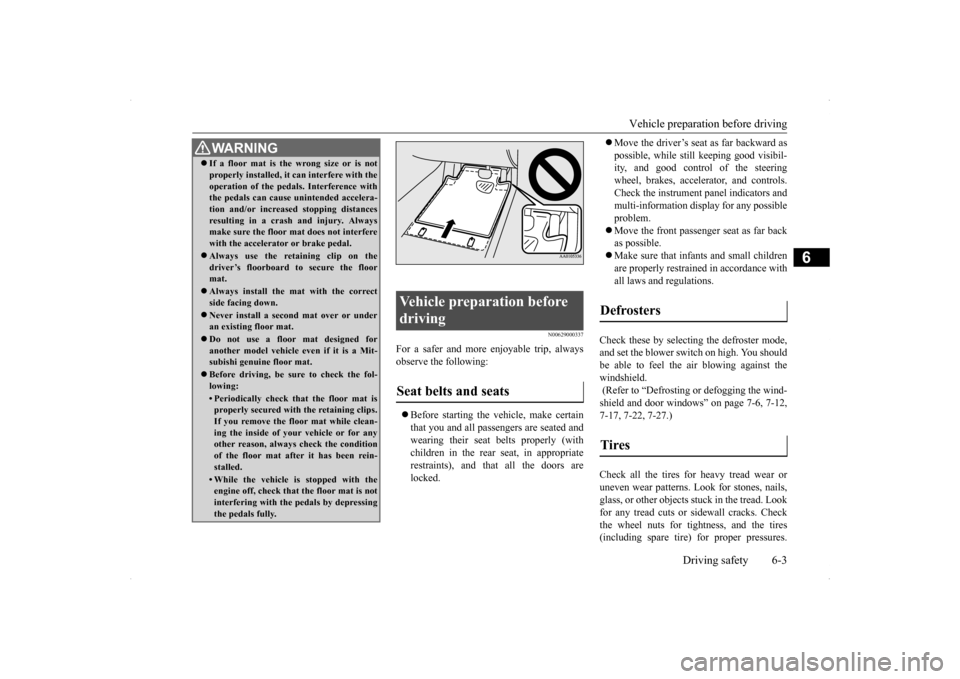
WA R N I N G If a floor mat is the wrong size or is not properly installed, it can interfere with the operation of the pedals. Interference with the pedals can cause unintended accelera- tion and/or increased stopping distancesresulting in a crash and injury. Always make sure the floor mat does not interfere with the accelerator or brake pedal. Always use the retaining clip on the driver’s floorboard to secure the floormat. Always install the mat with the correct side facing down. Never install a second mat over or under an existing floor mat. Do not use a floor mat designed for another model vehicle ev
en if it is a Mit-
subishi genuine floor mat. Before driving, be sure to check the fol- lowing:• Periodically check that the floor mat isproperly secured with the retaining clips. If you remove the floor mat while clean-ing the inside of your vehicle or for any other reason, always check the condition of the floor mat after it has been rein-stalled.• While the vehicle is stopped with the engine off, check that the floor mat is not interfering with the pedals by depressingthe pedals fully.
Vehicle preparation before driving Seat belts and seats
Defrosters Tires
Page 426 of 434

Alphabetical index
12-1
12
A
Accessory (installation)
.........................
3-6
ACD (Active center differential system) 5-83
ACD control mode display
..............
5-84
ACD control mode switch
...............
5-84
ACD warning display
......................
5-84
Active stability control (ASC)
..............
5-95
ASC OFF display or ASC indicator
..5-96
ASC operation display
....................
5-96
Air cleaner filter
...................
................
9-9
Air conditioning
Automatic air conditioning
.....
7-17
, 7-23
Important air conditioning operating tips
..
7-28 Manual air conditioning
...........
7-7
, 7-12
Air purifier
....................
.....................
7-28
All-wheel driving operation
.................
5-87
Aluminum wheels
...............................
9-52
AM/FM radio
....................
.................
7-29
Antenna
Roof antenna
.........................
7-62
, 7-63
Anti-lock braking system
.....................
5-92
Warning light / display
...........
5-93
, 5-94
Arm rest
........................
.......................
4-6
Assist grip
.....................
...................
5-194
Audio
AM/FM radio
................
.................
7-29
CD player
.....................
.................
7-29
Troubleshooting
.............................
7-60
Automatic air conditioning
..........
7-17
, 7-23
AWC control fluid
...............
...............
9-12
B
Back-up lights
Bulb capacity
..................
...............
9-34
Replacement
...................
...............
9-45
Ball joint, steering linkage seals and drive shaft boots
.....................
..................
9-27
Battery
........................
......................
9-14
Charging system warning light
.......
5-147
Checking battery electrolyte level
....
9-15
Disconnection and connection
.........
9-16
During cold weather
.......................
9-16
Removing and installing the battery uppercover (vehicles with turbocharger)
.9-14
Specification
...................
...............
11-5
Bluetooth 2.0 interface
.......................
5-161
Bottle holder
....................
.................
5-193
Brake
Anti-lock braking system
................
5-92
Braking
.......................
....................
6-5
Fluid
....................
.................
9-13
, 11-6
Hose
.......................
......................
9-27
Parking brake
..................
...............
5-49
Parking brake lever stroke
...............
9-24
Pedal
.......................
......................
5-90
Pedal free play
................
...............
9-24
Power brakes
..................
...............
5-90
Service brake
.................
.................
5-90
Brake assist
...................
.....................
5-91
Break-in recommendations
....................
5-3
Bulb capacity
.....................
.................
9-34
C
California Perchlorate Materials Requirements
.....................
................
3-7
Capacities
.....................
.....................
11-6
Card holder
............................
5-187
, 5-191
Cargo loads
...................
.....................
6-11
Catalytic converter
................
................
9-2
CD player
......................
.....................
7-29
Certification label
...............................
11-3
Charging system warning light
...........
5-147
Chassis number
..................
.................
11-2
Child restraint
....................
.................
4-14
Child safety locks for rear door
............
5-40
Cleaning
Inside of your vehicle
......................
9-48
Outside of your vehicle
...................
9-49
Clutch
Fluid
..................
...................
9-13
, 11-6
Pedal free play
...............
.................
9-24
Coat hooks
....................
...................
5-194
Combination headlights and dimmer switch
.
5-149
Page 429 of 434

Alphabetical index 12-4
12
Shift points (recommended speed)
....
5-61
Mirror
Inside day/night rearview mirror
......
5-51
Outside rearview mirrors
.................
5-53
Modifications to and racing of your vehicle
...
3-5 Multi-information display
..................
5-112
O
Octane requirement
...............
................
3-2
Oil
Engine oil
...............................
9-6
, 11-6
Manual transaxle oil
..............
9-11
, 11-6
Rear axle oil
..................
.................
9-12
Transfer oil
...................
.................
9-12
Operation under adverse driving conditions
...
8-15 Outside rearview mirrors
.....................
5-53
Overheating
......................
...................
8-4
P
Parking
.........................
.......................
6-6
Parking brake
................
.................
5-49
Parking brake lever stroke
...............
9-24
Polishing
.......................
.....................
9-51
Power brakes
.....................
.................
5-90
Power door locks
...............
.................
5-38
Power steering
Fluid
....................
.................
9-14
, 11-6
System
........................
...................
5-98
Power windows
...................
................
5-45
Puncture (Tire changing)
.......................
8-6
R
Radiator cap
....................
....................
9-9
Radio
General information about your radio 7-63
Rain sensor
..................
.....................
5-157
Rear axle oil
....................
...................
9-12
Rear side-marker lights
Bulb capacity
..................
................
9-34
Replacement
...................
................
9-44
Rear turn signal lights
Bulb capacity
..................
................
9-34
Replacement
...................
................
9-44
Rear window defogger switch
............
5-160
Rear-view camera
.............................
5-108
Rearview mirror
Inside
......................
.......................
5-51
Outside
.......................
...................
5-53
Refrigerant (air conditioning)
...............
11-6
Replacement of light bulbs
...................
9-33
Replacing tires and wheels
...................
9-22
Reporting Safety Defects
.....................
10-2
Roof antenna
.............................
7-62
, 7-63
S
Safe driving techniques
.........................
6-4
Seat
...........................
..........................
4-2
Arm rest
.......................
...................
4-6
Front seats
....................
...................
4-3
Heated seats
.....................
................
4-5
Rear seats
.....................
...................
4-5
Seats and restraint systems
................
4-2
Seat belt
........................
.......................
4-8
Adjustable seat belt shoulder anchor
.4-12
Child restraint
...............
.................
4-14
Driver’s seat belt reminder/warning
..4-11
Force limiter
.................
.................
4-14
Front passenger seat belt warning light
.....
4-12Maintenance and inspection
.............
4-21
Pre-tensioner
.................
.................
4-13
Seat belt extender
...........................
4-13
Seat belt instructions
.........................
4-9
Seat belt use during pregnancy
.........
4-13
Service brake
.....................
.................
5-90
Service precautions
...............
................
9-2
Snow tires
.....................
.....................
9-24
Spark plugs
...................
.....................
9-26
Steering
Power steering fluid
...............
9-14
, 11-6
Tilt lock lever
................
.................
5-51
Wheel lock
............................
5-20
, 5-56
Storage spaces
...................
...............
5-190