weight MITSUBISHI LANCER 2014 8.G User Guide
[x] Cancel search | Manufacturer: MITSUBISHI, Model Year: 2014, Model line: LANCER, Model: MITSUBISHI LANCER 2014 8.GPages: 434, PDF Size: 57.5 MB
Page 271 of 434
Loading information 6-10 Driving safety
6
NOTE
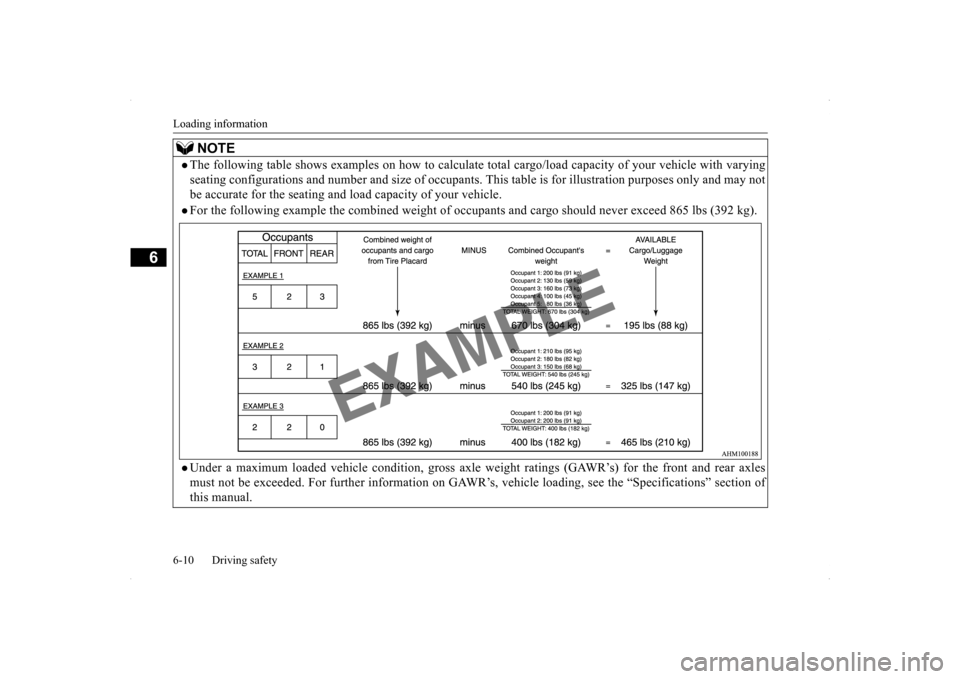
The following table shows examples on how
to calculate total cargo/load cap
acity of your vehicle with varying
seating configurations and number and size of occupants.
This table is for illustration purposes only and may not
be accurate for the seating and lo
ad capacity of your vehicle.
For the following example the combined weight of oc
cupants and cargo should never exceed 865 lbs (392 kg).
Under a maximum loaded vehicle condition, gross axle
weight ratings (GAWR’s) for the front and rear axles
must not be exceeded. For further information on GAWR
’s, vehicle loading, see the “Specifications” section of
this manual.
Page 272 of 434
Cargo loads
Driving safety 6-11
6
N00629700464
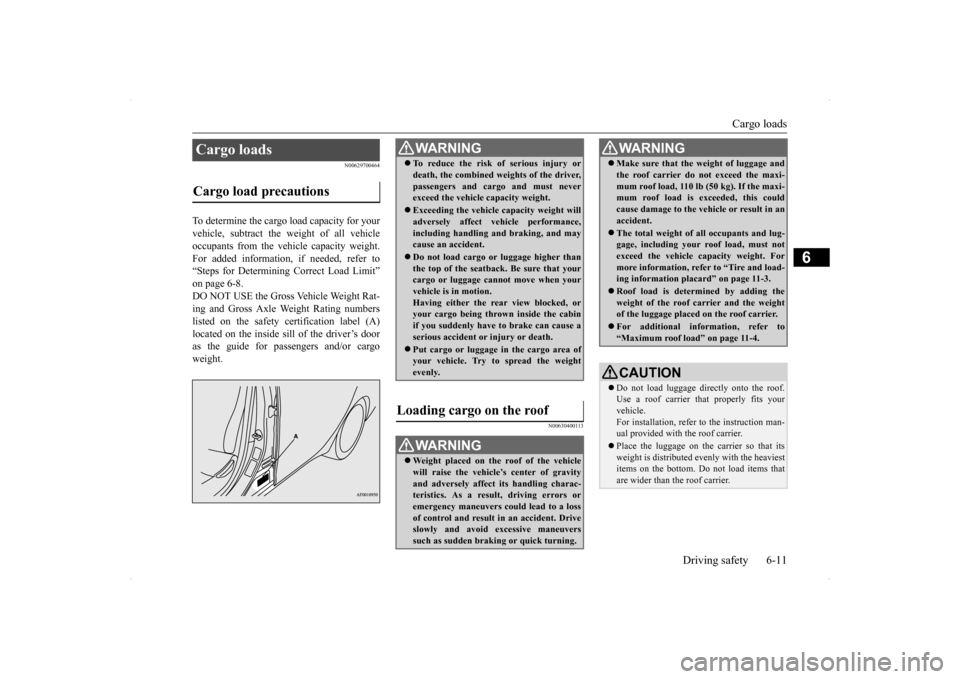
To determine the cargo load capacity for your vehicle, subtract the weight of all vehicleoccupants from the vehicle capacity weight. For added information, if needed, refer to “Steps for Determining Correct Load Limit”on page 6-8.DO NOT USE the Gross Vehicle Weight Rat- ing and Gross Axle Weight Rating numbers listed on the safety certification label (A)located on the inside sill of the driver’s door as the guide for passengers and/or cargo weight.
N00630400113
Cargo loads Cargo load precautions
WA R N I N G To reduce the risk of serious injury or death, the combined weights of the driver, passengers and cargo and must never exceed the vehicle capacity weight. Exceeding the vehicle capacity weight will adversely affect vehicle performance, including handling and braking, and maycause an accident. Do not load cargo or luggage higher than the top of the seatback. Be sure that your cargo or luggage cannot move when your vehicle is in motion.Having either the rear view blocked, or your cargo being thrown inside the cabin if you suddenly have to brake can cause aserious accident or injury or death. Put cargo or luggage in the cargo area of your vehicle. Try to spread the weight evenly.
Loading cargo on the roof
WA R N I N G Weight placed on the roof of the vehicle will raise the vehicle’s center of gravity and adversely affect its handling charac-teristics. As a result, driving errors or emergency maneuvers could lead to a loss of control and result in an accident. Driveslowly and avoid excessive maneuvers such as sudden braking or quick turning.
Make sure that the weight of luggage and the roof carrier do not exceed the maxi- mum roof load, 110 lb (50 kg). If the maxi- mum roof load is exceeded, this could cause damage to the vehicle or result in anaccident. The total weight of all occupants and lug- gage, including your roof load, must not exceed the vehicle capacity weight. For more information, refer to “Tire and load-ing information placard” on page 11-3. Roof load is determined by adding the weight of the roof carrier and the weight of the luggage placed on the roof carrier. For additional information, refer to “Maximum roof load” on page 11-4.CAUTION Do not load luggage directly onto the roof. Use a roof carrier th
at properly fits your
vehicle. For installation, refer to the instruction man- ual provided with the roof carrier. Place the luggage on the carrier so that its weight is distributed evenly with the heaviest items on the bottom. Do not load items that are wider than the roof carrier.WA R N I N G
Page 348 of 434
How to change a tire
For emergencies 8-7
8
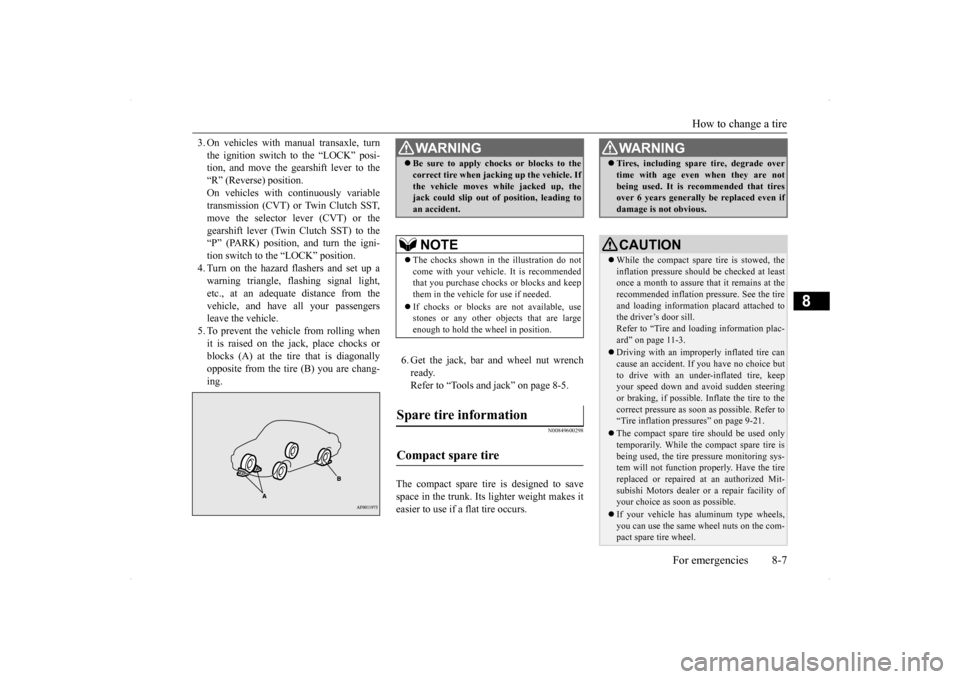
3. On vehicles with manual transaxle, turn the ignition switch to the “LOCK” posi- tion, and move the gearshift lever to the “R” (Reverse) position.On vehicles with continuously variable transmission (CVT) or Twin Clutch SST, move the selector lever (CVT) or thegearshift lever (Twin Clutch SST) to the “P” (PARK) position, and turn the igni- tion switch to the “LOCK” position.4. Turn on the hazard flashers and set up awarning triangle, flashing signal light, etc., at an adequate distance from the vehicle, and have all your passengersleave the vehicle. 5. To prevent the vehicle from rolling when it is raised on the jack, place chocks orblocks (A) at the tire that is diagonally opposite from the tire (B) you are chang- ing.
6. Get the jack, bar and wheel nut wrench ready.Refer to “Tools and jack” on page 8-5.
N00849600298
The compact spare tire is designed to savespace in the trunk. Its lighter weight makes it easier to use if a flat tire occurs.
WA R N I N G Be sure to apply chocks or blocks to the correct tire when jacking up the vehicle. If the vehicle moves while jacked up, the jack could slip out of position, leading to an accident.NOTE
The chocks shown in the illustration do not come with your vehicle. It is recommended that you purchase chocks or blocks and keepthem in the vehicle for use if needed. If chocks or blocks are not available, use stones or any other objects that are large enough to hold the wheel in position.
Spare tire information Compact spare tire
WA R N I N G Tires, including spare tire, degrade over time with age even when they are not being used. It is recommended that tires over 6 years generally be replaced even if damage is not obvious.CAUTION While the compact spare tire is stowed, the inflation pressure should be checked at least once a month to assure that it remains at therecommended inflation pressure. See the tire and loading information placard attached to the driver’s door sill.Refer to “Tire and loading information plac- ard” on page 11-3. Driving with an improperly inflated tire can cause an accident. If you have no choice but to drive with an under-inflated tire, keepyour speed down and avoid sudden steering or braking, if possible. Inflate the tire to the correct pressure as soon as possible. Refer to“Tire inflation pressures” on page 9-21. The compact spare tire should be used only temporarily. While the compact spare tire is being used, the tire pressure monitoring sys- tem will not function properly. Have the tire replaced or repaired at an authorized Mit- subishi Motors dealer or a repair facility ofyour choice as soon as possible. If your vehicle has aluminum type wheels, you can use the same wheel nuts on the com- pact spare tire wheel.
Page 364 of 434
View of the engine compartment
Vehicle care and maintenance 9-5
9
Unlatch the prop from the engine hood and put it back in its retainer. Slowly lower the engine hood about 8 inches (20 cm), then let it drop from its own weight.
N00937600667
To close
CAUTION Be careful not to trap your hands or fingers when closing the engine hood. Make sure the engine hood is firmly closed before driving. If you drive without the engine hood com-pletely closed, it could open up while driv- ing.NOTE
If this does not close the engine hood prop- erly, drop it again from a slightly higher position.
Do not push down strongly on the engine hood. Depending on how strongly or where you push down, you could create a dent in the vehicle body. For vehicles equipped with the theft-alarm system, if you drive with the engine hood left open, warning display is displayed on theinformation screen in the multi-information display.Type 1 Type 2
NOTE
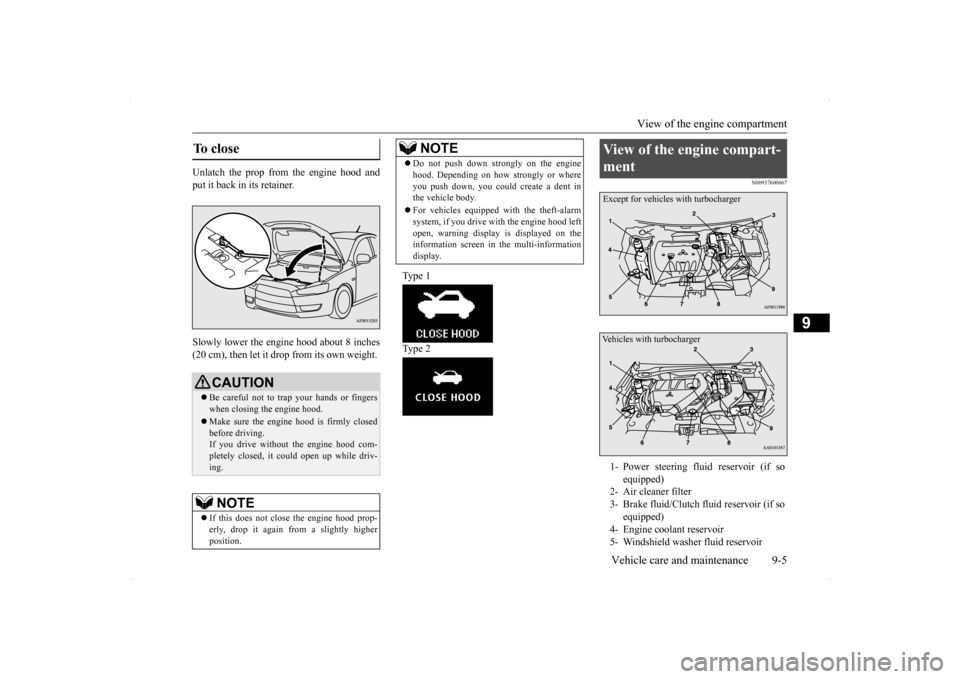
View of the engine compart- ment 1- Power steering fluid reservoir (if so
equipped)
2- Air cleaner filter 3- Brake fluid/Clutch fluid reservoir (if so
equipped)
4- Engine coolant reservoir 5- Windshield washer fluid reservoirExcept for vehicles with turbochargerVehicles with turbocharger
Page 376 of 434
Tires
Vehicle care and maintenance 9-17
9
N00939201563
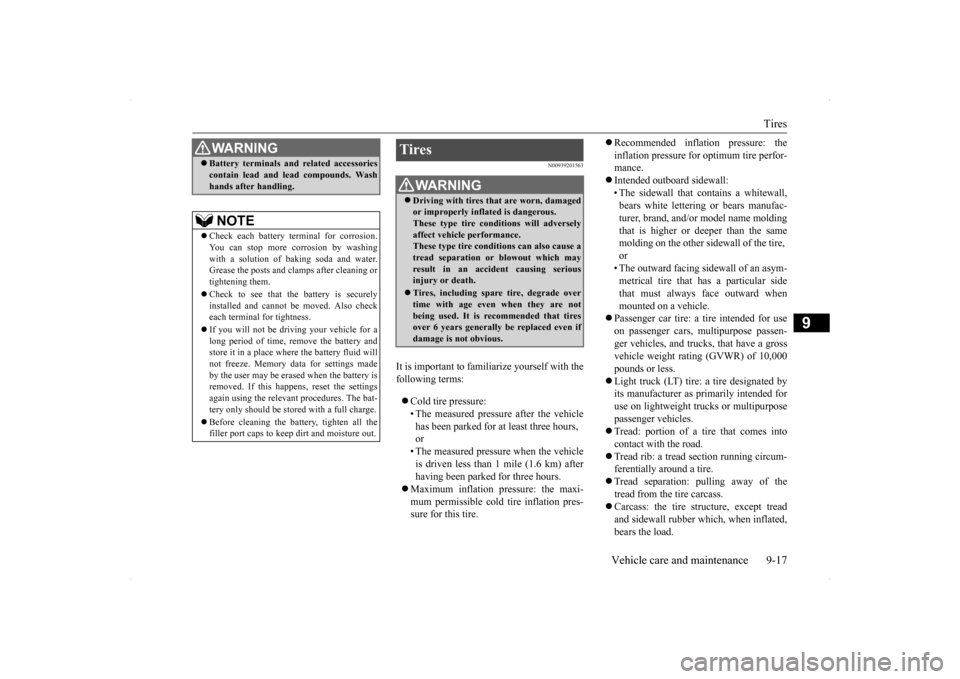
It is important to fami
liarize yourself with the
following terms: Cold tire pressure: • The measured pressure after the vehiclehas been parked for at least three hours, or • The measured pressure when the vehicleis driven less than 1 mile (1.6 km) after having been parked for three hours.
Maximum inflation pressure: the maxi- mum permissible cold tire inflation pres- sure for this tire.
Recommended inflation pressure: the inflation pressure for optimum tire perfor- mance. Intended outboard sidewall: • The sidewall that contains a whitewall, bears white lettering or bears manufac- turer, brand, and/or model name moldingthat is higher or deeper than the same molding on the other sidewall of the tire, or• The outward facing sidewall of an asym-metrical tire that has a particular side that must always face outward when mounted on a vehicle.
Passenger car tire: a tire intended for use on passenger cars, multipurpose passen- ger vehicles, and trucks, that have a grossvehicle weight rating (GVWR) of 10,000 pounds or less. Light truck (LT) tire: a tire designated by its manufacturer as primarily intended for use on lightweight trucks or multipurpose passenger vehicles. Tread: portion of a tire that comes into contact with the road. Tread rib: a tread section running circum- ferentially around a tire. Tread separation: pulling away of the tread from the tire carcass. Carcass: the tire structure, except tread and sidewall rubber which, when inflated, bears the load.
Battery terminals and related accessories contain lead and lead compounds. Wash hands after handling. NOTE
Check each battery terminal for corrosion. You can stop more corrosion by washing with a solution of baking soda and water.Grease the posts and clamps after cleaning or tightening them. Check to see that the battery is securely installed and cannot be moved. Also check each terminal for tightness. If you will not be driving your vehicle for a long period of time, remove the battery andstore it in a place where the battery fluid will not freeze. Memory data for settings made by the user may be erased when the battery isremoved. If this happens, reset the settings again using the relevant procedures. The bat- tery only should be stored with a full charge. Before cleaning the battery, tighten all the filler port caps to keep dirt and moisture out.WA R N I N G
Tires
WA R N I N G Driving with tires that are worn, damaged or improperly inflated is dangerous. These type tire conditions will adversely affect vehicle performance.These type tire conditions can also cause a tread separation or blowout which may result in an accident causing seriousinjury or death. Tires, including spare tire, degrade over time with age even when they are not being used. It is recommended that tires over 6 years generally be replaced even ifdamage is not obvious.
Page 381 of 434
Tires 9-22 Vehicle care and maintenance
9
Keep your tires inflated to the recom- mended pressures. (See the tire and load- ing information placard attached to the sill of the driver’s door.) Stay within the recommended load limits. Make sure that the weight of any load in your vehicle is evenly distributed. Drive at safe speeds. After filling your tires to the correct pres- sure, check them for damage and airleaks. Be sure to reinstall the caps on thevalve stems.
N00939600368
N00939700154
The following maintenance steps are recom- mended: Check tire pressures regularly.
Have regular maintenance done on the wheel balance and front and rear suspen- sion alignment. Rotate your tires regularly as described in the “Tire rotation” section on page 9-23.
N00939800214
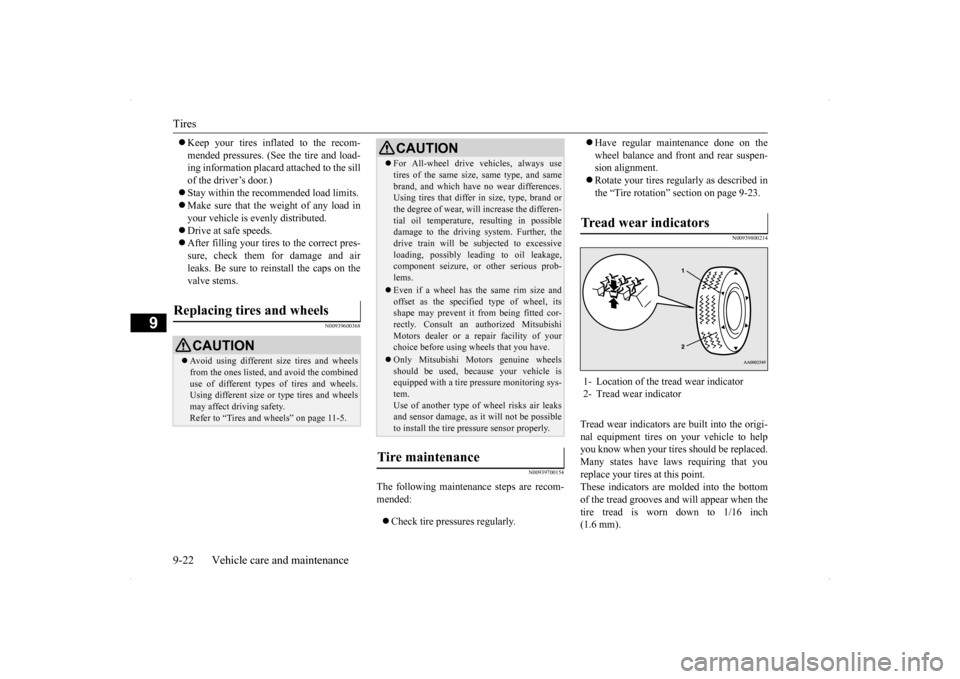
Tread wear indicators are built into the origi- nal equipment tires on your vehicle to help you know when your tires should be replaced.Many states have laws requiring that you replace your tires at this point. These indicators are molded into the bottomof the tread grooves and will appear when the tire tread is worn down to 1/16 inch (1.6 mm).
Replacing tires and wheels
CAUTION Avoid using different size tires and wheels from the ones listed, and avoid the combined use of different types of tires and wheels.Using different size or type tires and wheels may affect driving safety. Refer to “Tires and wheels” on page 11-5.
For All-wheel drive vehicles, always use tires of the same size, same type, and same brand, and which have no wear differences. Using tires that differ in size, type, brand or the degree of wear, will increase the differen-tial oil temperature, resulting in possible damage to the driving system. Further, the drive train will be subjected to excessiveloading, possibly leading to oil leakage, component seizure, or other serious prob- lems. Even if a wheel has the same rim size and offset as the specified type of wheel, itsshape may prevent it from being fitted cor- rectly. Consult an authorized Mitsubishi Motors dealer or a repair facility of yourchoice before using wheels that you have. Only Mitsubishi Motors genuine wheels should be used, because your vehicle is equipped with a tire pressure monitoring sys- tem.Use of another type of wheel risks air leaks and sensor damage, as it will not be possible to install the tire pressure sensor properly.
Tire maintenance
CAUTION
Tr e a d w e a r i n d i c a t o r s 1- Location of the tread wear indicator 2- Tread wear indicator
Page 418 of 434

11
SpecificationsVehicle labeling ...............
............................................................... 11-2
Vehicle dimensions ..........
............................................................... 11-4
Vehicle weights ................
............................................................... 11-4
Engine specifications
..............................................
........................ 11-5
Battery........................................
..................................................... 11-5
Tires and wheels ..............
............................................................... 11-5
Refill capacities ...............
............................................................... 11-6
Page 421 of 434
Vehicle dimensions 11-4 Specifications
11
N01147500482 N01147600890
GVWR: maximum total weight (load) limit specified for the vehicle GAWR: maximum weight (load) limit sp
ecified for the front or rear axle
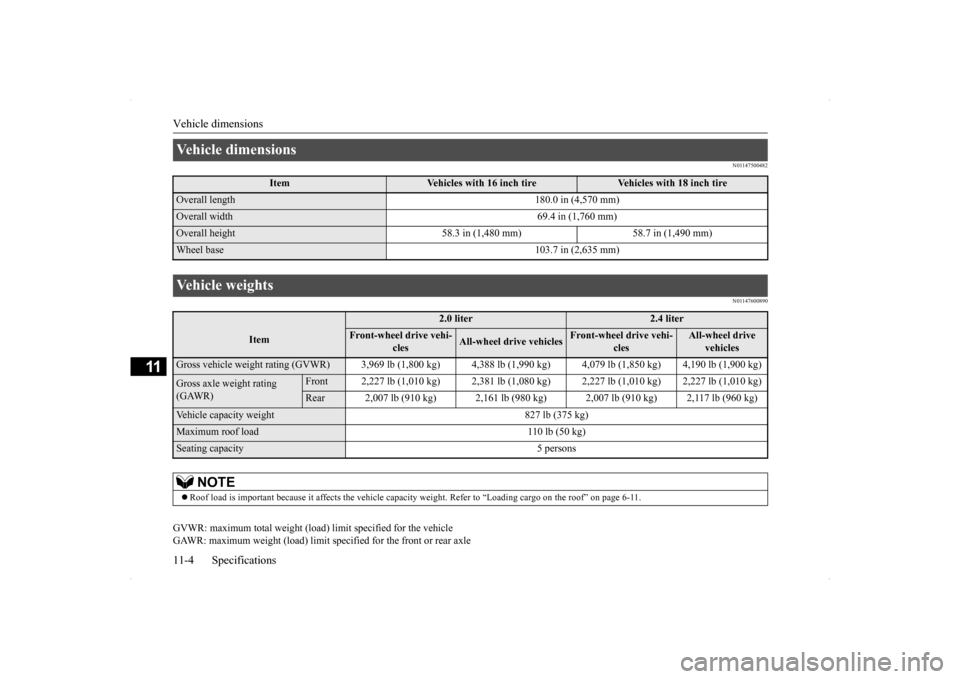
Vehicle dimensions
Item
Vehicles with 16 inch tire
Vehicles with 18 inch tire
Overall length 180.0 in (4,570 mm) Overall width 69.4 in (1,760 mm) Overall height 58.3 in (1,480 mm) 58.7 in (1,490 mm)Wheel base 103.7 in (2,635 mm) Vehicle weights
Item
2.0 liter
2.4 liter
Front-wheel drive vehi-
cles
All-wheel drive vehicles
Front-wheel drive vehi-
cles
All-wheel drive
vehicles
Gross vehicle weight rating (GVWR) 3,969 lb (1,800 kg
) 4,388 lb (1,990 kg) 4,079 lb (
1,850 kg) 4,190 lb (1,900 kg)
Gross axle weight rating (GAWR)
Front 2,227 lb (1,010 kg) 2,381 lb (1,080 kg)
2,227 lb (1,010 kg) 2,227 lb (1,010 kg)
Rear 2,007 lb (910 kg) 2,161 lb (980
kg) 2,007 lb (910 kg) 2,117 lb (960 kg)
Vehicle capacity weight 827 lb (375 kg)Maximum roof load 110 lb (50 kg)Seating capacity 5 persons
NOTE
Roof load is important because it affects the vehicle capacity
weight. Refer to “Loading cargo on the roof” on page 6-11.
Page 430 of 434
Alphabetical index
12-5
12
Sun visors
.....................
...................
5-186
Supplemental Restraint System
............
4-22
How the Supplement Restraint System works
.....................
.....................
4-24
Servicing
..................
.....................
4-36
Warning light/display
......................
4-27
T
Tank capacity
..............................
3-4
, 11-6
Theft-alarm system
System
......................
.....................
5-42
Time Setting
..................
.....................
7-59
Tire pressure monitoring system
.........
5-104
Warning light/display
....................
5-105
Tires
..........................
........................
9-17
How to change a tire
.........................
8-6
Inflation pressure
............................
9-21
Maintenance
..................
.................
9-22
Quality grading
...............................
10-2
Replacing tires and wheels
...............
9-22
Rotation
....................
.....................
9-23
Size (tire and wheel)
.......................
11-5
Snow tires
.....................
.................
9-24
Tire and loading information placard
.6-7
,
11-3 Tire chains
....................
.................
9-24
Tread wear indicators
......................
9-22
Tissue holder
.....................
...............
5-192
Tools
.........................
..........................
8-6
Storage
.........................
...................
8-5
Towing
........................
......................
8-14
Trailer towing
.....................
...............
6-12
Transfer oil
......................
..................
9-12
Trunk area light
Replacement
...................
...............
9-48
Trunk lid
.........................
..................
5-40
Turbocharger operation
.......................
5-60
Turn signal light
Indicators
....................
.................
5-145
Turn signal lights
Bulb capacity
..................
...............
9-34
Lever
......................
.....................
5-154
Replacement
...................
...............
9-40
Twin Clutch SST (Sportronic Shift Transmission)
...................
...............
5-71
Fluid
....................
.................
9-11
, 11-6
Gearshift lever operation
.................
5-71
Gearshift lever position display
........
5-73
Manual shift
....................
...............
5-77
Manual shift display
.......................
5-80
Twin Clutch SST control mode display
....
5-77 Twin Clutch SST control mode switch
.....
5-77 Warning display
.............................
5-73
U
USB input terminal
............................
5-183
How to connect an iPod
.................
5-184
USB input terminal device
How to connect a USB memory
.....
5-184
V
Vanity mirror
.....................
...............
5-186
Vehicle care precautions
......................
9-48
Vehicle dimensions
.............................
11-4
Vehicle labeling
.................
.................
11-2
Vehicle preparation before driving
..........
6-3
Vehicle weights
.................
.................
11-4
Vents
............................
.......................
7-2
W
Warning lights
...................
...............
5-146
Washer
Fluid
..................
...................
9-12
, 11-6
Switch
......................
...................
5-159
Windshield washer
........................
5-159
Waxing
......................
........................
9-51
Weights
........................
.....................
11-4
Welcome light
...................
...............
5-153
Wheel
Covers
......................
.....................
8-12
Specification
.................
.................
11-5
Wiper
Rain sensor
...................
...............
5-157
Windshield
....................
...............
5-156