battery MITSUBISHI LANCER 2014 8.G Workshop Manual
[x] Cancel search | Manufacturer: MITSUBISHI, Model Year: 2014, Model line: LANCER, Model: MITSUBISHI LANCER 2014 8.GPages: 434, PDF Size: 57.5 MB
Page 375 of 434
Battery 9-16 Vehicle care and maintenance
9
N00901600015
The battery is weaker in cold temperatures. This has to do with its chemical and physical properties and is why a very cold battery,especially one with a low charge, will have a hard time starting your vehicle. It is recommended that you have your batteryand charging system checked by an autho- rized Mitsubishi Motors
dealer or a repair
facility of your choice before the start of coldweather. If necessary, have it charged. This will guarantee more reliable starting, and lon- ger battery life.
N00901701084
To disconnect the battery cable, stop theengine. Disconnect the negative (-) terminalfirst, then the positive (+) terminal. To recon- nect the battery, first connect the positive (+) terminal and then the negative (-) terminal,before starting the vehicle.
NOTE
For vehicles equipped with a turbocharger, the battery upper cover does not need to be removed to check the battery electrolyte level.
During cold weather Disconnection and connection
NOTE
For vehicles equipped with turbocharger, remove the battery upper cover before dis- connecting the terminal of battery. Refer to “Removing and installing the battery upper cover” on page 9-14. Open the terminal cover (A) before discon- necting or connecting the positive (+) termi-nal of the battery.WA R N I N G Never disconnect the battery while the engine is running, or you could damagethe vehicle’s electrical parts. Never short-circuit the battery. This could cause it to overheat and be damaged. Keep sparks, cigarettes, and flames away from the battery because the battery could explode.
Electrolyte (battery acid) is made of corro- sive diluted sulfuric acid. If it spills on nearby parts, it can crack, stain, or dis- color them. And if gets on your skin or in your eyes, it can cause burns or blindness.Please observe the following handling instructions:• If electrolyte gets on plastic parts orother nearby parts, wipe it off with a soft cloth or chamois soaked in a solution ofwater and neutral detergent then imme- diately rinse the affected parts with plenty of water.• If electrolyte gets on your hands orclothes, rinse thoroughly with water. Ifelectrolyte gets in your eyes, flush them with water immediately and get immedi- ate medical attention.
Open doors and windows in any closed space where you may be charging orworking with the battery. Always wear protective clothing and gog- gles when working with the battery, or have a skilled automobile technician do it. If you are quick-charging your battery, first disconnect the
battery cables.
In order to prevent a short circuit, be sure to disconnect the negative (-) terminal first, and reconnect it last. If the electrolyte level is very low, have the battery checked at an authorized Mitsubi- shi Motors dealer or a repair facility of your choice.WA R N I N G
Page 376 of 434
Tires
Vehicle care and maintenance 9-17
9
N00939201563
It is important to fami
liarize yourself with the
following terms: Cold tire pressure: • The measured pressure after the vehiclehas been parked for at least three hours, or • The measured pressure when the vehicleis driven less than 1 mile (1.6 km) after having been parked for three hours.
Maximum inflation pressure: the maxi- mum permissible cold tire inflation pres- sure for this tire.
Recommended inflation pressure: the inflation pressure for optimum tire perfor- mance. Intended outboard sidewall: • The sidewall that contains a whitewall, bears white lettering or bears manufac- turer, brand, and/or model name moldingthat is higher or deeper than the same molding on the other sidewall of the tire, or• The outward facing sidewall of an asym-metrical tire that has a particular side that must always face outward when mounted on a vehicle.
Passenger car tire: a tire intended for use on passenger cars, multipurpose passen- ger vehicles, and trucks, that have a grossvehicle weight rating (GVWR) of 10,000 pounds or less. Light truck (LT) tire: a tire designated by its manufacturer as primarily intended for use on lightweight trucks or multipurpose passenger vehicles. Tread: portion of a tire that comes into contact with the road. Tread rib: a tread section running circum- ferentially around a tire. Tread separation: pulling away of the tread from the tire carcass. Carcass: the tire structure, except tread and sidewall rubber which, when inflated, bears the load.
Battery terminals and related accessories contain lead and lead compounds. Wash hands after handling. NOTE
Check each battery terminal for corrosion. You can stop more corrosion by washing with a solution of baking soda and water.Grease the posts and clamps after cleaning or tightening them. Check to see that the battery is securely installed and cannot be moved. Also check each terminal for tightness. If you will not be driving your vehicle for a long period of time, remove the battery andstore it in a place where the battery fluid will not freeze. Memory data for settings made by the user may be erased when the battery isremoved. If this happens, reset the settings again using the relevant procedures. The bat- tery only should be stored with a full charge. Before cleaning the battery, tighten all the filler port caps to keep dirt and moisture out.WA R N I N G
Tires
WA R N I N G Driving with tires that are worn, damaged or improperly inflated is dangerous. These type tire conditions will adversely affect vehicle performance.These type tire conditions can also cause a tread separation or blowout which may result in an accident causing seriousinjury or death. Tires, including spare tire, degrade over time with age even when they are not being used. It is recommended that tires over 6 years generally be replaced even ifdamage is not obvious.
Page 385 of 434
General maintenance 9-26 Vehicle care and maintenance
9
N00940900215
Spark plugs must fire properly for good engine performance and emission-control.Do not reuse them by cleaning or regapping. Change them at the mileage listed in the “WARRANTY AND MAINTENANCEMANUAL”.
N00941000037
Check the hose surfaces for any heat andmechanical damage, hard and brittle rubber,cracking, tears, cuts and abrasions. Pay spe- cial attention to the hoses closest to high heat sources such as the exhaust manifold. Checkall the hose connections, such as clamps and couplings, to make sure they are secure and that there are no leaks. If you see any wear ordamage, replace the hoses immediately.
N00950100050
Have the valve clearance checked at anauthorized Mitsubishi Motors dealer at themileage specified in the “WARRANTY AND MAINTENANCE MANUAL”. If the engine sounds abnormally loud, haveadjustments made by an authorized Mitsubishi Motors dealer.
N00941300085
Check these regularly for damage or leaks in the fuel lines and connections. Check the fuel tank filler cap for damage or looseness. Pay special attention to the fuel lines closest to
high heat sources such as the exhaust mani- fold.
N00941400116
If the fuel-vapor vent line is clogged or dam- aged, the fuel-vapor mixture will escape, pol- luting the air.Have the system checked at an authorized Mitsubishi Motors dealer at the mileage spec- ified in the “WARRANTY AND MAINTE-NANCE MANUAL”.
N00941500159
The next pages list the maintenance servicerecommended by Mitsubishi Motors Corpo- ration. In addition to the general maintenance that needs to be performed at the times listed,
NOTE
To meet government regulations and pro- mote cleaner air, your vehicle is equipped with an onboard diagnostic system (OBD). The engine electronic control module that controls OBD functions stores various data(especially about the exhaust emissions). This data will be erased if the battery cable is disconnected, which could make a rapiddiagnosis difficult. Do not disconnect the battery cable when the engine malfunction indicator (“SERVICE ENGINE SOON” or“Check engine light”) is on.
Spark plugs
NOTE
Use the spark plugs listed under “Engine specifications” on page 11-5 or plugs that are exactly the same. Other plugs could causeengine damage, performance problems or radio noise.
Fuel hoses Intake valve clearance Fuel system (tank, pipe line and connection, and fuel tank filler cap)
WA R N I N G If you see a fuel leak or if you smell fuel, do not run the engine. Any spark (includ- ing from the ignition), flame or smokingmaterial could cause an explosion or fire. Call an authorized Mitsubishi Motors dealer or a repair facility of your choicefor assistance.
Evaporative emission control system (except evaporative emission canister) General maintenance
Page 411 of 434
Cleaning the outside of your vehicle 9-52 Vehicle care and maintenance
9
N00946400065
To prevent spots and corrosion of chrome parts, wash with water, dry thoroughly, and apply a nonabrasive automotive wax. If thechrome is severely damaged or pitted, use a commercially available chrome polish.
N00946500196
1. Remove dirt using a wet sponge. 2. Use a mild detergent on any dirt that can-not be removed easily with water. Rinse off the detergent after washing the wheel.3. Dry the wheel thoroug
hly using a chamois
leather or a soft cloth.
N00946600067
The window glass can usually be cleaned using only a sponge and water. Glass cleanercan be used to remove
wax, oil, grease, dead
insects, etc. After washing the glass, wipe it dry with a clean, dry, soft cloth.
N00946700097
Use a soft cloth and glass cleaner to removegrease, dead insects, etc., from the wiperblades. Replace the wiper blades when they no longer clean the windshield and rear window prop-erly.
N00946800072
Clean the inside of the sunroof with a soft cloth. Hard deposits should be wiped away with a cloth dipped in warm, neutral deter-gent solution. Wipe away the solution with a sponge dipped in fresh water.
N00947000042
Never spray or splash water on the electricalcomponents in the engine compartment, as this may cause damage.Do not allow any nearby parts (such as plastic parts) come into contact with sulphuric acid (battery electrolyte), which may crack, stain,or discolour them. If this occurs, wipe the parts with a soft cloth saturated with a mild detergent and watersolution. Then immediately rinse the affected parts with plenty of water.
Do not let the plastic parts get soiled with gasoline, oil, brake fluids, engine oils, greases, paint thinner, and sulfuric acid (bat- tery electrolyte). These fluids, etc., may crack, stain or discolor the plastic parts.If any of these get on the plastic parts, wipe them up with a soft cloth or chamois and a mild solution of soap and water. Then rinsethem immediately with water.
Chrome parts Aluminum wheels (if so equipped)
CAUTION
CAUTION Do not use a brush or other hard implement on the wheels. Doing so could scratch the wheels. Do not use any cleaner that contains an abra- sive substance or is acidic or alkaline. Doing so could cause the coating on the wheels to peel or become discolored or stained. Do not directly apply hot water using a steam cleaner or by any other means. Contact with seawater or road salt used for de-icing can cause corrosion. Rinse off suchsubstances as soon as possible.
Window glass Wiper blades
Cleaning the sunroof
(if so
equipped)
NOTE
The surface treatment on the inside of the glass may be removed if a hard cloth or organic solvent is used.
Engine compartment
Page 418 of 434

11
SpecificationsVehicle labeling ...............
............................................................... 11-2
Vehicle dimensions ..........
............................................................... 11-4
Vehicle weights ................
............................................................... 11-4
Engine specifications
..............................................
........................ 11-5
Battery........................................
..................................................... 11-5
Tires and wheels ..............
............................................................... 11-5
Refill capacities ...............
............................................................... 11-6
Page 422 of 434
Engine specifications Specifications 11-5
11
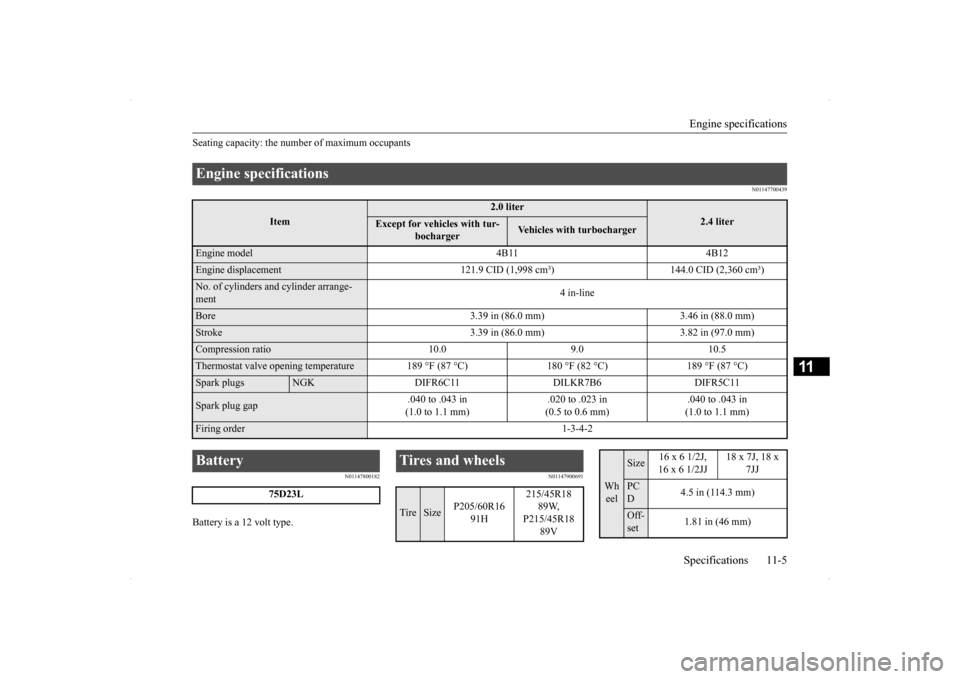
Seating capacity: the number of maximum occupants
N01147700439
N01147800182
Battery is a 12 volt type.
N01147900691
Engine specifications
Item
2.0 liter
2.4 liter
Except for vehicles with tur-
bocharger
Vehicles with turbocharger
Engine model 4B11 4B12Engine displacement 121.9 CID (1,998 cm³) 144.0 CID (2,360 cm³)No. of cylinders and cylinder arrange- ment
4 in-line
Bore 3.39 in (86.0 mm) 3.46 in (88.0 mm)Stroke 3.39 in (86.0 mm) 3.82 in (97.0 mm)Compression ratio 10.0 9.0 10.5Thermostat valve opening temperature 189 °F (87 °C) 180 °F (82 °C) 189 °F (87 °C)Spark plugs
NGK DIFR6C11 DILKR7B6 DIFR5C11
Spark plug gap
.040 to .043 in (1.0 to 1.1 mm)
.020 to .023 in (0.5 to 0.6 mm)
.040 to .043 in (1.0 to 1.1 mm)
Firing order 1-3-4-2Battery
75D23L
Tires and wheels Tire
Size
P205/60R16
91H
215/45R18
89W,
P215/45R18
89V
Wheel
Size
16 x 6 1/2J, 16 x 6 1/2JJ
18 x 7J, 18 x
7JJ
PCD
4.5 in (114.3 mm)
Off- set
1.81 in (46 mm)
Page 426 of 434
Alphabetical index
12-1
12
A
Accessory (installation)
.........................
3-6
ACD (Active center differential system) 5-83
ACD control mode display
..............
5-84
ACD control mode switch
...............
5-84
ACD warning display
......................
5-84
Active stability control (ASC)
..............
5-95
ASC OFF display or ASC indicator
..5-96
ASC operation display
....................
5-96
Air cleaner filter
...................
................
9-9
Air conditioning
Automatic air conditioning
.....
7-17
, 7-23
Important air conditioning operating tips
..
7-28 Manual air conditioning
...........
7-7
, 7-12
Air purifier
....................
.....................
7-28
All-wheel driving operation
.................
5-87
Aluminum wheels
...............................
9-52
AM/FM radio
....................
.................
7-29
Antenna
Roof antenna
.........................
7-62
, 7-63
Anti-lock braking system
.....................
5-92
Warning light / display
...........
5-93
, 5-94
Arm rest
........................
.......................
4-6
Assist grip
.....................
...................
5-194
Audio
AM/FM radio
................
.................
7-29
CD player
.....................
.................
7-29
Troubleshooting
.............................
7-60
Automatic air conditioning
..........
7-17
, 7-23
AWC control fluid
...............
...............
9-12
B
Back-up lights
Bulb capacity
..................
...............
9-34
Replacement
...................
...............
9-45
Ball joint, steering linkage seals and drive shaft boots
.....................
..................
9-27
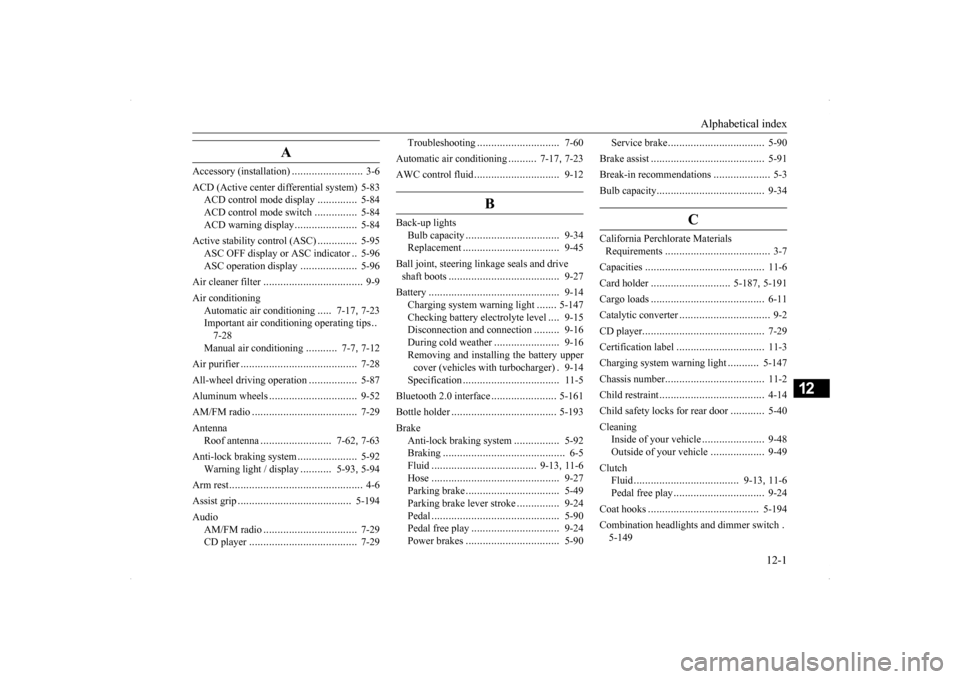
Battery
........................
......................
9-14
Charging system warning light
.......
5-147
Checking battery electrolyte level
....
9-15
Disconnection and connection
.........
9-16
During cold weather
.......................
9-16
Removing and installing the battery uppercover (vehicles with turbocharger)
.9-14
Specification
...................
...............
11-5
Bluetooth 2.0 interface
.......................
5-161
Bottle holder
....................
.................
5-193
Brake
Anti-lock braking system
................
5-92
Braking
.......................
....................
6-5
Fluid
....................
.................
9-13
, 11-6
Hose
.......................
......................
9-27
Parking brake
..................
...............
5-49
Parking brake lever stroke
...............
9-24
Pedal
.......................
......................
5-90
Pedal free play
................
...............
9-24
Power brakes
..................
...............
5-90
Service brake
.................
.................
5-90
Brake assist
...................
.....................
5-91
Break-in recommendations
....................
5-3
Bulb capacity
.....................
.................
9-34
C
California Perchlorate Materials Requirements
.....................
................
3-7
Capacities
.....................
.....................
11-6
Card holder
............................
5-187
, 5-191
Cargo loads
...................
.....................
6-11
Catalytic converter
................
................
9-2
CD player
......................
.....................
7-29
Certification label
...............................
11-3
Charging system warning light
...........
5-147
Chassis number
..................
.................
11-2
Child restraint
....................
.................
4-14
Child safety locks for rear door
............
5-40
Cleaning
Inside of your vehicle
......................
9-48
Outside of your vehicle
...................
9-49
Clutch
Fluid
..................
...................
9-13
, 11-6
Pedal free play
...............
.................
9-24
Coat hooks
....................
...................
5-194
Combination headlights and dimmer switch
.
5-149