engine MITSUBISHI LANCER 2015 8.G Owners Manual
[x] Cancel search | Manufacturer: MITSUBISHI, Model Year: 2015, Model line: LANCER, Model: MITSUBISHI LANCER 2015 8.GPages: 434, PDF Size: 16.59 MB
Page 360 of 434
Engine hood
Vehicle care and maintenance 9-3
9
To reduce the possibility of catalytic con- verter damage: Use UNLEADED GASOLINE ONLY of the type of recommended in “Fuel selec- tion”. Do not drive with an extremely low fuel level. Running out of gas could damage the catalytic converter. Do not try to start the engine by pushing or towing the vehicle. If the battery is weak or run down, use jumper cables to properly start the engine.
Do not idle the engine with any spark plug wires disconnected or removed, such as when performing diagnostic tests. Do not idle the engine for a long time if it is idling roughly or otherwise obviously malfunctioning. To prevent the catalytic converter from being damaged from unburned gas, do not race the engine when turning off the igni- tion switch. Stop driving the vehicle if you think the performance is less than normal, the engine is running oddly or there is any other engine trouble, such as with theignition, etc. If you
are not able to stop
driving immediately, slow down and drive for only a short time. Have an inspectionmade by an authorized Mitsubishi Motors dealer or a repair facility of your choice as soon as possible. In unusual situations involving major engine problems, a burning odor may indicate severe and abnormal catalyticconverter overheating. If this occurs, stop in a safe place, shut the engine off and let the vehicle cool. Once the engine is cool,immediately take your vehicle to a dealer or a repair facility of your choice for ser- vice.
N00937500464
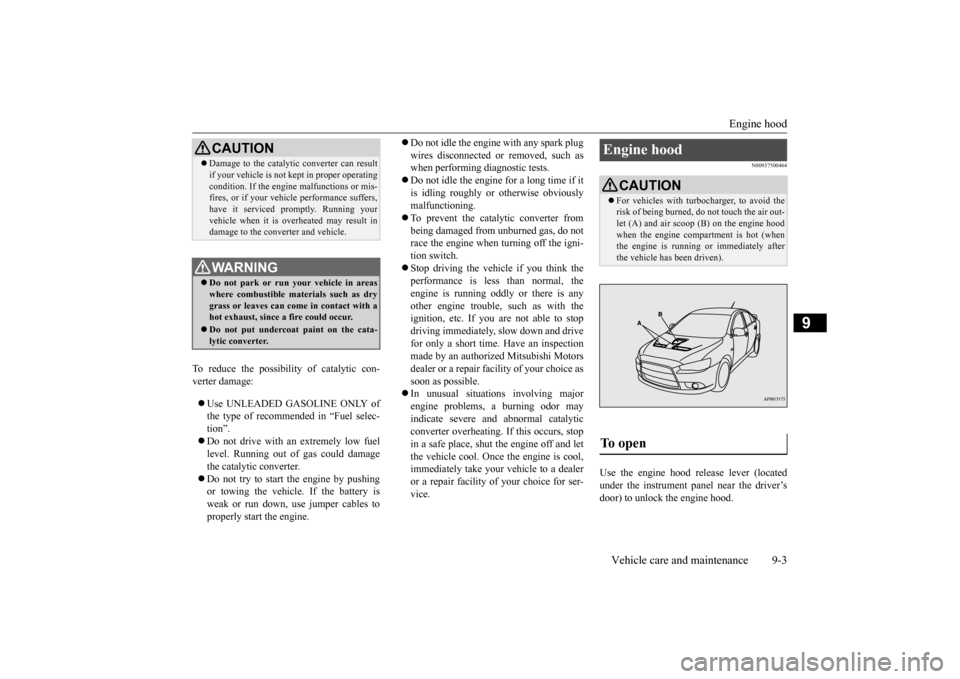
Use the engine hood release lever (locatedunder the instrument panel near the driver’s door) to unlock the engine hood.
CAUTION Damage to the catalytic converter can result if your vehicle is not kept in proper operating condition. If the engine malfunctions or mis- fires, or if your vehicle performance suffers, have it serviced promptly. Running yourvehicle when it is overheated may result in damage to the converter and vehicle.WA R N I N G Do not park or run your vehicle in areas where combustible materials such as dry grass or leaves can come in contact with a hot exhaust, since a fire could occur. Do not put undercoat paint on the cata- lytic converter.
Engine hood
CAUTION For vehicles with turbocharger, to avoid the risk of being burned, do not touch the air out- let (A) and air scoop (B) on the engine hood when the engine compartment is hot (whenthe engine is running or immediately after the vehicle has been driven).
To open
BK0210300US.bo
ok 3 ページ 2014年4月8日 火曜日 午前10時46分
Page 361 of 434
Engine hood 9-4 Vehicle care and maintenance
9
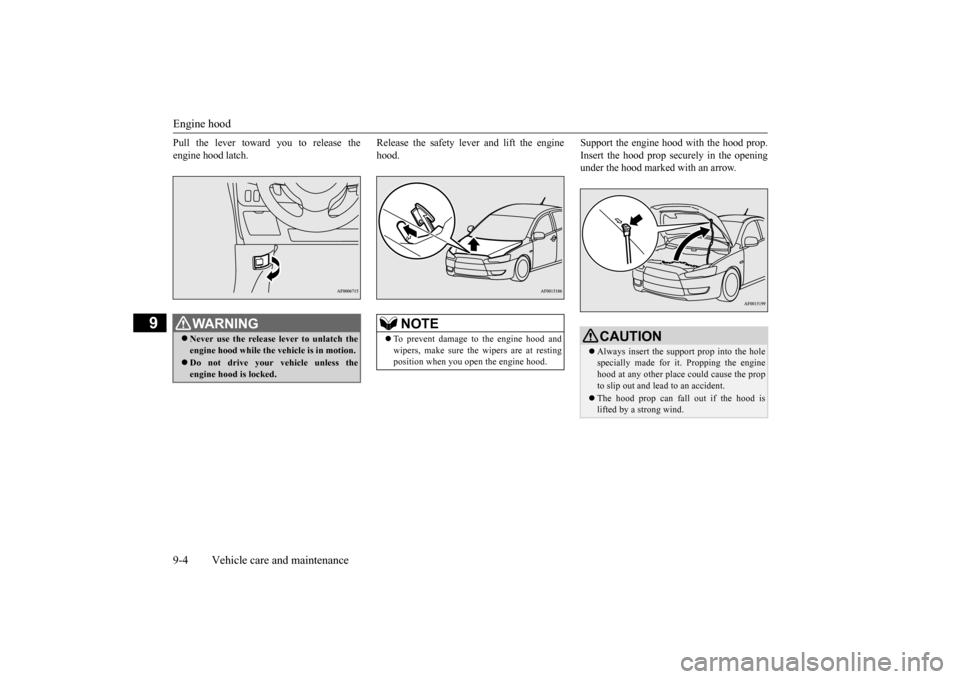
Pull the lever toward you to release the engine hood latch.
Release the safety lever and lift the engine hood.
Support the engine hood with the hood prop. Insert the hood prop securely in the opening under the hood marked with an arrow.
WA R N I N G Never use the release lever to unlatch the engine hood while the vehicle is in motion. Do not drive your vehicle unless the engine hood is locked.
NOTE
To prevent damage to the engine hood and wipers, make sure the wipers are at restingposition when you open the engine hood.
CAUTION Always insert the support prop into the hole specially made for it. Propping the engine hood at any other place could cause the propto slip out and lead to an accident. The hood prop can fall out if the hood is lifted by a strong wind.
BK0210300US.bo
ok 4 ページ 2014年4月8日 火曜日 午前10時46分
Page 362 of 434
View of the engine compartment
Vehicle care and maintenance 9-5
9
Unlatch the prop from the engine hood and put it back in its retainer. Slowly lower the engine hood about 8 inches (20 cm), then let it drop from its own weight.
N00937600667
To close
CAUTION Be careful not to trap your hands or fingers when closing the engine hood. Make sure the engine hood is firmly closed before driving. If you drive without the engine hood com-pletely closed, it could open up while driv- ing.NOTE
If this does not close the engine hood prop- erly, drop it again from a slightly higher position.
Do not push down strongly on the engine hood. Depending on how strongly or where you push down, you could create a dent in the vehicle body. For vehicles equipped with the theft-alarm system, if you drive with the engine hood left open, warning display is displayed on theinformation screen in the multi-information display.Type 1 Type 2
NOTE
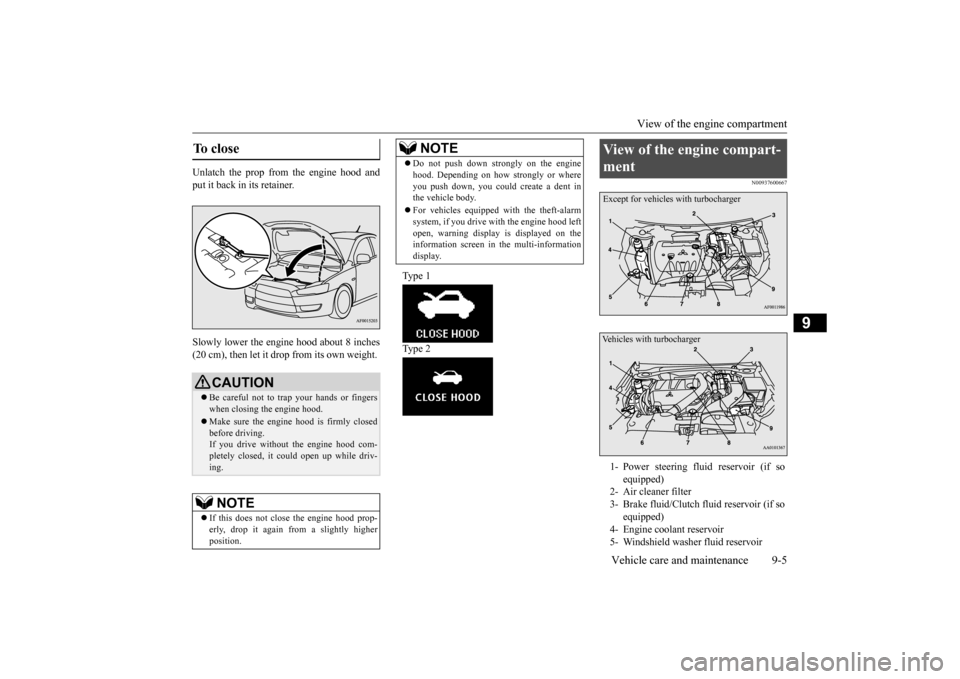
View of the engine compart- ment 1- Power steering fluid reservoir (if so
equipped)
2- Air cleaner filter 3- Brake fluid/Clutch fluid reservoir (if so
equipped)
4- Engine coolant reservoir 5- Windshield washer fluid reservoirExcept for vehicles with turbochargerVehicles with turbocharger
BK0210300US.bo
ok 5 ページ 2014年4月8日 火曜日 午前10時46分
Page 363 of 434
Engine oil and oil filter 9-6 Vehicle care and maintenance
9
N00937702040
It is normal for an engi
ne to use oil. You may
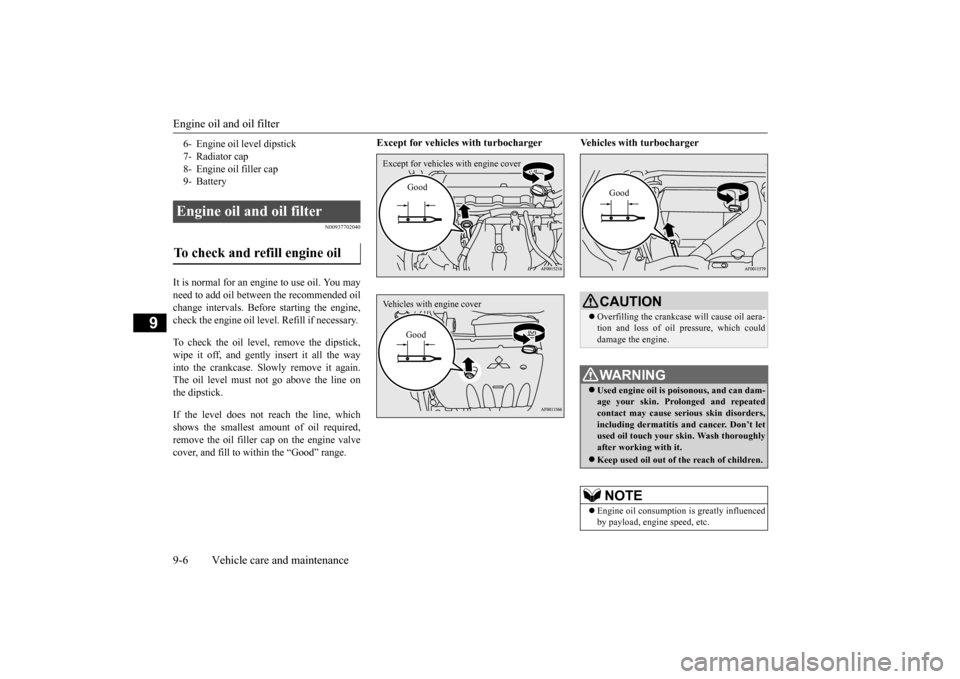
need to add oil between the recommended oil change intervals. Before starting the engine,check the engine oil level. Refill if necessary. To check the oil level, remove the dipstick, wipe it off, and gently insert it all the way into the crankcase. Slowly remove it again.The oil level must not go above the line on the dipstick. If the level does not reach the line, which shows the smallest amount of oil required,remove the oil filler cap on the engine valve cover, and fill to within the “Good” range.
Except for vehicles with turbocharger Vehicles with turbocharger
6- Engine oil level dipstick 7- Radiator cap8- Engine oil filler cap 9- Battery Engine oil and oil filter To check and refill engine oil
Except for vehicles with engine cover
Good
Vehicles with engine cover
Good
CAUTION Overfilling the crankcase will cause oil aera- tion and loss of oil pressure, which coulddamage the engine.WA R N I N G Used engine oil is poisonous, and can dam- age your skin. Prolonged and repeatedcontact may cause serious skin disorders, including dermatitis and cancer. Don’t let used oil touch your skin. Wash thoroughlyafter working with it. Keep used oil out of the reach of children.NOTE
Engine oil consumption is greatly influenced by payload, engine speed, etc.
Good
BK0210300US.bo
ok 6 ページ 2014年4月8日 火曜日 午前10時46分
Page 364 of 434
Engine oil and oil filter
Vehicle care and maintenance 9-7
9
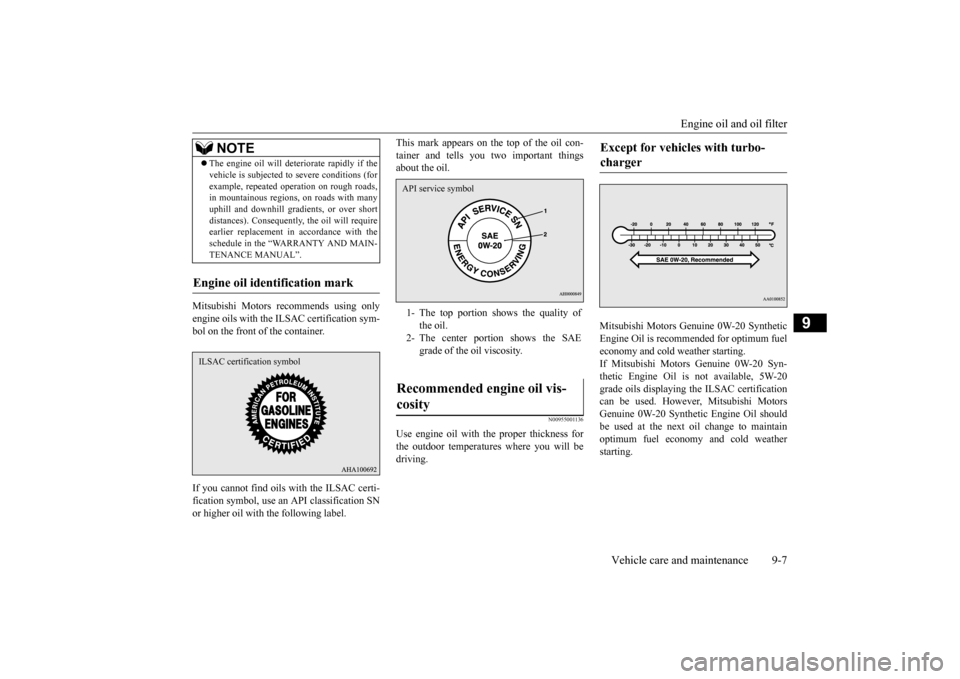
Mitsubishi Motors recommends using only engine oils with the ILSAC certification sym- bol on the front of the container. If you cannot find oils with the ILSAC certi- fication symbol, use an API classification SNor higher oil with the following label.
This mark appears on th
e top of the oil con-
tainer and tells you two important things about the oil.
N00955001136
Use engine oil with the proper thickness for the outdoor temperatures where you will be driving.
Mitsubishi Motors Genuine 0W-20 Synthetic Engine Oil is recommended for optimum fueleconomy and cold weather starting. If Mitsubishi Motors Genuine 0W-20 Syn- thetic Engine Oil is not available, 5W-20grade oils displaying the ILSAC certificationcan be used. However, Mitsubishi Motors Genuine 0W-20 Synthetic Engine Oil should be used at the next oil change to maintainoptimum fuel economy and cold weather starting.
The engine oil will deteriorate rapidly if the vehicle is subjected to severe conditions (for example, repeated operation on rough roads, in mountainous regions, on roads with many uphill and downhill gradients, or over shortdistances). Consequently, the oil will require earlier replacement in accordance with the schedule in the “WARRANTY AND MAIN-TENANCE MANUAL”.
Engine oil identification mark
NOTE
ILSAC certification symbol
1- The top portion shows the quality of
the oil.
2- The center portion shows the SAE
grade of the oil viscosity.
Recommended engine oil vis- cosity API service symbol
Except for vehicles with turbo- charger
BK0210300US.bo
ok 7 ページ 2014年4月8日 火曜日 午前10時46分
Page 365 of 434
Engine coolant 9-8 Vehicle care and maintenance
9
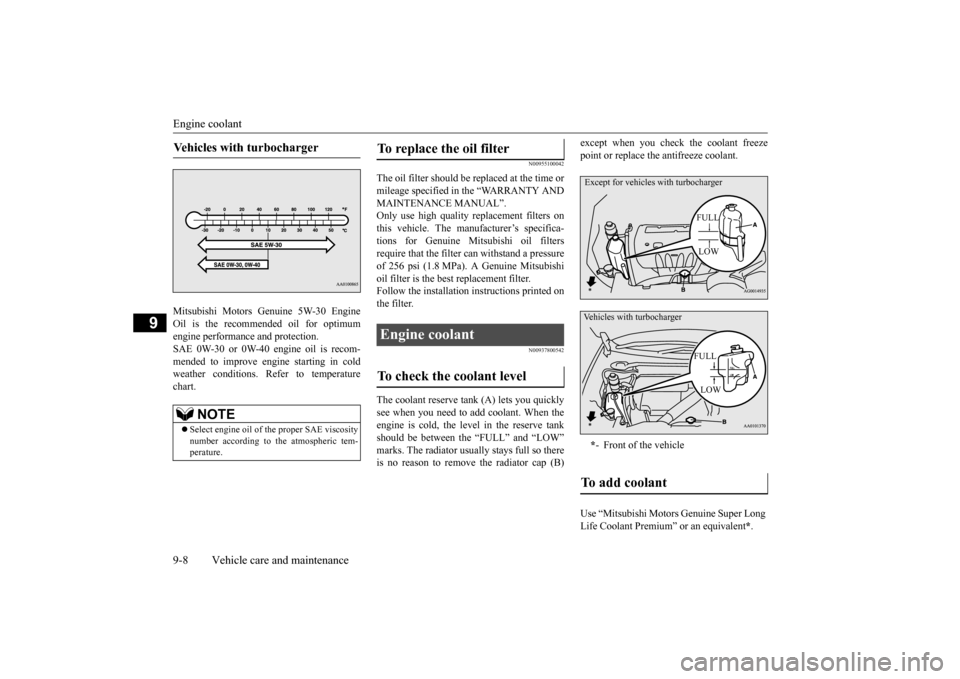
Mitsubishi Motors Genuine 5W-30 Engine Oil is the recommended oil for optimum engine performance and protection. SAE 0W-30 or 0W-40 engine oil is recom-mended to improve engine starting in cold weather conditions. Refer to temperature chart.
N00955100042
The oil filter should be replaced at the time ormileage specified in the “WARRANTY ANDMAINTENANCE MANUAL”. Only use high quality replacement filters on this vehicle. The manufacturer’s specifica-tions for Genuine Mitsubishi oil filters require that the filter can withstand a pressure of 256 psi (1.8 MPa). A Genuine Mitsubishioil filter is the best replacement filter.Follow the installation
instructions printed on
the filter.
N00937800542
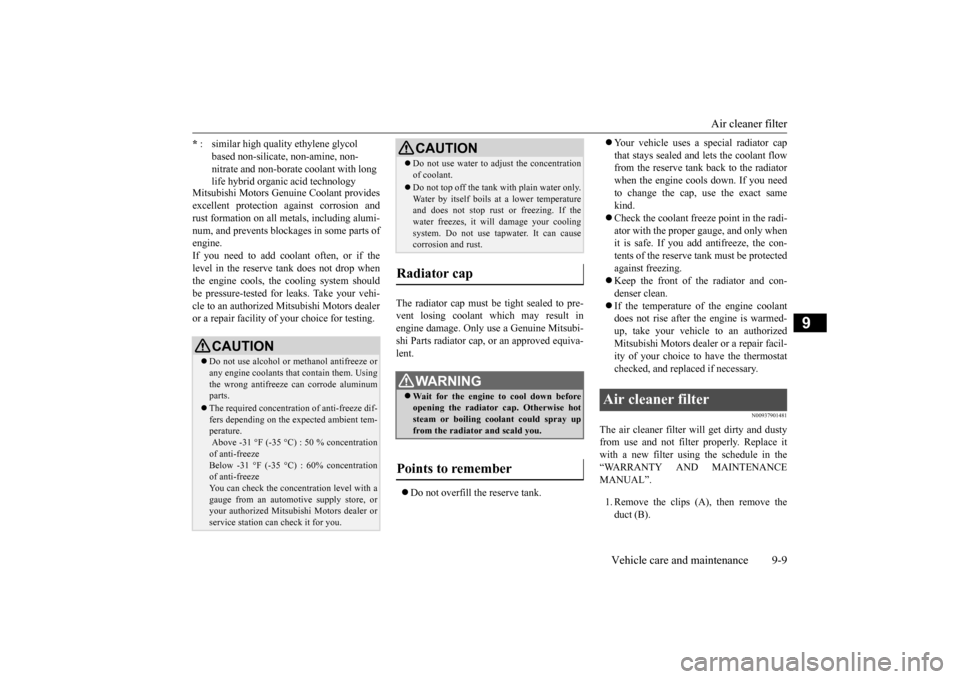
The coolant reserve tank (A) lets you quickly see when you need to add coolant. When the engine is cold, the level in the reserve tank should be between the “FULL” and “LOW”marks. The radiator usually stays full so there is no reason to remove
the radiator cap (B)
except when you check the coolant freeze point or replace the antifreeze coolant.
Vehicles with turbocharger
NOTE
Select engine oil of the proper SAE viscosity number according to the atmospheric tem-perature.
To replace the oil filter Engine coolant To check the coolant level
* - Front of the vehicle
To add coolant Use “Mitsubishi Motors Genuine Super Long Life Coolant Premium” or an equivalent
*.
Except for vehicles with turbocharger
FULL LOW
Vehicles with turbocharger
FULL LOW
BK0210300US.bo
ok 8 ページ 2014年4月8日 火曜日 午前10時46分
Page 366 of 434
Air cleaner filter
Vehicle care and maintenance 9-9
9
Mitsubishi Motors Genuine Coolant provides excellent protection against corrosion and rust formation on all metals, including alumi-num, and prevents blockages in some parts of engine. If you need to add co
olant often, or if the
level in the reserve tank does not drop whenthe engine cools, the cooling system should be pressure-tested for leaks. Take your vehi- cle to an authorized
Mitsubishi Motors dealer
or a repair facility of your choice for testing.
The radiator cap must be tight sealed to pre- vent losing coolant which may result in engine damage. Only use a Genuine Mitsubi-shi Parts radiator cap, or an approved equiva- lent. Do not overfill the reserve tank.
Your vehicle uses a special radiator cap that stays sealed and lets the coolant flow from the reserve tank back to the radiator when the engine cools down. If you needto change the cap, use the exact same kind. Check the coolant freeze point in the radi- ator with the proper gauge, and only when it is safe. If you add antifreeze, the con- tents of the reserve tank must be protectedagainst freezing. Keep the front of the radiator and con- denser clean. If the temperature of the engine coolant does not rise after th
e engine is warmed-
up, take your vehicle to an authorized Mitsubishi Motors dealer or a repair facil-ity of your choice to have the thermostat checked, and replaced if necessary.
N00937901481
The air cleaner filter w
ill get dirty and dusty
from use and not filter properly. Replace it with a new filter using the schedule in the“WARRANTY AND MAINTENANCE MANUAL”. 1. Remove the clips (A), then remove the duct (B).
* : similar high quality ethylene glycol
based non-silicate, non-amine, non-nitrate and non-borate coolant with long life hybrid organic acid technologyCAUTION Do not use alcohol or methanol antifreeze or any engine coolants that contain them. Using the wrong antifreeze can corrode aluminum parts. The required concentration of anti-freeze dif- fers depending on the expected ambient tem-perature. Above -31 °F (-35 °C) : 50 % concentration of anti-freeze Below -31 °F (-35 °C) : 60% concentration of anti-freezeYou can check the concentration level with a gauge from an automotive supply store, or your authorized Mitsubishi Motors dealer orservice station can check it for you.
Do not use water to adjust the concentration of coolant. Do not top off the tank with plain water only. Water by itself boils at a lower temperatureand does not stop rust or freezing. If the water freezes, it will damage your cooling system. Do not use tapwater. It can causecorrosion and rust.
Radiator cap
WA R N I N G Wait for the engine to cool down before opening the radiator cap. Otherwise hotsteam or boiling coolant could spray up from the radiator and scald you.
Points to remember
CAUTION
Air cleaner filter
BK0210300US.bo
ok 9 ページ 2014年4月8日 火曜日 午前10時46分
Page 370 of 434
Washer fluid
Vehicle care and maintenance 9-13
9
N00938600273
The windshield washer fluid reservoir is in the engine compartment.
Check the washer fluid level at regular inter- vals and add washer fluid to reservoir if nec- essary. Open the reservoir cap and check the fluidlevel with the dipstick. When freezing weather is anticipated, flush out the water in the reservoir by operating thepump. Fill the reservoir with windshield anti- freeze (not radiator antifreeze), and operate the system for a few seconds to flush out theresidual water.
N00938700186
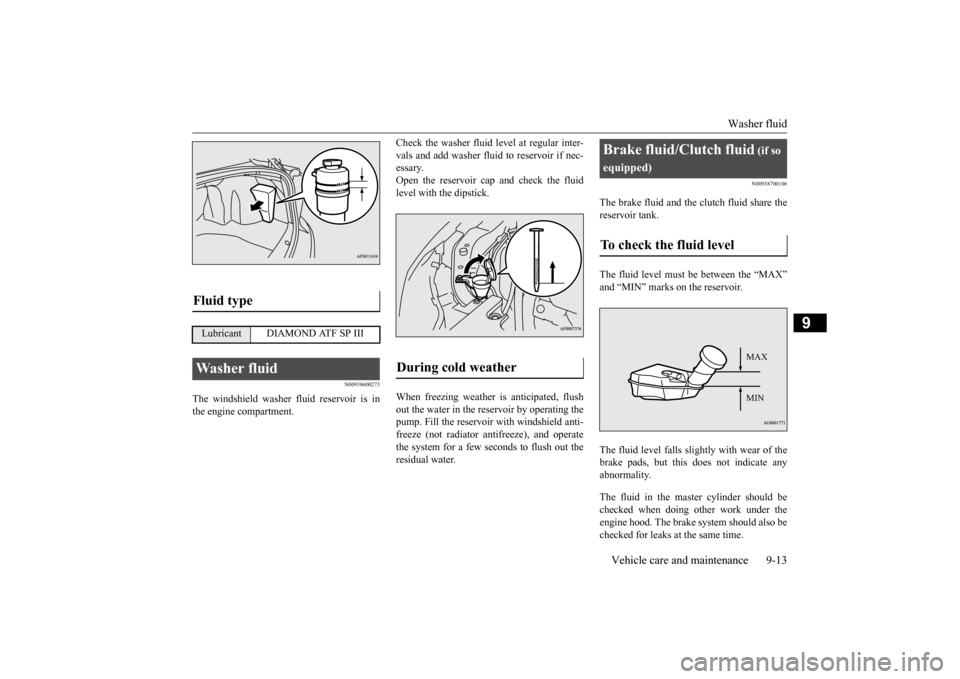
The brake fluid and the clutch fluid share thereservoir tank. The fluid level must be between the “MAX” and “MIN” marks on the reservoir. The fluid level falls slightly with wear of the brake pads, but this does not indicate any abnormality. The fluid in the master cylinder should be checked when doing other work under the engine hood. The brake
system should also be
checked for leaks at the same time.
Fluid type
Lubricant DIAMOND ATF SP IIIWasher fluid
During cold weather
Brake fluid/Clutch fluid
(if so
equipped)To check the fluid level
MAX MIN
BK0210300US.bo
ok 13 ページ 2014年4月8日 火曜日 午前10時46分
Page 371 of 434
Power steering fluid (if so equipped) 9-14 Vehicle care and maintenance
9
If the fluid level falls markedly in a short length of time, it indicates leaks from the brake system. If this occurs, have the vehicle checked by anauthorized Mitsubishi Motors dealer or a repair facility of your choice. Use the recommended brake fluid conform- ing to DOT 3 or DOT 4. The reservoir cap must be tightly sealed to keep dirt and water out.
N00939000388
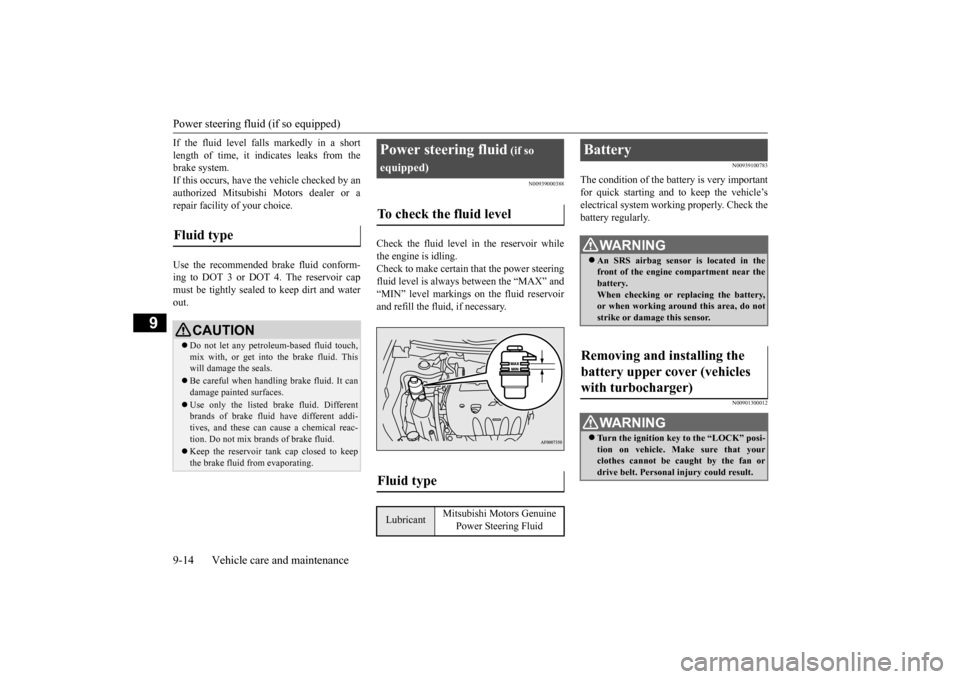
Check the fluid level in the reservoir whilethe engine is idling. Check to make certain that the power steering fluid level is always between the “MAX” and“MIN” level markings on the fluid reservoirand refill the fluid, if necessary.
N00939100783
The condition of the battery is very importantfor quick starting and to keep the vehicle’selectrical system working properly. Check the battery regularly.
N00901300012
Fluid type
CAUTION Do not let any petroleum-based fluid touch, mix with, or get into the brake fluid. This will damage the seals. Be careful when handling brake fluid. It can damage painted surfaces. Use only the listed brake fluid. Different brands of brake fluid have different addi-tives, and these can cause a chemical reac- tion. Do not mix brands of brake fluid. Keep the reservoir tank cap closed to keep the brake fluid from evaporating.
Power steering fluid
(if so
equipped)To check the fluid level
Fluid type
Lubricant
Mitsubishi Motors Genuine
Power Steering Fluid
Battery
WA R N I N G An SRS airbag sensor is located in the front of the engine compartment near the battery. When checking or replacing the battery,or when working around this area, do not strike or damage this sensor.
Removing and installing the battery upper cover (vehicles with turbocharger)
WA R N I N G Turn the ignition key to the “LOCK” posi- tion on vehicle. Make sure that your clothes cannot be ca
ught by the fan or
drive belt. Personal injury could result.
BK0210300US.bo
ok 14 ページ 2014年4月8日 火曜日 午前10時46分
Page 372 of 434
Battery
Vehicle care and maintenance 9-15
9
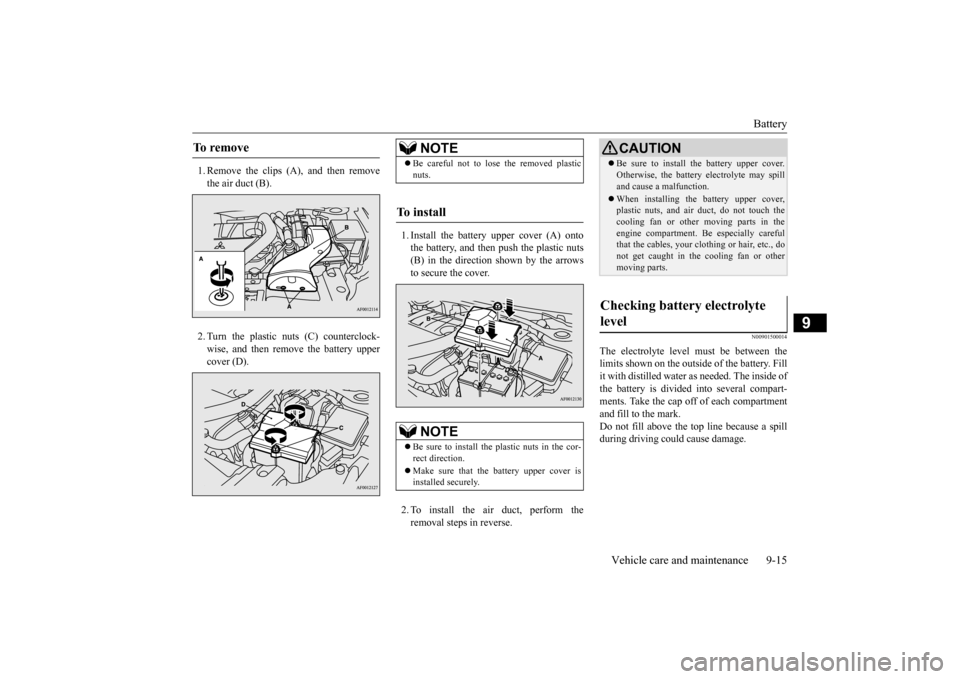
1. Remove the clips (A), and then remove the air duct (B). 2. Turn the plastic nuts (C) counterclock- wise, and then remove the battery uppercover (D).
1. Install the battery upper cover (A) onto the battery, and then push the plastic nuts (B) in the direction shown by the arrows to secure the cover. 2. To install the air duct, perform the removal steps in reverse.
N00901500014
The electrolyte level must be between the limits shown on the outside of the battery. Fill it with distilled water as needed. The inside ofthe battery is divided into several compart- ments. Take the cap off of each compartment and fill to the mark.Do not fill above the top line because a spill during driving could cause damage.
To remove
NOTE
Be careful not to lose the removed plastic nuts.
To install
NOTE
Be sure to install the plastic nuts in the cor- rect direction. Make sure that the battery upper cover is installed securely.
CAUTION Be sure to install the battery upper cover. Otherwise, the battery electrolyte may spill and cause a malfunction. When installing the battery upper cover, plastic nuts, and air duct, do not touch the cooling fan or other moving parts in the engine compartment. Be especially carefulthat the cables, your clothing or hair, etc., do not get caught in the cooling fan or other moving parts.
Checking battery electrolyte level
BK0210300US.bo
ok 15 ページ 2014年4月8日 火曜日 午前10時46分