engine MITSUBISHI LANCER 2015 8.G User Guide
[x] Cancel search | Manufacturer: MITSUBISHI, Model Year: 2015, Model line: LANCER, Model: MITSUBISHI LANCER 2015 8.GPages: 434, PDF Size: 16.59 MB
Page 21 of 434
If this problem occurs... 2-6 Quick index
2
Problem
Do this
Ref. page
The brakes are not functioning prop- erly after driving through water.
Dry out the brakes by driving slowly whil
e lightly pressing the brake pedal. P.6-5
The CVT makes no engine speed to vehicle speed ratio change when accelerating. The initial movement of the vehicle is slow when the vehicle starts moving.(for vehicles with CVT)
There may be a problem in the CVT. If the or warning lights on the multi-infor
mation display will not turn off, or if
they are coming on frequently, please have
the vehicle checked at your nearest Mitsubi-
shi Motors dealer.
P.5-69
Twin Clutch SST does not shift. Vehicle cannot move. Acceleration is slow.The vehicle does not creep. A large shock is felt when shifting. Shifting occurs at higher engine speed. Response is slow. (for vehicles with Twin Clutch SST)
The temperature of the Twin Clutch SST fluid
is high, a safety device in the Twin Clutch
SST has been activated due to a possible malfun
ction in the Twin Clutch SST, or there is
a possible malfunction in the engine electronic control module.
P.5-72, 5-81,
5-144
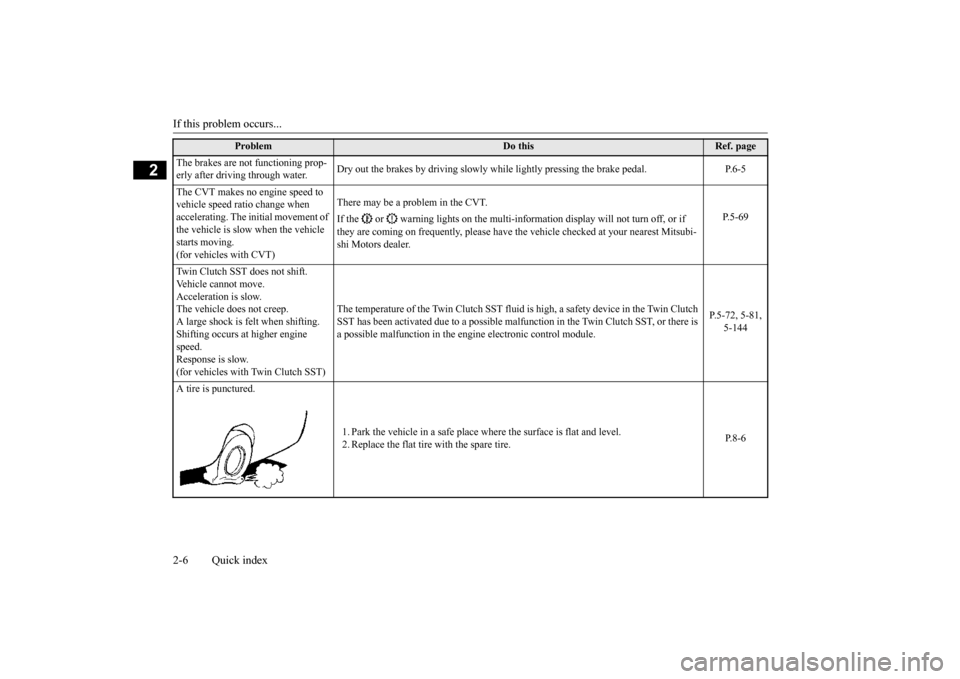
A tire is punctured.
1. Park the vehicle in a safe place
where the surface is flat and level.
2. Replace the flat tire with the spare tire.
P.8-6
BK0210300US.bo
ok 6 ページ 2014年4月8日 火曜日 午前10時46分
Page 23 of 434
Fuel selection 3-2 General information
3
N00301000866
Your vehicle is designed to use unleaded gas- oline only. It is equipped with a fuel fillertube especially designed to accept only a small diameter unlead
ed gasoline dispensing
nozzle. In the United States, fuel suppliers are required by law to add detergents to their gas-
oline to minimize fuel-injector fouling and minimize intake-valve deposits. Detergent gasoline helps keep your engine in tune and your emission-control system working prop-erly. Your vehicle is designed to operate on unleaded gasoline having a minimum octanenumber of 87 [(MON+RON)/2], or 91 RON. Your vehicle is designed to operate on pre- mium grade unleaded gasoline having a mini- mum octane number of 93 [(MON+RON)/2] or higher for optimum performance. In casepremium grade unleaded gasoline 93 [(MON+RON)/2] is not available, unleaded gasoline number of 91 [(MON+RON)/2] canbe used. However, the performance level is reduced. In order to maintain exhaust system durabil-ity, premium unleaded gasoline having an octane number of at least 91 [(MON+RON)/2] must be used.
If the premium grade unleaded gasoline num- ber of 91 [(MON+RON)/2] or higher is not available on journey, etc., regular unleaded gasoline having an octane number of 87[(MON+RON)/2] can be used temporarily as an emergency measure. MON: Motor Octane Number RON: Research Octane Number Gasoline sold at some service stations con- tains oxygenates such as ethanol, although the oxygenates may not be identified by thosenames. Oxygenates are required in some areas of the country. Such fuel can be used in your vehicle. A mixture of up to 10 % ethanol (grain alco- hol) and 90 % unleaded gasoline may be usedin your vehicle, provided the octane number is at least as high as that recommended for unleaded gasoline.
Fuel selection
WA R N I N G Gasoline is highly flammable and explo- sive. You could be burned, seriouslyinjured or killed when handling it. When- ever you refuel your vehicle, stop the engine and keep flames, sparks, andsmoking materials away from the vehicle. Always handle fuel in well-ventilated out- door areas.CAUTION Using leaded gasoline in your vehicle will damage the engine, catalytic converter, and the oxygen sensors. Also, using leaded gaso-line is illegal, and will void your warranty coverage of the engine, catalytic converter, and oxygen sensors.
Gasoline detergent additives
Octane requirement Except for RALLIART RALLIART
Oxygenated gasoline Ethanol (Gasohol)
BK0210300US.bo
ok 2 ページ 2014年4月8日 火曜日 午前10時46分
Page 24 of 434

Fuel selection
General information 3-3
3
Do not operate your vehicle on gasoline con- taining methanol (wood alcohol). Using thistype of alcohol could adversely affect the vehicle’s performance and damage critical parts of the vehicle’s fuel system. Many areas of the country require the use of cleaner burning fuel referred to as “Reformu- lated Gasoline”.Reformulated gasoline contains oxygenates and is specially blended to reduce vehicle emissions and improve air quality.Mitsubishi Motors Cor
poration strongly sup-
ports the use of reformulated gasoline. Prop- erly blended reformulated gasoline has noadverse effect on vehicle performance or the durability of the engine and fuel system. MMT is a manganese-containing metallic additive that is blended into some gasolinesto increase the octane number. Mitsubishi Motors Corporation recommends using gasolines without MMT.
Use of gasolines blended with MMT may adversely affect performance, and cause the malfunction indicator on your instrument panel to come on. If this happens, contact anauthorized Mitsubishi Motors dealer or a repair facility of your choice for assistance. Your vehicle may have been designed to sat- isfy California’s low-emission regulations based on clean-burning low-sulfur gasoline. Gasoline sold in parts of the country otherthan California is allowed to have a higher sulfur content. Using such gasoline could adversely affect the vehicle’s catalytic con-verter and cause the engine malfunction indi- cator (“SERVICE ENGINE SOON” or “CHECK ENGINE”) to come on. Illumina-tion of this indicator while you are using high-sulfur gasoline does not necessarily mean the vehicle’s emis
sion-control system is
malfunctioning. Your authorized Mitsubishi Motors dealer may suggest you try using a different, lower-sulfur brand of unleaded gas-oline to determine whether the problem is fuel-related.
Methanol Reformulated gasoline MMT (methylcyclopentadienyl manganese tricarbonyl)
Sulfur in gasoline
NOTE
Poor-quality gasoline can cause problems such as poor starting,
stalling during idling,
abnormal engine noise, and poor accelera- tion. If you experience any of these prob- lems, try using a different brand of gasoline.If the engine malfunction indicator (“SER- VICE ENGINE SOON” or “CHECK ENGINE”) flashes, have the vehicleinspected as soon as possible by the nearest authorized Mitsubishi Motors dealer or a repair facility of your choice. Repeatedly driving short distances at low speeds can cause deposits to form in the fuelsystem and engine, resulting in poor starting and poor acceleration. If these problems occur, you are advised to add a detergentadditive to the gasoline when you refuel the vehicle. The additive will remove the depos- its, thereby returning the engine to a normalcondition. Be sure to use a Mitsubishi Motors Genuine cleaning additive. Using an unsuitable additive could make the enginemalfunction. For details, please contact the nearest authorized Mitsubishi Motors dealer.
BK0210300US.bo
ok 3 ページ 2014年4月8日 火曜日 午前10時46分
Page 25 of 434
Filling the fuel tank 3-4 General information
3
N00301100900
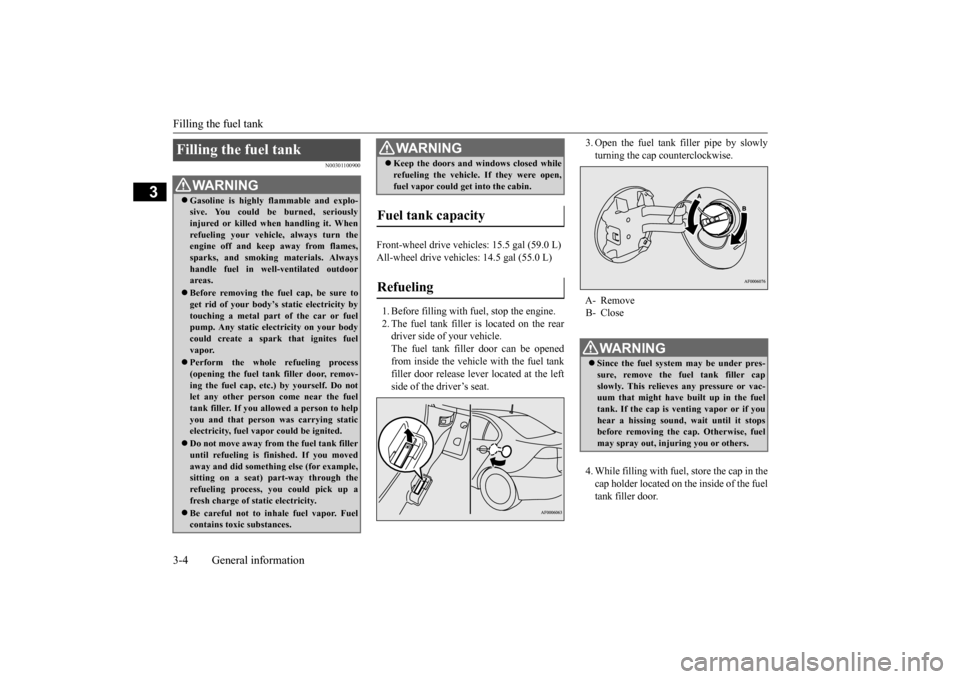
Front-wheel drive vehicles: 15.5 gal (59.0 L) All-wheel drive vehicles: 14.5 gal (55.0 L) 1. Before filling with fuel, stop the engine. 2. The fuel tank filler is located on the rear driver side of your vehicle. The fuel tank filler door can be openedfrom inside the vehicle with the fuel tank filler door release lever located at the left side of the driver’s seat.
3. Open the fuel tank filler pipe by slowly turning the cap counterclockwise. 4. While filling with fuel, store the cap in the cap holder located on the inside of the fuel tank filler door.
Filling the fuel tank
WA R N I N G Gasoline is highly flammable and explo- sive. You could be burned, seriously injured or killed when handling it. When refueling your vehicle, always turn theengine off and keep away from flames, sparks, and smoking materials. Always handle fuel in well-ventilated outdoorareas. Before removing the fuel cap, be sure to get rid of your body’s static electricity by touching a metal part of the car or fuel pump. Any static electricity on your bodycould create a spark that ignites fuel vapor. Perform the whole refueling process (opening the fuel tank filler door, remov- ing the fuel cap, etc.) by yourself. Do notlet any other person come near the fuel tank filler. If you allowed a person to help you and that person was carrying staticelectricity, fuel vapor could be ignited. Do not move away from the fuel tank filler until refueling is finished. If you moved away and did something else (for example, sitting on a seat) part-way through the refueling process, you could pick up a fresh charge of static electricity. Be careful not to inhale fuel vapor. Fuel contains toxic substances.
Keep the doors and windows closed while refueling the vehicle. If they were open, fuel vapor could get into the cabin.
Fuel tank capacity Refueling
WA R N I N G
A- Remove B- Close
WA R N I N G Since the fuel system may be under pres- sure, remove the fuel tank filler cap slowly. This relieves any pressure or vac-uum that might have built up in the fuel tank. If the cap is venting vapor or if you hear a hissing sound, wait until it stopsbefore removing the cap. Otherwise, fuel may spray out, injuring you or others.
BK0210300US.bo
ok 4 ページ 2014年4月8日 火曜日 午前10時46分
Page 26 of 434
Modifications to and racing of your vehicle
General information 3-5
3
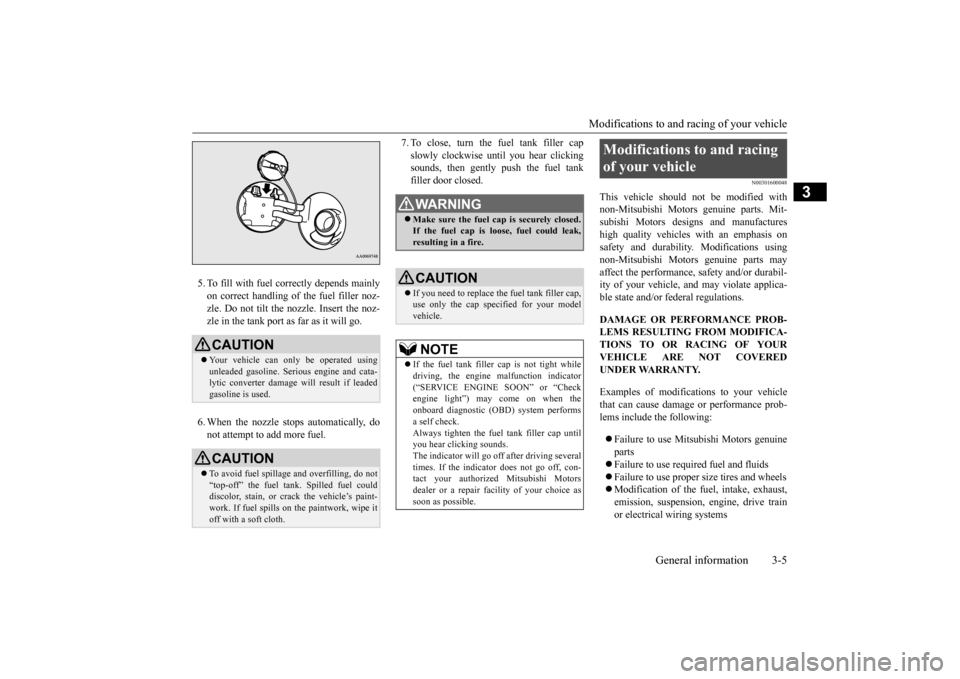
5. To fill with fuel correctly depends mainly on correct handling of the fuel filler noz- zle. Do not tilt the nozzle. Insert the noz-zle in the tank port as far as it will go. 6. When the nozzle stops automatically, do not attempt to add more fuel.
7. To close, turn the fuel tank filler cap slowly clockwise until you hear clicking sounds, then gently push the fuel tank filler door closed.
N00301600048
This vehicle should not be modified withnon-Mitsubishi Motors genuine parts. Mit-subishi Motors designs and manufactures high quality vehicles
with an emphasis on
safety and durability. Modifications usingnon-Mitsubishi Motors genuine parts may affect the performance, safety and/or durabil- ity of your vehicle, and may violate applica-ble state and/or federal regulations. DAMAGE OR PERFORMANCE PROB- LEMS RESULTING FROM MODIFICA- TIONS TO OR RACING OF YOUR VEHICLE ARE NOT COVEREDUNDER WARRANTY. Examples of modifications to your vehicle that can cause damage or performance prob- lems include the following: Failure to use Mitsubishi Motors genuine parts Failure to use required fuel and fluids Failure to use proper size tires and wheels Modification of the fuel, intake, exhaust, emission, suspension, engine, drive train or electrical wiring systems
CAUTION Your vehicle can only be operated using unleaded gasoline. Serious engine and cata-lytic converter damage will result if leaded gasoline is used.CAUTION To avoid fuel spillage and overfilling, do not “top-off” the fuel tank. Spilled fuel could discolor, stain, or crack the vehicle’s paint-work. If fuel spills on the paintwork, wipe it off with a soft cloth.
WA R N I N G Make sure the fuel cap is securely closed. If the fuel cap is loose, fuel could leak, resulting in a fire.CAUTION If you need to replace the fuel tank filler cap, use only the cap specified for your model vehicle. NOTE
If the fuel tank filler
cap is not tight while
driving, the engine malfunction indicator (“SERVICE ENGINE SOON” or “Checkengine light”) may come on when the onboard diagnostic (OBD) system performs a self check. Always tighten the fuel tank filler cap until you hear clicking sounds.The indicator will go off after driving several times. If the indicator does not go off, con- tact your authorized Mitsubishi Motorsdealer or a repair facility of your choice as soon as possible.
Modifications to and racing of your vehicle
BK0210300US.bo
ok 5 ページ 2014年4月8日 火曜日 午前10時46分
Page 72 of 434
Break-in recommendations
Features and controls 5-3
5
N00508700297
Advanced automobile manufacturing tech- niques permit you to operate your new vehi-cle without requiring a long break-in period of low-speed driving. However, you can add to the future perfor-mance and economy of your vehicle by observing the following precautions during the first 300 miles (500 km).Drive your vehicle at moderate speeds duringthe break-in period. Avoid revving the engine. For vehicles with turbocharger, do not exceed 5,000 rpm for the first 600 miles (1,000 km). Avoid rough driving such as fast starts, sudden acceleration, prolonged high- speed driving and sudden braking. Thesewould have a detrimental effect on the engine and also cause increased fuel and oil consumption, which could result inmalfunction of the engine components. Be particularly careful to avoid full accelera- tion while in low gear. Do not overload the vehicle. Observe the seating capacity (See “Cargo load precau- tions” on page 6-10). Do not use this vehicle for trailer towing.
N00508800559
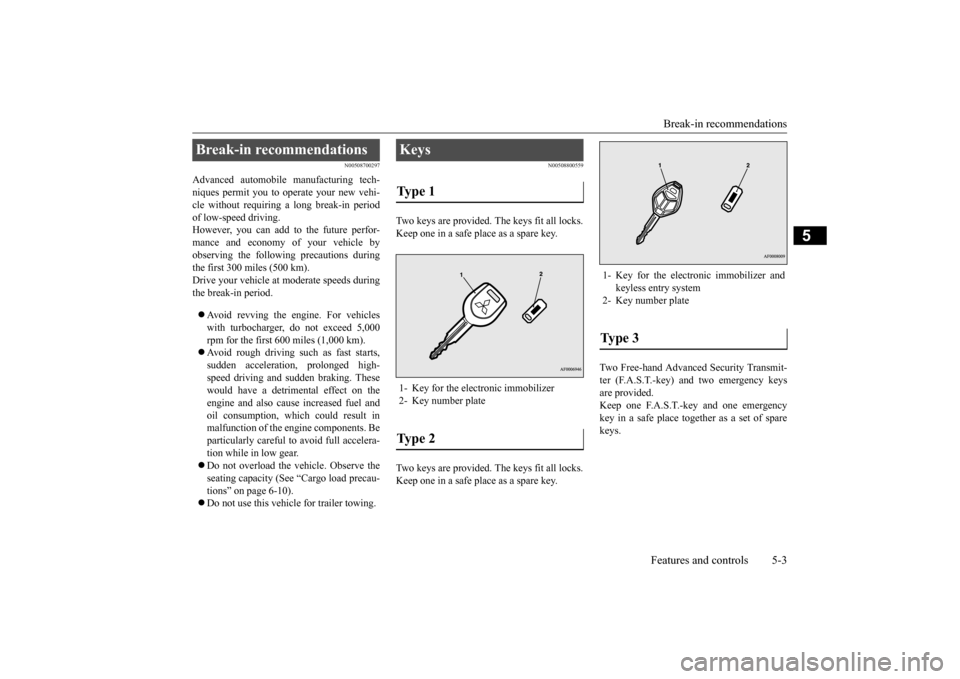
Two keys are provided. The keys fit all locks. Keep one in a safe place as a spare key. Two keys are provided. The keys fit all locks. Keep one in a safe place as a spare key.
Two Free-hand Advanced Security Transmit- ter (F.A.S.T.-key) and two emergency keysare provided. Keep one F.A.S.T.-key and one emergency key in a safe place together as a set of sparekeys.
Break-in recommendations
Keys Type 1 1- Key for the electronic immobilizer2- Key number plateType 2
1- Key for the electronic immobilizer and
keyless entry system
2- Key number plateType 3
BK0210300US.bo
ok 3 ページ 2014年4月8日 火曜日 午前10時46分
Page 73 of 434
![MITSUBISHI LANCER 2015 8.G User Guide Electronic immobilizer (Anti-theft starting system) 5-4 Features and controls
5
N00509101804
[For vehicles equipped with the Free-hand Advanced Security Transmitter (F.A.S.T.-key)] For information on](/img/19/7462/w960_7462-72.png "MITSUBISHI LANCER 2015 8.G User Guide Electronic immobilizer (Anti-theft starting system) 5-4 Features and controls
5
N00509101804
[For vehicles equipped with the Free-hand Advanced Security Transmitter (F.A.S.T.-key)] For information on")
Electronic immobilizer (Anti-theft starting system) 5-4 Features and controls
5
N00509101804
[For vehicles equipped with the Free-hand Advanced Security Transmitter (F.A.S.T.-key)] For information on operations for vehicles equipped with the Free-hand Advanced Secu-rity Transmitter (F.A.S.T.-key), refer to “Free-hand Advanced Security Transmitter (F.A.S.T.-key)”: “Electronic immobilizer(Anti-theft starting system)” on page 5-28. [Except for vehicles equipped with the Free- hand Advanced Security Transmitter (F.A.S.T.-key)] The electronic immobilizer is designed to sig-nificantly reduce the possibility of vehicle theft. The purpose of the system is to immo- bilize the vehicle if an invalid start isattempted. A valid start attempt can only be achieved (subject to certain conditions) using a key “registered” to the immobilizer system.All of the keys provided with your new vehi- cle have been programmed to the vehicle’s electronics.
1- Free-hand Advanced Security Transmit-
ter (F.A.S.T.-key) (with electronic immo
bilizer and keyless
entry system function)
2- Emergency key 3- Key number plate
NOTE
The key is a precision electronic device with a built-in signal transmitter. Please observethe following in order to prevent damage. • Do not leave where it may be exposed to heat caused by direct sunlight, such as on top of the dashboard. • Do not take the remote control transmitter apart. • Do not excessively bend the key or subject it to strong impacts. • Keep the remote control transmitter dry. • Keep away from magnetic objects such as key holders.
• Keep away from devices that produce mag- netism, such as audio systems, computers and televisions. • Keep away from devices that emit strong electromagnetic waves, such as cellular phones, wireless devices and high fre- quency equipment (including medicaldevices). • Do not clean with ultrasonic cleaners.• Do not leave the key where it may be exposed to high temperature or high humid-ity.
If you lose your key, to prevent the theft of the vehicle immediately contact an autho- rized Mitsubishi Motors dealer. If you notify an authorized MitsubishiMotors dealer of the key number, they can make a new key. The key number is stamped on the key number plate. Keep the key num-ber plate in a safe place separate from the key itself. No keys other than those registered in advance can be used to start the engine. Refer to “Electronic immobilizer (Anti-theftstarting system)” on page 5-4. Refer to “Free-hand Advanced Security Transmitter (F.A.S.T.-key)”: “Electronic immobilizer (Anti-theft starting system)” on page 5-28.NOTE
Electronic immobilizer (Anti-theft starting system)
BK0210300US.bo
ok 4 ページ 2014年4月8日 火曜日 午前10時46分
Page 74 of 434
Electronic immobilizer (Ant
i-theft starting system)
Features and controls 5-5
5
Only keys that have been programmed to the vehicle’s electronics can be used to start the vehicle. If you lose the key, you can order a key from your authorized Mitsubishi Motors dealer by referring to the key number. To prevent vehicle theft, the ID code for thevehicle keys must be changed. Take your vehicle and all remaining keys to your authorized Mitsubishi Motors dealer tohave your ID code changed. To add a key, you need to register the ID code to the vehicle. Registering the ID code can be done by your authorized Mitsubishi Motors dealer. Or itcan be done by yourself (except for vehicles sold in Canada).
NOTE
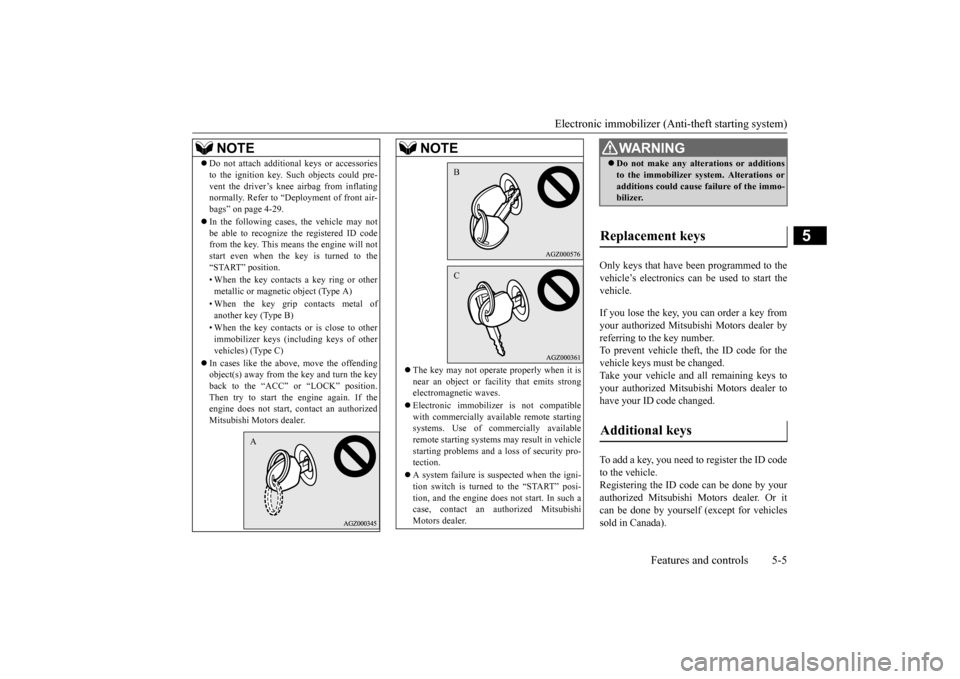
Do not attach additional keys or accessories to the ignition key. Such objects could pre- vent the driver’s knee airbag from inflating normally. Refer to “Deployment of front air- bags” on page 4-29. In the following cases, the vehicle may not be able to recognize the registered ID codefrom the key. This means the engine will not start even when the key is turned to the “START” position. • When the key contacts a key ring or other metallic or magnetic object (Type A) • When the key grip contacts metal of another key (Type B) • When the key contacts or is close to other immobilizer keys (including keys of othervehicles) (Type C)
In cases like the above, move the offending object(s) away from the key and turn the key back to the “ACC” or “LOCK” position. Then try to start the
engine again. If the
engine does not start, contact an authorized Mitsubishi Motors dealer.
A
The key may not operate properly when it is near an object or facility that emits strong electromagnetic waves. Electronic immobilizer is not compatible with commercially available remote startingsystems. Use of commercially available remote starting systems may result in vehicle starting problems and a lo
ss of security pro-
tection. A system failure is suspected when the igni- tion switch is turned to the “START” posi- tion, and the engine does not start. In such a case, contact an authorized MitsubishiMotors dealer.NOTE
BC
WA R N I N G Do not make any alterations or additions to the immobilizer system. Alterations or additions could cause failure of the immo- bilizer.
Replacement keys Additional keys
BK0210300US.bo
ok 5 ページ 2014年4月8日 火曜日 午前10時46分
Page 81 of 434
Free-hand Advanced Security Transmitter (F.A.S.T.-key) (if so equipped) 5-12 Features and controls
5
8. Check the keyless entry system to see that it works.
N00503100052
The Free-hand Advanced Security Transmit-ter (F.A.S.T.-key) enables the doors to belocked and unlocked, the trunk lid to be opened, and the engine to be started simply by carrying it.The F.A.S.T.-key can also be used as the remote control transmitter of the keyless entry system.Refer to “Free-hand Advanced Security Transmitter (F.A.S.T.-key)”: “Keyless entry
system” on page 5-30.
NOTE
You may purchase a replacement battery at an electric appliance store. Your authorized Mitsubishi Motors dealer can replace the battery for you if you prefer.CAUTION When the remote control transmitter case is opened, be careful to keep water, dust, etc.out. Also, do not touch the internal compo- nents.
Free-hand Advanced Secu- rity Transmitter (F.A.S.T.-key)
(if so equipped)
The F.A.S.T.-key must be carried by the driver. The F.A.S.T.-key is required for vehicle operations such as locking and unlocking the doors, opening the trunk lid, and starting the engine. When leaving the vehicle, make sure you are carrying the F.A.S.T.-key and then lock the vehi- cle.
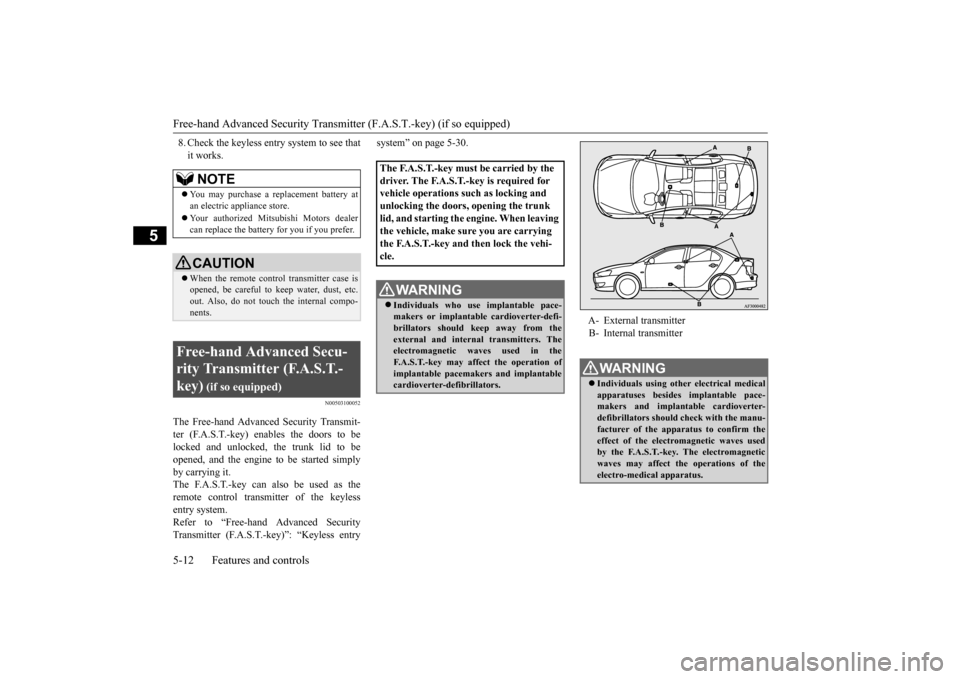
WA R N I N G Individuals who use implantable pace- makers or implantable cardioverter-defi-brillators should keep away from the external and internal
transmitters. The
electromagnetic waves used in theF.A.S.T.-key may affect the operation of implantable pacemakers and implantable cardioverter-defibrillators.
A- External transmitter B- Internal transmitterWA R N I N G Individuals using other electrical medical apparatuses besides implantable pace-makers and implantable cardioverter- defibrillators should check with the manu- facturer of the apparatus to confirm the effect of the electromagnetic waves used by the F.A.S.T.-key. The electromagneticwaves may affect the operations of the electro-medical apparatus.
BK0210300US.bo
ok 12 ページ 2014年4月8日 火曜日 午前10時46分
Page 82 of 434
Free-hand Advanced Security Transmit
ter (F.A.S.T.-key) (if so equipped)
Features and controls 5-13
5
The operations possible with the F.A.S.T.- key can be modified as stated below. (Keyless entry operations are possible.) For details, contact an authorized Mitsubi-shi Motors dealer. • Enabling only the locking and unlocking of the doors and the opening of the trunklid • Enabling only the starting of the engine • Deactivating the F.A.S.T.-key
N00503200112
When a person enters the operating range of the F.A.S.T.-key while carrying the F.A.S.T.- key and presses the driver’s or front passen-ger’s door lock/unlock switch or the trunk lid OPEN switch, verification of the ID code is performed.The F.A.S.T.-key enables the doors to be locked and unlocked, the trunk lid to be opened and the engine to be started only
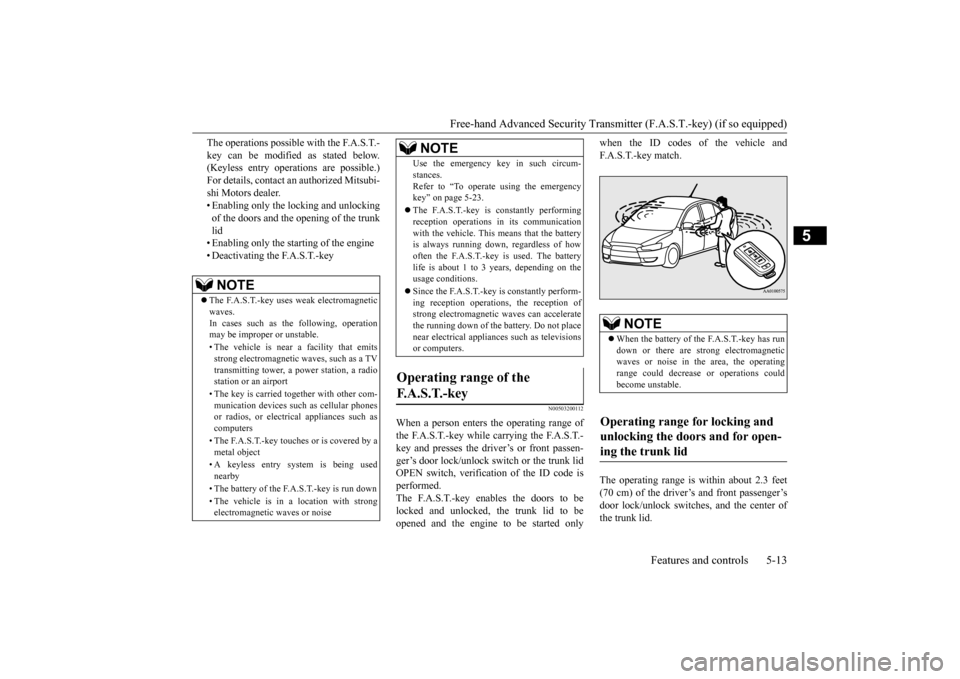
when the ID codes of the vehicle and F.A.S.T.-key match. The operating range is within about 2.3 feet (70 cm) of the driver’s and front passenger’s door lock/unlock switches, and the center of the trunk lid.
NOTE
The F.A.S.T.-key uses weak electromagnetic waves.In cases such as the following, operation may be improper or unstable. • The vehicle is near a facility that emits strong electromagnetic waves, such as a TV transmitting tower, a power station, a radiostation or an airport • The key is carried together with other com- munication devices such as cellular phones or radios, or electrical appliances such as computers • The F.A.S.T.-key touches or is covered by a metal object • A keyless entry system is being used nearby • The battery of the F.A.S.T.-key is run down• The vehicle is in a location with strong electromagnetic waves or noise
Use the emergency key in such circum- stances. Refer to “To operate using the emergency key” on page 5-23. The F.A.S.T.-key is constantly performing reception operations in its communication with the vehicle. This means that the batteryis always running down, regardless of how often the F.A.S.T.-key is used. The battery life is about 1 to 3 years, depending on theusage conditions. Since the F.A.S.T.-key is constantly perform- ing reception operations, the reception of strong electromagnetic waves can accelerate the running down of the battery. Do not placenear electrical appliances such as televisions or computers.
Operating range of the F. A . S . T. - k e y
NOTE
NOTE
When the battery of the F.A.S.T.-key has run down or there are strong electromagnetic waves or noise in the area, the operating range could decrease or operations couldbecome unstable.
Operating range for locking and unlocking the doors and for open- ing the trunk lid
BK0210300US.bo
ok 13 ページ 2014年4月8日 火曜日 午前10時46分