warning light MITSUBISHI LANCER 2015 8.G User Guide
[x] Cancel search | Manufacturer: MITSUBISHI, Model Year: 2015, Model line: LANCER, Model: MITSUBISHI LANCER 2015 8.GPages: 434, PDF Size: 16.59 MB
Page 89 of 434
Free-hand Advanced Security Transmitter (F.A.S.T.-key) (if so equipped) 5-20 Features and controls
5
N00560100105
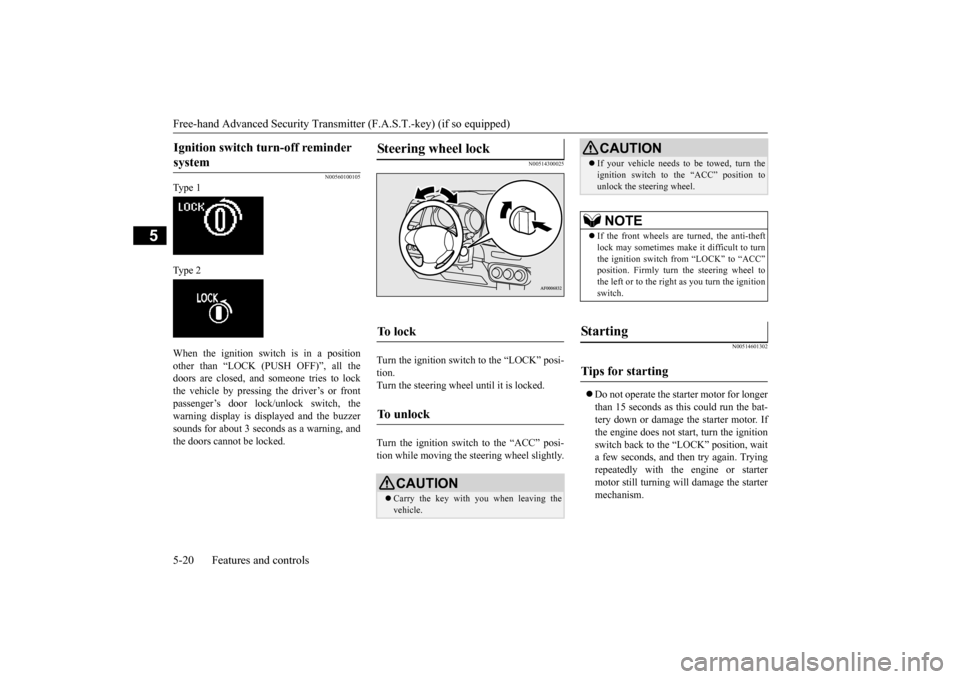
Ty p e 1 Ty p e 2 When the ignition switch is in a position other than “LOCK (PUSH OFF)”, all the doors are closed, and someone tries to lock the vehicle by pressing the driver’s or frontpassenger’s door lock/unlock switch, the warning display is displayed and the buzzer sounds for about 3 seconds as a warning, andthe doors cannot be locked.
N00514300025
Turn the ignition switch to the “LOCK” posi-tion.Turn the steering wheel until it is locked. Turn the ignition switch to the “ACC” posi- tion while moving the steering wheel slightly.
N00514601302
Do not operate the starter motor for longer than 15 seconds as this could run the bat-tery down or damage the starter motor. If the engine does not start, turn the ignition switch back to the “LOCK” position, waita few seconds, and then try again. Trying repeatedly with the engine or starter motor still turning will damage the startermechanism.
Ignition switch turn-off reminder system
Steering wheel lock
To l o c k
To u n l o c k
CAUTION Carry the key with you when leaving the vehicle.
If your vehicle needs to be towed, turn the ignition switch to the “ACC” position to unlock the steering wheel.NOTE
If the front wheels are turned, the anti-theft lock may sometimes make it difficult to turn the ignition switch from “LOCK” to “ACC”position. Firmly turn the steering wheel to the left or to the right as you turn the ignition switch.
St arting
Tips for starting
CAUTION
BK0210300US.bo
ok 20 ページ 2014年4月8日 火曜日 午前10時46分
Page 91 of 434

Free-hand Advanced Security Transmitter (F.A.S.T.-key) (if so equipped) 5-22 Features and controls
5
5. While pushing the ignition switch from “LOCK” (PUSH OFF) to “LOCK” (PUSH ON), set the ignition switch to the “ON” position and confirm that all warn-ing lights and warning displays are oper- ating properly. 6. Without pressing the accelerator pedal,slowly turn the ignition switch to the “START” position to start the engine. Release the ignition switch when theengine starts.
After several attempts, you may experience that the engine still does not start. 1. Make sure that all electric devices, such as lights, air conditioning blower and rear window defogger, are turned off.
2. While depressing the brake pedal on vehi- cles equipped with continuously variable transmission (CVT) or Twin Clutch SST or the clutch pedal on the vehiclesequipped with manual transaxle, press the accelerator pedal halfway and hold it there, then crank the engine. Release theaccelerator pedal, immediately after the engine starts. 3. If the engine still will not start, the enginecould be flooded with too much gasoline.While depressing the brake pedal on vehi- cles equipped with CVT or Twin Clutch SST or the clutch pedal on the vehiclesequipped with manual
transaxle, push the
accelerator pedal all the way down and hold it there, then crank the engine for 5to 6 seconds. Return the ignition switch to the “LOCK” position and release the accelerator pedal. Wait a few seconds, andthen crank the engine again for 5 to 6 sec- onds while depressing the brake pedal or the clutch pedal, but do not push theaccelerator pedal. Release the ignition key if the engine starts.
If the engine fails to
start, repeat these procedures. If theengine still will not start, contact your local Mitsubishi Motors dealer or a repair facility of your choice for assistance.
When the ambient temperature is -4°F (-20°C) or lower on vehicles with CVT, or -22°F (-30°C) or lower on vehicles with Twin Clutch SST, it may not be possible to startfrom a standstill even with the selector lever (CVT) or the gearshift lever (Twin Clutch SST) in the “D” (DRIVE) or “R”(REVERSE) position.This phenomenon occurs because the trans- axle has not warmed up sufficiently; it does not indicate a problem. If this occurs, placethe selector lever (CVT) or the gearshift lever (Twin Clutch SST) in the “P” (PARK) posi- tion and let the engine idle for at least 10 min-utes. The transaxle will warm up, and you will be able to drive normally.Do not leave the vehicle during warm-up operation.
NOTE
Minor noises may be heard on engine start- up. These will disappear as the engine warms up.
When the engine is hard to start
Startability of continuously variable transmission (CVT) vehicles or Twin Clutch SST vehicles at extremely coldambient temperature
BK0210300US.bo
ok 22 ページ 2014年4月8日 火曜日 午前10時46分
Page 96 of 434
Free-hand Advanced Security Transmit
ter (F.A.S.T.-key) (if so equipped)
Features and controls 5-27
5
7. On vehicles with manual transaxle, place the gearshift lever in the “N” (Neutral) position. On vehicles with CVT or Twin ClutchSST, make sure the selector lever (CVT)or the gearshift lever (Twin Clutch SST) is in the “P” (PARK) position.
8. Turn the emergency key with the F.A.S.T.-key to the “ON” position and make certain that all warning lights and warning displays are functioning properlybefore starting the engine. 9. Turn the emergency key with the F.A.S.T.-key to the “START” positionwithout pressing the accelerator pedal. Release the emergency key with the F.A.S.T.-key when the engine starts.
10. Remove the F.A.S.T.-key from the emer-
gency key.
After several attempts, you may experience that the engine still does not start. 1. Make sure that all electric devices, such as lights, air conditioning blower and rearwindow defogger, are turned off. 2. While depressing the brake pedal on vehi- cles equipped with continuously variabletransmission (CVT) or Twin Clutch SST or the clutch pedal on the vehicles equipped with manual transaxle, press theaccelerator pedal halfway and hold it there, then crank the engine. Release the accelerator pedal, immediately after theengine starts.
NOTE
For models equipped with a manual trans- axle, the starter will
not operate unless the
clutch pedal is fully depressed (Clutch inter- lock). This is a safety feature.NOTE
On vehicles with continuously variable transmission (CVT) or Twin Clutch SST, the starter will not operate unless the selector lever (CVT) or the gearshift lever (TwinClutch SST) is in the “P” (PARK) position or the selector lever (CVT) or the gearshift lever (Twin Clutch SST) is in the “N” (NEU-TRAL) position with the brake pedal depressed. For safety reasons, start the engine in the “P” (PARK) position so that the wheels are locked.
NOTE
Minor noises may be heard on engine start- up. These will disappear as the engine warms up. WA R N I N G Make sure to remove the F.A.S.T.-key from the emergency key after the engine is started. If not removed, the F.A.S.T.-key could fall to the floor, which may interfere with pedal operation.Furthermore, the F.A.S.T.-key could pre- vent the driver’s knee airbag from inflat- ing normally or could be propelled tocause serious injury if the airbag inflates.
NOTE
When using the emergency key to start the engine, first remove the key from the key holder. If the emergency key is attached to a key holder (key ring), it may become impos- sible to insert the keyless operation key intothe emergency key, and it may prevent the engine from being started.
When the engine is hard to start
BK0210300US.bo
ok 27 ページ 2014年4月8日 火曜日 午前10時46分
Page 112 of 434
Theft-alarm system
Features and controls 5-43
5
N00510401197
The alarm will be activated if any of the fol- lowing occur while the vehicle is parked andthe system is armed. One of the doors is opened without using the remote control transmitter or the F. A . S . T. - k e y. The engine hood or the trunk lid is opened.
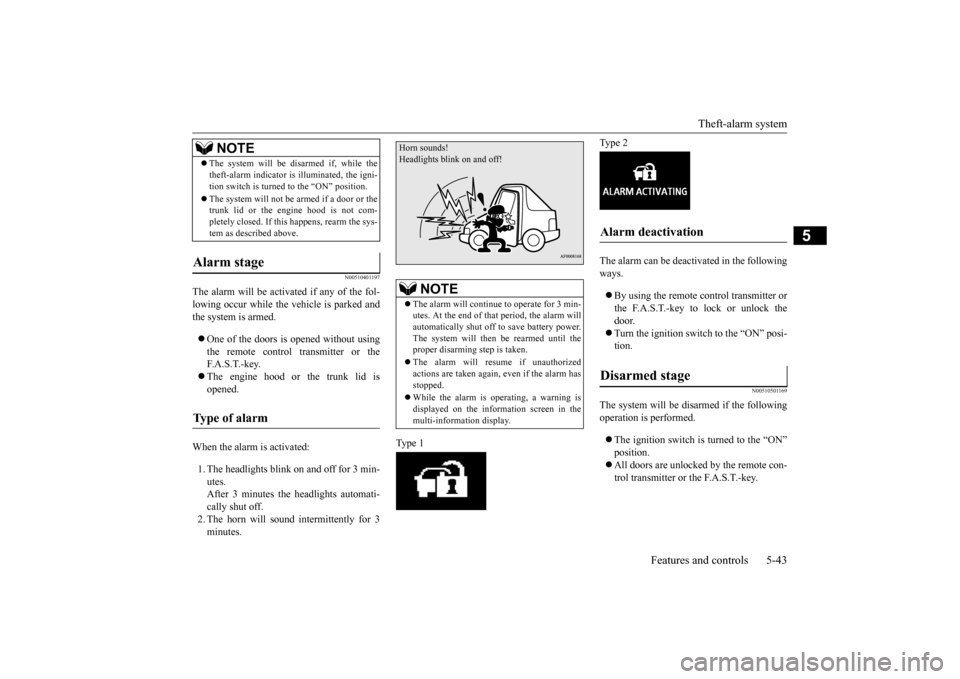
When the alarm is activated: 1. The headlights blink on and off for 3 min- utes. After 3 minutes the headlights automati-cally shut off. 2. The horn will sound intermittently for 3 minutes.
Type 1
Type 2 The alarm can be deactivated in the following ways. By using the remote control transmitter or the F.A.S.T.-key to lock or unlock the door. Turn the ignition switch to the “ON” posi- tion.
N00510501169
The system will be disarmed if the followingoperation is performed. The ignition switch is turned to the “ON” position. All doors are unlocked by the remote con- trol transmitter or the F.A.S.T.-key.
The system will be disarmed if, while the theft-alarm indicator is illuminated, the igni- tion switch is turned to the “ON” position. The system will not be
armed if a door or the
trunk lid or the engine hood is not com- pletely closed. If this happens, rearm the sys- tem as described above.
Alarm stage Type of alarm
NOTE
NOTE
The alarm will continue to operate for 3 min- utes. At the end of that period, the alarm will automatically shut off to save battery power. The system will then
be rearmed until the
proper disarming step is taken. The alarm will resume if unauthorized actions are taken again, even if the alarm has stopped. While the alarm is operating, a warning is displayed on the information screen in the multi-information display.
Horn sounds!Headlights blink on and off!
Alarm deactivation Disarmed stage
BK0210300US.bo
ok 43 ページ 2014年4月8日 火曜日 午前10時46分
Page 118 of 434
Parking brake
Features and controls 5-49
5
When parking on a hill, apply the parking brake and turn the front wheels toward thecurb on a downhill grade, away from the curb on an uphill grade.
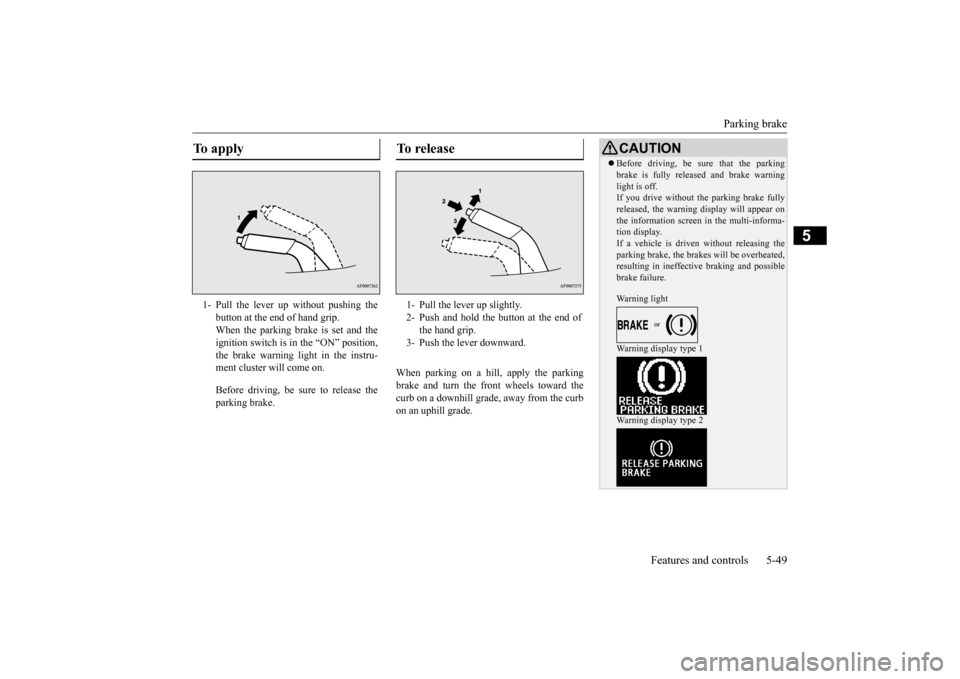
To apply 1- Pull the lever up without pushing the
button at the end of hand grip. When the parking brake is set and theignition switch is in the “ON” position, the brake warning light in the instru- ment cluster will come on. Before driving, be sure to release the parking brake.
To release 1- Pull the lever up slightly. 2- Push and hold the button at the end of
the hand grip.
3- Push the lever downward.
CAUTION Before driving, be sure that the parking brake is fully released and brake warning light is off. If you drive without the parking brake fully released, the warning display will appear onthe information screen in the multi-informa- tion display. If a vehicle is driven without releasing theparking brake, the brakes will be overheated, resulting in ineffective braking and possible brake failure. Warning light Warning display type 1 Warning display type 2
BK0210300US.bo
ok 49 ページ 2014年4月8日 火曜日 午前10時46分
Page 126 of 434

Starting and stopping the engine Features and controls 5-57
5
7. Turn the ignition switch to the “ON” posi- tion and make certain that all warning lights are functioning properly beforestarting the engine. 8. Turn the ignition switch to the “START”pedal. Release the key when the engine starts.
After several attempts, you may experience that the engine still does not start.
1. Make sure that all electric devices, such as lights, air conditioning blower and rear window defogger, are turned off. 2. While depressing the brake pedal on vehi-cles equipped with continuously variable transmission (CVT) or Twin Clutch SST or the clutch pedal on the vehiclesequipped with manual transaxle, press the accelerator pedal halfway and hold it there, then crank the engine. Release theaccelerator pedal, immediately after theengine starts. 3. If the engine still will not start, the engine could be flooded with too much gasoline.While depressing the brake pedal on vehi- cles equipped with CVT or Twin Clutch SST or the clutch pedal on the vehiclesequipped with manual transaxle, push the accelerator pedal all the way down and hold it there, then crank the engine for 5to 6 seconds. Return the ignition switch to the “LOCK” position and release the accelerator pedal. Wait a few seconds, andthen crank the engine again for 5 to 6 sec- onds while depressing the brake pedal or the clutch pedal, but do not push theaccelerator pedal. Release the ignition key if the engine starts. If the engine fails to start, repeat these procedures. If theengine still will not start, contact your local Mitsubishi Motors dealer or a repair facility of your choice for assistance.
When the ambient temperature is -4 °F (-20 °C) or lower on vehicles with CVT, or -22 °F (-30 °C) or lower on vehicles withTwin Clutch SST, it may not be possible tostart from a standstill even with the selector lever (CVT) or the gearshift lever (Twin Clutch SST) in the “D” (DRIVE) or “R”(REVERSE) position. This phenomenon occurs because the trans- axle has not warmed up sufficiently; it doesnot indicate a problem. If it occurs, place the selector lever (CVT) or the gearshift lever (Twin Clutch SST) in the “P” (PARK) posi-tion and let the engine idle for at least 10 min- utes. The transaxle will warm up, and you will beable to start normally. Do not leave the vehicle during warm-up operation.
N00547600015
At high altitude locations, the idle speed maybe higher. This is done in order to stabilize
NOTE
On vehicles with CVT, the starter will not operate unless the selector lever is in the “P” (PARK) or “N” (NEUTRAL) position. On vehicles with Twin Clutch SST, the starter will not operate unless the gearshiftlever is in the “P”
(PARK) position or the
gearshift lever is in the “N” (NEUTRAL) position with the brake pedal depressed.For safety reasons, start the engine in the “P” (PARK) position so that the wheels are locked.NOTE
Minor noises may be heard on engine start- up. These will disappear as the engine warms up.
When the engine is hard to start
Startability of continuously vari- able transmission (CVT) vehicles or Twin Clutch SST vehicles at extremely cold ambient tempera- ture Idle speed in high altitude area
BK0210300US.bo
ok 57 ページ 2014年4月8日 火曜日 午前10時46分
Page 149 of 434
Twin Clutch SST (Sportronic Shif
t Transmission) (if so equipped)
5-80 Features and controls
5
N00541600039
The Twin Clutch SST may not upshift to a higher shift position if the computer deter- mines the current speed cannot be maintainedonce a higher shift position is engaged. For smoother vehicle performance, if you release the throttle while climbing a steepgrade, the Twin Clutch SST may not upshift.This is normal, as the computer is temporarily preventing shifting. After reaching the top of the hill, normal shift function will resume.
When traveling down steep grades, the com- puter may automatically select a lower shift position. This function
assists engine braking
efforts, reducing the need for using the ser- vice brakes.
N00541000033
For short waiting periods, such as at trafficlights, the vehicle can be left in gearshift
lever position and held stationary with the service brake. For longer waiting periods with the engine running, place the gearshift lever in the “N”(NEUTRAL) position and apply the parking brake, while holding the vehicle stationary with the service brake.Prior to moving off after having stopped the vehicle, make sure that the gearshift lever is in “D” (DRIVE) position or manual shiftposition.
Uphill/downhill driving
DRIVING UPHILL
CAUTION Do not use the tendency of the vehicle to creep forward in order to drive at low speeds up hills.The transmission may be damaged and an accident may occur due to the following con- ditions.• The Twin Clutch SST fluid temperaturewill rise and can cause transmission dam-age.
• If the vehicle is continuously driven at low speeds using the tendency of the vehicle to creep forward, the vehicle will vibrate or the warning display will appear on the information screen in the multi-information display to alert the driver that the Twin Clutch SST fluid temperature has risen.After that, if the Twin Clutch SST fluid temperature rises even higher, the transmis- sion protection control will operate.If this occurs, the vehicle may suddenly reverse as if the gearshift lever was in the “N” (NEUTRAL) position and cause an accident. If the warning display appears or the transmission protection control operates, refer to “When warning display is showing” on page 5-72.
DRIVING DOWNHILLWa i t i n g
CAUTION
CAUTION Do not rev the engine unnecessarily while the vehicle is stationary. Unexpected acceler- ation may occur if the gearshift lever is in aposition other than “P” (PARK) or “N” (NEUTRAL). Do not keep the vehicle in a stopped position on an uphill slope by depressing the acceler- ator pedal instead of the brake pedal.The transmission may be damaged and an accident may occur due to the following con- ditions.• The Twin Clutch SST fluid temperaturewill rise and can cause transmission dam- age.
BK0210300US.bo
ok 80 ページ 2014年4月8日 火曜日 午前10時46分
Page 150 of 434
Twin Clutch SST (Sportronic Shif
t Transmission) (if so equipped) Features and controls 5-81
5
N00541100018
To park the vehicle, first bring it to a com- plete stop, fully engage the parking brake, and then move the gearshift lever to the “P”(PARK) position.
N00541201087
If there is a malfunction in the Twin Clutch SST or engine electronic control module, the following may occur. Twin Clutch SST does not shift. Vehicle cannot move. Twin Clutch SST acceleration is slow. Vehicle does not creep. “Shift shock” is large. Shifting occurs at higher engine speed. Response is slow.
If any of these occurs, perform the following procedure. The temperature of Twin Clutch SST fluid is high. Refer to “Warning display” on page 5-72 and follow the appropriate measures. There could be a malfunction in the engine electronic control module.
Refer to “Engine malfunction indicator (“SERVICE ENGINE SOON” or “Check engine light”)” on page 5-144 and follow the appropriate measures. A safety device in the Twin Clutch SST has been activated due to a possible malfunctionin the Twin Clutch SST. Refer to “If the gearshift lever position dis- play is not showing” on
page 5-72 and follow
the appropriate measures. A safety device in the Twin Clutch SST has been activated due to a possible malfunctionin the Twin Clutch SST or in the engine elec-tronic control module. Perform the following procedure.1. Park your vehicle in a safe place and stop the engine. 2. Restart the engine. If the vehicle moves and accelerates normally after this procedure is performed, there is no malfunction in the transmission.
• If the vehicle is kept in a stopped position by depressing the accelerator pedal instead of the brake pedal, the vehicle will vibrate or the warning display will appear on the information screen in the multi-infor- mation display to alert the driver that the Twin Clutch SST fluid temperature hasrisen. After that, if the Twin Clutch SST fluid temperature rises even higher, the transmis-sion protection control will operate. If this occurs, the vehicle may suddenly reverse as if the gearshift lever was in the “N” (NEUTRAL) position and cause an accident. If the warning display appears or the transmission protection control operates, refer to “When warning display is showing” on page 5-72.
Parking
CAUTION
What to do if the following occur with the Twin Clutch SST
When warning display is showing When the engine malfunction indicator (“SERVICE ENGINE SOON” or “Check engine light”) comes on or blinking
When the gearshift lever position displayis not showing When warning display is showing or when no warning is showing in the multi- information display
BK0210300US.bo
ok 81 ページ 2014年4月8日 火曜日 午前10時46分
Page 155 of 434
All-wheel driving operation 5-86 Features and controls
5
N00530600169
Full-time 4WD vehicles are propelled by engine power distributed constantly andappropriately to all 4 wheels. Not only does this ensure enhanced handling on dry, paved roads but also permits bettertraction when driving on slippery, wet orsnow-covered roads and when moving out of mud. These vehicles, however, are not designedfor off-road use, and are unsuitable for driving on bumpy ground that may cause excessive strain.
Full-time 4WD vehicles
should be driven only under the same condi- tions as are suitable for ordinary front-wheel drive vehicles. Electronically controlled 4WD system vehi- cles are propelled by engine power distrib- uted constantly and appropriately to all 4 wheels. Not only does this ensure enhanced handling on dry, paved roads but also permits better
traction when driving on slippery, wet or snow-covered roads and when moving out of mud. These vehicles, however, are not designedfor off-road use, and are unsuitable for driving on bumpy ground that may cause excessive strain.
Electronically controlled
4WD system vehicles should be driven only under the same conditions as are suitable for ordinary front-wheel drive vehicles. When turning a sharp corner in “4WD LOCK” position at low speed, a slight differ- ence in steering may be experienced similarto feeling as if the brakes were applied. This is called tight corner braking and results from each of the four tires being at a different dis-tance from the corner. The phenomenon is typical of 4-wheel drive vehicles. If this occurs, either straighten out the steeringwheel, or change to “2WD” or “4WD AUTO” mode. Set the drive mode-selector to “4WD AUTO” conditions, and then gradually depress theaccelerator pedal for a smooth start.
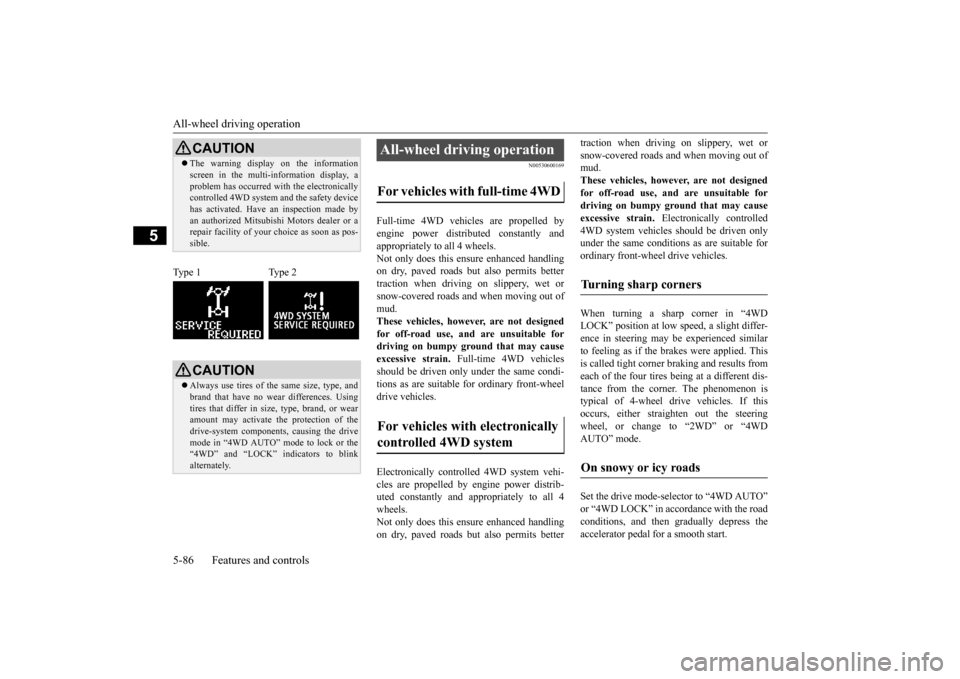
CAUTION The warning display on the information screen in the multi-information display, a problem has occurred with the electronically controlled 4WD system and the safety device has activated. Have an inspection made byan authorized Mitsubishi Motors dealer or a repair facility of your choice as soon as pos- sible.
Type 1 Type 2
CAUTION Always use tires of the same size, type, and brand that have no wear differences. Using tires that differ in size, type, brand, or wear amount may activate the protection of thedrive-system components, causing the drive mode in “4WD AUTO” mode to lock or the “4WD” and “LOCK” indicators to blinkalternately.
All-wheel driving operation For vehicles with full-time 4WD For vehicles with electronically controlled 4WD system
Turning sharp corners On snowy or icy roads
BK0210300US.bo
ok 86 ページ 2014年4月8日 火曜日 午前10時46分
Page 156 of 434
Cautions on handling of all-wheel drive vehicles
Features and controls 5-87
5
Set the drive mode-selector to “4WD LOCK” and then gradually depress the accelerator pedal for a smooth start. Keep the pressure on the accelerator pedal asconstant as possible, and drive at low speed.
Your vehicle may not provide sufficient hill climbing ability and engine braking on steepslopes. Avoid driving on steep slopes even though the vehicle is a 4-wheel drive vehicle.
N00530800190
Since driving torque can
be applied to all four
wheels, the performance of the vehicle when operating in all-wheel drive is greatly affected by the condition of the tires. Pay close attention to the tires. Install specified tires on all wheels. Refer to “Tires and wheels” on page 11-5. Be sure to fit all four tires and wheels of the same size and type.When replacement of any of the tires or wheels is necessary, replace all of them. All tires should be rotated whenever the wear difference between the front and rear tires is recognizable.
NOTE
The use of snow tires is recommended. Maintain a safe distance between vehicles, avoid sudden braking, and use engine brak- ing (downshifting).CAUTION Avoid sudden braking, sudden acceleration, and sharp turning. Skidding occurs and con- trol of the vehicle could be lost.
Moving out of mud
CAUTION If any of the following conditions occur, fol- low these procedures:• The engine coolant temperature display appears on the information screen in the multi-information display or the engine power drops suddenly. Refer to “Engine overheating” on page 8-4.
• The “ ” warning display or the “ ” warning display appear on the information screen in the multi-information display. Refer to “Warning display” on page 5-64.WA R N I N G When attempting to rock your vehicle out of a stuck position, be sure that the area around the vehicle is clear of people and physical objects. The rocking motion may cause the vehicle to suddenly launch for- ward/backward, causing injury or dam-age to nearby people or objects.NOTE
Avoid sudden braking, sudden acceleration and sharp turning; such operations couldresult in the vehicle becoming stuck. If the vehicle becomes stuck in muddy roads, it can often be moved with a rocking motion. Move the selector lever alternately between “D” (DRIVE) and “R” (REVERSE) posi-tions, while pressing lightly on the accelera- tor pedal.CAUTION
Climbing/descending sharp grades Cautions on handling of all- wheel drive vehicles Tires and wheels
BK0210300US.bo
ok 87 ページ 2014年4月8日 火曜日 午前10時46分