sport mode MITSUBISHI LANCER 2015 8.G Owners Manual
[x] Cancel search | Manufacturer: MITSUBISHI, Model Year: 2015, Model line: LANCER, Model: MITSUBISHI LANCER 2015 8.GPages: 434, PDF Size: 16.59 MB
Page 43 of 434
Child restraint systems 4-14 Seat and restraint systems
4
The airbag control unit monitors the readiness of the electronic parts of the system whenever the ignition switch is in the “ON” or “START” position. These include all of theitems listed above and all related wiring. The pre-tensioner seat belt system will oper- ate only when the ignition switch is in the“ON” or “START” position.When the seat belt pre-tensioners activate, some smoke is released and a loud noise will be heard. The smoke is not harmful, but careshould be taken not to intentionally inhale it, as it may cause some temporary irritation to people with respiratory problems.The pre-tensioners activate in the event of a moderate-to-severe frontal or side impact, even if the seat belt is not being worn. Theseat belt pre-tensioners may not activate in certain types of collisions, even though the vehicle may appear to be severely damaged.Such non-activation does not mean some- thing is wrong with the seat belt pre-tensioner system, but rather that the collision forceswere not severe enough or not of the type to activate the system.
N00408700094
This warning tells you if there is a probleminvolving the SRS airbags and the pre-ten- sioner seat belts. Refer to “SRS warning” onpage 4-27.
N00408900113
In the event of an accident, the seat belt forcelimiter system will help reduce the force applied to the driver and front seat passenger.
N00407101766
When transporting infants or small childrenin your vehicle, an appropriate child restraint system must always be used. This is requiredby law in the U.S. and Canada.
Child restraint systems specifically designed for infants and small children are offered by several manufacturers. Choose only a child restraint system with a label certifying that itcomplies with Federal Motor Vehicle Safety Standard 213 (FMVSS 213) or Motor Vehicle Restraint Systems and Booster Seats SafetyRegulations (RSSR). Look for the manufac- turer’s statement of compliance on the box and child restraint system itself. The child restraint system should be appropri- ate for your child’s weight and height, andshould properly fit your vehicle’s seat. For detail information, refer to the instruction manual accompanying the child restraint sys-tem. All children should be properly restrained in a restraint device that offers the maximum protection for their size and age.Be sure to check local, state, or provincial requirements for child size and age that may vary from the recommendations listed below. Children less than 1 year old and who weigh 22 pounds (10 kg) or less MUST ride in a rear-facing child safety seat that MUST ONLY be used in the rear seat.
4- Airbag control unit 5- Side impact sensors
WA R N I N G The seat belt pre-tensioner system is designed to work only once. After the seat belt pre-tensioners have been activated, they will not work again. They must promptly be replaced and the entire seatbelt pre-tensioner system inspected by an authorized Mitsubishi Motors dealer.
SRS warning Force limiter system Child restraint systems
Guidelines for child restraint system selection
BK0210300US.bo
ok 14 ページ 2014年4月8日 火曜日 午前10時46分
Page 130 of 434
Continuously variable transmission (CVT) (if so equipped)
Features and controls 5-61
5
N00513000096
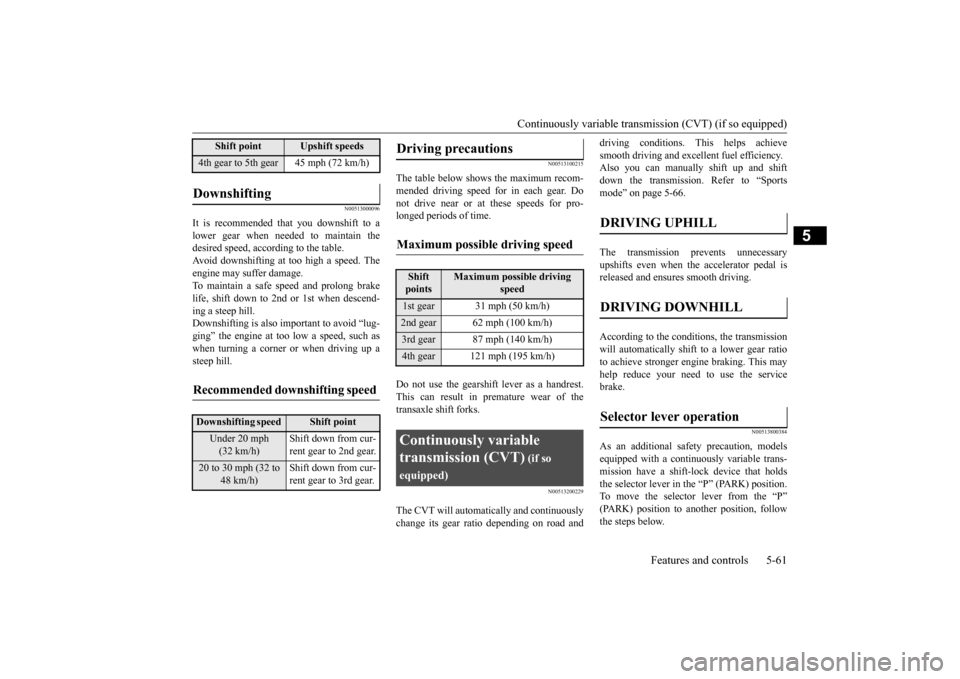
It is recommended that you downshift to a lower gear when needed to maintain the desired speed, according to the table.Avoid downshifting at too high a speed. The engine may suffer damage. To maintain a safe speed and prolong brakelife, shift down to 2nd or 1st when descend- ing a steep hill. Downshifting is also important to avoid “lug-ging” the engine at too low a speed, such aswhen turning a corner or when driving up a steep hill.
N00513100215
The table below shows the maximum recom- mended driving speed for in each gear. Donot drive near or at these speeds for pro- longed periods of time. Do not use the gearshift lever as a handrest. This can result in premature wear of the transaxle shift forks.
N00513200229
The CVT will automatically and continuously change its gear ratio depending on road and
driving conditions. This helps achieve smooth driving and excellent fuel efficiency. Also you can manually shift up and shift down the transmission. Refer to “Sportsmode” on page 5-66. The transmission prevents unnecessary upshifts even when the accelerator pedal isreleased and ensures smooth driving. According to the condi
tions, the transmission
will automatically shift to a lower gear ratio to achieve stronger engine braking. This may help reduce your need to use the servicebrake.
N00513800384
As an additional safe
ty precaution, models
equipped with a continuously variable trans- mission have a shift-lock device that holds the selector lever in the “P” (PARK) position.To move the selector lever from the “P” (PARK) position to another position, follow the steps below.
4th gear to 5th gear 45 mph (72 km/h)Downshifting
Recommended downshifting speed
Downshifting speed
Shift point
Under 20 mph (32 km/h)
Shift down from cur- rent gear to 2nd gear.
20 to 30 mph (32 to
48 km/h)
Shift down from cur- rent gear to 3rd gear.
Shift point
Upshift speeds
Driving precautions
Maximum possible driving speed
Shift points
Maximum possible driving
speed
1st gear 31 mph (50 km/h)2nd gear 62 mph (100 km/h)3rd gear 87 mph (140 km/h)4th gear 121 mph (195 km/h)Continuously variable transmission (CVT)
(if so
equipped)
DRIVING UPHILL
DRIVING DOWNHILL
Selector lever operation
BK0210300US.bo
ok 61 ページ 2014年4月8日 火曜日 午前10時46分
Page 132 of 434
Continuously variable transmission (CVT) (if so equipped)
Features and controls 5-63
5
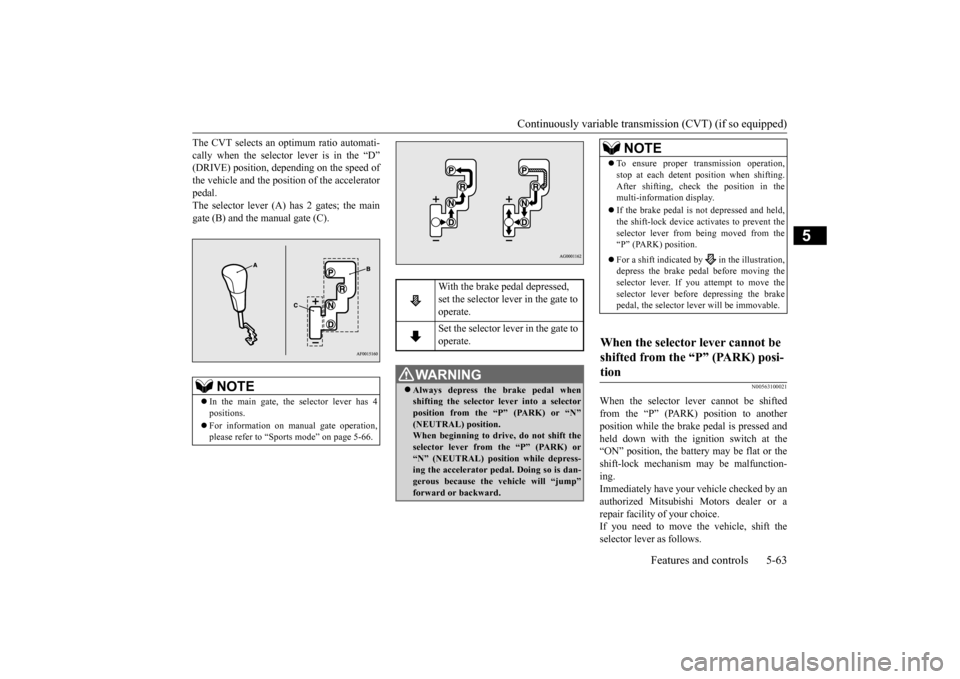
The CVT selects an optimum ratio automati- cally when the selector lever is in the “D” (DRIVE) position, depending on the speed of the vehicle and the position of the acceleratorpedal. The selector lever (A) has 2 gates; the main gate (B) and the manual gate (C).
N00563100021
When the selector lever cannot be shiftedfrom the “P” (PARK) position to anotherposition while the brake pedal is pressed andheld down with the ignition switch at the “ON” position, the battery may be flat or the shift-lock mechanism may be malfunction-ing. Immediately have your vehicle checked by an authorized Mitsubishi Motors dealer or arepair facility of your choice. If you need to move the vehicle, shift the selector lever as follows.
NOTE
In the main gate, the selector lever has 4 positions. For information on manual gate operation, please refer to “Sports mode” on page 5-66.
With the brake pedal depressed, set the selector lever in the gate to operate. Set the selector lever in the gate to operate.
WA R N I N G Always depress the brake pedal when shifting the selector lever into a selector position from the “P” (PARK) or “N” When beginning to drive, do not shift the selector lever from the “P” (PARK) or“N” (NEUTRAL) position while depress- ing the accelerator pedal. Doing so is dan- gerous because the vehicle will “jump”forward or backward.
NOTE
To ensure proper transmission operation, stop at each detent position when shifting. After shifting, check the position in the multi-information display. If the brake pedal is not depressed and held, the shift-lock device activates to prevent the selector lever from being moved from the“P” (PARK) position. For a shift indicated by in the illustration, depress the brake pedal before moving the selector lever. If y
ou attempt to move the
selector lever before
depressing the brake
pedal, the selector lever will be immovable.
When the selector lever cannot be shifted from the “P” (PARK) posi-tion
BK0210300US.bo
ok 63 ページ 2014年4月8日 火曜日 午前10時46分
Page 135 of 434
Continuously variable transm
ission (CVT) (if so equipped)
5-66 Features and controls
5
N00514400417
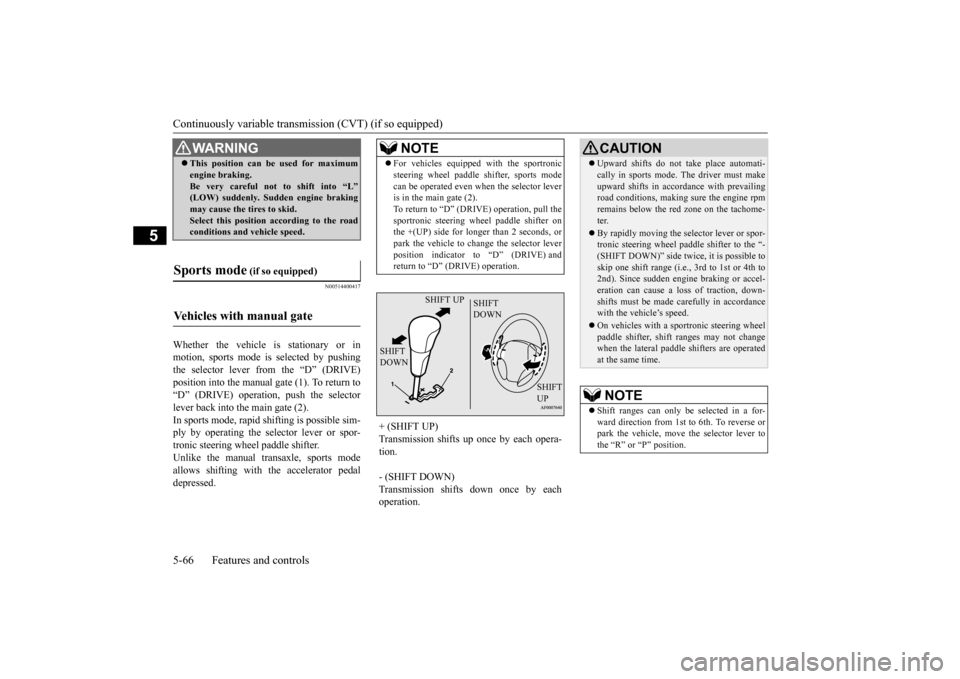
Whether the vehicle is stationary or in motion, sports mode is selected by pushingthe selector lever from the “D” (DRIVE) position into the manual gate (1). To return to “D” (DRIVE) operation, push the selectorlever back into the main gate (2). In sports mode, rapid shifting is possible sim- ply by operating the selector lever or spor-tronic steering wheel paddle shifter. Unlike the manual transaxle, sports mode allows shifting with the accelerator pedaldepressed.
WA R N I N G This position can be used for maximum engine braking. Be very careful not to shift into “L” (LOW) suddenly. Sudden engine braking may cause the tires to skid.Select this position according to the road conditions and vehicle speed.
Sports mode
(if so equipped)
Vehicles with manual gate
NOTE
For vehicles equipped with the sportronic steering wheel paddle shifter, sports mode can be operated even when the selector lever is in the main gate (2). To return to “D” (DRIVE) operation, pull thesportronic steering wheel paddle shifter on the +(UP) side for longer than 2 seconds, or park the vehicle to change the selector leverposition indicator to “D” (DRIVE) and return to “D” (DRIVE) operation.
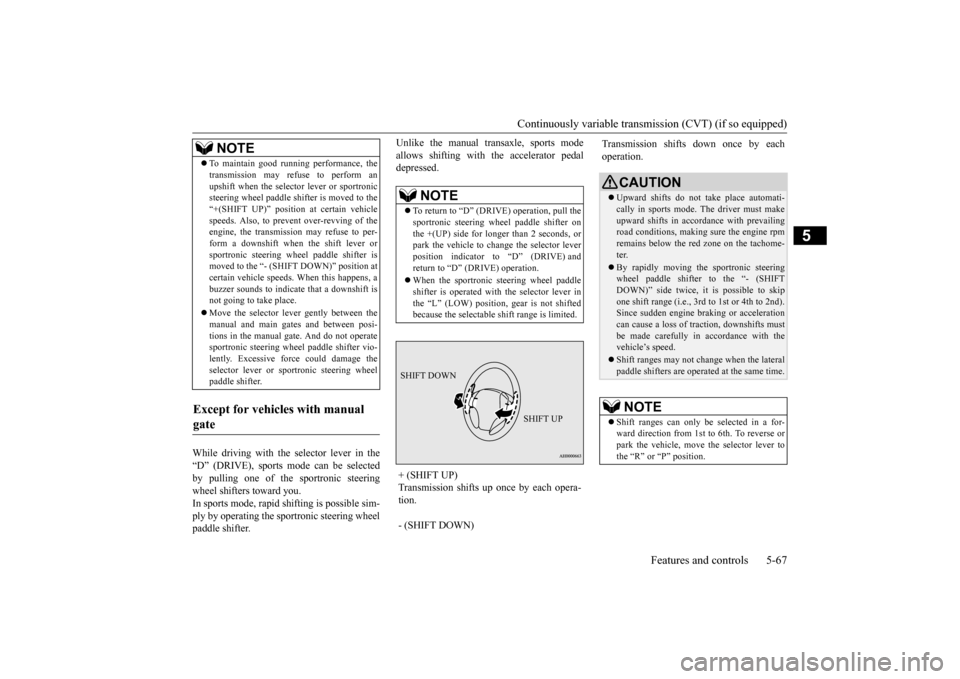
+ (SHIFT UP) Transmission shifts up once by each opera- tion. - (SHIFT DOWN) Transmission shifts down once by each operation.
SHIFT UP
SHIFT DOWN
SHIFT DOWN
SHIFT UP
CAUTION Upward shifts do not take place automati- cally in sports mode. The driver must make upward shifts in accordance with prevailing road conditions, making sure the engine rpm remains below the red zone on the tachome-ter. By rapidly moving the selector lever or spor- tronic steering wheel padd
le shifter to the “-
(SHIFT DOWN)” side tw
ice, it is possible to
skip one shift range (i.e
., 3rd to 1st or 4th to
2nd). Since sudden engine braking or accel- eration can cause a loss of traction, down- shifts must be made carefully in accordancewith the vehicle’s speed. On vehicles with a sportronic steering wheel paddle shifter, shift ranges may not change when the lateral paddle shifters are operated at the same time.NOTE
Shift ranges can only be selected in a for- ward direction from 1st to 6th. To reverse or park the vehicle, move the selector lever tothe “R” or “P” position.
BK0210300US.bo
ok 66 ページ 2014年4月8日 火曜日 午前10時46分
Page 136 of 434
Continuously variable transmission (CVT) (if so equipped)
Features and controls 5-67
5
While driving with the selector lever in the “D” (DRIVE), sports mode can be selected by pulling one of the sportronic steering wheel shifters toward you.In sports mode, rapid
shifting is possible sim-
ply by operating the sportronic steering wheel paddle shifter.
Unlike the manual transaxle, sports mode allows shifting with the accelerator pedal depressed.
To maintain good running performance, the transmission may refuse to perform an upshift when the selector lever or sportronic steering wheel paddle shifter is moved to the “+(SHIFT UP)” positi
on at certain vehicle
speeds. Also, to prevent over-revving of the engine, the transmission may refuse to per- form a downshift when the shift lever orsportronic steering wheel paddle shifter is moved to the “- (SHIFT DOWN)” position at certain vehicle speeds. When this happens, abuzzer sounds to indicate that a downshift is not going to take place. Move the selector lever gently between the manual and main gates and between posi- tions in the manual gate. And do not operatesportronic steering wheel paddle shifter vio- lently. Excessive force could damage the selector lever or sportronic steering wheelpaddle shifter.
Except for vehicles with manual gate
NOTE
NOTE
To return to “D” (DRIVE) operation, pull the sportronic steering wheel paddle shifter on the +(UP) side for longer than 2 seconds, or park the vehicle to change the selector leverposition indicator to “D” (DRIVE) and return to “D” (DRIVE) operation. When the sportronic steering wheel paddle shifter is operated with the selector lever in the “L” (LOW) position, gear is not shiftedbecause the selectable shift range is limited.
+ (SHIFT UP) Transmission shifts up once by each opera- tion. - (SHIFT DOWN) SHIFT DOWN
SHIFT UP
Transmission shifts down once by each operation.
CAUTION Upward shifts do not take place automati- cally in sports mode. The driver must makeupward shifts in accordance with prevailing road conditions, making sure the engine rpm remains below the red zone on the tachome-ter. By rapidly moving the sportronic steering wheel paddle shifter to the “- (SHIFT DOWN)” side twice, it is possible to skip one shift range (i.e., 3rd to 1st or 4th to 2nd).Since sudden engine braking or acceleration can cause a loss of traction, downshifts must be made carefully in accordance with thevehicle’s speed. Shift ranges may not change when the lateral paddle shifters are operated at the same time.NOTE
Shift ranges can only be selected in a for- ward direction from 1st to 6th. To reverse orpark the vehicle, move the selector lever to the “R” or “P” position.
BK0210300US.bo
ok 67 ページ 2014年4月8日 火曜日 午前10時46分
Page 137 of 434
Continuously variable transm
ission (CVT) (if so equipped)
5-68 Features and controls
5
N00538800154
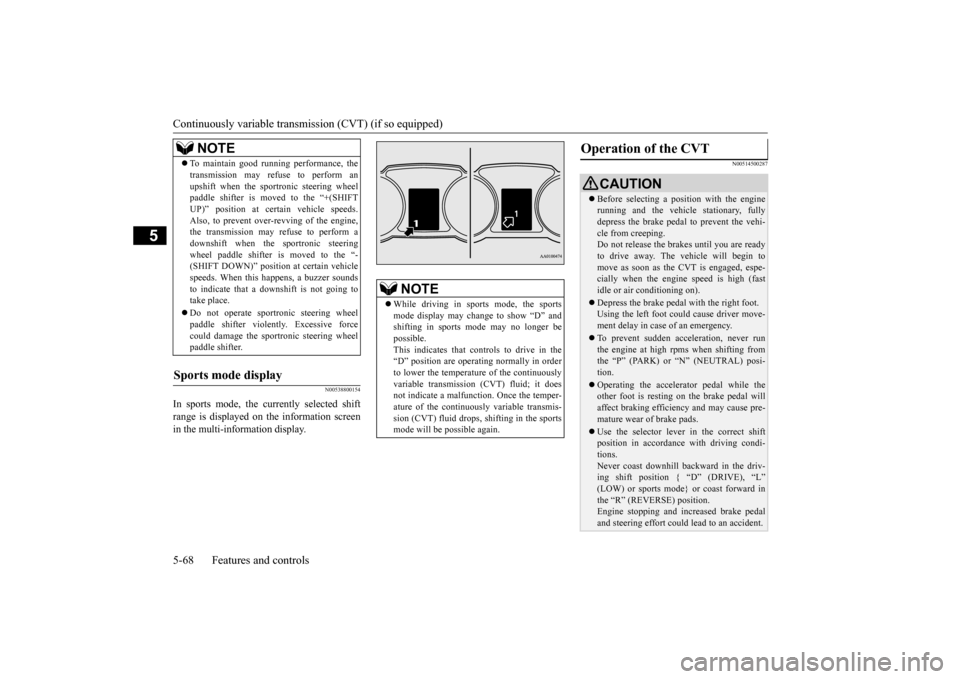
In sports mode, the currently selected shift range is displayed on the information screen in the multi-information display.
N00514500287
To maintain good running performance, the transmission may refuse to perform an upshift when the sportronic steering wheel paddle shifter is moved to the “+(SHIFT UP)” position at certain vehicle speeds.Also, to prevent over-revving of the engine, the transmission may refuse to perform a downshift when the sportronic steeringwheel paddle shifter is moved to the “- (SHIFT DOWN)” position at certain vehicle speeds. When this happens, a buzzer soundsto indicate that a downshift is not going to take place. Do not operate sportronic steering wheel paddle shifter violently. Excessive force could damage the sportronic steering wheelpaddle shifter.
Sports mode display
NOTE
NOTE
While driving in sports mode, the sports mode display may change to show “D” and shifting in sports mode may no longer bepossible. This indicates that controls to drive in the “D” position are operating normally in orderto lower the temperature of the continuously variable transmission (CVT) fluid; it does not indicate a malfunction. Once the temper-ature of the continuously variable transmis- sion (CVT) fluid drops, shifting in the sports mode will be possible again.
Operation of the CVT
CAUTION Before selecting a position with the engine running and the vehicle stationary, fully depress the brake pedal to prevent the vehi- cle from creeping.Do not release the brakes until you are ready to drive away. The vehicle will begin to move as soon as the CVT is engaged, espe-cially when the engine speed is high (fast idle or air conditioning on). Depress the brake pedal with the right foot. Using the left foot could cause driver move- ment delay in case of an emergency. To prevent sudden acceleration, never run the engine at high rpms when shifting fromthe “P” (PARK) or “N” (NEUTRAL) posi- tion. Operating the accelerator pedal while the other foot is resting on the brake pedal will affect braking efficiency and may cause pre-mature wear of brake pads. Use the selector lever in the correct shift position in accordance with driving condi- tions. Never coast downhill backward in the driv- ing shift position { “D” (DRIVE), “L” (LOW) or sports mode} or coast forward inthe “R” (REVERSE) position. Engine stopping and increased brake pedal and steering effort could lead to an accident.
BK0210300US.bo
ok 68 ページ 2014年4月8日 火曜日 午前10時46分
Page 138 of 434
Continuously variable transmission (CVT) (if so equipped)
Features and controls 5-69
5
N00514900063
To gain extra acceleration in “D” (DRIVE) position (when passing another vehicle) push the accelerator to the floor
if it is safe to do so
in traffic conditions. The CVT will automati-cally downshift.
N00515000074
For short waiting periods, such as at traffic lights, the vehicle can be left in selector lever position and held stationary with the servicebrake.
For longer waiting periods with the engine running, the selector lever should be placed in the “N” (NEUTRAL) position.
N00515100062
To park the vehicle, first bring it to a com- plete stop, fully engage the parking brake,and then move the selector lever to the “P” (PARK) position. If you are going to leave the vehicle unat-tended, always switch off the engine and carry the key.
N00515300194
If the CVT does not shift while driving, or your vehicle does not pick up enough speed when starting on an uphill slope, there may be something unusual happening in the transmis-sion, causing a safety device to activate. Have your vehicle checked at an authorized Mit- subishi Motors dealer or a repair facility ofyour choice as soon as possible. 1. If your vehicle has difficulty moving uphill, shift the selector lever into “L” (LOW) position (except for vehicles withsport mode) or 2nd shift range of the sports mode. This method might not work dependingon the type of transmission malfunction.
Do not rev the engine with the brake pedal pressed when the vehicle is stationary. This can damage the CVT. Also, when you depress the accelerator pedal while holding down the brake pedal with theselector lever in the “D” (DRIVE) position, the engine revolutions may not rise as high as when performing the same operation withthe selector lever in the “N” (NEUTRAL) position.
Passing acceleration
NOTE
In sports mode, downshifts do not take place when the accelerator is depressed all the way to the floor.
Waiting
CAUTION
CAUTION To avoid transmission overheating, never try to keep your vehicle stationary on a hill by using the accelerator pedal. Always apply the parking brake and/or service brake. Unexpected acceleration may occur if the selector lever is in a position other than “P”(PARK) or “N” (NEUTRAL). Before driving off from a stop, make sure that the selector lever is in “D” (DRIVE)position or “Sports mode” position.
Parking
NOTE
On a slope, be sure to apply the parking brake before moving the selector lever to the “P” (PARK) position. If you move the selec- tor lever to the “P” (PARK) position before applying the parking brake, it may be diffi-cult to disengage the selector lever from the “P” (PARK) position when next you drive the vehicle, requiring application of a strongforce to the selector lever to move from the “P” (PARK) position.
When the CVT makes no speed change
BK0210300US.bo
ok 69 ページ 2014年4月8日 火曜日 午前10時46分
Page 139 of 434
Twin Clutch SST (Sportronic Shif
t Transmission) (if so equipped)
5-70 Features and controls
5
2. Once the vehicle is moving on a level road, move the selector lever back to “D” (DRIVE) position.
N00539700059
The Twin Clutch SST is a transmission that,through integrated control of the engine and transmission, is able to achieve both thesmooth shifting of an automatic transaxle and the acceleration and fuel economy close to a manual transaxle. In addition, the controlmode can be selected from two types to suit the driving conditions. Together with manual shifting, the transmis-sion is capable of responding to a variety of driving circumstances. Twin Clutch SST control mode
P.5-74
Manual shift
P.5-76
N00539800050
As an additional safety precaution, models equipped with a Twin Clutch SST have ashift-lock device that holds the gearshift lever in the “P” (PARK) position. To move the gearshift lever from the “P” (PARK) positionto another position, follow the steps below. 1. Press and hold the brake pedal down. 2. Move the gearshift lever to the desired position.
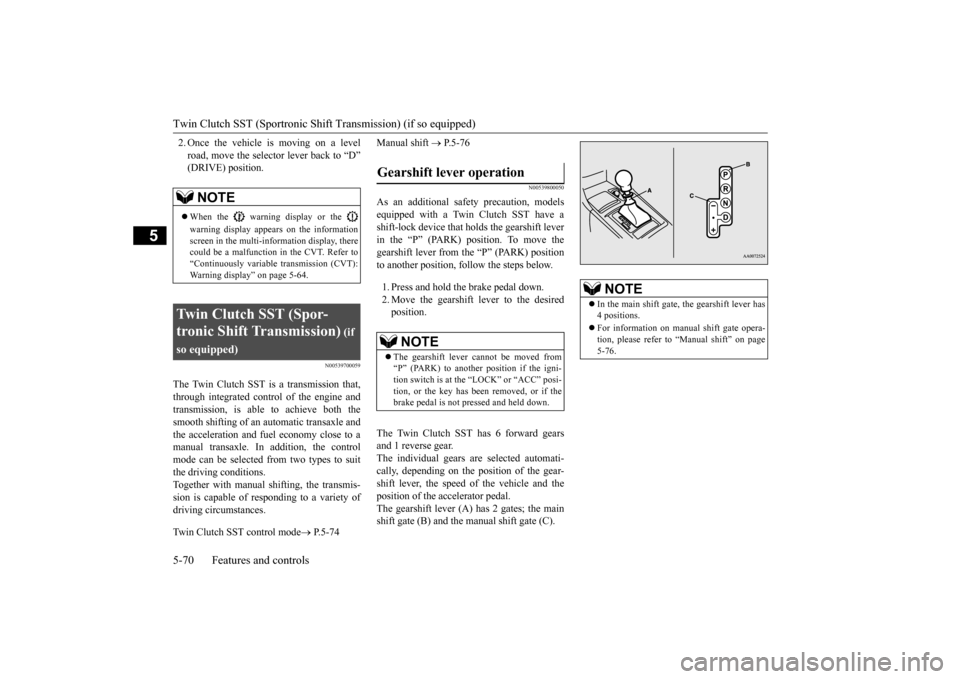
The Twin Clutch SST has 6 forward gears and 1 reverse gear. The individual gears are selected automati-cally, depending on the position of the gear- shift lever, the speed of the vehicle and the position of the accelerator pedal.The gearshift lever (A) has 2 gates; the main shift gate (B) and the manual shift gate (C).
NOTE
When the warning display or the warning display appears on the information screen in the multi-information display, therecould be a malfunction in the CVT. Refer to “Continuously variable transmission (CVT): Warning display” on page 5-64.
Twin Clutch SST (Spor- tronic Shift Transmission)
(if
so equipped)
Gearshift lever operation
NOTE
The gearshift lever cannot be moved from “P” (PARK) to another position if the igni-tion switch is at the “LOCK” or “ACC” posi- tion, or the key has been removed, or if the brake pedal is not pressed and held down.
NOTE
In the main shift gate, the gearshift lever has 4 positions. For information on manual shift gate opera- tion, please refer to “Manual shift” on page 5-76.
BK0210300US.bo
ok 70 ページ 2014年4月8日 火曜日 午前10時46分
Page 143 of 434
Twin Clutch SST (Sportronic Shif
t Transmission) (if so equipped)
5-74 Features and controls
5
N00540100011
This position locks the transmission to pre- vent the vehicle from moving. The engine can be started from the “PARK” position. Move the lever to this position only after the vehicle has come to a complete stop. At this position, the transmission is disen- gaged. It is the same as the neutral position on a manual transaxle and should be used whenthe vehicle is not moving for an extended
length of time during driving, such as in a traffic jam. This position is used for most city and high- way driving. Engine shifting and braking are done automatically as needed, depending onroad conditions.
N00540200070
Select the control mode from the following two types to suit the driving conditions.
Gearshift lever positions (Main shift gate)
“P” PARK
“R” REVERSE
CAUTION Never shift into the “P” (PARK) or “R” (REVERSE) position while
the vehicle is in
motion. If the lever is shifted into the “P” (PARK) or “R” (REVERSE) position whilethe vehicle is in motion, the transmission may be damaged.
“N” NEUTRAL
WA R N I N G Never move the gearshift lever to the “N” (NEUTRAL) position while driving since you could accidentally slip it into the “P”(PARK) or “R”(REVERSE) position and the engine speed could rise, damaging the transmission. To prevent the vehicle from rolling when stopped on a slope, the engine should bestarted in the “P” (PARK) position. Although the engine can be started when the vehicle is in the “N” (NEUTRAL) posi-tion, for safety reasons, do not start the engine in the “N” (NEUTRAL) position. Always keep your foot on the brake pedal when the vehicle is in “N” (NEUTRAL) position, or when shifting into or out of“N” (NEUTRAL) position, to prevent roll- ing.
“D” DRIVE
CAUTION Never shift into the “D” (DRIVE) position from the “R” (REVERSE) position while the vehicle is in motion. If the lever is shifted into the “D” (DRIVE) from the “R” (REVERSE) position while thevehicle is in motion, the transmission may be damaged.NOTE
For information on manual shift gate opera- tion, please refer to “Manual shift” on page 5-76. When the engine is cold, upshifts occur at a higher vehicle speed than when the engine is warm.This control is performed to quickly warm up the engine. It does not indicate a malfunc- tion. After the vehicle
has been driven for a
while, upshifts will occur at the regular engine speeds.
Twin Clutch SST control mode
BK0210300US.bo
ok 74 ページ 2014年4月8日 火曜日 午前10時46分
Page 144 of 434
Twin Clutch SST (Sportronic Shif
t Transmission) (if so equipped) Features and controls 5-75
5
N00540300068
When the ignition switch is set to the “ON” position, operate the Twin Clutch SST control mode switch (A) to change the control mode. When the engine is started, the control mode is automatically set to the “Normal” mode. Use the following procedures to change the control mode. While the vehicle is stopped or being driven, push the Twin Clutch SST control modeswitch forward.
Tw i n Clutch SST con-trol mode
Characteristic
Normal (Control mode when engine is started)
Control mode for normal driv- ing on local roads, freeways, and the like.Smooth shifting is performed at low engine speeds for eco- nomical driving with good ride quality.
Sport
Control mode for driving on mountain roads, roads with uphill and downhill slopes, and freeways with long down- hill slopes where engine brak- ing is necessary.Compared to “Normal” mode, shifting occurs at higher engine speeds and is quicker. In addition, quick downshift- ing is possible when the accel- erator pedal is depressed for quick acceleration or when the brakes are applied.
NOTE
When continuously driving on closed circuit tracks or at other locations where the engine is operated at high speeds and under a heavy load, the Twin Clutch SST fluid temperature will have a tendency to rise.In this case, if the temperature rises too high, the warning display will appear on the information screen in the multi-information display to alert the driver. If the warning display appears, be sure to refer to “Warning display” on page 5-72and follow the appropriate measures. The Twin Clutch SST control mode can be selected both when “D” range operation is selected and when manual shifting is selected. If you select “Sport” mode while the engine is cold, the transmission may shift up at dif-ferent speeds compared to that when the engine is warm. This is simply the operation of the controlsystem to warm the engine quickly. It does not indicate a malfunction. For slippery road surfaces, such as roads with accumulated snow, “Normal” mode is recommended for smooth shifting at low engine speeds.
Twin Clutch SST control mode switch
To shift from “Normal” mode to “Sport” mode
BK0210300US.bo
ok 75 ページ 2014年4月8日 火曜日 午前10時46分