ECU MITSUBISHI LANCER 2016 8.G User Guide
[x] Cancel search | Manufacturer: MITSUBISHI, Model Year: 2016, Model line: LANCER, Model: MITSUBISHI LANCER 2016 8.GPages: 392, PDF Size: 13.12 MB
Page 40 of 392
Child
restraint
systems
4-16
Seat and restraint systems
4
N0041880
0131
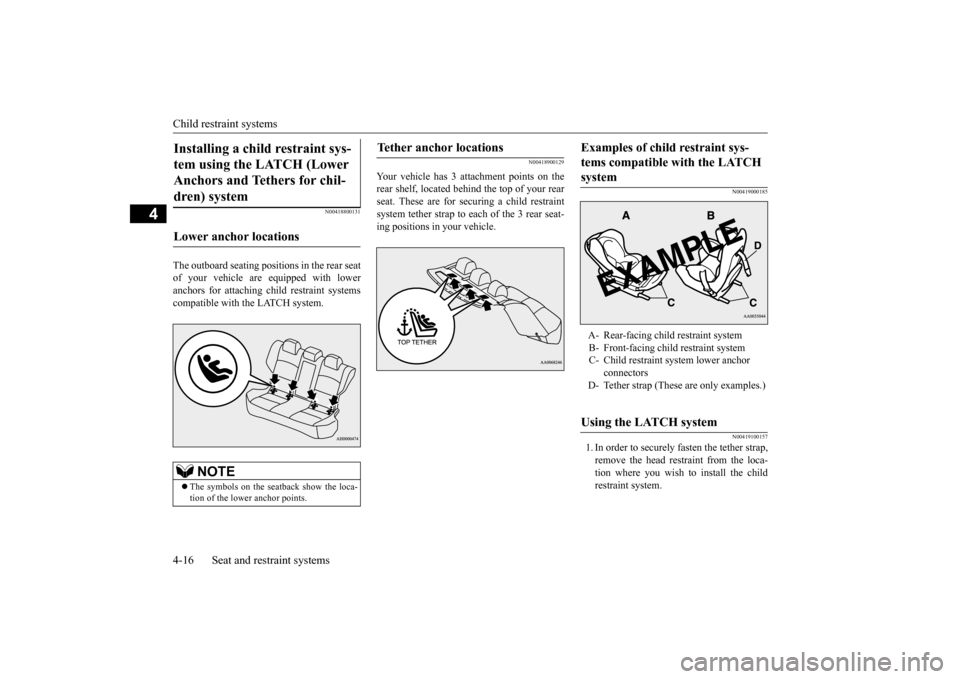
The
outboard
seating
positions
in the
rear
seat
of
your
vehicle
are
equipped
with
lower
anchors
for
attaching
child
restraint
systems
compatible with the LA
TCH system.
N0041890
0129
Your
vehicle
has
3 attachment
points
on
the
rear
shelf,
located
behind
the
top
of your
rear
seat.
These
are
for
securing
a child
restraint
system
tether
strap
to each
of
the
3 rear
seat-
ing
positions
in your
vehicle.
N0041900
0185
N0041910
0157
1.In order
to securely
fasten
the
tether
strap,
remove
the
head
restraint
from
the
loca-
tion
where
you
wish
to
install
the
child
restraint system.
Installing a child r
estraint sys-
tem using the LA
TCH (Lower
Anchors and
Tethers for chil-
dr
en) system
Lower anchor locations
NOTE
The
symbols
on
the
seatback
show
the
loca-
tion
of the
low
er anchor
points.
Tether anchor locations
Examples of child r
estraint sys-
tems compatible with the LA
TCH
system A-
Rear
-facing
child
restraint
system
B-
Front-facing child restraint system
C-
Child restraint system lower anchor connectors
D-
Tether
strap
(These
are
only
examples.)
Using the LA
TCH system
Page 41 of 392
Child restraint systems
Seat and restraint systems
4-17
4
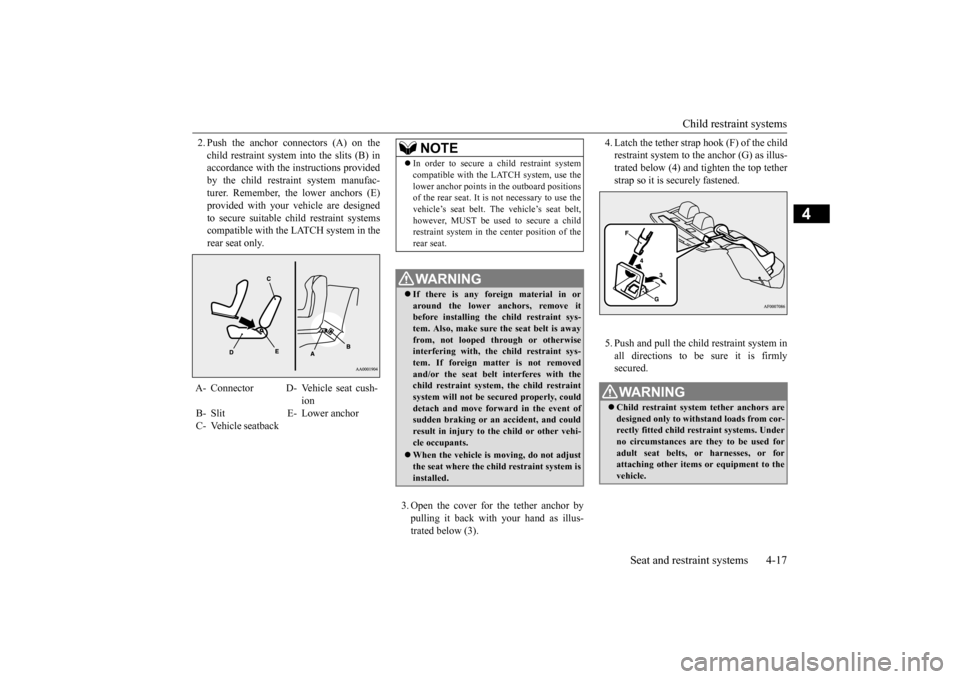
2.Push
the
anchor
connectors
(A)
on
the
child
restraint
system
into
the
slits
(B)
in
accordance
with
the
instructions
provided
by
the
child
restraint
system
manufac-
turer
. Remembe
r, the
lower
anchors
(E)
provided
with
your
vehicle
are
designed
to
secure
suitable
child
restraint
systems
compatible
with
the
LA
TCH
system
in the
rear seat onl
y.
3.Open
the
cover
for
the
tether
anchor
by
pulling
it back
with
your
hand
as
illus-
trated below
(3).
4.Latch
the
tether
strap
hook
(F)
of the
child
restraint
system
to the
anchor
(G)
as illus-
trated
below
(4)
and
tighten
the
top
tether
strap so it is securely fastened.5.Push
and
pull
the
child
res
traint
system
in
all
directions
to
be
sure
it
is
firmly
secured.
A-
Connector
D-
Vehicle
seat
cush-
ion
B-
Slit
E-
Lower anchor
C-
Vehicle
seatback
NOTE
In
orde
r to secure
a child restrain
t system
compatib
le with the LATCH
system,
use
the
low
er anchor
points
in the
outboard
pos
itions
of the rear seat.
It is not
necessa
ry to use
the
vehicle’
s seat
belt.
The
vehicle’
s seat
belt,
howe
ver, MUST
be use
d to secure
a child
restraint
system
in the
center
position
of the
rear
seat.
W
AR
NING
If
the
re is any
for
eign
materia
l in or
around
the
lower
anc
hor
s,
remove
it
befor
e installing
the
child restraint
sys-
tem. Also, make
sure the
seat
belt
is away
from,
not
looped
thr
ough
or
otherwise
interfering
with,
the
child
restraint
sys-
tem.
If
for
eign
matter
is
not
removed
and/
or the
seat
belt interf
eres with
the
child restrain
t system,
the child restrain
t
system
will not be secu
red properly
, cou
ld
detach
and
move
forw
ard
in the even
t of
sudden
braking
or
an
accident,
and
could
resul
t in injury
to the
child or other
veh
i-
cle
occupa
nts.
Whe
n the
vehicle
is movi
ng, do
not
adjust
the
seat
whe
re the
child restraint syste
m is
installed
.
W
AR
NING
Child
restraint
system tether
anc
hor
s are
designed
only
to withstand
loads
from
cor
-
rectly fitted
child restrain
t systems
. Unde
r
no circumstan
ces
are they
to be use
d for
adul
t seat
belts,
or har
nesses,
or for
attac
hing
other
items
or equi
pme
nt to the
vehicle.
Page 42 of 392
Child
restraint
systems
4-18
Seat and restraint systems
4
N0040730
1508
With
the
exception
of
the
driver
, the
seat
belt
in all other
seating
positions
can
be
converted
from
normal
Eme
rgency
Locking
Retractor
(ELR)
mode
to Automatic
Locking
Retractor
(ALR)
mode.
This
means
that
when
you
pull
the
seat
belt
fully
out
of
the
retractor
, the
retractor
will
switch
to its
ALR
child
restraint
installation
function.
Always
use
the
ALR
child
restraint
installation
function
when
you
install
a child
restraint
system
using
the
seat
bel
t.
Children
12
years
old
and
under
should
always
be
restrained
in
the
rear
seat,
when-
ever
possible,
although
the
front
passenger
seat belt can also be converted to ALR mode.
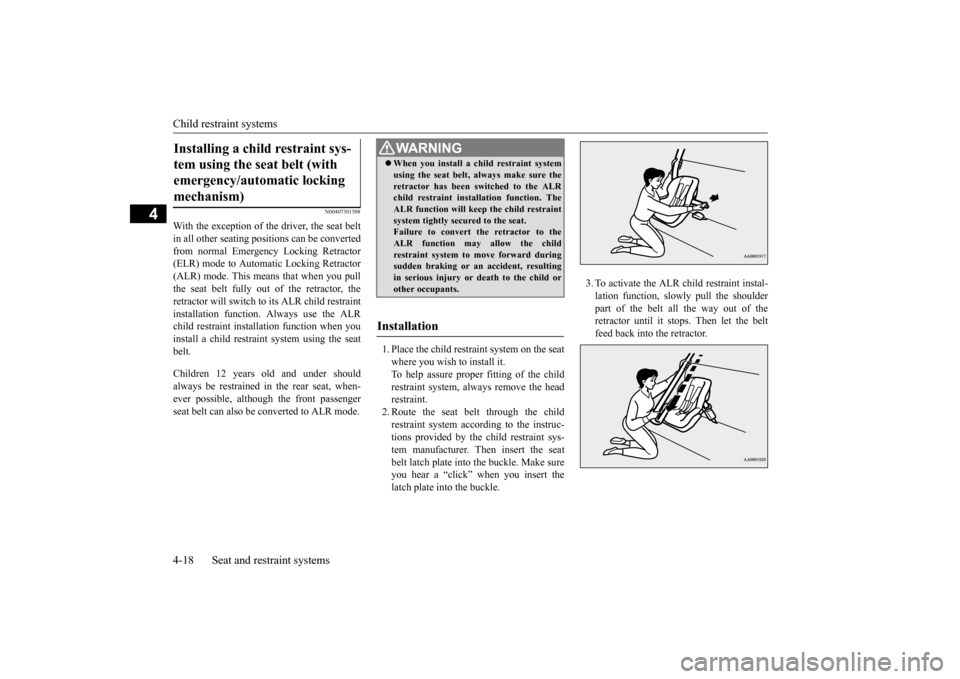
1.Place
the
child
restraint
system
on
the
seat
where you wish to install it.To help
assure
proper
fitting
of
the
child
restraint
system,
always
remove
the
head
restraint.2.Route
the
seat
belt
through
the
child
restraint
system
according
to
the
instruc-
tions
provided
by
the
child
restraint
sys-
tem
manufacturer
. Then
insert
the
seat
belt
latch
plate
into
the
buckle.
Make
sure
you
hear
a “click”
when
you
insert
the
latch plate into the buckle.
3.To activate
the
ALR
child
restraint
instal-
lation
function,
slow
ly
pull
the
shoulder
part
of
the
belt
all
the
way
out
of
the
retractor
until
it stops.
Then
let
the
belt
feed back into the retractor
.
Installing a child r
estraint sys-
tem using the seat belt (with emergency/automatic locking mechanism)
W
AR
NING
Whe
n you
install
a child restraint
syste
m
usi
ng
the
seat belt,
always
make
sur
e the
retractor
has
been
swi
tched to
the
ALR
child restraint
installati
on
func
tion.
The
ALR
func
tion
will keep
the
child restraint
system
tightly
secur
ed to the
seat.
Failur
e to
convert
the
retractor
to
the
ALR func
tion
may allow
the
child
restraint
system to move
for
war
d durin
g
sudden
braking
or
an
accident,
resulting
in serious
injury
or
death
to the
child
or
other
occupa
nts.
Installation
Page 43 of 392
Child restraint systems
Seat and restraint systems
4-19
4
4.After
the
belt
has
retracted,
tug
on
it.
If
the
belt
is in
the
ALR
function,
you
will
not
be
able
to
pull
it out.
If the
webbing
can
be
pulled
out
from
retracto
r, the
ALR
function
has
not
been
activated
and
you
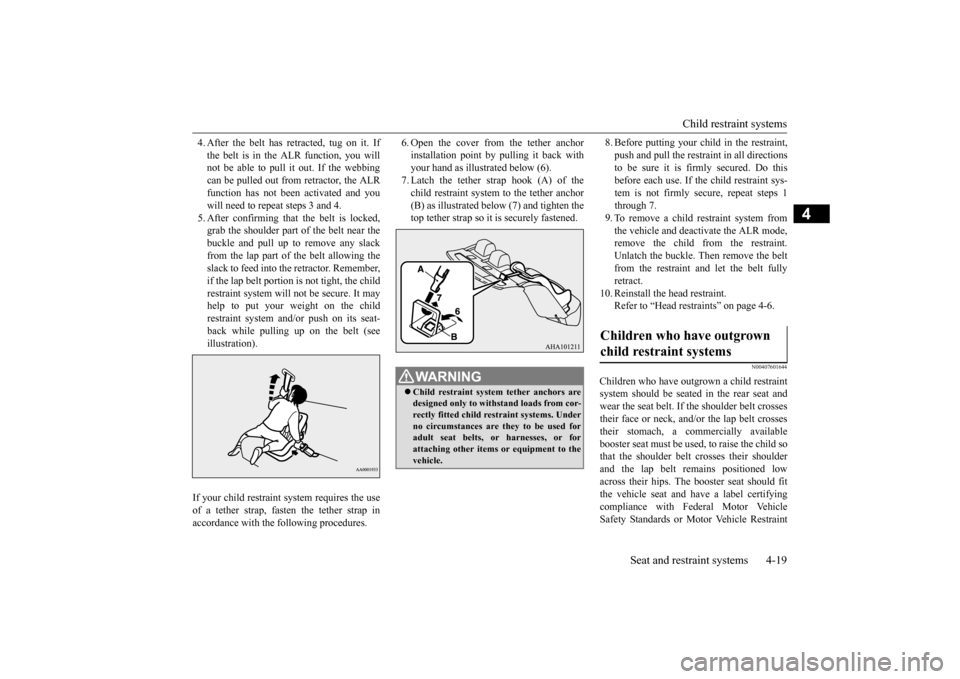
will need to repeat steps 3 and 4.5.After
confirming
that
the
belt
is locked,
grab
the
shoulder
part
of
the
belt
near
the
buckle
and
pull
up
to
remove
any
slack
from
the
lap
part
of
the
belt
allowing
the
slack
to feed
into
the
retractor
. Remember
,
if the
lap
belt
portion
is not
tight,
the
child
restraint
system
will
not
be
secure.
It may
help
to
put
your
weight
on
the
child
restraint
system
and/or
push
on
its
seat-
back
while
pulling
up
on
the
belt
(see
illustration).
6.Open
the
cover
from
the
tether
anchor
installation
point
by
pulling
it back
with
your hand as illustrated below (6).7.Latch
the
tether
strap
hook
(A)
of
the
child
restraint
system
to the
tether
anchor
(B)
as illustrated
below
(7)
and
tighten
the
top tether strap so it is securely fastened.
8.Before
putting
your
child
in the
restraint,
push
and
pull
the
restraint
in all directions
to
be
sure
it is
firmly
secured.
Do
this
before
each
use.
If the
child
restraint
sys-
tem
is
not
firmly
secure,
repeat
steps
1
through 7.9.To remove
a child
restraint
system
from
the
vehicle
and
deactivate
the
ALR
mode,
remove
the
child
from
the
restraint.
Unlatch
the
buckle.
Then
remove
the
belt
from
the
restraint
and
let
the
belt
fully
retract.
10.
Reinstall the head restraint.Refer to “Head restraints” on page 4-6.
N00407601
644
Children
who
have
outgrown
a child
restraint
system
should
be
seated
in
the
rear
seat
and
wear
the
seat
belt.
If the
shoulder
belt
crosses
their
face
or
neck,
and/or
the
lap
belt
crosses
their
stomach,
a
commercially
available
booster
seat
must
be
used,
to raise
the
child
so
that
the
shoulder
belt
crosses
their
shoulder
and
the
lap
belt
remains
positioned
low
across
their
hips.
The
booster
seat
should
fit
the
vehicle
seat
and
have
a label
certifying
compliance
with
Federal
Motor
Vehicle
Safety
Standards
or
Motor
Vehicle
Restraint
If your
child
restraint
system
requires
the
use
of
a tether
strap,
fasten
the
tether
strap
in
accordance with the following procedures.
W
AR
NING
Child
restraint
syste
m tether
anc
hors
are
designed
only
to withstand
loads
from
cor
-
rectly fitted child r
estraint systems. Under
no circumsta
nces
are the
y to be use
d for
adul
t seat
belts,
or
har
nesses,
or for
attach
ing
other
items
or
equi
pme
nt to the
vehicle.
Childr
en who have outg
rown
child r
estraint systems
Page 49 of 392
Supplemental Restraint System (SRS) - airbag
Seat and restraint systems
4-25
4
N00418100
277
The
passenger
’s
airbag
off
indicator
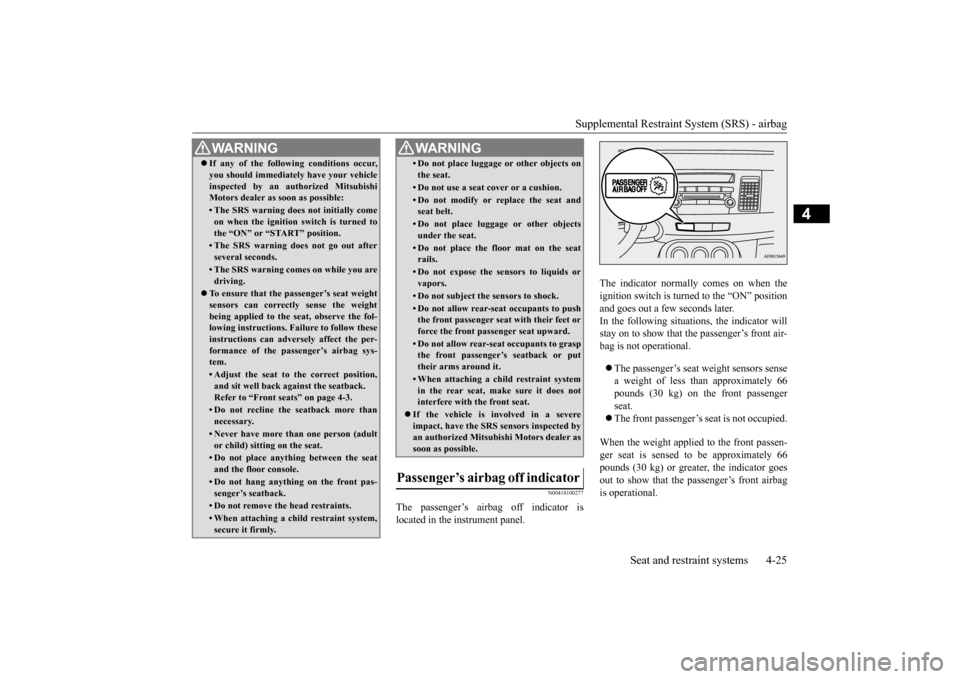
is
located in the instrument panel.
The
indicator
normally
comes
on
when
the
ignition
switch
is turned
to the
“ON”
position
and goes out a few seconds later
.
In
the
following
situations,
the
indicator
will
stay
on
to show
that
the
passenger
’s front
air-
bag is not operational.The
passenger
’s seat
weight
sensors
sense
a weight
of
less
than
approximately
66
pounds
(30
kg)
on
the
front
passenger
seat.The
front
passenger
’s seat
is not
occupied.
When
the
weight
applied
to the
front
passen-
ger
seat
is
sensed
to
be
approximately
66
pounds
(30
kg)
or
greater
, the
indicator
goes
out
to show
that
the
passenger
’s front
airbag
is operational.
W
AR
NING
If any
of
the
followi
ng
condi
tions
occu
r,
you
shoul
d imme
diately
have
your
vehicle
inspected
by an authorized
Mitsubi
shi
Motors
dealer
as soon
as possible:
•The SRS
warn
ing does
not
initially come
on
whe
n the
ign
ition
swi
tch is tur
ned to
the
“ON” or “ST
ART” posi
tion.
•The
SRS
warning
does
not
go
out
after
several
seconds.
•The SRS
warn
ing comes
on while
you
are
driv
ing.
To ensur
e that
the
passe
nge
r’s seat weight
sensors
can
corr
ectly
sense
the
weight
being
applied
to the
seat
, observe
the
fol-
lowing
ins
tructions.
Failur
e to follow
these
instr
uctions
can
advers
ely
affect
the
per-
for
mance
of
the
passe
nge
r’s airbag
sys-
tem.•Adjust
the
seat
to
the
correct posi
tion,
and
sit well
back
against
the seatb
ack
.
Refer
to “Fr
ont seats
” on page
4-3.
•Do
not
reclin
e the
seatbac
k mor
e than
necessary
.
•Never
have
mor
e than
one
person
(adult
or child)
sitting
on
the
seat.
•Do
not
place
anything
between
the
seat
and the floor console.•Do
not
hang
anything
on
the
front
pas-
sen
ger
’s seatback.
•Do not remove
the
head
restraints.
•When
attaching
a child
restraint
system,
secur
e it firmly
.
•Do not place
luggage
or
oth
er objects
on
the
seat.
•Do
not
use
a seat
cover
or a cushion.
•Do
not
modify
or
replace
the
seat
and
seat
belt.
•Do
not
place
luggage
or other
object
s
under
the
seat.
•Do not
place
the floo
r mat
on the
seat
rails
.
•Do
not
expose
the
sensors
to
liquids
or
vapors.•Do not subject
the sensors
to shock
.
•Do not allow
rear
-seat
occupa
nts to push
the
front
passenger
seat
with
their
feet
or
force the
front passe
nger s
eat upward
.
•Do not
allow
rear
-seat
occupants
to grasp
the
front
passe
nge
r’s seatbac
k or put
their
arms
around i
t.
•When attac
hing
a child restraint
syste
m
in
the
rear
seat, make
sure it does
not
interfer
e with
the front seat.
If
the
vehicle
is
involved
in
a sever
e
impac
t, have
the
SRS
sensor
s inspect
ed by
an authorized
Mitsubi
shi
Motor
s dealer
as
soon
as possi
ble.
Passenger
’s airbag
off
indicator
W
AR
NING
Page 63 of 392
5
Features and controlsBreak-in recommendation
s ..............................................................
5-3
Keys
..........................................
.......................................................
5-3
Electronic
immobilizer
(Anti-thef
t starting system)
........................
5-4
Keyless entry system (if so equipped)
..............................................
5-7
Free-hand Advanced Security T
ransmitter
(F.A.S.T
.-key)
(if
so
equipped
)..................................................
5-12
Door locks
.......................
...............................................................
5-34
Power door locks
............
...............................................................
5-37
“Child safety locks” for
rear door
..................................................
5-38
Trunk lid
...................................
.....................................................
5-39
Inside emer
gency trunk lid
release
................................................
5-40
Theft-alarm system
................................................
........................
5-41
Power windows
...............
...............................................................
5-43
Sunroof (if so equipped
).........................................
........................
5-46
Parking brake
..................
...............................................................
5-48
Steering wheel tilt lock lever
.........................................................
5-49
Inside
day/night
rearview
mirror
...................................................
5-50
Outside
rearview
mirr
ors
...............................................................
5-51
Ignition switch
......
.................................................
........................
5-52
Steering wheel lock
................................................
........................
5-54
Starting
and
stopping
the
engine
....................................................
5-55
Manual transaxle (if so equipped)
..................................................
5-57
Continuously variable transmissi
on
(CVT)
(if
so
equipped)
..........
5-59
Electronically controlled 4WD system (if so equipped)
.................
5-68
All-wheel driving opera
tion
...........................................................
5-70
Cautions on handling of all-wheel drive vehicles
..........................
5-71
Service brake
..................
...............................................................
5-72
Brake assist system
................................................
........................
5-73
Anti-lock
braking
syst
em
.....................................
.........................
5-74
Active
Stability Control (ASC
) (if
so
equipped
)............................
5-76
Power
steering
system
..........................................
.........................
5-79
Cruise control (if so eq
uipped)
.......................................................
5-80
Tire pressure monitoring
system
...................................................
5-84
Rear
-view camera (if so
equipped
)..............
...................................
5-88
Instrument cluster
.................................................
.........................
5-90
Multi-information
disp
lay
....................................
.........................
5-91
Indicator light, warning light, and information screen display list
.................................................
..........................................
5-1
12
Indicators
.................................
....................................................
5-123
Warning lights
................
.................................................
.............
5-124
Information screen disp
lay
...................................
.......................
5-125
Combination headlights and dimmer switch
...............................
5-127
Headlight leveling switch (if
so equipped)
...................................
5-132
Turn signal lever
...................................................
.......................
5-133
Hazard warning flasher
switch
....................................................
5-133
Front fog light switch (if so
equipped)
.........................................
5-134
Wiper and washer swit
ch
......................................
.......................
5-134
Electric rear window def
ogger switch
.........................................
5-138
Horn switch
.............................
....................................................
5-139
Link System (if so equi
pped)
.......................................................
5-139
Bluetooth
® 2.0 interface (if so
equipped)
.....................................
5-139
USB input terminal
...............................................
.......................
5-162
Sun visors
......................
.................................................
.............
5-166
12 V power outlet
..........
.................................................
.............
5-166
Interior
lights
.................
.................................................
.............
5-167
Storage spaces ................
.................................................
.............
5-169
Page 65 of 392
Break-in recommendations
Features and controls
5-3
5
N00508700
297
Advanced
automobile
manufacturing
tech-
niques
permit
you
to operate
your
new
vehi-
cle
without
requiring
a long
break-in
period
of low-speed driving.However
, you
can
add
to
the
future
perfor
-
mance
and
economy
of
your
vehicle
by
observing
the
following
precautions
during
the first 300 miles (500 km). Drive
your
vehicle
at moderate
speeds
during
the break-in period. Avoid
revving
the
engine.
For
vehicles
with
turbochar
ger
, do
not
exceed
5,000
rpm for the first 600 miles (1,000 km).Avoid
rough
driving
such
as
fast
starts,
sudden
acceleration,
prolonged
high-
speed
driving
and
sudden
braking.
These
would
have
a detrimental
effect
on
the
engine
and
also
cause
increased
fuel
and
oil
consumption,
which
could
result
in
malfunction
of the
engine
components.
Be
particularly
careful
to avoid
full
accelera-
tion
while
in low
gear
.
Do
not
overload
the
vehicle.
Observe
the
seating
capacity
(See
“Car
go
load
precau-
tions”
on
page
6-10).
Do not use this vehicle for trailer towing.
N00508801
657
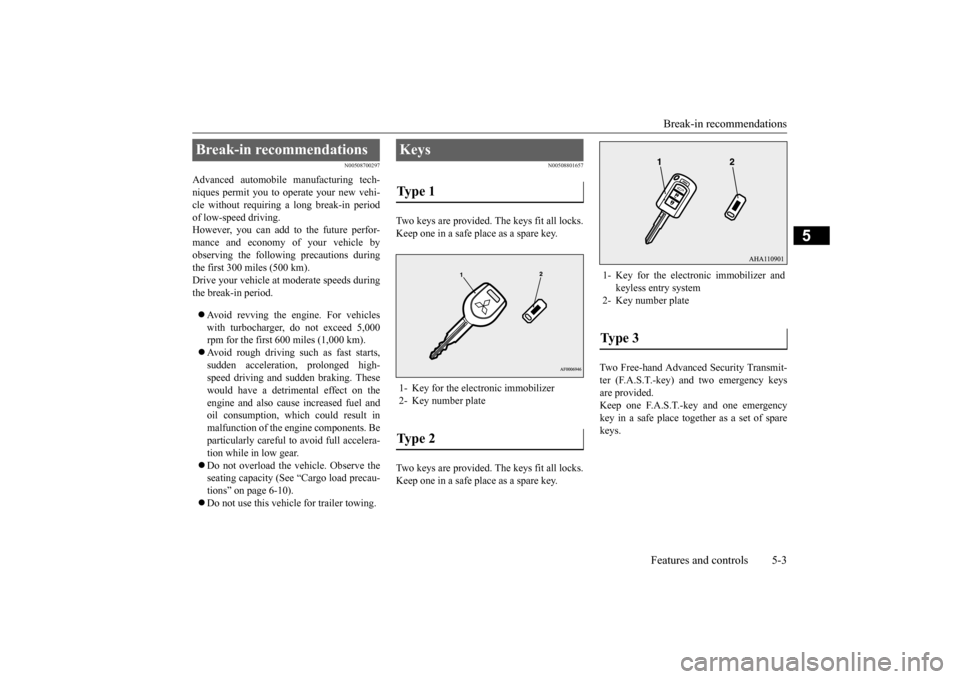
Two keys are provided. The keys fit all locks.
Keep one in a safe place as a spare key
.
Two keys are provided. The keys fit all locks.
Keep one in a safe place as a spare key
.
Two Free-hand
Advanced
Security
Transmit-
ter
(F.A.S.T
.-key)
and
two
emer
gency
keys
are provided.Keep
one
F.A.S.T
.-key
and
one
emer
gency
key
in a safe
place
together
as
a set
of
spare
keys.
Br
eak-in r
ecommendations
Keys Type 1 1-
Key for the electronic immobilizer
2-
Key number plate
Type 2
1-
Key
for
the
electronic
immobilizer
and
keyless entry system
2-
Key number plate
Type 3
Page 66 of 392
![MITSUBISHI LANCER 2016 8.G User Guide Electronic immobilizer (Anti-theft starting system)5-4
Features and controls
5
N0050910
1804
[For
vehicles
equipped
with
the
Free-hand
Advanced
Security
Trans
mitter
(F.A.S.T.-
key)]For
infor](/img/19/7463/w960_7463-65.png "MITSUBISHI LANCER 2016 8.G User Guide Electronic immobilizer (Anti-theft starting system)5-4
Features and controls
5
N0050910
1804
[For
vehicles
equipped
with
the
Free-hand
Advanced
Security
Trans
mitter
(F.A.S.T.-
key)]For
infor")
Electronic immobilizer (Anti-theft starting system)5-4
Features and controls
5
N0050910
1804
[For
vehicles
equipped
with
the
Free-hand
Advanced
Security
Trans
mitter
(F.A.S.T.-
key)]For
information
on
operations
for
vehicles
equipped
with
the
Free-hand
Advanced
Secu-
rity
Transmitter
(F.A.S.T
.-key),
refer
to
“Free-hand
Advanced
Security
Transmitter
(F.A.S.T
.-key)”:
“Electronic
immobilizer
(Anti-theft starting system)” on page 5-27.[Except
for
vehicles
equipped
with
the
Free-
hand
Advanced
Security
Transmitter
(F.A.S.T
.-key)]
The
electronic
immobilizer
is designed
to sig-
nificantly
reduce
the
possibility
of
vehicle
theft.
The
purpose
of
the
system
is to immo-
bilize
the
vehicle
if
an
invalid
start
is
attempted.
A valid
start
attempt
can
only
be
achieved
(subject
to certain
conditions)
using
a key “registered” to the immobilizer system.All
of the
keys
provided
with
your
new
vehi-
cle
have
been
programmed
to
the
vehicle’
s
electronics.
1-
Free-hand
Advanced
Security
Transmit-
ter (F
.A.S.T
.-key)
(with
electronic
immo
bilizer
and
keyless
entry system function)
2-
Emer
gency key
3-
Key number plateNOTE
The key
is a precis
ion
electronic
device
with
a built-in sign
al trans
mitter
. Pleas
e obse
rve
the following in order to prevent damage.•Do
not
leav
e whe
re it may
be expose
d to
heat
cause
d by
direct
sunlight
, suc
h as on
top
of the dashboa
rd.
•Do
not
tak
e the remo
te cont
rol transmitter
apart.•Do
not
excessi
vely
bend
the key or subject
it to strong
impacts.
•Keep
the
remote
control
transmitter
dry
.
•Keep
away
from
magnetic
objects
such
as
key
holders
.
•Keep
away from
devices
that
produce
mag-
netis
m, suc
h as audi
o systems,
computer
s
and
televis
ions
.
•Keep
away
from
devices
that
emit
strong
electromagnetic
waves
, such
as cellular
phones,
wireless
devices
and
high
fre-
quency equip
ment
(inclu
ding
med
ical
devices).•Do
not
clean
with
ultrasonic
cleaners.
•Do not
leave
the
key
where
it may
be
expos
ed to high
temperature
or high
humid-
ity.
If you
lose
your
key
, to prevent
the
theft
of
the vehicle
immed
iately
contact
an autho-
rized Mitsubi
shi Mot
ors dealer
.
If
you
notify
an authorized
Mitsubi
shi
Mot
ors
dealer
of
the key num
ber, they can
make
a new
key
. The
key
number
is stamped
on
the
key
number
plate.
Keep
the
key
num-
ber
plate
in a safe
place
separate
from
the
key
itself.
No keys
oth
er than
those
registered in
adv
ance can b
e us
ed to s
tart th
e eng
ine.
Ref
er to “Electronic
immobilizer
(Anti-
theft
starting system)” on page 5-4. Ref
er to
“Free-
hand
Adva
nced
Security
Trans
mitter
(F.A.S.T
.-key)
”:
“Electr
onic
immobilizer
(Anti-theft
starting
system)”
on
page
5-27.
NOTE
Electr
onic immobilizer
(Anti-theft starting system)
Page 67 of 392
Electronic
immobilizer
(Ant
i-theft starting system)
Features and controls
5-5
5
Only
keys
that
have
been
programmed
to the
vehicle
’s electronics
can
be
used
to
start
the
veh
icle.
If you
lose
the
key
, you
can
order
a key
from
your
authorized
Mitsubishi
Motors
dealer
by
referring
to the
key
number
.
To prevent
vehicle
theft,
the
ID
code
for
the
vehicle keys must be changed. Take
your
vehicle
and
all
remaining
keys
to
your
authorized
Mitsubishi
Motors
dealer
to
have your ID code changed. To add
a key
, you
need
to register
the
ID
code
to the vehicle.Registering
the
ID
code
can
be
done
by
your
authorized
Mitsubishi
Motors
dealer
. Or
it
can
be
done
by
yourself
(except
for
vehicles
sold in Canada).
NOTE
Do
not
attach
additional
keys or accessories
to the ignition
key. Suc
h objects
coul
d pre
-
vent the driver’s knee
airba
g from
inflatin
g
normally
. Refer
to “Deployment
of front
air-
bags
” on
page
4-28.
In the
follow
ing
cas
es, the
vehicle
may
not
be
able
to recognize
the
registered
ID
code
from
the key. This means
the engi
ne will not
start
even
when
the
key
is turned
to
the
“ST
ART” position.
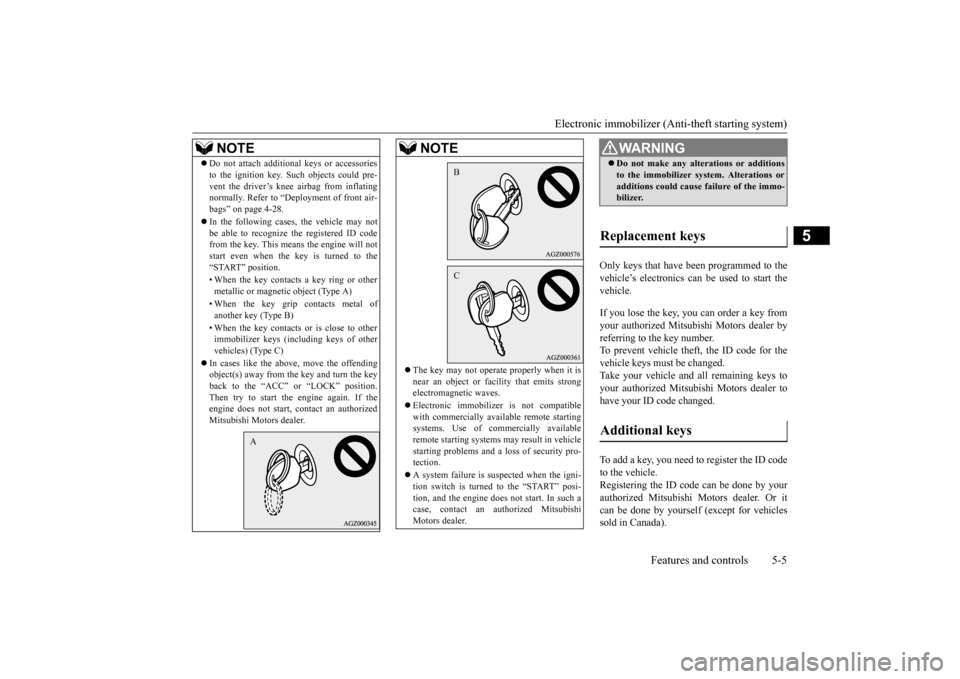
•When
the
key
contacts
a key
ring
or other
metallic or magnetic object (T
ype A)
•When
the
key
grip
contacts
metal
of
another
key
(Type
B)
•When
the
key
contacts
or is close
to other
immobilizer
keys
(including
keys
of
other
vehicles)
(Type
C)
In cas
es like the above
, move
the offendi
ng
object(s)
away from
the key and
turn
the key
back
to the “ACC”
or
“LOCK”
position.
Then
try
to
start
the
engine
again.
If the
engin
e does not start, con
tact
an author
ized
Mitsubishi
Motors
dealer
.
A
The
key
may
not
operate
properly
when
it is
near an object
or
facility
that emits
strong
electromagnetic
waves.
Electronic
immobilizer
is not
compatib
le
with commer
cially
availab
le remo
te starting
systems.
Use
of
commer
cially
availab
le
remo
te starting
systems
may
result
in vehicle
starting
problems
and
a loss of security
pro-
tection.A system
failure
is suspected
when
the
igni-
tion
switch
is turned
to the
“START” pos
i-
tion,
and
the
engine
does
not
start.
In such
a
cas
e,
contact
an
authorized
Mitsubis
hi
Mot
ors
dealer
.
NOTE
BC
W
AR
NING
Do not mak
e any alterations
or
addition
s
to the
immobilizer
system.
Alterations
or
addi
tions
coul
d cause
failu
re of the
immo
-
bilizer
.
Replacement keys Additional keys
Page 74 of 392
Free-hand Advanced Security Transmitter (F.A.S.T.-key) (if so equipped)5-12
Features and controls
5
8.Check
the
keyless
entry
system
to see
that
it works.
N0050310
0052
The
Free-hand
Advanced
Security
Transmit-
ter
(F.A.S.T
.-key)
enables
the
doors
to
be
locked
and
unlocked,
the
trunk
lid
to
be
opened,
and
the
engine
to
be
started
simply
by carrying
it.
The
F.A.S.T
.-key
can
also
be
used
as
the
remote
control
transmitter
of
the
keyless
entry system. Refer
to
“Free-hand
Advanced
Security
Transmitter
(F.A.S.T
.-key)”:
“Keyless
entry
system” on page 5-30.
NOTE
You
may
purchas
e a replacement
battery
at
an electr
ic applian
ce s
tore
.
Your
authorized
Mitsubi
shi Mot
ors
dealer
can
replace
the battery
for
you
if you
pre
fer.
CAUTIONWhen
the
remote
control
transmitter
case
is
open
ed, be
careful to keep
water
, dus
t, etc.
out.
Also,
do
not
touch
the
internal
compo-
nents
.
Fr
ee-hand Advanced Secu-
rity T
ransmitter (F
.A.S.T
.-
key)
(if so equipped)
The
F.A.S.T
.-key
must
be
carried
by
the
driver
. The F
.A.S.T
.-key is r
equir
ed for
vehicle operations such as locking and unlocking the doors, opening the trunk lid,
and
starting
the
engine.
When
leaving
the vehicle, make sur
e you ar
e carrying
the F
.A.S.T
.-key and then lock the vehi-
cle.
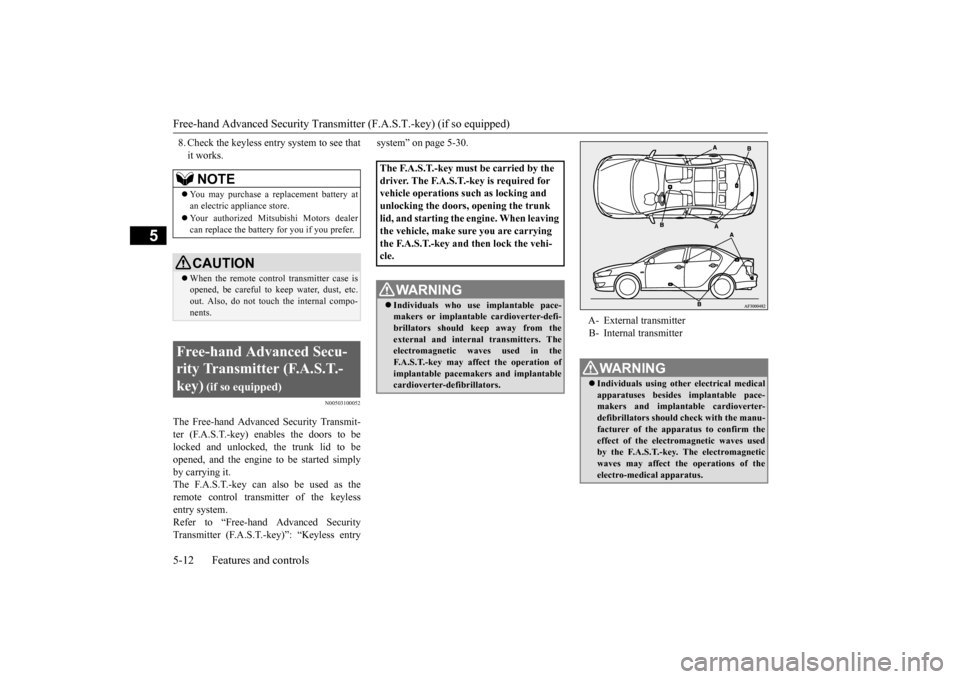
W
AR
NING
Indi
vidual
s who
use
impl
antable
pace-
makers
or
implantable
cardioverter
-defi-
brillator
s shoul
d keep
away
from
the
ext
ern
al
and
internal
transmitters.
The
elect
romagne
tic
wave
s use
d in the
F.A.S.T
.-ke
y may
affect
the
operati
on
of
impl
antable
pacemakers
and
impl
antabl
e
cardiovert
er-de
fibrillator
s.
A-
External transmitter
B-
Internal transmitterW
AR
NING
Indi
vidual
s usi
ng
other
elect
rica
l medica
l
appar
atuse
s besides impl
antable
pace-
makers
and
impl
antable
cardiovert
er-
defibrillators
should
check
with
the
manu-
fac
tur
er
of
the
appar
atus
to
confirm
the
effect
of
the
elect
romagne
tic wave
s use
d
by
the
F.A.S.T
.-ke
y. The
elect
romagne
tic
waves
may
affect
the
operations
of
the
elect
ro-me
dical
appar
atus.