seats MITSUBISHI LANCER 2016 8.G User Guide
[x] Cancel search | Manufacturer: MITSUBISHI, Model Year: 2016, Model line: LANCER, Model: MITSUBISHI LANCER 2016 8.GPages: 392, PDF Size: 13.12 MB
Page 35 of 392
Seat
belts
Seat and restraint systems
4-11
4
tion
switch
was
turned
on,
the
warning
light
will
come
on
and
blink
repeatedly
and
the
tone
will
sound
intermittentl
y.
The
warning
light
and
the
tone
will
stop
after
approximately 90 seconds.If
you
then
repeatedly
stop
and
start
your
vehicle
with
the
seat
belt
unfastened,
the
warning
light/display
and
tone
will
remind
you
to
fasten
your
seat
belt
every
time
the
vehicle
starts
moving.
You
will
also
be
reminded
to fasten
your
seat
belt
in this
way
when
you
remove
your
seat
belt
while
driv-
ing.
The
warning
light
and
the
tone
go
off
when
the
seat
belt
is fastened.
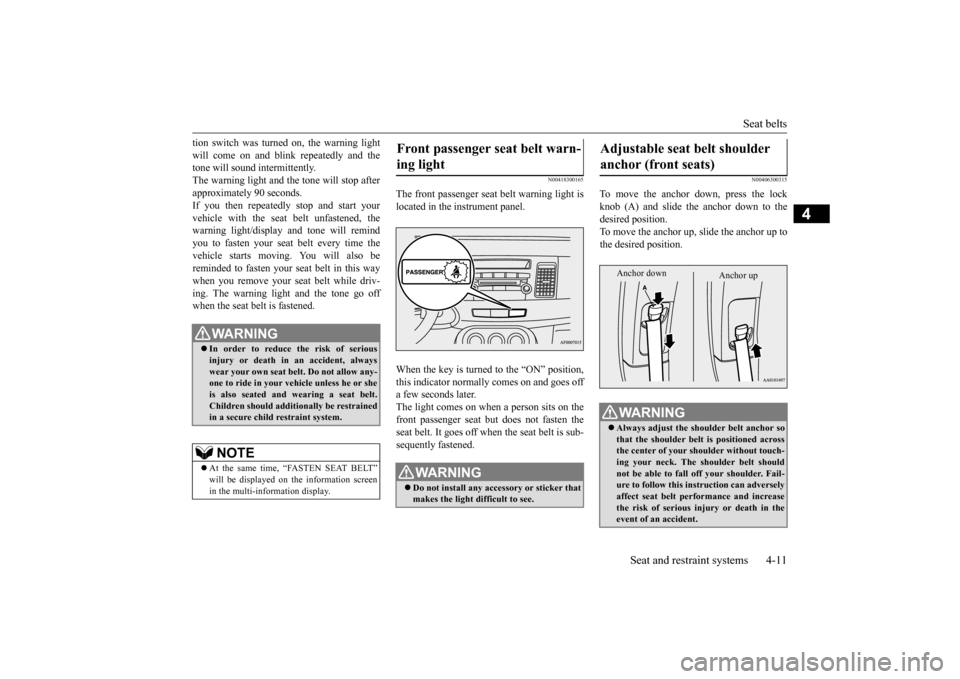
N00418300
165
The
front
passenger
seat
belt
warning
light
is
located in the instrument panel.When
the
key
is turned
to the
“ON”
position,
this
indicator
normally
comes
on
and
goes
off
a few seconds later
.
The
light
comes
on
when
a person
sits
on
the
front
passenger
seat
but
does
not
fasten
the
seat
belt.
It goes
off when
the
seat
belt
is sub-
sequently fastened.
N00406300
315
To move
the
anchor
down,
press
the
lock
knob
(A)
and
slide
the
anchor
down
to
the
desired position. To move
the
anchor
up,
slide
the
anchor
up
to
the desired position.
W
AR
NING
In
order
to
reduce
the
risk
of
serious
injury
or
death
in
an
accident,
always
wear
your own
seat belt. Do
not
allow
any-
one to ride in your vehicle unless he or she is also
seate
d and
wearing
a seat
belt.
Child
ren sho
uld addition
ally
be restrain
ed
in a secu
re child
restraint syste
m.
NOTE
At the same
time,
“FASTEN
SEAT BELT”
will be display
ed on
the information
screen
in the multi-information
display
.
Fr
ont passenger seat belt warn-
ing light
W
AR
NING
Do not install
any accessory
or stick
er that
makes the light difficult to see.
Adjustable seat belt shoulder anchor (fr
ont seats)
W
AR
NING
Always
adjust
the
shoulder
belt
anchor
so
that
the
shoul
der belt is posi
tione
d across
the
center
of your
shoul
der without
touc
h-
ing
your
neck.
The
shoul
der
belt shoul
d
not
be able
to fall
off
your
shoul
der. Fail-
ure to follow
this instr
uction
can
advers
ely
affect
seat belt perfor
mance
and
increase
the
risk
of serious
injur
y or death
in the
event of an accident.Anchor
down
Anchor
up
Page 36 of 392
Seat belt use during pregnancy4-12
Seat and restraint systems
4
N0040670
1215
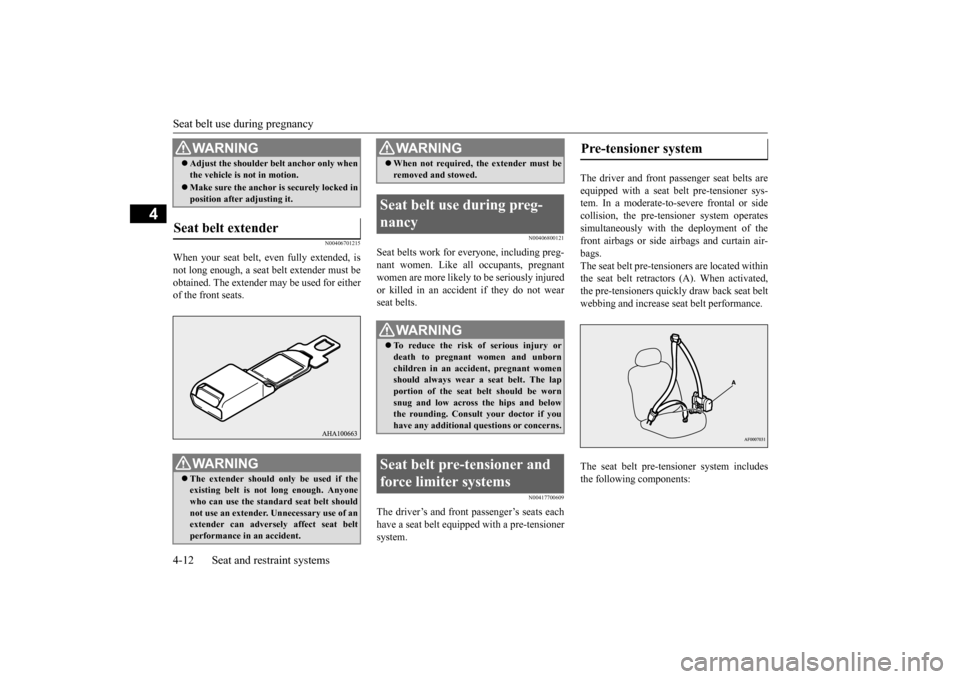
When
your
seat
belt,
even
fully
extended,
is
not
long
enough,
a seat
belt
extender
must
be
obtained.
The
extender
may
be
used
for
either
of the
front
seats.
N0040680
0121
Seat
belts
work
for
everyone,
including
preg-
nant
women.
Like
all
occupants,
pregnant
women
are
more
likely
to be
seriously
injured
or
killed
in
an
accident
if they
do
not
wear
seat
belts.
N0041770
0609
The
driver
’s and
front
passenger
’s seats
each
have a seat belt equipped with a pre-tensioner system.
The
driver
and
front
passenger
seat
belts
are
equipped
with
a seat
belt
pre-tensioner
sys-
tem.
In
a moderate-to-severe
frontal
or
side
collision,
the
pre-tensioner
system
operates
simultaneously
with
the
deployment
of
the
front
airbags
or
side
airbags
and
curtain
air-
bags.The
seat
belt
pre-tensioners
are
located
within
the
seat
belt
retractors
(A).
When
activated,
the
pre-tensioners
quickly
draw
back
seat
belt
webbing and increase seat belt performance. The
seat
belt
pre-tensioner
system
includes
the following components:
Adjust
the
shoulder
belt
anchor
only
when
the
vehicle
is not
in motion.
Mak
e sur
e the anchor is secu
rely
lock
ed in
position
after
adjusting
it.
Seat belt extender
W
AR
NING
The
extender
should
only
be
used
if the
exis
ting belt
is not
lon
g enough. Anyon
e
who
can
use
the
standar
d seat belt shoul
d
not
use
an
exte
nde
r. Unnecessar
y use
of an
exte
nder
can
advers
ely
affect
seat
belt
performance
in an
accident.
W
AR
NING
When not requi
red, the extender
must
be
removed
and
stow
ed.
Seat belt use during pr
eg-
nancy
W
AR
NING
To reduce
the
risk
of
serious
injur
y or
death
to
pregn
ant women
and
unborn
children in an
accid
ent,
pregnant
wome
n
sho
uld alw
ays
wear
a seat
belt.
The lap
por
tion
of
the
seat
belt shoul
d be wor
n
snug
and
low
acr
oss
the
hips
and
below
the
rounding.
Consult
your
doctor
if you
have any
addi
tional
que
stions
or con
cerns.
Seat belt pr
e-tensioner and
for
ce limiter systems W
AR
NING
Pr
e-tensioner system
Page 37 of 392
Child restraint systems
Seat and restraint systems
4-13
4
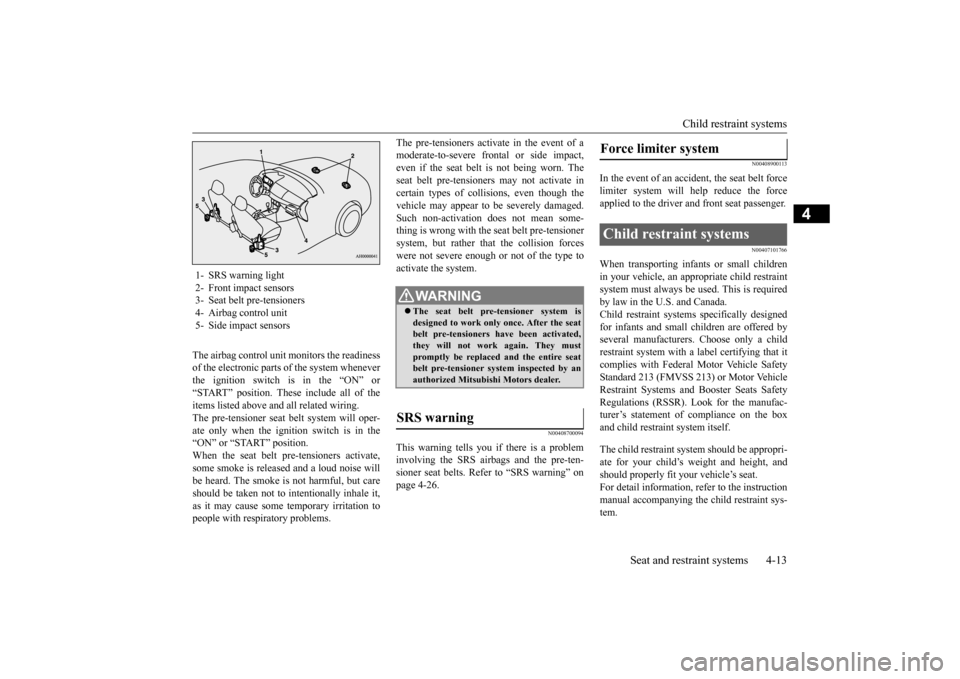
The
airbag
control
unit
monitors
the
readiness
of the
electronic
parts
of the
system
whenever
the
ignition
switch
is
in
the
“ON”
or
“ST
ART” position.
These
include
all
of
the
items listed above and all related wiring. The
pre-tensioner
seat
belt
system
will
oper
-
ate
only
when
the
ignition
switch
is
in
the
“ON”
or “ST
ART” position.
When
the
seat
belt
pre-tensioners
activate,
some
smoke
is released
and
a loud
noise
will
be
heard.
The
smoke
is not
harmful,
but
care
should
be
taken
not
to intentionally
inhale
it,
as
it may
cause
some
temporary
irritation
to
people with respiratory problems.
The
pre-tensioners
activate
in
the
event
of
a
moderate-to-severe
frontal
or
side
impact,
even
if the
seat
belt
is not
being
worn.
The
seat
belt
pre-tensioners
may
not
activate
in
certain
types
of
collisions,
even
though
the
vehi
cle
may
appea
r to be
severely
damaged.
Such
non-activation
does
not
mean
some-
thing
is wrong
with
the
seat
belt
pre-tensioner
system,
but
rather
that
the
collision
forces
were
not
severe
enough
or
not
of
the
type
to
activate the system.
N00408700
094
This
warning
tells
you
if there
is a problem
involving
the
SRS
airbags
and
the
pre-ten-
sioner
seat
belts.
Refer
to “SRS
warning”
on
page 4-26.
N0040890
0113
In the
event
of an
accident,
the
seat
belt
force
limiter
system
will
help
reduce
the
force
applied
to the
driver
and
front
seat
passenger
.
N00407101
766
When
transporting
infants
or
small
children
in your
vehicle,
an
appropriate
child
restraint
system
must
always
be
used.
This
is required
by law in the U.S. and Canada.Child
restraint
systems
specifically
designed
for
infants
and
small
children
are
offered
by
several
manufacturers.
Choose
only
a child
restraint
system
with
a label
certifying
that
it
complies
with
Federal
Motor
Vehicle
Safety
Standard
213
(FMVSS
213)
or Motor
Vehicle
Restraint
Systems
and
Booster
Seats
Safety
Regulations
(RSSR).
Look
for
the
manufac-
turer
’s statement
of
compliance
on
the
box
and child restraint system itself. The
child
restraint
system
should
be
appropri-
ate
for
your
child’
s weight
and
height,
and
should properly fit your vehicle’
s seat.
For
detail
information,
refer
to the
instruction
manual
accompanying
the
child
restraint
sys-
tem.
1-
SRS warning light
2-
Front impact sensors
3-
Seat belt pre-tensioners
4-
Airbag control unit
5-
Side impact sensors
W
AR
NING
The
seat
belt
pre-tensioner
system
is
designe
d to wor
k onl
y once.
After
the
seat
belt pre-tensi
oners
have
been
activate
d,
they
will
not
work
again.
They
must
promptl
y be replaced
and
the
entire seat
belt
pre-tension
er
system
inspected
by an
authorized
Mitsubi
shi
Motors
dealer
.
SRS
warning
For
ce limiter system
Child r
estraint systems
Page 38 of 392
Child
restraint
systems
4-14
Seat and restraint systems
4
All
children
should
be
properly
restrained
in
a restraint
device
that
offers
the
maximum
protection
for
their
size
and
age.
Be
sure
to
check
local,
state,
or
provincial
requirements
for
child
size
and
age
that
may
vary from the recommendations listed below
.
Children
less
than
1 year
old
and
who
weigh
22
pounds
(10
kg)
or
less
MUST
ride
in a rear
-facing
child
safety
seat
that
MUST ONL
Y be used in the rear seat.
Children
older
than
1 year
of age
and
who
weigh
less
than
40
pounds
(18
kg)
or who
are
less
than
40
inches
(100
cm)
tall
must
be
in a forward-facing
restraint
used
only
in the rear seat.Children
who
weigh
more
than
40
pounds
(18
kg)
or
who
are
more
than
40
inches
(100
cm)
tall,
regardless
of
age,
should
use
a suitable
child
seat
or
a booster
seat
in
the
rear
seat
until
the
vehicle’
s
lap/shoulder belt fits them properly
.
Guidelines for child
restraint
system selection
W
AR
NING
All
childr
en must
be
seated
in
the
rear
seat,
and
properly
restrained.
Accident
statistics
show
that
childr
en
of
all
sizes
and
ages
are safer
when
properly
restrained in the
rear
seat, rather
than
in
the
front
seat.
Any
child who
is too
large to use
a child
restraint
system
should
ride
in
the
rear
seat
and
wear
the lap
and
sho
ulder
belt
properly
. The
shoulder
belt
must
be
posi-
tion
ed over
the
shoul
der
and
acr
oss
the
chest,
not
acr
oss their
neck
, and
with
the
lap
belt posi
tione
d low
on
the
child’s hips,
not
acr
oss their
stomach.
If necessary
, a
booster
seat sho
uld be use
d to help
achieve
a proper
seat
belt
fit.
Follow
the
booster
seat
manufac
tur
er’s instr
uctions.
Only use
a booster
seat
that
is certified
as
comply-
ing
with
Federal
Motor
Vehicle
Safety
Standards
or Motor
Vehicle
Restraint
Sys-
tems
and
Booster
Seats
Safety
Regula-
tions. Never
hold
an
infant
or child
in your
arms
or on
your
lap
when
riding
in this
vehicle,
even
whe
n you are wearin
g your seat belt.
Never
place
any par
t of the
seat
belt you
are wearing
around
an
infant
or
child.
Failur
e to follow
these
simple
instructions
create
s a risk
of serious
injury
or death
to
your
child
in the
event
of an
accident
or
sudden
stop.
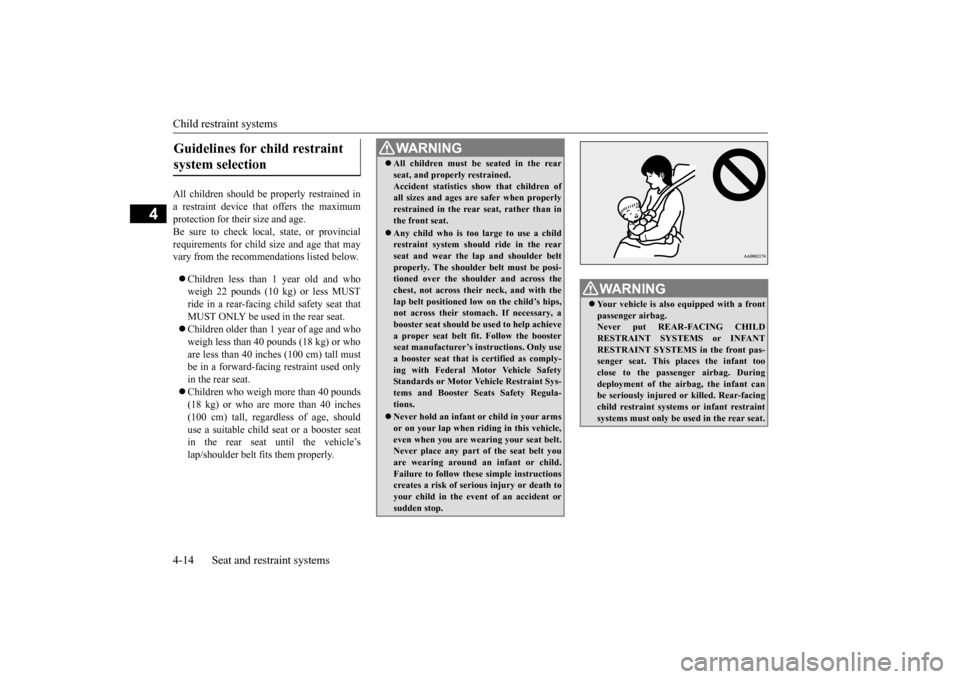
W
AR
NING
Your vehicle
is also equi
ppe
d with a front
passe
nger
airbag.
Never
put
REAR-
FACING
CHILD
RESTRAINT
SYSTEM
S or INF
ANT
RESTRAINT
SYSTEM
S in the
front
pas-
senger
seat.
Thi
s places
the
infant
too
close
to
the
passe
nger
airbag.
Durin
g
deployme
nt
of
the
airbag,
the
infant
can
be
seriously
injur
ed or
killed.
Rear
-facing
child
restraint
systems
or
infant
restraint
systems
must
only be use
d in the rear
seat.
Page 44 of 392
Maintenance and inspection of seat belts4-20
Seat and restraint systems
4
Systems
and
Booster
Seats
Safety
Regula-
tions.
N0040700
0221
The
seat
belt
webbing
may
be
cleaned
with
mild
soap
or deter
gent
solution.
Do
not
use
an
organic
solvent.
Allow
the
belts
to dry
in the
shade.
Do
not
allow
them
to retract
until
com-
pletely
dry
. Do
not
attempt
to
bleach
or
re-
dye
the
belts.
The
color
may
rub
off and
the
webbing strength may be a
ffected.
Regularly
check
your
seat
belt
buckles
and
their
release
mechanisms
for
positive
engage-
ment
and
release
of the
latch
plate.
Check
the
retractors
for
automatic
locking
when
in
the
Automatic
Locking
Retractor
function.
The
entire
seat
belt
assembly
should
be
replaced
if the
webbing
shows
any
obvious
cuts,
tears,
increase
in
thickness
in
any
sec-
tion
of
the
webbing
from
broken
fibers,
or
severe
fading
from
sunlight.
All
of these
con-
ditions
indicate
a weakening
of
the
belt,
which
may
adversely
affect
seat
belt
perfor
-
mance
in an
accident.
N0040770
1805
This
vehicle
is equipped
with
a Supplemental
Restraint
System
(SRS),
which
includes
air-
bags for the driver and passengers.The
SRS
front
airbags
are
designed
to supple-
ment
the
primary
protection
of
the
driver
and
front
passenger
seat
belt
systems
by
provid-
ing
those
occupants
with
protection
against
head
and
chest
injuries
in certain
moderate
to
severe frontal collisions. The
SRS
front
airbags,
together
with
sensors
at
the
front
of
the
vehicle
and
sensors
attached
to the
front
seats,
form
an
advanced
airbag system.The
SRS
driver
’s knee
airbag
is designed
to
supplement
the
primary
protection
of
the
driver
’s seat
belt
system.
It can
reduce
the
forward
movement
of
the
driver
’s lower
legs
and
provide
increased
overall
body
protection
in
certain
moderate
to
severe
frontal
colli-
sions. The
SRS
side
airbags
(if so
equipped)
and
the
curtain
airbags
(if
so
equipped)
are
also
designed
to
supplement
the
seat
belts.
The
SRS
side
airbags
provide
the
driver
and
front
passenger
with
protection
against
chest
inju-
ries
by
deploying
the
bag
on
the
side
W
AR
NING
Any
child
who
is too
small
to
properly
wear
a seat
belt
must
be properly
restrain
ed in an appr
opriate
child
restrain
t system,
to
reduce
their
risk
of
serious
injury or d
eath
in an accid
ent.
A child should never be left unattended in,or
unsupervised,
around
your
vehicle.
When you
leave
the veh
icle
alw
ays
tak
e
the ch
ild out
as well.
Childr
en can die f
rom heat str
oke if left o
r
trapped
inside
the
vehicle,
especially
on
hot
days
.
Keep
you
r veh
icle
lock
ed and
the trunk
lid
close
d whe
n not
in use
. Keep
your
vehicle
keys
away
from
children.
Never
allow
children to play
in the
trunk
of you
r vehicle.
Maintenance
and
inspection
of seat belts
W
AR
NING
Do
not
attempt
to
repair
or
replace
any
part
of the
seat
belt
assemblies.
This
work
shoul
d be done
by an
authorized
Mitsubishi
Motors
dealer
. Failur
e to have
an
authorized
Mitsubishi
Motors
dealer
perform
the
wor
k coul
d reduce
the
effec-
tiveness
of the
belts
and
could
result
in a
serious
injury o
r death
in an accid
ent.
Supplemental Restraint Sys-tem (SRS) - airbag
Page 48 of 392
Supplemental Restraint System (SRS) - airbag4-24
Seat and restraint systems
4
The
EDR
is designed
to record
data
related
to
vehicle
dynamics
and
safety
systems
for
a
short
period
of
time,
typically
30
seconds
or
less.The
EDR
in this
vehicle
is designed
to record
such data as:How
various
systems
in your
vehicle
were
oper
atin
g;
Whether
or
not
the
driver
and
passenger
safety belts were buckled/fastened;How
far
(if
at all)
the
driver
was
depress-
ing
the
accelerator
and/or
brake
pedal;
and,How fast the vehicle was traveling.
These
data
can
help
provide
a better
under
-
standing
of
the
circumstances
in
which
crashes
and
injuries
occur
.
To read
data
recorded
by
an
EDR,
special
equipment
is required,
and
access
to the
vehi-
cle
or
the
EDR
is needed.
In
addition
to
the
vehicle
manufacture
r, other
parties,
such
as
law
enforcement,
that
have
the
special
equip-
ment,
can
read
the
information
if they
have
access to the vehicle or the EDR.
N0041790
0164
The
driver
’s seat
position
sensor
is attached
to the
seat
rail
and
provides
the
airbag
control
unit
with
information
on
the
seat’
s fore-aft
position.
The
airbag
control
unit
controls
deployment
of
the
driver
’s front
airbag
in
accordance
with
the
information
it receives
from this
sens
or.
If there
is a problem
involving
the
driver
’s
seat
position
sensor
, the
SRS
warning
in
the
instrument
panel
will
come
on.
Refer
to “SRS
warning” on page 4-26.
N0041800
0247
The
passenger
’s
seat
weight
sensors
are
attached
to the
seat
rails
and
provide
the
air-
bag
control
unit
with
information
regarding
the
weight
on
the
front
passenger
seat.
The
airbag
control
unit
controls
deployment
of the
passenger
’s front
airbag
in
accordance
with
the information it receives from this sensor
.
The
passenger
’s front
airbag
will
not
deploy
in
an
impact
when
the
weight
on
the
seat
is
sensed
to
be
less
than
approximately
66
pounds
(30
kg).
In
this
case,
the
passenger
’s
airbag of
f indicator will come on.
Refer to “Passenger
’s airbag of
f indicator” on
page 4-25. If
there
is
a problem
involving
the
passen-
ger
’s seat
weight
sensors,
the
SRS
warning
in
the
instrument
panel
will
come
on.
Refer
to
“SRS warning” page 4-26.
NOTE
EDR data
are
recorded
by
your
vehicle
only
if a non-trivial
cras
h situation
occurs
; no
data
are
recorded
by
the
EDR
under
normal
driv-
ing
conditions
and
no
personal
data
(e.g.,
name,
gende
r, age, and
crash
location)
are
recorded.
However
, other
parties,
such
as
law
enforcement,
could
combine
the
EDR
data
with
the
type
of personally
identifying
data
routinely
acquired
during
a crash
inves-
tigation.
Driver
’s seat position sensor
W
AR
NING
If the SRS
warn
ing comes
on, have
the
vehicle
inspect
ed by
an
authorized
Mit
-
subishi
Motors
dealer
as soon
as possible.
Please
observ
e the
followi
ng
instr
uctions
to
ensur
e that
the
driv
er’s seat
posi
tion
sensor
can
operate
correctly.
•Adjust
the
seat
to
the
correct posi
tion,
and
sit well
back
against
the seatb
ack
.
Refer
to “Fr
ont seats
” on page
4-3.
•Do
not
reclin
e the
seatbac
k mor
e than
necessar
y whe
n driv
ing.
•Do
not
place
metallic
objects
or
luggage
under
the front seat.
If
the
vehicle
is
involved
in
a sever
e
impact,
have
the
SRS
sensor
inspected
by
an
authorized
Mitsubi
shi
Motor
s dealer
as
soon
as possible.
Passenger
’s seat
weight
sensors
W
AR
NING
Page 49 of 392
Supplemental Restraint System (SRS) - airbag
Seat and restraint systems
4-25
4
N00418100
277
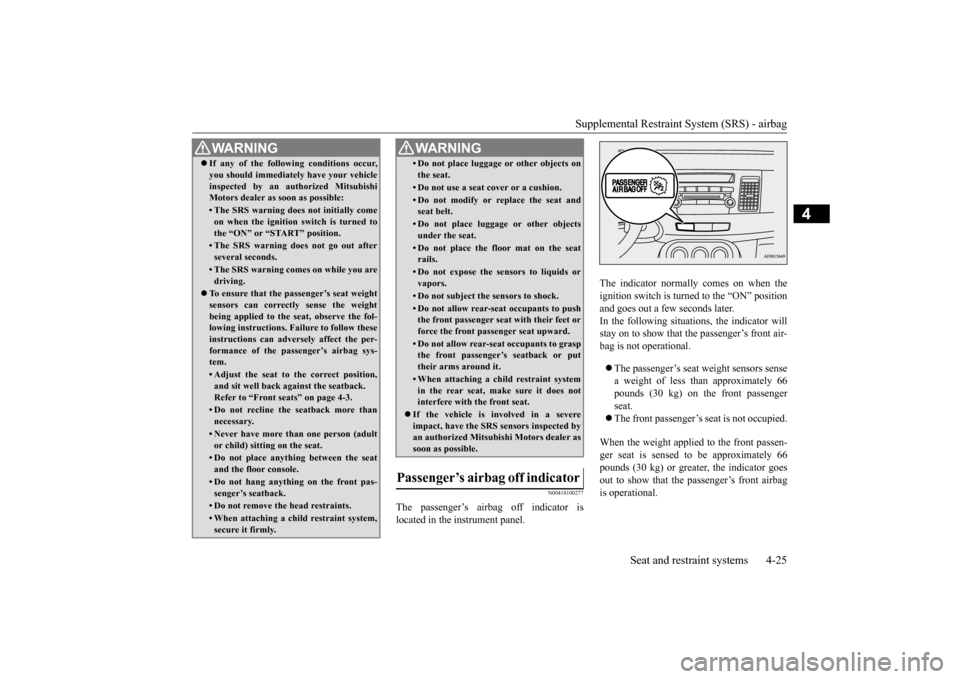
The
passenger
’s
airbag
off
indicator
is
located in the instrument panel.
The
indicator
normally
comes
on
when
the
ignition
switch
is turned
to the
“ON”
position
and goes out a few seconds later
.
In
the
following
situations,
the
indicator
will
stay
on
to show
that
the
passenger
’s front
air-
bag is not operational.The
passenger
’s seat
weight
sensors
sense
a weight
of
less
than
approximately
66
pounds
(30
kg)
on
the
front
passenger
seat.The
front
passenger
’s seat
is not
occupied.
When
the
weight
applied
to the
front
passen-
ger
seat
is
sensed
to
be
approximately
66
pounds
(30
kg)
or
greater
, the
indicator
goes
out
to show
that
the
passenger
’s front
airbag
is operational.
W
AR
NING
If any
of
the
followi
ng
condi
tions
occu
r,
you
shoul
d imme
diately
have
your
vehicle
inspected
by an authorized
Mitsubi
shi
Motors
dealer
as soon
as possible:
•The SRS
warn
ing does
not
initially come
on
whe
n the
ign
ition
swi
tch is tur
ned to
the
“ON” or “ST
ART” posi
tion.
•The
SRS
warning
does
not
go
out
after
several
seconds.
•The SRS
warn
ing comes
on while
you
are
driv
ing.
To ensur
e that
the
passe
nge
r’s seat weight
sensors
can
corr
ectly
sense
the
weight
being
applied
to the
seat
, observe
the
fol-
lowing
ins
tructions.
Failur
e to follow
these
instr
uctions
can
advers
ely
affect
the
per-
for
mance
of
the
passe
nge
r’s airbag
sys-
tem.•Adjust
the
seat
to
the
correct posi
tion,
and
sit well
back
against
the seatb
ack
.
Refer
to “Fr
ont seats
” on page
4-3.
•Do
not
reclin
e the
seatbac
k mor
e than
necessary
.
•Never
have
mor
e than
one
person
(adult
or child)
sitting
on
the
seat.
•Do
not
place
anything
between
the
seat
and the floor console.•Do
not
hang
anything
on
the
front
pas-
sen
ger
’s seatback.
•Do not remove
the
head
restraints.
•When
attaching
a child
restraint
system,
secur
e it firmly
.
•Do not place
luggage
or
oth
er objects
on
the
seat.
•Do
not
use
a seat
cover
or a cushion.
•Do
not
modify
or
replace
the
seat
and
seat
belt.
•Do
not
place
luggage
or other
object
s
under
the
seat.
•Do not
place
the floo
r mat
on the
seat
rails
.
•Do
not
expose
the
sensors
to
liquids
or
vapors.•Do not subject
the sensors
to shock
.
•Do not allow
rear
-seat
occupa
nts to push
the
front
passenger
seat
with
their
feet
or
force the
front passe
nger s
eat upward
.
•Do not
allow
rear
-seat
occupants
to grasp
the
front
passe
nge
r’s seatbac
k or put
their
arms
around i
t.
•When attac
hing
a child restraint
syste
m
in
the
rear
seat, make
sure it does
not
interfer
e with
the front seat.
If
the
vehicle
is
involved
in
a sever
e
impac
t, have
the
SRS
sensor
s inspect
ed by
an authorized
Mitsubi
shi
Motor
s dealer
as
soon
as possi
ble.
Passenger
’s airbag
off
indicator
W
AR
NING
Page 56 of 392
Supplemental Restraint System (SRS) - airbag4-32
Seat and restraint systems
4
N0041920
1230
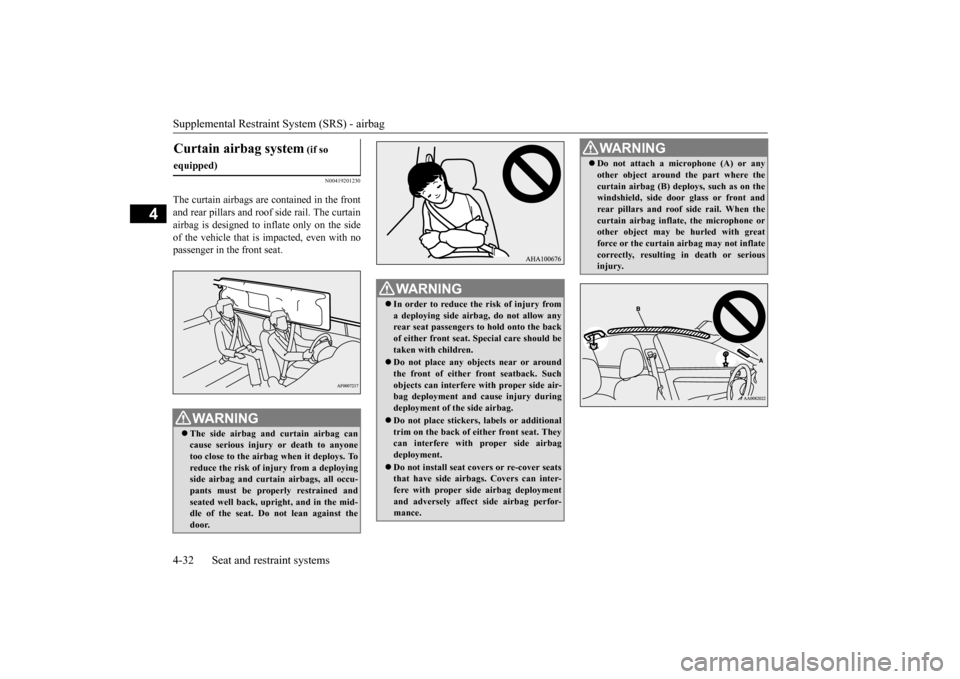
The
curtain
airbags
are
contained
in the
front
and
rear
pillars
and
roof
side
rail.
The
curtain
airbag
is designed
to inflate
only
on
the
side
of
the
vehicle
that
is impacted,
even
with
no
passenger in the front seat.Curtain airbag system
(if so
equipped)
W
AR
NING
The side airb
ag
and
curtain airbag
can
cause
serious
injur
y or death
to
any
one
too close
to the
airbag
whe
n it deploys.
To
reduce
the
risk
of injur
y from a deployin
g
side airb
ag and
curtain
airb
ags,
all
occu
-
pants
must
be properly
restrained and
seated
well
back,
upright,
and
in the
mid-
dle of
the
seat.
Do
not
lean
agai
nst
the
door
.
W
AR
NING
In
ord
er to reduce
the
risk
of injury
from
a deploying
side
airbag,
do
not
allow
any
rear seat passe
ngers
to hol
d onto
the
bac
k
of either
front
seat.
Specia
l care shoul
d be
take
n with children.
Do not place
any
objects
near or around
the
front
of
either
front
seatback.
Such
objects
can
interf
ere with proper
side air-
bag deployment
and
cause
injury
durin
g
deployme
nt of the
side airb
ag.
Do
not
place stick
ers,
labels
or addi
tional
trim
on
the
bac
k of either
front
seat.
The
y
can
interf
ere with
proper
side airbag
deploymen
t.
Do
not
install
seat
covers
or re-cover
seats
that
have
side
airbags.
Covers
can
inter
-
fere with proper
side airb
ag
deploymen
t
and
adversely
affect
side
airbag
perfor
-
mance.
Do
not
attach
a micr
ophone
(A)
or
any
other
object
around
the
part
wher
e the
curtain
airbag
(B)
deploys,
such
as on
the
windshield,
side
door
glass
or
front
and
rear
pillars
and
roof
side
rail.
When
the
curtain
airbag
inflate,
the
micr
ophone
or
other
object
may
be
hurled
with
great
for
ce or the
curtain
airbag
may
not
inflate
corr
ectly
, resulting
in
death
or
serious
injury.
W
AR
NING
Page 59 of 392
Supplemental Restraint System (SRS) - airbag
Seat and restraint systems
4-35
4
N00408500
672
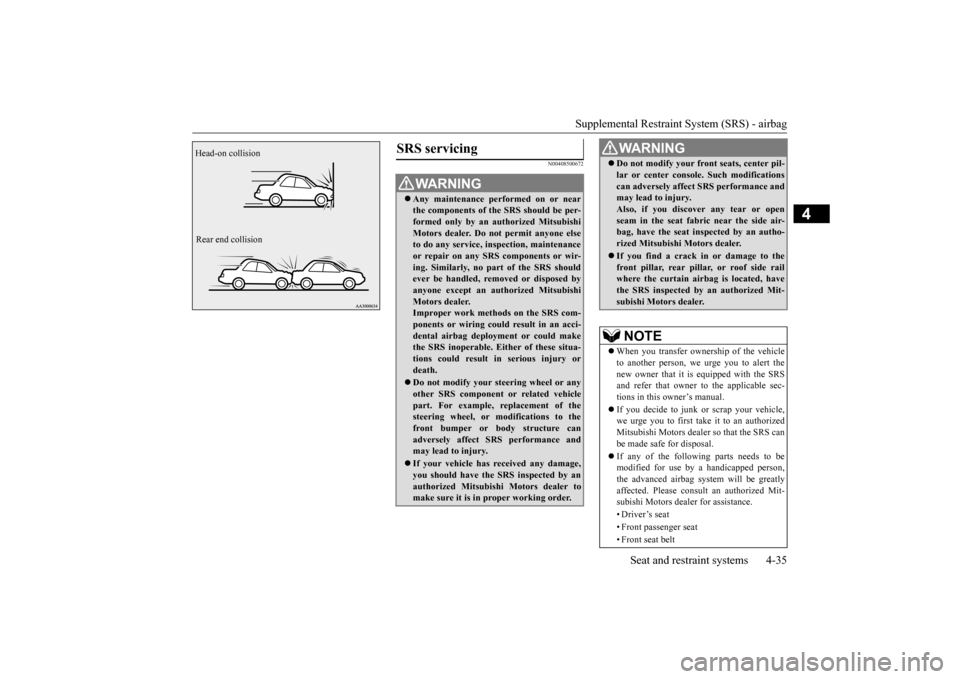
Head-on
collision
Rear e
nd c
ollisi
on
SRS
servicing W
AR
NING
Any
mai
nte
nance
perfor
med on or
near
the
compone
nts
of the
SRS
shoul
d be per-
form
ed only by
an
authorized
Mitsubi
shi
Motor
s dealer
. Do
not
perm
it any
one
else
to do any
serv
ice,
inspect
ion,
mai
nte
nanc
e
or
repair
on any
SRS
compone
nts
or wir-
ing.
Similarly, no par
t of the
SRS
shoul
d
ever
be
handled,
removed
or
disposed
by
anyone
except
an
authorized
Mitsubishi
Motor
s dealer
.
Impr
oper work
methods
on the
SRS
com
-
ponents
or
wiring
could
result
in an
acci-
dental
airb
ag deployme
nt
or coul
d make
the
SRS
inoperable.
Either
of these
situa-
tions
could
result
in
serious
injury
or
death. Do not modify your
steering
wheel
or
any
other
SRS
component
or
related
vehicle
part.
For
example,
replacement
of
the
steering
wheel,
or
modifications
to
the
front
bumper
or body
structur
e can
advers
ely
affect
SRS
perfor
mance
and
may
lead
to injury
.
If your
vehicle
has
receiv
ed any
damage
,
you
shoul
d have
the
SRS
inspect
ed by
an
authorized
Mitsubishi
Motors
dealer
to
make sur
e it is in pr
oper working order
.
Do
not
modi
fy your
front
seats,
center
pil-
lar or center
console.
Suc
h modi
ficati
ons
can
advers
ely
affect
SRS
performan
ce and
may
lead
to injury.
Also,
if you
discover
any
tear or ope
n
seam
in the seat
fab
ric
near
the side air-
bag,
have
the seat
inspected
by an autho-
rized
Mitsubi
shi
Motors
dealer
.
If you find
a cra
ck in or damage
to the
front
pillar
, rear
pillar
, or
roof
side
rail
wher
e the
curtain
airbag
is located,
have
the
SRS
inspected
by
an
authorized
Mit-
subishi
Motors
dealer
.
NOTE
When
you
trans
fer
owners
hip
of the
vehicle
to another
person,
we
urge
you
to alert
the
new
owner
that
it is equipped
with
the
SRS
and
refer
that
owner
to the
applicable
sec-
tions i
n this owne
r’s manual.
If you
decide
to junk
or scrap
your
vehicle,
we urge
you
to firs
t take
it to an
authorized
Mitsubi
shi Mot
ors
dealer
so that the SRS
can
be made s
afe
for
dispos
al.
If any
of
the
following
parts
needs
to
be
mod
ified
for
use by
a handicap
ped
person,
the adv
anced
airbag
system
will
be greatly
affected.
Pleas
e consult
an authorized
Mit-
subishi
Motors
dealer
for
assistance.
•Driver
’s seat
•Front
passenger
seat
•Front seat
belt
W
AR
NING
Page 234 of 392
Bottle holder 5-172 Features and controls
5
N00502800049
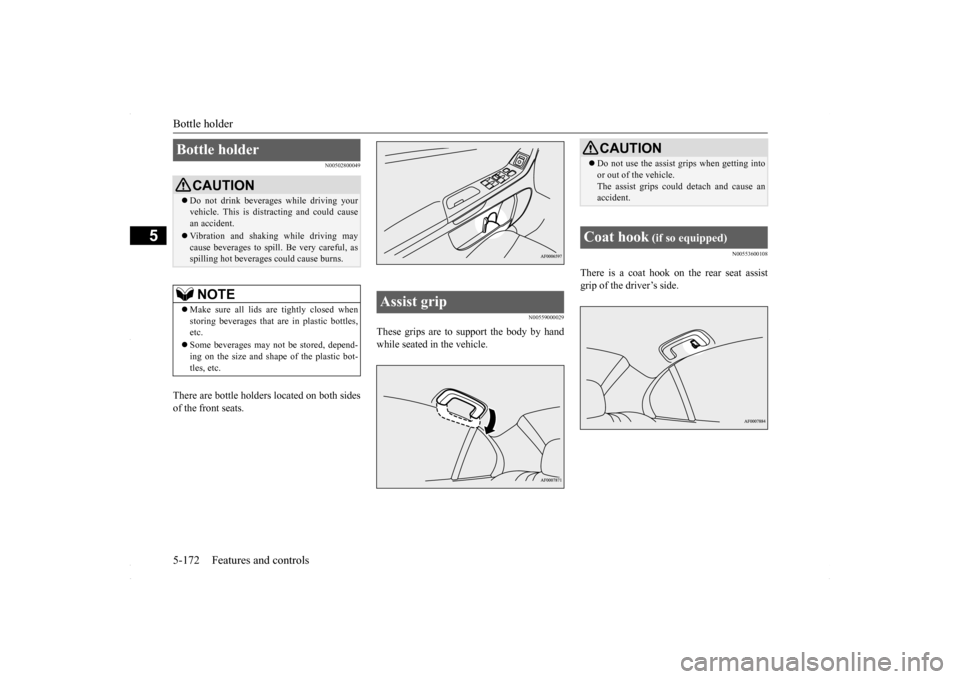
There are bottle holders located on both sides of the front seats.
N00559000029
These grips are to support the body by hand while seated in the vehicle.
N00553600108
There is a coat hook on
the rear seat assist
grip of the driver’s side.
Bottle holder
CAUTION Do not drink beverages while driving your vehicle. This is distracting and could cause an accident. Vibration and shaking while driving may cause beverages to spill. Be very careful, as spilling hot beverages could cause burns.NOTE
Make sure all lids are tightly closed when storing beverages that are in plastic bottles, etc. Some beverages may not be stored, depend- ing on the size and shape of the plastic bot-tles, etc.
Assist grip
CAUTION Do not use the assist grips when getting into or out of the vehicle. The assist grips could detach and cause an accident.
Coat hook
(if so equipped)
BK0230300US.book
172 ページ 2015年7月30日 木曜日 午後8時38分