warning light MITSUBISHI LANCER 2016 8.G User Guide
[x] Cancel search | Manufacturer: MITSUBISHI, Model Year: 2016, Model line: LANCER, Model: MITSUBISHI LANCER 2016 8.GPages: 392, PDF Size: 13.12 MB
Page 63 of 392
5
Features and controlsBreak-in recommendation
s ..............................................................
5-3
Keys
..........................................
.......................................................
5-3
Electronic
immobilizer
(Anti-thef
t starting system)
........................
5-4
Keyless entry system (if so equipped)
..............................................
5-7
Free-hand Advanced Security T
ransmitter
(F.A.S.T
.-key)
(if
so
equipped
)..................................................
5-12
Door locks
.......................
...............................................................
5-34
Power door locks
............
...............................................................
5-37
“Child safety locks” for
rear door
..................................................
5-38
Trunk lid
...................................
.....................................................
5-39
Inside emer
gency trunk lid
release
................................................
5-40
Theft-alarm system
................................................
........................
5-41
Power windows
...............
...............................................................
5-43
Sunroof (if so equipped
).........................................
........................
5-46
Parking brake
..................
...............................................................
5-48
Steering wheel tilt lock lever
.........................................................
5-49
Inside
day/night
rearview
mirror
...................................................
5-50
Outside
rearview
mirr
ors
...............................................................
5-51
Ignition switch
......
.................................................
........................
5-52
Steering wheel lock
................................................
........................
5-54
Starting
and
stopping
the
engine
....................................................
5-55
Manual transaxle (if so equipped)
..................................................
5-57
Continuously variable transmissi
on
(CVT)
(if
so
equipped)
..........
5-59
Electronically controlled 4WD system (if so equipped)
.................
5-68
All-wheel driving opera
tion
...........................................................
5-70
Cautions on handling of all-wheel drive vehicles
..........................
5-71
Service brake
..................
...............................................................
5-72
Brake assist system
................................................
........................
5-73
Anti-lock
braking
syst
em
.....................................
.........................
5-74
Active
Stability Control (ASC
) (if
so
equipped
)............................
5-76
Power
steering
system
..........................................
.........................
5-79
Cruise control (if so eq
uipped)
.......................................................
5-80
Tire pressure monitoring
system
...................................................
5-84
Rear
-view camera (if so
equipped
)..............
...................................
5-88
Instrument cluster
.................................................
.........................
5-90
Multi-information
disp
lay
....................................
.........................
5-91
Indicator light, warning light, and information screen display list
.................................................
..........................................
5-1
12
Indicators
.................................
....................................................
5-123
Warning lights
................
.................................................
.............
5-124
Information screen disp
lay
...................................
.......................
5-125
Combination headlights and dimmer switch
...............................
5-127
Headlight leveling switch (if
so equipped)
...................................
5-132
Turn signal lever
...................................................
.......................
5-133
Hazard warning flasher
switch
....................................................
5-133
Front fog light switch (if so
equipped)
.........................................
5-134
Wiper and washer swit
ch
......................................
.......................
5-134
Electric rear window def
ogger switch
.........................................
5-138
Horn switch
.............................
....................................................
5-139
Link System (if so equi
pped)
.......................................................
5-139
Bluetooth
® 2.0 interface (if so
equipped)
.....................................
5-139
USB input terminal
...............................................
.......................
5-162
Sun visors
......................
.................................................
.............
5-166
12 V power outlet
..........
.................................................
.............
5-166
Interior
lights
.................
.................................................
.............
5-167
Storage spaces ................
.................................................
.............
5-169
Page 82 of 392

Free-hand Advanced Security Transmitter (F.A.S.T.-key) (if so equipped) 5-20
Features and controls
5
N005601
00105
Type 1
Type 2
When
the
ignition
switch
is
in
a position
other than “LO
CK
(PUSH
OFF)
”, all
the
doors
are
closed,
and
someone
tries
to
lock
the
vehicle
by
pressing
the
drive
r’s or front
passenger
’s
door
lock/unlock
switch,
the
warning
display
is displayed
and
the
buzzer
sounds
for
about
3 seconds
as a warning,
and
the doors cannot be locked.
N0051430
0025
Turn
the
ignition
switch
to the
“LOCK”
posi-
tion.Turn the steering wheel until it is locked.Turn
the ignition
switch
to
the “AC
C”
posi-
tion
while
moving
the
steering
wheel
slightl
y.
N0051460
1386
Do
not
operate
the
starter
motor
for
longer
than
15
seconds
as
this
could
run
the
bat-
tery
down
or
damage
the
starter
motor
. If
the
engine
does
not
start,
turn
the
ignition
switch
back
to the
“LOCK”
position,
wait
a few
seconds,
and
then
try
again.
Trying
repeatedly
with
the
engine
or starter
motor
still
turning
will
damage
the
starter
mechanism.
Ignition switch turn-off
reminder
system
Steering wheel lock
To loc
k
To unloc
k
CAUTIONCarry the key with you when leaving the
vehicle
.
If your veh
icle
need
s to be tow
ed, turn the
ignition switch to the “ACC”
position to
unlock the steer
ing wheel
.
NOTE
If the fron
t wheels are turned, the anti-theft
lock may
sometime
s mak
e it difficu
lt to turn
the ignition switch from “LOCK” to “ACC”
position
. Firmly
turn the steer
ing wheel
to
the left or to the right as you turn the ignitio
n
switch
.
Startin
g
Tips for starting
CAUTION
Page 83 of 392
Free-hand Advanced Security Transmit
ter (F.A.S.T.-key) (if so equipped)
Features and controls
5-21
5
If the
engine
will
not
start
because
the
bat-
tery
is
weak
or
dischar
ged,
refer
to
“Jump-starting
the
engine”
on
page
8-2
for instructions.A longer
warm
up
peri
od
wil
l only
con-
sume
extra
fuel.
The
engine
is warmed
up
enough
for
driving
when
the
bar
graph
of
the
engine
coolant
temperature
display
starts
to move.
Refer
to “Interrupt
display
screen
(W
ith
ignition
switch
in the
“ON”
position)” on page 5-101.
Your
vehicle
is equipped
with
an
electroni-
cally
controlled
fuel
injection
system.
This
is
a
system
that
automatically
controls
fuel
injection.
There
is
no
need
to
depress
the
accelerator pedal when starting the engine.The starte
r mo
tor sho
uld
not
be run
for
mo
re
than
15
seconds
at a time.
To prevent
battery
drain,
wait
a few
seconds
between attempts to restart the engine.1.Make
sure
all
occupants
are
properly
seated with seat belts fastened.2.Make sure the parking brake is applied.3.Press
and
hold
the
brake
pedal
down
firmly with your right foot.4.Press
and
hold
the
clutch
pedal
all
the
way
down
(manual
transaxle).
5.On
vehicles
with
manual
transaxle,
place
the
gearshift
lever
in
the
“N”
(Neutral)
position.On
vehicles
with
continuously
variable
transmission
(CVT)
make
sure
the
selec-
tor lever is in the “P” (P
ARK) position.
6.While
pushing
the
ignition
switch
from
“LOCK”
(PUSH
OFF)
to “LOCK”
(PUSH
ON),
set
the
ignition
switch
to the
“ON”
position
and
confirm
that
all
warn-
ing
lights
and
warning
displays
are
oper
-
ating properly
.
7.Without
pressing
the
accelerator
pedal,
slowly
turn
the
ignition
switch
to
the
“ST
ART”
position
to
start
the
engine.
Release
the
ignition
switch
when
the
engine
starts.
After
several
attempts,
you
may
experience
that the engine still does not start.
W
AR
NING
Never
run
the
engi
ne in a clos
ed or poorly
ventilate
d area
any
longer
than
is need
ed
to move your
veh
icle
out
of the
area. Car
-
bon
monoxide
gas,
which
is odorless
and
extr
emely
poisonous,
could
build
up
and
cause serious injury or death.CAUTIONDo not
push-star
t the vehicle.
Do
not
run
the
engine
at high
rpms
or drive
at high speeds
until
the
engin
e has had a
chance
to warm
up.
Releas
e the ignition
switch
as soon
as the
engi
ne starts. Otherwi
se, the starter motor
will be damag
ed.
Starting
the
engine
NOTE
For
models
equipped
with
a manual
trans-
axle,
the
starter
will
not
operate
unless
the
clutch
pedal
is fully
depressed
(Clutch
inter
-
lock). This is a safety feature.
NOTE
On
vehicles
with
CVT
, the
starter
will
not
ope
rate
unless
the selector
lev
er is in the “P”
(PARK)
or “
N” (NE
UTRAL
) position.
For s
afety
reasons, s
tart the engi
ne in the “P”
(PARK)
position
so
that
the wheels
are
locked.NOTE
Minor
noi
ses may
be heard
on
engi
ne start-
up.
These will disappear
as the engi
ne warms
up.
When the engine is hard to start
Page 88 of 392
Free-hand Advanced Security Transmitter (F.A.S.T.-key) (if so equipped)5-26
Features and controls
5
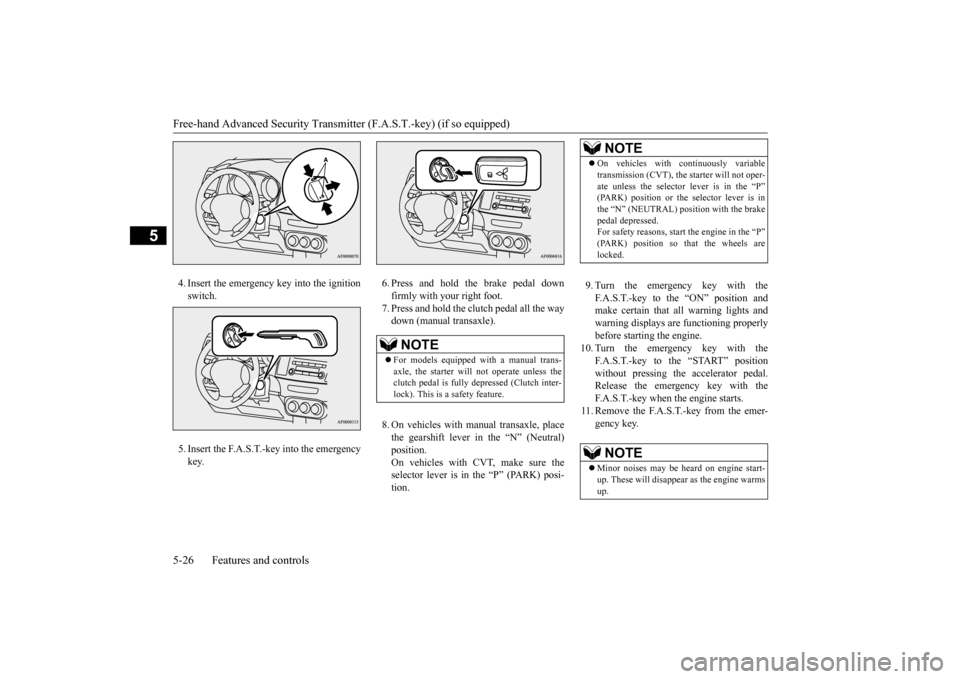
4.Insert
the
emer
gency
key
into
the
ignition
switch.5.Insert
the
F.A.S.T
.-key
into
the
emer
gency
key
.
6.Press
and
hold
the
brake
pedal
down
firmly with your right foot.7.Press
and
hold
the
clutch
pedal
all
the
way
down
(manual
transaxle).
8.On
vehicles
with
manual
transaxle,
place
the
gearshift
lever
in
the
“N”
(Neutral)
position. On
vehicles
with
CVT
, make
sure
the
selector
lever
is in
the
“P”
(PARK)
posi-
tion.
9.Turn
the
emer
gency
key
with
the
F.A.S.T
.-key
to
the
“ON”
position
and
make
certain
that
all
warning
lights
and
warning
displays
are
functioning
properly
before starting the engine.
10.
Turn
the
emer
gency
key
with
the
F.A.S.T.-key
to
the
“START”
pos
ition
without
pressing
the
accelerator
pedal.
Release
the
emer
gency
key
with
the
F.A.S.T
.-key when the engine starts.
11.Remove
the
F.A.S.T
.-key
from
the
emer
-
gency key
.
NOTE
For
models
equipped
with
a manual
trans
-
axle,
the
starter
will
not
operate
unless
the
clu
tch
pedal is fully
depre
ssed (Cl
utch
inter-
lock). This is a safety feature.
NOTE
On
vehicles
with
continuously
variable
trans
mission
(CV
T),
the
starter
will not
oper
-
ate
unless
the
selector
lever
is in
the
“P”
(PARK)
position
or
the
selector
lever
is in
the “N” (NE
UTRA
L) position
with
the brake
pedal depr
essed.
For s
afety
reas
ons, s
tart the eng
ine in t
he “P”
(PARK)
position
so
that
the
wheels
are
locked.NOTE
Minor
noi
ses may
be heard
on
engi
ne start-
up.
These will disappear
as the engi
ne warms
up.
Page 104 of 392
Theft-alarm system 5-42 Features and controls
5
4. The system has entered the armed stage after about 20 seconds, when the theft- alarm indicator (A) flashing becomes slower.The theft-alarm indicator (A) continues to flash while the system is in the armed stage.
N00510401197
The alarm will be activated if any of the fol-lowing occur while the vehicle is parked andthe system is armed.
One of the doors is opened without using the remote control transmitter or the F. A . S . T. - k e y. The engine hood or the trunk lid is opened.
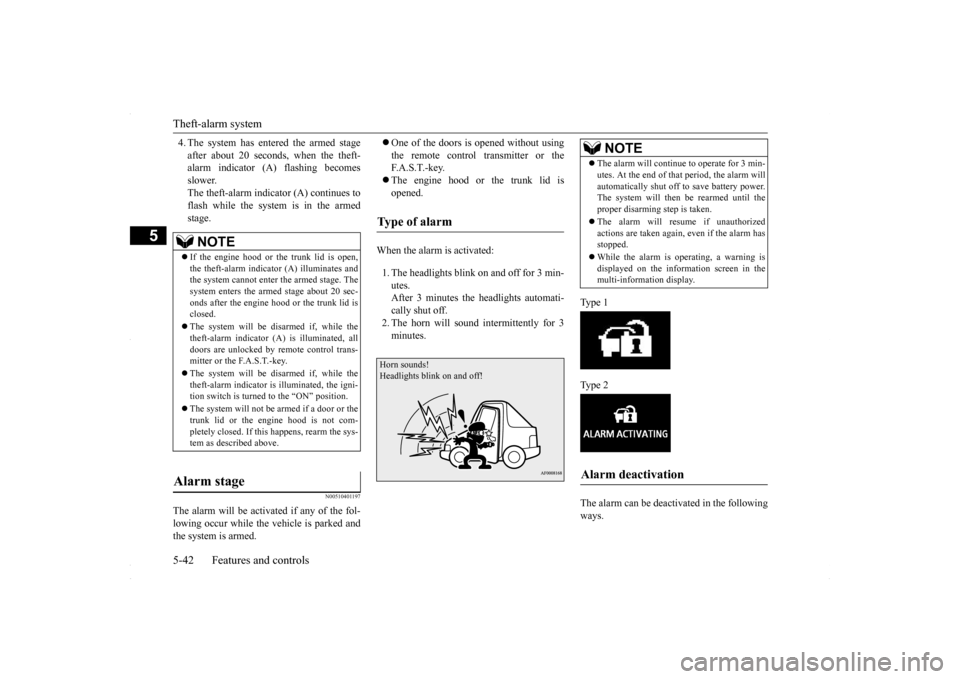
When the alarm is activated: 1. The headlights blink on and off for 3 min- utes.After 3 minutes the headlights automati- cally shut off. 2. The horn will sound intermittently for 3minutes.
Ty p e 1 Ty p e 2 The alarm can be deactivated in the following ways.
NOTE
If the engine hood or the trunk lid is open, the theft-alarm indicator (A) illuminates and the system cannot enter the armed stage. The system enters the armed stage about 20 sec-onds after the engine hood or the trunk lid is closed. The system will be disarmed if, while the theft-alarm indicator (A) is illuminated, all doors are unlocked by remote control trans-mitter or the F.A.S.T.-key. The system will be disarmed if, while the theft-alarm indicator is illuminated, the igni- tion switch is turned to the “ON” position. The system will not be
armed if a door or the
trunk lid or the engine hood is not com- pletely closed. If this happens, rearm the sys-tem as described above.
Alarm stage
Type of alarm Horn sounds!Headlights blink on and off!
NOTE
The alarm will continue to operate for 3 min- utes. At the end of that period, the alarm will automatically shut off to save battery power. The system will then
be rearmed until the
proper disarming step is taken. The alarm will resume if unauthorized actions are taken again, even if the alarm hasstopped. While the alarm is operating, a warning is displayed on the information screen in the multi-information display.
Alarm deactivation
BK0230300US.bo
ok 42 ページ 2015年7月30日 木曜日 午後8時38分
Page 110 of 392
Parking brake 5-48 Features and controls
5
N00511401439
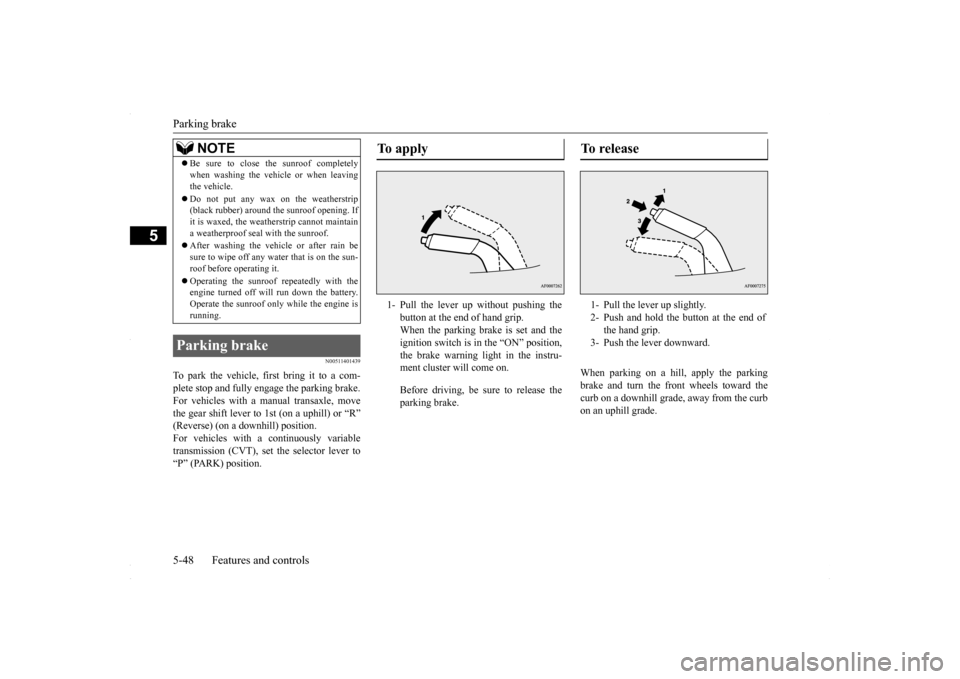
To park the vehicle, first bring it to a com- plete stop and fully engage the parking brake.For vehicles with a manual transaxle, move the gear shift lever to 1st (on a uphill) or “R” (Reverse) (on a downhill) position.For vehicles with a continuously variable transmission (CVT), set the selector lever to “P” (PARK) position.
When parking on a hill, apply the parking brake and turn the front wheels toward thecurb on a downhill grade, away from the curb on an uphill grade.
Be sure to close the sunroof completely when washing the vehicle or when leaving the vehicle. Do not put any wax on the weatherstrip (black rubber) around the sunroof opening. If it is waxed, the weatherstrip cannot maintain a weatherproof seal with the sunroof. After washing the vehicle or after rain be sure to wipe off any water that is on the sun-roof before operating it. Operating the sunroof repeatedly with the engine turned off will run down the battery. Operate the sunroof only while the engine is running.
Parking brake
NOTE
To apply 1- Pull the lever up without pushing the
button at the end of hand grip. When the parking brake is set and theignition switch is in the “ON” position, the brake warning light in the instru- ment cluster will come on. Before driving, be sure to release the parking brake.
To r e l e a s e 1- Pull the lever up slightly. 2- Push and hold the button at the end of
the hand grip.
3- Push the lever downward.
BK0230300US.bo
ok 48 ページ 2015年7月30日 木曜日 午後8時38分
Page 111 of 392
Steering wheel tilt lock lever Features and controls 5-49
5
N00511500215
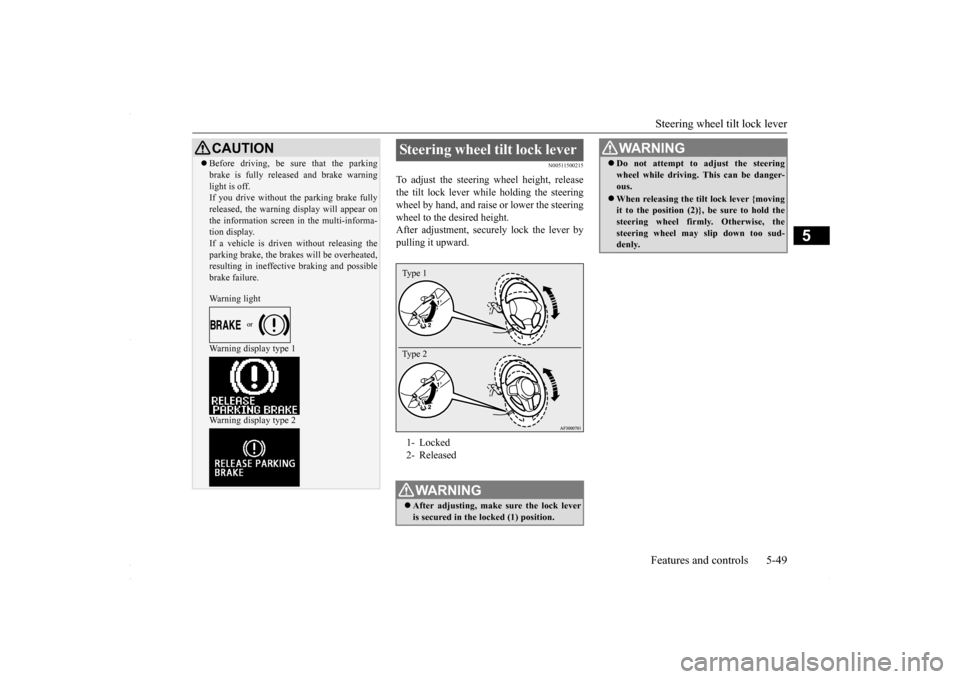
To adjust the steering wheel height, release the tilt lock lever while holding the steeringwheel by hand, and raise or lower the steering wheel to the desired height. After adjustment, securely lock the lever bypulling it upward.
CAUTION Before driving, be sure that the parking brake is fully released and brake warning light is off. If you drive without the parking brake fully released, the warning display will appear onthe information screen in the multi-informa- tion display. If a vehicle is driven without releasing theparking brake, the brakes will be overheated, resulting in ineffective braking and possible brake failure. Warning light Warning display type 1 Warning display type 2
Steering wheel tilt lock lever 1- Locked 2- ReleasedWA R N I N G After adjusting, make sure the lock lever is secured in the locked (1) position. Type 1 Type 2
Do not attempt to adjust the steering wheel while driving. This can be danger- ous. When releasing the tilt lock lever {moving it to the position (2)}, be sure to hold the steering wheel firmly. Otherwise, the steering wheel may slip down too sud-denly. WA R N I N G
BK0230300US.bo
ok 49 ページ 2015年7月30日 木曜日 午後8時38分
Page 118 of 392
Starting and stopping the engine 5-56 Features and controls
5
7. Turn the ignition switch to the “ON” posi- tion and make certain that all warning lights are functioning properly beforestarting the engine.8. Turn the ignition switch to the “START” pedal. Release the key when the enginestarts.
After several attempts, you may experience that the engine still does not start. 1. Make sure that all electric devices, such as lights, air conditioning blower and rearwindow defogger, are turned off.
2. While depressing the brake pedal on vehi- cles equipped with continuously variable transmission (CVT) or the clutch pedal on the vehicles equipped with manual trans-axle, press the accelerator pedal halfway and hold it there, then crank the engine. Release the accelerator pedal, immedi-ately after the engine starts. 3. If the engine still will not start, the engine could be flooded with too much gasoline.While depressing the brake pedal on vehi-cles equipped with CVT or the clutch pedal on the vehicles
equipped with man-
ual transaxle, push the accelerator pedalall the way down and hold it there, then crank the engine for 5 to 6 seconds. Return the ignition switch to the “LOCK”position and release the accelerator pedal. Wait a few seconds, and then crank the engine again for 5 to 6 seconds whiledepressing the brake pedal or the clutch pedal, but do not push the accelerator pedal. Release the ignition key if theengine starts. If the engine fails to start, repeat these procedures. If the engine still will not start, contact your local Mitsubi-shi Motors dealer or a repair facility of your choice for assistance.
When the ambient temperature is -4 °F (-20 °C) or lower on vehicles with CVT, itmay not be possible to start from a standstill even with the selector lever in the “D” (DRIVE) or “R” (REVERSE) position.This phenomenon occurs because the trans-axle has not warmed up sufficiently; it does not indicate a problem. If it occurs, place the selector lever in the “P” (PARK) position andlet the engine idle for at least 10 minutes. The transaxle will warm up, and you will be able to start normally.Do not leave the vehicle during warm-up operation.
N00542301102
1. Bring the vehicle to a complete stop. 2. Fully engage the parking brake while depressing the brake pedal. 3. For vehicles with a manual transaxle, turn the ignition switch to the “LOCK” posi- tion to stop the engine, and then move thegearshift lever to the 1st (on a uphill) or “R” (Reverse) (on a downhill) position.
NOTE
On vehicles with CVT, the starter will not operate unless the selector lever is in the “P” (PARK) or “N” (NEUTRAL) position. For safety reasons, start the engine in the “P” (PARK) position so that the wheels arelocked.NOTE
Minor noises may be heard on engine start- up. These will disappear as the engine warms up.
When the engine is hard to start
Startability of continuously vari- able transmission (CVT) vehicles at extremely cold ambient temper- ature Stopping the engine
BK0230300US.bo
ok 56 ページ 2015年7月30日 木曜日 午後8時38分
Page 132 of 392
All-wheel driving operation 5-70 Features and controls
5
N00530600169
Full-time 4WD vehicles are propelled by engine power distributed constantly andappropriately to all 4 wheels. Not only does this ensure enhanced handling on dry, paved roads but also permits bettertraction when driving on slippery, wet orsnow-covered roads and when moving out of mud. These vehicles, however, are not designedfor off-road use, and are unsuitable for driving on bumpy ground that may cause excessive strain.
Full-time 4WD vehicles
should be driven only under the same condi- tions as are suitable for ordinary front-wheel drive vehicles. Electronically controlled 4WD system vehi- cles are propelled by engine power distrib- uted constantly and appropriately to all 4 wheels. Not only does this ensure enhanced handling on dry, paved roads but also permits better
traction when driving on slippery, wet or snow-covered roads and when moving out of mud. These vehicles, however, are not designedfor off-road use, and are unsuitable for driving on bumpy ground that may cause excessive strain.
Electronically controlled
4WD system vehicles should be driven only under the same conditions as are suitable for ordinary front-wheel drive vehicles. When turning a sharp corner in “4WD LOCK” position at low speed, a slight differ- ence in steering may be experienced similarto feeling as if the brakes were applied. This is called tight corner braking and results from each of the four tires being at a different dis-tance from the corner. The phenomenon is typical of 4-wheel drive vehicles. If this occurs, either straighten out the steeringwheel, or change to “2WD” or “4WD AUTO” mode. Set the drive mode-selector to “4WD AUTO” conditions, and then gradually depress theaccelerator pedal for a smooth start.
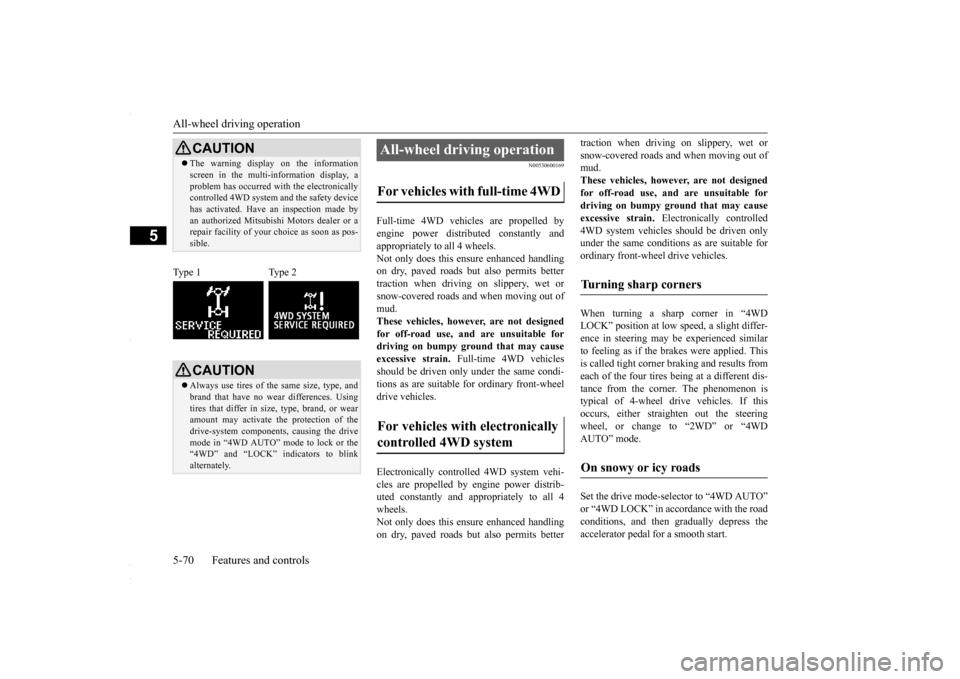
CAUTION The warning display on the information screen in the multi-information display, a problem has occurred with the electronically controlled 4WD system and the safety device has activated. Have an inspection made byan authorized Mitsubishi Motors dealer or a repair facility of your choice as soon as pos- sible.
Type 1 Type 2
CAUTION Always use tires of the same size, type, and brand that have no wear differences. Using tires that differ in size, type, brand, or wear amount may activate the protection of thedrive-system components, causing the drive mode in “4WD AUTO” mode to lock or the “4WD” and “LOCK” indicators to blinkalternately.
All-wheel driving operation For vehicles with full-time 4WD For vehicles with electronically controlled 4WD system
Turning sharp corners On snowy or icy roads
BK0230300US.bo
ok 70 ページ 2015年7月30日 木曜日 午後8時38分
Page 133 of 392
Cautions on handling of all-wheel drive vehicles
Features and controls 5-71
5
Set the drive mode-selector to “4WD LOCK” and then gradually depress the accelerator pedal for a smooth start. Keep the pressure on the accelerator pedal asconstant as possible, and drive at low speed.
Your vehicle may not provide sufficient hill climbing ability and engine braking on steepslopes. Avoid driving on steep slopes even though the vehicle is a 4-wheel drive vehicle.
N00530800190
Since driving torque can
be applied to all four
wheels, the performance of the vehicle when operating in all-wheel drive is greatly affected by the condition of the tires. Pay close attention to the tires. Install specified tires on all wheels. Refer to “Tires and wheels” on page 11-5. Be sure to fit all four tires and wheels of the same size and type.When replacement of any of the tires or wheels is necessary, replace all of them. All tires should be rotated whenever the wear difference between the front and rear tires is recognizable.
NOTE
The use of snow tires is recommended. Maintain a safe distance between vehicles, avoid sudden braking, and use engine brak- ing (downshifting).CAUTION Avoid sudden braking, sudden acceleration, and sharp turning. Skidding occurs and con- trol of the vehicle could be lost.
Moving out of mud
CAUTION If any of the following conditions occur, fol- low these procedures:• The engine coolant temperature display appears on the information screen in the multi-information display or the engine power drops suddenly. Refer to “Engine overheating” on page 8-4.
• The “ ” warning display or the “ ” warning display appear on the information screen in the multi-information display. Refer to “Warning display” on page 5-62.WA R N I N G When attempting to rock your vehicle out of a stuck position, be sure that the area around the vehicle is clear of people and physical objects. The rocking motion may cause the vehicle to suddenly launch for- ward/backward, causing injury or dam-age to nearby people or objects.NOTE
Avoid sudden braking, sudden acceleration and sharp turning; such operations couldresult in the vehicle becoming stuck. If the vehicle becomes stuck in muddy roads, it can often be moved with a rocking motion. Move the selector lever alternately between “D” (DRIVE) and “R” (REVERSE) posi-tions, while pressing lightly on the accelera- tor pedal.CAUTION
Climbing/descending sharp grades Cautions on handling of all- wheel drive vehicles Tires and wheels
BK0230300US.bo
ok 71 ページ 2015年7月30日 木曜日 午後8時38分