maintenance MITSUBISHI LANCER 2016 8.G Owners Manual
[x] Cancel search | Manufacturer: MITSUBISHI, Model Year: 2016, Model line: LANCER, Model: MITSUBISHI LANCER 2016 8.GPages: 392, PDF Size: 13.12 MB
Page 1 of 392
T
able of contents
123456789101112
OverviewQ
uick
inde
x
General
information
Seat and restraint systemsFeatures
and
controls
Driving
safety
Comfort
controls
For
emerge
ncies
Vehicle care and maintenanceCustomer
assistance/
Reporting Safety Defects
SpecificationsAlphabetical
index
Page 21 of 392
Modifications to and racing of your vehicle
General information
3-5
3
7.To close,
turn
the
fuel
tank
filler
cap
slowly
clockwise
until
you
hear
clicking
sounds,
then
gently
push
the
fuel
tank
filler door closed.
N00301600
048
This
vehicle
should
not
be
modified
with
non-Mitsubishi
Motors
genuine
parts.
Mit-
subishi
Motors
designs
and
manufactures
high
quality
vehicles
with
an
emphasis
on
safety
and
durabilit
y. Modifications
using
non-Mitsubishi
Motors
genuine
parts
may
affect
the
performance,
safety
and/or
durabil-
ity
of
your
vehicle,
and
may
violate
applica-
ble state and/or federal regulations. DAMAGE
OR
PERFORMANCE
PROB-
LEMS
RESUL
TING
FR
OM
MODIFICA-
TIONS
TO OR
RACING
OF
YOU
R
VEHICLE
ARE
NOT
COVERED
UNDER
W
ARRANTY
.
Examples
of
modifications
to
your
vehicle
that
can
cause
damage
or
performance
prob-
lems
include
the
following:
Failure
to use
Mitsubishi
Motors
genuine
partsFailure
to use
required
fuel
and
fluids
Failure to use proper size tires and wheelsModification
of
the
fuel,
intake,
exhaust,
emission,
suspension,
engine,
drive
train
or electrical wiring systems
Modification
of
any
onboard
com-
puter/control
module,
including
repro-
gramming,
or
replacing/adding
chips
to
any
onboard
computer/control
module
Review
the
Warranty
and
Maintenance
Man-
ual
for
further
details
regarding
warranty
cov-
erage.
N00301700
182
The
installation
of
accessories,
optional
parts,
etc.,
should
only
be
carried
out
within
the
limits
prescribed
by
law
in the
driving
area
and
in
accordance
with
the
guidelines
and
warnings
contained
within
the
documents
accompanying
this
vehicle.
Only
Mitsubis
hi
Motors
approved
acces
-
sories should be fitted to your vehicle.Improper
installation
of
electrical
parts
could
cause
fire.
Refer
to
the
“Modifica-
tion/alterations
to
the
electrical
or
fuel
systems”
section
with
in this
owner
’s man
-
ual.
W
AR
NING
Make
sur
e the
fuel
cap
is secur
ely closed.
If the
fuel
cap
is loose,
fuel
could
leak,
resulting
in a fire.
CAUTIONIf you
need
to replace
the fuel
tank
filler
cap
,
use only
the
cap
specified
for
your
model
vehicle. NOTE
If the
fuel
tank
filler
cap
is not
tight
while
driving,
the
engine
malfunction
indicator
(“SER
VICE
ENGINE
SOON”
or
“Check
engin
e light”)
may
come
on when
the
onboard
diagnostic
(OBD)
system
performs
a self check.
Always
tigh
ten
the
fuel
tan
k filler
cap
until
you
hear
clicking
sounds.
The indicator
will go off after drivin
g several
times.
If the
indicator
does not go off, con
-
tact
your authorized
Mitsubishi
Mot
ors
dealer
or a repair
facility
of your
choice
as
soon
as possible.
Modifications to and racing of your vehicle
Installation of accessories
CAUTIONBef
ore any electr
ical
or
electronic
accesso-
ries are installed,
consult
an
authorized
Mit-
subishi
Motors
dealer
.
Page 22 of 392
Mitsubishi Motors genuine parts3-6
General information
3
Using
a cellular
phone
or
radio
set
inside
the
vehicle
without
an
external
antenna
may
cause
electrical
system
interference,
which
could
lead
to unsafe
vehicle
opera-
tion.Tires
and
wheels
which
do
not
meet
spec-
ifications must not be used. Refer
to
the
“Specifications”
section
for
information
regarding
wheel
and
tire
sizes.
Due
to
the
large number
of
accessory
and
replacement
parts
provided
by
different
man-
ufacturers
in the
market,
it is not
always
pos-
sible
for
an
authorized
Mitsubishi
Motors
dealer
to
check
whether
the
attachment
or
installation
of
non-Mitsubishi
Motors
genu-
ine
parts
will
affect
the
driving
safety
of your
Mitsubishi-vehicle.
N0030180
0040
Mitsubishi
Motors
ma
nufactures
high
quality
vehicles
with
an
emphasis
on
safety
. It
is
important
to consult
an
authorized
Mitsubishi
Motors
dealer
before
installation
of
any
accessory
which
may
involve
modification
of
the electrical or fuel systems.
N0030140
0105
Mitsubishi
Motors
Genuine
Parts
are
designed
and
manufactured
to meet
high
stan-
dards
of
performance,
and
are
recommended
for
all
of your
maintenance
needs.
Also
avail-
able
from
your
Mitsubishi
Motors
dealer
are
a wide
variety
of
accessories
to
personalize
your
new
vehicle.
Each
Mitsubishi
vehicle
has
a selection
of
Mitsubishi
Motors
autho-
rized
accessories
to choose
from
to tailor
your
new
vehicle
to your
own
personal
preference.
Your
Mitsubishi
Motors
dealer
’s Parts
Man-
ager
has
information
on
various
audio
sys-
tems,
protection
items,
as well
as interior
and
exterior
accessories
available
for
your
spe-
cific model.
N0030010
0017
Certain
components
of
this
vehicle,
such
as
airbag
modules,
seat
belt
pretensioners,
and
button
cell
batteries,
may
contain
perchlorate
materials.Special
handling
may
apply
. For
additional
information,
see
www
.dtsc.ca.gov/hazardous-
waste/perchlorate.
W
AR
NING
If you
choose
to use
a cellu
lar phone
while
driv
ing,
you
must
not
allow
that
usage
to
distract
you
in the
safe
operation
of your
vehicle.
Anything,
including
cellular
pho
ne usage,
that
distracts
you
from
the
safe
operati
on
of
your
vehicle
increase
s
your
risk
of an
accident.
Refer to and
follow
all state and
local laws
in your
area
regard
ing cellu
lar phone
usage
while
driving.
Important
point!
Modification/alterations to the electrical or fuel systems
CAUTIONPlease
consult
an
authorized
Mitsubishi
Motors
dealer
concerning
any
such
acces-
sory
fitment
or modification.
If the
wires
interfere
with
the
vehicle
body
or
improper
installation
methods
are
used
(pro-
tective
fuses
not
included,
etc.),
electronic
devices
may
be
adversely
affected,
resulting
in a fire, vehicle damage, or other accident.
Mitsubishi Motors genuine parts
California
Per
chlorate
Materials Requir
ements
Page 25 of 392

4
Seat and restraint systemsSeats
..........................................
.......................................................
4-2
Seats
and
restraint
syst
ems
..............................................................
4-2
Front seats
.......................
.................................................................
4-3
Rear seats
........................
.................................................................
4-5
Head restraints
......
.................................................
..........................
4-6
Seat
belts
.........................
.................................................................
4-8
Seat belt use during preg
nancy
......................................................
4-12
Seat belt pre-tensioner and fo
rce limiter systems
..........................
4-12
Child restraint system
s ...........................................
........................
4-13
Maintenance
and
inspection
of seat
belts
......................................
4-20
Supplemental Restraint System (SRS) - airbag
.............................
4-20
Page 44 of 392
Maintenance and inspection of seat belts4-20
Seat and restraint systems
4
Systems
and
Booster
Seats
Safety
Regula-
tions.
N0040700
0221
The
seat
belt
webbing
may
be
cleaned
with
mild
soap
or deter
gent
solution.
Do
not
use
an
organic
solvent.
Allow
the
belts
to dry
in the
shade.
Do
not
allow
them
to retract
until
com-
pletely
dry
. Do
not
attempt
to
bleach
or
re-
dye
the
belts.
The
color
may
rub
off and
the
webbing strength may be a
ffected.
Regularly
check
your
seat
belt
buckles
and
their
release
mechanisms
for
positive
engage-
ment
and
release
of the
latch
plate.
Check
the
retractors
for
automatic
locking
when
in
the
Automatic
Locking
Retractor
function.
The
entire
seat
belt
assembly
should
be
replaced
if the
webbing
shows
any
obvious
cuts,
tears,
increase
in
thickness
in
any
sec-
tion
of
the
webbing
from
broken
fibers,
or
severe
fading
from
sunlight.
All
of these
con-
ditions
indicate
a weakening
of
the
belt,
which
may
adversely
affect
seat
belt
perfor
-
mance
in an
accident.
N0040770
1805
This
vehicle
is equipped
with
a Supplemental
Restraint
System
(SRS),
which
includes
air-
bags for the driver and passengers.The
SRS
front
airbags
are
designed
to supple-
ment
the
primary
protection
of
the
driver
and
front
passenger
seat
belt
systems
by
provid-
ing
those
occupants
with
protection
against
head
and
chest
injuries
in certain
moderate
to
severe frontal collisions. The
SRS
front
airbags,
together
with
sensors
at
the
front
of
the
vehicle
and
sensors
attached
to the
front
seats,
form
an
advanced
airbag system.The
SRS
driver
’s knee
airbag
is designed
to
supplement
the
primary
protection
of
the
driver
’s seat
belt
system.
It can
reduce
the
forward
movement
of
the
driver
’s lower
legs
and
provide
increased
overall
body
protection
in
certain
moderate
to
severe
frontal
colli-
sions. The
SRS
side
airbags
(if so
equipped)
and
the
curtain
airbags
(if
so
equipped)
are
also
designed
to
supplement
the
seat
belts.
The
SRS
side
airbags
provide
the
driver
and
front
passenger
with
protection
against
chest
inju-
ries
by
deploying
the
bag
on
the
side
W
AR
NING
Any
child
who
is too
small
to
properly
wear
a seat
belt
must
be properly
restrain
ed in an appr
opriate
child
restrain
t system,
to
reduce
their
risk
of
serious
injury or d
eath
in an accid
ent.
A child should never be left unattended in,or
unsupervised,
around
your
vehicle.
When you
leave
the veh
icle
alw
ays
tak
e
the ch
ild out
as well.
Childr
en can die f
rom heat str
oke if left o
r
trapped
inside
the
vehicle,
especially
on
hot
days
.
Keep
you
r veh
icle
lock
ed and
the trunk
lid
close
d whe
n not
in use
. Keep
your
vehicle
keys
away
from
children.
Never
allow
children to play
in the
trunk
of you
r vehicle.
Maintenance
and
inspection
of seat belts
W
AR
NING
Do
not
attempt
to
repair
or
replace
any
part
of the
seat
belt
assemblies.
This
work
shoul
d be done
by an
authorized
Mitsubishi
Motors
dealer
. Failur
e to have
an
authorized
Mitsubishi
Motors
dealer
perform
the
wor
k coul
d reduce
the
effec-
tiveness
of the
belts
and
could
result
in a
serious
injury o
r death
in an accid
ent.
Supplemental Restraint Sys-tem (SRS) - airbag
Page 148 of 392
Tire pressure monitoring system 5-86 Features and controls
5
Accordingly, when the low tire pressure tell- tale illuminates, you should stop and check your tires as soon as possible, and inflate them to the proper pressure. Driving on a sig-nificantly under-inflated tire causes the tire to overheat and can lead to tire failure. Under-inflation also reduces fuel efficiencyand tire tread life, and may affect the vehi- cle’s handling and stopping ability. Please note that the TPMS is not a substitute forproper tire maintenance, and it is the driver’sresponsibility to maintain correct tire pres- sure, even if under-inflation has not reached the level to trigger illumination of the TPMSlow tire pressure telltale. Your vehicle has also been equipped with a TPMS malfunction indicator to indicate whenthe system is not operating properly. The TPMS malfunction indicator is combined with the low tire pressure telltale.When the system detects a malfunction, the telltale will flash for approximately one min- ute and then remain continuously illuminated.This sequence will continue upon subsequent vehicle start-ups as long as the malfunction exists.When the malfunction indicator is illumi- nated, the system may not be able to detect or signal low tire pressure as intended.TPMS malfunctions may occur for a variety of reasons, including the installation of replacement or alternate tires or wheels on the
vehicle that prevent the TPMS from function- ing properly. Always check the TPMS mal- function telltale after replacing one or more tires or wheels on your vehicle to ensure thatthe replacement or alternate tires and wheels allow the TPMS to continue to function prop- erly.
N00532800439
1. If the tire pressure monitoring systemwarning light illuminates, avoid hardbraking, sharp steering maneuvers and high speeds. You should stop and adjust the tires to the proper inflation pressure assoon as possible. Adjust the spare tire at the same time. Refer to “Tires” on page 9-14.
2. If the tire pressure monitoring system warning light remains illuminated afteryou have been driving for about 20 min- utes after you adjust the tire inflation pres- sure, one or more of the tires may have apuncture. Inspect the tire and if it has a puncture, have it repaired by an autho- rized Mitsubishi Motors dealer as soon aspossible.
If the warning light/display illu- minates while driving
NOTE
In addition, the warning display is displayed on the information screen in the multi-infor-mation display. When inspecting or adjusting the tire pres- sure, do not apply excessive force to the valve stem to avoid breakage.
After inspecting or adjusting the tire pres- sure, always reinstall the valve cap on the valve stem. Without the valve cap, dirt or moisture could get into the valve, resulting in damage to thetire inflation pressure sensor. Do not use metal valve caps, which may cause a metal reaction, resulting in corrosion and damage of the tire inflation pressure sen- sors. Once adjustments have been made, the warn- ing light will go off after a few minutes ofdriving.WA R N I N G If the warning light/display illuminates while you are driving, avoid hard braking, sharp steering maneuvers and highspeeds. Driving with an under-inflated tire adversely affects vehicle performance and can result in an accident.NOTE
BK0230300US.bo
ok 86 ページ 2015年8月4日 火曜日 午後3時5分
Page 166 of 392
Multi-information display 5-104 Features and controls
5
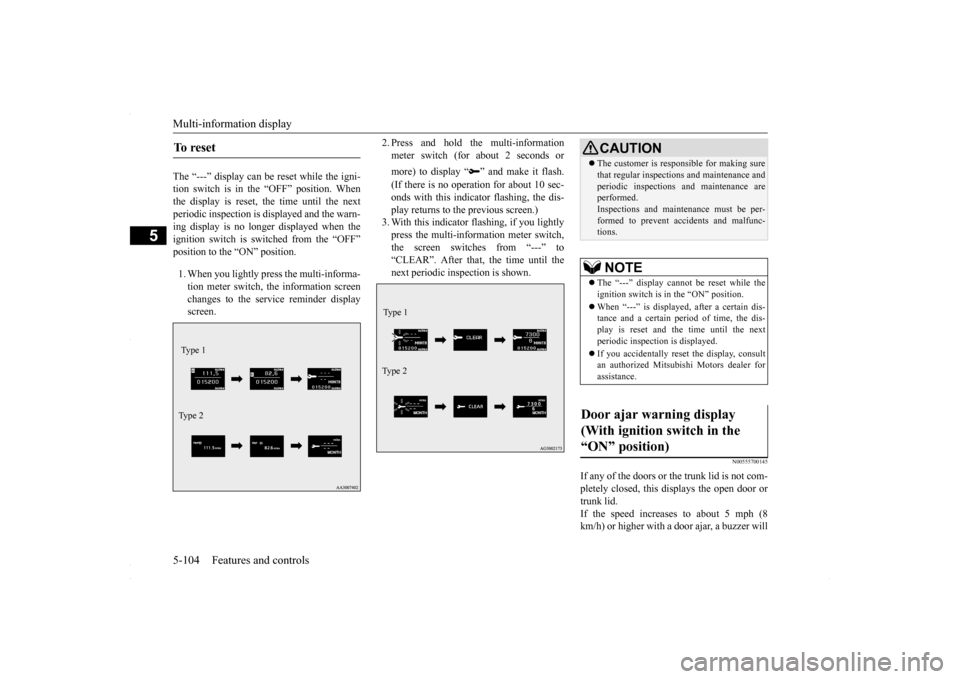
The “---” display can be reset while the igni- tion switch is in the “OFF” position. Whenthe display is reset, the time until the next periodic inspection is displayed and the warn- ing display is no longer displayed when theignition switch is switched from the “OFF” position to the “ON” position. 1. When you lightly press the multi-informa- tion meter switch, the information screen changes to the service reminder displayscreen.
2. Press and hold the multi-information meter switch (for about 2 seconds or more) to display “ ” and make it flash. (If there is no operation for about 10 sec- onds with this indicator flashing, the dis-play returns to the previous screen.) 3. With this indicator flashing, if you lightly press the multi-information meter switch,the screen switches from “---” to “CLEAR”. After that, the time until the next periodic inspection is shown.
N00555700145
If any of the doors or the trunk lid is not com- pletely closed, this displays the open door or trunk lid.If the speed increases to about 5 mph (8 km/h) or higher with a door ajar, a buzzer will
To r e s e t Type 1 Ty p e 2
Type 1 Ty p e 2
CAUTION The customer is responsible for making sure that regular inspections and maintenance and periodic inspections and maintenance are performed. Inspections and maintenance must be per-formed to prevent accidents and malfunc- tions.NOTE
The “---” display cannot be reset while the ignition switch is in the “ON” position. When “---” is displayed, after a certain dis- tance and a certain period of time, the dis- play is reset and the time until the next periodic inspection is displayed. If you accidentally reset the display, consult an authorized Mitsubishi Motors dealer forassistance.
Door ajar warning display (With ignition switch in the “ON” position)
BK0230300US.book
104 ページ 2015年7月30日 木曜日 午後8時38分
Page 241 of 392
Braking
Driving safety 6-5
6
Please read this section in conjunction with the “Engine coolant” on page 9-7.
N00629500446
All the parts of the brake system are criticalto safety. Have the vehicle serviced by anauthorized Mitsubishi Motors dealer or a repair facility of your choice at regular inter- vals according to the “WARRANTY ANDMAINTENANCE MANUAL”. Check the brake system while driving at a low speed immediately after starting, espe- cially when the brakes are wet, to confirm they work normally.A film of water can be formed on the brake discs or brake drums and prevent normal braking after driving in heavy rain or throughlarge puddles, or after the vehicle is washed. If this occurs, dry the brakes out by driving slowly while lightly depressing the brakepedal.
On snowy roads, ice can form on the braking system, making the brakes less effective.While driving in such conditions, pay close attention to preceding and following vehicles and to the condition of
the road surface. From
time to time, lightly depress the brake pedal and check how effective the brakes are. It is important to take advantage of the engine braking by shifting to a lower gear while driving on steep downhill roads in order to prevent the brakes from overheating.
N00629601356
When parking on a hill, set the parking brake,and turn the front wheels toward the curb on adownhill, or away from the curb on an uphill. If necessary, apply chocks to wheels.
Place the gearshift lever into the “R” (Reverse) position when parking on a down- hill slope, into the 1s
t position when parking
on an uphill slope. Be sure that the parking brake is firmly set when parked and that the selector lever is in the “P” (PARK) position.When parking on a hill, it is important to set the parking brake before moving the selector lever to the “P” (PARK) position. This pre-vents loading the parking brake against the transaxle gear. When this happens, it is diffi- cult to move the selector lever out of the “P”(PARK) position. Never leave the engine running while you take a short sleep/rest. Also, never leave the engine running in a closed or poorly venti-lated place.
WA R N I N G Never open the radiator cap when the radiator is hot. You could be seriouslyburned.
Braking When brakes are wet
When driving in cold weather When driving downhill Parking Parking on a hill
For vehicles with manual trans- axle For vehicles with continuously variable transmission (CVT) Parking with the engine run- ning
BK0230300US.bo
ok 5 ページ 2015年7月30日 木曜日 午後8時38分
Page 268 of 392
Important air conditioning operating tips 7-18 Comfort controls
7
N00733700280
1. Park the vehicle in the shade whenever possible. Parking in the hot sun makes the vehicle interior extremely hot which then requires more time to cool. If it is neces-sary to park in the sun, open the windows for the first few minutes of air condition- ing to expel the hot air.2. Afterwards, keep the windows closed when the air conditioning is in use. The entry of outside air through open windowswill reduce cooling efficiency. 3. When running the air conditioning, make sure the air intake, which is located infront of the windshield, is free of obstruc- tions such as leaves. Leaves collected in the air-intake chamber may reduce airflow and plug the water drains.
If the air conditioning seems less effective than usual, the cause might be a refrigerant leak.Have the system inspected by your authorized Mitsubishi Motors dealer or a repair facility of your choice.
The air conditioning should be operated for at least five minutes each week, even in coldweather. This includes the quick defrosting mode. Operating the air condition system weekly maintains lubrication of the compres-sor internal parts to keep the air conditioning in the best operating condition.
N00733800151
The air conditioning system is equipped with an air filter to remove pollen and dust. The air filter’s ability to collect pollen and dirt is reduced as it becomes dirty, so replaceit periodically. For the maintenance interval, refer to the “WARRANTY AND MAINTE- NANCE MANUAL”.
When defrosting, do not set the temperature control dial to the maximum cool position. This will blow cool air on the window glass and fog it up.
Important air conditioning operating tips
NOTE
Air conditioning system refrig- erant and lubricant recommen- dations
CAUTION The air conditioning system in your vehicle must be charged with the refrigerant HFC-134a and the lubricant SUN-PAG56. Use of any other refrigerant or lubricant will cause severe damage and may require replac-ing your vehicle’s entire air conditioning system. The release of refrigerant into the atmo-sphere is not recommended. The new refrigerant HFC-134a in your vehi- cle is designed not to harm the earth’s ozonelayer. However, it may contribute slightly to global warming. It is recommended that the old refrigerant be saved and recycled for future use.
During a long period of disuse Air purifier
NOTE
Operation in certain conditions such as driv- ing on a dusty road and
frequent use of the
air conditioning can lead to reduction of ser- vice life of the filter.
When you feel that the
air flow is lower than normal or when thewindshield or windows start to fog up easily, replace the air filter. Contact your Mitsubishi Motors dealer or arepair facility of your choice for assistance.
BK0230300US.bo
ok 18 ページ 2015年7月30日 木曜日 午後8時38分
Page 327 of 392
9
Vehicle care and maintenanceService precautions .........
.................................................................9-2
Catalytic converter
.................................................
..........................9-2
Engine hood ..............................
.......................................................9-3
View of the engine comp
artment .....................................................9-5
Engine oil and oil filt
er ................................
....................................9-5
Engine coolant ................
.................................................................9-7
Air cleaner filter ....
.................................................
..........................9-8
Manual transaxle oil (if so
equipped) ...............................................9-9
Continuously variable transmission (CVT) fluid (if so equipped) .
.................................................
........................9-10
Transfer oil (All-wheel dr
ive models) ...........................................9-10
Rear axle oil (All-wheel dr
ive models) ........................................9-10
Washer fluid ....................
...............................................................9-10
Brake fluid/Clutch fluid (if
so equipped)........................................ 9-11
Power steering fluid (if so equipped)..............................................9-12 Battery .......................................
.....................................................9-12
Tires ..........................................
.....................................................9-14
Clutch pedal free play (if so equipped)...........................................9-20 Brake pedal free play
.............................................
........................9-21
Parking brake lever stroke .............................................................9-21 Parking brake break-in
...........................................
........................9-21
Wiper blades ...................
...............................................................9-21
Emission-control system maintenance ..........................................9-22General maintenance
.............................................
........................9-23
For cold and snowy weat
her ..........................................................9-24
Fusible links ....................
...............................................................9-24
Fuses .........................................
.....................................................9-25
Replacement of light bu
lbs ............................................................9-29
Vehicle care precautions
.......................................
......................... 9-41
Cleaning the inside of you
r vehicle ............................................... 9-41
Cleaning the outside of your
vehicle ............................................. 9-43
BK0230300US.bo
ok 1 ページ 2015年7月30日 木曜日 午後8時38分