wheel MITSUBISHI LANCER 2017 8.G User Guide
[x] Cancel search | Manufacturer: MITSUBISHI, Model Year: 2017, Model line: LANCER, Model: MITSUBISHI LANCER 2017 8.GPages: 385, PDF Size: 14.34 MB
Page 48 of 385
Supplemental Restraint System (SRS) - airbag
Seat and restraint systems 4-21
4
N00407701805
This vehicle is equipped with a Supplemental Restraint System (SRS), which includes air-bags for the driver and passengers. The SRS front airbags are designed to supple- ment the primary protection of the driver and front passenger seat belt systems by provid-ing those occupants with protection against head and chest injuries in certain moderate to severe frontal collisions. The SRS front airbags, together with sensors at the front of the vehicle and sensors attached to the front seats, form an advancedairbag system. The SRS driver’s knee airbag is designed to supplement the primary protection of the driver’s seat belt system. It can reduce theforward movement of the driver’s lower legs
and provide increased overall body protection in certain moderate to severe frontal colli- sions. The SRS side airbags (if so equipped) and the curtain airbags (if so equipped) are alsodesigned to supplement the seat belts. The SRS side airbags provide the driver and front passenger with protection against chest inju-ries by deploying the bag on the side impacted in moderate to severe side impact collisions. The SRS curtain airbags providethe driver and passengers on the front seatand rear outboard seat with protection against head injuries by deploying a bag on the side impacted in moderate to severe side impactcollisions. The SRS airbags are NOT
a substitute for use
of the seat belts. For maximum protection in all types of accidents, seat belts mustALWAYS be worn by everyone who drives or rides in this vehicle (with infants and small children in an appropriate child restraint sys-tem in the rear seat, and older children buck- led in the rear seat). Refer to “Child restraint systems” on page 4-13.
The seat belt webbing may be cleaned with mild soap or detergent solution. Do not use an organic solvent. Allow the belts to dry in the shade. Do not allow them to retract until completely dry. Do notattempt to bleach or re-dye the belts. The color may rub off and the webbing strength may be affected.
Supplemental Restraint Sys- tem (SRS) - airbag
WA R N I N G
WA R N I N G IT IS VERY IMPORTANT TO ALWAYS WEAR YOUR SEAT BELT PROPERLYEVEN WITH AN AIRBAG.
• Seat belts help keep the driver and pas- sengers properly positioned. This reduces the risk of injury in all collisions, and reduces the risk of serious injuries or death when the airbags inflate.During sudden braking just before a col- lision, an unrestrained or improperly restrained driver or passengers can moveforward into direct contact with, or within close proximity to, the airbag when it begins to inflate.The beginning stage of airbag inflation is the most forceful and can cause serious injuries or death if the occupant comes incontact with the airbag at this time. • Seat belts reduce the risk of injury inrollovers, rear impact collisions, and in lower-speed frontal collisions, because the airbags are not designed to inflate inthose situations.• Seat belts reduce the risk of beingthrown from your vehicle in a collision or rollover.
IT IS VERY IMPORTANT TO BE PROP- ERLY SEATED.• A driver or front passenger sitting tooclose to the steering wheel or instrument panel during airbag deployment can be seriously injured or killed.WA R N I N G
BK0237700US.bo
ok 21 ページ 2016年4月15日 金曜日 午前11時28分
Page 49 of 385
Supplemental Restraint System (SRS) - airbag 4-22 Seat and restraint systems
4
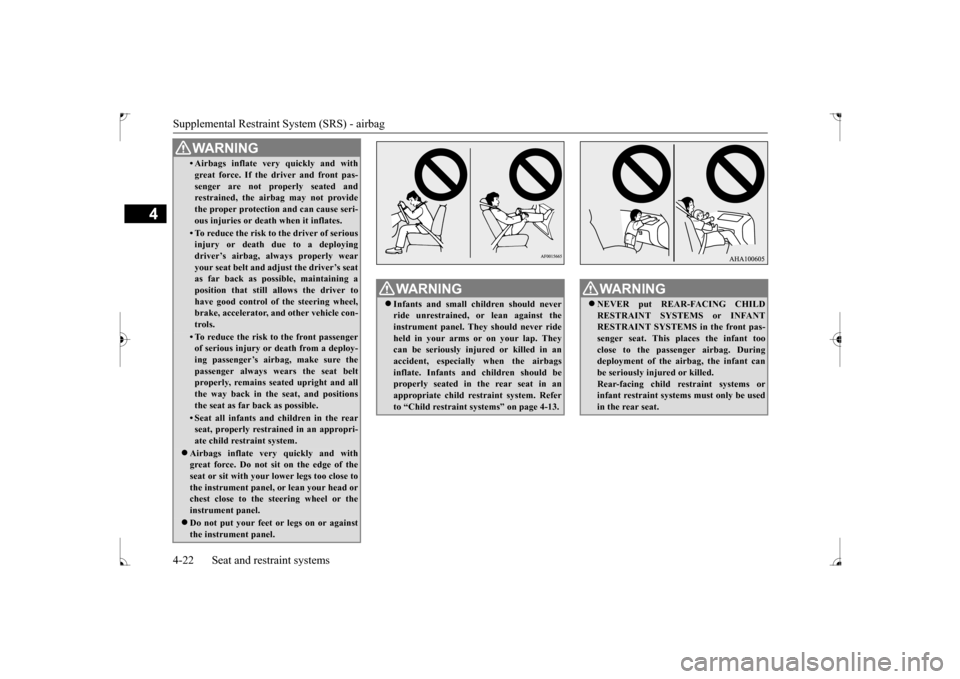
• Airbags inflate very quickly and with great force. If the driver and front pas- senger are not properly seated and restrained, the airbag may not provide the proper protection and can cause seri-ous injuries or death when it inflates.• To reduce the risk to the driver of seriousinjury or death due to a deploying driver’s airbag, always properly wear your seat belt and adjust the driver’s seatas far back as possible, maintaining a position that still allows the driver to have good control of the steering wheel,brake, accelerator, and other vehicle con- trols.• To reduce the risk to the front passengerof serious injury or death from a deploy- ing passenger’s airbag, make sure thepassenger always wears the seat belt properly, remains seated upright and all the way back in the seat, and positionsthe seat as far back as possible. • Seat all infants and children in the rearseat, properly restrained in an appropri- ate child restraint system.
Airbags inflate very quickly and with great force. Do not sit on the edge of the seat or sit with your lower legs too close to the instrument panel, or lean your head or chest close to the steering wheel or theinstrument panel. Do not put your feet or legs on or against the instrument panel.WA R N I N G
WA R N I N G Infants and small children should never ride unrestrained, or lean against the instrument panel. They should never ride held in your arms or on your lap. Theycan be seriously injured or killed in an accident, especially when the airbags inflate. Infants and children should beproperly seated in the rear seat in an appropriate child restraint system. Refer to “Child restraint systems” on page 4-13.
WA R N I N G NEVER put REAR-FACING CHILD RESTRAINT SYSTEMS or INFANT RESTRAINT SYSTEMS in the front pas-senger seat. This places the infant too close to the passenger airbag. During deployment of the airbag, the infant canbe seriously injured or killed. Rear-facing child restraint systems or infant restraint systems must only be usedin the rear seat.
BK0237700US.bo
ok 22 ページ 2016年4月15日 金曜日 午前11時28分
Page 54 of 385
Supplemental Restraint System (SRS) - airbag
Seat and restraint systems 4-27
4
N00407900318
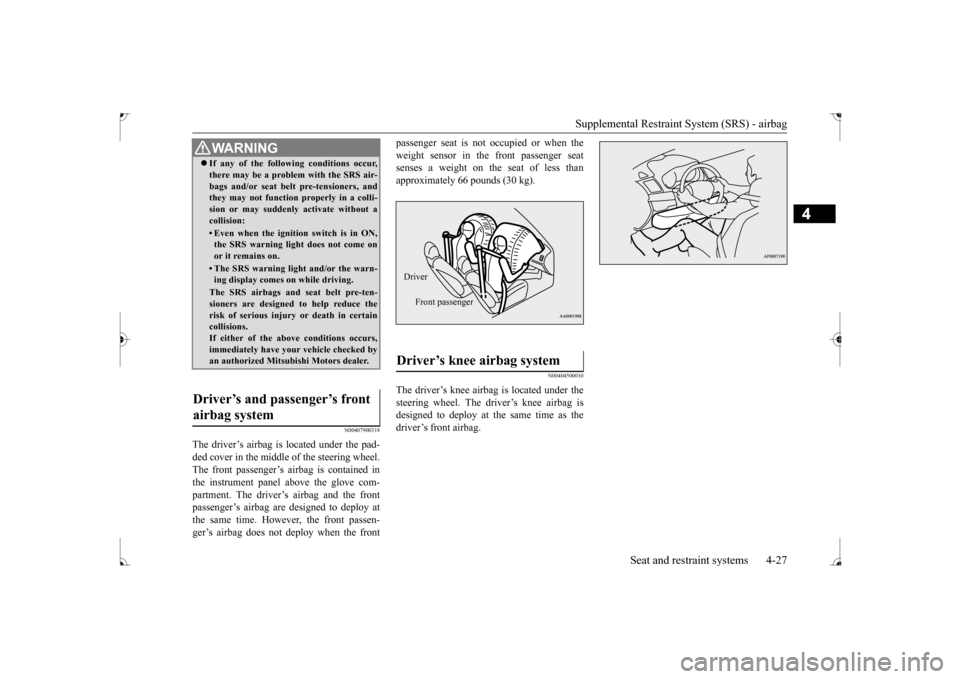
The driver’s airbag is located under the pad- ded cover in the middle of the steering wheel. The front passenger’s airbag is contained in the instrument panel above the glove com-partment. The driver’s airbag and the front passenger’s airbag are designed to deploy at the same time. However, the front passen-ger’s airbag does not deploy when the front
passenger seat is not occupied or when the weight sensor in the front passenger seat senses a weight on the seat of less than approximately 66 pounds (30 kg).
N00404500010
The driver’s knee airbag is located under the steering wheel. The driver’s knee airbag is designed to deploy at the same time as thedriver’s front airbag.
WA R N I N G If any of the following conditions occur, there may be a problem with the SRS air- bags and/or seat belt pre-tensioners, and they may not function properly in a colli- sion or may suddenly activate without acollision:• Even when the ignition switch is in ON,the SRS warning light does not come on or it remains on.• The SRS warning light and/or the warn-ing display comes on while driving.The SRS airbags and seat belt pre-ten-sioners are designed to help reduce the risk of serious injury or death in certaincollisions. If either of the above conditions occurs, immediately have your vehicle checked byan authorized Mitsubishi Motors dealer.
Driver’s and passenger’s front airbag system
Driver’s knee airbag system Driver
Front passenger
BK0237700US.bo
ok 27 ページ 2016年4月15日 金曜日 午前11時28分
Page 57 of 385
Supplemental Restraint System (SRS) - airbag 4-30 Seat and restraint systems
4
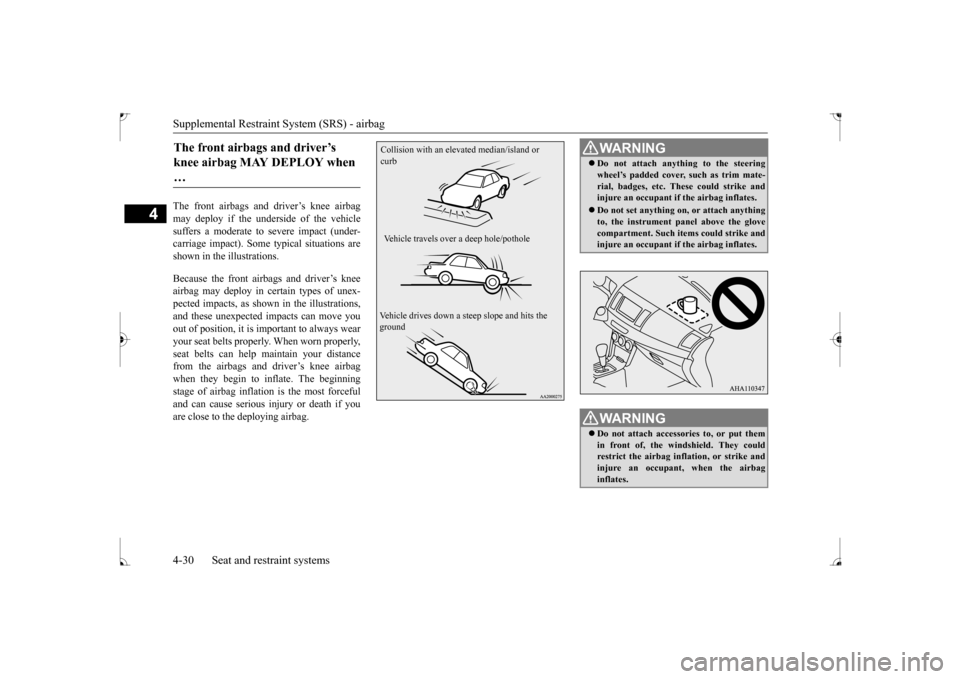
The front airbags and driver’s knee airbag may deploy if the underside of the vehicle suffers a moderate to severe impact (under- carriage impact). Some typical situations areshown in the illustrations. Because the front airbags and driver’s knee airbag may deploy in certain types of unex- pected impacts, as shown in the illustrations, and these unexpected impacts can move youout of position, it is important to always wear your seat belts properly. When worn properly, seat belts can help maintain your distancefrom the airbags and driver’s knee airbag when they begin to inflate. The beginning stage of airbag inflatio
n is the most forceful
and can cause serious injury or death if you are close to the deploying airbag.The front airbags and driver’s knee airbag MAY DEPLOY when …
Collision with an elevated median/island or curb Vehicle travels over a deep hole/pothole Vehicle drives down a steep slope and hits the ground
WA R N I N G Do not attach anything to the steering wheel’s padded cover, such as trim mate- rial, badges, etc. These could strike and injure an occupant if the airbag inflates. Do not set anything on, or attach anything to, the instrument panel above the glove compartment. Such items could strike andinjure an occupant if the airbag inflates. WA R N I N G Do not attach accessories to, or put them in front of, the windshield. They couldrestrict the airbag inflation, or strike and injure an occupant, when the airbag inflates.
BK0237700US.bo
ok 30 ページ 2016年4月15日 金曜日 午前11時28分
Page 62 of 385
Supplemental Restraint System (SRS) - airbag
Seat and restraint systems 4-35
4
N00408500672
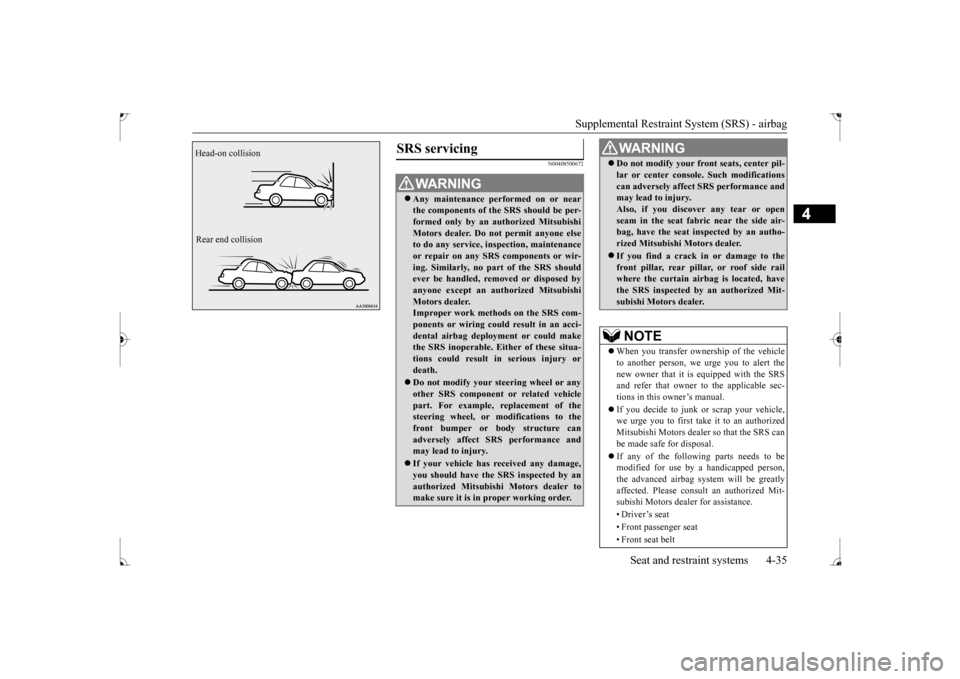
Head-on collision Rear end collision
SRS servicing
WA R N I N G Any maintenance performed on or near the components of the SRS should be per- formed only by an authorized Mitsubishi Motors dealer. Do not permit anyone elseto do any service, inspection, maintenance or repair on any SRS components or wir- ing. Similarly, no part of the SRS shouldever be handled, removed or disposed by anyone except an authorized Mitsubishi Motors dealer.Improper work methods on the SRS com- ponents or wiring could result in an acci- dental airbag deployment or could makethe SRS inoperable. Either of these situa- tions could result in serious injury or death. Do not modify your steering wheel or any other SRS component or related vehiclepart. For example, replacement of the steering wheel, or modifications to the front bumper or body structure canadversely affect SRS performance and may lead to injury. If your vehicle has received any damage, you should have the SRS inspected by an authorized Mitsubishi Motors dealer to make sure it is in proper working order.
Do not modify your front seats, center pil- lar or center console. Such modifications can adversely affect SRS performance and may lead to injury. Also, if you discover any tear or openseam in the seat fabric near the side air- bag, have the seat inspected by an autho- rized Mitsubishi Motors dealer. If you find a crack in or damage to the front pillar, rear pillar, or roof side railwhere the curtain airbag is located, have the SRS inspected by an authorized Mit- subishi Motors dealer.NOTE
When you transfer ownership of the vehicle to another person, we urge you to alert the new owner that it is equipped with the SRS and refer that owner to the applicable sec-tions in this owner’s manual. If you decide to junk
or scrap your vehicle,
we urge you to first take it to an authorized Mitsubishi Motors dealer so that the SRS can be made safe for disposal. If any of the following parts needs to be modified for use by a handicapped person, the advanced airbag system will be greatly affected. Please consult an authorized Mit-subishi Motors dealer for assistance. • Driver’s seat• Front passenger seat • Front seat beltWA R N I N G
BK0237700US.bo
ok 35 ページ 2016年4月15日 金曜日 午前11時28分
Page 63 of 385
Supplemental Restraint System (SRS) - airbag 4-36 Seat and restraint systems
4
N00408600341
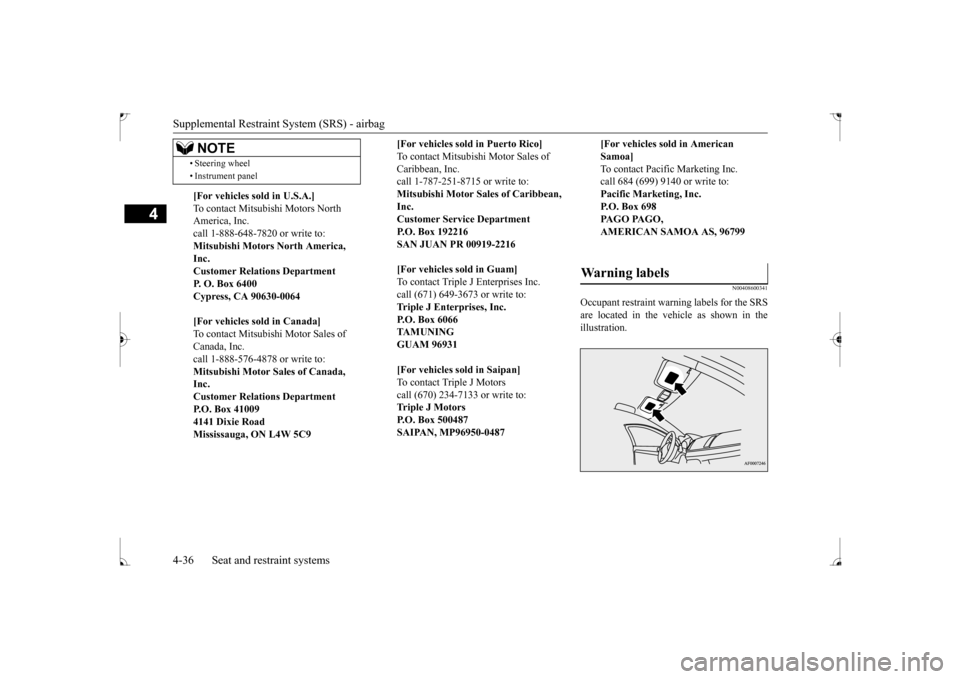
Occupant restraint warning labels for the SRS are located in the vehicle as shown in the illustration.
• Steering wheel • Instrument panel[For vehicles sold in U.S.A.] To contact Mitsubishi Motors North America, Inc. call 1-888-648-7820 or write to:Mitsubishi Motors North America, Inc. Customer Relations DepartmentP. O. Box 6400Cypress, CA 90630-0064 [For vehicles sold in Canada] To contact Mitsubishi Motor Sales of Canada, Inc. call 1-888-576-4878 or write to:Mitsubishi Motor Sales of Canada, Inc. Customer Relations DepartmentP.O. Box 41009 4141 Dixie Road Mississauga, ON L4W 5C9NOTE
[For vehicles sold in Puerto Rico]To contact Mitsubishi Motor Sales of Caribbean, Inc. call 1-787-251-8715 or write to: Mitsubishi Motor Sales of Caribbean, Inc. Customer Service Department P.O. Box 192216SAN JUAN PR 00919-2216 [For vehicles sold in Guam] To contact Triple J Enterprises Inc.call (671) 649-3673 or write to: Triple J Enterprises, Inc. P.O. Box 6066TAMUNING GUAM 96931 [For vehicles sold in Saipan] To contact Triple J Motors call (670) 234-7133 or write to:Triple J Motors P.O. Box 500487 SAIPAN, MP96950-0487
[For vehicles sold in American Samoa]To contact Pacific Marketing Inc. call 684 (699) 9140 or write to: Pacific Marketing, Inc.P.O. Box 698 PA G O PA G O , AMERICAN SAMOA AS, 96799
Warning labels
BK0237700US.bo
ok 36 ページ 2016年4月15日 金曜日 午前11時28分
Page 66 of 385
5
Features and controlsBreak-in recommendation
s ..............................................................5-3
Keys ..........................................
.......................................................5-3
Electronic immobilizer (Anti-thef
t starting system) ........................5-4
Keyless entry system (if so equipped) ..............................................5-7Free-hand Advanced Security Transmitter (F.A.S.T.-key) (if so
equipped) ..................................................5-12
Door locks .......................
...............................................................5-34
Power door locks ............
...............................................................5-37
“Child safety locks” for
rear door ..................................................5-38
Trunk lid ...................................
.....................................................5-39
Inside emergency trunk lid
release ................................................5-40
Theft-alarm system (if so
equipped) ...............................................5-41
Power windows ...............
...............................................................5-43
Sunroof (if so equipped
) .........................................
........................5-46
Parking brake ..................
...............................................................5-48
Steering wheel tilt lock lever .........................................................5-49Inside day/night rearview
mirror ...................................................5-50
Outside rearview mirr
ors ...............................................................5-51
Ignition switch ......
.................................................
........................5-52
Steering wheel lock
................................................
........................5-54
Starting and stopping the e
ngine ....................................................5-55
Manual transaxle (if so equipped) ..................................................5-57Continuously variable transmissi
on (CVT) (if so equipped)..........5-59
Electronically controlled 4WD system (if so equipped).................5-68 All-wheel driving opera
tion ...........................................................5-70
Cautions on handling of all-wheel drive vehicles ..........................5-71Service brake ..................
...............................................................5-72
Brake assist system
................................................
........................5-73
Anti-lock braking syst
em .....................................
......................... 5-74
Active Stability Control (ASC
) (if so equipped) ............................ 5-76
Power steering system
..........................................
......................... 5-79
Cruise control (if so eq
uipped) ....................................................... 5-80
Tire pressure monitoring
system ................................................... 5-84
Rear-view camera (if so
equipped)..............
................................... 5-88
Instrument cluster
.................................................
......................... 5-90
Multi-information disp
lay ....................................
......................... 5-91
Indicator light, warning light, and information screen display list .................................................
.......................................... 5-112
Indicators .................................
.................................................... 5-123
Warning lights ................
.................................................
............. 5-124
Information screen disp
lay ...................................
....................... 5-125
Combination headlights and dimmer switch ............................... 5-127 Headlight leveling switch (if
so equipped)................................... 5-132
Turn signal lever ..
.................................................
....................... 5-133
Hazard warning flasher
switch .................................................... 5-133
Front fog light switch (if so
equipped) ......................................... 5-134
Wiper and washer swit
ch ......................................
....................... 5-134
Electric rear window def
ogger switch ......................................... 5-138
Horn switch .............................
.................................................... 5-139
Link System (if so equi
pped) ....................................................... 5-139
Bluetooth
® 2.0 interface (if so
equipped)..................................... 5-139
USB input terminal
...............................................
....................... 5-160
Sun visors ......................
.................................................
............. 5-163
12 V power outlet ..........
.................................................
............. 5-163
Interior lights .................
.................................................
............. 5-164
Storage spaces ................
.................................................
............. 5-166
BK0237700US.bo
ok 1 ページ 2016年4月15日 金曜日 午前11時28分
Page 81 of 385
Free-hand Advanced Security Transmitter (F.A.S.T.-key) (if so equipped) 5-16 Features and controls
5
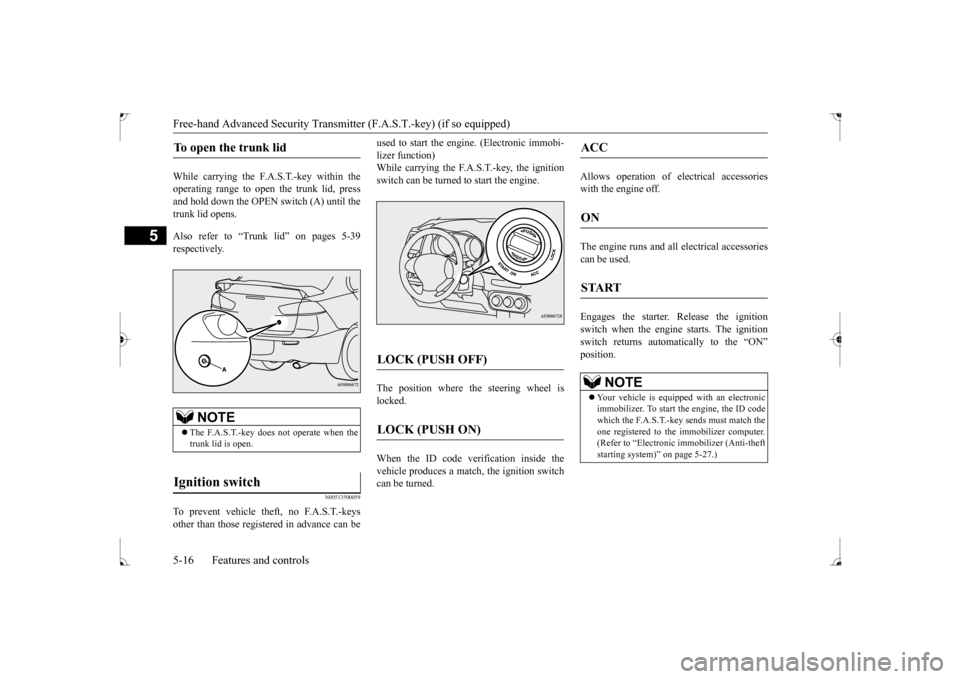
While carrying the F.A.S.T.-key within the operating range to open the trunk lid, pressand hold down the OPEN
switch (A) until the
trunk lid opens. Also refer to “Trunk lid” on pages 5-39 respectively.
N00513500059
To prevent vehicle theft, no F.A.S.T.-keysother than those registered in advance can be
used to start the engine. (Electronic immobi- lizer function) While carrying the F.A.S.T.-key, the ignition switch can be turned to start the engine. The position where the steering wheel is locked. When the ID code verification inside the vehicle produces a match, the ignition switchcan be turned.
Allows operation of electrical accessories with the engine off. The engine runs and all electrical accessories can be used. Engages the starter. Release the ignition switch when the engine starts. The ignition switch returns automatically to the “ON”position.
To open the trunk lid
NOTE
The F.A.S.T.-key does not operate when the trunk lid is open.
Ignition switch
LOCK (PUSH OFF)
LOCK (PUSH ON)
ACC
ON
START
NOTE
Your vehicle is equipped with an electronic immobilizer. To start the engine, the ID code which the F.A.S.T.-key sends must match the one registered to the immobilizer computer.(Refer to “Electronic immobilizer (Anti-theft starting system)” on page 5-27.)
BK0237700US.bo
ok 16 ページ 2016年4月15日 金曜日 午前11時28分
Page 82 of 385
Free-hand Advanced Security Transmit
ter (F.A.S.T.-key) (if so equipped)
Features and controls 5-17
5
N00513600021
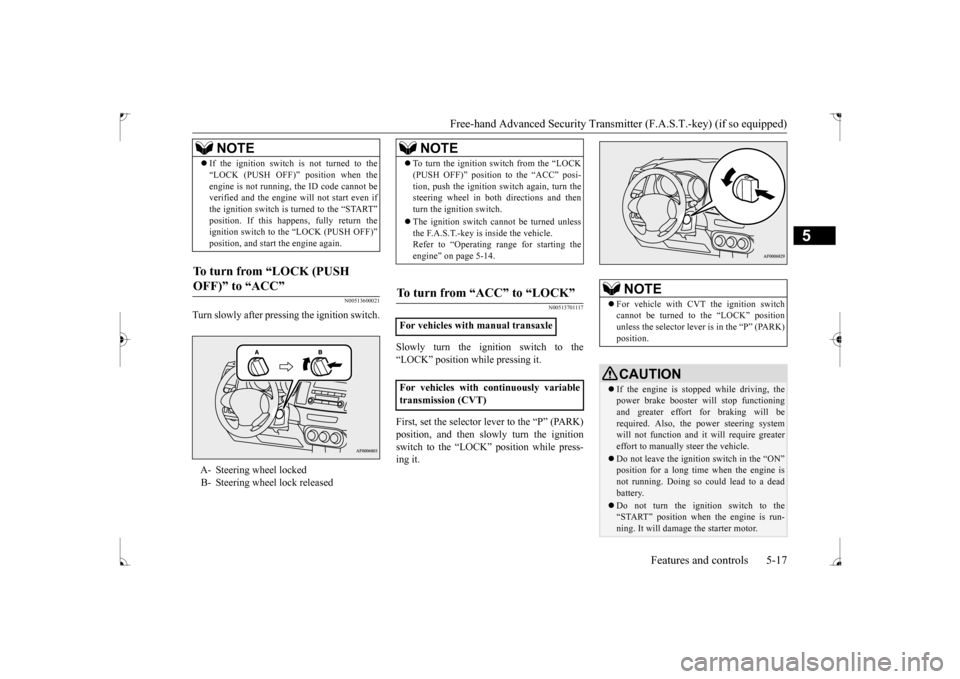
Turn slowly after pressing the ignition switch.
N00513701117
Slowly turn the ignition switch to the “LOCK” position while pressing it. First, set the selector lever to the “P” (PARK) position, and then slowly turn the ignitionswitch to the “LOCK” position while press- ing it.
If the ignition switch is not turned to the “LOCK (PUSH OFF)” position when the engine is not running, the ID code cannot be verified and the engine will not start even if the ignition switch is turned to the “START” ignition switch to the “LOCK (PUSH OFF)” position, and start the engine again.
To turn from “LOCK (PUSH OFF)” to “ACC”
A- Steering wheel locked B- Steering wheel lock released
NOTE
NOTE
To turn the ignition switch from the “LOCK (PUSH OFF)” position to the “ACC” posi- tion, push the ignition switch again, turn the steering wheel in both directions and then turn the ignition switch. The ignition switch cannot be turned unless the F.A.S.T.-key is inside the vehicle.Refer to “Operating range for starting the engine” on page 5-14.
To turn from “ACC” to “LOCK”
For vehicles with manual transaxle For vehicles with continuously variable transmission (CVT)
NOTE
For vehicle with CVT the ignition switch cannot be turned to the “LOCK” position unless the selector lever is in the “P” (PARK) position.CAUTION If the engine is stopped while driving, the power brake booster will stop functioning and greater effort for braking will berequired. Also, the power steering system will not function and it will require greater effort to manually steer the vehicle. Do not leave the ignition switch in the “ON” position for a long time when the engine isnot running. Doing so could lead to a dead battery. Do not turn the ignition switch to the “START” position when the engine is run- ning. It will damage the starter motor.
BK0237700US.bo
ok 17 ページ 2016年4月15日 金曜日 午前11時28分
Page 85 of 385
Free-hand Advanced Security Transmitter (F.A.S.T.-key) (if so equipped) 5-20 Features and controls
5
N00560100105
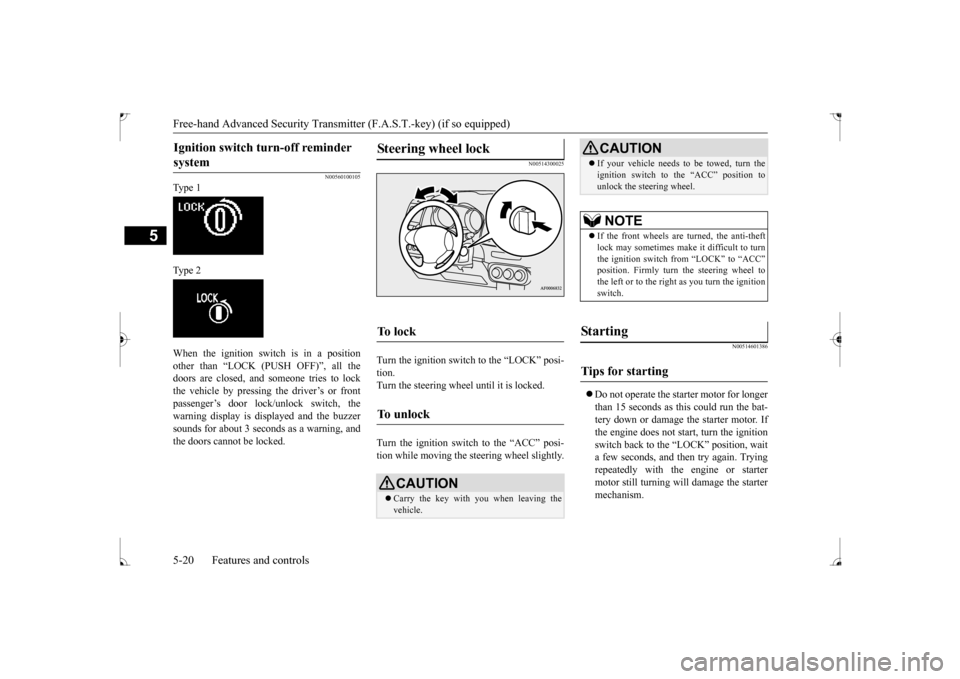
Ty p e 1 Ty p e 2 When the ignition switch is in a position other than “LOCK (PUSH OFF)”, all the doors are closed, and someone tries to lock the vehicle by pressing the driver’s or frontpassenger’s door lock/unlock switch, the warning display is displayed and the buzzer sounds for about 3 seconds as a warning, andthe doors cannot be locked.
N00514300025
Turn the ignition switch to the “LOCK” posi-tion.Turn the steering wheel until it is locked. Turn the ignition switch to the “ACC” posi- tion while moving the steering wheel slightly.
N00514601386
Do not operate the starter motor for longer than 15 seconds as this could run the bat-tery down or damage the starter motor. If the engine does not start, turn the ignition switch back to the “LOCK” position, waita few seconds, and then try again. Trying repeatedly with the engine or starter motor still turning will damage the startermechanism.
Ignition switch turn-off reminder system
Steering wheel lock
To l o c k
To u n l o c k
CAUTION Carry the key with you when leaving the vehicle.
If your vehicle needs to be towed, turn the ignition switch to the “ACC” position to unlock the steering wheel.NOTE
If the front wheels are turned, the anti-theft lock may sometimes make it difficult to turn the ignition switch from “LOCK” to “ACC”position. Firmly turn the steering wheel to the left or to the right as you turn the ignition switch.
St arting
Tips for starting
CAUTION
BK0237700US.bo
ok 20 ページ 2016年4月15日 金曜日 午前11時28分