seats MITSUBISHI LANCER 2017 8.G Owner's Manual
[x] Cancel search | Manufacturer: MITSUBISHI, Model Year: 2017, Model line: LANCER, Model: MITSUBISHI LANCER 2017 8.GPages: 385, PDF Size: 14.34 MB
Page 238 of 385
Vehicle preparation before driving
Driving safety 6-3
6
N00629001796
For a safer and more enjoyable trip, always observe the following: Before starting the vehicle, make certain that you and all passengers are seated and wearing their seat belts properly (with children in the rear seat, in appropriaterestraints), and that all the doors are locked.
Move the driver’s seat as far backward as possible, while still keeping good visibil- ity, and good control of the steering wheel, brakes, accelerator, and controls.Check the instrument panel indicators and multi-information display for any possible problem. Move the front passenger seat as far back as possible. Make sure that infants and small children are properly restrained in accordance withall laws and regulations.
Check these by selecting the defroster mode, and set the blower switch on high. You should be able to feel the air blowing against the windshield. (Refer to “Defrosting or defogging the wind- shield and door windows” on page 7-8, 7-13.) Check all the tires for heavy tread wear or uneven wear patterns. Look for stones, nails, glass, or other objects stuck in the tread. Lookfor any tread cuts or sidewall cracks. Check the wheel nuts for tightness, and the tires (including spare tire) for proper pressures.
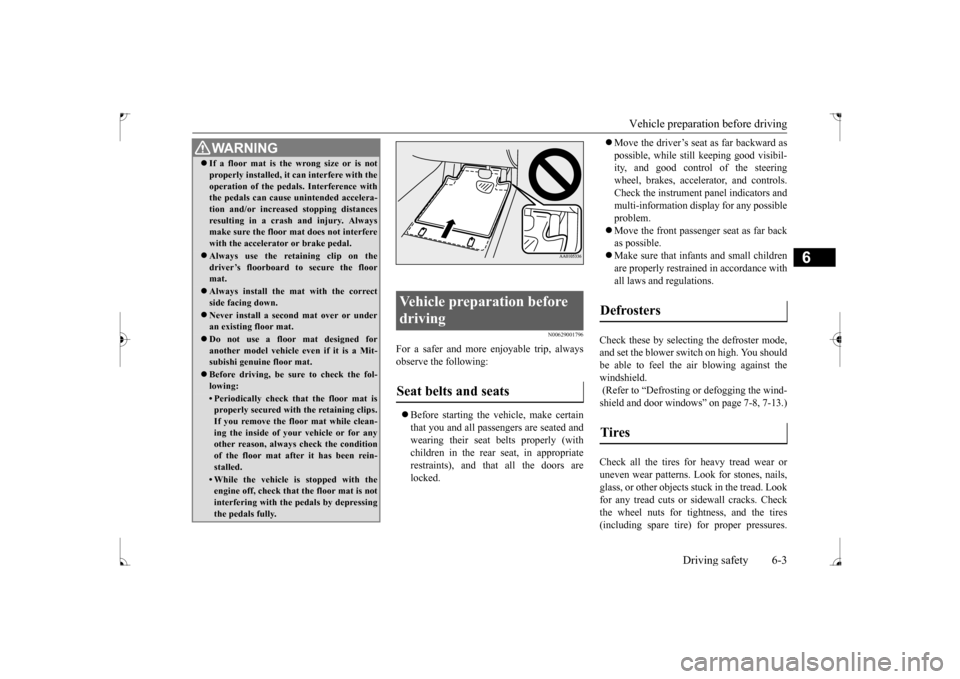
WA R N I N G If a floor mat is the wrong size or is not properly installed, it can interfere with the operation of the pedals. Interference with the pedals can cause unintended accelera- tion and/or increased stopping distancesresulting in a crash and injury. Always make sure the floor mat does not interfere with the accelerator or brake pedal. Always use the retaining clip on the driver’s floorboard to secure the floormat. Always install the mat with the correct side facing down. Never install a second mat over or under an existing floor mat. Do not use a floor mat designed for another model vehicle ev
en if it is a Mit-
subishi genuine floor mat. Before driving, be sure to check the fol- lowing:• Periodically check that the floor mat isproperly secured with the retaining clips. If you remove the floor mat while clean-ing the inside of your vehicle or for any other reason, always check the condition of the floor mat after it has been rein-stalled.• While the vehicle is stopped with the engine off, check that the floor mat is not interfering with the pedals by depressingthe pedals fully.
Vehicle preparation before driving Seat belts and seats
Defrosters Tires
BK0237700US.bo
ok 3 ページ 2016年4月15日 金曜日 午前11時28分
Page 241 of 385
Loading information 6-6 Driving safety
6
Your front bumper can be damaged if you scrape it over curbs or parking stop blocks.Be careful when traveling up or down steep slopes where your bumper can scrape the road. When leaving the vehicle unattended, always carry the key and lock all doors.Always try to park your vehicle in a well lit area.
N00629900349
It is very important to know how much weight your vehicle can carry. This weight iscalled the vehicle capacity weight and includes the weight of all occupants, cargo and non-factory-installed options. The tireand loading information placard located on the driver’s door sill of your vehicle will show how much weight it may properly carry. It is important to familiarize yourself with the following terms before loading your vehicle: Vehicle maximum load on the tire: load on an individual tire that is determined by distributing to each axle its share of the maximum loaded vehicle weight anddividing by two. Vehicle normal load on the tire: load on an individual tire that is determined by dis-tributing to each axle its share of the curb weight, accessory weight, and normal occupant weight and dividing by two.
Maximum loaded vehicle weight: the sum of - (a) Curb weight; (b) Accessory weight;(c) Vehicle capacity weight; and (d) Production options weight. Curb weight: the weight of a motor vehi- cle with standard equipment including the maximum capacity of fuel, oil, and cool- ant. Accessory weight: the combined weight (in excess of those standard items which may be replaced) of automatic transmis- sion, power steering, power brakes, powerwindows, power seats, radio, and heater, to the extent that these items are available as factory- installed equipment (whetherinstalled or not). Vehicle capacity weight: the rated cargo and luggage load plus 150 lbs (68 kg)
*
times the vehicle’s designated seating capacity. Production options weight: the combined weight of those installed regular produc- tion options weighing over 5 lbs (2.3 kg) in excess of those standard items whichthey replace, not previously considered in curb weight or accessory weight, includ- ing heavy duty brakes, ride levelers, roofrack, heavy duty battery, and special trim.
WA R N I N G Leaving the engine running risks injury or death from accidentally moving the gear- shift lever (manual transaxle or the selec- tor lever (CVT) or from the accumulation of toxic exhaust fumes in the passengercompartment.
Where you park
WA R N I N G Do not park your vehicle in areas where combustible materials such as dry grass or leaves can come in contact with a hotexhaust, since a fire could occur.
When leaving the vehicle
Loading information
WA R N I N G Never overload your vehicle. Overloading can damage your vehicle, adversely affectvehicle performance, including handling and braking, cause tire failure, and result in an accident.
BK0237700US.bo
ok 6 ページ 2016年4月15日 金曜日 午前11時28分
Page 346 of 385
Fuses
Vehicle care and maintenance 9-27
9
* - Fusible link Some fuses may not be installed on your vehicle, depending on the vehicle model or specifications. The table above shows the main equip- ment corresponding to each fuse. 20
Power window con-
trol
30 A
*
21 Defogger 30 A
*
22
Heated
outside rearview
mirrors
7.5 A
23 115V Power outlet 15 A 24 Power seats
25 (20) A
25 Heated seats 30 ANo.
Sym- bol
Electrical system
Capac-ity
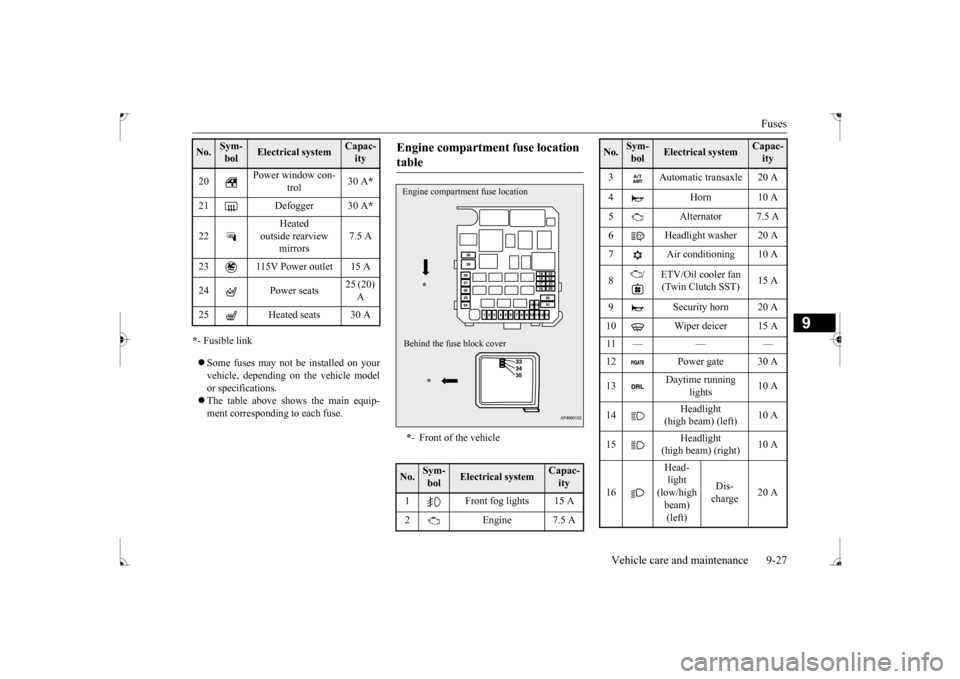
Engine compartment fuse location table * - Front of the vehicle
No.
Sym- bol
Electrical system
Capac-ity
1 Front fog lights 15 A 2 Engine 7.5 AEngine compartment fuse location
*
Behind the fuse block cover
*
3 Automatic transaxle 20 A 4 Horn 10 A 5 Alternator 7.5 A 6 Headlight washer 20 A 7 Air conditioning 10 A 8
/ ETV/Oil cooler fan
(Twin Clutch SST)
15 A
9 Security horn 20 A 10 Wiper deicer 15 A 11 — — — 13
Daytime running
lights
10 A
14
Headlight
(high beam) (left)
10 A
15
Headlight
(high beam) (right)
10 A
16
Head- light (low/high beam) (left)
Dis- charge
20 A
No.
Sym- bol
Electrical system
Capac-ity
BK0237700US.bo
ok 27 ページ 2016年4月15日 金曜日 午前11時28分
Page 361 of 385
Cleaning the inside of your vehicle 9-42 Vehicle care and maintenance
9
These can all be dangerous, and they all can damage your vehicle.
N00945200079
After washing the inside of your vehicle withany cleaner, wipe it dry in a shady, well venti-lated area.
N00945300171
1. Lightly wipe these off with a soft clothsoaked in a 3 % solution of gentle soapand water. 2. Dip cloth in fresh water and wring out well. Using this cloth, wipe off the deter-gent thoroughly.
N00945500131
1. To maintain the value of your new vehi-cle, maintain the upholstery carefully and keep the interior clean. Use a vacuum cleaner and brush to cleanthe seats. If stained, vinyl and synthetic leather should be cleaned with an appro- priate cleaner. Cloth fabrics can becleaned with either upholstery cleaner or a 3 % solution of gentle soap in lukewarm water. 2. Clean the carpeting with a vacuum cleaner and remove any stains with carpet cleaner. Oil and grease can be removed bylightly dabbing with a clean white cloth and spot remover.
CAUTION Cleaning products can be dangerous. Some are poisonous. Others are highly flammable. Some are dangerous if you breathe their fumes in a closed space. When you use any- thing in a container to clean your vehicle, besure to follow the instructions. Always open your vehicle doors or windows when you’re cleaning the inside. Never use the followingchemicals to clean your vehicle:• Gasoline• Carbon Tetrachloride• Benzine• Kerosene• Naphtha• Acetone• Turpentine• Paint Thinner• Lacquer Thinner• Nail Polish Remover
Cleaning the inside of your vehicle
CAUTION Do not use organic substances (solvents, benzine, kerosene, alcohol, gasoline, etc.) or alkaline or acidic solutions. These chemicals can cause discoloring, staining or cracking of the surface.If you use cleaners or polishing agents, make sure their ingredients do not include the sub- stances mentioned above.NOTE
Always read the instructions on the cleaner label.
Plastic, vinyl leather, fabric and flocked parts
NOTE
Do not use cleaners, conditioners, and pro- tectants containing silicones or wax. Such products, when applied to the instru- ment panels or other parts, may cause reflec- tions on the windshield and obscure vision.Also, if such products get on the switches of the electrical accessories, it may lead to fail- ure of these accessories.
Upholstery
BK0237700US.bo
ok 42 ページ 2016年4月15日 金曜日 午前11時28分
Page 362 of 385
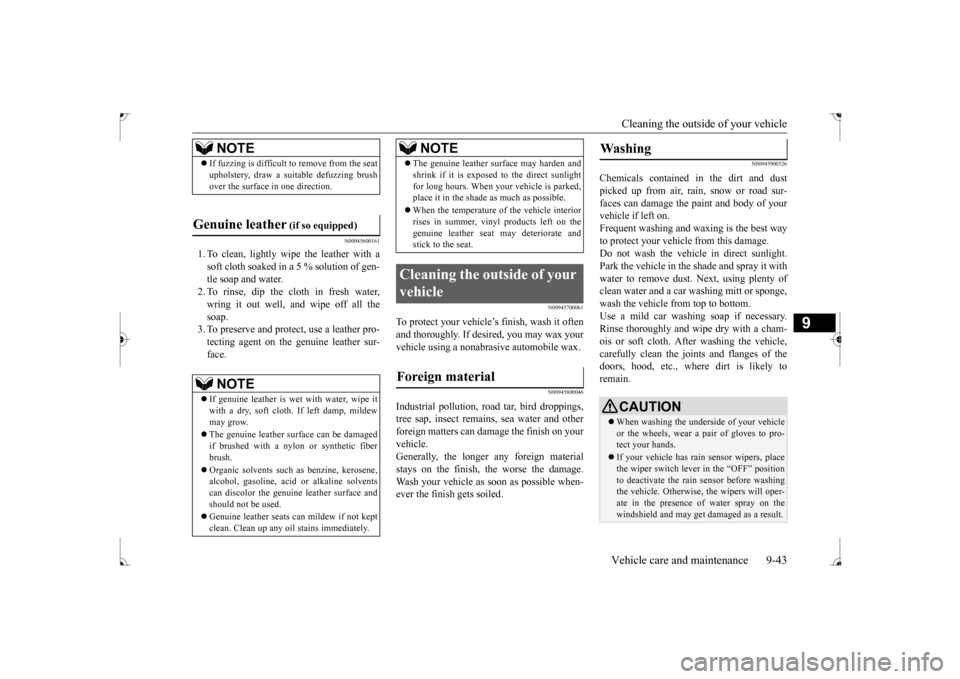
Cleaning the outside of your vehicle Vehicle care and maintenance 9-43
9
N00945600161
1. To clean, lightly wipe the leather with a soft cloth soaked in a 5 % solution of gen-tle soap and water. 2. To rinse, dip the cloth in fresh water, wring it out well, and wipe off all thesoap. 3. To preserve and protect, use a leather pro- tecting agent on the genuine leather sur-face.
N00945700061
To protect your vehicle’s finish, wash it often and thoroughly. If desired, you may wax your vehicle using a nonabrasive automobile wax.
N00945800046
Industrial pollution, road tar, bird droppings,tree sap, insect remains, sea water and otherforeign matters can damage the finish on your vehicle. Generally, the longer any foreign materialstays on the finish, the worse the damage. Wash your vehicle as s
oon as possible when-
ever the finish gets soiled.
N00945900526
Chemicals contained in the dirt and dustpicked up from air, rain, snow or road sur-faces can damage the paint and body of your vehicle if left on. Frequent washing and waxing is the best wayto protect your vehicle from this damage. Do not wash the vehicle in direct sunlight. Park the vehicle in the shade and spray it withwater to remove dust. Next, using plenty ofclean water and a car washing mitt or sponge, wash the vehicle from top to bottom. Use a mild car washing soap if necessary.Rinse thoroughly and wipe dry with a cham- ois or soft cloth. After washing the vehicle, carefully clean the joints and flanges of thedoors, hood, etc., where dirt is likely to remain.
NOTE
If fuzzing is difficult to remove from the seat upholstery, draw a suitable defuzzing brush over the surface in one direction.
Genuine leather
(if so equipped)
NOTE
If genuine leather is wet with water, wipe it with a dry, soft cloth. If left damp, mildew may grow. The genuine leather surface can be damaged if brushed with a nylon or synthetic fiber brush. Organic solvents such as benzine, kerosene, alcohol, gasoline, acid or alkaline solvents can discolor the genuine leather surface and should not be used. Genuine leather seats can mildew if not kept clean. Clean up any oil stains immediately.
The genuine leather surface may harden and shrink if it is exposed to the direct sunlight for long hours. When your vehicle is parked, place it in the shade as much as possible. When the temperature of the vehicle interior rises in summer, vinyl products left on the genuine leather seat may deteriorate andstick to the seat.
Cleaning the outside of your vehicle Foreign material
NOTE
Wa s h i n g
CAUTION When washing the underside of your vehicle or the wheels, wear a pair of gloves to pro-tect your hands. If your vehicle has rain sensor wipers, place the wiper switch lever in the “OFF” position to deactivate the rain sensor before washingthe vehicle. Otherwise, the wipers will oper- ate in the presence of water spray on the windshield and may get damaged as a result.
BK0237700US.bo
ok 43 ページ 2016年4月15日 金曜日 午前11時28分
Page 381 of 385
Alphabetical index 12-2
12
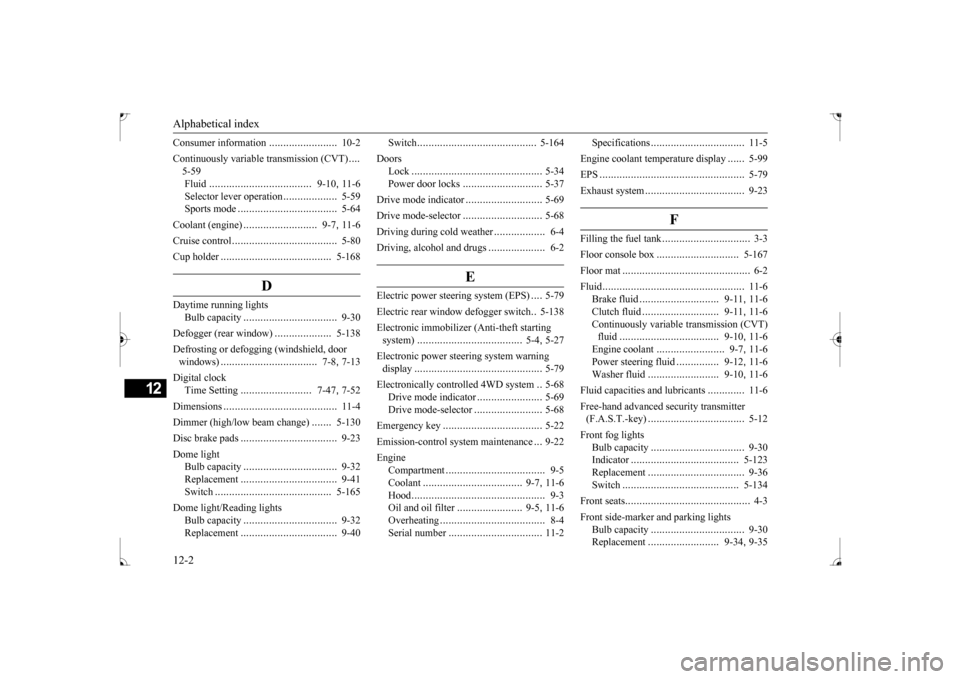
Consumer information
........................
10-2
Continuously variable transmission (CVT)
....
5-59 Fluid
.....................
...............
9-10
, 11-6
Selector lever operation
...................
5-59
Sports mode
..................
.................
5-64
Coolant (engine)
..........................
9-7
, 11-6
Cruise control
....................
.................
5-80
Cup holder
....................
...................
5-168
D
Daytime running lights
Bulb capacity
................
.................
9-30
Defogger (rear window)
....................
5-138
Defrosting or defogging (windshield, door windows)
.................
.................
7-8
, 7-13
Digital clock
Time Setting
.........................
7-47
, 7-52
Dimensions
...................
.....................
11-4
Dimmer (high/low beam change)
.......
5-130
Disc brake pads
.................
.................
9-23
Dome light
Bulb capacity
................
.................
9-32
Replacement
.................
.................
9-41
Switch
......................
...................
5-165
Dome light/Reading lights
Bulb capacity
................
.................
9-32
Replacement
.................
.................
9-40
Switch
.....................
.....................
5-164
Doors
Lock
.......................
.......................
5-34
Power door locks
............................
5-37
Drive mode indicator
...........................
5-69
Drive mode-selector
............................
5-68
Driving during cold weather
..................
6-4
Driving, alcohol and drugs
....................
6-2
E
Electric power steering system (EPS)
....
5-79
Electric rear window defogger switch
..5-138
Electronic immobilizer (Anti-theft starting system)
.....................
................
5-4
, 5-27
Electronic power steering system warning display
......................
.......................
5-79
Electronically controlled 4WD system
..5-68
Drive mode indicator
.......................
5-69
Drive mode-selector
........................
5-68
Emergency key
...................
................
5-22
Emission-control system maintenance
...
9-22
Engine
Compartment
..................
.................
9-5
Coolant
...................
................
9-7
, 11-6
Hood
.......................
........................
9-3
Oil and oil filter
.......................
9-5
, 11-6
Overheating
....................
.................
8-4
Serial number
.................
................
11-2
Specifications
................
.................
11-5
Engine coolant temperature display
......
5-99
EPS
...........................
........................
5-79
Exhaust system
..................
.................
9-23
F
Filling the fuel tank
...............
................
3-3
Floor console box
.............................
5-167
Floor mat
......................
.......................
6-2
Fluid
..........................
........................
11-6
Brake fluid
............................
9-11
, 11-6
Clutch fluid
...........................
9-11
, 11-6
Continuously variable transmission (CVT)fluid
....................
...............
9-10
, 11-6
Engine coolant
........................
9-7
, 11-6
Power steering fluid
...............
9-12
, 11-6
Washer fluid
.........................
9-10
, 11-6
Fluid capacities and lubricants
.............
11-6
Free-hand advanced security transmitter (F.A.S.T.-key)
.................
.................
5-12
Front fog lights
Bulb capacity
................
.................
9-30
Indicator
...................
...................
5-123
Replacement
.................
.................
9-36
Switch
......................
...................
5-134
Front seats
.........................
...................
4-3
Front side-marker and parking lights
Bulb capacity
................
.................
9-30
Replacement
.........................
9-34
, 9-35
BK0237700US.bo
ok 2 ページ 2016年4月15日 金曜日 午前11時28分
Page 383 of 385
Alphabetical index 12-4
12
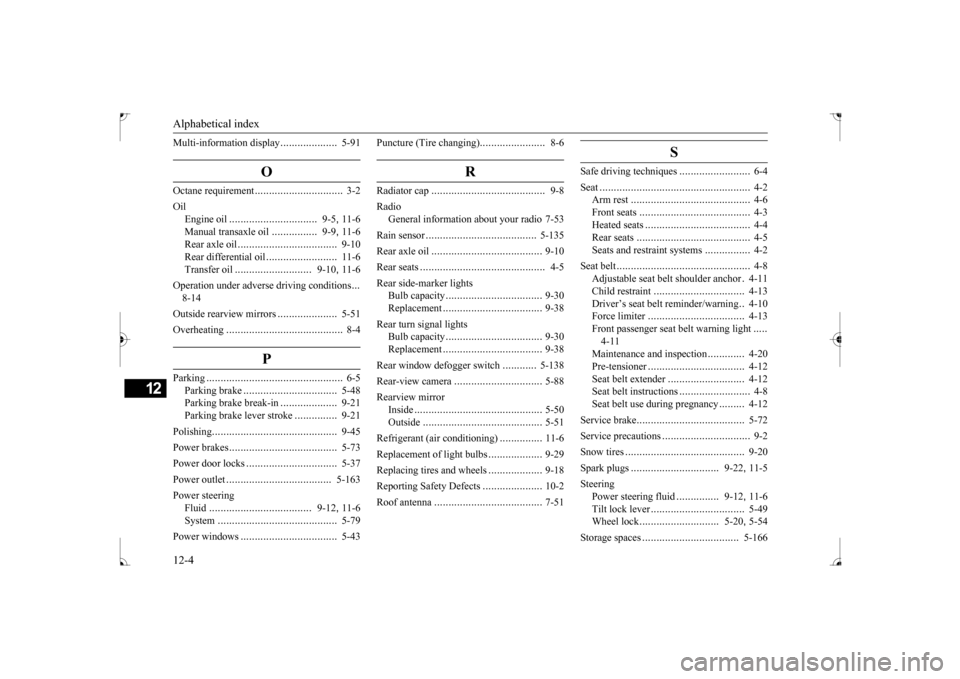
Multi-information display
....................
5-91
O
Octane requirement
...............
................
3-2
Oil
Engine oil
...............................
9-5
, 11-6
Manual transaxle oil
................
9-9
, 11-6
Rear axle oil
..................
.................
9-10
Rear differential oil
.........................
11-6
Transfer oil
...........................
9-10
, 11-6
Operation under adverse driving conditions
...
8-14 Outside rearview mirrors
.....................
5-51
Overheating
......................
...................
8-4
P
Parking
.........................
.......................
6-5
Parking brake
................
.................
5-48
Parking brake break-in
....................
9-21
Parking brake lever stroke
...............
9-21
Polishing
.......................
.....................
9-45
Power brakes
.....................
.................
5-73
Power door locks
...............
.................
5-37
Power outlet
..................
...................
5-163
Power steering
Fluid
.....................
...............
9-12
, 11-6
System
.....................
.....................
5-79
Power windows
.................
.................
5-43
Puncture (Tire changing)
.......................
8-6
R
Radiator cap
....................
....................
9-8
Radio
General information about your radio 7-53
Rain sensor
..................
.....................
5-135
Rear axle oil
....................
...................
9-10
Rear seats
........................
....................
4-5
Rear side-marker lights
Bulb capacity
..................
................
9-30
Replacement
...................
................
9-38
Rear turn signal lights
Bulb capacity
..................
................
9-30
Replacement
...................
................
9-38
Rear window defogger switch
............
5-138
Rear-view camera
...............
................
5-88
Rearview mirror
Inside
......................
.......................
5-50
Outside
.......................
...................
5-51
Refrigerant (air conditioning)
...............
11-6
Replacement of light bulbs
...................
9-29
Replacing tires and wheels
...................
9-18
Reporting Safety Defects
.....................
10-2
Roof antenna
...................
...................
7-51
S
Safe driving techniques
.........................
6-4
Seat
...........................
..........................
4-2
Arm rest
.......................
...................
4-6
Front seats
....................
...................
4-3
Heated seats
.....................
................
4-4
Rear seats
.....................
...................
4-5
Seats and restraint systems
................
4-2
Seat belt
........................
.......................
4-8
Adjustable seat belt shoulder anchor
.4-11
Child restraint
...............
.................
4-13
Driver’s seat belt reminder/warning
..4-10
Force limiter
.................
.................
4-13
Front passenger seat belt warning light
.....
4-11Maintenance and inspection
.............
4-20
Pre-tensioner
.................
.................
4-12
Seat belt extender
...........................
4-12
Seat belt instructions
.........................
4-8
Seat belt use during pregnancy
.........
4-12
Service brake
.....................
.................
5-72
Service precautions
...............
................
9-2
Snow tires
.....................
.....................
9-20
Spark plugs
................
...............
9-22
, 11-5
Steering
Power steering fluid
...............
9-12
, 11-6
Tilt lock lever
................
.................
5-49
Wheel lock
............................
5-20
, 5-54
Storage spaces
...................
...............
5-166
BK0237700US.bo
ok 4 ページ 2016年4月15日 金曜日 午前11時28分