Pair MITSUBISHI LANCER 2017 8.G Owners Manual
[x] Cancel search | Manufacturer: MITSUBISHI, Model Year: 2017, Model line: LANCER, Model: MITSUBISHI LANCER 2017 8.GPages: 385, PDF Size: 14.34 MB
Page 12 of 385
2-1
2
If this warning light comes on or
flashes while you’re driving...
Quick index
N00200702191
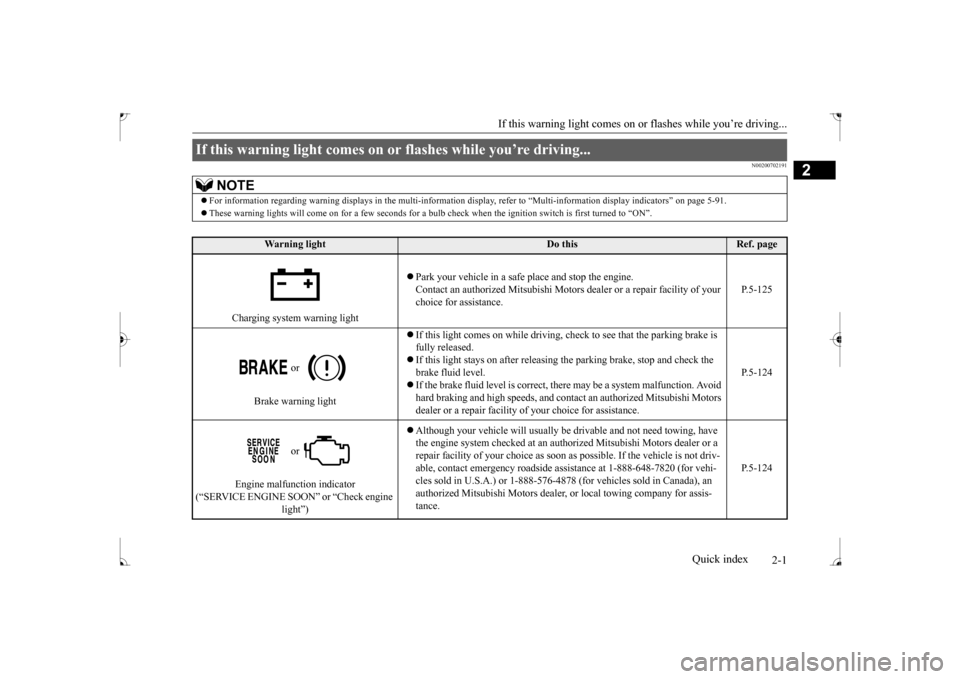
If this warning light comes on or flashes while you’re driving...
NOTE
For information regarding warning displays in the multi-informat
ion display, refer to “Multi-information display indicators” on
page 5-91.
These warning lights will come on for a few seconds for a bul
b check when the ignition switc
h is first turned to “ON”.
Warning light
Do this
Ref. page
Charging system warning light
Park your vehicle in a safe
place and stop the engine.
Contact an authorized Mitsubishi Motors
dealer or a repair facility of your
choice for assistance.
P.5-125
or
Brake warning light
If this light comes on while driving, check to see that the parking brake is fully released. If this light stays on after releasing the parking brake, stop and check the brake fluid level. If the brake fluid level is correct, th
ere may be a system malfunction. Avoid
hard braking and high speeds, and contact an authorized Mitsubishi Motors dealer or a repair facility of your choice for assistance.
P.5-124
or
Engine malfunction indicator
(“SERVICE ENGINE SOON” or “Check engine
light”)
Although your vehicle will usually be drivable and not need towing, have the engine system checked at an aut
horized Mitsubishi Motors dealer or a
repair facility of your choice as soon
as possible. If the vehicle is not driv-
able, contact emergency roadside assistance at 1-888-648-7820 (for vehi- cles sold in U.S.A.) or 1-888-576-487
8 (for vehicles sold in Canada), an
authorized Mitsubishi Motors dealer
, or local towing company for assis-
tance.
P.5-124
BK0237700US.bo
ok 1 ページ 2016年4月15日 金曜日 午前11時28分
Page 13 of 385

If this warning light comes on or
flashes while you’re driving...
2-2 Quick index
2
Anti-lock braking system warning light
When this light comes on, the anti-lock braking system is not functioning and only the ordinary braking system is functioning. Park your vehicle in a safe
place and stop the engine.
Test the system as described on page 5-75. If the light does not go out after the test
, or if it comes on again, we recom-
mend that you have the system checked at
an authorized Mitsubishi Motors
dealer or a repair facility of your choice as soon as possible.
P.5-74, 5-75
SRS warning light
Immediately have the airbag and the pre-tensioner seat belt system checked at an authorized Mitsubishi Motors dealer.
P.4-13, 4-26
Tire pressure monitoring system warning light
If the warning light comes on, you should
stop and adjust the tires to the
proper inflation pressure as soon as possible. (See “Tire inflation pressures” on page 9-17.)Once adjustments have been made, the
warning light will go off after a few
minutes of driving. If the warning light blinks for approximately 1 minute and then remain continuously illuminated, the system is not operating properly. If the sys- tem returns to normal, the warning light will go off. If the warning light does not go off, have the vehicle inspected at an authorized Mitsubishi Motors dealer.
P.5-84
Warning light
Do this
Ref. page
BK0237700US.bo
ok 2 ページ 2016年4月15日 金曜日 午前11時28分
Page 22 of 385
Filling the fuel tank
General information 3-3
3
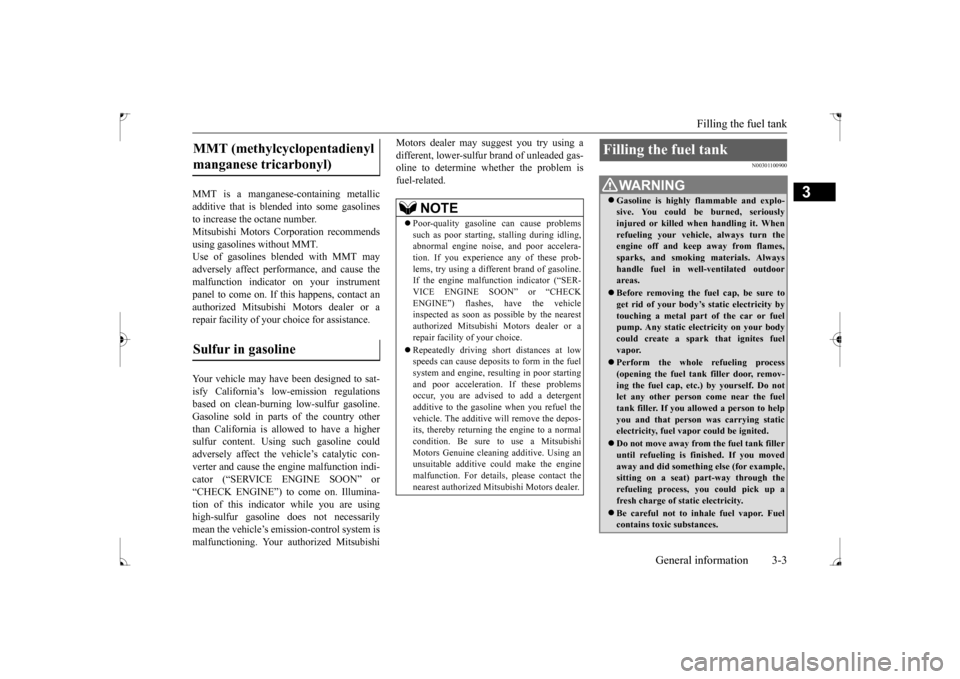
MMT is a manganese-containing metallic additive that is blended into some gasolines to increase the octane number. Mitsubishi Motors Corporation recommendsusing gasolines without MMT. Use of gasolines blended with MMT may adversely affect performance, and cause themalfunction indicator on your instrumentpanel to come on. If this happens, contact an authorized Mitsubishi Motors dealer or a repair facility of your choice for assistance. Your vehicle may have been designed to sat- isfy California’s low-emission regulationsbased on clean-burning low-sulfur gasoline. Gasoline sold in parts of the country other than California is allowed to have a highersulfur content. Using such gasoline could adversely affect the vehicle’s catalytic con- verter and cause the engine malfunction indi-cator (“SERVICE ENGINE SOON” or “CHECK ENGINE”) to come on. Illumina- tion of this indicator while you are usinghigh-sulfur gasoline does not necessarily mean the vehicle’s emission-control system is malfunctioning. Your authorized Mitsubishi
Motors dealer may suggest you try using a different, lower-sulfur brand of unleaded gas- oline to determine whether the problem is fuel-related.
N00301100900
MMT (methylcyclopentadienyl manganese tricarbonyl) Sulfur in gasoline
NOTE
Poor-quality gasoline can cause problems such as poor starting,
stalling during idling,
abnormal engine noise, and poor accelera- tion. If you experience any of these prob- lems, try using a different brand of gasoline.If the engine malfunction indicator (“SER- VICE ENGINE SOON” or “CHECK ENGINE”) flashes, have the vehicleinspected as soon as possible by the nearest authorized Mitsubishi Motors dealer or a repair facility of your choice. Repeatedly driving short distances at low speeds can cause deposits to form in the fuelsystem and engine, resulting in poor starting and poor acceleration. If these problems occur, you are advised to add a detergentadditive to the gasoline when you refuel the vehicle. The additive will remove the depos- its, thereby returning the engine to a normalcondition. Be sure to use a Mitsubishi Motors Genuine cleaning additive. Using an unsuitable additive could make the engine malfunction. For details, please contact the nearest authorized Mitsubishi Motors dealer.
Filling the fuel tank
WA R N I N G Gasoline is highly flammable and explo- sive. You could be burned, seriously injured or killed when handling it. When refueling your vehicle, always turn theengine off and keep away from flames, sparks, and smoking materials. Always handle fuel in well-ventilated outdoorareas. Before removing the fuel cap, be sure to get rid of your body’s static electricity by touching a metal part of the car or fuel pump. Any static electricity on your bodycould create a spark that ignites fuel vapor. Perform the whole refueling process (opening the fuel tank filler door, remov- ing the fuel cap, etc.) by yourself. Do notlet any other person come near the fuel tank filler. If you allowed a person to help you and that person was carrying staticelectricity, fuel vapor could be ignited. Do not move away from the fuel tank filler until refueling is finished. If you moved away and did something else (for example, sitting on a seat) part-way through the refueling process, you could pick up a fresh charge of static electricity. Be careful not to inhale fuel vapor. Fuel contains toxic substances.
BK0237700US.bo
ok 3 ページ 2016年4月15日 金曜日 午前11時28分
Page 24 of 385

Modifications to and racing of your vehicle
General information 3-5
3
7. To close, turn the fuel tank filler cap slowly clockwise until you hear clicking sounds, then gently push the fuel tank filler door closed.
N00301600048
This vehicle should not be modified withnon-Mitsubishi Motors genuine parts. Mit-subishi Motors designs and manufactures high quality vehicles
with an emphasis on
safety and durability. Modifications usingnon-Mitsubishi Motors genuine parts may affect the performance, safety and/or durabil- ity of your vehicle, and may violate applica-ble state and/or federal regulations. DAMAGE OR PERFORMANCE PROB- LEMS RESULTING FROM MODIFICA- TIONS TO OR RACING OF YOUR VEHICLE ARE NOT COVEREDUNDER WARRANTY. Examples of modifications to your vehicle that can cause damage or performance prob- lems include the following: Failure to use Mitsubishi Motors genuine parts Failure to use required fuel and fluids Failure to use proper size tires and wheels Modification of the fuel, intake, exhaust, emission, suspension, engine, drive train or electrical wiring systems
Modification of any onboard com- puter/control module, including repro- gramming, or replacing/adding chips to any onboard computer/control module
Review the Warranty and Maintenance Man- ual for further details regarding warranty cov- erage.
N00301701235
The installation of accessories, optional parts, etc., should only be carried out within the limits prescribed by law in the driving area and in accordance with theguidelines and warnings contained within the documents accompanying this vehicle.
WA R N I N G Make sure the fuel cap is securely closed. If the fuel cap is loose, fuel could leak, resulting in a fire.CAUTION If you need to replace the fuel tank filler cap, use only the cap specified for your model vehicle. NOTE
If the fuel tank filler cap
is not tight while
driving, the engine malfunction indicator (“SERVICE ENGINE SOON” or “Checkengine light”) may come on when the onboard diagnostic (OBD) system performs a self check. Always tighten the fuel tank filler cap until you hear clicking sounds.The indicator will go off after driving several times. If the indicator does not go off, con- tact your authorized Mitsubishi Motorsdealer or a repair f
acility of your choice as
soon as possible.
Modifications to and racing of your vehicle
Installation of accessories
CAUTION Before any electrical or electronic accesso- ries are installed, consult an authorized Mitsubishi Motors dealer. Your vehicle is equipped with a diagnosis connector (data link connector) for checkingand servicing the electronic control system. Mitsubishi Motors does not recommend con- necting a device other than the Scan Tool forinspections and service to this connector because an unexpected problem could result. In addition, malfunctions caused by connect-ing a device other than the Scan Tool may not be covered under warranty.
BK0237700US.bo
ok 5 ページ 2016年4月15日 金曜日 午前11時28分
Page 47 of 385
Maintenance and inspection of seat belts 4-20 Seat and restraint systems
4
8. Before putting your child in the restraint, push and pull the restraint in all directions to be sure it is firmly secured. Do this before each use. If the child restraint sys-tem is not firmly secure, repeat steps 1 through 7. 9. To remove a child restraint system fromthe vehicle and deactivate the ALR mode, remove the child from the restraint. Unlatch the buckle. Then remove the beltfrom the restraint and let the belt fullyretract.
10. Reinstall the head restraint.
Refer to “Head restraints” on page 4-6.
N00407601644
Children who have outgrown a child restraintsystem should be seated in the rear seat and wear the seat belt. If the shoulder belt crosses their face or neck, and/or the lap belt crossestheir stomach, a commercially available booster seat must be used, to raise the child so that the shoulder belt crosses their shoulderand the lap belt remains positioned low across their hips. The booster seat should fit the vehicle seat and have a label certifyingcompliance with Federal Motor Vehicle Safety Standards or Motor Vehicle Restraint
Systems and Booster Seats Safety Regula- tions.
N00407001387
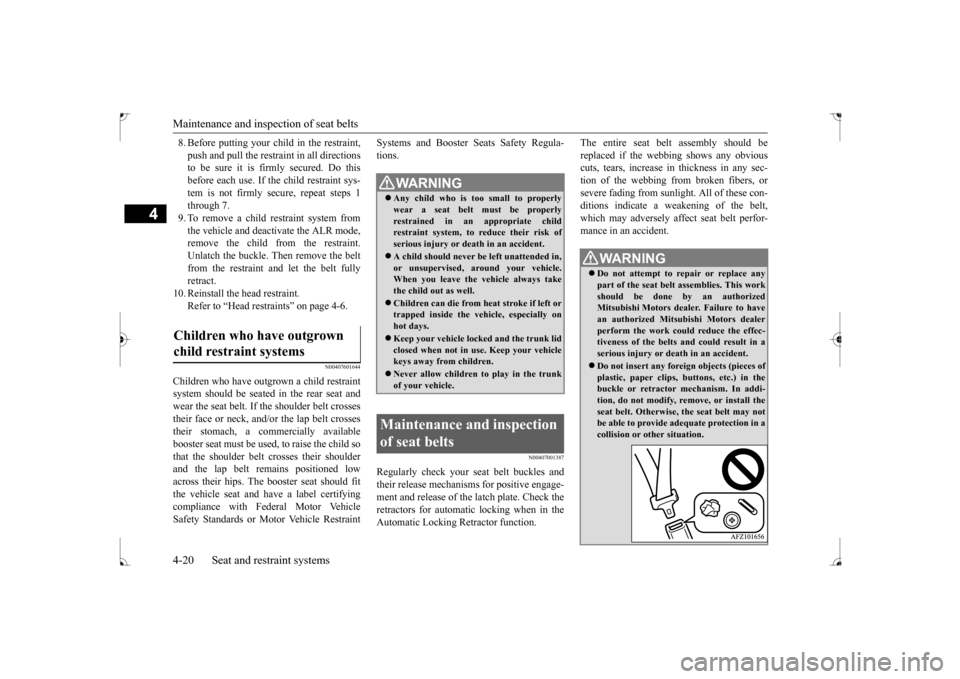
Regularly check your seat belt buckles andtheir release mechanisms for positive engage- ment and release of the latch plate. Check the retractors for automatic locking when in theAutomatic Locking Retractor function.
The entire seat belt assembly should be replaced if the webbing shows any obvious cuts, tears, increase in thickness in any sec- tion of the webbing from broken fibers, orsevere fading from sunlight. All of these con- ditions indicate a weakening of the belt, which may adversely affect seat belt perfor-mance in an accident.
Children who have outgrown child restraint systems
WA R N I N G Any child who is too small to properly wear a seat belt must be properly restrained in an appropriate childrestraint system, to reduce their risk of serious injury or death in an accident. A child should never be left unattended in, or unsupervised, around your vehicle. When you leave the vehicle always takethe child out as well. Children can die from heat stroke if left or trapped inside the vehicle, especially on hot days. Keep your vehicle locked and the trunk lid closed when not in use. Keep your vehicle keys away from children. Never allow children to play in the trunk of your vehicle.
Maintenance and inspection of seat belts
WA R N I N G Do not attempt to repair or replace any part of the seat belt assemblies. This work should be done by an authorizedMitsubishi Motors dealer. Failure to have an authorized Mitsubishi Motors dealer perform the work could reduce the effec-tiveness of the belts and could result in a serious injury or death in an accident. Do not insert any foreign objects (pieces of plastic, paper clips, buttons, etc.) in the buckle or retractor mechanism. In addi-tion, do not modify, remove, or install the seat belt. Otherwise, the seat belt may not be able to provide adequate protection in acollision or other situation.
BK0237700US.bo
ok 20 ページ 2016年4月15日 金曜日 午前11時28分
Page 58 of 385
Supplemental Restraint System (SRS) - airbag
Seat and restraint systems 4-31
4
N00408101460
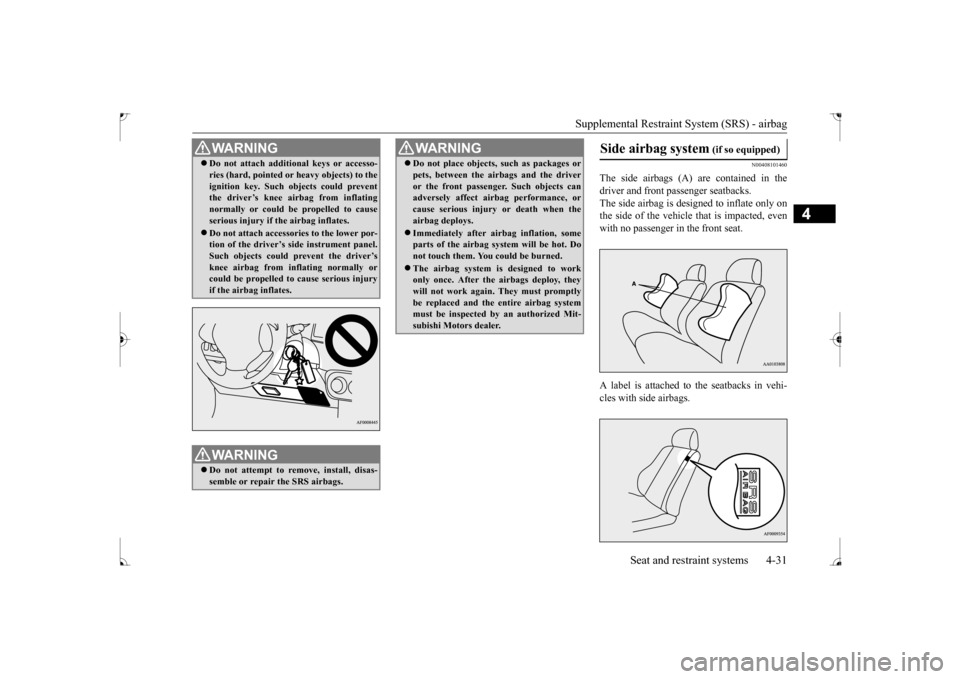
The side airbags (A) are contained in the driver and front passenger seatbacks.The side airbag is designed to inflate only on the side of the vehicle that is impacted, even with no passenger in the front seat. A label is attached to the seatbacks in vehi- cles with side airbags.
Do not attach additional keys or accesso- ries (hard, pointed or heavy objects) to the ignition key. Such objects could prevent the driver’s knee airbag from inflating normally or could be propelled to causeserious injury if the airbag inflates. Do not attach accessories to the lower por- tion of the driver’s side instrument panel. Such objects could prevent the driver’s knee airbag from inflating normally orcould be propelled to cause serious injury if the airbag inflates.WA R N I N G Do not attempt to remove, install, disas- semble or repair the SRS airbags.WA R N I N G
Do not place objects, such as packages or pets, between the airbags and the driver or the front passenger. Such objects can adversely affect airbag performance, or cause serious injury or death when theairbag deploys. Immediately after airbag inflation, some parts of the airbag system will be hot. Do not touch them. You could be burned. The airbag system is designed to work only once. After the airbags deploy, they will not work again. They must promptlybe replaced and the entire airbag system must be inspected by an authorized Mit- subishi Motors dealer.WA R N I N G
Side airbag system
(if so equipped)
BK0237700US.bo
ok 31 ページ 2016年4月15日 金曜日 午前11時28分
Page 62 of 385
Supplemental Restraint System (SRS) - airbag
Seat and restraint systems 4-35
4
N00408500672
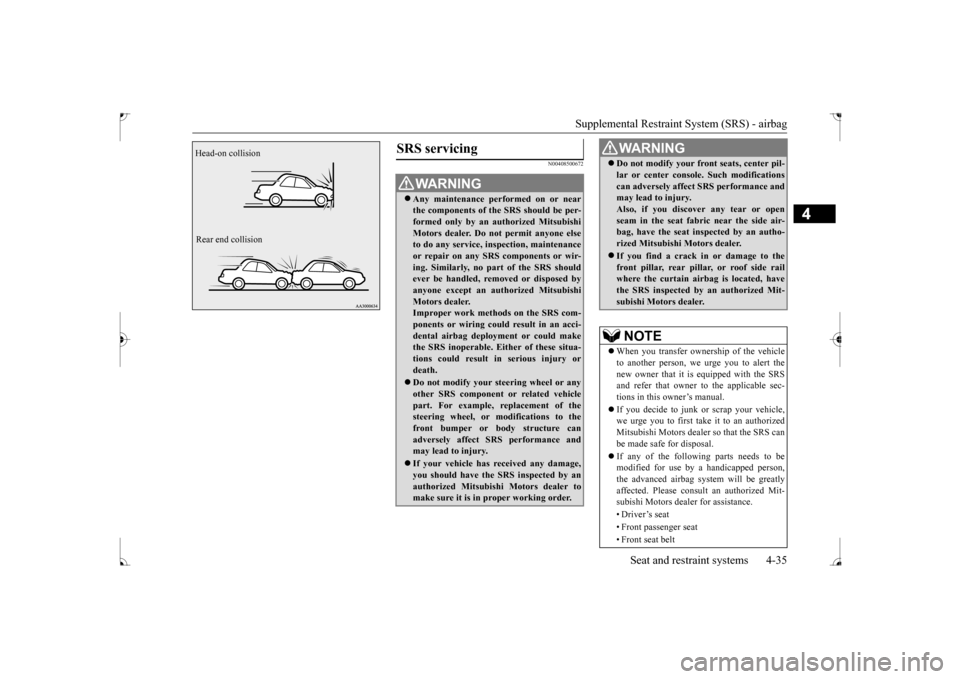
Head-on collision Rear end collision
SRS servicing
WA R N I N G Any maintenance performed on or near the components of the SRS should be per- formed only by an authorized Mitsubishi Motors dealer. Do not permit anyone elseto do any service, inspection, maintenance or repair on any SRS components or wir- ing. Similarly, no part of the SRS shouldever be handled, removed or disposed by anyone except an authorized Mitsubishi Motors dealer.Improper work methods on the SRS com- ponents or wiring could result in an acci- dental airbag deployment or could makethe SRS inoperable. Either of these situa- tions could result in serious injury or death. Do not modify your steering wheel or any other SRS component or related vehiclepart. For example, replacement of the steering wheel, or modifications to the front bumper or body structure canadversely affect SRS performance and may lead to injury. If your vehicle has received any damage, you should have the SRS inspected by an authorized Mitsubishi Motors dealer to make sure it is in proper working order.
Do not modify your front seats, center pil- lar or center console. Such modifications can adversely affect SRS performance and may lead to injury. Also, if you discover any tear or openseam in the seat fabric near the side air- bag, have the seat inspected by an autho- rized Mitsubishi Motors dealer. If you find a crack in or damage to the front pillar, rear pillar, or roof side railwhere the curtain airbag is located, have the SRS inspected by an authorized Mit- subishi Motors dealer.NOTE
When you transfer ownership of the vehicle to another person, we urge you to alert the new owner that it is equipped with the SRS and refer that owner to the applicable sec-tions in this owner’s manual. If you decide to junk
or scrap your vehicle,
we urge you to first take it to an authorized Mitsubishi Motors dealer so that the SRS can be made safe for disposal. If any of the following parts needs to be modified for use by a handicapped person, the advanced airbag system will be greatly affected. Please consult an authorized Mit-subishi Motors dealer for assistance. • Driver’s seat• Front passenger seat • Front seat beltWA R N I N G
BK0237700US.bo
ok 35 ページ 2016年4月15日 金曜日 午前11時28分
Page 87 of 385
Free-hand Advanced Security Transmitter (F.A.S.T.-key) (if so equipped) 5-22 Features and controls
5
1. Make sure that all electric devices, such as lights, air conditioning blower and rear window defogger, are turned off. 2. While depressing the brake pedal on vehi-cles equipped with continuously variable transmission (CVT) or the clutch pedal on the vehicles equipped with manual trans-axle, press the accelerator pedal halfway and hold it there, then crank the engine. Release the accelerator pedal, immedi-ately after the engine starts.3. If the engine still will not start, the engine could be flooded with too much gasoline. While depressing the brake pedal on vehi-cles equipped with CVT or the clutch pedal on the vehicles
equipped with man-
ual transaxle, push the accelerator pedalall the way down and hold it there, then crank the engine for 5 to 6 seconds. Return the ignition switch to the “LOCK”position and release the accelerator pedal. Wait a few seconds, and then crank the engine again for 5 to 6 seconds whiledepressing the brake pedal or the clutch pedal, but do not push the accelerator pedal. Release the ignition key if theengine starts. If the engine fails to start, repeat these procedures. If the engine still will not start, contact your local Mitsubi-shi Motors dealer or a repair facility of your choice for assistance.
When the ambient temperature is -4°F (-20°C) or lower, it may not be possible tostart from a standstill even with the selector lever in the “D” (DRIVE) or “R” (REVERSE) position.This phenomenon occurs because the trans- axle has not warmed up sufficiently; it does not indicate a problem. If this occurs, placethe selector lever in the “P” (PARK) positionand let the engine idle for at least 10 minutes. The transaxle will warm up, and you will be able to drive normally.Do not leave the vehicle during warm-up operation.
N00514800020 N00515200148
The emergency key is built into the F.A.S.T.- key.When the F.A.S.T.-key cannot be used, such as when the battery of the F.A.S.T.-key or the vehicle has run down, the emergency key can
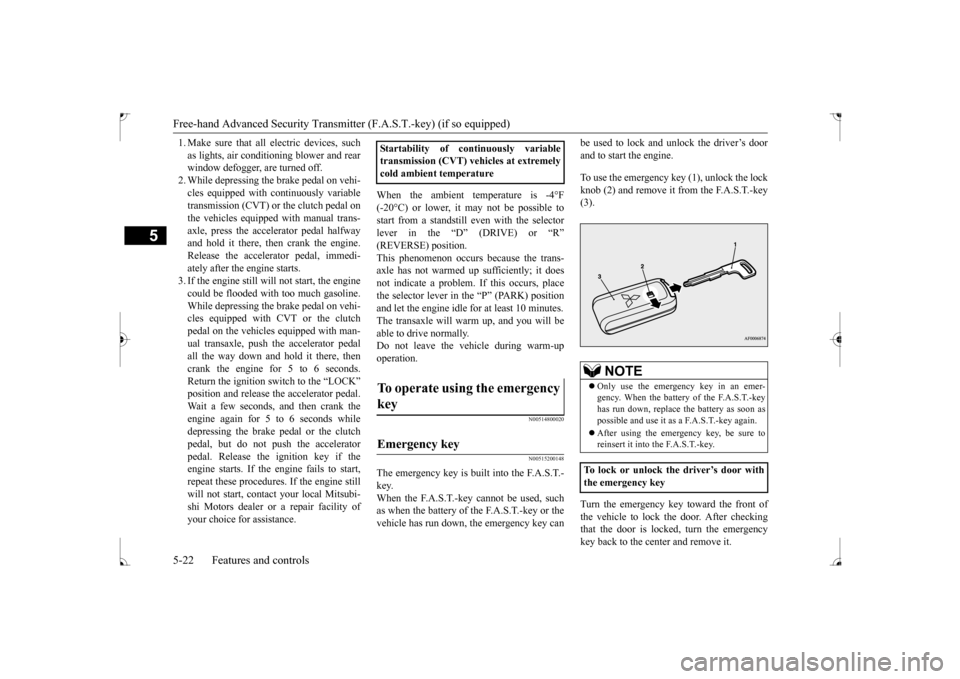
be used to lock and unlock the driver’s door and to start the engine. To use the emergency key (1), unlock the lock knob (2) and remove it from the F.A.S.T.-key (3). Turn the emergency key toward the front of the vehicle to lock the door. After checking that the door is locked, turn the emergencykey back to the center and remove it.
Startability of continuously variable transmission (CVT) vehicles at extremely cold ambient temperatureTo operate using the emergency key
Emergency key
NOTE
Only use the emergency key in an emer- gency. When the battery of the F.A.S.T.-key has run down, replace the battery as soon as possible and use it as a F.A.S.T.-key again. After using the emergency key, be sure to reinsert it into the F.A.S.T.-key.
To lock or unlock the driver’s door with the emergency key
BK0237700US.bo
ok 22 ページ 2016年4月15日 金曜日 午前11時28分
Page 92 of 385
Free-hand Advanced Security Transmit
ter (F.A.S.T.-key) (if so equipped)
Features and controls 5-27
5
After several attempts, you may experience that the engine still does not start. 1. Make sure that all electric devices, such as lights, air conditioning blower and rear window defogger, are turned off.
2. While depressing the brake pedal on vehi- cles equipped with continuously variable transmission (CVT) or the clutch pedal on the vehicles equipped with manual trans-axle, press the accelerator pedal halfway and hold it there, then crank the engine. Release the accelerator pedal, immedi-ately after the engine starts. 3. If the engine still will not start, the engine could be flooded with too much gasoline.While depressing the brake pedal on vehi-cles equipped with CVT or the clutch pedal on the vehicles equipped with man- ual transaxle, push the accelerator pedalall the way down and hold it there, then crank the engine for 5 to 6 seconds. Return the ignition switch to the “LOCK”position and release the accelerator pedal. Wait a few seconds, and then crank the engine again for 5 to 6 seconds whiledepressing the brake pedal or the clutch pedal, but do not push the accelerator pedal. Release the ignition key if theengine starts. If the engine fails to start, repeat these procedures. If the engine still will not start, contact your local Mitsubi-shi Motors dealer or a repair facility of your choice for assistance.
When the ambient temperature is -4 °Fstart from a standstill even with the selector lever in the “D” (DRIVE) or “R” (REVERSE) position.This phenomenon occurs because the trans- axle has not warmed up sufficiently; it does not indicate a problem. If this occurs, placethe selector lever in the “P” (PARK) positionand let the engine idle for at least 10 minutes. The transaxle will warm up, and you will be able to drive normally.Do not leave the vehicle during warm-up operation.
N00529600101
The electronic immobilizer is designed to sig- nificantly reduce the possibility of vehicletheft. The purpose of the system is to immo- bilize the vehicle if an invalid start is attempted. A valid start attempt can only beachieved (subject to certain conditions) using a F.A.S.T.-Key “registered” to the immobi- lizer system.
WA R N I N G Make sure to remove the F.A.S.T.-key from the emergency key after the engine is started. If not removed, the F.A.S.T.-key could fall to the floor, which may interfere withpedal operation. Furthermore, the F.A.S.T.-key could pre- vent the driver’s knee airbag from inflat-ing normally or could be propelled to cause serious injury if the airbag inflates.NOTE
When using the emergency key to start the engine, first remove the key from the key holder. If the emergency key is attached to a key holder (key ring), it may become impos-sible to insert the keyless operation key into the emergency key, and it may prevent the engine from being started.
When the engine is hard to start
Startability of continuously variable transmission (CVT) vehicles at extremely cold ambient temperatureElectronic immobilizer (Anti- theft starting system)
BK0237700US.bo
ok 27 ページ 2016年4月15日 金曜日 午前11時28分
Page 121 of 385
Starting and stopping the engine 5-56 Features and controls
5
7. Turn the ignition switch to the “ON” posi- tion and make certain that all warning lights are functioning properly beforestarting the engine.8. Turn the ignition switch to the “START” pedal. Release the key when the enginestarts.
After several attempts, you may experience that the engine still does not start. 1. Make sure that all electric devices, such as lights, air conditioning blower and rearwindow defogger, are turned off.
2. While depressing the brake pedal on vehi- cles equipped with continuously variable transmission (CVT) or the clutch pedal on the vehicles equipped with manual trans-axle, press the accelerator pedal halfway and hold it there, then crank the engine. Release the accelerator pedal, immedi-ately after the engine starts. 3. If the engine still will not start, the engine could be flooded with too much gasoline.While depressing the brake pedal on vehi-cles equipped with CVT or the clutch pedal on the vehicles
equipped with man-
ual transaxle, push the accelerator pedalall the way down and hold it there, then crank the engine for 5 to 6 seconds. Return the ignition switch to the “LOCK”position and release the accelerator pedal. Wait a few seconds, and then crank the engine again for 5 to 6 seconds whiledepressing the brake pedal or the clutch pedal, but do not push the accelerator pedal. Release the ignition key if theengine starts. If the engine fails to start, repeat these procedures. If the engine still will not start, contact your local Mitsubi-shi Motors dealer or a repair facility of your choice for assistance.
When the ambient temperature is -4 °F (-20 °C) or lower on vehicles with CVT, itmay not be possible to start from a standstill even with the selector lever in the “D” (DRIVE) or “R” (REVERSE) position.This phenomenon occurs because the trans-axle has not warmed up sufficiently; it does not indicate a problem. If it occurs, place the selector lever in the “P” (PARK) position andlet the engine idle for at least 10 minutes. The transaxle will warm up, and you will be able to start normally.Do not leave the vehicle during warm-up operation.
N00542301102
1. Bring the vehicle to a complete stop. 2. Fully engage the parking brake while depressing the brake pedal. 3. For vehicles with a manual transaxle, turn the ignition switch to the “LOCK” posi- tion to stop the engine, and then move thegearshift lever to the 1st (on a uphill) or “R” (Reverse) (on a downhill) position.
NOTE
On vehicles with CVT, the starter will not operate unless the selector lever is in the “P” (PARK) or “N” (NEUTRAL) position. For safety reasons, start the engine in the “P” (PARK) position so that the wheels arelocked.NOTE
Minor noises may be heard on engine start- up. These will disappear as the engine warms up.
When the engine is hard to start
Startability of continuously vari- able transmission (CVT) vehicles at extremely cold ambient temper- ature Stopping the engine
BK0237700US.bo
ok 56 ページ 2016年4月15日 金曜日 午前11時28分