towing MITSUBISHI LANCER 2017 8.G Owners Manual
[x] Cancel search | Manufacturer: MITSUBISHI, Model Year: 2017, Model line: LANCER, Model: MITSUBISHI LANCER 2017 8.GPages: 385, PDF Size: 14.34 MB
Page 12 of 385
2-1
2
If this warning light comes on or
flashes while you’re driving...
Quick index
N00200702191
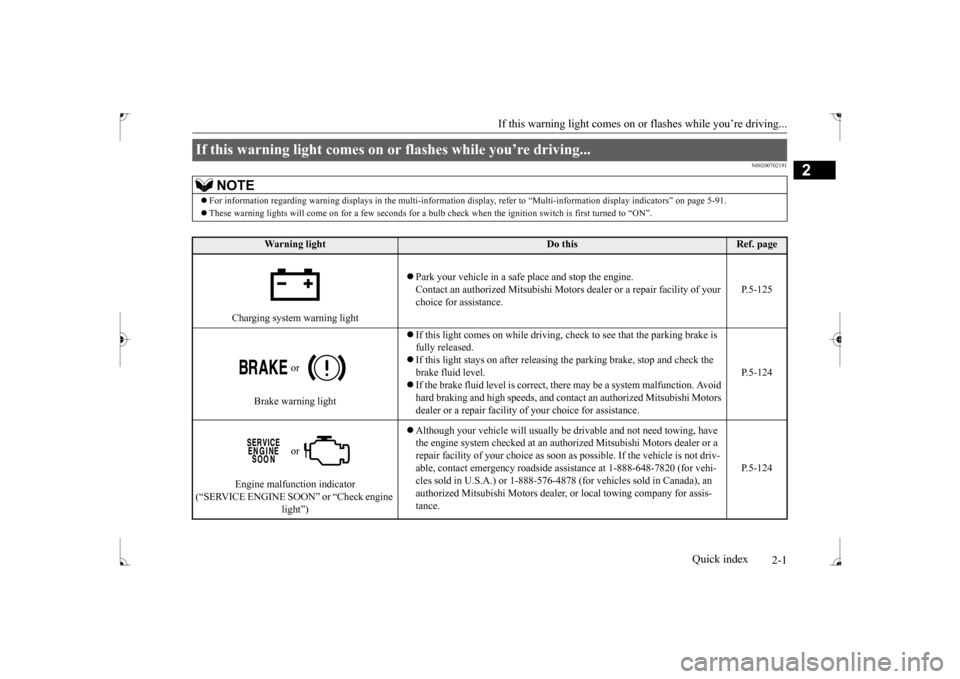
If this warning light comes on or flashes while you’re driving...
NOTE
For information regarding warning displays in the multi-informat
ion display, refer to “Multi-information display indicators” on
page 5-91.
These warning lights will come on for a few seconds for a bul
b check when the ignition switc
h is first turned to “ON”.
Warning light
Do this
Ref. page
Charging system warning light
Park your vehicle in a safe
place and stop the engine.
Contact an authorized Mitsubishi Motors
dealer or a repair facility of your
choice for assistance.
P.5-125
or
Brake warning light
If this light comes on while driving, check to see that the parking brake is fully released. If this light stays on after releasing the parking brake, stop and check the brake fluid level. If the brake fluid level is correct, th
ere may be a system malfunction. Avoid
hard braking and high speeds, and contact an authorized Mitsubishi Motors dealer or a repair facility of your choice for assistance.
P.5-124
or
Engine malfunction indicator
(“SERVICE ENGINE SOON” or “Check engine
light”)
Although your vehicle will usually be drivable and not need towing, have the engine system checked at an aut
horized Mitsubishi Motors dealer or a
repair facility of your choice as soon
as possible. If the vehicle is not driv-
able, contact emergency roadside assistance at 1-888-648-7820 (for vehi- cles sold in U.S.A.) or 1-888-576-487
8 (for vehicles sold in Canada), an
authorized Mitsubishi Motors dealer
, or local towing company for assis-
tance.
P.5-124
BK0237700US.bo
ok 1 ページ 2016年4月15日 金曜日 午前11時28分
Page 16 of 385
If this problem occurs...
Quick index 2-5
2
Problem
Do this
Ref. page
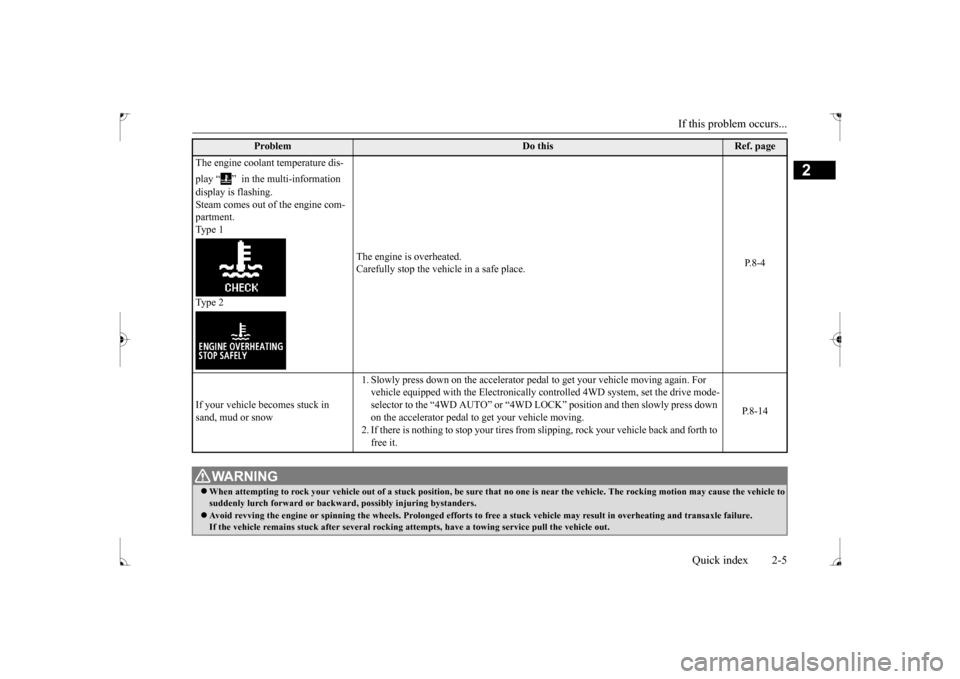
The engine coolant temperature dis- play “ ” in the multi-information display is flashing. Steam comes out of the engine com- partment. Type 1 Type 2
The engine is overheated. Carefully stop the vehicle in a safe place.
P.8-4
If your vehicle becomes stuck in sand, mud or snow
1. Slowly press down on the accelerator peda
l to get your vehicle moving again. For
vehicle equipped with the Electronically controlled 4WD system, set the drive mode- selector to the “4WD AUTO” or “4WD LO
CK” position and then slowly press down
on the accelerator pedal to get your vehicle moving.2. If there is nothing to stop your tires from
slipping, rock your vehicle back and forth to
free it.
P.8-14
WA R N I N G When attempting to rock your vehicle out of
a stuck position, be sure that no one is
near the vehicle. The rocking motion may c
ause the vehicle to
suddenly lurch forward or backward, possibly injuring bystanders. Avoid revving the engine or spinning the
wheels. Prolonged efforts to free a stuck ve
hicle may result in overheating and transa
xle failure.
If the vehicle remains stuck after several rocking at
tempts, have a towing service pull the vehicle out.
BK0237700US.bo
ok 5 ページ 2016年4月15日 金曜日 午前11時28分
Page 68 of 385
Break-in recommendations
Features and controls 5-3
5
N00508701395
Advanced automobile manufacturing tech- niques permit you to operate your new vehi-cle without requiring a long break-in period of low-speed driving. However, you can add to the future perfor-mance and economy of your vehicle by observing the following precautions during the first 300 miles (500 km).Drive your vehicle at moderate speeds duringthe break-in period. Avoid revving the engine. Avoid rough driving such as fast starts, sudden acceleration, prolonged high-speed driving and sudden braking. These would have a detrimental effect on the engine and also cause increased fuel andoil consumption, which could result in malfunction of the engine components. Be particularly careful to avoid full accelera-tion while in low gear. Do not overload the vehicle. Observe the seating capacity (See “Cargo load precau-tions” on page 6-10). Do not use this vehicle for trailer towing.
N00508801657
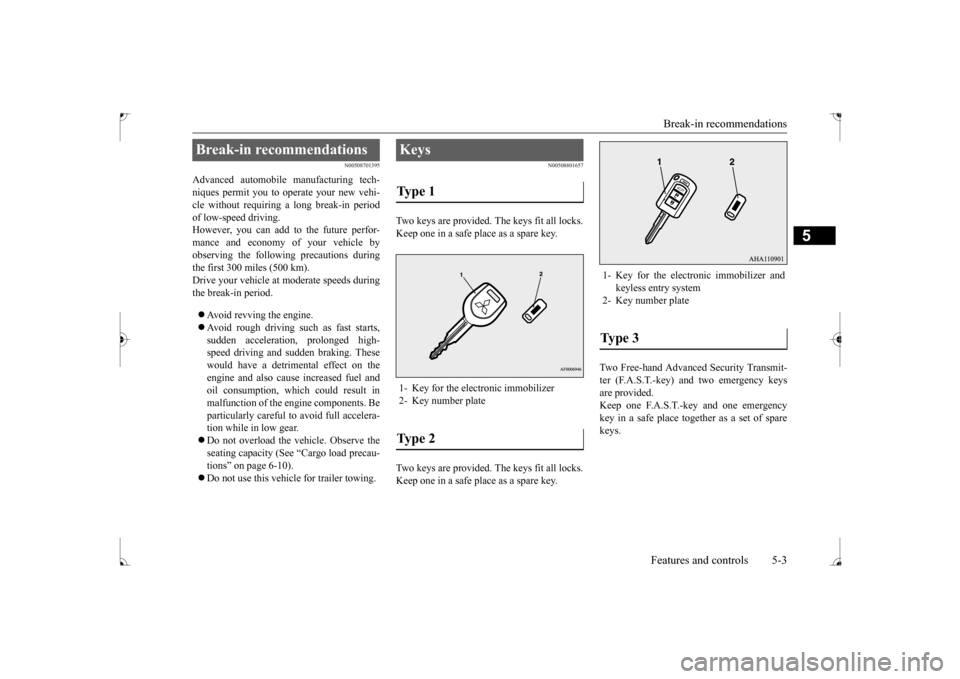
Two keys are provided. The keys fit all locks. Keep one in a safe place as a spare key. Two keys are provided. The keys fit all locks. Keep one in a safe place as a spare key.
Two Free-hand Advanced Security Transmit- ter (F.A.S.T.-key) and two emergency keysare provided.Keep one F.A.S.T.-key and one emergency key in a safe place together as a set of spare keys.
Break-in recommendations
Keys Type 1 1- Key for the electronic immobilizer2- Key number plateType 2
1- Key for the electronic immobilizer and
keyless entry system
2- Key number plateType 3
BK0237700US.bo
ok 3 ページ 2016年4月15日 金曜日 午前11時28分
Page 137 of 385
Service brake 5-72 Features and controls
5
Good vehicle performance cannot be expected if there is a difference in wear between tires. Refer to “Tire rotation” on page 9-19. Check the tire inflation pressure regularly.
N00517500262
Overuse of the brake can cause poor brake response and premature wear of the brake pads and linings.When driving down a long or steep hill, use engine braking by downshifting.
CAUTION Always use tires of the same size, same type, and same brand, and which have no wear dif-ferences. Using tires that differ in size, type, brands or the degree of wear, will increase the differential oil temperature, resulting inpossible damage to the driving system. Fur- ther, the drive train will be subjected to excessive loading, possibly leading to oilleakage, component seizure, or other serious problems.
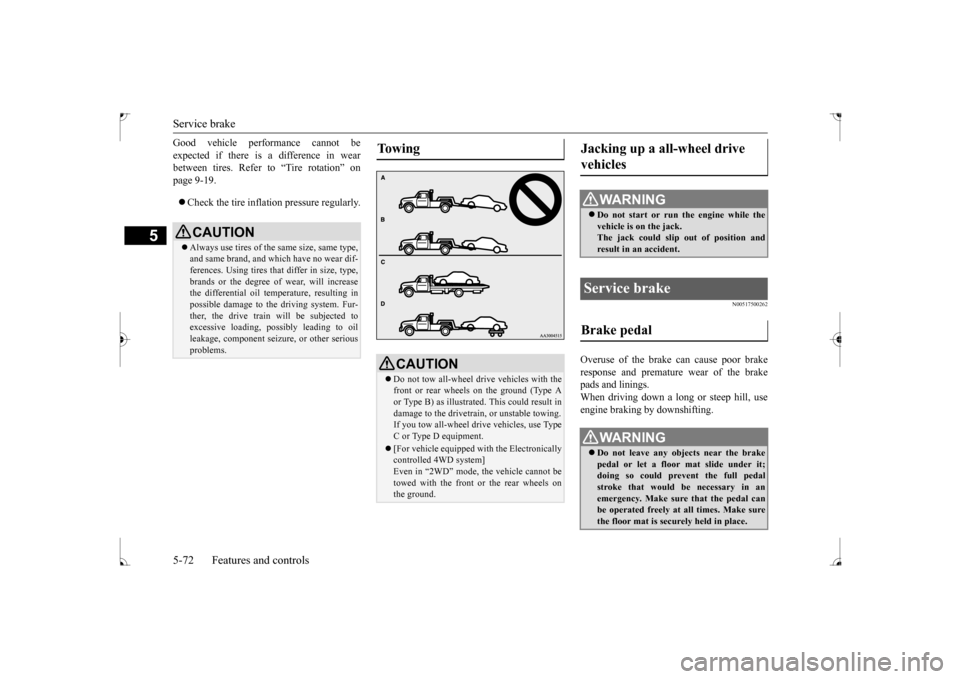
To w i n g
CAUTION Do not tow all-wheel drive vehicles with the front or rear wheels on the ground (Type Aor Type B) as illustrated. This could result in damage to the drivetrain, or unstable towing. If you tow all-wheel drive vehicles, use Type C or Type D equipment. [For vehicle equipped with the Electronically controlled 4WD system] Even in “2WD” mode, the vehicle cannot betowed with the front or the rear wheels on the ground.
Jacking up a all-wheel drive vehicles
WA R N I N G Do not start or run the engine while the vehicle is on the jack.The jack could slip out of position and result in an accident.
Service brake Brake pedal
WA R N I N G Do not leave any objects near the brake pedal or let a floor mat slide under it; doing so could prevent the full pedal stroke that would be necessary in anemergency. Make sure that the pedal can be operated freely at all times. Make sure the floor mat is securely held in place.
BK0237700US.bo
ok 72 ページ 2016年4月15日 金曜日 午前11時28分
Page 144 of 385
Power steering system
Features and controls 5-79
5
N00546300015
N00518000310
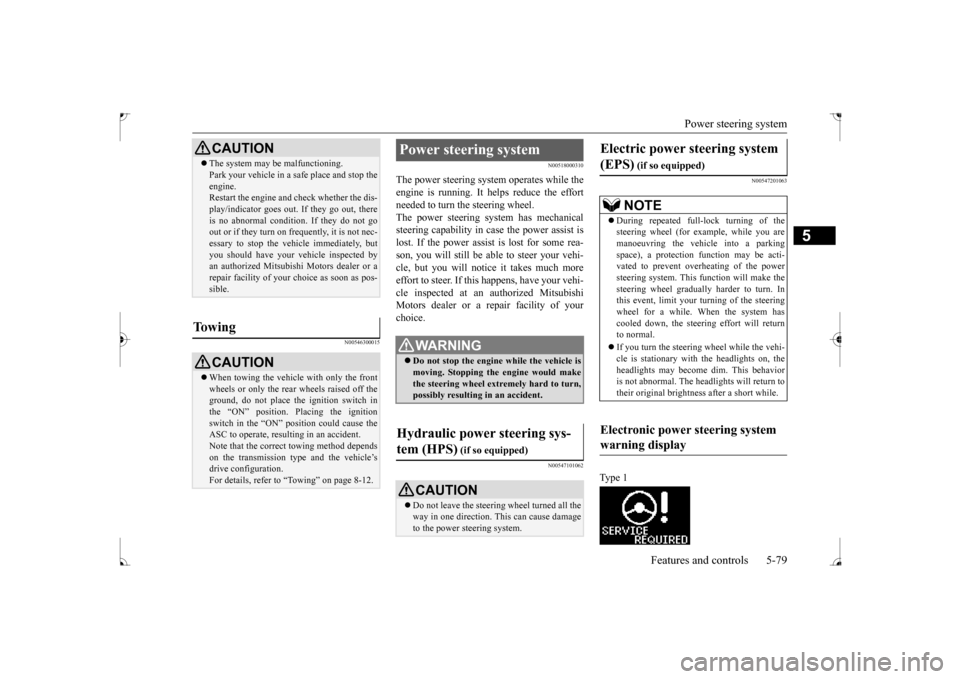
The power steering system operates while the engine is running. It helps reduce the effortneeded to turn the steering wheel. The power steering system has mechanical steering capability in case the power assist islost. If the power assist is lost for some rea- son, you will still be able to steer your vehi- cle, but you will notice it takes much moreeffort to steer. If this happens, have your vehi-cle inspected at an authorized Mitsubishi Motors dealer or a repair facility of your choice.
N00547101062
N00547201063
Type 1
CAUTION The system may be malfunctioning. Park your vehicle in a safe place and stop the engine. Restart the engine and check whether the dis- play/indicator goes out. If they go out, thereis no abnormal condition. If they do not go out or if they turn on frequently, it is not nec- essary to stop the vehicle immediately, butyou should have your vehicle inspected by an authorized Mitsubishi Motors dealer or a repair facility of your choice as soon as pos-sible.
To w i n g
CAUTION When towing the vehicle with only the front wheels or only the rear wheels raised off theground, do not place the ignition switch in the “ON” position. Placing the ignition switch in the “ON” position could cause theASC to operate, resulting in an accident. Note that the correct towing method depends on the transmission type and the vehicle’s drive configuration. For details, refer to “Towing” on page 8-12.
Power steering system
WA R N I N G Do not stop the engine while the vehicle is moving. Stopping the engine would make the steering wheel extremely hard to turn,possibly resulting in an accident.
Hydraulic power steering sys- tem (HPS)
(if so equipped)
CAUTION Do not leave the steering wheel turned all the way in one direction. This can cause damage to the power steering system.
Electric power steering system (EPS)
(if so equipped)NOTE
During repeated full-lock turning of the steering wheel (for example, while you are manoeuvring the vehicle into a parkingspace), a protection function may be acti- vated to prevent overheating of the power steering system. This function will make thesteering wheel gradually harder to turn. In this event, limit your turning of the steering wheel for a while. When the system hascooled down, the steering effort will return to normal. If you turn the steering wheel while the vehi- cle is stationary with the headlights on, the headlights may become dim. This behavioris not abnormal. The headlights will return to their original brightness after a short while.
Electronic power steering system warning display
BK0237700US.bo
ok 79 ページ 2016年4月15日 金曜日 午前11時28分
Page 236 of 385
6
Driving safetyFuel economy ............................
.......................................................6-2
Driving, alcohol and dr
ugs ..............................................................6-2
Floor mat ...................................
.......................................................6-2
Vehicle preparation before driving ..................................................6-3Safe driving techniques
..........................................
..........................6-4
Driving during cold weat
her ............................................................6-4
Braking .....................................
.......................................................6-5
Parking ......................................
.......................................................6-5
Loading information
..............................................
..........................6-6
Cargo loads .....................
...............................................................6-10
Trailer towing .................
............................................................... 6-11
BK0237700US.bo
ok 1 ページ 2016年4月15日 金曜日 午前11時28分
Page 243 of 385
Loading information 6-8 Driving safety
6
4.The resulting figure equals the available amount of cargo and luggage load capacity. For exam- ple, if the “XXX” amount equals 1400 lbs. and there will be five150 lbs. passengers in your vehi- cle, the amount of available cargo and luggage load capacity is 650lbs. (1400 - 750 (5 x 150) =650 lbs.)5.Determine the combined weight of luggage and cargo being loaded on the vehicle. That weight may not safely exceed the availablecargo and luggage load capacity calculated in Step 4.6.If your vehicle will be towing a trailer, load from your trailer will be transferred to your vehicle. Consult this manual to determinehow this reduces the available cargo and luggage load capacity of your vehicle.
NOTE
The above steps for determining correct load limit were written in accordance with U.S.A. regula-tions. Your vehicle cannot tow a trailer, so step 6 is irrelevant.
BK0237700US.bo
ok 8 ページ 2016年4月15日 金曜日 午前11時28分
Page 246 of 385
Trailer towing
Driving safety 6-11
6
N00630600102
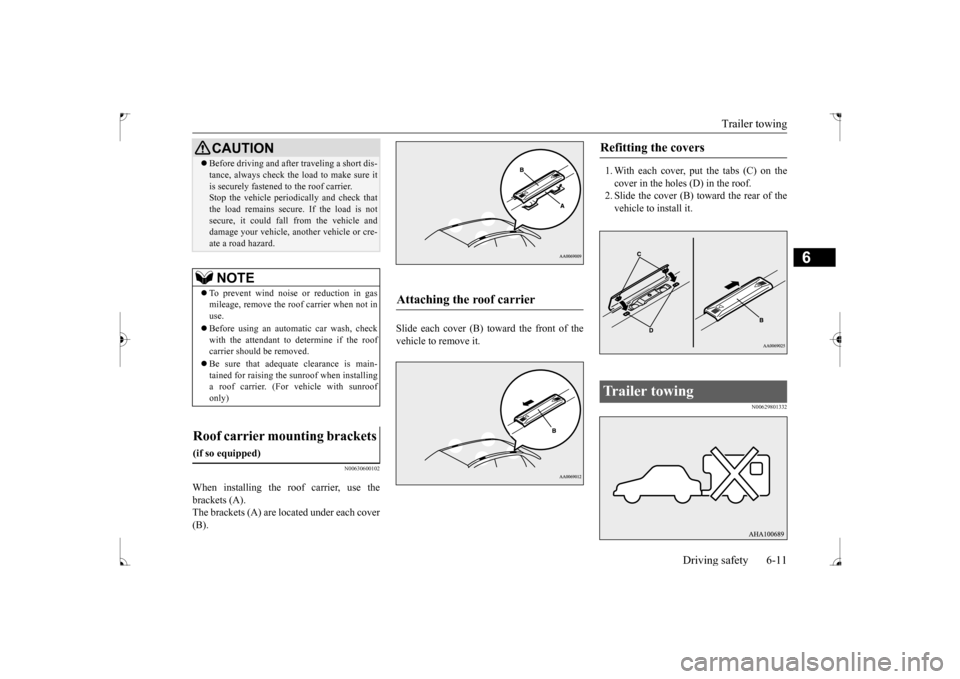
When installing the roof carrier, use the brackets (A). The brackets (A) are located under each cover (B).
Slide each cover (B) toward the front of the vehicle to remove it.
1. With each cover, put the tabs (C) on the cover in the holes (D) in the roof. 2. Slide the cover (B) toward the rear of thevehicle to install it.
N00629801332
Before driving and after traveling a short dis- tance, always check the load to make sure it is securely fastened to the roof carrier. Stop the vehicle periodically and check that the load remains secure. If the load is notsecure, it could fall from the vehicle and damage your vehicle, another vehicle or cre- ate a road hazard.NOTE
To prevent wind noise or reduction in gas mileage, remove the roof carrier when not in use. Before using an automatic car wash, check with the attendant to determine if the roof carrier should be removed. Be sure that adequate clearance is main- tained for raising the sunroof when installinga roof carrier. (For vehicle with sunroof only)
Roof carrier mounting brackets
(if so equipped)
CAUTION
Attaching the roof carrier
Refitting the covers
Trailer towing
BK0237700US.bo
ok 11 ページ 2016年4月15日 金曜日 午前11時28分
Page 247 of 385
Trailer towing 6-12 Driving safety
6
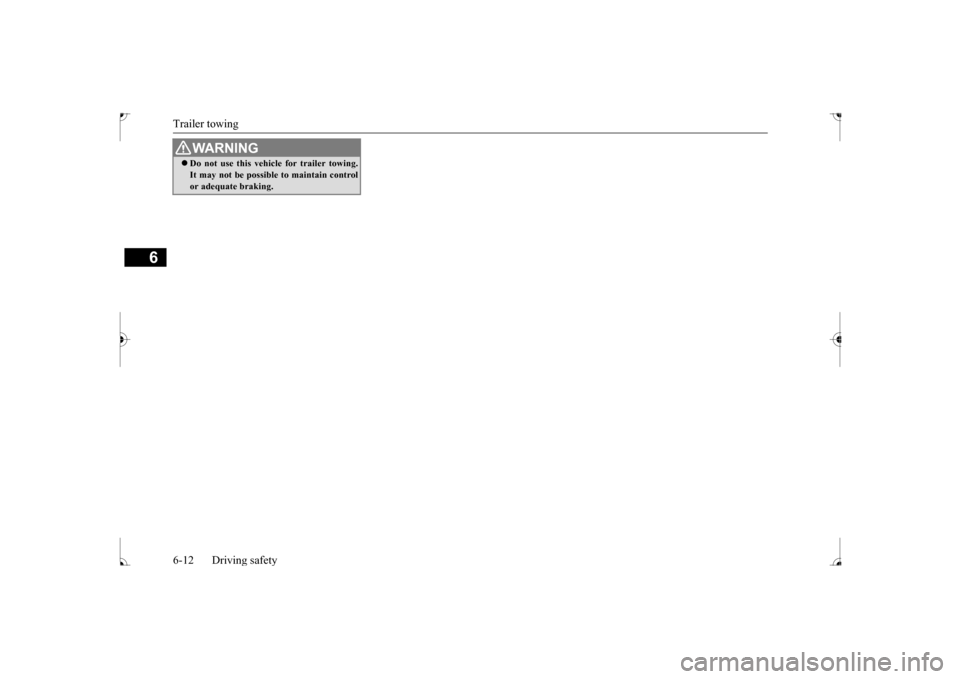
WA R N I N G Do not use this vehicle for trailer towing. It may not be possible to maintain control or adequate braking.
BK0237700US.bo
ok 12 ページ 2016年4月15日 金曜日 午前11時28分
Page 304 of 385
8
For emergenciesIf the vehicle breaks
down ...............................................................8-2
Jump-starting the engine
........................................
..........................8-2
Engine overheating .........
.................................................................8-4
Tools and jack .................
.................................................................8-5
How to change a tire
..............................................
..........................8-6
Towing ................................................
...........................................8-12
Operation under adverse driv
ing conditions ..................................8-14
Fuel Pump Shut-off Sy
stem ...........................................................8-15
BK0237700US.bo
ok 1 ページ 2016年4月15日 金曜日 午前11時28分