engine mount MITSUBISHI LANCER EVOLUTION 2007 Service Repair Manual
[x] Cancel search | Manufacturer: MITSUBISHI, Model Year: 2007, Model line: LANCER EVOLUTION, Model: MITSUBISHI LANCER EVOLUTION 2007Pages: 1449, PDF Size: 56.82 MB
Page 1 of 1449
00
11
12
13
14
15
16
17
21
22
25
26
27
31
32
33
34
35
36
37
42
51
52
54
55
General........................
Engine .........................
Engine Lubrication .............
Fuel ...........................
Engine Cooling .................
Intake and Exhaust ............
Engine Electrical ...............
Engine and Emission Control ....
Clutch .........................
Manual Transmission ...........
Propeller Shaft .................
Front Axle ......................
Rear Axle ......................
Wheel and Tyre .................
Power Plant Mount ..............
Front Suspension ...............
Rear Suspension ...............
Service Brakes .................
Parking Brakes .................
Steering ........................
Body ...........................
Exterior ........................
Chassis Electrical ..............
Electrical Wiring ................
Body Repair ....................
WORKSHOP
MANUAL
FOREWORD
This Workshop Manual contains procedures for
service mechanics, including removal, disassembly,
inspection, adjustment, reassembly and
installation. Use the following manuals in
combination with this manual as required.
TECHNICAL INFORMATION MANUAL N0104CT9A
All information, illustrations and product
descriptions contained in this manual are current
as at the time of publication. We, however, reserve
the right to make changes at any time without prior
notice or obligation.
The EVOLUTION-VII is sold exclusively through
RALLIART Inc. Since the EVOLUTION-VII is a
rally-based model, it will not be warranted and will
not be homologated for general production.
Therefore, any service matters on the
EVOLUTION-VII should be inquired to RALLIART
Inc. as usual.
EMitsubishi Motors Corporation May 2001
Interior and Supplemental
Restraint System (SRS) ........
Heater, Air Conditioner and
Ventilation .....................
Page 5 of 1449

BODY CONSTRUCTION -Body ComponentsA-3
1. Headlamp support panel
2. Hood lock stay
3. Front end crossmember
4. Front end upper bar
5. Headlamp support panel side
6. Front fender shield
7. Front upper frame inner
8. Upper frame bulkhead front
9. Upper frame bulkhead
10. Upper frame bulkhead rear
11. Front sidemember inner
12. Engine mount bracket
13. Front sidemember rear
14. Front sidemember outer
15. Spring house panel
16. Dash panel
17. Dash panel silencer
18. Dash panel reinforcement
19. Upper frame to front pillar brace
20. Upper frame extension outer
21. Upper frame extension inner
22. Cowl top lower panel
23. Cowl top inner panel
24. Cowl top upper panel
25. Front deck crossmember
26. Hood inner panel
27. Hood outer panel
28. Front roof rail
29. Front roof bow
30. Roof panel
31. Rear roof bow
32. Rear roof rail
33. Seat back plate
34. Rear seat back panel
35. Rear shelf panel
36. Rear seat back brace
37. Trunk lid outer panel
38. Trunk lid inner panel
39. Trunk lid hinge
40. Quarter inner extension rear
41. Quarter corner panel42. Rear combination lamp housing
43. Side roof rail inner
44. Front pillar inner upper
45. Front pillar inner lower
46. Center pillar inner
47. Side outer panel
48. Rear wheel house inner panel
49. Quarter inner panel
50. Rear floor side brace
51. Quarter outer extension lower
52. Fuel filler door
53. Rear license plate bracket
54. Rear end panel outer
55. Rear end panel inner
56. Rear door outer panel
57. Rear door side door beam
58. Rear door inner panel
59. Front door outer panel
60. Front door side door beam
61. Front door inner panel
62. Fender panel
63. Front floor crossmember rear
64. Front floor crossmember front
65. Front floor side sill inner
66. Front floor sidemember
67. Backbone reinforcement
68. Installment panel center bracket reinforcement
69. Front floor pan
70. Front floor extension panel rear
71. Rear floor extension
72. Rear floor pan
73. Seat back plate extension
74. Jack bracket
75. Spare tire bracket
76. Towing hook reinforcement
77. Rear floor sidemember extension
78. Crossmember center support
79. Rear floor crossmember
80. Rear floor sidemember
81. Rear seat back reinforcement
Page 11 of 1449
BODY CONSTRUCTION -Body Construction CharacteristicsA-9
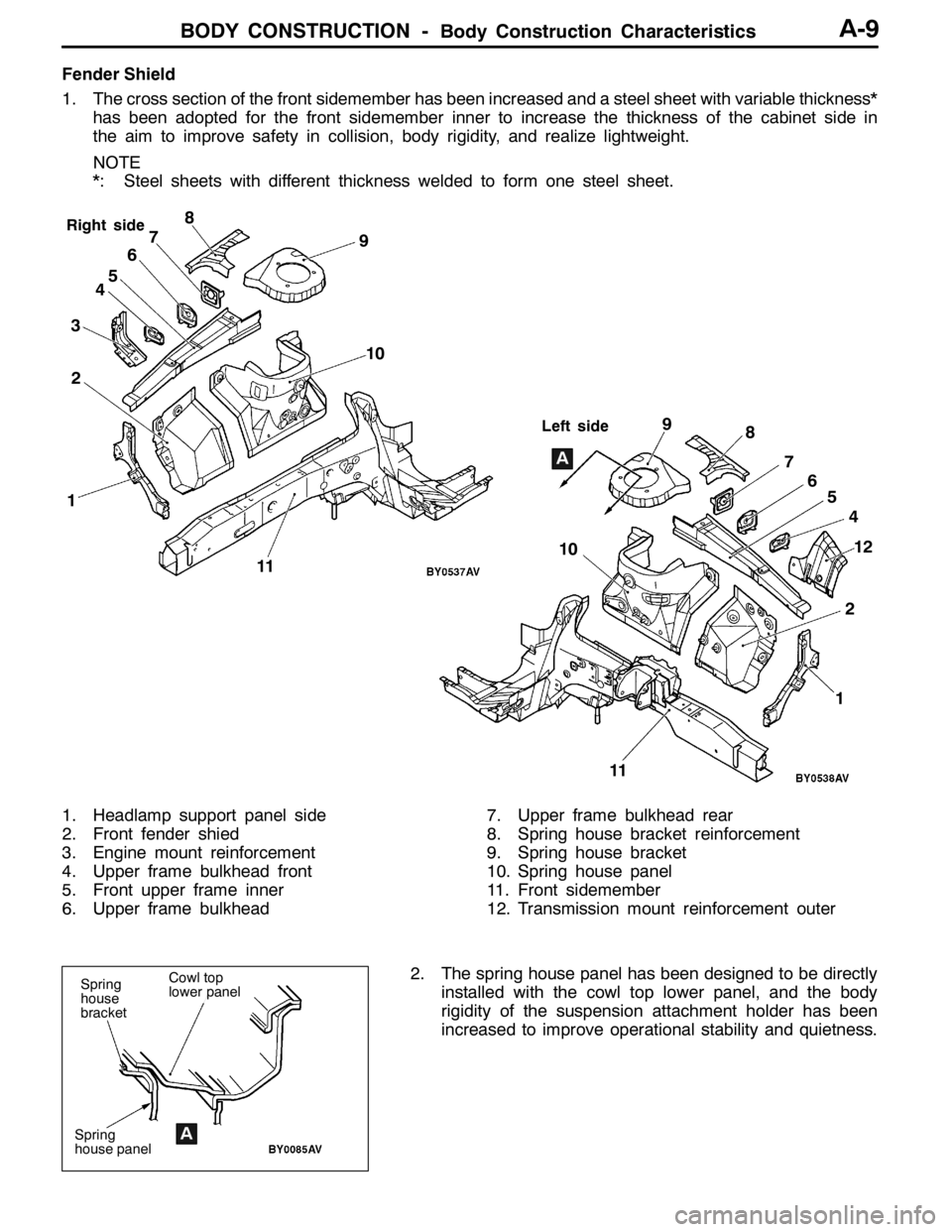
Fender Shield
1. The cross section of the front sidemember has been increased and a steel sheet with variable thickness*
has been adopted for the front sidemember inner to increase the thickness of the cabinet side in
the aim to improve safety in collision, body rigidity, and realize lightweight.
NOTE
*: Steel sheets with different thickness welded to form one steel sheet.
12 345678
9
1112
Right side
Left side
10
10
124 5 6 7 8 9
A
11
1. Headlamp support panel side
2. Front fender shied
3. Engine mount reinforcement
4. Upper frame bulkhead front
5. Front upper frame inner
6. Upper frame bulkhead7. Upper frame bulkhead rear
8. Spring house bracket reinforcement
9. Spring house bracket
10. Spring house panel
11. Front sidemember
12. Transmission mount reinforcement outer
2. The spring house panel has been designed to be directly
installed with the cowl top lower panel, and the body
rigidity of the suspension attachment holder has been
increased to improve operational stability and quietness.
Spring
house
bracket
Spring
house panelA
Cowl top
lower panel
Page 12 of 1449
BODY CONSTRUCTION -Body Construction Characteristics
A
1 2 3B
5
1
3
A-10
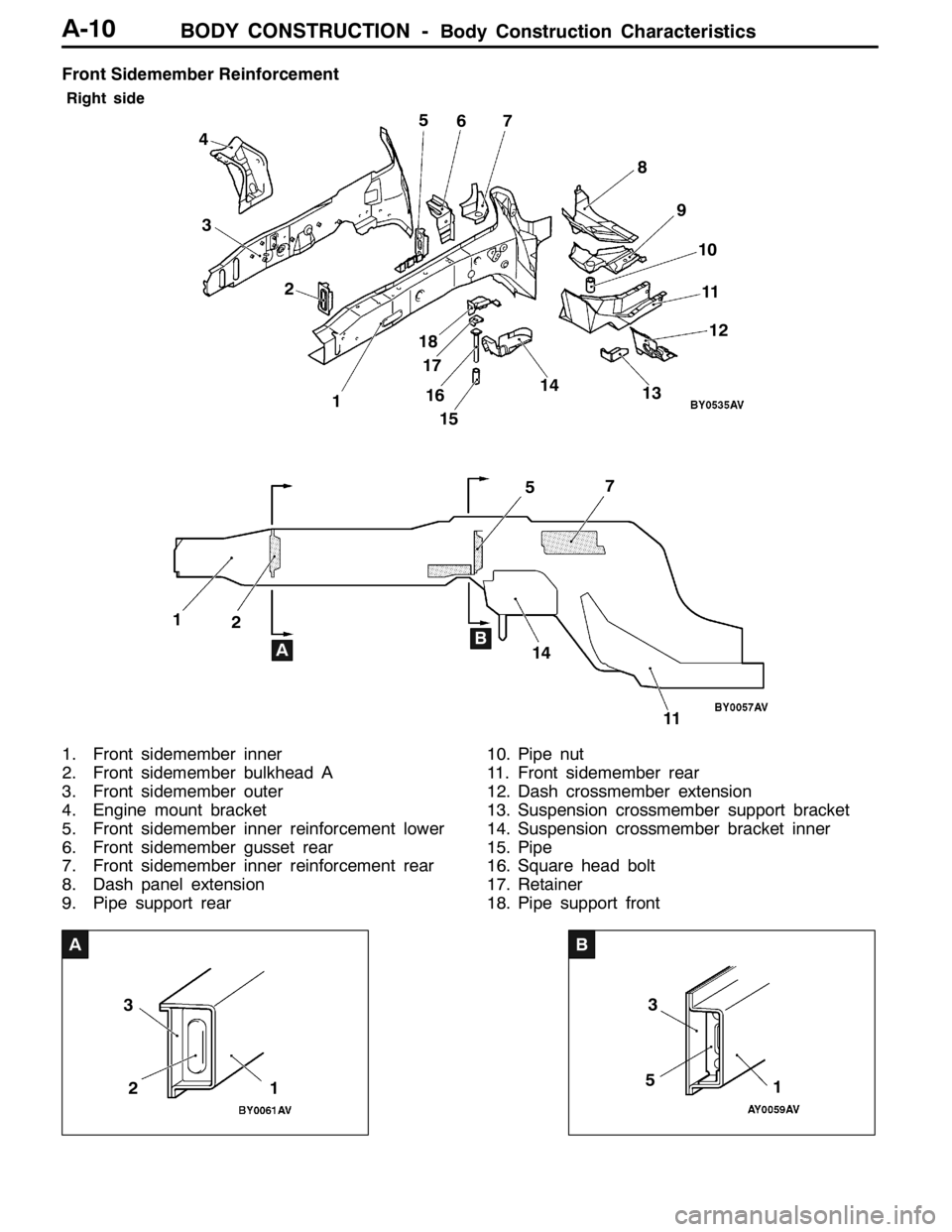
Front Sidemember Reinforcement
Right side
57 2 3 45
67
8
9
10
11
AB 11512
11 14
1413
16 17 18
1
2
1. Front sidemember inner
2. Front sidemember bulkhead A
3. Front sidemember outer
4. Engine mount bracket
5. Front sidemember inner reinforcement lower
6. Front sidemember gusset rear
7. Front sidemember inner reinforcement rear
8. Dash panel extension
9. Pipe support rear10. Pipe nut
11. Front sidemember rear
12. Dash crossmember extension
13. Suspension crossmember support bracket
14. Suspension crossmember bracket inner
15. Pipe
16. Square head bolt
17. Retainer
18. Pipe support front
Page 82 of 1449
BODY COLOUR -Body Colour Code/Body Colour ChartsF-2
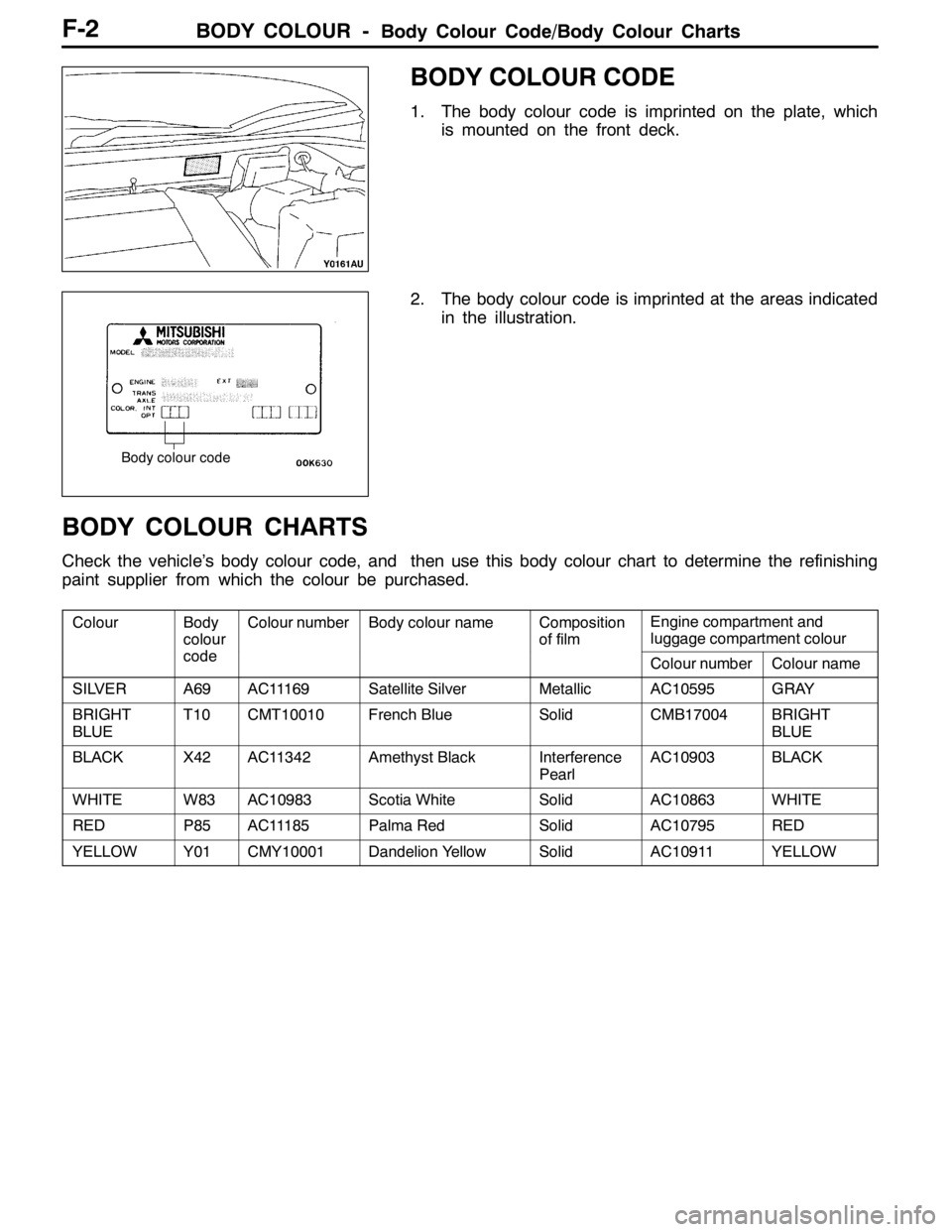
BODY COLOUR CODE
1. The body colour code is imprinted on the plate, which
is mounted on the front deck.
2. The body colour code is imprinted at the areas indicated
in the illustration.
BODY COLOUR CHARTS
Check the vehicle’s body colour code, and then use this body colour chart to determine the refinishing
paint supplier from which the colour be purchased.
ColourBody
colour
d
Colour numberBody colour nameComposition
of filmEngine compartment and
luggage compartment colour
codeColour numberColour name
SILVERA69AC11169Satellite SilverMetallicAC10595GRAY
BRIGHT
BLUET10CMT10010French BlueSolidCMB17004BRIGHT
BLUE
BLACKX42AC11342Amethyst BlackInterference
PearlAC10903BLACK
WHITEW83AC10983Scotia WhiteSolidAC10863WHITE
REDP85AC11185Palma RedSolidAC10795RED
YELLOWY01CMY10001Dandelion YellowSolidAC10911YELLOW
Body colour code
Page 89 of 1449
HOW TO READ THE WIRING DIAGRAMS -How to Read Configuration DiagramsA-3
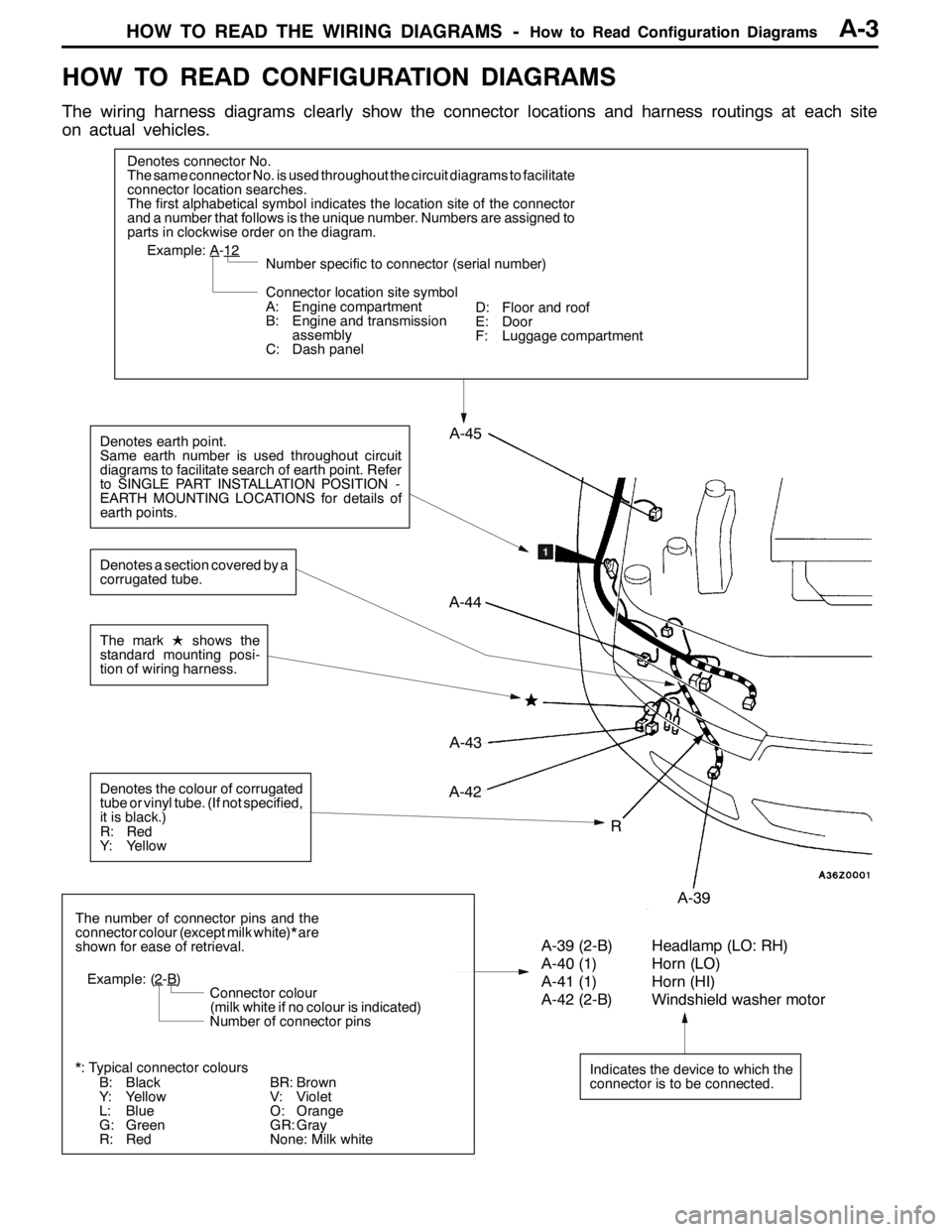
HOW TO READ CONFIGURATION DIAGRAMS
The wiring harness diagrams clearly show the connector locations and harness routings at each site
on actual vehicles.
Denotes connector No.
The same connector No. is used throughout the circuit diagrams to facilitate
connector location searches.
The first alphabetical symbol indicates the location site of the connector
and a number that follows is the unique number. Numbers are assigned to
parts in clockwise order on the diagram.
A-43
Example: A-12
Number specific to connector (serial number)
Connector location site symbol
A: Engine compartment
B: Engine and transmission
assembly
C: Dash panel
Denotes earth point.
Same earth number is used throughout circuit
diagrams to facilitate search of earth point. Refer
to SINGLE PART INSTALLATION POSITION -
EARTH MOUNTING LOCATIONS for details of
earth points.
Indicates the device to which the
connector is to be connected.
A-39 (2-B) Headlamp (LO: RH)
A-40 (1) Horn (LO)
A-41 (1) Horn (HI)
A-42 (2-B) Windshield washer motor
The number of connector pins and the
connector colour (except milk white)* are
shown for ease of retrieval.
Example: (2
-B)
Connector colour
(milk white if no colour is indicated)
Number of connector pins
*: Typical connector colours
B: Black
Y: Yellow
L: Blue
G: Green
R: Red
The markLshows the
standard mounting posi-
tion of wiring harness.
R
A-44
A-45
A-42
A-39
Denotes the colour of corrugated
tube or vinyl tube. (If not specified,
it is black.)
R: Red
Y: Yellow
Denotes a section covered by a
corrugated tube.
BR: Brown
V: Violet
O: Orange
GR: Gray
None: Milk whiteD: Floor and roof
E: Door
F: Luggage compartment
Page 167 of 1449

CIRCUIT DIAGRAMSB-69
DEDICATED FUSE
Power supply
circuitNo.Rated
capacity (A)Identification
colourCircuit
Battery/alternator
(FusiblelinkNo6)
115BlueSpare connectors
(FusiblelinkNo.6)210RedHorn relay
320YellowEngine control relay and ignition control relay
410RedA/C compressor
515BlueABS-ECU, 4WD-ECU, high-mounted stop lamp and rear
combination lamp
630GreenCondenser fan motor
77.5BrownAlternator
810RedETACS-ECU
9---
1015BlueFuel pump
Front-ECU
(Headlamprelay:
1110RedHeadlamp
(Headlamp relay:
HI)1210RedHeadlamp
Front-ECU
(Headlamprelay:
1310RedFront combination lamp
(Headlamp relay:
LO)1410RedFront combination lamp
Front-ECU
(Tail lamp relay)157.5BrownHeater control unit or A/C-ECU, clock, combination
meter, fog lamp switch, hazard warning switch, radio,
rear combination lamp, headlamp leveling switch, front
combination lamp, cigarette lighter illumination lamp,
ashtray illumination lamp, ACD mode changeover switch
and inter cooler water splay switch
167.5BrownFront combination lamp, licence plate lamp and rear
combination lamp
Ignition switch
(ACC)1710RedClock
Battery/alternator
(Fusible link No. 6)1810RedEngine-ECU, ETACS-ECU, front-ECU and combination
meter
-19---
Fusible link No. 52120YellowIntercooler water splay
-22---
Ignition switch
(IG2)23---
-24---
Battery/alternator
(Fusible link No. 6)2530GreenCondenser fan motor
Page 183 of 1449

CIRCUIT DIAGRAMSB-85
CHARGING SYSTEM (See P.B-84.)
OPERATION
When engine is stationary
DWhen the ignition switch is turned to the ON
position, current flows the alternator L terminal
and, at the same time, the charge warning lamp
illuminates.
When engine is started and after engine has
started
DWhen the engine is started, the charge warning
lamp goes out because of the charging voltage
begin applied to the alternator L terminal.
DThe battery voltage being applied to the
alternator S terminal is monitored by the voltage
regulator. Therefore, the amount of electricity
produced by the alternator is controlled by
allowing and cutting off the current flowing to
the field coil.
DThe alternator B terminal supplies power to
each load.TROUBLESHOOTING HINTS
1. Charging indicator lamp does not illuminate
when the ignition switch is turned to ON
position, before the engine starts.
DCheck multi-purpose fuse No.(2).
DCheck the bulb.
2. Charging indicator lamp fails to switch off once
the engine starts.
DCheck voltage regulator of alternator.
3. Discharged or overcharged battery.
DCheck voltage regulator of alternator.
4. Charge warning lamp illuminates dimly.
DCheck combination meter diode (for short).
Page 410 of 1449

ENGINE -Service Specifications/Sealants11A-4
SERVICE SPECIFICATIONS
ItemsStandard valueLimit
Drive belt tensionVibration frequency Hz (Reference)110 - 144-
Tension N (Reference)245 - 412-
Basic ignition timing5_BTDC±3_-
Ignition timingApproximetely
5_BTDC-
Idle speed r/min850±100-
CO contents %0.1 or less-
HC contents ppm100 or less-
Compression pressure (250 - 400 r/min) kPa1,128951
Compression pressure difference of all cylinder kPa-Max. 98
Intake manifold vacuum kPa-Min. 60
Cylinder head bolt shank length mm-99.4
Timing belt B tension
(Whenchecked)
Vibration frequency Hz52 - 92-
(When checked)Deflection mm (Reference)5-10-
Timing belt B tension
(Whenadjusted)
Vibration frequency Hz76 - 92-
(When adjusted)Deflection mm (Reference)5-7-
Timing belt B tension
(Whenreplaced)
Vibration frequency Hz76 - 92-
(When replaced)Deflection mm (Reference)5-7-
Auto-tensioner rod protrusion amount mm3.8 - 4.5-
Auto-tensioner rod sink in amount mmWithin 1-
SEALANTS
ItemsSpecified SealantsRemarks
Rocker coverMITSUBISHI GENUINE PART MD970389 or
equivalent
Semi-drying
sealant
Rocker cover gasket
equivalentsealant
Cylinder head
Camshaft position sensor support
Oil pan
Camshaft end seal3M ATD Part No. 8660 or equivalent
Page 417 of 1449
ENGINE -On-vehicle ServiceENGINE -On-vehicle ServiceENGINE -On-vehicle Service11A-11
10. Turn the ignition switch to the “LOCK” (OFF) position
and then remove the MUT-II.
COMPRESSION PRESSURE CHECK
1. Before inspection, check that the engine oil, starter and
battery are normal. In addition, set the vehicle to the
pre-inspection condition.
2. Remove the ignition coils and spark plug cables.
3. Remove all of the spark plugs.
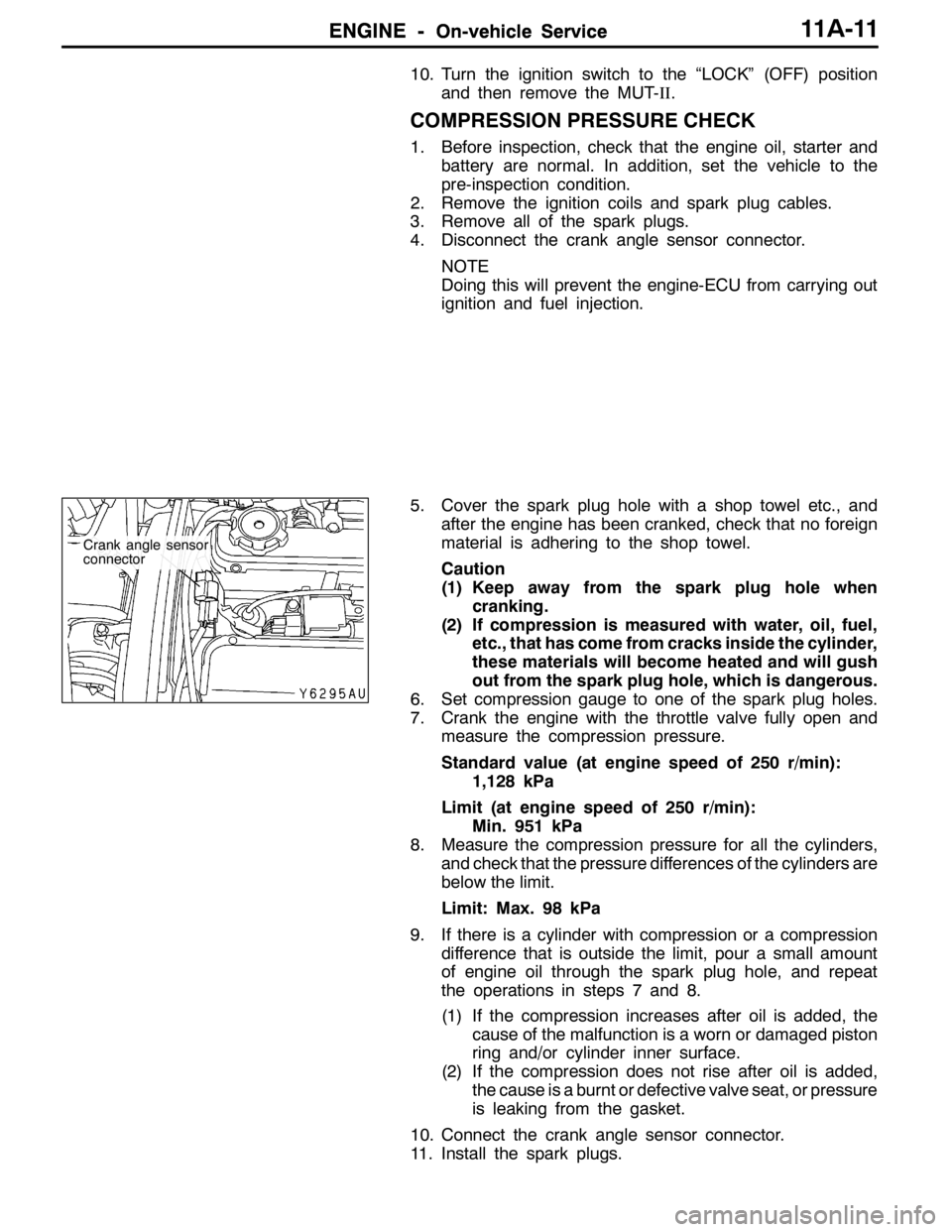
4. Disconnect the crank angle sensor connector.
NOTE
Doing this will prevent the engine-ECU from carrying out
ignition and fuel injection.
5. Cover the spark plug hole with a shop towel etc., and
after the engine has been cranked, check that no foreign
material is adhering to the shop towel.
Caution
(1) Keep away from the spark plug hole when
cranking.
(2) If compression is measured with water, oil, fuel,
etc., that has come from cracks inside the cylinder,
these materials will become heated and will gush
out from the spark plug hole, which is dangerous.
6. Set compression gauge to one of the spark plug holes.
7. Crank the engine with the throttle valve fully open and
measure the compression pressure.
Standard value (at engine speed of 250 r/min):
1,128 kPa
Limit (at engine speed of 250 r/min):
Min. 951 kPa
8. Measure the compression pressure for all the cylinders,
and check that the pressure differences of the cylinders are
below the limit.
Limit: Max. 98 kPa
9. If there is a cylinder with compression or a compression
difference that is outside the limit, pour a small amount
of engine oil through the spark plug hole, and repeat
the operations in steps 7 and 8.
(1) If the compression increases after oil is added, the
cause of the malfunction is a worn or damaged piston
ring and/or cylinder inner surface.
(2) If the compression does not rise after oil is added,
the cause is a burnt or defective valve seat, or pressure
is leaking from the gasket.
10. Connect the crank angle sensor connector.
11. Install the spark plugs.
Crank angle sensor
connector