wheel MITSUBISHI LANCER EVOLUTION 2007 Service Repair Manual
[x] Cancel search | Manufacturer: MITSUBISHI, Model Year: 2007, Model line: LANCER EVOLUTION, Model: MITSUBISHI LANCER EVOLUTION 2007Pages: 1449, PDF Size: 56.82 MB
Page 1313 of 1449

SRS -AirBagModuleandSeatBeltPre-tensioner
Disposal Procedures52B-69
(2) Connect deployment harnesses longer than 6 m to
each SRS air bag adapter harness and insulate the
connections with plastic tape.
Also, connect the deployment harness in the other
ends to connect (short-circuit). This prevents the
driver’s air bag module from accidental deployment
caused by static and etc.
(3) Touch the vehicle’s body with bare hands to discharge
static in you.
Caution
Never fail to do Step (3) in order to prevent
accidental deployment caused by static.
(4) Install a nut to the bolt behind the driver’s air bag
module and tie thick wire there for securing.
(5) Route the deployment harnesses connected to the
driver’s air bag module beneath an old tyre and wheel
assembly. Then, using the wire tied to the bolt, secure
the driver’s air bag module to the tyre and wheel
assembly with the deployment surface facing up.
(6) Place three old tyres without wheels on the tyre
secured with the driver’s air bag module.
SRS air bag
adapter harness
MR203491 or
MB628919Deployment
harnessShort-circuited
6 m or longer
Insulation tape
Driver’s air bag module
Deployment
harnesses
Tyres without wheels
Deployment harnesses
Page 1314 of 1449

SRS -AirBagModuleandSeatBeltPre-tensioner
Disposal Procedures52B-70
(7) Separate the deployment harnesses as far from the
driver’s side air bag module as possible and connect
to the terminals of the battery removed from the
vehicle. Then deploy.
Caution
1) Before the deployment, see that no one is near
around the driver’s air bag module.
2) The deployment makes the inflator of the
driver’s air bag very hot. Before handling the
inflator, wait more than 30 minutes for cooling.
3) If the driver’s air bag module fails to deploy
although the procedure is respected, do not go
near the module. Contact your local
distributor.
(8) Discard the deployed air bag module as specified
in Deployed Air Bag Module Disposal Procedures.
(Refer to P.52B-75.)
Driver’s side air bag module
(1) Remove the steering wheel - air bag module assembly
from the vehicle. (Refer to P.52B-52.)
Caution
Once disconnected, both electrodes of the driver’s
air bag module connector short automatically to
prevent accidental deployment caused by static
etc. Still, in consideration of the accidental
deployment, store the air bag module on flat place
with deployment surface facing up. Also, do not
put anything on it.
(2) Prepare two deployment harnesses longer than 6 m
for deployment and connect the terminals in one end
to short-circuit. This is to prevent accidental
deployment caused by static etc.
(3) Touch the vehicle’s body with bare hands to discharge
static in you.
Caution
Never fail to do Step (3) in order to prevent
accidental deployment caused by static.
Deployment harnesses
Shorted Deployment harnesses
6 m or longer
Page 1315 of 1449

SRS -AirBagModuleandSeatBeltPre-tensioner
Disposal Procedures52B-71
(4) Release the secured connector of the steering
wheel - driver’s air bag module assembly to cut off
the connector from the harness with a nipper and
etc. Connect deployment harnesses to each of two
separated harnesses and cover the area with
insulation tape.
(5) Use a rope to tie the steering wheel - driver’s air bag
module assembly to secure old tyres with wheels.
(6) Route the deployment harness connected to driver’s
air bag module beneath old tyres with wheels. Then,
secure the steering wheel - driver’s air bag module
assembly with the deployment surface facing up.
(7) Place three old tyres without wheels on the tyre
secured with the driver’s air bag module.
(8) Separate the deployment harnesses as far from the
driver’s side air bag module as possible and connect
to the terminals of the battery removed from the
vehicle. Then deploy.
Caution
1) Before the deployment, see that no one is near
around the driver’s air bag module.
2) The deployment makes the inflator of the
driver’s air bag very hot. Before handling the
inflator, wait more than 30 minutes for cooling.
3) If the driver’s air bag module fails to deploy
although the procedure is respected, do not go
near the module. Contact your local
distributor.
(9) Discard the deployed air bag module as specified
in Deployed Air Bag Module Disposal Procedures.
(Refer to P.52B-75.)Deployment
harness
Short-circuited area Steering wheel - driver’s air bag
module assembly
Insulation tape
Steering wheel - driver’s air bag module assembly
Deployment
harness
Tyres without wheels
Deployment harnesses
Deployment harnesses
Page 1316 of 1449

SRS -AirBagModuleandSeatBeltPre-tensioner
Disposal Procedures52B-72
Front passenger’s air bag module
(1) Remove the front passenger’s air bag module from
the vehicle. (Refer to P.52B-52.)
Caution
Once disconnected, both electrodes of the front
passenger’s air bag module connector short
automatically to prevent accidental deployment
caused by static etc. Still, in consideration of the
accidental deployment, store the air bag module
on flat place with deployment surface facing up.
Also, do not put anything on it.
(2) Connect deployment harness 6 m or longer with the
SRS air bag adapter harness respectively. Insulate
the connection with tape.
Also, connect the other ends of the deployment
harness each other to short, thereby preventing the
front passenger’s air bag from accidental deployment
caused by static etc.
(3) Route the SRS air bag adapter harness with the
deployment harnesses beneath an old tyre and wheel
assembly. Then, connect the harnesses to the front
passenger’s air bag module.
(4) Route a thick wire through the holes in the front
passenger’s air bag module bracket. With the
deployment surface facing up, secure the front
passenger’s air bag module to the old tyre and wheel
assembly.
Caution
1) The adapter harness below the wheel should
be loose. If it is too tight, the reaction when the
air bag deploys could damage the adapter
harness.
2) Place the connector of the SRS air bag adapter
harness so that it is not clamped by the tyre at
deployment.
(5) Put three old tyres without wheels on the tyre secured
to the front passenger’s air bag module. Secure all
the tyres with ropes (4 locations).
NOTE
The tyres must be bound because the passenger’s
air bag inflates more than the driver’s air bag.
SRS air bag
adapter
harness
MR686560Shorted
6 m long
or more Insulation tape
Deployment
harnesses
Front passenger’s air bag module
Deployment
harnesses
Tyres without wheels
Deployment harnesses
Page 1318 of 1449

SRS -AirBagModuleandSeatBeltPre-tensioner
Disposal Procedures52B-74
(3) Route a thick wire through the holes in the seat belt
retractor bracket to secure at the top of the wheel
(convex part). (two locations)
(4) Connect the seat belt pre-tensioner connector to the
the SRS air bag adapter harness with the operation
harness attached.
(5) Pull out the seat belt outside the tyre.
Caution
Place the connector of the SRS air bag adapter
harness so that it is not clamped by the tyres at
deployment.
(6) Place an old tyre (without a wheel) on the tyre, which
the seat belt with pre-tensioner is secured on.
(7) Disconnect the deployment harness as far fromthe
seat belt pre-tensioner as possible and connect the
both terminals of the battery removed from the vehicle.
Then deploy.
Caution
1) Before the deployment, see that no one is near
the seat belt pre-tensioner.
2) Before handling the insulator, wait for a while
for cooling.
3) If the seat belt pre-tensioner fails to operate
although the procedure is respected, do not go
near the seat belt pre-tensioner. Contact your
local distributor.
(8) Discard the operated seat belt pre-tensioner
according to Disposal Procedure.(Refer to P.52B-75.)Seat belt pre-tensioner
Deployment harness
Old tyres without
wheels
Deployment harness
Page 1331 of 1449

CHASSIS ELECTRICAL -Ignition Switch and Immobilizer System54A-11
IGNITION SWITCH
REMOVAL AND INSTALLATION
7
6
15 32
4
8
Removal steps
1. Lower column cover (Refer to GROUP
52A - Instrument Panel.)
2. Upper column cover (Refer to GROUP
52A - Instrument Panel.)
3. Steering Wheel (Refer to GROUP
37A.)
4. Clock spring column switch assembly
(Refer to GROUP 37A - Steering
Shaft.)AA"5. Steering lock cylinder
6. Ignition switch
7. Key reminder switch
8. Immobilizer-ECU
REMOVAL SERVICE POINT
AA"STEERING LOCK CYLINDER REMOVAL
1. Insert key into steering lock cylinder to turn ignition key
to “ACC” position.
2. Insert locking pin with small plus screwdriver, etc., and
remove steering lock cylinder.
Locking pin
Page 1339 of 1449
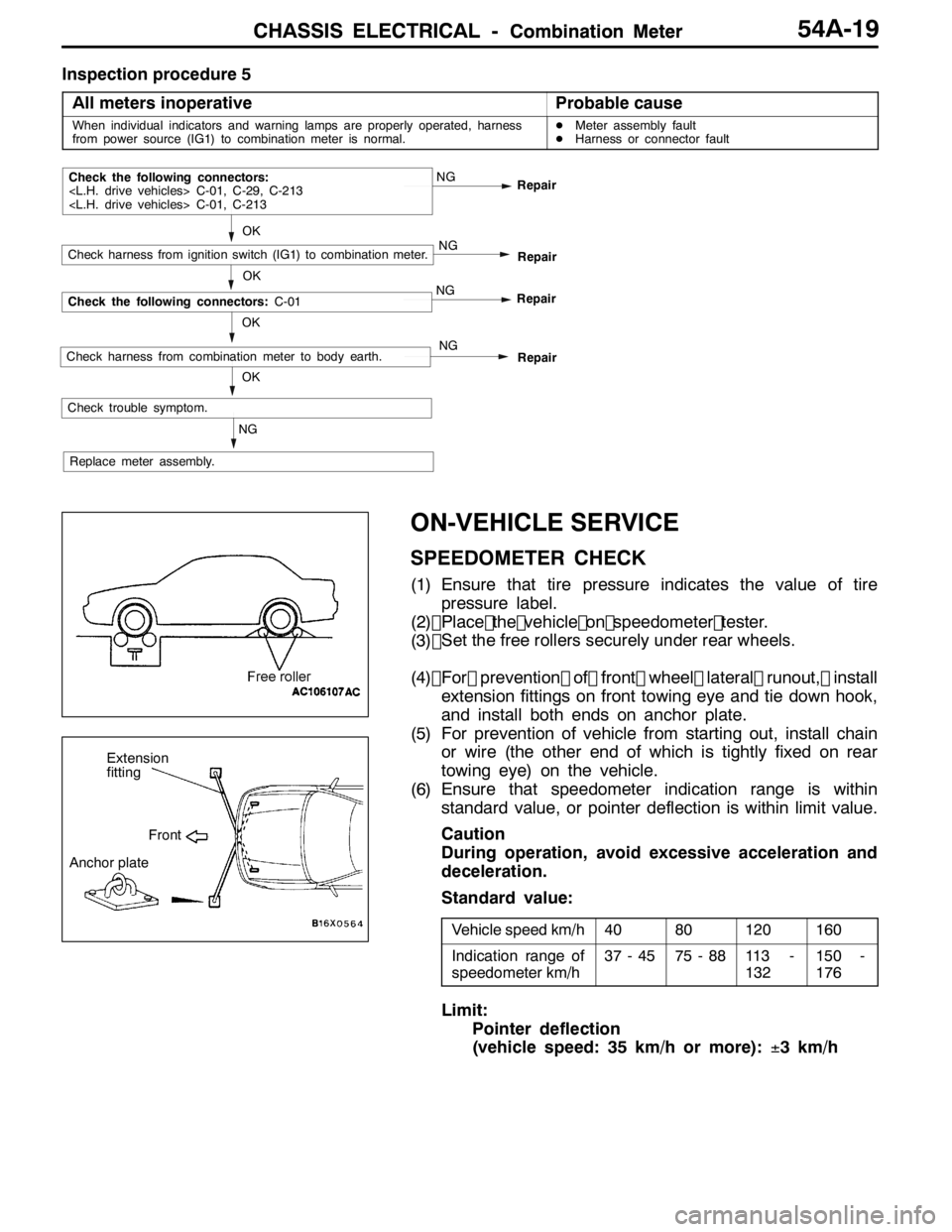
CHASSIS ELECTRICAL -Combination MeterCHASSIS ELECTRICAL -Combination Meter54A-19
Inspection procedure 5All meters inoperative
Probable cause
When individual indicators and warning lamps are properly operated, harness
from power source (IG1) to combination meter is normal.D Meter assembly fault
D Harness or connector fault
NG Repair
NG
OK
Check trouble symptom. Repair
OK
Check the following connectors:
NG
Check harness from ignition switch (IG1) to combination meter.
Replace meter assembly. Repair
NG
OK
Check the following connectors:
C-01
NG
RepairCheck harness from combination meter to body earth.
ON-VEHICLE SERVICE
SPEEDOMETER CHECK
(1) Ensure that tire pressure indicates the value of tirepressure label.
(2) Place the vehicle on speedometer teste r.
(3)
(4) For prevention of front wheel lateral runout, install
extension fittings on front towing eye and tie down hook,
and install both ends on anchor plate.
(5) For prevention of vehicle from starting out, install chain or wire (the other end of which is tightly fixed on rear
towing eye) on the vehicle.
(6) Ensure that speedometer indication range is within standard value, or pointer deflection is within limit value.
Caution
During operation, avoid excessive acceleration and
deceleration.
Standard value:
Vehicle speed km/h4080120160
Indication range of
speedometer km/h37 - 4575 - 8811 3 -
132150 -
176
Limit:
Pointer deflection
(vehicle speed: 35 km/h or more): ±3 km/h
Extension
fitting
Front
Anchor plate
OK
Set the free rollers securely under rear wheels.