rear MITSUBISHI LANCER EVOLUTION 2007 Service Repair Manual
[x] Cancel search | Manufacturer: MITSUBISHI, Model Year: 2007, Model line: LANCER EVOLUTION, Model: MITSUBISHI LANCER EVOLUTION 2007Pages: 1449, PDF Size: 56.82 MB
Page 1046 of 1449

BASIC BRAKE SYSTEM -General Information35A-4
CONSTRUCTION DIAGRAM
Brake booster*
Rear disc brake
Parking brake
Front disc brake Master cylinder*Hydraulic unit*
Brake booster*
Rear disc brake
Parking brake
Front disc brake Master cylinder and
proportioning valves*
NOTE
For R.H. drive vehicles, only the position indicated by the * is symmetrical.
Page 1047 of 1449

BASIC BRAKE SYSTEM -Service Specifications35A-5
SERVICE SPECIFICATIONS
ItemsStandard valueLimit
Brake pedal height mm169.1 - 172.1-
Brake pedal play mm3-8-
Brake pedal to floorboard clearance when the brake pedal is depressed mm90 or more-
Brake booster push rod protrusion amount mm8.98 - 9.23-
Proportioning valve
Split point MPa2.70 - 3.19-
Output fluid pressure MPa 3.68 - 4.17-
Output fluid pressure difference between left and right MPa-0.49
Front disc brake
Pad thickness mm10.02.0
Discthicknessmm24 022 4Discthickness mm24.022.4
Disc run-out mm-0.03
Drag force N51 or less-
Brembo front disc brake
Pad thickness mm10.02.0
Discthicknessmm32 029 8Discthickness mm32.029.8
Disc run-out mm-0.03
Drag force N69 or less-
Rear disc brake
Pad thickness mm10.02.0
Discthicknessmm20 018 4Discthickness mm20.018.4
Disc run-out mm-0.03
Drag force N69 or less-
Brembo rear disc brake
Pad thickness mm9.02.0
Discthicknessmm22 020 4Discthickness mm22.020.4
Disc run-out mm-0.03
Drag force N69 or less-
Front wheel bearing axial play mm-0.06
Rear wheel bearing axial play mm-0.05
Page 1053 of 1449

BASIC BRAKE SYSTEM -On-vehicle Service35A-11
BRAKE FLUID LEVEL SENSOR CHECK
The brake fluid level sensor is in good condition if there is
no continuity when the float surface is above “MIN” and if
there is continuity when the float surface is below “MIN”.
DISC BRAKE PAD CHECK AND REPLACEMENT
NOTE
The wear indicator contacts the brake disc when the brake
pad thickness reaches approximately 2 mm and emit a
squealing sound to warn the driver.
1. Check the brake pad thickness through the caliper body
check port.
Standard value: 10.0 mm
Limit: 2.0 mm
2. When the thickness is less than the limit, always replace
the pads at an axle set.
3. Remove the pin bolt. Pivot the caliper assembly and hold
it with wires.
Caution
Do not wipe off the special grease that is on the pin
or allow it to contaminate the pin.
4. Remove the following parts from the caliper support.
1. Pad and wear indicator assembly
2. Pad assembly
3. Clip
4. Outer shim
5. In order to measure the brake drag force after pad
installation, measure the rotary-sliding resistance of the
hub with the pads removed. (Refer to P.35A-21.)
6. Install the pads and caliper assembly, and then check
the brake drag force. (Refer to P.35A-21.)
14Z0017
Front Rear
Front Rear
Front Rear
12 34
3
1
2 3
4
3
Page 1054 of 1449
BASIC BRAKE SYSTEM -On-vehicle Service35A-12
Caution
Take care not to contact the parts or tools to the caliper
because the paint of caliper will be scratched. And if
there is brake fluid on the caliper, wipe out quickly.
NOTE
The wear indicator contacts the brake disc when the brake
pad thickness reaches approximately 2 mm and emit a
squealing sound to warn the driver.
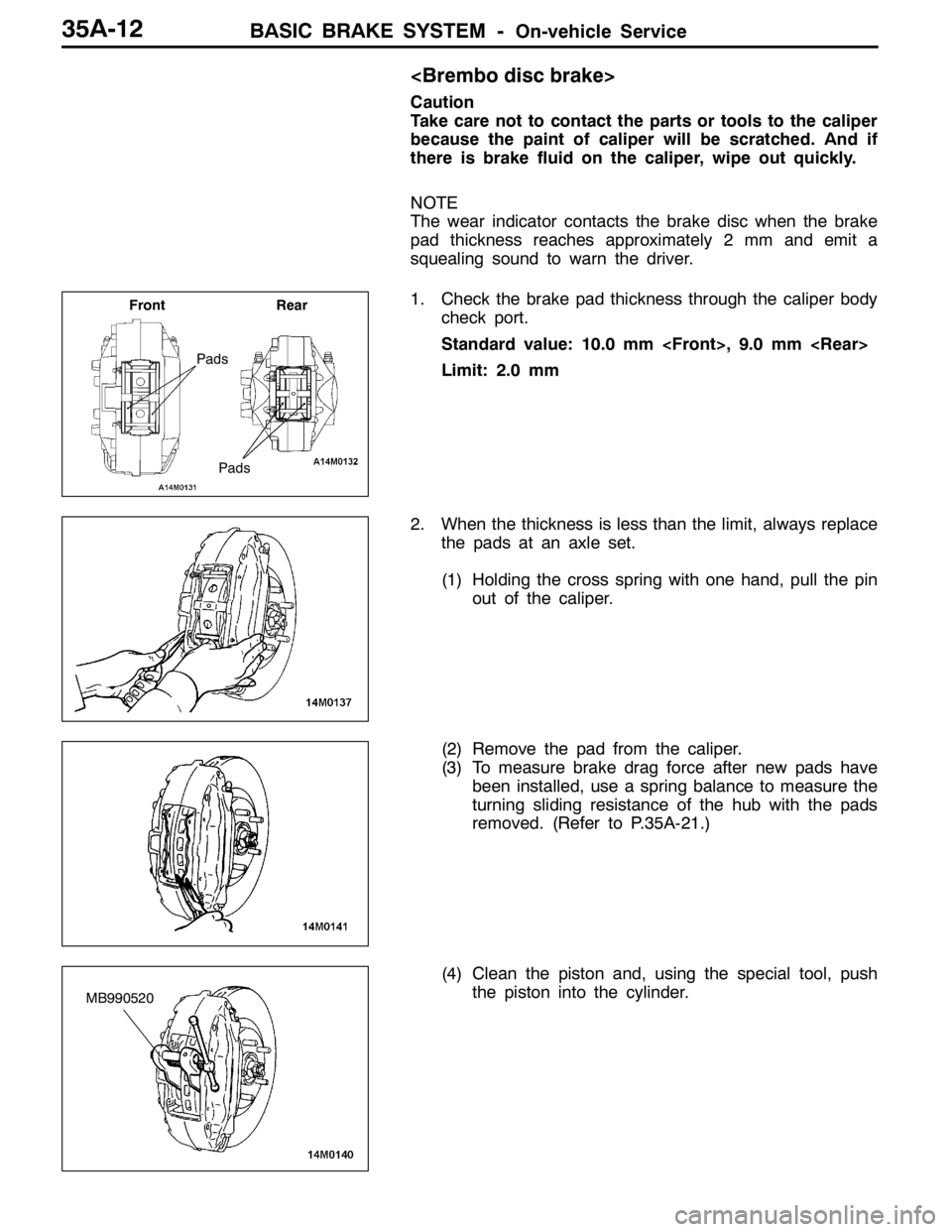
1. Check the brake pad thickness through the caliper body
check port.
Standard value: 10.0 mm
Limit: 2.0 mm
2. When the thickness is less than the limit, always replace
the pads at an axle set.
(1) Holding the cross spring with one hand, pull the pin
out of the caliper.
(2) Remove the pad from the caliper.
(3) To measure brake drag force after new pads have
been installed, use a spring balance to measure the
turning sliding resistance of the hub with the pads
removed. (Refer to P.35A-21.)
(4) Clean the piston and, using the special tool, push
the piston into the cylinder.
Pads
Front Rear
Pads
MB990520
Page 1055 of 1449
BASIC BRAKE SYSTEM -On-vehicle Service35A-13
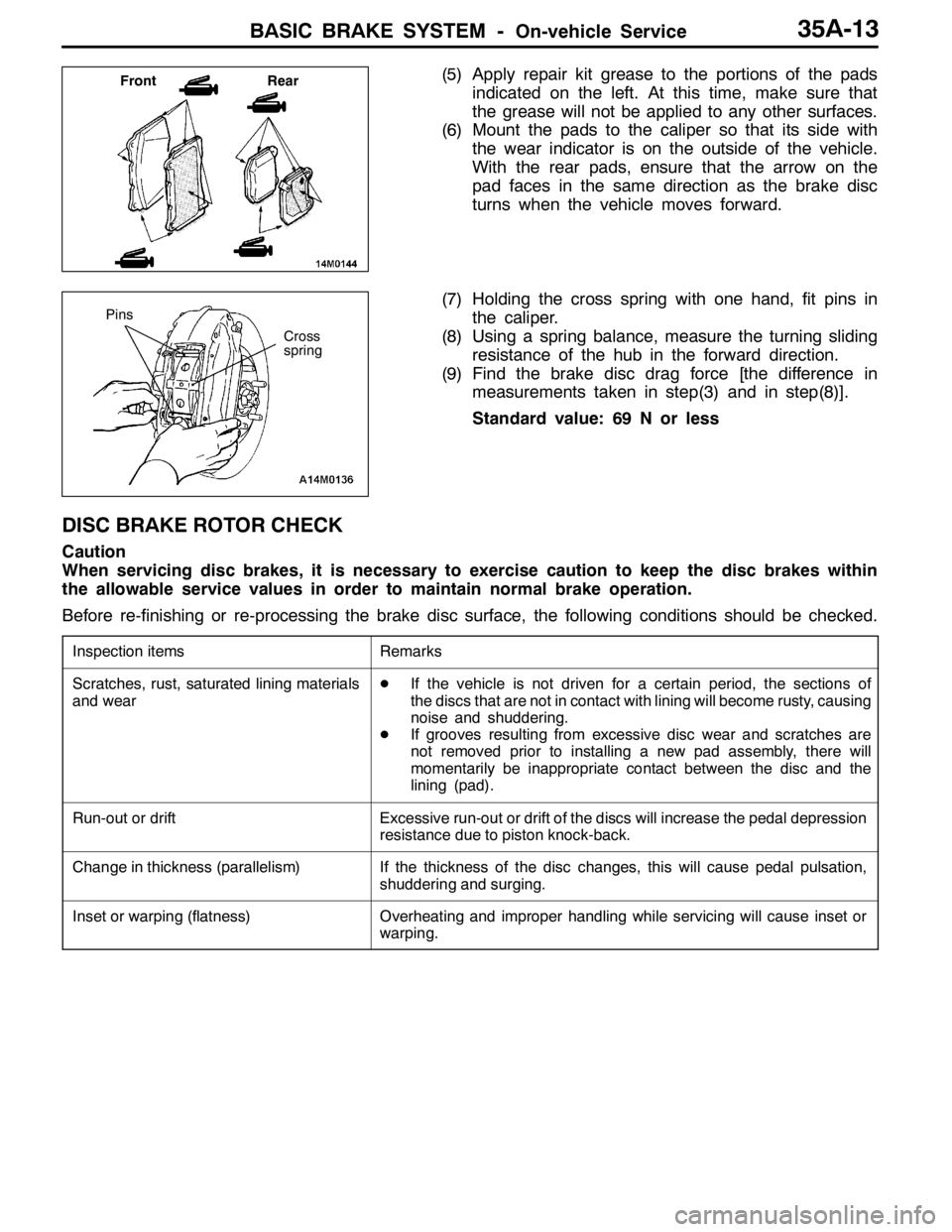
(5) Apply repair kit grease to the portions of the pads
indicated on the left. At this time, make sure that
the grease will not be applied to any other surfaces.
(6) Mount the pads to the caliper so that its side with
the wear indicator is on the outside of the vehicle.
With the rear pads, ensure that the arrow on the
pad faces in the same direction as the brake disc
turns when the vehicle moves forward.
(7) Holding the cross spring with one hand, fit pins in
the caliper.
(8) Using a spring balance, measure the turning sliding
resistance of the hub in the forward direction.
(9) Find the brake disc drag force [the difference in
measurements taken in step(3) and in step(8)].
Standard value: 69 N or less
DISC BRAKE ROTOR CHECK
Caution
When servicing disc brakes, it is necessary to exercise caution to keep the disc brakes within
the allowable service values in order to maintain normal brake operation.
Before re-finishing or re-processing the brake disc surface, the following conditions should be checked.
Inspection itemsRemarks
Scratches, rust, saturated lining materials
and wearDIf the vehicle is not driven for a certain period, the sections of
the discs that are not in contact with lining will become rusty, causing
noise and shuddering.
DIf grooves resulting from excessive disc wear and scratches are
not removed prior to installing a new pad assembly, there will
momentarily be inappropriate contact between the disc and the
lining (pad).
Run-out or driftExcessive run-out or drift of the discs will increase the pedal depression
resistance due to piston knock-back.
Change in thickness (parallelism)If the thickness of the disc changes, this will cause pedal pulsation,
shuddering and surging.
Inset or warping (flatness)Overheating and improper handling while servicing will cause inset or
warping.
Front Rear
Cross
spring
Pins
Page 1056 of 1449
BASIC BRAKE SYSTEM -On-vehicle Service35A-14
BRAKE DISC THICKNESS CHECK
Caution: Brembo disc brake
Take care not to contact the parts or tools to the caliper
because the paint of caliper will be scratched. And if
there is brake fluid on the caliper, wipe out quickly.
1. Using a micrometer, measure disc thickness at eight
positions, approximately 45°apart and 10 mm in from
the outer edge of the disc.
Brake disc thickness
Standard value: 24.0 mm
Limit: 22.4 mm
Brake disc thickness
Standard value:32.0 mm
Limit: 29.8 mm
Thickness variation (at least 8 positions)
The difference between any thickness measurements
should not be more than 0.015 mm.
2. If the disc is beyond the limits for thickness, remove it
and install a new one. If thickness variation exceeds the
specification, replace the brake disc or grind it with
on-the-car type brake lathe (“MAD, DL-8700PF” or
equivalent).
Caution
(1) After a new brake disc is installed, always grind
the brake disc with on-the-car type brake lathe.If
this step is not carried out, the brake disc run-out
exceeds the specified value, resulting in judder.
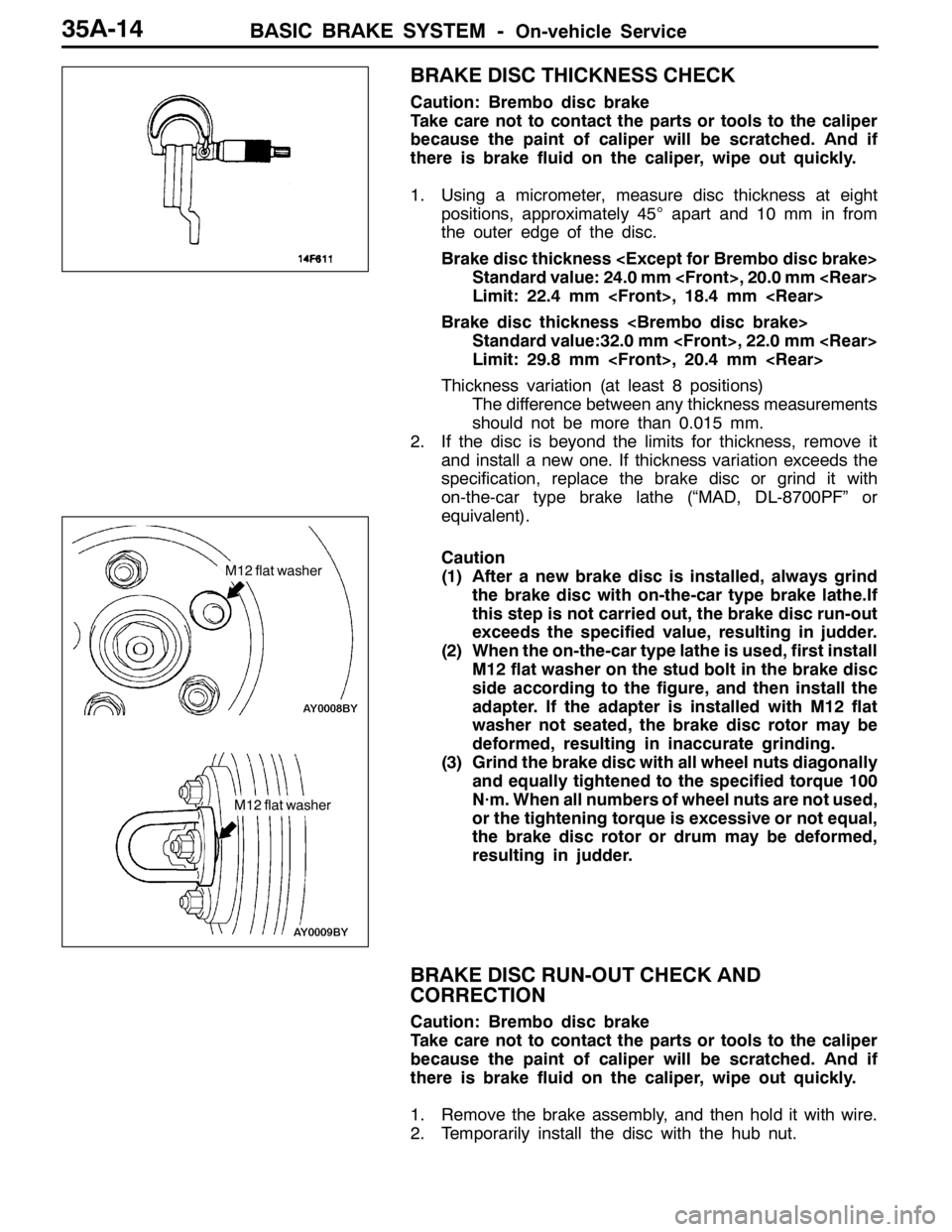
(2) When the on-the-car type lathe is used, first install
M12 flat washer on the stud bolt in the brake disc
side according to the figure, and then install the
adapter. If the adapter is installed with M12 flat
washer not seated, the brake disc rotor may be
deformed, resulting in inaccurate grinding.
(3) Grind the brake disc with all wheel nuts diagonally
and equally tightened to the specified torque 100
N·m. When all numbers of wheel nuts are not used,
or the tightening torque is excessive or not equal,
the brake disc rotor or drum may be deformed,
resulting in judder.
BRAKE DISC RUN-OUT CHECK AND
CORRECTION
Caution: Brembo disc brake
Take care not to contact the parts or tools to the caliper
because the paint of caliper will be scratched. And if
there is brake fluid on the caliper, wipe out quickly.
1. Remove the brake assembly, and then hold it with wire.
2. Temporarily install the disc with the hub nut.
M12 flat washer
M12 flat washer
Page 1057 of 1449
BASIC BRAKE SYSTEM -On-vehicle Service35A-15
3. Place a dial gauge approximately 5 mm from the outer
circumference of the brake disc, and measure the run-out
of the disc.
Limit: 0.03 mm or less
4. If the brake disc run-out exceeds the limit, correct it as
follows:
(1) Chalk phase marks on the wheel stud and the brake
disc, which run-out is excessive.
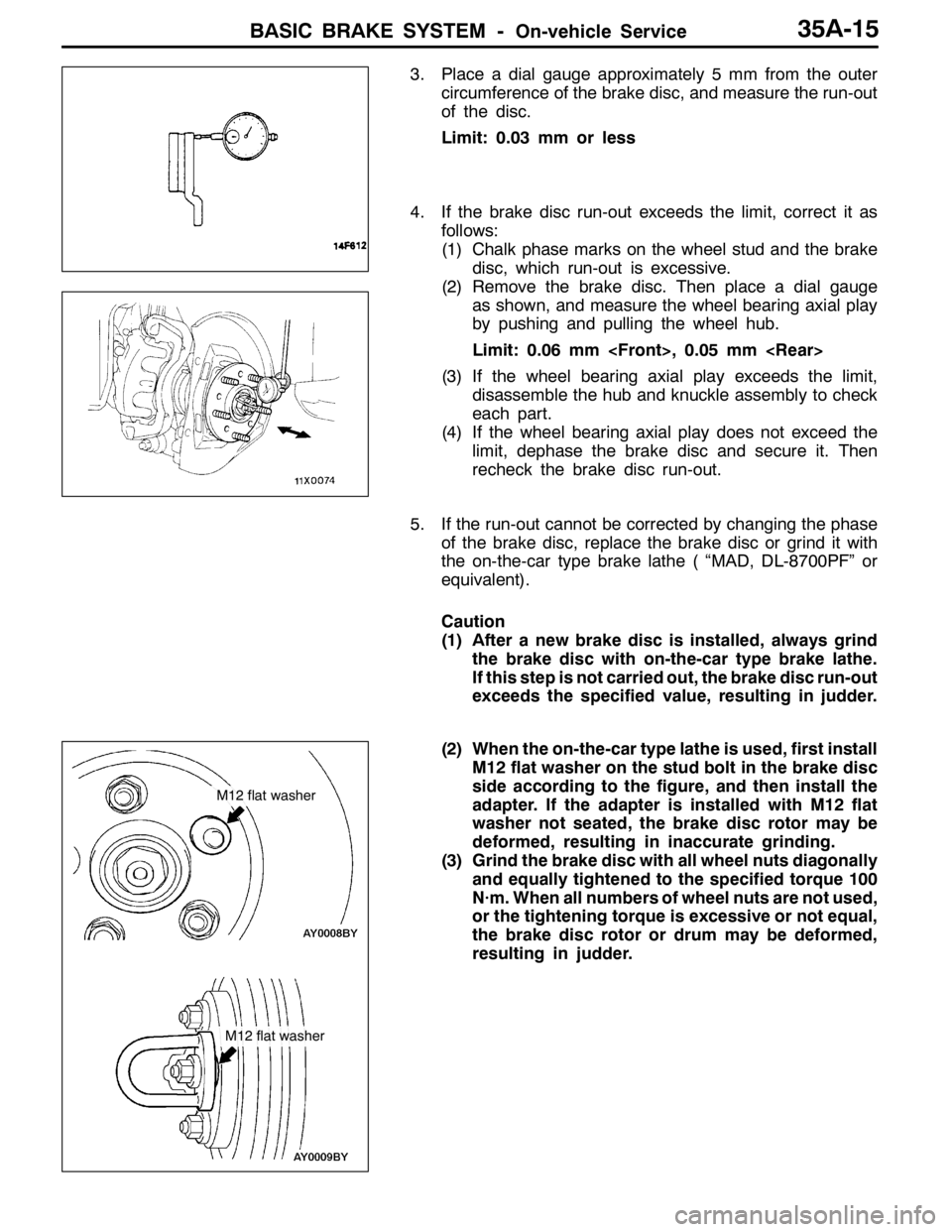
(2) Remove the brake disc. Then place a dial gauge
as shown, and measure the wheel bearing axial play
by pushing and pulling the wheel hub.
Limit: 0.06 mm
(3) If the wheel bearing axial play exceeds the limit,
disassemble the hub and knuckle assembly to check
each part.
(4) If the wheel bearing axial play does not exceed the
limit, dephase the brake disc and secure it. Then
recheck the brake disc run-out.
5. If the run-out cannot be corrected by changing the phase
of the brake disc, replace the brake disc or grind it with
the on-the-car type brake lathe ( “MAD, DL-8700PF” or
equivalent).
Caution
(1) After a new brake disc is installed, always grind
the brake disc with on-the-car type brake lathe.
If this step is not carried out, the brake disc run-out
exceeds the specified value, resulting in judder.
(2) When the on-the-car type lathe is used, first install
M12 flat washer on the stud bolt in the brake disc
side according to the figure, and then install the
adapter. If the adapter is installed with M12 flat
washer not seated, the brake disc rotor may be
deformed, resulting in inaccurate grinding.
(3) Grind the brake disc with all wheel nuts diagonally
and equally tightened to the specified torque 100
N·m. When all numbers of wheel nuts are not used,
or the tightening torque is excessive or not equal,
the brake disc rotor or drum may be deformed,
resulting in judder.
M12 flat washer
M12 flat washer
Page 1062 of 1449
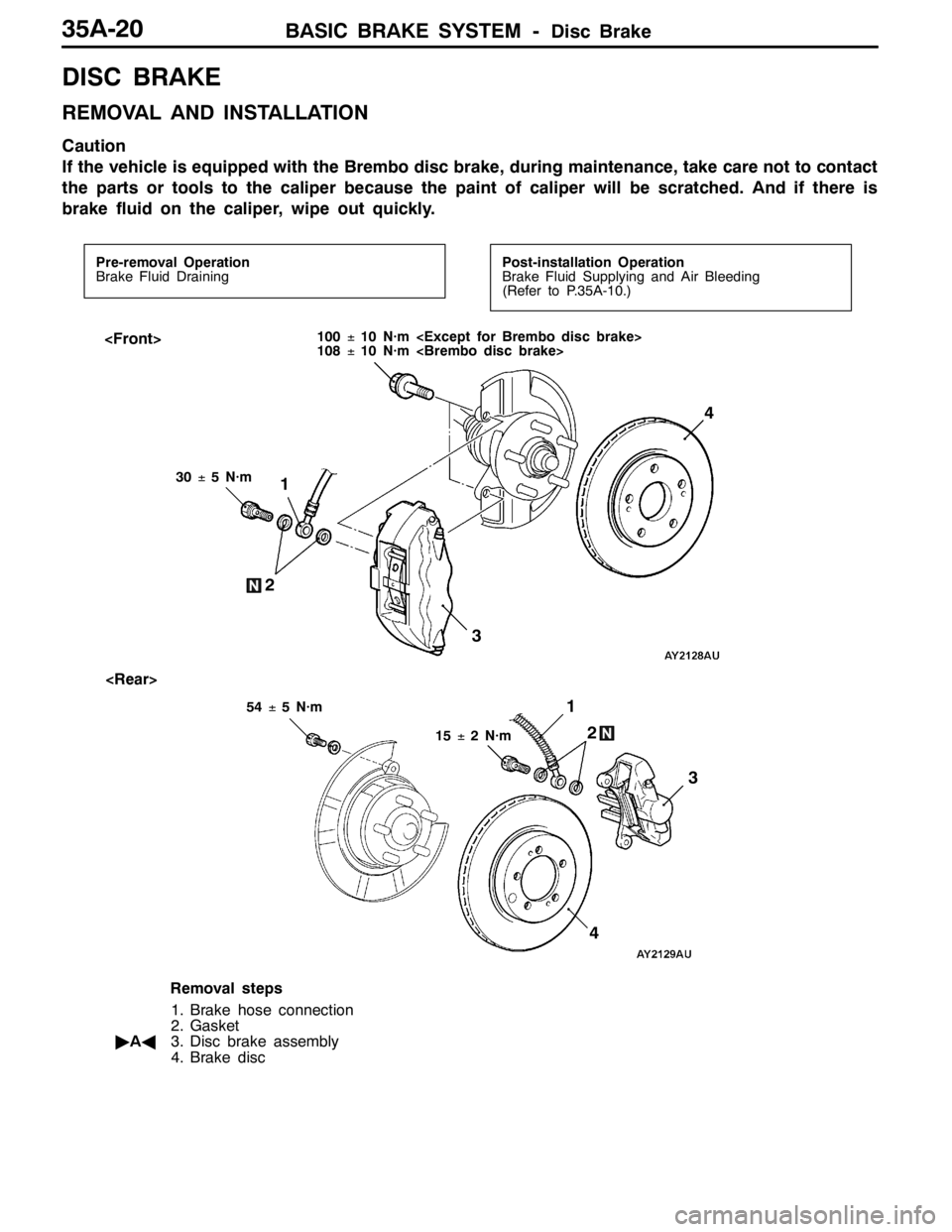
BASIC BRAKE SYSTEM -Disc Brake35A-20
DISC BRAKE
REMOVAL AND INSTALLATION
Caution
If the vehicle is equipped with the Brembo disc brake, during maintenance, take care not to contact
the parts or tools to the caliper because the paint of caliper will be scratched. And if there is
brake fluid on the caliper, wipe out quickly.
Pre-removal Operation
Brake Fluid DrainingPost-installation Operation
Brake Fluid Supplying and Air Bleeding
(Refer to P.35A-10.)
34
21
100±10 N·m
108±10 N·m
30±5 N·m
3 2 1
54±5 N·m
15±2 N·m
4
Removal steps
1. Brake hose connection
2. Gasket
"AA3. Disc brake assembly
4. Brake disc
Page 1063 of 1449

BASIC BRAKE SYSTEM -Disc Brake35A-21
INSTALLATION SERVICE POINT
"AADISC BRAKE ASSEMBLY INSTALLATION
1. In order to measure the brake drag force after pad
installation, measure the rotary-sliding resistance of the
hub by the following procedure with the pads removed.
(1) Withdraw the drive shaft. (Refer to GROUP 26, 27.)
(2) Attach the special tool to the front hub assembly as
shown in the illustration, and tighten it to the specified
torque.
Tightening torque:
245±29 N·m
(3) Use a spring balance to measure the rotary-sliding
resistance of the hub in the forward direction.
2. Install the caliper support to the knuckle, and then
assemble the pad and the clip to the caliper support.
Caution
Do not contaminate the friction surfaces of the pads
and brake discs by any oil or grease.
3. Clean the piston and insert it into the cylinder with the
special tool.
4. Be careful that the piston boot does not become caught,
when lowering the caliper assembly and install the guide
pin to the caliper.
5. Start the engine, and then depress the brake pedal two
or three times strongly. Then stop the engine.
6. Turn the brake disc forward 10 times.
7. Use a spring balance to measure the rotary-sliding
resistance of the hub in the forward direction.
8. Calculate the drag force of the disc brake [difference
between the values measured at steps 1 and 7].
Standard value:
51 N or less
9. If that drag force exceeds the standard value, disassemble
the piston assembly. Then check the piston for
contamination or rust, and confirm if the piston or the
piston seal is deteriorated, and if the slide pins slide
smoothly.
1. Find the drag force of the disc brake. (Refer to P.35A-13.)
Standard value: 69 N or less
2. If that drag force exceeds the standard value, disassemble
the piston assembly. Then check the piston for
contamination or rust, and confirm if the piston or the
piston seal is deteriorated.MB990998
Bolt
MB990998Bolt
MB990520
Page 1066 of 1449

BASIC BRAKE SYSTEM -Disc Brake35A-24
Rear
11
1213
4 1
25
6 89
Brake caliper kit Pad set Seal and boot kit
55
2
3
5 1108
76
39 12
97
Clip set
14
Shim set
11
10
6 31414
14
13
44±5 N·m
7.9±0.9 N·m
5
57Grease
4
Disassembly steps
"AA1. Guide pin
"AA2. Lock pin
3. Bushing
4. Caliper support (including pad, clip,
and shim)
5. Pin boot
6. Boot ring
AA"7. Piston bootAA"8. Piston
AB"9. Piston seal
10. Caliper body
11. Pad and wear indicator assembly
12. Pad assembly
13. Outer shim
14. Clip