charging MITSUBISHI LANCER EVOLUTION 2007 Service Owner's Manual
[x] Cancel search | Manufacturer: MITSUBISHI, Model Year: 2007, Model line: LANCER EVOLUTION, Model: MITSUBISHI LANCER EVOLUTION 2007Pages: 1449, PDF Size: 56.82 MB
Page 743 of 1449
ENGINE ELECTRICAL -Charging System16-11
1
234
5
8.8±1.0 N·m 22±4 N·m
23±3 N·m11±1 N·m
13±1 N·m
8
(Engine oil)
679
10
20±2 N·m 36±6 N·m
1211
44±10 N·m
14±3 N·m
13
1415 18
1617
9.0±1.0 N·m
9.0±1.0 N·m5.0±1.0 N·m
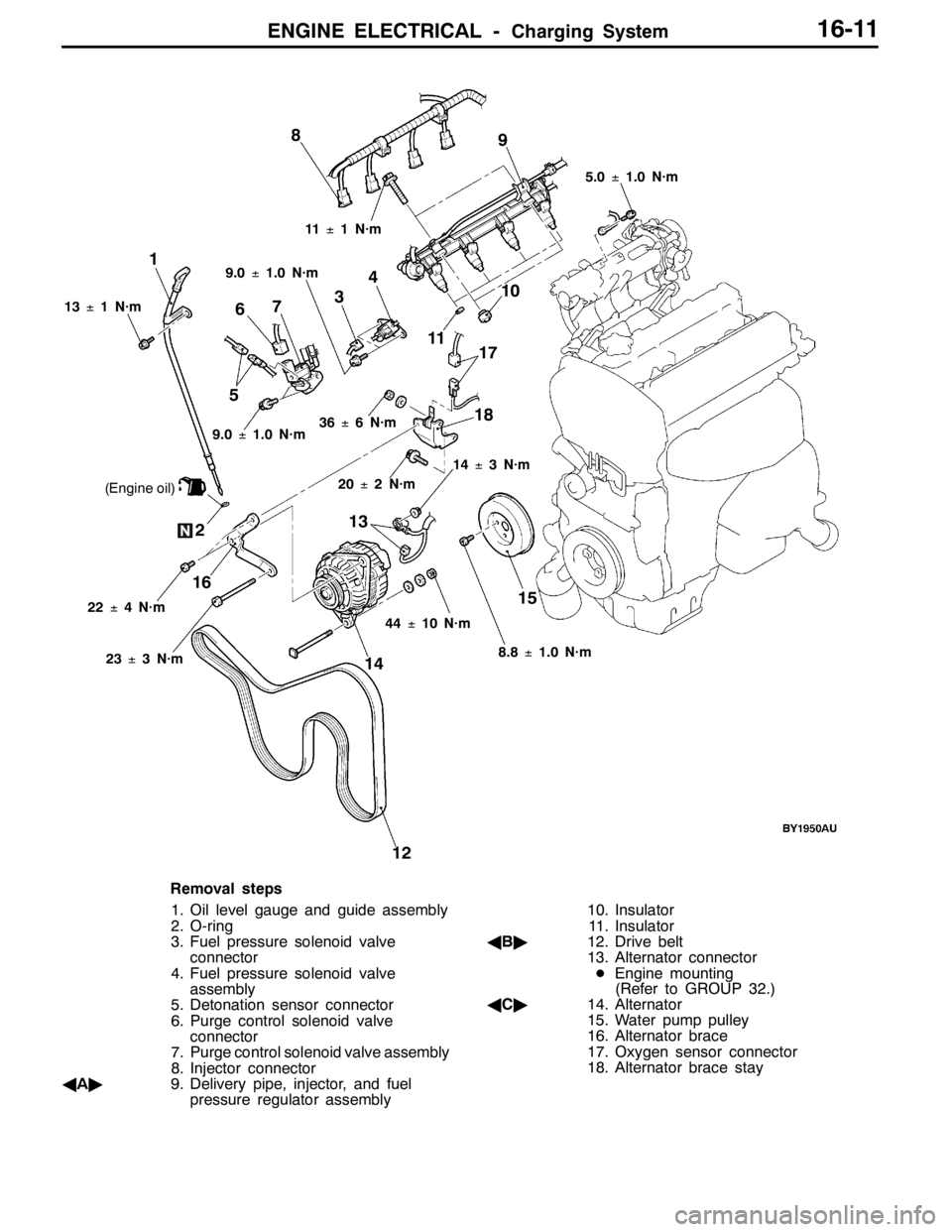
Removal steps
1. Oil level gauge and guide assembly
2. O-ring
3. Fuel pressure solenoid valve
connector
4. Fuel pressure solenoid valve
assembly
5. Detonation sensor connector
6. Purge control solenoid valve
connector
7. Purge control solenoid valve assembly
8. Injector connector
AA"9. Delivery pipe, injector, and fuel
pressure regulator assembly10. Insulator
11. Insulator
AB"12. Drive belt
13. Alternator connector
DEngine mounting
(Refer to GROUP 32.)
AC"14. Alternator
15. Water pump pulley
16. Alternator brace
17. Oxygen sensor connector
18. Alternator brace stay
Page 744 of 1449
ENGINE ELECTRICAL -Charging System16-12
REMOVAL SERVICE POINTS
AA"DELIVERY PIPE, INJECTOR, AND FUEL
PRESSURE REGULATOR ASSEMBLY REMOVAL
After loosening the installed parts, set the related parts
aside to make some space for removing the alternator.
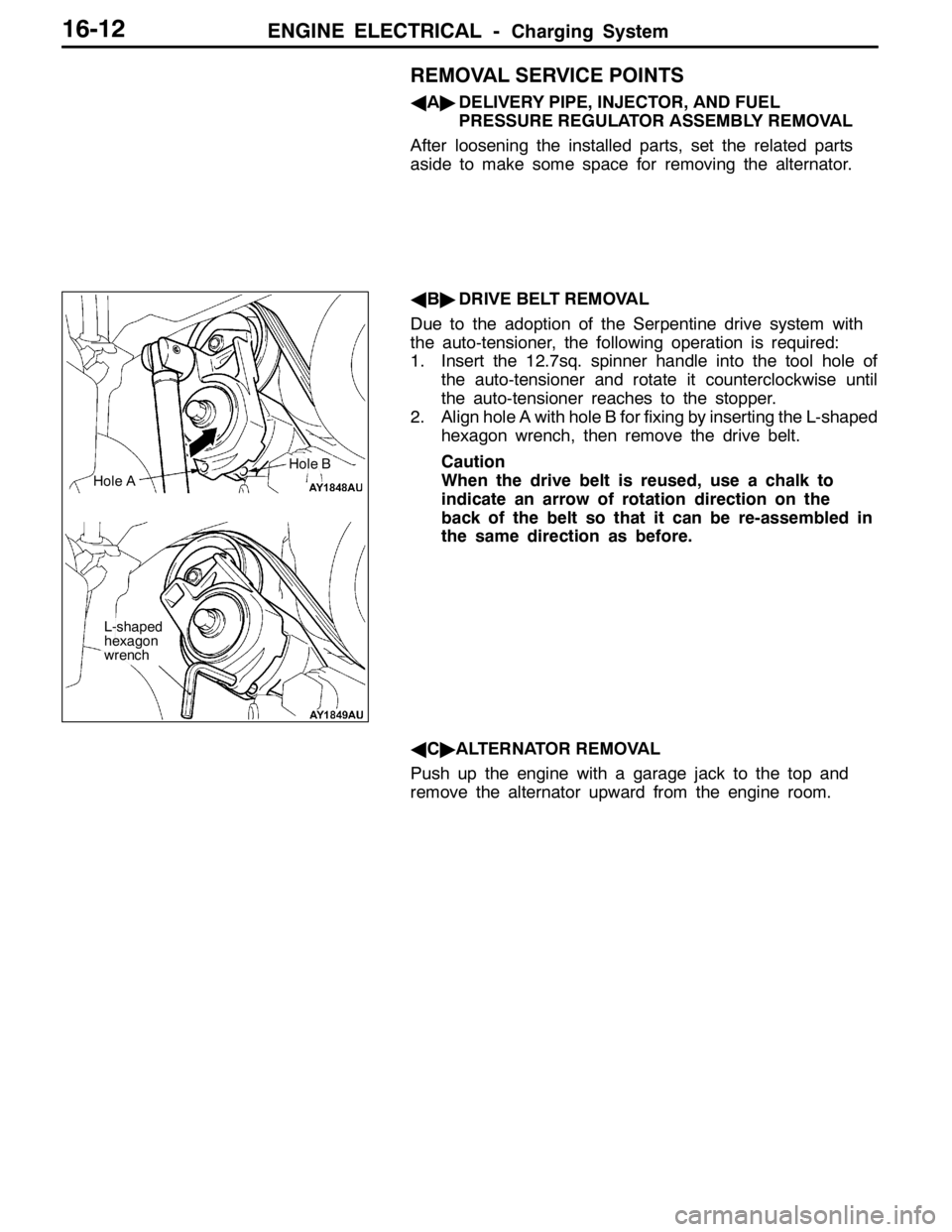
AB"DRIVE BELT REMOVAL
Due to the adoption of the Serpentine drive system with
the auto-tensioner, the following operation is required:
1. Insert the 12.7sq. spinner handle into the tool hole of
the auto-tensioner and rotate it counterclockwise until
the auto-tensioner reaches to the stopper.
2. Align hole A with hole B for fixing by inserting the L-shaped
hexagon wrench, then remove the drive belt.
Caution
When the drive belt is reused, use a chalk to
indicate an arrow of rotation direction on the
back of the belt so that it can be re-assembled in
the same direction as before.
AC"ALTERNATOR REMOVAL
Push up the engine with a garage jack to the top and
remove the alternator upward from the engine room.
Hole A
L-shaped
hexagon
wrench
Hole B
Page 745 of 1449

ENGINE ELECTRICAL -Charging System16-13
DISASSEMBLY AND REASSEMBLY
1
23
4 7654
891012
111314
Disassembly steps
AA"1. Front bracket assembly
AB"2. Alternator pulley
"BA3. Rotor
4. Rear bearing
5. Bearing retainer
6. Front bearing
7. Front bracketAC"8. Stator
9. Plate
AC""AA10. Regulator assembly
11. Brush
12. Packing
13. Rectifier
14. Rear bracket
Page 746 of 1449

ENGINE ELECTRICAL -Charging System16-14
DISASSEMBLY SERVICE POINTS
AA"FRONT BRACKET ASSEMBLY REMOVAL
Insert a flat tip screwdrivers or the like in the clearance between
the front bracket assembly and stator core, to pry open and
separate the stator and front bracket.
Caution
Do not insert a screwdriver too far, or the stator coil gets
damaged.
AB"ALTERNATOR PULLEY REMOVAL
Face pulley side upward, fix the rotor with a work bench
and remove the pulley.
Caution
Use care not to damage the rotor.
AC"STATOR/REGULATOR ASSEMBLY REMOVAL
1. Unsolder the stator with a soldering iron (180 to 250
W). Complete this work within four seconds not to transfer
heat to the diode.
2. When removing rectifier from the regulator assembly,
remove the soldered sections to rectifier.
Caution
(1) Use care to make sure that the heat of the soldering
iron is not transmitted to the diodes for a long period.
(2) Use care that no undue force is exerted to the
lead wires of the diodes.
REASSEMBLY SERVICE POINTS
"AAREGULATOR ASSEMBLY INSTALLATION
After installing the regulator assembly, insert a wire into the
hole provided on the rear bracket while pressing in the brush
to fix the brush.
NOTE
The brush is fixed when a wire is inserted, making rotor
installation easier.
SolderedRectifier
assembly
Soldered
Wire
Rear bracket
BrushWire
Page 747 of 1449

ENGINE ELECTRICAL -Charging System16-15
"BAROTOR INSTALLATION
After installing the rotor, remove the wire used to fix the brush.
INSPECTION
ROTOR CHECK
1. Check the continuity between the rotor coil slip rings,
and replace the rotor if the resistance value is not at
the standard value.
Standard value: 3 - 5Ω
2. Check the continuity between the slip ring and core, and
if there is continuity, replace the rotor.
STATOR CHECK
1. Check the continuity between the coil leads, and if there
is continuity, replace the stator.
2. Check the continuity between the coil and core, and if
there is continuity, replace the stator.
Wire
Page 748 of 1449

ENGINE ELECTRICAL -Charging System16-16
RECTIFIERS CHECK
1. Inspect the (+) heat sink by checking the continuity
between the (+) heat sink and stator coil lead wire
connection terminal using a tester probe.
If there is a continuity at both, the diode is short circuited,
so replace the rectifier.
2. Inspect the ( - ) heat sink by checking the continuity
between the ( - ) heat sink and stator coil lead wire
connection terminal using a tester probe.
If there is a continuity at both, the diode is short circuited,
so replace the rectifier.
3. Check the diode trio by connecting an ohmmeter to both
ends of each diode and check the continuity of the three
diodes.
If there is a continuity at both ends, or if there is no
continuity, the diode is damaged so replace the rectifier.
BRUSH CHECK
1. Measure the length of the brush protrusion shown in the
illustration, and replace the brush if the measured value
is below the limit value.
Limit: 2 mm or less
2. The brush can be removed if the solder of the brush
lead wire is removed.
3. When installing a new brush, insert the brush into the
holder as shown in the illustration, and then solder the
lead wires.
Protrusion
length
Soldered
Page 1322 of 1449

54A-2
CHASSIS
ELECTRICAL
CONTENTS
BATTERY 4..............................
SERVICE SPECIFICATION 4....................
ON-VEHICLE SERVICE 4......................
Fluid Level and Specific Gravity Check 4........
Charging 4.................................
Battery Testing Procedure 5...................
IGNITION SWITCH AND IMMOBILIZER
SYSTEM 6...............................
SPECIAL TOOLS 6............................
TROUBLESHOOTING 6........................
IMMOBILIZER-ECU CHECK 10.................
IGNITION SWITCH 11..........................
COMBINATION METER 14................
SERVICE SPECIFICATIONS 14.................
SEALANT 14..................................
SPECIAL TOOLS 15...........................
TROUBLESHOOTING 15.......................
ON-VEHICLE SERVICE 19.....................Speedometer Check 19......................
Tachometer Check 20........................
Fuel Gauge Unit Check 20....................
Engine Coolant Temperature Gauge
Unit Check 21...............................
COMBINATION METER 22.....................
HEADLAMP ASSEMBLY 24...............
SERVICE SPECIFICATIONS 24.................
TROUBLESHOOTING 24.......................
ON-VEHICLE SERVICE 24.....................
Headlamp Aiming 24.........................
Headlamp Intensity Measurement 28...........
Headlamp Bulb(low beam)Replacement28 ....
Headlamp Bulb(high beam)Replacement29 ...
Position Lamp Bulb Replacement29 ...........
Front Turn Signal Lamp Bulb Replacement29 ...
Headlamp Auto Cut Adjustment Procedure29 ...
HeadlampAuto Cut Function Check 29.........
HEADLAMP ASSEMBLY 30....................
CONTINUED ON NEXT PAGE
Page 1324 of 1449
![MITSUBISHI LANCER EVOLUTION 2007 Service Owners Manual CHASSIS ELECTRICAL -BatteryCHASSIS ELECTRICAL -Battery54A-4
BATTERY
SERVICE SPECIFICATION
ItemSpecification
Specific gravity of the battery fluid1.220 - 1.290 [20_C]
ON-VEHICLE SERVICE
FLUID LEVEL AND](/img/19/57084/w960_57084-1323.png "MITSUBISHI LANCER EVOLUTION 2007 Service Owners Manual CHASSIS ELECTRICAL -BatteryCHASSIS ELECTRICAL -Battery54A-4
BATTERY
SERVICE SPECIFICATION
ItemSpecification
Specific gravity of the battery fluid1.220 - 1.290 [20_C]
ON-VEHICLE SERVICE
FLUID LEVEL AND")
CHASSIS ELECTRICAL -BatteryCHASSIS ELECTRICAL -Battery54A-4
BATTERY
SERVICE SPECIFICATION
ItemSpecification
Specific gravity of the battery fluid1.220 - 1.290 [20_C]
ON-VEHICLE SERVICE
FLUID LEVEL AND SPECIFIC GRAVITY CHECK
1. Inspect whether or not the battery fluid is between the
UPPER LEVEL and LOWER LEVEL marks.
Caution
(1) If the battery fluid is below the LOWER LEVEL,
the battery could explode in using.
(2) If the battery fluid is over the UPPER LEVEL,
leakage could result.
2. Use a hydrometer and thermometer to check the specific
gravity of the battery fluid.
Standard value: 1.220 - 1.290 [20_C]
The specific gravity of the battery fluid varies with the
temperature, so use the following formula to calculate
the specific gravity for 20_C. Use the calculated value
to determine whether or not the specific gravity is
satisfactory.
D20 = (t - 20)×0.0007 + Dt
D20: Specific gravity of the battery fluid calculated
for 20_C.
Dt: Actually measured specific gravity
t: Actually measured temperature
CHARGING
1. Remove the battery from the vehicle.
2. The normal charging current is a value in amperes which is 1/10th of the battery capacity. If the
battery needs to be charged rapidly because of reasons such as time limitations, the maximum charging
current for rapid charging is the battery capacity expressed as an ampere value.
Battery typeCapacity (5-hour rate)Normal charging currentRapid charging current
44B2034 A3.4 A34 A
3. Determine when charging is finished.
DWhen the specific gravity of the battery electrolyte is constantly within 1.250 - 1.290 for a
continuous period of one hour or more
DWhen the voltage per cell during charging is 2.5 - 2.8 V constantly for a continuous period
of one hour or more
Thermometer
HydrometerGood
Page 1325 of 1449
CHASSIS ELECTRICAL -Battery54A-5
Caution
1. The battery plugs should be removed during charging.
2. The battery electrolyte level may rise and overflow from the battery during charging.
3. Explosions may occur if the battery is brought close to naked flames during charging.
4. Be careful to avoid tasks that might produce sparks or other danger while the battery is
charging.
5. After charging is complete, replace the battery plugs, pour water over the battery to rinse
away any sulphuric acid, and let the battery stand to dry.
6. Charge the battery in a well-ventilated location.
7. Do not let the battery electrolyte temperature rise above approximately 45_C
(approximately 55_Cduring rapid charging).
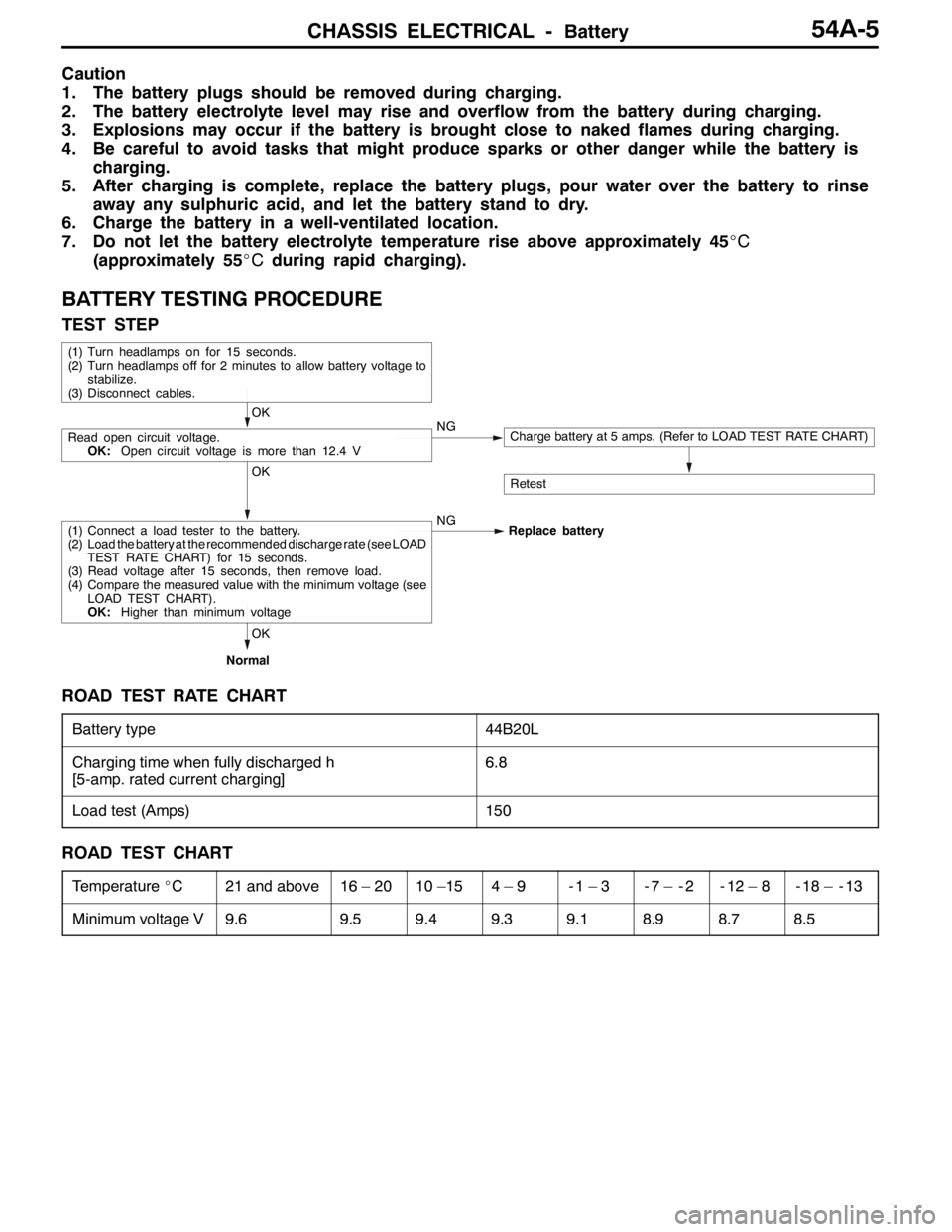
BATTERY TESTING PROCEDURE
TEST STEP
(1) Turn headlamps on for 15 seconds.
(2) Turn headlamps off for 2 minutes to allow battery voltage to
stabilize.
(3) Disconnect cables.
OK
Read open circuit voltage.
OK:Open circuit voltage is more than 12.4 VNGCharge battery at 5 amps. (Refer to LOAD TEST RATE CHART)
RetestOK
(1) Connect a load tester to the battery.
(2) Load the battery at the recommended discharge rate (see LOAD
TEST RATE CHART) for 15 seconds.
(3) Read voltage after 15 seconds, then remove load.
(4) Compare the measured value with the minimum voltage (see
LOAD TEST CHART).
OK:Higher than minimum voltageNG
Replace battery
OK
Normal
ROAD TEST RATE CHART
Battery type44B20L
Charging time when fully discharged h
[5-amp. rated current charging]6.8
Load test (Amps)150
ROAD TEST CHART
Temperature_C21 and above16 – 2010 –154–9-1–3-7 – -2-12 – 8-18 – -13
Minimum voltage V9.69.59.49.39.18.98.78.5
Page 1348 of 1449
CHASSIS ELECTRICAL -Headlamp Assembly54A-28
HEADLAMP INTENSITY MEASUREMENT
1. Using a photometer, and following its manufacture’s
instruction manual.
2. Maintain an engine speed of 2,000 r/min., with the battery
in the charging condition
3. Set the headlamps to high beam
4. Measure the headlamp centre intensity (a point of H line
and V line) and check to be sure that the limit value
is satisfied.
Limit:
High beam 30,000 cd or more per one headlamp
NOTE
1. There may be special local regulations pertaining to
headlamp intensity, be sure to make any adjustments
necessary to satisfy such regulations.
2. If an illuminometer is used to make the measurements,
convert its values to photometer values by using the
following formula.
I=Er
2Where:
I=intensity (cd)
E=illumination (lux)
r=distance (m) from headlamps to illuminometer
Caution
1. On the headlamp not yet adjusted, perform aiming
with connector removed and the lamps switched off,
if applicable. In addition, care should be taken to
prevent a change of optical axis when connector is
reconnected.
2. Plastic outer lens are equipped with headlamps. When
lens surface is covered with materials for not
penetrating light, headlamp operation time should be
within 3 minutes. In addition, masking such as taping
should not be performed.
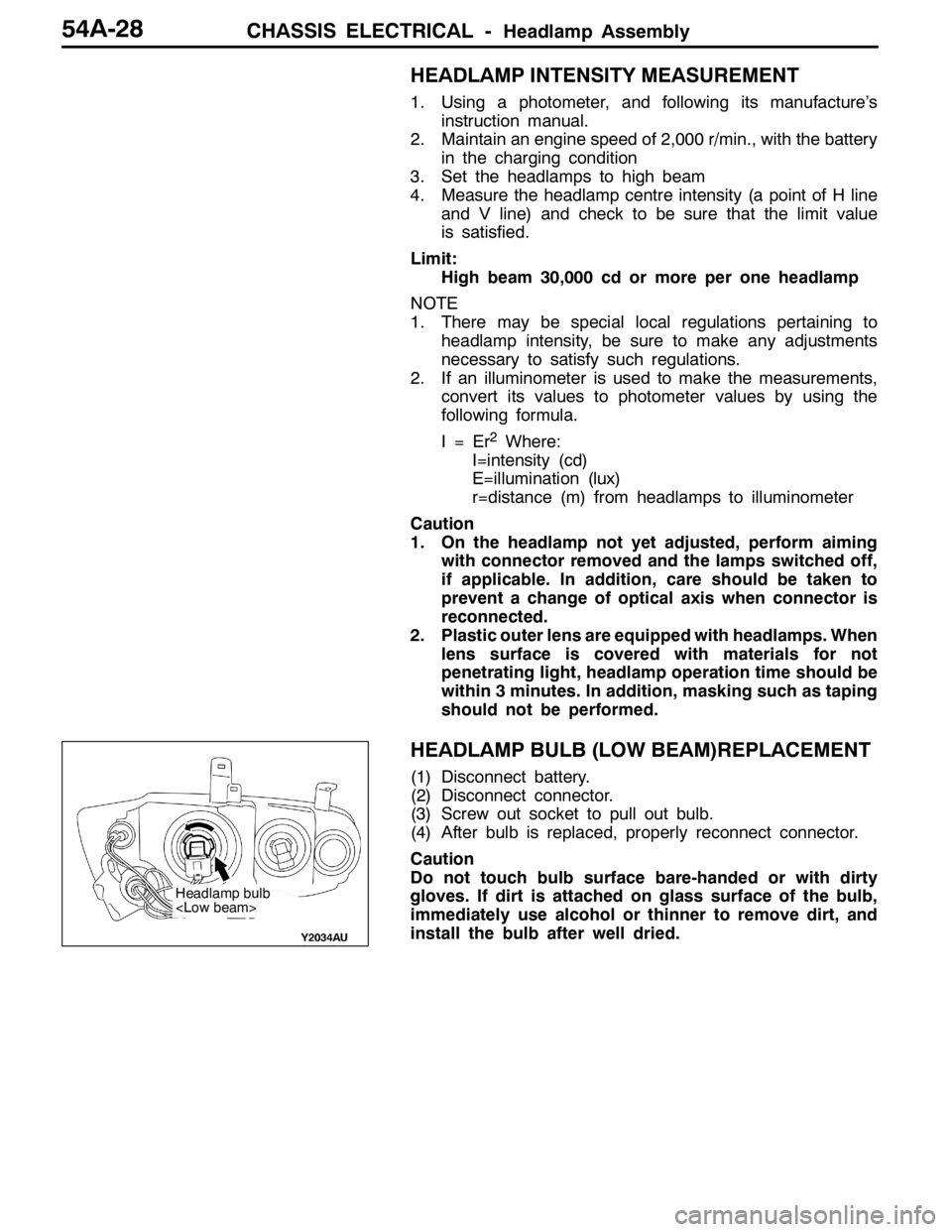
HEADLAMP BULB (LOW BEAM)REPLACEMENT
(1) Disconnect battery.
(2) Disconnect connector.
(3) Screw out socket to pull out bulb.
(4) After bulb is replaced, properly reconnect connector.
Caution
Do not touch bulb surface bare-handed or with dirty
gloves. If dirt is attached on glass surface of the bulb,
immediately use alcohol or thinner to remove dirt, and
install the bulb after well dried.
Headlamp bulb