suspension MITSUBISHI LANCER EVOLUTION 2007 Service Owner's Manual
[x] Cancel search | Manufacturer: MITSUBISHI, Model Year: 2007, Model line: LANCER EVOLUTION, Model: MITSUBISHI LANCER EVOLUTION 2007Pages: 1449, PDF Size: 56.82 MB
Page 1030 of 1449
FRONT SUSPENSION -Special Tools/On-vehicle Service33A-4
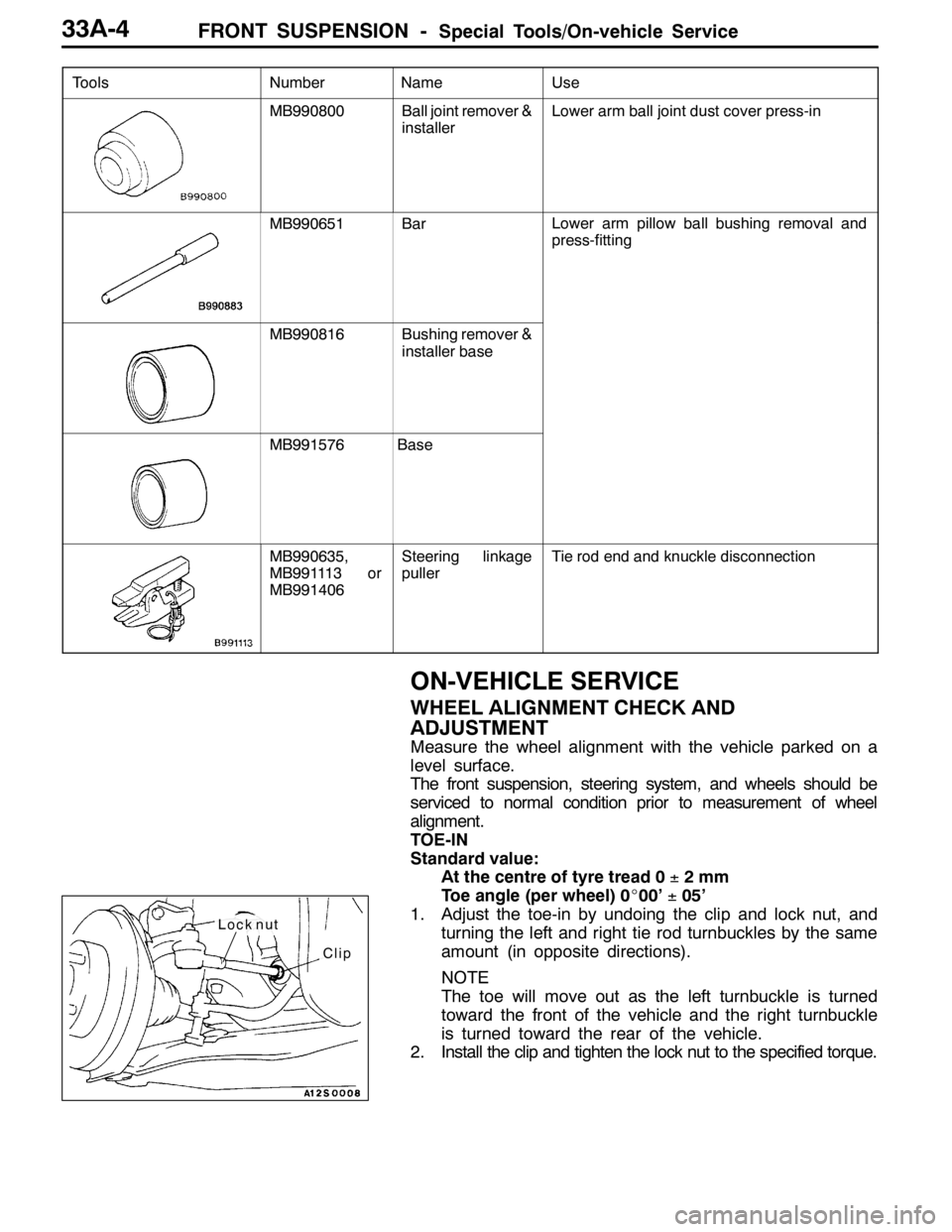
Tools UseName Number
MB990800Ball joint remover &
installerLower arm ball joint dust cover press-in
MB990651BarLower arm pillow ball bushing removal and
press-fitting
MB990816Bushing remover &
installer base
MB991576Base
MB990635,
MB991113 or
MB991406Steering linkage
pullerTie rod end and knuckle disconnection
ON-VEHICLE SERVICE
WHEEL ALIGNMENT CHECK AND
ADJUSTMENT
Measure the wheel alignment with the vehicle parked on a
level surface.
The front suspension, steering system, and wheels should be
serviced to normal condition prior to measurement of wheel
alignment.
TOE-IN
Standard value:
At the centre of tyre tread 0±2mm
Toe angle (per wheel) 0_00’±05’
1. Adjust the toe-in by undoing the clip and lock nut, and
turning the left and right tie rod turnbuckles by the same
amount (in opposite directions).
NOTE
The toe will move out as the left turnbuckle is turned
toward the front of the vehicle and the right turnbuckle
is turned toward the rear of the vehicle.
2. Install the clip and tighten the lock nut to the specified torque.
Clip
Lock nut
Page 1031 of 1449
FRONT SUSPENSION -On-vehicle Service33A-5
Tightening torque: 52±2 N·m
3. Confirm that the toe-in is at the standard value.
4. Use a turning radius gauge to check that the steering
angle is at the standard value.
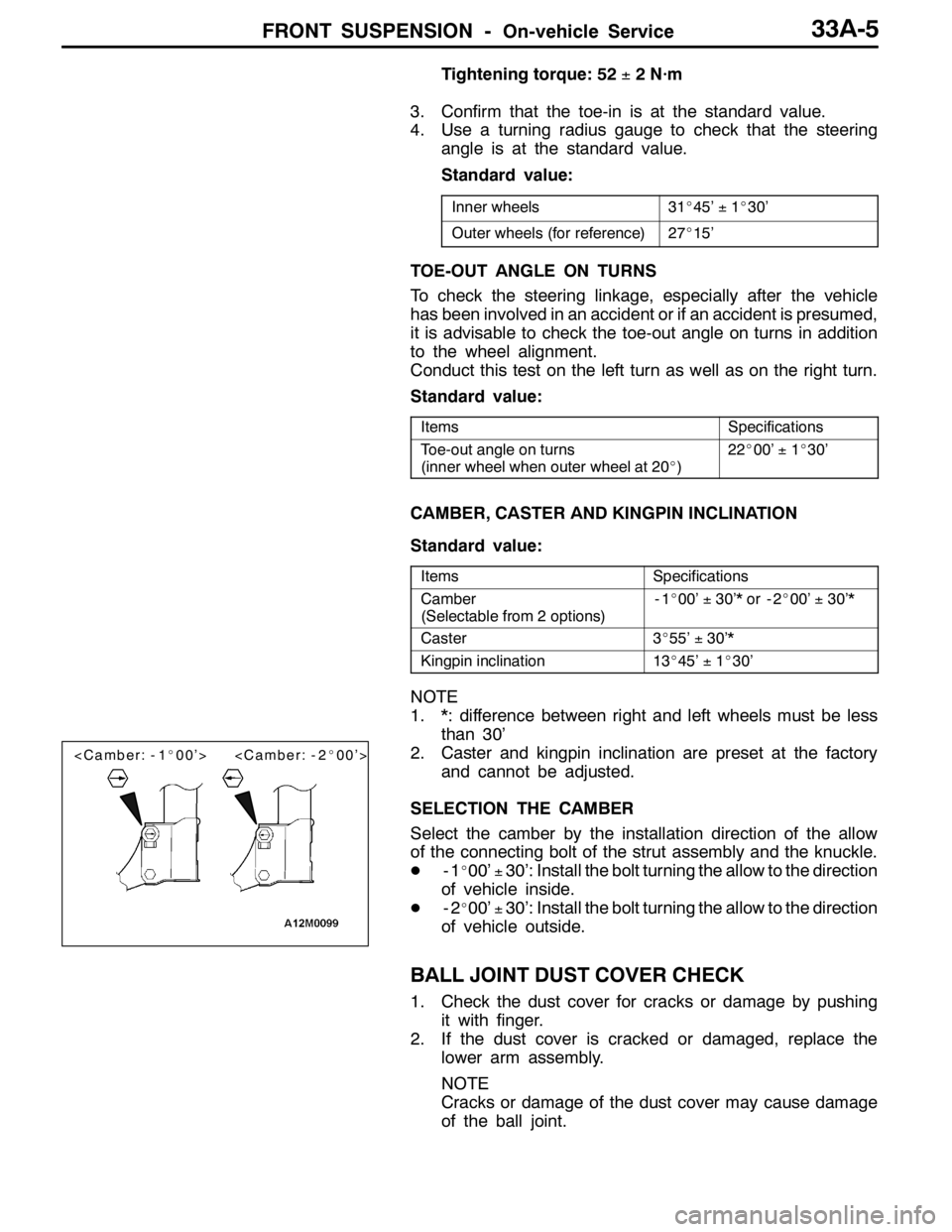
Standard value:
Inner wheels31_45’±1_30’
Outer wheels (for reference)27_15’
TOE-OUT ANGLE ON TURNS
To check the steering linkage, especially after the vehicle
has been involved in an accident or if an accident is presumed,
it is advisable to check the toe-out angle on turns in addition
to the wheel alignment.
Conduct this test on the left turn as well as on the right turn.
Standard value:
ItemsSpecifications
Toe-out angle on turns
(inner wheel when outer wheel at 20_)22_00’±1_30’
CAMBER, CASTER AND KINGPIN INCLINATION
Standard value:
ItemsSpecifications
Camber
(Selectable from 2 options)-1_00’±30’* or - 2_00’±30’*
Caster3_55’±30’*
Kingpin inclination13_45’±1_30’
NOTE
1. *: difference between right and left wheels must be less
than 30’
2. Caster and kingpin inclination are preset at the factory
and cannot be adjusted.
SELECTION THE CAMBER
Select the camber by the installation direction of the allow
of the connecting bolt of the strut assembly and the knuckle.
D-1
_00’±30’: Install the bolt turning the allow to the direction
of vehicle inside.
D-2
_00’±30’: Install the bolt turning the allow to the direction
of vehicle outside.
BALL JOINT DUST COVER CHECK
1. Check the dust cover for cracks or damage by pushing
it with finger.
2. If the dust cover is cracked or damaged, replace the
lower arm assembly.
NOTE
Cracks or damage of the dust cover may cause damage
of the ball joint.
Page 1032 of 1449
FRONT SUSPENSION -Strut Assembly33A-6
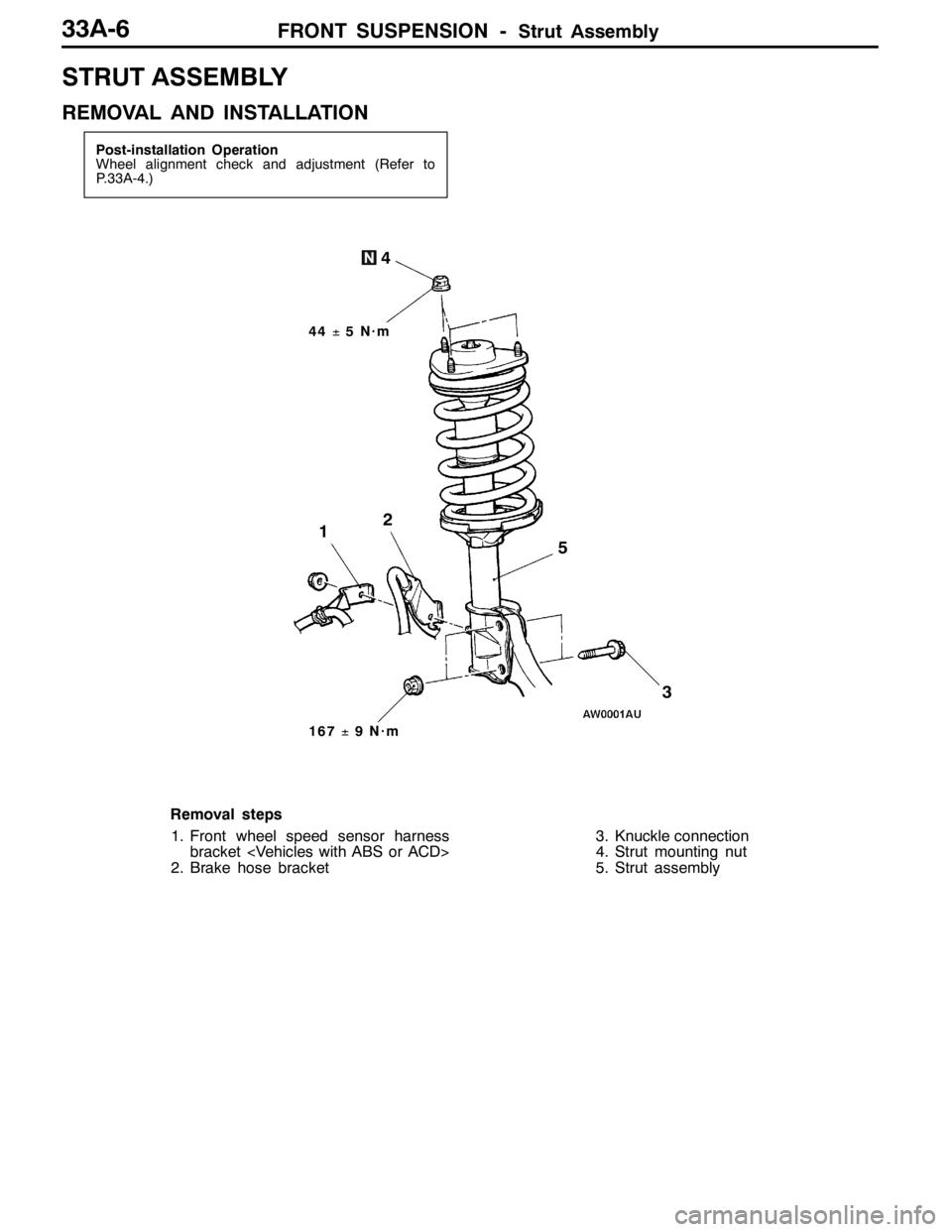
STRUT ASSEMBLY
REMOVAL AND INSTALLATION
Post-installation Operation
Wheel alignment check and adjustment (Refer to
P.33A-4.)
44±5N·m
3
21
167±9N·m
4
5
Removal steps
1. Front wheel speed sensor harness
bracket
2. Brake hose bracket3. Knuckle connection
4. Strut mounting nut
5. Strut assembly
Page 1033 of 1449
FRONT SUSPENSION -Strut Assembly33A-7
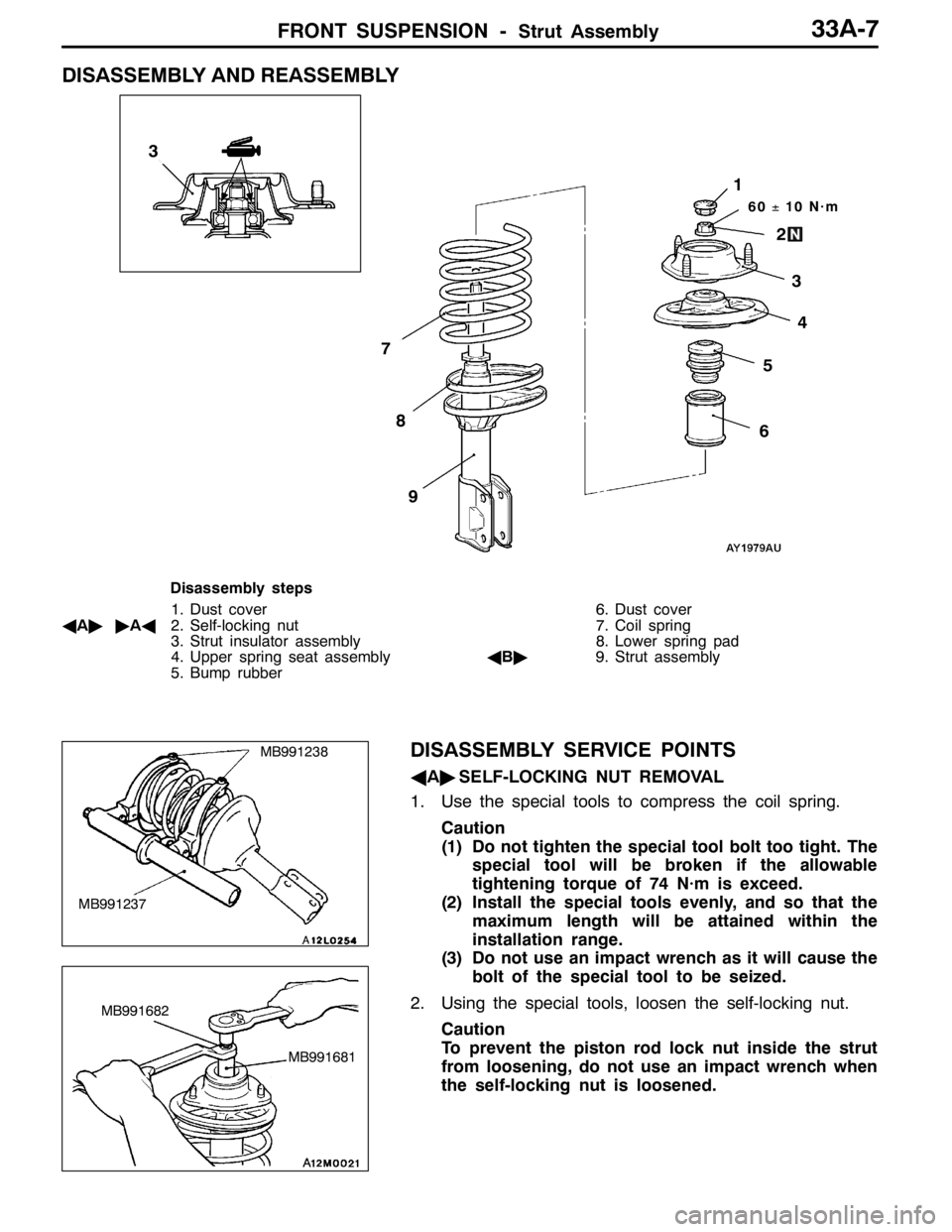
DISASSEMBLY AND REASSEMBLY
60±10 N·m
3
2
1
5
6
7
8
9
4
3
Disassembly steps
1. Dust cover
AA""AA2. Self-locking nut
3. Strut insulator assembly
4. Upper spring seat assembly
5. Bump rubber6. Dust cover
7. Coil spring
8. Lower spring pad
AB"9. Strut assembly
DISASSEMBLY SERVICE POINTS
AA"SELF-LOCKING NUT REMOVAL
1. Use the special tools to compress the coil spring.
Caution
(1) Do not tighten the special tool bolt too tight. The
special tool will be broken if the allowable
tightening torque of 74 N·m is exceed.
(2) Install the special tools evenly, and so that the
maximum length will be attained within the
installation range.
(3) Do not use an impact wrench as it will cause the
bolt of the special tool to be seized.
2. Using the special tools, loosen the self-locking nut.
Caution
To prevent the piston rod lock nut inside the strut
from loosening, do not use an impact wrench when
the self-locking nut is loosened.
MB991237
MB991238
MB991681
MB991682
Page 1034 of 1449
FRONT SUSPENSION -Strut Assembly33A-8
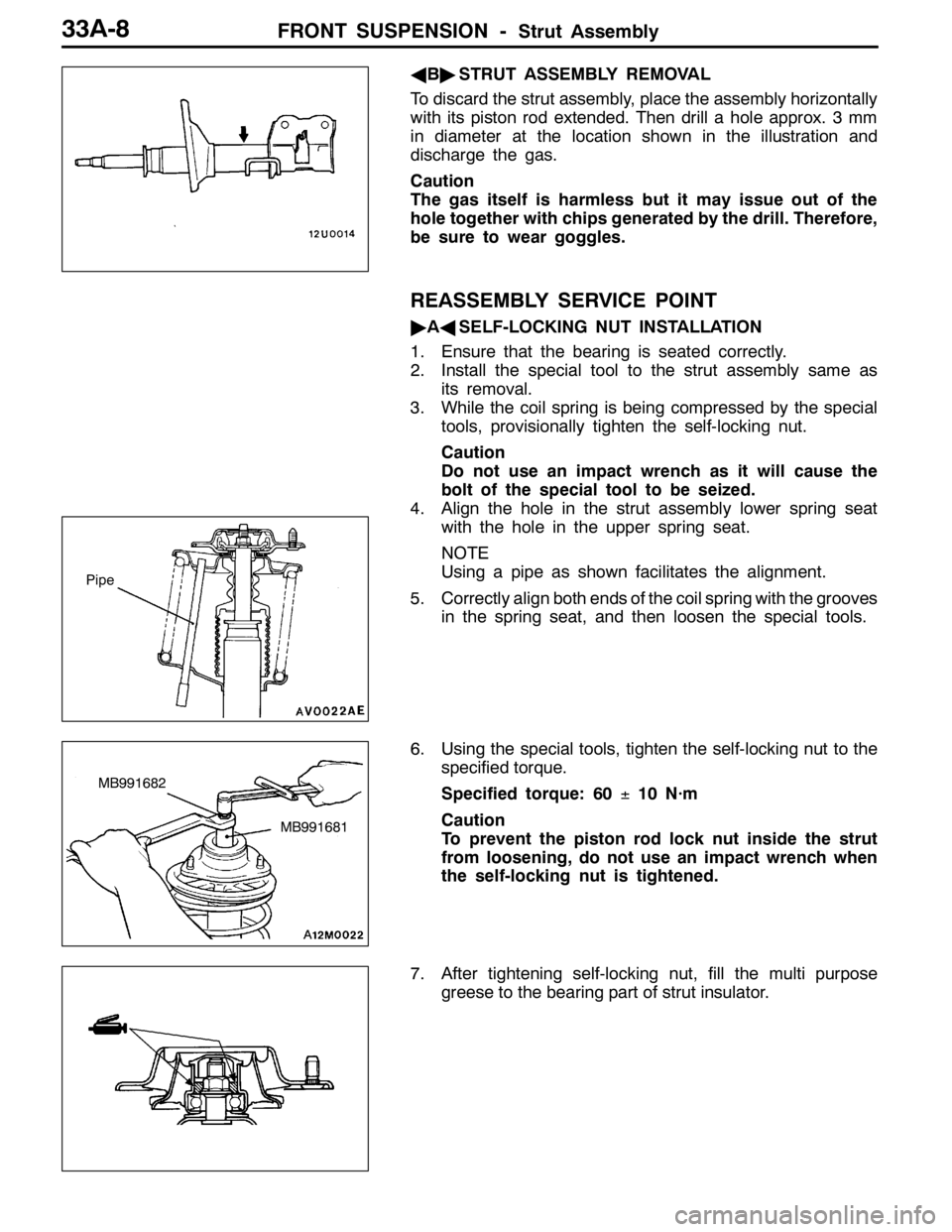
AB"STRUT ASSEMBLY REMOVAL
To discard the strut assembly, place the assembly horizontally
with its piston rod extended. Then drill a hole approx. 3 mm
in diameter at the location shown in the illustration and
discharge the gas.
Caution
The gas itself is harmless but it may issue out of the
hole together with chips generated by the drill. Therefore,
be sure to wear goggles.
REASSEMBLY SERVICE POINT
"AASELF-LOCKING NUT INSTALLATION
1. Ensure that the bearing is seated correctly.
2. Install the special tool to the strut assembly same as
its removal.
3. While the coil spring is being compressed by the special
tools, provisionally tighten the self-locking nut.
Caution
Do not use an impact wrench as it will cause the
bolt of the special tool to be seized.
4. Align the hole in the strut assembly lower spring seat
with the hole in the upper spring seat.
NOTE
Using a pipe as shown facilitates the alignment.
5. Correctly align both ends of the coil spring with the grooves
in the spring seat, and then loosen the special tools.
6. Using the special tools, tighten the self-locking nut to the
specified torque.
Specified torque: 60±10 N·m
Caution
To prevent the piston rod lock nut inside the strut
from loosening, do not use an impact wrench when
the self-locking nut is tightened.
7. After tightening self-locking nut, fill the multi purpose
greese to the bearing part of strut insulator.
Pipe
MB991681
MB991682
Page 1035 of 1449
FRONT SUSPENSION -Lower Arm Assembly33A-9
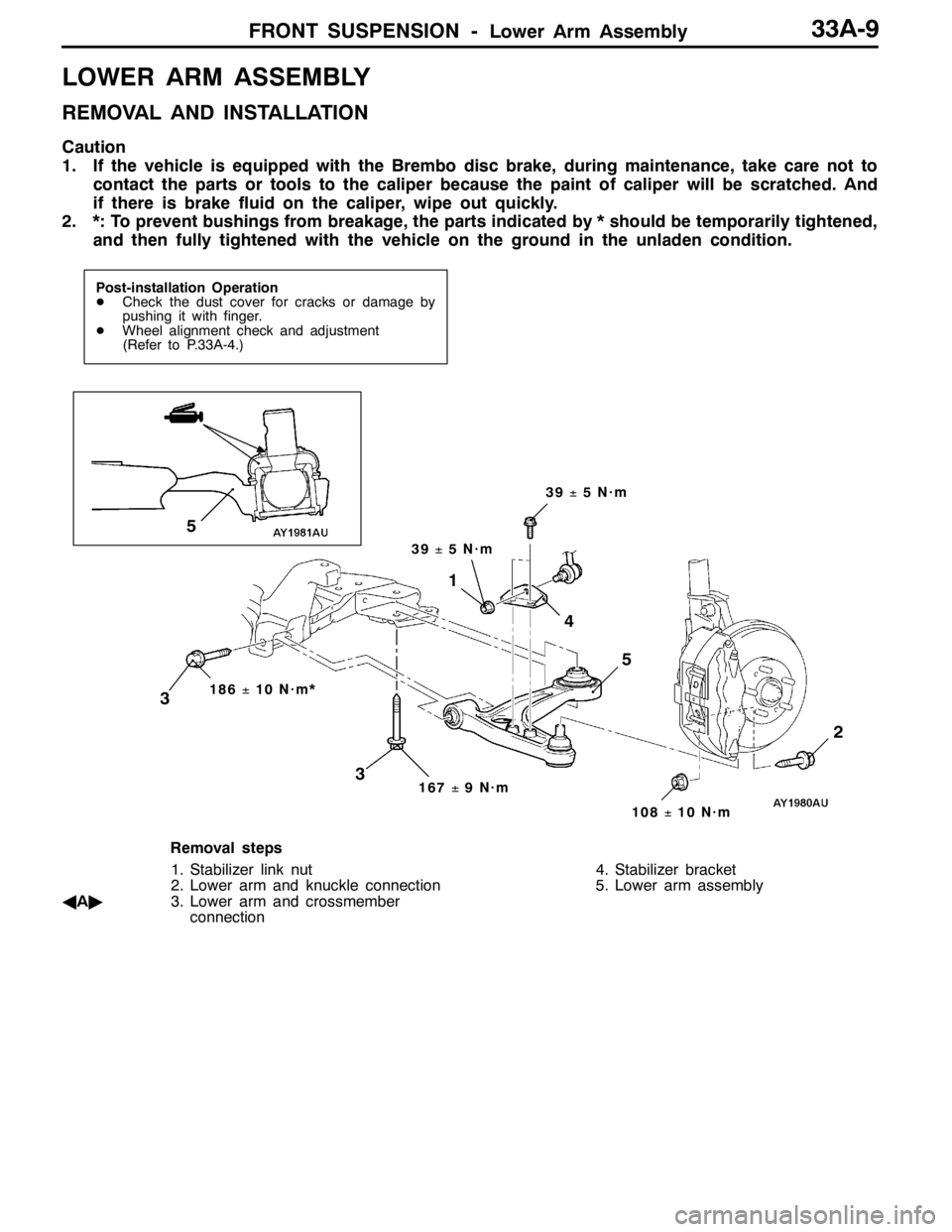
LOWER ARM ASSEMBLY
REMOVAL AND INSTALLATION
Caution
1. If the vehicle is equipped with the Brembo disc brake, during maintenance, take care not to
contact the parts or tools to the caliper because the paint of caliper will be scratched. And
if there is brake fluid on the caliper, wipe out quickly.
2. *: To prevent bushings from breakage, the parts indicated by * should be temporarily tightened,
and then fully tightened with the vehicle on the ground in the unladen condition.
Post-installation Operation
DCheck the dust cover for cracks or damage by
pushing it with finger.
DWheel alignment check and adjustment
(Refer to P.33A-4.)
72
5
186±10 N·m*
3167±9N·m
5
1
3
4
108±10 N·m
39±5N·m
39±5N·m
Removal steps
1. Stabilizer link nut
2. Lower arm and knuckle connection
AA"3. Lower arm and crossmember
connection4. Stabilizer bracket
5. Lower arm assembly
Page 1036 of 1449
FRONT SUSPENSION -Lower Arm Assembly33A-10
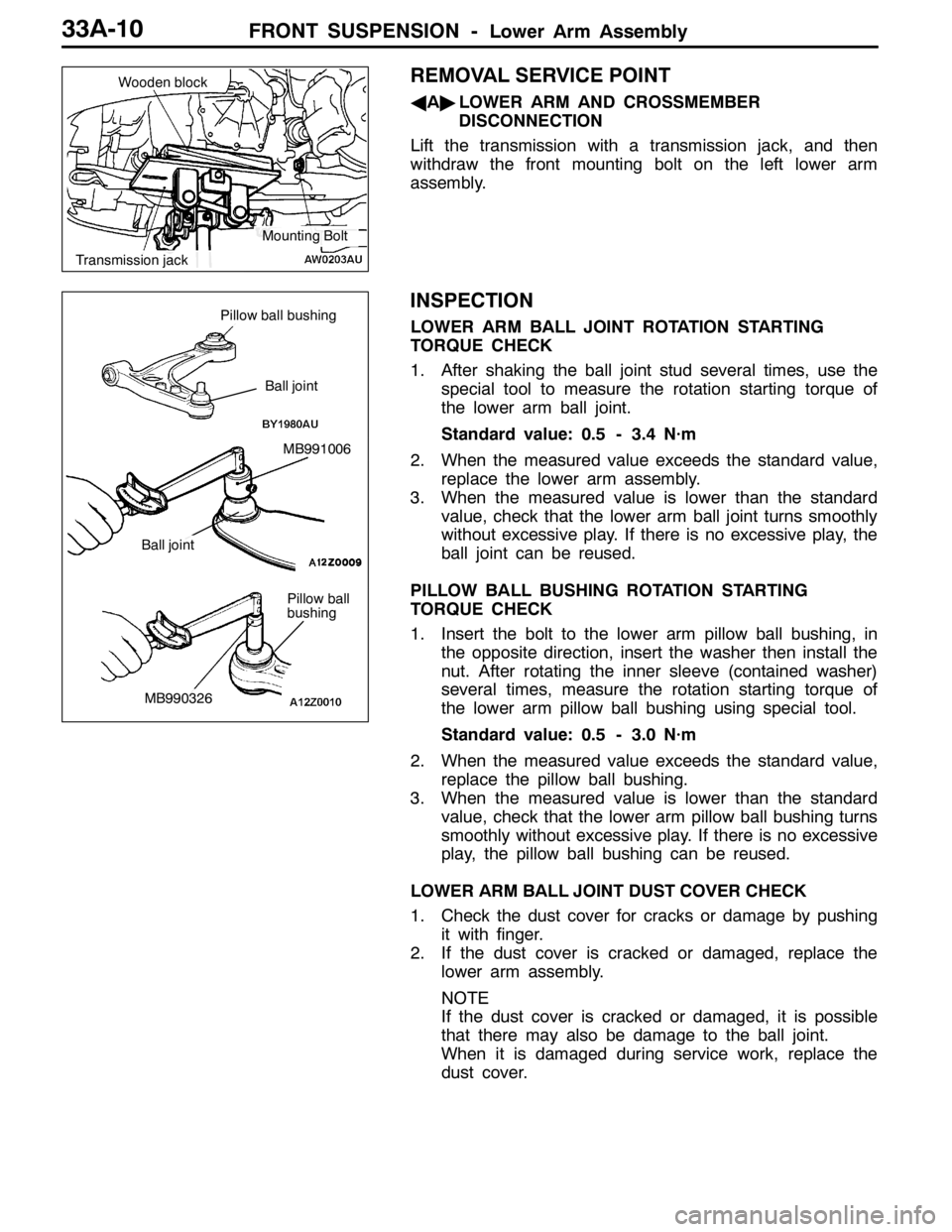
REMOVAL SERVICE POINT
AA"LOWER ARM AND CROSSMEMBER
DISCONNECTION
Lift the transmission with a transmission jack, and then
withdraw the front mounting bolt on the left lower arm
assembly.
INSPECTION
LOWER ARM BALL JOINT ROTATION STARTING
TORQUE CHECK
1. After shaking the ball joint stud several times, use the
special tool to measure the rotation starting torque of
the lower arm ball joint.
Standard value: 0.5 - 3.4 N·m
2. When the measured value exceeds the standard value,
replace the lower arm assembly.
3. When the measured value is lower than the standard
value, check that the lower arm ball joint turns smoothly
without excessive play. If there is no excessive play, the
ball joint can be reused.
PILLOW BALL BUSHING ROTATION STARTING
TORQUE CHECK
1. Insert the bolt to the lower arm pillow ball bushing, in
the opposite direction, insert the washer then install the
nut. After rotating the inner sleeve (contained washer)
several times, measure the rotation starting torque of
the lower arm pillow ball bushing using special tool.
Standard value: 0.5 - 3.0 N·m
2. When the measured value exceeds the standard value,
replace the pillow ball bushing.
3. When the measured value is lower than the standard
value, check that the lower arm pillow ball bushing turns
smoothly without excessive play. If there is no excessive
play, the pillow ball bushing can be reused.
LOWER ARM BALL JOINT DUST COVER CHECK
1. Check the dust cover for cracks or damage by pushing
it with finger.
2. If the dust cover is cracked or damaged, replace the
lower arm assembly.
NOTE
If the dust cover is cracked or damaged, it is possible
that there may also be damage to the ball joint.
When it is damaged during service work, replace the
dust cover.
Wooden block
Transmission jack
Mounting Bolt
Pillow ball
bushing
MB991006
Pillow ball bushing
Ball joint
Ball joint
MB990326
Page 1037 of 1449
FRONT SUSPENSION -Lower Arm Assembly33A-11
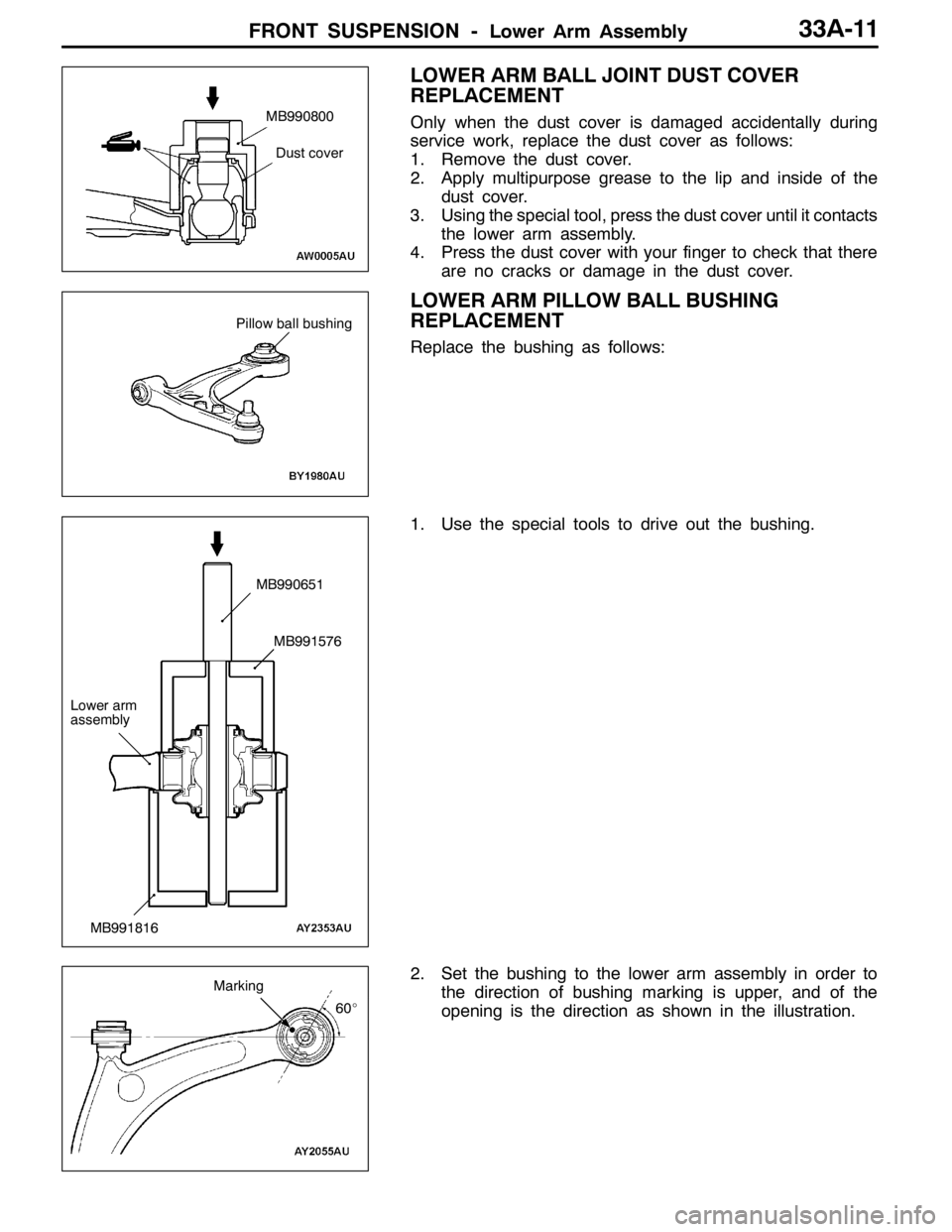
LOWER ARM BALL JOINT DUST COVER
REPLACEMENT
Only when the dust cover is damaged accidentally during
service work, replace the dust cover as follows:
1. Remove the dust cover.
2. Apply multipurpose grease to the lip and inside of the
dust cover.
3. Using the special tool, press the dust cover until it contacts
the lower arm assembly.
4. Press the dust cover with your finger to check that there
are no cracks or damage in the dust cover.
LOWER ARM PILLOW BALL BUSHING
REPLACEMENT
Replace the bushing as follows:
1. Use the special tools to drive out the bushing.
2. Set the bushing to the lower arm assembly in order to
the direction of bushing marking is upper, and of the
opening is the direction as shown in the illustration.
MB990800
Dust cover
Pillow ball bushing
Lower arm
assembly
MB990651
MB991576
MB991816
60_
Marking
Page 1038 of 1449
FRONT SUSPENSION -Lower Arm Assembly/Stabilizer Bar33A-12
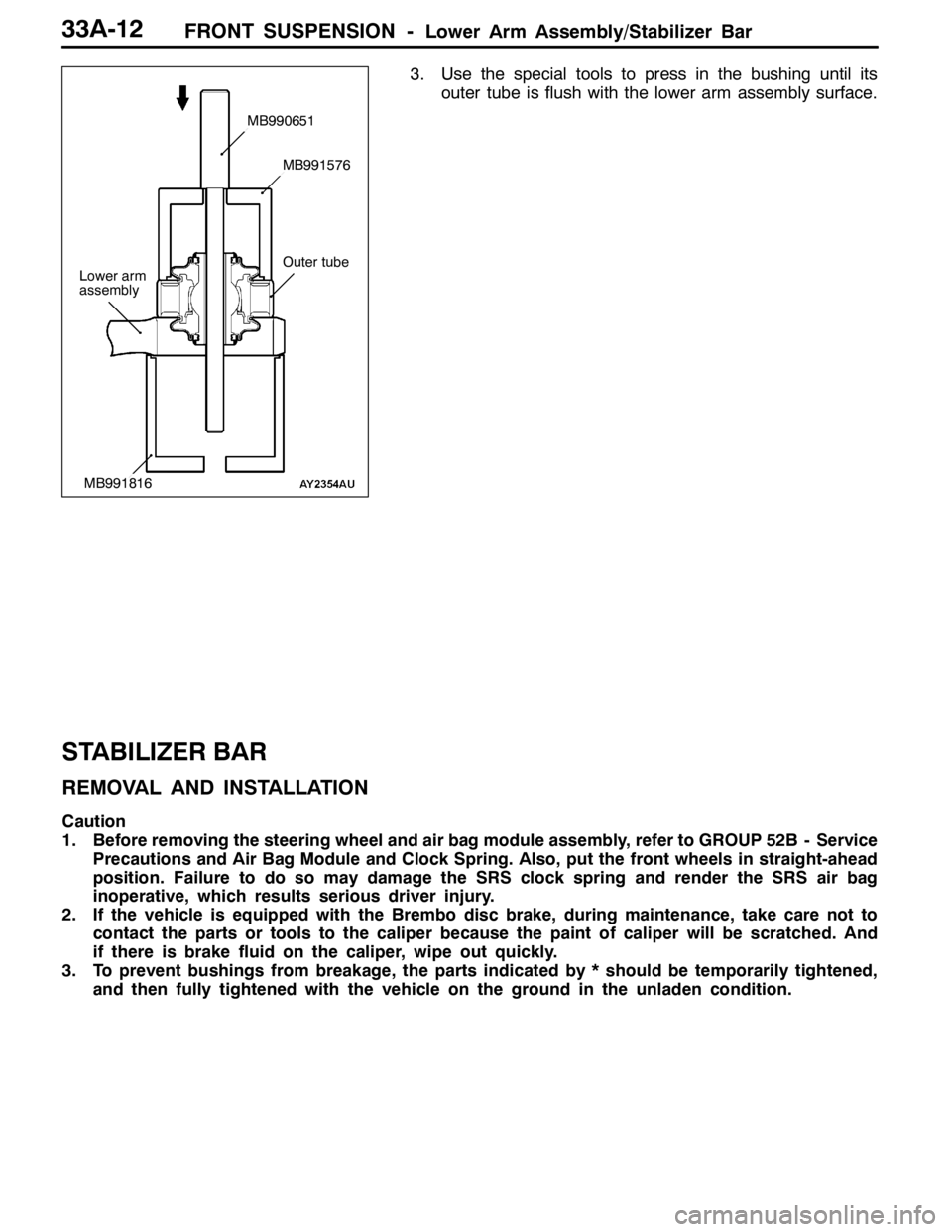
3. Use the special tools to press in the bushing until its
outer tube is flush with the lower arm assembly surface.
STABILIZER BAR
REMOVAL AND INSTALLATION
Caution
1. Before removing the steering wheel and air bag module assembly, refer to GROUP 52B - Service
Precautions and Air Bag Module and Clock Spring. Also, put the front wheels in straight-ahead
position. Failure to do so may damage the SRS clock spring and render the SRS air bag
inoperative, which results serious driver injury.
2. If the vehicle is equipped with the Brembo disc brake, during maintenance, take care not to
contact the parts or tools to the caliper because the paint of caliper will be scratched. And
if there is brake fluid on the caliper, wipe out quickly.
3. To prevent bushings from breakage, the parts indicated by * should be temporarily tightened,
and then fully tightened with the vehicle on the ground in the unladen condition.
Lower arm
assembly
MB990651
MB991576
MB991816
Outer tube
Page 1039 of 1449
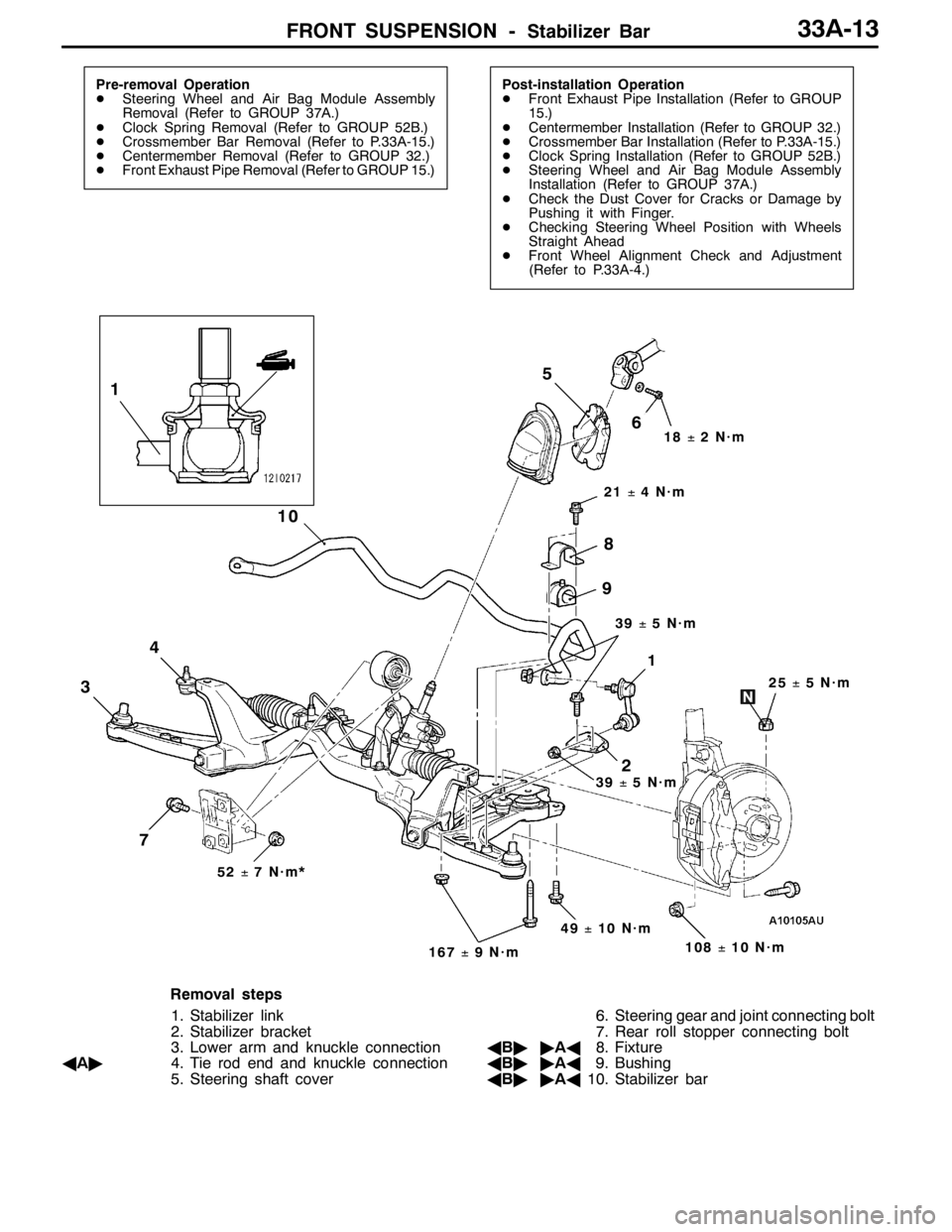
FRONT SUSPENSION -Stabilizer Bar33A-13
Pre-removal Operation
DSteering Wheel and Air Bag Module Assembly
Removal (Refer to GROUP 37A.)
DClock Spring Removal (Refer to GROUP 52B.)
DCrossmember Bar Removal (Refer to P.33A-15.)
DCentermember Removal (Refer to GROUP 32.)
DFront Exhaust Pipe Removal (Refer to GROUP 15.)Post-installation Operation
DFront Exhaust Pipe Installation (Refer to GROUP
15.)
DCentermember Installation (Refer to GROUP 32.)
DCrossmember Bar Installation (Refer to P.33A-15.)
DClock Spring Installation (Refer to GROUP 52B.)
DSteering Wheel and Air Bag Module Assembly
Installation (Refer to GROUP 37A.)
DCheck the Dust Cover for Cracks or Damage by
Pushing it with Finger.
DChecking Steering Wheel Position with Wheels
Straight Ahead
DFront Wheel Alignment Check and Adjustment
(Refer to P.33A-4.)
3
4
10
21±4N·m
51
1
2
25±5N·m
18±2N·m
108±10 N·m
52±7N·m*
49±10 N·m
167±9N·m
7
8
9
6
39±5N·m
39±5N·m
Removal steps
1. Stabilizer link
2. Stabilizer bracket
3. Lower arm and knuckle connection
AA"4. Tie rod end and knuckle connection
5. Steering shaft cover6. Steering gear and joint connecting bolt
7. Rear roll stopper connecting bolt
AB""AA8. Fixture
AB""AA9. Bushing
AB""AA10. Stabilizer bar