turn signal MITSUBISHI LANCER EVOLUTION 2007 Service Owner's Manual
[x] Cancel search | Manufacturer: MITSUBISHI, Model Year: 2007, Model line: LANCER EVOLUTION, Model: MITSUBISHI LANCER EVOLUTION 2007Pages: 1449, PDF Size: 56.82 MB
Page 621 of 1449
MPI -Troubleshooting13A-89
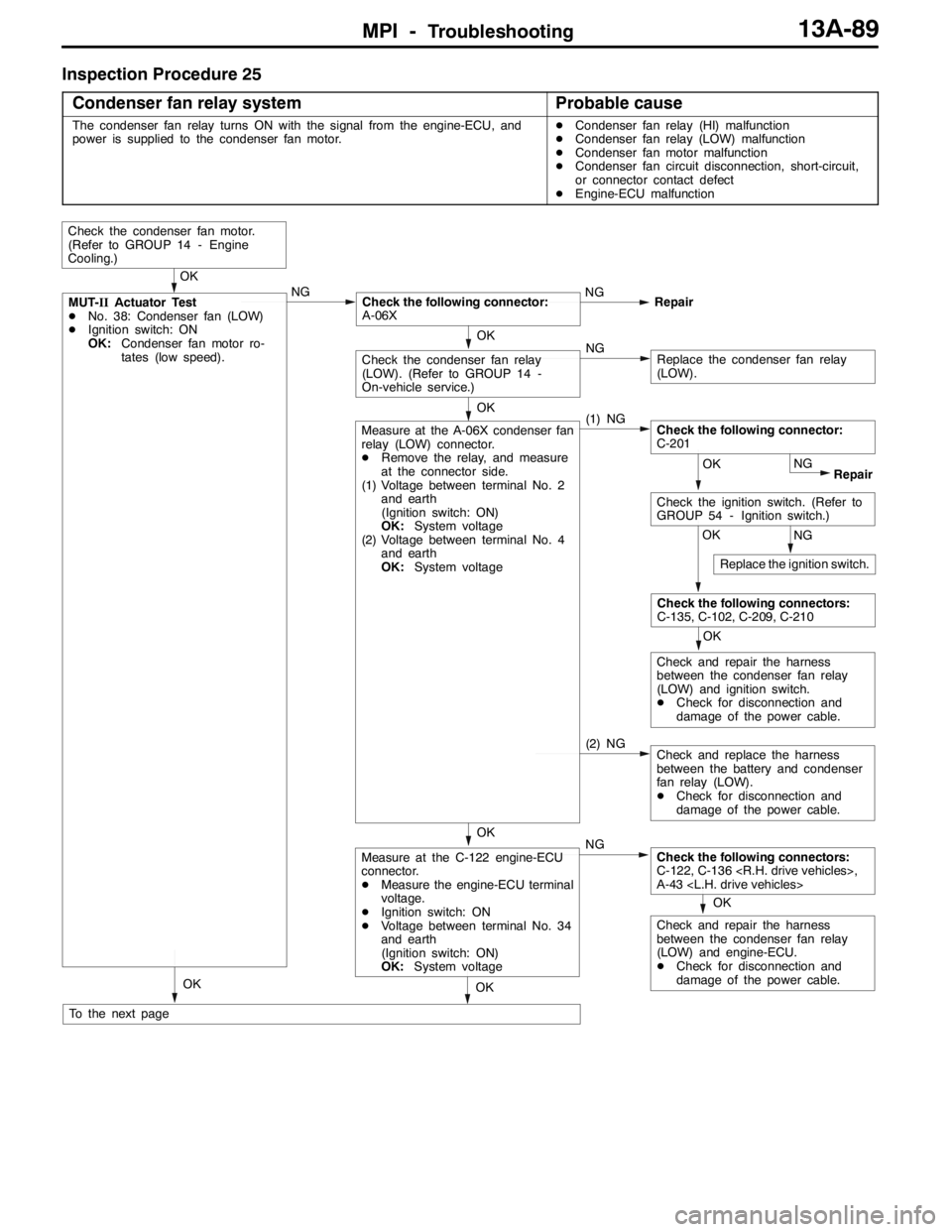
Inspection Procedure 25
Condenser fan relay system
Probable cause
The condenser fan relay turns ON with the signal from the engine-ECU, and
power is supplied to the condenser fan motor.DCondenser fan relay (HI) malfunction
DCondenser fan relay (LOW) malfunction
DCondenser fan motor malfunction
DCondenser fan circuit disconnection, short-circuit,
or connector contact defect
DEngine-ECU malfunction
OK
Check and repair the harness
between the condenser fan relay
(LOW) and engine-ECU.
DCheck for disconnection and
damage of the power cable.
(2) NG
OK
OK
Check the condenser fan motor.
(Refer to GROUP 14 - Engine
Cooling.)
OK
NG
OK
Check the following connector:
A-06X
OK
MUT-IIActuator Test
DNo. 38: Condenser fan (LOW)
DIgnition switch: ON
OK:Condenser fan motor ro-
tates (low speed).NG
OK
Measure at the C-122 engine-ECU
connector.
DMeasure the engine-ECU terminal
voltage.
DIgnition switch: ON
DVoltage between terminal No. 34
and earth
(Ignition switch: ON)
OK:System voltageRepair
NG
To the next page
NGReplace the condenser fan relay
(LOW).
OK
Check the condenser fan relay
(LOW). (Refer to GROUP 14 -
On-vehicle service.)
(1) NGMeasure at the A-06X condenser fan
relay (LOW) connector.
DRemove the relay, and measure
at the connector side.
(1) Voltage between terminal No. 2
and earth
(Ignition switch: ON)
OK:System voltage
(2) Voltage between terminal No. 4
and earth
OK:System voltage
NG
Repair OK
OK
Check the following connectors:
C-135, C-102, C-209, C-210
Check and repair the harness
between the condenser fan relay
(LOW) and ignition switch.
DCheck for disconnection and
damage of the power cable.
Check the following connectors:
C-122, C-136
A-43
Check the following connector:
C-201
NG
Check the ignition switch. (Refer to
GROUP 54 - Ignition switch.)
Replace the ignition switch.
Check and replace the harness
between the battery and condenser
fan relay (LOW).
DCheck for disconnection and
damage of the power cable.
Page 624 of 1449
MPI -Troubleshooting13A-92
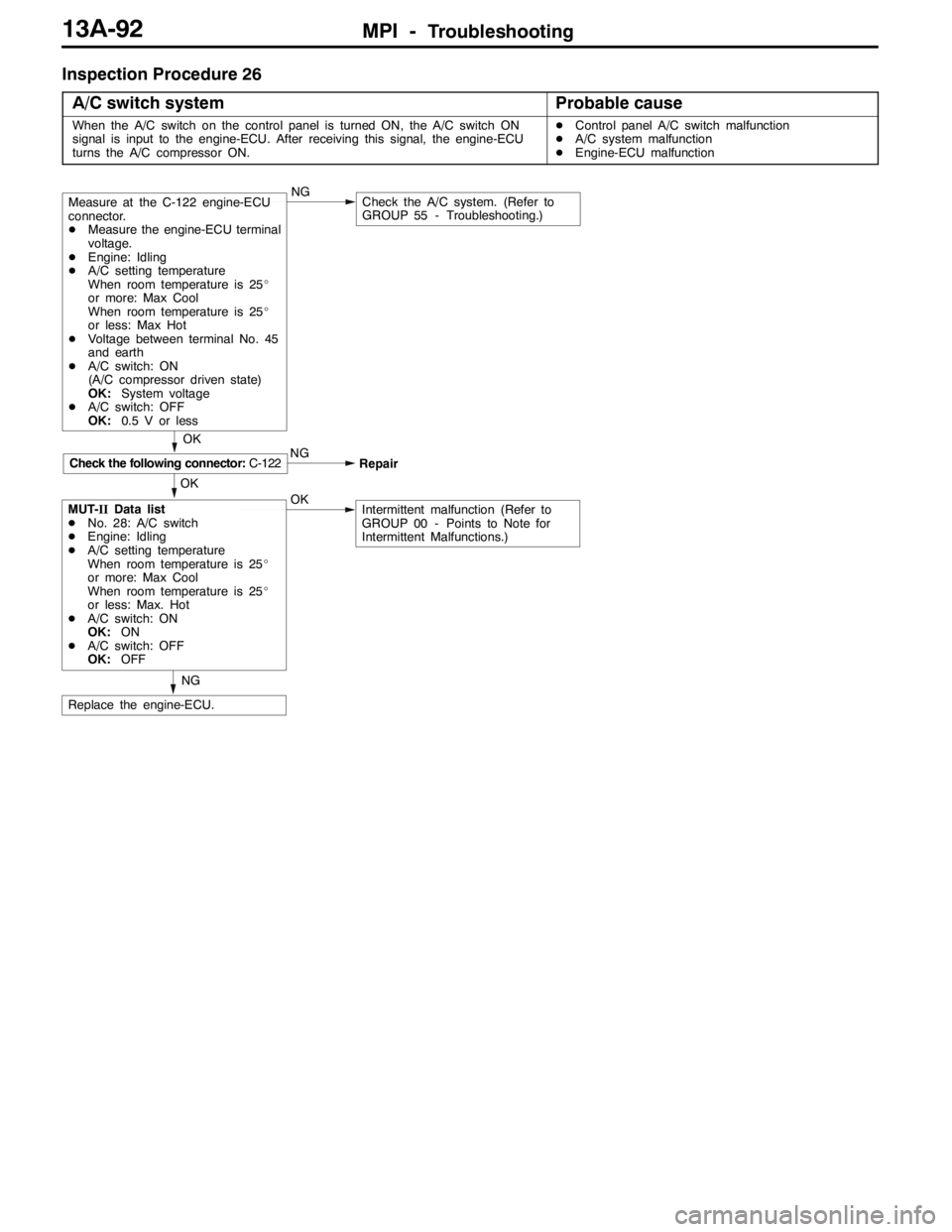
Inspection Procedure 26
A/C switch system
Probable cause
When the A/C switch on the control panel is turned ON, the A/C switch ON
signal is input to the engine-ECU. After receiving this signal, the engine-ECU
turns the A/C compressor ON.DControl panel A/C switch malfunction
DA/C system malfunction
DEngine-ECU malfunction
NG
Replace the engine-ECU.
Check the A/C system. (Refer to
GROUP 55 - Troubleshooting.)NG
OK
Intermittent malfunction (Refer to
GROUP 00 - Points to Note for
Intermittent Malfunctions.)MUT-IIData list
DNo. 28: A/C switch
DEngine: Idling
DA/C setting temperature
When room temperature is 25_
or more: Max Cool
When room temperature is 25_
or less: Max. Hot
DA/C switch: ON
OK:ON
DA/C switch: OFF
OK:OFFOK NG
OK
Check the following connector:C-122
Repair
Measure at the C-122 engine-ECU
connector.
DMeasure the engine-ECU terminal
voltage.
DEngine: Idling
DA/C setting temperature
When room temperature is 25_
or more: Max Cool
When room temperature is 25_
or less: Max Hot
DVoltage between terminal No. 45
and earth
DA/C switch: ON
(A/C compressor driven state)
OK:System voltage
DA/C switch: OFF
OK:0.5 V or less
Page 625 of 1449
MPI -Troubleshooting13A-93
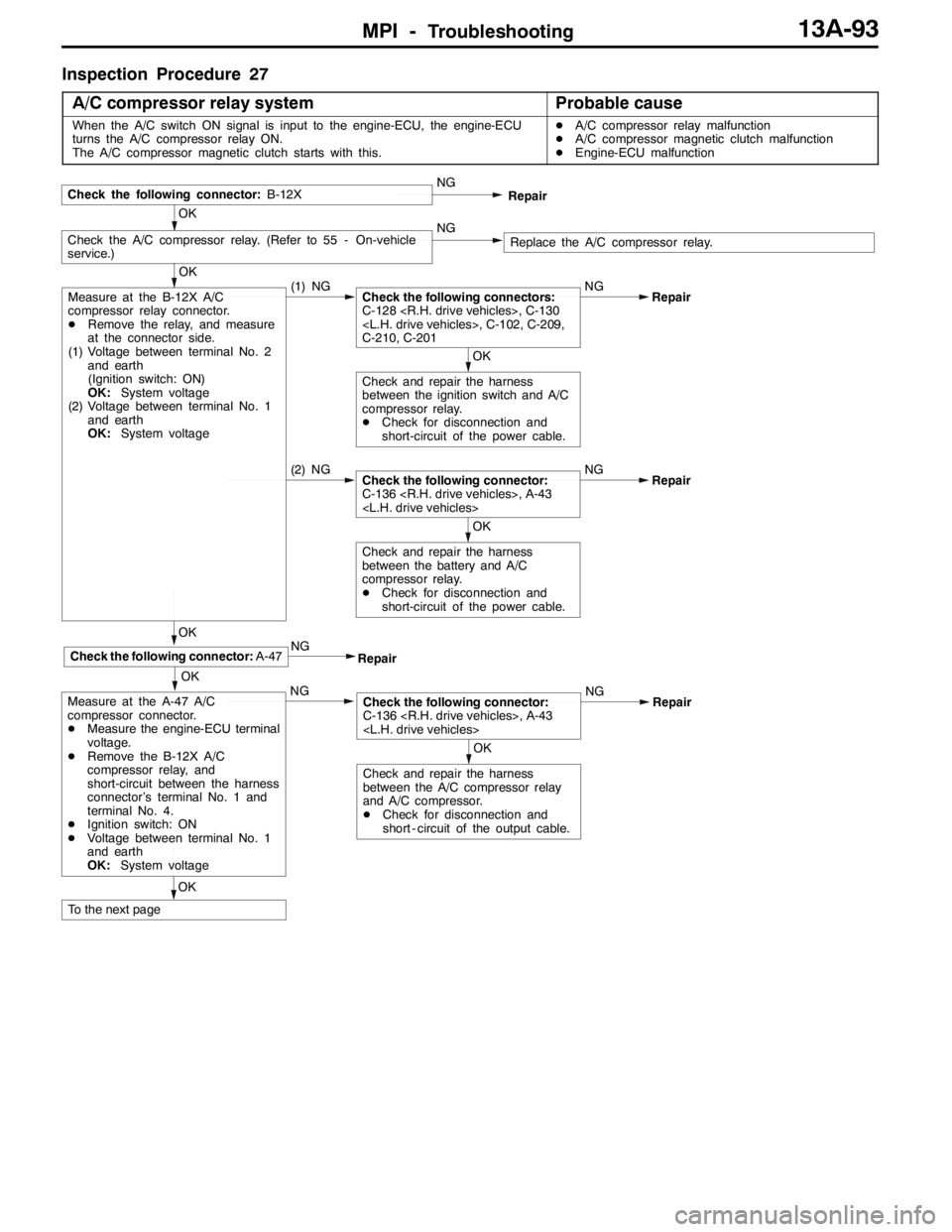
Inspection Procedure 27
A/C compressor relay system
Probable cause
When the A/C switch ON signal is input to the engine-ECU, the engine-ECU
turns the A/C compressor relay ON.
The A/C compressor magnetic clutch starts with this.DA/C compressor relay malfunction
DA/C compressor magnetic clutch malfunction
DEngine-ECU malfunction
OK
(2) NGCheck the following connector:
C-136
Check and repair the harness
between the battery and A/C
compressor relay.
DCheck for disconnection and
short-circuit of the power cable.
OK
Check the A/C compressor relay. (Refer to 55 - On-vehicle
service.)NGReplace the A/C compressor relay.
Check the following connector:B-12XNG
Repair
OK
OK
Measure at the B-12X A/C
compressor relay connector.
DRemove the relay, and measure
at the connector side.
(1) Voltage between terminal No. 2
and earth
(Ignition switch: ON)
OK:System voltage
(2) Voltage between terminal No. 1
and earth
OK:System voltage(1) NGCheck the following connectors:
C-128
C-210, C-201NG
OK
Check and repair the harness
between the ignition switch and A/C
compressor relay.
DCheck for disconnection and
short-circuit of the power cable.Repair
OKNG
Measure at the A-47 A/C
compressor connector.
DMeasure the engine-ECU terminal
voltage.
DRemove the B-12X A/C
compressor relay, and
short-circuit between the harness
connector’s terminal No. 1 and
terminal No. 4.
DIgnition switch: ON
DVoltage between terminal No. 1
and earth
OK:System voltage
To the next pageRepair
NG
OK
Check the following connector:A-47
Repair
OK
Check the following connector:
C-136
Check and repair the harness
between the A/C compressor relay
and A/C compressor.
DCheck for disconnection and
short - circuit of the output cable.Repair
Page 629 of 1449
MPI -Troubleshooting13A-97
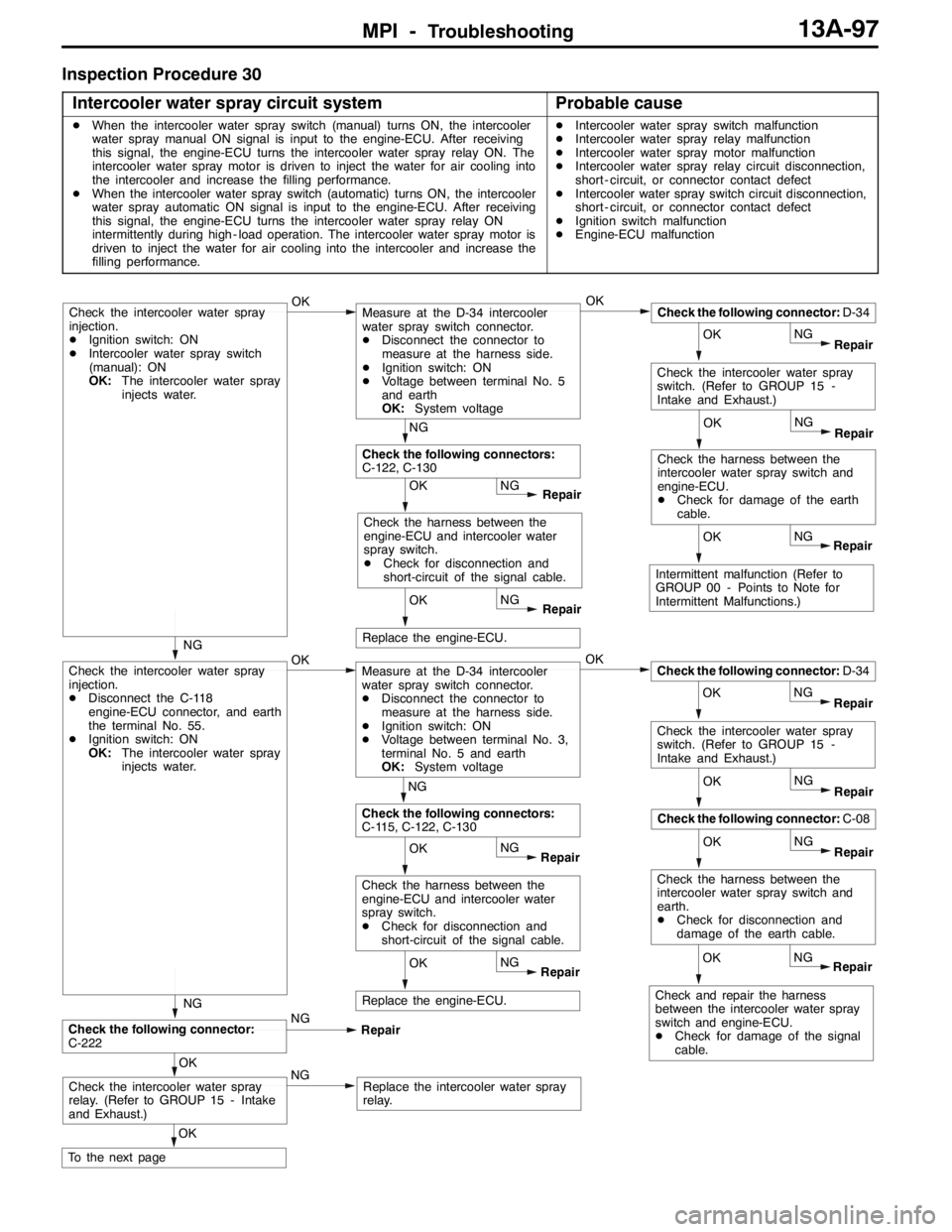
Inspection Procedure 30
Intercooler water spray circuit system
Probable cause
DWhen the intercooler water spray switch (manual) turns ON, the intercooler
water spray manual ON signal is input to the engine-ECU. After receiving
this signal, the engine-ECU turns the intercooler water spray relay ON. The
intercooler water spray motor is driven to inject the water for air cooling into
the intercooler and increase the filling performance.
DWhen the intercooler water spray switch (automatic) turns ON, the intercooler
water spray automatic ON signal is input to the engine-ECU. After receiving
this signal, the engine-ECU turns the intercooler water spray relay ON
intermittently during high - load operation. The intercooler water spray motor is
driven to inject the water for air cooling into the intercooler and increase the
filling performance.DIntercooler water spray switch malfunction
DIntercooler water spray relay malfunction
DIntercooler water spray motor malfunction
DIntercooler water spray relay circuit disconnection,
short - circuit, or connector contact defect
DIntercooler water spray switch circuit disconnection,
short - circuit, or connector contact defect
DIgnition switch malfunction
DEngine-ECU malfunction
NG
Repair OK
Replace the engine-ECU.
OK
NGOK
NG
Repair OK
Check the following connector:D-34
Check the intercooler water spray
switch. (Refer to GROUP 15 -
Intake and Exhaust.)
Check the intercooler water spray
injection.
DIgnition switch: ON
DIntercooler water spray switch
(manual): ON
OK:The intercooler water spray
injects water.
NG
Repair OK
Measure at the D-34 intercooler
water spray switch connector.
DDisconnect the connector to
measure at the harness side.
DIgnition switch: ON
DVoltage between terminal No. 5
and earth
OK:System voltage
NG
OK
Check the harness between the
engine-ECU and intercooler water
spray switch.
DCheck for disconnection and
short-circuit of the signal cable.
Repair
Intermittent malfunction (Refer to
GROUP 00 - Points to Note for
Intermittent Malfunctions.)
NG
OK
Check the harness between the
intercooler water spray switch and
engine-ECU.
DCheck for damage of the earth
cable.
Repair
NG
Repair OK
Replace the engine-ECU.
OK
NGOK
NG
Repair OK
Check the following connector:D-34
Check the intercooler water spray
switch. (Refer to GROUP 15 -
Intake and Exhaust.)
Check the intercooler water spray
injection.
DDisconnect the C-118
engine-ECU connector, and earth
the terminal No. 55.
DIgnition switch: ON
OK:The intercooler water spray
injects water.
NG
Repair OK
Measure at the D-34 intercooler
water spray switch connector.
DDisconnect the connector to
measure at the harness side.
DIgnition switch: ON
DVoltage between terminal No. 3,
terminal No. 5 and earth
OK:System voltage
NG
OK
Check the harness between the
engine-ECU and intercooler water
spray switch.
DCheck for disconnection and
short-circuit of the signal cable.
Repair
Check and repair the harness
between the intercooler water spray
switch and engine-ECU.
DCheck for damage of the signal
cable.
NG
OK
Check the harness between the
intercooler water spray switch and
earth.
DCheck for disconnection and
damage of the earth cable.
Repair
NG
Repair OK
Check the following connector:C-08
OK
Check the following connector:
C-222NG
Repair
OK
To the next page
NGReplace the intercooler water spray
relay.Check the intercooler water spray
relay. (Refer to GROUP 15 - Intake
and Exhaust.)
NG
Check the following connectors:
C-122, C-130
Check the following connectors:
C-115, C-122, C-130NG
Page 636 of 1449

MPI -Troubleshooting13A-104
Item
No.Reference
page Inspection
procedure
No. Normal condition Inspection contents Inspection
item
25Barometric
pressure
Ignition switch: ONAltitude: 0 m101 kPaCode No.
P0105
13A-15
pressure
sensor
Altitude: 0 m95 kPa
P0105
Altitude: 0 m88 kPa
Altitude: 0 m81 kPa
27Power
steering
fluidEngine: Idle operationSteering wheel
stationaryOFFCode No.
P055113A-46
fluid
pressure
switchSteering wheel turningON
28A/C switchEngine: Idle operation
(When A/C switch isA/C switch: OFFOFFProcedure
No. 2613A-92
(WhenA/Cswitchis
ON, A/C compressor
should be operating.)A/C switch: ONON
No.26
34Air flow
sensorEngine: After
warm-upIdle operationONCode No.
P010013A-13
sensor
reset
signal
warm up
3,000 r/minOFF
P0100
37Volumetric
efficiency
DEngine coolant
temperature:
Idle operation15 - 35%--
efficiencytemperature:
85 - 95_C
DLightningand
2,500 r/min15 - 35%
DLightning and
accessories:
OFFExcessive
accellerationAccording to ac-
celeration, volu-
metric efficiency
is increased.
41Injectors*1Engine: CrankingWhen engine coolant
temperature is 0_C
(injection is carried out
for all cylinders simulta-
neously)25 - 37 ms--
When engine coolant
temperature is 20_C15 - 22 ms
When engine coolant
temperature is 80_C4.2 - 6.3 ms
Injectors*2DEngine coolant
temperature:
80–95_C
Engine: Idle operation1.5 - 2.7 ms--
80–95_C
DLamps, electric
cooling fan and
allaccessories:
2,500 r/min1.2 - 2.4 ms
allaccessories:
OFF
DTransmission:
Neutral
When engine is sud-
denly racedIncreases
Page 643 of 1449

MPI -Troubleshooting13A-111
Terminal No.Normal condition Check condition (Engine condition) Check item
37Power steering fluid
pressure switchEngine: Idling after
warming upWhen steering wheel
is stationarySystem voltage
When steering wheel
is turned1 V or less
38Engine control relayIgnition switch: “LOCK” (OFF)System voltage
Ignition switch: “ON”1 V or less
39Fuel pump relay 3While engine is idling, suddenly depress the
accelerator pedal.Temporarily rises slightly
from 1 V or less.
41Alternator FR
terminalDEngine: After warm-up, idle operation
DRadiator fan: Not operating
DHead lamp: OFF→ON
DStop lamp: OFF→ON
DRear deffogger switch: OFF→ONVoltage decrease
44Intercooler water
spray switch (Auto)DIgnition switch: “ON”
DIntercooler water spray switch: ON1 V or less
DIgnition switch: “ON”
DIntercooler water spray switch: OFFSystem voltage
45A/C switchEngine: Idle operationTurn the A/C switch
OFF0.5 V or less
DA/C switch: ON
DA/C setting
temperature
When room tem-
perature is 25_C
or more: Max
Cool
When room tem-
perature is 25_C
or less: Max. HotSystem voltage
53Secondary air control
solenoid valveIgnition switch: “ON”System voltage
54Oxygen sensor
heater(Rear)
Engine: Idling after warming up1 V or less
heater(Rear)
Engine speed: 5,000r/minSystem voltage
55Intercooler water
sprayrelay
Ignition switch: “ON”System voltage
spray relay
Ignition switch: “LOCK” (OFF)1 V or less
58Tachometer signalEngine speed: 3,000r/min0.3 - 3.0 V
60Oxygen sensor
heater(front)
Engine: Idling after warming up1 V or less
heater(front)
Engine speed: 5,000r/minSystem voltage
71Ignition switch - STEngine: Cranking8 V or more
Page 653 of 1449

MPI -Troubleshooting13A-121
IDLE SPEED CONTROL SERVO (STEPPER MOTOR)
Measurement Method
1. Disconnect the idle speed control servo connector, and
connect the special tool (test harness: MB991709) in
between.
2. Connect the analyzer special patterns pickup to the idle
speed control servo-side connector terminal No. 1,
terminal No. 3, terminal No. 4 and terminal No. 6
respectively.
Alternate Method (Test harness not available)
1. Connect the analyzer special patterns pickup to
engine-ECU terminal No. 4, connection terminal No. 5,
connection terminal No. 17, and connection terminal No.
18 respectively.
Standard Wave Pattern
Observation conditions
FunctionSpecial patterns
Pattern heightHigh
Pattern selectorDisplay
Engine conditionWhen the engine coolant temperature is 20_C or below, turn the ignition switch from “LOCK”
(OFF) position to “ON” position (without starting the engine).
While the engine is idling, turn the A/C switch to ON.
Immediately after starting the warm engine
Standard wave pattern
Stepper
motor
control
signal
wave
pattern(V)
30
20
10The wave pattern
appears for an
instant, but soon
disappears.Point B
Coil reverse electromotive
force (Approx. 3×10 V)Point A
Induced electromotive force
from the motor turning
Time
Special
patterns
pickupAnalyzer
Page 655 of 1449

MPI -Troubleshooting13A-123
IGNITION COIL AND POWER TRANSISTOR
DIgnition coil primary signal
Refer to GROUP 16 - Ignition system.
DPower transistor control signal
Measurement Method
1. Disconnect the ignition coil connector, and connect the
special tool (test harness: MB991658) in between. (All
terminals should be connected.)
2. Connect the analyzer special patterns pickup to terminal
No. 3 of each ignition coil connector in turn.
Alternate Method (Test harness not available)
1. Connect the analyzer special patterns pickup to
engine-ECU terminal No. 10 (No. 1 - No. 4), terminal
No. 23 (No. 2 - No. 3) respectively.
Standard Wave Pattern
Observation condition
FunctionSpecial patterns
Pattern heightLow
Pattern selectorDisplay
Engine r/minApproximately 1,200 r/min
Standard wave pattern
Crank angle
sensor output
wave pattern
Power transistor
control signal
wave pattern(V)
75_BTDC5_BTDCT: Revolution time corresponding to a crank angle of 180_
Compression top dead center
θ: Spark
advance
angleIgnition period
OFF ON
Dwell section
T1: Time computed by the engine-ECUTime θ T1T
6
4
2
0
4
2
0
Special
patterns
pickupAnalyzer
Page 758 of 1449

ENGINE ELECTRICAL -Ignition System16-26
IGNITION SYSTEM
GENERAL INFORMATION
This system is equipped with two ignition coils (A
and B) with built-in power transistors for the No.
1 and No. 4 cylinders and the No. 2 and No. 3
cylinders respectively.
Interruption of the primary current flowing in the
primary side of ignition coil A generates a high
voltage in the secondary side of ignition coil A.
The high voltage thus generated is applied to the
spark plugs of No. 1 and No. 4 cylinders to generate
sparks. At the time that the sparks are generated
at both spark plugs, if one cylinder is at the
compression stroke, the other cylinder is at the
exhaust stroke, so that ignition of the compressed
air/fuel mixture occurs only for the cylinder which
is at the compression stroke.
In the same way, when the primary current flowing
in ignition coil B is interrupted, the high voltage
thus generated is applied to the spark plugs of
No. 2 and No. 3 cylinders.
The Engine-ECU turns the two power transistors
inside the ignition coils alternately on and off. Thiscauses the primary currents in the ignition coils
to be alternately interrupted and allowed to flow
to fire the cylinders in the order 1-3-4-2.
The Engine-ECU determines which ignition coil
should be controlled by means of the signals from
the camshaft position sensor which is incorporated
in the camshaft and from the crank angle sensor
which is incorporated in the crankshaft. It also
detects the crankshaft position in order to provide
ignition at the most appropriate timing in response
to the engine operation conditions. It also detects
the crankshaft position in order to provide ignition
at the most appropriate timing in response to the
engine operation conditions.
When the engine is cold or operated at high
altitudes, the ignition timing is slightly advanced
to provide optimum performance.
When the automatic transmission shifts gears, the
ignition timing is also retarded in order to reduce
output torque, thereby alleviating shifting shocks.
SYSTEM DIAGRAM
Barometric pressure sensor
Intake air temperature sensor
Engine coolant temperature sensor
Camshaft position sensor
Crank angle sensor
Ignition switch - ST
Vehicle speed signalEngine-ECU
Ignition coil A
Ignition coil B Ignition switch
Spark plugBattery
To tachometerCylinder No. Air flow sensor
1 4
23
Detonation sensor
Page 814 of 1449

MANUAL TRANSMISSION - Troubleshooting
INSPECTION CHART FOR DIAGNOSIS CODES
Diagnosis
code No.Diagnosis itemsReference page
12Power supply voltage (valve power supply) systemopen circuit or short-circuit22A-8
13Fail-safe relay system
21Wheel speed sensor
22Wheel speed sensor
23Wheel speed sensor
24Wheel speed sensor
25Wrong-diameter tire22A-11
26Wheel speed sensor (faulty output signal)22A-13
31Steering wheel sensor
32Steering wheel sensor
33fixed22A-16
34Steering wheel sensor
fixed22A-17
41TPS systemopen circuit or ground22A-18
42short-circuit22A-18
45Pressure sensor systemopen circuit or ground22A-19
46open earth22A-19
47abnormal power supply22A-20
51Longitudinal G sensor systemopen circuit or short-circuit22A-21
52defective sensor22A-22
56Lateral G sensor systemopen circuit or short-circuit22A-23
57defective sensor22A-24
61Stop lamp switch systemopen circuit22A-25
62ACD mode switch systemstuck22A-26
63Parking brake switch systemshort-circuit or not re-
turned to original position22A-27
65ABS monitor systemopen circuit or defective
ABS22A-28
71Proportional valve
GROUP27B
72Directional control valve
GROUP27B.
73Directional control valve
74Proportional valve