clutch MITSUBISHI LANCER EVOLUTION 2015 10.G Workshop Manual
[x] Cancel search | Manufacturer: MITSUBISHI, Model Year: 2015, Model line: LANCER EVOLUTION, Model: MITSUBISHI LANCER EVOLUTION 2015 10.GPages: 338, PDF Size: 43.12 MB
Page 235 of 338
Loading information 6-6 Driving safety
6
Be sure that the parking brake is firmly set when parked and that the gearshift lever is inthe “P” (PARK) position. When parking on a hill, it is important to set the parking brake before moving the gearshiftlever to the “P” (PARK) position. This pre- vents loading the parking brake against the transmission gear. When this happens, it isdifficult to move the gearshift lever out of the“P” (PARK) position. Never leave the engi
ne running while you
take a short sleep/rest. Also, never leave the engine running in a closed or poorly venti-lated place.
Your front bumper can be damaged if you scrape it over curbs or parking stop blocks.Be careful when traveling up or down steep slopes where your bumper can scrape the road. When leaving the vehicle unattended, always carry the key and lock all doors. Always try to park your vehicle in a well litarea.
N00629900365
It is very important to know how muchweight your vehicle can carry. This weight is called the vehicle capacity weight and includes the weight of all occupants, cargo(including the roof load) and non-factory- installed options. The tire and loading infor-
mation placard located on the driver’s door sill of your vehicle will show how much weight it may properly carry. It is important to familiarize yourself with the following terms before loading your vehicle: Vehicle maximum load on the tire: load on an individual tire that is determined bydistributing to each axle its share of the maximum loaded vehicle weight and dividing by two. Vehicle normal load on the tire: load on an individual tire that is determined by dis- tributing to each axle its share of the curbweight, accessory weight, and normal occupant weight and dividing by two. Maximum loaded vehicle weight: the sum of - (a) Curb weight; (b) Accessory weight;(c) Vehicle capacity weight; and (d) Production options weight.
For vehicles with Twin Clutch SST Parking with the engine run- ning
WA R N I N G Leaving the engine running risks injury or death from accidentally moving the gear- shift lever (manual transaxle) or the gear-shift lever (Twin Clutch SST) or from the accumulation of toxic exhaust fumes in the passenger compartment.
Where you park
WA R N I N G Do not park your vehicle in areas where combustible materials such as dry grass orleaves can come in contact with a hot exhaust, since a fire could occur.
When leaving the vehicle Loading information
WA R N I N G Never overload your vehicle. Overloading can damage your vehicle, adversely affect vehicle performance, including handling and braking, cause tire failure, and resultin an accident.
BK0210800US.bo
ok 6 ページ 2014年4月8日 火曜日 午前11時28分
Page 259 of 338
If the vehicle breaks down 8-2 For emergencies
8
N00836300190
If your vehicle breaks down on the road, move to the shoulder and turn on the hazardwarning flashers. If there is no shoulder, or the shoulder is not safe, drive in the right lane slowly, with the hazard lights flashing, untilyou come to a safe stopping place. Keep the flashers flashing. If the engine stops, there will be no power assist to the steering and brakes, making these difficult to use. The brake booster will not work, so the brakes will not grip well. The brake pedalwill be harder to press than usual. Since there is no power steering assist, the steering wheel will be hard to turn.
Get help from your passengers, bystanders, etc. to push the vehicl
e and move it to a safe
zone.
N00836400670
If the engine cannot be started because the battery is weak or dead, you can start it withthe battery from another vehicle using jumper cables.
1. Take off any metal jewelry such as watch bands or bracelets that might make an accidental electrical contact. 2. Position the vehicles close enoughtogether so that the jumper cables can reach, but be sure the vehicles aren’t touching each other. 3. You could be injured if the vehicles move. Set the parking brake firmly on each vehi- cle. Put an automatic transaxle, Twin Clutch SST or CVT in “P” (PARK) or amanual transaxle in “N” (Neutral). Turn the ignition switch to the “LOCK” posi- tion.
If the vehicle breaks down If the engine stops/fails When the engine fails at the intersection
Jump-starting the engine
WA R N I N G Follow the procedure described in this sec- tion when using the jump cable to start the engine. Failure to follow these instructions can cause serious injury or death.CAUTION Do not try to start your vehicle by pushing or towing. Vehicles with Twin Clutch SST can- not be started this way. Pushing or towing avehicle that has a manual transaxle may overheat and damage the catalytic converter. Also, there is more ri
sk of an accident when
a vehicle is being pushed or towed.NOTE
Although the battery in your vehicle is located in the trunk (refer to page 9-11), use the joint terminal in the engine compartment to jump start the engine.
CAUTION Check the other vehicle. It must have a 12- volt battery. If the other system isn’t 12-volt, both systems can be damaged.WA R N I N G Turn the ignition switch to the “LOCK” position on both vehicles. Make sure that the cables or your clothes cannot be caught by the fan or drive belt. Personalinjury could result. NOTE
Turn off all lights, heater, and other electrical loads. This will avoid sparks and help saveboth batteries.
BK0210800US.bo
ok 2 ページ 2014年4月8日 火曜日 午前11時28分
Page 263 of 338
How to change a tire 8-6 For emergencies
8
N00836900763
Before changing a tire, first stop your vehicle in a safe, flat location. 1. Park the vehicle on level and stable ground. 2. Set the parking brake firmly.3. On vehicles with manual transaxle, turn the ignition switch to the “LOCK” posi- tion, and move the gearshift lever to the“R” (Reverse) position. On vehicles with Twin Clutch SST, move the gearshift lever to the “P” (PARK)position, and turn the ignition switch to the “LOCK” position. 4. Turn on the hazard flashers and set up awarning triangle, flashing signal light, etc., at an adequate distance from the vehicle, and have all your passengersleave the vehicle.
5. To prevent the vehicle from rolling when it is raised on the jack, place chocks or blocks (A) at the tire that is diagonally opposite from the tire (B) you are chang-ing.
6. Get the jack, bar and wheel nut wrench ready. Refer to “Tools and jack” on page 8-5.
N00849600328
The compact spare tire is designed to save space in the trunk. Its lighter weight makes it easier to use if a flat tire occurs.
How to change a tire
WA R N I N G The jack should not be used for any pur- pose other than to change a tire. Never get under the vehicle or put any portion of your body under the vehicle while it is supported by the jack.
WA R N I N G Be sure to apply chocks or blocks to the correct tire when jacking up the vehicle. Ifthe vehicle moves while jacked up, the jack could slip out of position, leading to an accident.NOTE
The chocks shown in the illustration do not come with your vehicle. It is recommended that you purchase chocks or blocks and keepthem in the vehicle for use if needed. If chocks or blocks are not available, use stones or any other objects that are large enough to hold the wheel in position.
Spare tire information Compact spare tire
WA R N I N G Tires, including spare tire, degrade over time with age even when they are notbeing used. It is recommended that tires over 6 years generally be replaced even if damage is not obvious.CAUTION While the compact spare tire is stowed, the inflation pressure should be checked at least once a month to assure that it remains at the recommended inflation pressure. See the tire and loading information placard attached tothe driver’s door sill. Refer to “Tire and loading information plac- ard” on page 11-3.
BK0210800US.bo
ok 6 ページ 2014年4月8日 火曜日 午前11時28分
Page 272 of 338
9
Vehicle care and maintenanceService precautions .........
.................................................................9-2
Catalytic converter
.................................................
..........................9-2
Engine hood ..............................
.......................................................9-3
View of the engine comp
artment .....................................................9-5
Engine oil and oil filt
er ................................
....................................9-5
Engine coolant ................
.................................................................9-7
Air cleaner filter ....
.................................................
..........................9-8
Manual transaxle oil (if so
equipped) ...............................................9-9
Twin Clutch Sportronic shift transmission (Twin Clutch SST) fluid (i
f so equipped) ....................................9-9
Transfer oil ......................
.................................................................9-9
Rear axle oil ....................
.................................................................9-9
AWC control fluid ..........
.................................................................9-9
Washer fluid ....................
...............................................................9-10
Brake fluid/Clutch fluid (if
so equipped)........................................9-10
Power steering fluid
...............................................
........................ 9-11
Battery .......................................
..................................................... 9-11
Tires ..........................................
.....................................................9-12
Clutch pedal free play (if so equipped)...........................................9-19Brake pedal free play
.............................................
........................9-19
Parking brake lever stroke .............................................................9-19 Parking brake break-in
...........................................
........................9-20
Wiper blades ...................
...............................................................9-20
Emission-control system maintenance ..........................................9-20 General maintenance
.............................................
........................9-21
For cold and snowy weat
her ..........................................................9-23
Fusible links ....................
...............................................................9-23
Fuses .........................................
.....................................................9-23
Replacement of light bul
bs ...................................
......................... 9-28
Vehicle care precautions
.......................................
......................... 9-40
Cleaning the inside of you
r vehicle ............................................... 9-40
Cleaning the outside of your
vehicle ............................................. 9-41
BK0210800US.bo
ok 1 ページ 2014年4月8日 火曜日 午前11時28分
Page 276 of 338
View of the engine compartment
Vehicle care and maintenance 9-5
9
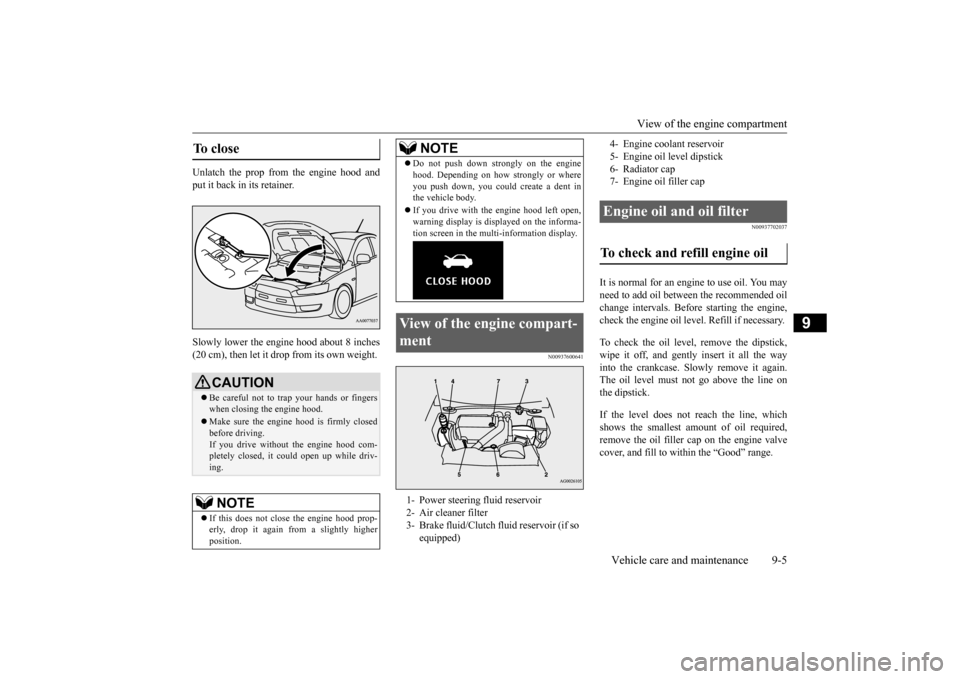
Unlatch the prop from the engine hood and put it back in its retainer. Slowly lower the engine hood about 8 inches (20 cm), then let it drop from its own weight.
N00937600641
N00937702037
It is normal for an engi
ne to use oil. You may
need to add oil between the recommended oil change intervals. Before starting the engine,check the engine oil level. Refill if necessary. To check the oil level, remove the dipstick, wipe it off, and gently insert it all the way into the crankcase. Slowly remove it again.The oil level must not go above the line on the dipstick. If the level does not reach the line, which shows the smallest amount of oil required,remove the oil filler cap on the engine valve cover, and fill to with
in the “Good” range.
To close
CAUTIONBe careful not to trap your hands or fingers when closing the engine hood. Make sure the engine hood is firmly closed before driving.If you drive without the engine hood com- pletely closed, it could open up while driv- ing.NOTE
If this does not close the engine hood prop- erly, drop it again from a slightly higher position.
Do not push down strongly on the engine hood. Depending on how strongly or where you push down, you could create a dent in the vehicle body. If you drive with the engine hood left open, warning display is displayed on the informa- tion screen in the multi-information display.
View of the engine compart- ment 1- Power steering fluid reservoir 2- Air cleaner filter 3- Brake fluid/Clutch fluid reservoir (if so
equipped)NOTE
4- Engine coolant reservoir 5- Engine oil level dipstick6- Radiator cap 7- Engine oil filler capEngine oil and oil filter To check and refill engine oil
BK0210800US.bo
ok 5 ページ 2014年4月8日 火曜日 午前11時28分
Page 280 of 338
Manual transaxle oil (if so equipped) Vehicle care and maintenance 9-9
9
N00938200165
Whenever the manual transaxle oil level is checked, add oil to maintain the proper level, if necessary. Refill or change the oil according to the table.
N00938300049
The Twin Clutch Sportronic shift transmis-sion (Twin Clutch SST) should be maintained and serviced by an authorized Mitsubishi Motors dealer or a repair facility of yourchoice to obtain the best performance and longest life. It is impor
tant that the transmis-
sion fluid is kept at the correct level.
Use only Mitsubishi Motors Genuine SSTF-I to ensure optimum transmission performance. Mitsubishi Motors Corporation does not rec- ommend the addition of any fluid additives to the transmission.
N00938400255
Whenever the transfer oil level is checked,add oil as necessary to maintain the proper level. Fill or change the oil according to thetable.
N00915200243
Whenever the oil level is checked, add oil asnecessary to maintain the proper level.Fill or change oil according to the table.
N00915300013
Remove the lid on the trunk room right side trim. Check the fluid level in the reservoir 90 min-utes or more after turning the ignition switch to the “LOCK” position. Check to make certain that the AWC controlfluid level is always between the “MAX” and “MIN” level markings on the fluid reservoir and refill the fluid, if necessary.
Manual transaxle oil
(if so
equipped)Oil type
Lubricant
Mitsubishi Motors Genuine NEW MULTI GEAR OIL API
Classification GL-3
Viscosity range
SAE 75W-80
Twin Clutch Sportronic shift transmission (Twin Clutch SST) fluid
(if so equipped)
Fluid type
CAUTION Using the improper transmission fluid may damage the transaxle.
Special additives
Transfer oil Oil type Lubri- cant
Mitsubishi Motors Genuine LSD
gear oil or equivalent
Rear axle oil Oil type Lubri- cant
For differen- tial mecha- nism
Mitsubishi Motors Genuine LSD gear
oil
For torque transfer mechanism
MITSUBISHI MOTORS Genu- ine ATF SP III
AWC control fluid To check the fluid level
BK0210800US.bo
ok 9 ページ 2014年4月8日 火曜日 午前11時28分
Page 281 of 338
Washer fluid 9-10 Vehicle care and maintenance
9
N00938600257
The windshield washer fluid reservoir is in the trunk. Check the washer fluid level at regular inter- vals and add washer fluid to reservoir if nec-essary.
When freezing weather is anticipated, flush out the water in the reservoir by operating the pump. Fill the reservoir with windshield anti-freeze (not radiator antifreeze), and operate the system for a few seconds to flush out the residual water.
N00938700232
The brake fluid and the clutch fluid share thereservoir tank.
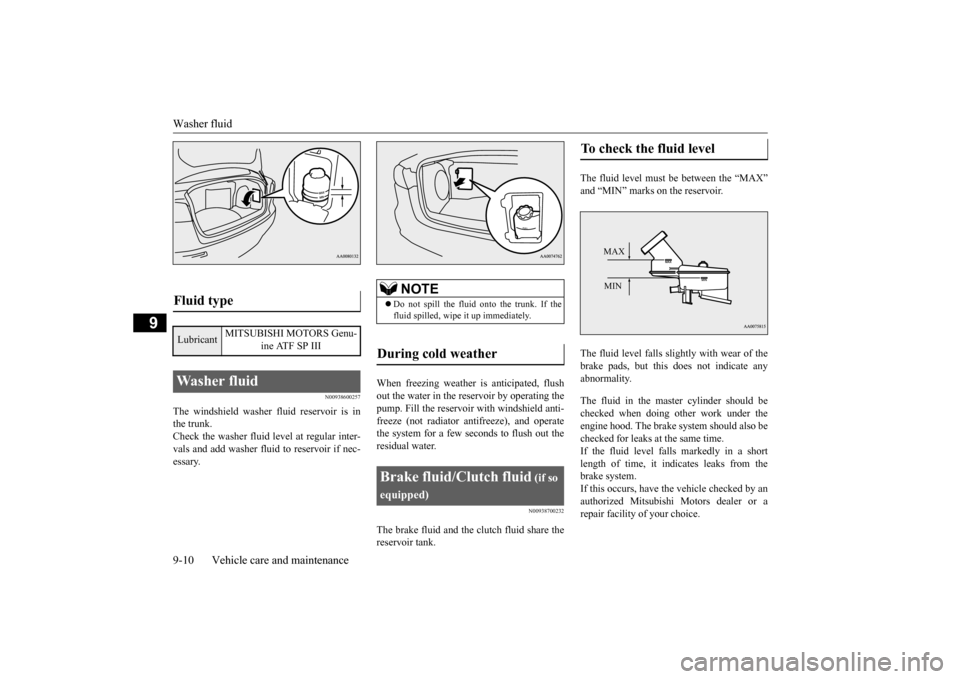
The fluid level must be between the “MAX” and “MIN” marks on the reservoir. The fluid level falls slightly with wear of the brake pads, but this does not indicate any abnormality. The fluid in the master cylinder should be checked when doing other work under theengine hood. The brake system should also be checked for leaks at the same time. If the fluid level falls markedly in a shortlength of time, it indicates leaks from the brake system. If this occurs, have the vehicle checked by anauthorized Mitsubishi Motors dealer or a repair facility of your choice.
Fluid type Lubricant
MITSUBISHI MOTORS Genu-
ine ATF SP III
Washer fluid
NOTE
Do not spill the fluid onto the trunk. If the fluid spilled, wipe it up immediately.
During cold weather Brake fluid/Clutch fluid
(if so
equipped)
To check the fluid level
MAX MIN
BK0210800US.bo
ok 10 ページ 2014年4月8日 火曜日 午前11時28分
Page 290 of 338
Clutch pedal free play (if so equipped) Vehicle care and maintenance 9-19
9
N00940000359
In some areas of the country, snow tires are required for winter driving. If snow tires arerequired in your area, you must choose snow tires of the same size and type as the original tires provided with your vehicle. Snow tiresshould also be installed on all four wheels. Otherwise your safety and vehicle handling can be reduced.Even where laws may permit it, snow tiresshould not be operated at sustained speeds over 75 mph (120 km/h).
N00940100015 N00940201097
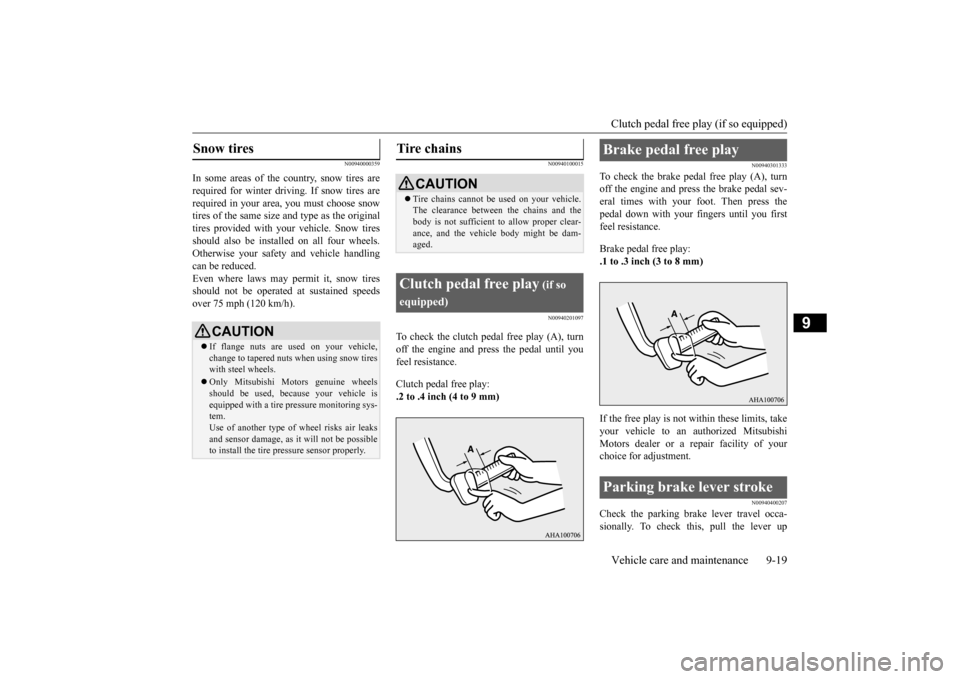
To check the clutch pedal free play (A), turn off the engine and press the pedal until you feel resistance. Clutch pedal free play: .2 to .4 inch (4 to 9 mm)
N00940301333
To check the brake pedal free play (A), turnoff the engine and press the brake pedal sev-eral times with your foot. Then press the pedal down with your fingers until you first feel resistance. Brake pedal free play: .1 to .3 inch (3 to 8 mm) If the free play is not within these limits, take your vehicle to an authorized Mitsubishi Motors dealer or a repair facility of your choice for adjustment.
N00940400207
Check the parking brake lever travel occa-sionally. To check this, pull the lever up
Snow tires
CAUTION If flange nuts are used on your vehicle, change to tapered nuts when using snow tireswith steel wheels. Only Mitsubishi Motors genuine wheels should be used, because your vehicle is equipped with a tire pressure monitoring sys- tem.Use of another type of wheel risks air leaks and sensor damage, as it will not be possible to install the tire pressure sensor properly.
Tire chains
CAUTION Tire chains cannot be used on your vehicle. The clearance between the chains and the body is not sufficient to allow proper clear- ance, and the vehicle body might be dam-aged.
Clutch pedal free play
(if so
equipped)
Brake pedal free play Parking brake lever stroke
BK0210800US.bo
ok 19 ページ 2014年4月8日 火曜日 午前11時28分
Page 328 of 338
Battery
Specifications 11-5
11
N01147800212
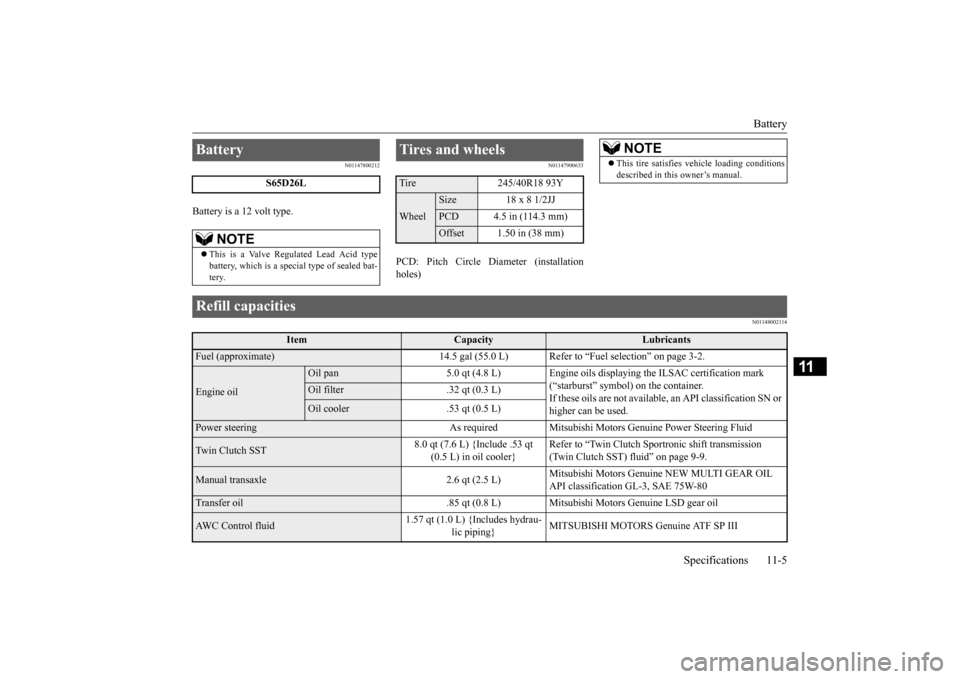
Battery is a 12 volt type.
N01147900633
PCD: Pitch Circle Diameter (installation holes)
N01148002114
Battery
S65D26L
NOTE
This is a Valve Regulated Lead Acid type battery, which is a special type of sealed bat- tery.
Tires and wheels Tire 245/40R18 93YWheel
Size 18 x 8 1/2JJPCD 4.5 in (114.3 mm)Offset 1.50 in (38 mm)
NOTE
This tire satisfies vehicle loading conditions described in this owner’s manual.
Refill capacities
Item
Capacity
Lubricants
Fuel (approximate) 14.5 gal (55.0 L) Refer
to “Fuel selection” on page 3-2.
Engine oil
Oil pan 5.0 qt (4.8 L) Engine oils displaying the ILSAC certification mark
(“starburst” symbol) on the container.If these oils are not available,
an API classification SN or
higher can be used.
Oil filter .32 qt (0.3 L)Oil cooler .53 qt (0.5 L)
Power steering As required Mitsubishi
Motors Genuine Power Steering Fluid
Twin Clutch SST
8.0 qt (7.6 L) {Include .53 qt
(0.5 L) in oil cooler}
Refer to “Twin Clutch Sportronic shift transmission (Twin Clutch SST) fluid” on page 9-9.
Manual transaxle 2.6 qt (2.5 L)
Mitsubishi Motors Genuine NEW MULTI GEAR OIL API classification GL-3, SAE 75W-80
Transfer oil .85 qt (0.8 L) Mitsubishi Motors Genuine LSD gear oilAWC Control fluid
1.57 qt (1.0 L) {Includes hydrau-
lic piping}
MITSUBISHI MOTORS Genuine ATF SP III
BK0210800US.bo
ok 5 ページ 2014年4月8日 火曜日 午前11時28分
Page 329 of 338
Refill capacities 11-6 Specifications
11
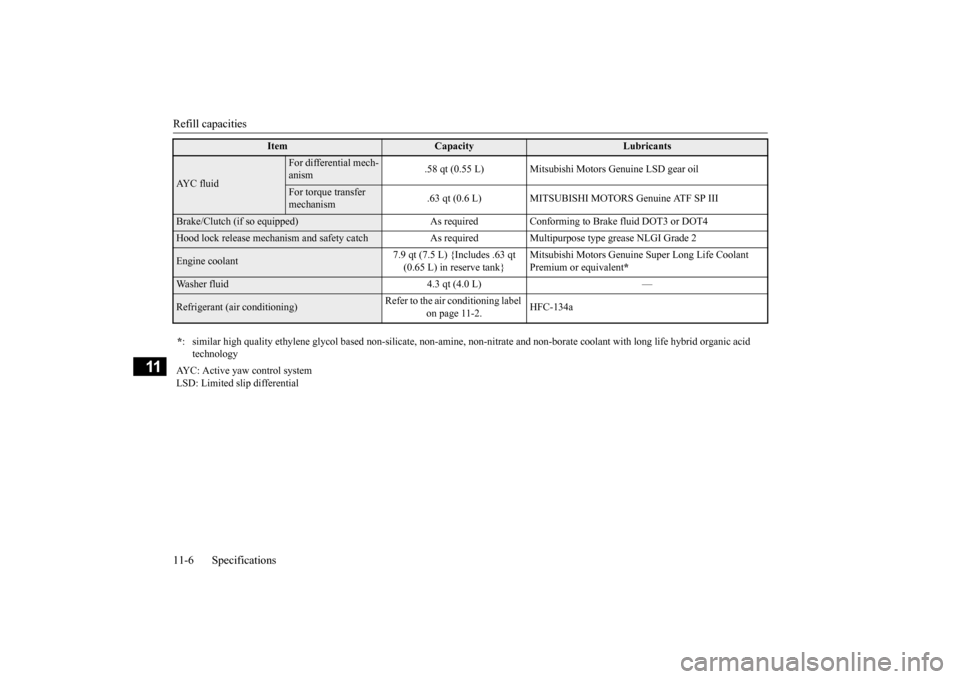
AYC fluid
For differential mech- anism
.58 qt (0.55 L) Mitsubishi Motors Genuine LSD gear oil
For torque transfer mechanism
.63 qt (0.6 L) MITSUBISHI
MOTORS Genuine ATF SP III
Brake/Clutch (if so equipped) As required Conforming to Brake fluid DOT3 or DOT4 Hood lock release mechanism and safety catch As required Multipurpose type grease NLGI Grade 2 Engine coolant
7.9 qt (7.5 L) {Includes .63 qt (0.65 L) in reserve tank}
Mitsubishi Motors Genuine Super Long Life Coolant Premium or equivalent
*
Washer fluid 4.3 qt (4.0 L) — Refrigerant (air conditioning)
Refer to the air conditioning label
on page 11-2.
HFC-134a
* : similar high quality ethylene glycol based non-silicate, non-a
mine, non-nitrate and non-borate coolant with long life hybrid o
rganic acid
technology
AYC: Active yaw control system LSD: Limited slip differential
Item
Capacity
Lubricants
BK0210800US.bo
ok 6 ページ 2014年4月8日 火曜日 午前11時28分