ECU MITSUBISHI LANCER SPORTBACK 2014 8.G Repair Manual
[x] Cancel search | Manufacturer: MITSUBISHI, Model Year: 2014, Model line: LANCER SPORTBACK, Model: MITSUBISHI LANCER SPORTBACK 2014 8.GPages: 422, PDF Size: 55.11 MB
Page 330 of 422
Antenna
Comfort controls 7-59
7
Here is a list of symptoms, causes and responses
if you think something is not working properly.
N00734200468
Turn the pole (A) counterclockwise.
Screw the pole (A) clockwise into the base (B) until it is securely retained.
If You Think Something Is Not Working Properly...
Symptoms
Cause
Response
There is no sound or quiet sound.
The volume is turned to its minimum. Adjust the volume.
“Adjust Volume” (P.7-36)
The balance or fader is turned to one side. Adjust the balance or fader.
“Adjust Audio Quality and Volume Balance” (P.7-53)
The disc cannot be inserted.
A disc is already in the product. Eject the disc.
“Insert/Eject Discs” (P.7-36)
There is no disc in the product, but the prod- uct says it is loading.
Press the eject button once. “Insert/Eject Discs” (P.7-36)
The disc cannot be played. The disc is inserted upside down. Insert with the label side up.
The disc has condensation on it. Wait a while before inserting.The disc is dirty. Clean the read surface of the disc.
The sound skips in the same place.
The disc is damaged or dirty. Check the disc.
There is no sound, even if the disc is inserted.
Damage to or dirt on the disc means that its data cannot be read.
Check the disc. Additionally, if using CD-R/RW discs, their charac- teristics may render them unable to be played.
Antenna To remove
To install
BK0200700US.bo
ok 59 ページ 2013年2月15日 金曜日 午後12時17分
Page 346 of 422
Towing
For emergencies 8-13
8
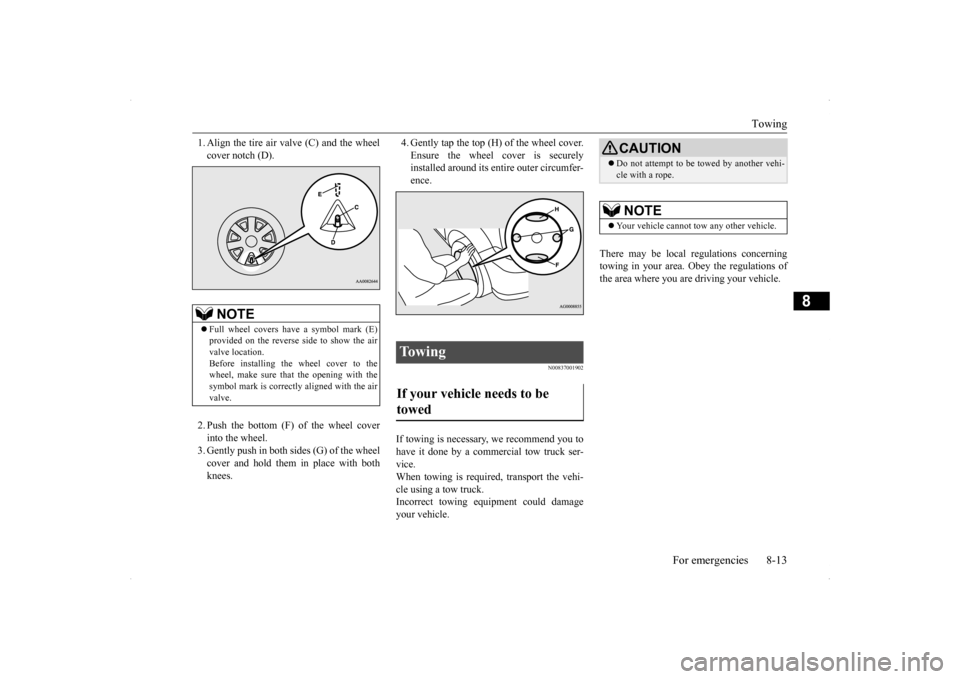
1. Align the tire air valve (C) and the wheel cover notch (D). 2. Push the bottom (F) of the wheel cover into the wheel. 3. Gently push in both sides (G) of the wheel cover and hold them in place with bothknees.
4. Gently tap the top (H) of the wheel cover. Ensure the wheel cover is securely installed around its entire outer circumfer- ence.
N00837001902
If towing is necessary, we recommend you to have it done by a commercial tow truck ser- vice.When towing is required, transport the vehi-cle using a tow truck. Incorrect towing equipment could damage your vehicle.
There may be local regulations concerning towing in your area. Obey the regulations of the area where you are driving your vehicle.
NOTE
Full wheel covers have a symbol mark (E) provided on the reverse side to show the airvalve location. Before installing the wheel cover to the wheel, make sure that the opening with thesymbol mark is correctly aligned with the air valve.
To w i n g If your vehicle needs to be towed
CAUTION Do not attempt to be towed by another vehi- cle with a rope.NOTE
Your vehicle cannot tow any other vehicle.
BK0200700US.bo
ok 13 ページ 2013年2月15日 金曜日 午後12時17分
Page 347 of 422
Towing 8-14 For emergencies
8
Place the gearshift lever in the “Neutral” position. Turn the ignition switch to the “ACC” posi-tion and secure the steering wheel in a straight-ahead position with a rope or tie- down strap. Never place the ignition switch inthe “LOCK” position when towing. Release the parking brake. Place the gearshift lever in the “Neutral”position (manual transaxle) or the selector
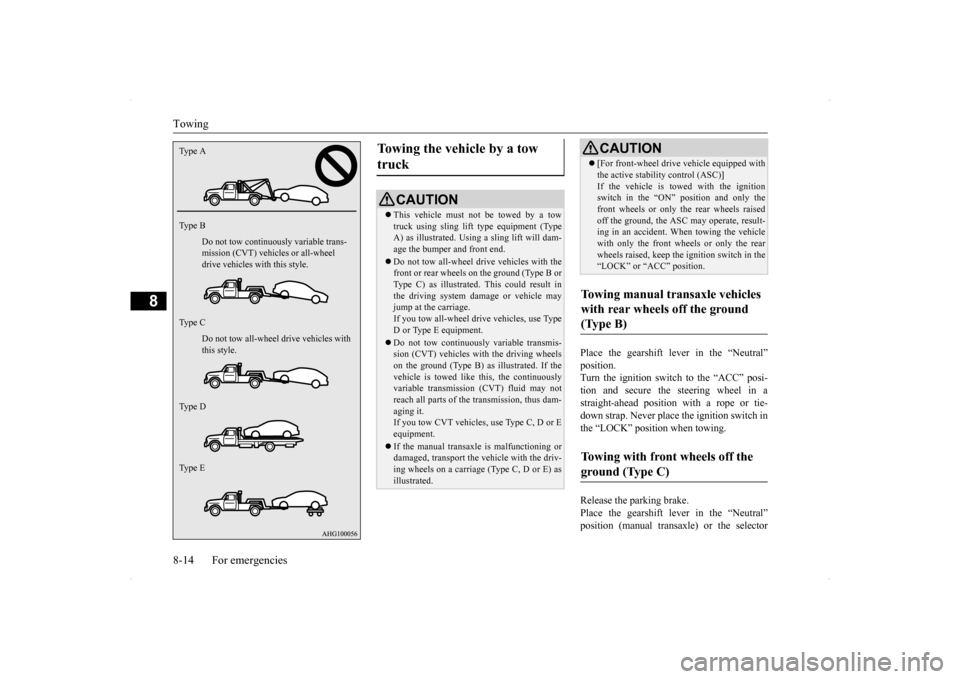
Type A Type B
Do not tow continuously variable trans- mission (CVT) vehicles or all-wheel drive vehicles with this style. Do not tow all-wheel drive vehicles with this style.
Type C Type D Type E
Towing the vehicle by a tow truck
CAUTION This vehicle must not be towed by a tow truck using sling lift type equipment (TypeA) as illustrated. Using a sling lift will dam- age the bumper and front end. Do not tow all-wheel drive vehicles with the front or rear wheels on the ground (Type B or Type C) as illustrated. This could result inthe driving system damage or vehicle may jump at the carriage. If you tow all-wheel drive vehicles, use TypeD or Type E equipment. Do not tow continuously variable transmis- sion (CVT) vehicles with the driving wheels on the ground (Type B) as illustrated. If the vehicle is towed like this, the continuouslyvariable transmission (CVT) fluid may not reach all parts of the transmission, thus dam- aging it.If you tow CVT vehicles, use Type C, D or E equipment. If the manual transaxle is malfunctioning or damaged, transport the vehicle with the driv- ing wheels on a carriage (Type C, D or E) as illustrated.
[For front-wheel drive vehicle equipped with the active stability control (ASC)] If the vehicle is towed with the ignition switch in the “ON” position and only the front wheels or only the rear wheels raisedoff the ground, the ASC may operate, result- ing in an accident. When towing the vehicle with only the front wheels or only the rearwheels raised, keep the ignition switch in the “LOCK” or “ACC” position.
Towing manual transaxle vehicles with rear wheels off the ground (Type B) Towing with front wheels off the ground (Type C)
CAUTION
BK0200700US.bo
ok 14 ページ 2013年2月15日 金曜日 午後12時17分
Page 353 of 422
Engine hood 9-4 Vehicle care and maintenance
9
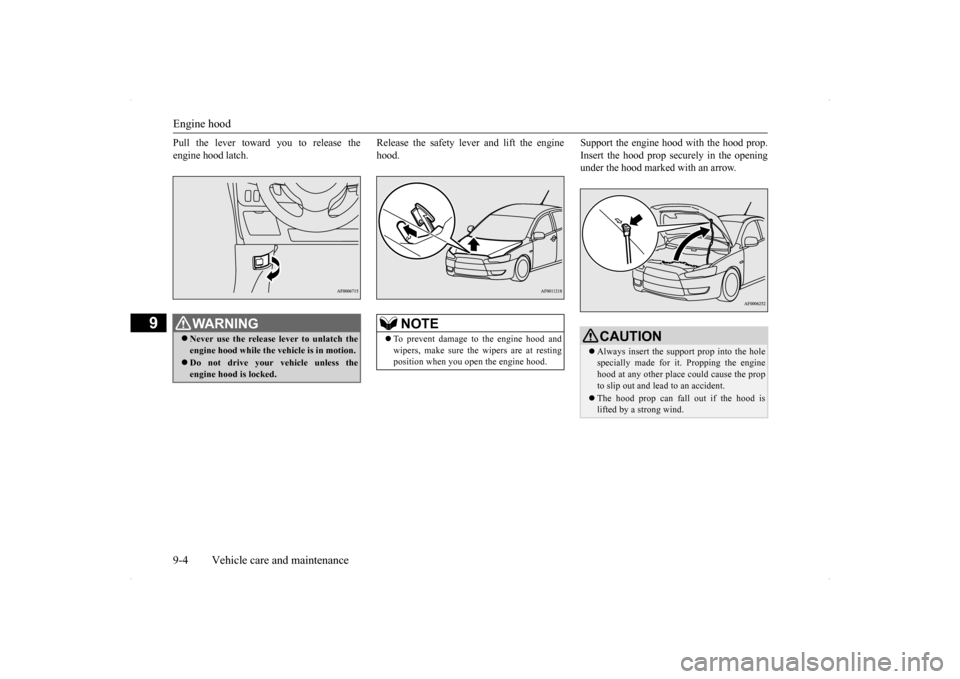
Pull the lever toward you to release the engine hood latch.
Release the safety lever and lift the engine hood.
Support the engine hood with the hood prop. Insert the hood prop securely in the opening under the hood marked with an arrow.
WA R N I N G Never use the release lever to unlatch the engine hood while the vehicle is in motion. Do not drive your vehicle unless the engine hood is locked.
NOTE
To prevent damage to the engine hood and wipers, make sure the wipers are at restingposition when you open the engine hood.
CAUTION Always insert the support prop into the hole specially made for it. Propping the engine hood at any other place could cause the propto slip out and lead to an accident. The hood prop can fall out if the hood is lifted by a strong wind.
BK0200700US.bo
ok 4 ページ 2013年2月15日 金曜日 午後12時17分
Page 364 of 422
Battery
Vehicle care and maintenance 9-15
9
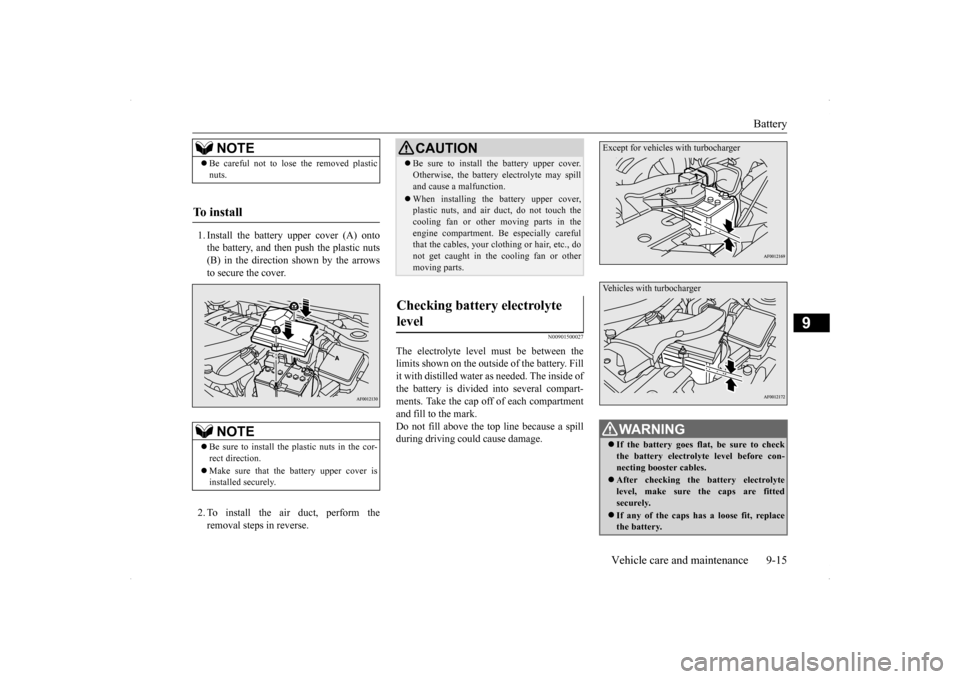
1. Install the battery upper cover (A) onto the battery, and then push the plastic nuts (B) in the direction shown by the arrows to secure the cover. 2. To install the air duct, perform the removal steps in reverse.
N00901500027
The electrolyte level must be between thelimits shown on the outside of the battery. Fill it with distilled water as needed. The inside ofthe battery is divided into several compart- ments. Take the cap off of each compartment and fill to the mark.Do not fill above the top line because a spill during driving could cause damage.
NOTE
Be careful not to lose the removed plastic nuts.
To install
NOTE
Be sure to install the plastic nuts in the cor- rect direction. Make sure that the battery upper cover is installed securely.
CAUTION Be sure to install the battery upper cover. Otherwise, the battery electrolyte may spill and cause a malfunction. When installing the battery upper cover, plastic nuts, and air
duct, do not touch the
cooling fan or other moving parts in the engine compartment. Be especially carefulthat the cables, your clothing or hair, etc., do not get caught in the cooling fan or other moving parts.
Checking battery electrolyte level
WA R N I N G If the battery goes flat, be sure to check the battery electrolyte level before con- necting booster cables. After checking the battery electrolyte level, make sure the caps are fittedsecurely. If any of the caps has a loose fit, replace the battery.
Except for vehicles with turbochargerVehicles with turbocharger
BK0200700US.bo
ok 15 ページ 2013年2月15日 金曜日 午後12時17分
Page 366 of 422
Tires
Vehicle care and maintenance 9-17
9
N00939201563
It is important to fami
liarize yourself with the
following terms: Cold tire pressure: • The measured pressure after the vehiclehas been parked for at least three hours, or • The measured pressure when the vehicleis driven less than 1 mile (1.6 km) after having been parked for three hours.
Maximum inflation pressure: the maxi- mum permissible cold tire inflation pres- sure for this tire.
Recommended inflation pressure: the inflation pressure for optimum tire perfor- mance. Intended outboard sidewall: • The sidewall that contains a whitewall, bears white lettering or bears manufac- turer, brand, and/or model name moldingthat is higher or deeper than the same molding on the other sidewall of the tire, or• The outward facing sidewall of an asym-metrical tire that has a particular side that must always face outward when mounted on a vehicle.
Passenger car tire: a tire intended for use on passenger cars, multipurpose passen- ger vehicles, and trucks, that have a grossvehicle weight rating (GVWR) of 10,000 pounds or less. Light truck (LT) tire: a tire designated by its manufacturer as primarily intended for use on lightweight trucks or multipurpose passenger vehicles. Tread: portion of a tire that comes into contact with the road. Tread rib: a tread section running circum- ferentially around a tire. Tread separation: pulling away of the tread from the tire carcass. Carcass: the tire structure, except tread and sidewall rubber which, when inflated, bears the load.
Battery terminals and related accessories contain lead and lead compounds. Wash hands after handling. NOTE
Check each battery terminal for corrosion. You can stop more corrosion by washing with a solution of baking soda and water.Grease the posts and clamps after cleaning or tightening them. Check to see that the battery is securely installed and cannot be moved. Also check each terminal for tightness. If you will not be driving your vehicle for a long period of time, remove the battery andstore it in a place where the battery fluid will not freeze. Memory data for settings made by the user may be erased when the battery isremoved. If this happens, reset the settings again using the relevant procedures. The bat- tery only should be stored with a full charge. Before cleaning the battery, tighten all the filler port caps to keep dirt and moisture out.WA R N I N G
Tires
WA R N I N G Driving with tires that are worn, damaged or improperly inflated is dangerous. These type tire conditions will adversely affect vehicle performance.These type tire conditions can also cause a tread separation or blowout which may result in an accident causing seriousinjury or death. Tires, including spare tire, degrade over time with age even when they are not being used. It is recommended that tires over 6 years generally be replaced even ifdamage is not obvious.
BK0200700US.bo
ok 17 ページ 2013年2月15日 金曜日 午後12時17分
Page 375 of 422
General maintenance 9-26 Vehicle care and maintenance
9
N00941000037
Check the hose surfaces for any heat and mechanical damage, hard and brittle rubber,cracking, tears, cuts and abrasions. Pay spe- cial attention to the hoses closest to high heat sources such as the exhaust manifold. Checkall the hose connections, such as clamps and couplings, to make sure they are secure and that there are no leaks. If you see any wear ordamage, replace the hoses immediately.
N00950100050
Have the valve clearance checked at anauthorized Mitsubishi Motors dealer at themileage specified in the “WARRANTY AND MAINTENANCE MANUAL”. If the engine sounds abnormally loud, haveadjustments made by an authorized Mitsubishi Motors dealer.
N00941300186
Check these regularly for damage or leaks in the fuel lines and connections. Check the fuel tank filler cap for damage or looseness. Pay special attention to the fuel lines closest to
high heat sources such as the exhaust mani- fold.
N00941400116
If the fuel-vapor vent line is clogged or dam- aged, the fuel-vapor mixture will escape, pol- luting the air.Have the system checked at an authorized Mitsubishi Motors dealer at the mileage spec- ified in the “WARRANTY AND MAINTE-NANCE MANUAL”.
N00941500159
The next pages list the maintenance servicerecommended by Mitsubishi Motors Corpo- ration. In addition to the general maintenance that needs to be performed at the times listed,
there are other parts which do not usually need regular maintenance. But, if any of these parts stops working prop- erly, your vehicle performance could suffer.Have these items checked if you notice a problem with them. See your authorized Mitsubishi Motors dealer for assistance, if you have any questions.
N00941600075
Good brakes are essential to safe driving. Check the brake pads for wear. For good braking performance, replace the brake padswith the same type pads as the originals.
N00941700047
Brake hoses and tubing should be checkedfor: Severe surface cracking, scuffing or worn spots. If the fabric casing of the hose is showing through any cracks or worn spotsin the rubber hose cover, the hose should be replaced. The brakes can fail if the hose wears through. Improper installation may cause twisting, or wheel, tire or chassis interference.
Fuel hoses Intake valve clearance Fuel system (tank, pipe line and connection, and fuel tank filler cap)
WA R N I N G If you see a fuel leak or if you smell fuel, do not run the engine. Any spark (includ- ing from the ignition), flame or smokingmaterial could cause an explosion or fire. Call an authorized Mitsubishi Motors dealer or a repair facility of your choicefor assistance.
Evaporative emission control system (except evaporative emission canister) General maintenance
Disc brake pads Brake hoses
BK0200700US.bo
ok 26 ページ 2013年2月15日 金曜日 午後12時17分
Page 380 of 422
Fuses
Vehicle care and maintenance 9-31
9
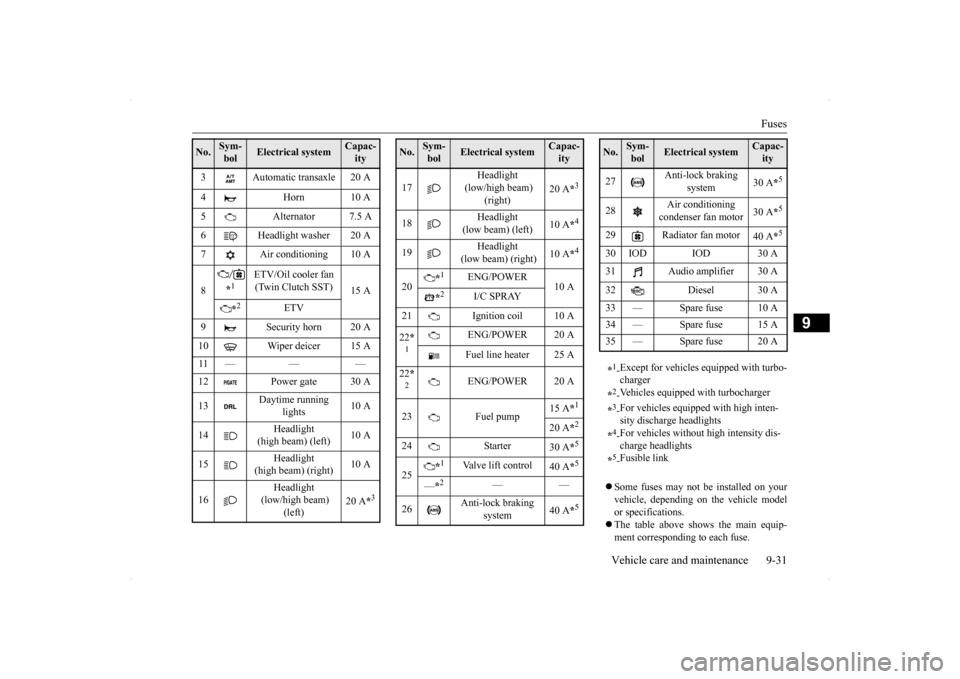
Some fuses may not be installed on your vehicle, depending on the vehicle model or specifications. The table above shows the main equip- ment corresponding to each fuse.
3 Automatic transaxle 20 A 4 Horn 10 A 5 Alternator 7.5 A 6 Headlight washer 20 A 7 Air conditioning 10 A 8
*1
ETV/Oil cooler fan (Twin Clutch SST)
15 A
*2
ETV
9 Security horn 20 A 10 Wiper deicer 15 A 11 — — — 12 Power gate 30 A 13
Daytime running
lights
10 A
14
Headlight
(high beam) (left)
10 A
15
Headlight
(high beam) (right)
10 A
16
Headlight
(low/high beam)
(left)
20 A
*3
No.
Sym- bol
Electrical system
Capac-ity
17
Headlight
(low/high beam)
(right)
20 A
*3
18
Headlight
(low beam) (left)
10 A
*4
19
Headlight
(low beam) (right)
10 A
*4
20
*1
ENG/POWER
10 A
*2
I/C SPRAY
21 Ignition coil 10 A 22 *1
ENG/POWER 20 A Fuel line heater 25 A
22 *2
ENG/POWER 20 A
23 Fuel pump
15 A
*1
20 A
*2
24 Starter
30 A
*5
25
*1
Valve lift control
40 A
*5
—*2
——
26
Anti-lock braking
system
40 A
*5
No.
Sym- bol
Electrical system
Capac-ity
27
Anti-lock braking
system
30 A
*5
28
Air conditioning condenser fan motor
30 A
*5
29 Radiator fan motor
40 A
*5
30 IOD IOD 30 A 31 Audio amplifier 30 A 32 Diesel 30 A 33 — Spare fuse 10 A 34 — Spare fuse 15 A35 — Spare fuse 20 A *1- Except for vehicles equipped with turbo- charger
*2- Vehicles equipped with turbocharger
*3- For vehicles equipped with high inten- sity discharge headlights
*4- For vehicles without high intensity dis- charge headlights
*5- Fusible link
No.
Sym- bol
Electrical system
Capac-ity
BK0200700US.bo
ok 31 ページ 2013年2月15日 金曜日 午後12時17分
Page 381 of 422
Fuses 9-32 Vehicle care and maintenance
9
There are no 7.5 A, 25 A or 30 A spare fuses. If a fuse of one of these capacities blows, replace it temporarily by borrowing one of the fuses indicated below.7.5 A: 10 A spare fuse 25 A: 20 A spare fuse 30 A: 30 A audio amplifier fuseReplace the borrowed fuse with a fuse that has the correct capacity as soon as possible.
N00954900085
1. Before replacing a fuse, always turn off the electrical item connected to the fuseand turn the ignition switch to the “LOCK” position.
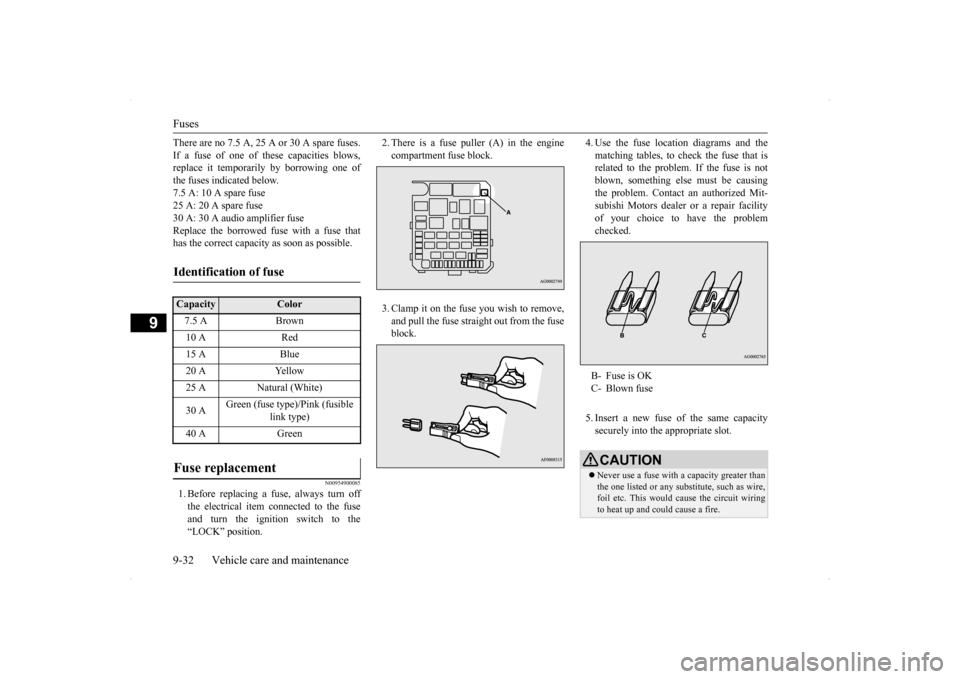
2. There is a fuse puller (A) in the engine compartment fuse block. 3. Clamp it on the fuse you wish to remove, and pull the fuse straight out from the fuse block.
4. Use the fuse location diagrams and the matching tables, to check the fuse that is related to the problem. If the fuse is not blown, something else must be causingthe problem. Contact an authorized Mit- subishi Motors dealer or a repair facility of your choice to have the problemchecked. 5. Insert a new fuse of the same capacity securely into the appropriate slot.
Identification of fuse Capacity
Color
7.5 A Brown10 A Red15 A Blue20 A Yellow25 A Natural (White) 30 A
Green (fuse type)/Pink (fusible
link type)
40 A Green
Fuse replacement
B- Fuse is OK C- Blown fuseCAUTION Never use a fuse with a capacity greater than the one listed or any substitute, such as wire, foil etc. This would cause the circuit wiringto heat up and could cause a fire.
BK0200700US.bo
ok 32 ページ 2013年2月15日 金曜日 午後12時17分
Page 417 of 422
Alphabetical index 12-2
12
Consumer information
........................
10-2
Continuously variable transmission (CVT)
....
5-61 Fluid
.....................
...............
9-11
, 11-6
Selector lever operation
...................
5-62
Sports mode
..................
.................
5-66
Coolant (engine)
..........................
9-8
, 11-6
Cruise control
....................
.................
5-94
Cup holder
....................
...................
5-189
D
Daytime running lights
Bulb capacity
................
.................
9-33
Replacement
.................
.................
9-37
Defogger (rear window)
....................
5-157
Defrosting or defogging (windshield, door windows)
.................
7-9
, 7-14
, 7-19
, 7-24
Digital clock
Time setting
..................
.................
7-56
Dimensions
...................
.....................
11-4
Dimmer (high/low beam change)
.......
5-148
Disc brake pads
.................
.................
9-26
Dome light (rear)
Bulb capacity
................
.................
9-35
Replacement
.................
.................
9-47
Switch
......................
...................
5-185
Dome light/Reading lights
Bulb capacity
................
.................
9-35
Replacement
...................
................
9-46
Switch
.....................
.....................
5-184
Doors
Lock
.......................
.......................
5-36
Power door locks
............................
5-38
Driving during cold weather
..................
6-4
Driving, alcohol and drugs
....................
6-2
Dual height adjustable cargo floor board
......
5-191
E
Electric rear window defogger switch
..5-157
Electronic immobilizer (Anti-theft starting system)
.....................
................
5-4
, 5-28
Emission-control system maintenance
...
9-25
Engine
Compartment
..................
.................
9-5
Coolant
...................
................
9-8
, 11-6
Hood
.......................
........................
9-3
Oil and oil filter
.......................
9-5
, 11-6
Overheating
....................
.................
8-4
Serial number
.................
................
11-2
Specifications
.................
................
11-5
Engine coolant temperature display
.....
5-115
Exhaust system
...................
................
9-27
F
Filling the fuel tank
..............................
3-4
Floor console box
.............................
5-188
Floor mat
......................
.......................
6-2
Fluid
..........................
........................
11-6
AWC control fluid
.................
9-12
, 11-6
Brake fluid
............................
9-13
, 11-6
Clutch fluid
...........................
9-13
, 11-6
Continuously variable transmission (CVT)fluid
....................
...............
9-11
, 11-6
Engine coolant
........................
9-8
, 11-6
Power steering fluid
...............
9-14
, 11-6
Twin Clutch SST fluid
...........
9-11
, 11-6
Washer fluid
.................
.................
11-6
Fluid capacities and lubricants
.............
11-6
Fog lights
Bulb capacity
................
.................
9-33
Indicator
...................
...................
5-141
Replacement
.........................
9-40
, 9-42
Switch
......................
...................
5-151
Free-hand advanced security transmitter (F.A.S.T.-key)
.................
.................
5-11
Front console boxes
..........................
5-188
Front console tray
.............................
5-188
Front seats
.........................
...................
4-3
Front side-marker and parking light
Bulb capacity
................
.................
9-33
Replacement
.........................
9-38
, 9-39
Front turn signal lights
Bulb capacity
................
.................
9-33
Replacement
.................
.................
9-40
BK0200700US.bo
ok 2 ページ 2013年2月15日 金曜日 午後12時17分