air condition MITSUBISHI LANCER SPORTBACK 2014 8.G Owners Manual
[x] Cancel search | Manufacturer: MITSUBISHI, Model Year: 2014, Model line: LANCER SPORTBACK, Model: MITSUBISHI LANCER SPORTBACK 2014 8.GPages: 422, PDF Size: 55.11 MB
Page 5 of 422

Center panel 1-3 Overview
1
N00100701223
Center panel
Audio (if so equipped) P.7-26 DISPLAY AUDIO (if so equipped) Refer to the separated owner’s manual
Front passenger seat belt warning light P.4-13
Hazard warning flasher switch P.5-151 Passenger’s airbag off indicator P.4-28
Electric rear window defogger switch P.5-157
Auxiliary Audio connector (RCA) (if so equipped) P.7-50
Air conditioning P.7-4, 7-9, 7-14, 7-20
Front console tray P.5-188
12 V power outlet P.5-183
BK0200700US.bo
ok 3 ページ 2013年2月15日 金曜日 午後12時17分
Page 6 of 422

Center panel
Overview 1-4
1
DISPLAY AUDIO (if so equipped) Mitsubishi Multi-Communication System (if so equipped) Refer to the separated owner’s manual
Hazard warning flasher switch P.5-151
Front passenger seat
belt warning light
P.4-13
Passenger’s airbag off indicator P.4-28
Electric rear window defogger switch P.5-157 Air conditioning P.7-14
Front console
box (Upper box)
P.5-188
Front console box (Lower box) P.5-188
12 V power outlet P.5-183
BK0200700US.bo
ok 4 ページ 2013年2月15日 金曜日 午後12時17分
Page 22 of 422

Fuel selection
General information 3-3
3
Do not operate your vehicle on gasoline con- taining methanol (wood alcohol). Using thistype of alcohol could adversely affect the vehicle’s performance and damage critical parts of the vehicle’s fuel system. Many areas of the country require the use of cleaner burning fuel referred to as “Reformu- lated Gasoline”.Reformulated gasoline contains oxygenates and is specially blended to reduce vehicle emissions and improve air quality.Mitsubishi Motors Cor
poration strongly sup-
ports the use of reformulated gasoline. Prop- erly blended reformulated gasoline has noadverse effect on vehicle performance or the durability of the engine and fuel system. MMT is a manganese-containing metallic additive that is blended into some gasolinesto increase the octane number. Mitsubishi Motors Corporation recommends using gasolines without MMT.
Use of gasolines blended with MMT may adversely affect performance, and cause the malfunction indicator on your instrument panel to come on. If this happens, contact anauthorized Mitsubishi Motors dealer or a repair facility of your choice for assistance. Your vehicle may have been designed to sat- isfy California’s low-emission regulations based on clean-burning low-sulfur gasoline. Gasoline sold in parts of the country otherthan California is allowed to have a higher sulfur content. Using such gasoline could adversely affect the vehicle’s catalytic con-verter and cause the engine malfunction indi- cator (“SERVICE ENGINE SOON” or “Check engine light”) to come on. Illumina-tion of this indicator while you are using high-sulfur gasoline does not necessarily mean the vehicle’s emis
sion-control system is
malfunctioning. Your authorized Mitsubishi Motors dealer may suggest you try using a different, lower-sulfur brand of unleaded gas-oline to determine whether the problem is fuel-related.
Methanol Reformulated gasoline MMT (methylcyclopentadienyl manganese tricarbonyl)
Sulfur in gasoline
NOTE
Poor-quality gasoline can cause problems such as poor starting,
stalling during idling,
abnormal engine noise, and poor accelera- tion. If you experience any of these prob- lems, try using a different brand of gasoline.If the engine malfunction indicator (“SER- VICE ENGINE SOON” or “Check engine light”) flashes, have the vehicle inspected assoon as possible by the nearest authorized Mitsubishi Motors dealer or a repair facility of your choice. Repeatedly driving short distances at low speeds can cause deposits to form in the fuelsystem and engine, resulting in poor starting and poor acceleration. If these problems occur, you are advised to add a detergentadditive to the gasoline when you refuel the vehicle. The additive will remove the depos- its, thereby returning the engine to a normalcondition. Be sure to use a Mitsubishi Motors Genuine cleaning additive. Using an unsuitable additive could make the enginemalfunction. For details, please contact the nearest authorized Mitsubishi Motors dealer.
BK0200700US.bo
ok 3 ページ 2013年2月15日 金曜日 午後12時17分
Page 53 of 422

Supplemental Restraint System (SRS) - airbag 4-26 Seat and restraint systems
4
The airbag control unit monitors the readiness of the electronic parts of the system whenever the ignition switch is in the “ON” or “START” position. These include all of theitems listed above and all related wiring. The airbags will operate
only when the igni-
tion switch is in the “ON” or “START” posi- tion. When the impact sensors detect a front or side impact sufficient to deploy the airbag(s),the appropriate airbag(s) will be deployed. When airbags deploy, some smoke is released accompanied by a loud noise. The smoke is not harmful, but do not intentionally inhale
the smoke as it may cause temporary irrita- tion to people with respiratory problems. After deployment, the airbags will quickly deflate, so quickly that some people may not even realize the airbags inflated.Airbag inflation does not prevent the driver from seeing or being ab
le to steer the vehicle,
and does not prevent people from leaving thevehicle.
N00418600230
This vehicle is equipped with an event datarecorder (EDR). The main purpose of an EDR is to record, in certain crash or near crash-like situations,such as an airbag deployment or hitting a road obstacle, data that will assist in under- standing how a vehicle’s systems performed.The EDR is designed to record data related to vehicle dynamics and safety systems for a
short period of time, typically 30 seconds or less. The EDR in this vehicle is designed to record such data as: How various systems in your vehicle were operating; Whether or not the driver and passenger safety belts were buckled/fastened; How far (if at all) the driver was depress- ing the accelerator and/or brake pedal;and, How fast the vehicle was traveling.
These data can help provide a better under- standing of the circumstances in whichcrashes and injuries occur. To read data recorded by an EDR, special equipment is required, and access to the vehi-
10- Side airbag modules 11- Curtain airbag modules12- Side impact sensors
CAUTION Airbags inflate very quickly and with great force. In certain situations, contact with an inflating airbag may cause small cuts, abra-sions, and bruises. Refer to “Supplemental Restraint System (SRS) - airbag” on page 4-23.
Event Data Recording
NOTE
EDR data are recorded by your vehicle only if a non-trivial crash situation occurs; no data are recorded by the EDR under normal driv- ing conditions and no personal data (e.g.,name, gender, age, and crash location) are recorded. However, other parties, such as law enforcement, could combine the EDR data with the type of personally identifying data routinely acquired during a crash inves-tigation.
BK0200700US.bo
ok 26 ページ 2013年2月15日 金曜日 午後12時17分
Page 54 of 422

Supplemental Restraint System (SRS) - airbag
Seat and restraint systems 4-27
4
cle or the EDR is needed. In addition to the vehicle manufacturer, other parties, such as law enforcement, that have the special equip- ment, can read the information if they haveaccess to the vehicle or the EDR.
N00417900180
The driver’s seat position sensor is attachedto the seat rail and prov
ides the airbag control
unit with information on the seat’s fore-aft position. The airbag control unit controls deployment of the driver’s front airbag inaccordance with the information it receives from this sensor. If there is a problem involving the driver’sseat position sensor, the SRS warning in the instrument panel will come on. Refer to “SRS warning light/display” on page 4-29.
N00418000292
The passenger’s seat weight sensors areattached to the seat rails and provide the air- bag control unit with information regarding the weight on the front passenger seat. Theairbag control unit controls deployment of the passenger’s front airbag in accordance with the information it receives from this sensor.The passenger’s front airbag will not deploy in an impact when the weight on the seat is sensed to be less than approximately 66pounds (30 kg). In this case, the passenger’s airbag off indicator will come on. Refer to “Passenger’s airbag off indicator” onpage 4-28. If there is a problem involving the passen- ger’s seat weight sensors, the SRS warning inthe instrument panel will come on. Refer to “SRS warning light/display” on page 4-29.
Driver’s seat position sensor
WA R N I N G If the SRS warning comes on, have the vehicle inspected by an authorized Mit- subishi Motors dealer as soon as possible. Please observe the following instructions to ensure that the driver’s seat position sensor can operate correctly.• Adjust the seat to the correct position,and sit well back against the seatback. Refer to “Front seats” on page 4-3.• Do not recline the seatback more thannecessary when driving.
• Do not place metallic objects or luggage under the front seat.
If the vehicle is involved in a severe impact, have the SRS sensor inspected byan authorized Mitsubishi Motors dealer as soon as possible.
Passenger’s seat weight sensors
WA R N I N G
WA R N I N G If any of the following conditions occur, you should immediately have your vehicle inspected by an authorized Mitsubishi Motors dealer as soon as possible:• The SRS warning does not initially comeon when the ignition switch is turned to the “ON” or “START” position.• The SRS warning does not go out afterseveral seconds.• The SRS warning comes on while you aredriving.
To ensure that the passenger’s seat weight sensors can correctly sense the weightbeing applied to the seat, observe the fol- lowing instructions. Failure to follow these instructions can adversely affect the per-formance of the passenger’s airbag sys- tem.• Adjust the seat to the correct position,and sit well back against the seatback. Refer to “Front seats” on page 4-3.• Do not recline the seatback more thannecessary.• Never have more than one person (adultor child) sitting on the seat.• Do not place anything between the seatand the floor console.• Do not hang anything on the front pas-senger’s seatback.• Do not remove the head restraints.• When attaching a child restraint system,secure it firmly.
BK0200700US.bo
ok 27 ページ 2013年2月15日 金曜日 午後12時17分
Page 55 of 422
Supplemental Restraint System (SRS) - airbag 4-28 Seat and restraint systems
4
N00418100251
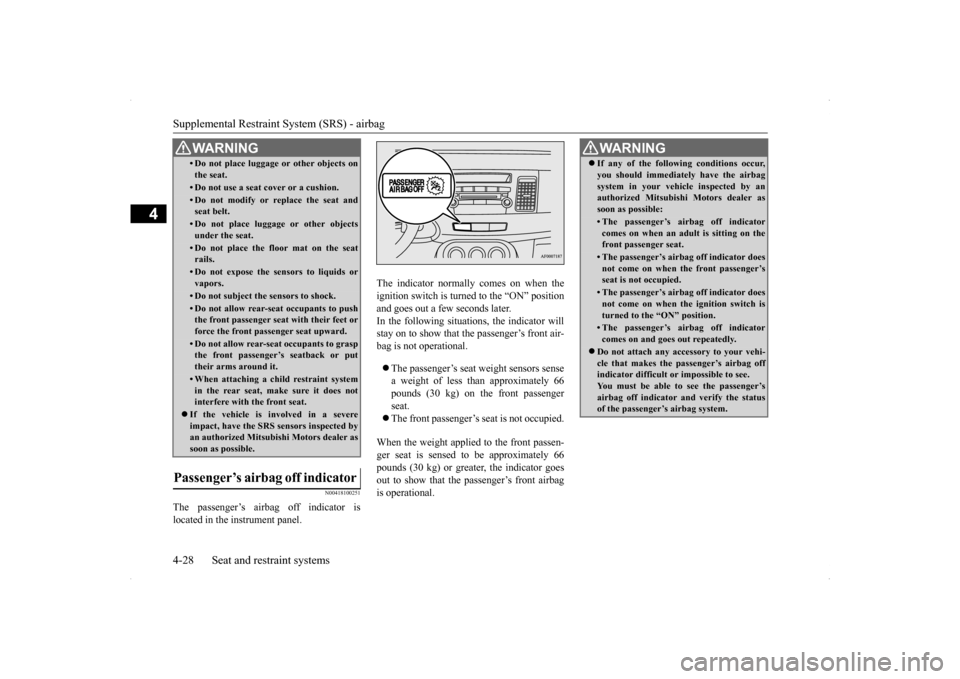
The passenger’s airbag off indicator is located in the instrument panel.
The indicator normally comes on when the ignition switch is turned to the “ON” positionand goes out a few seconds later. In the following situa
tions, the indicator will
stay on to show that the passenger’s front air-bag is not operational. The passenger’s seat weight sensors sense a weight of less than approximately 66 pounds (30 kg) on the front passenger seat. The front passenger’s seat is not occupied.
When the weight applied to the front passen- ger seat is sensed to be approximately 66 pounds (30 kg) or greater, the indicator goesout to show that the passenger’s front airbag is operational.
• Do not place luggage or other objects on the seat.• Do not use a seat cover or a cushion.• Do not modify or replace the seat andseat belt.• Do not place luggage or other objectsunder the seat.• Do not place the floor mat on the seatrails.• Do not expose the sensors to liquids orvapors.• Do not subject the sensors to shock.• Do not allow rear-seat occupants to push the front passenger seat with their feet or force the front passenger seat upward.• Do not allow rear-seat occupants to graspthe front passenger’s seatback or put their arms around it.• When attaching a child restraint systemin the rear seat, make sure it does notinterfere with the front seat.
If the vehicle is involved in a severe impact, have the SRS sensors inspected by an authorized Mitsubishi Motors dealer as soon as possible.
Passenger’s airbag off indicator
WA R N I N G
WA R N I N G If any of the following conditions occur, you should immediately have the airbag system in your vehicle inspected by an authorized Mitsubishi Motors dealer as soon as possible:• The passenger’s airbag off indicatorcomes on when an adult is sitting on thefront passenger seat.• The passenger’s airbag off indicator doesnot come on when the front passenger’s seat is not occupied.• The passenger’s airbag off indicator doesnot come on when the ignition switch is turned to the “ON” position.• The passenger’s airbag off indicatorcomes on and goes out repeatedly.
Do not attach any accessory to your vehi- cle that makes the passenger’s airbag offindicator difficult or impossible to see. You must be able to see the passenger’s airbag off indicator and verify the statusof the passenger’s airbag system.
BK0200700US.bo
ok 28 ページ 2013年2月15日 金曜日 午後12時17分
Page 56 of 422
Supplemental Restraint System (SRS) - airbag
Seat and restraint systems 4-29
4
N00408300524
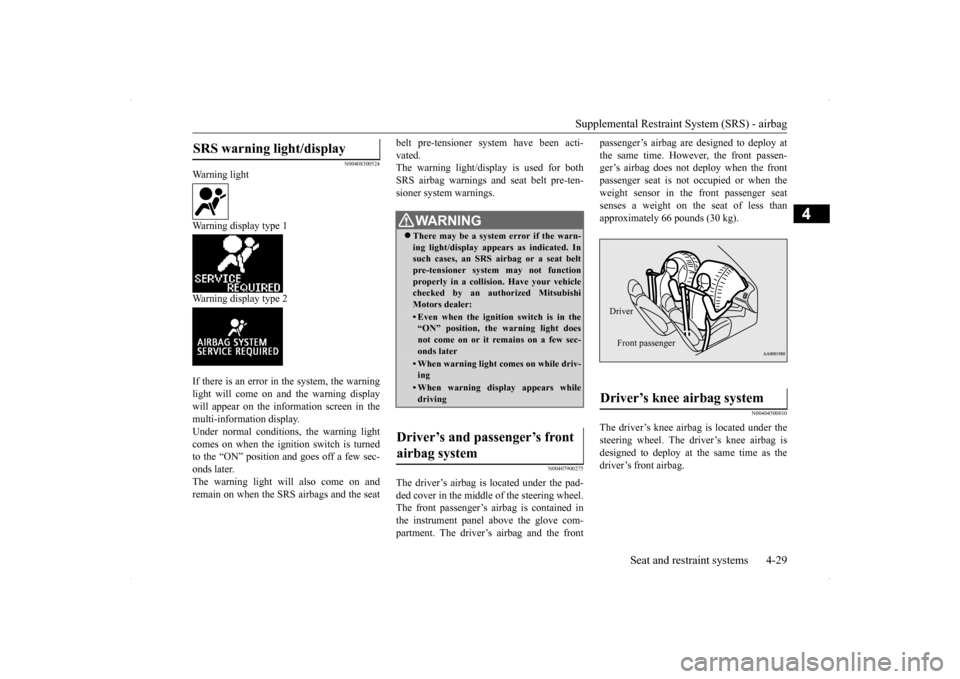
Warning light Warning display type 1 Warning display type 2 If there is an error in the system, the warning light will come on and the warning display will appear on the information screen in the multi-information display.Under normal conditions, the warning lightcomes on when the ignition switch is turned to the “ON” position and goes off a few sec- onds later.The warning light will also come on and remain on when the SRS airbags and the seat
belt pre-tensioner system have been acti- vated. The warning light/display is used for both SRS airbag warnings and seat belt pre-ten-sioner system warnings.
N00407900275
The driver’s airbag is located under the pad- ded cover in the middle of the steering wheel. The front passenger’s airbag is contained inthe instrument panel above the glove com- partment. The driver’s airbag and the front
passenger’s airbag are designed to deploy at the same time. However, the front passen- ger’s airbag does not deploy when the front passenger seat is not occupied or when theweight sensor in the front passenger seat senses a weight on the seat of less than approximately 66 pounds (30 kg).
N00404500010
The driver’s knee airbag is located under the steering wheel. The driver’s knee airbag is designed to deploy at the same time as thedriver’s front airbag.
SRS warning light/display
WA R N I N G There may be a system error if the warn- ing light/display appears as indicated. In such cases, an SRS airbag or a seat beltpre-tensioner system may not function properly in a collision. Have your vehicle checked by an authorized MitsubishiMotors dealer:• Even when the ignition switch is in the“ON” position, the warning light does not come on or it remains on a few sec- onds later• When warning light comes on while driv-ing• When warning display appears whiledriving
Driver’s and passenger’s front airbag system
Driver’s knee airbag system Driver Front passenger
BK0200700US.bo
ok 29 ページ 2013年2月15日 金曜日 午後12時17分
Page 58 of 422

Supplemental Restraint System (SRS) - airbag
Seat and restraint systems 4-31
4
The front airbags and driver’s knee airbag are designed to deploy when the vehicle suffers a moderate to severe frontal impact. A typical condition is shown in th
e illustration to the
left. The front airbags and driver’s knee airbag are designed to deploy only in certain moderate to severe frontal collisions within the shadedarea between the arrows in the illustration to the right. The front airbags and driver’s knee airbagwill deploy if the impact to the vehicle’s mainstructure is above a specific threshold level. The threshold level is approximately 15 mph (25 km/h) for a frontal collision straight into asolid flat wall that does not bend or deform. If the impact to the vehicle’s main structure is below this threshold level, the front airbagsand driver’s knee airbag may not deploy. This threshold level may also be higher if the vehi- cle hits something that absorbs the impact,either by bending or moving (for example, another stationary vehicle, a pole or a guard rail).The beginning stage of airbag inflation is the most forceful, and can cause serious injuries or death if you are too
close to the deploying
airbag. Accordingly, it is important that you always wear the available seat belt.
In certain types of front collisions, the front airbags and driver’s knee airbag may not deploy, even if the deformation of the body seems to be large, because the vehicle’s bodystructure is designed to absorb the impact and deform in order to help protect the occupants. Some typical situations where the front air-bags and driver’s knee airbag may not deployare shown in the illustrations. Because the front airbags and driver’s knee airbag do not protect the occupant in all types of frontal collisions, be sure to always wearyour seat belts properly.
The front airbags and driver’s knee airbag are not designed to deploy in situations where
The front airbags and driver’s knee airbag MAY NOT DEPLOY when …
The front airbags and driver’s knee airbag ARE NOT DESIGNED TO DEPLOY when … Collision with a utility pol
e, tree or other nar-
row objects Collision where the vehi
cle slides under the
rear body of a truck Oblique frontal impact
BK0200700US.bo
ok 31 ページ 2013年2月15日 金曜日 午後12時17分
Page 71 of 422

Electronic immobilizer (Anti-theft starting system) 5-4 Features and controls
5
N00509101817
[For vehicles equipped with the Free-hand Advanced Security Transmitter (F.A.S.T.- key)] For information on operations for vehiclesequipped with the Free-hand Advanced Secu- rity Transmitter (F.A.S.T.-key), refer to “Free-hand Advanced Security Transmitter(F.A.S.T.-key): Electronic immobilizer (Anti- theft starting system)” on page 5-28.
[Except for vehicles equipped with the Free- hand Advanced Security Transmitter (F.A.S.T.-key)] The electronic immobilizer is designed to sig-nificantly reduce the possibility of vehicle theft. The purpose of the system is to immo- bilize the vehicle if an invalid start isattempted. A valid start attempt can only be achieved (subject to certain conditions) using a key “registered” to the immobilizer system.All of the keys provided with your new vehi-cle have been programmed to the vehicle’s electronics.
• Do not excessively bend the key or subject it to strong impacts. • Keep the remote control transmitter dry. • Keep away from magnetic objects such as key rings. • Keep away from devices that produce mag- netism, such as audio systems, computers and televisions. • Keep away from devices that emit strong electromagnetic waves, such as cellularphones, wireless devices and high fre- quency equipment (including medical devices.) • Do not clean with ultrasonic cleaners. • Do not leave the key where it may be exposed to high temperature or high humid- ity.
If you lose your key, to prevent the theft of the vehicle immediately contact an autho-rized Mitsubishi Motors dealer. If you notify an authorized Mitsubishi Motors dealer of the key number, they canmake a new key. The key number is stamped on the key number plate. Keep the key num- ber plate in a safe place separate from thekey itself.NOTE
No keys other than those registered in advance can be used to start the engine. Refer to “Electronic immobilizer (Anti-theft starting system)” on page 5-4. Refer to “Free-hand Advanced SecurityTransmitter (F.A.S.T.-key): Electronic immobilizer (Anti-theft starting system)” on page 5-28. When the theft-alarm is in the system opera- tional status, the alarm operates if a door orrear hatch is opened after using the key, the door lock knob or the power door lock to unlock the vehicle. The system does not enter the preparation status if the keyless entry system or theF.A.S.T.-key was not used to lock the vehi- cle.
Electronic immobilizer (Anti-theft starting system)
NOTE
NOTE
Do not attach additional keys or accessories to the ignition key. Such objects could pre-vent the driver’s knee airbag from inflating normally. Refer to “Deployment of front air- bags” on page 4-30. In the following cases, the vehicle may not be able to recognize the registered ID codefrom the key. This means the engine will not start even when the key is turned to the “START” position. • When the key contacts a key ring or other metallic or magnetic object (Type A) • When the key grip contacts metal of another key (Type B) • When the key contacts or is close to other immobilizer keys (including keys of other vehicles) (Type C)
BK0200700US.bo
ok 4 ページ 2013年2月15日 金曜日 午後12時17分
Page 89 of 422

Free-hand Advanced Security Transmitter (F.A.S.T.-key) (if so equipped) 5-22 Features and controls
5
7. Without pressing the accelerator pedal, slowly turn the ignition switch to the “START” position to start the engine. Release the ignition switch when theengine starts.
After several attempts, you may experience that the engine still does not start. 1. Make sure that all electric devices, such as lights, air conditioning blower and rear window defogger, are turned off.2. While depressing the brake pedal on vehi- cles equipped with continuously variable transmission (CVT) or the clutch pedal onthe vehicles equipped with manual trans- axle, press the accelerator pedal halfway and hold it there, then crank the engine.Release the accelerator pedal, immedi- ately after the engine starts.
3. If the engine still will not start, the engine could be flooded with too much gasoline. While depressing the brake pedal on vehi- cles equipped with CVT or the clutchpedal on the vehicles
equipped with man-
ual transaxle, push the accelerator pedal all the way down and hold it there, thencrank the engine for 5 to 6 seconds. Return the ignition switch to the “LOCK” position and release the accelerator pedal.Wait a few seconds, and then crank theengine again for 5 to 6 seconds while depressing the brake pedal or the clutch pedal, but do not push the acceleratorpedal. Release the ignition key if the engine starts. If the engine fails to start, repeat these procedures. If the engine stillwill not start, contact your local Mitsubi- shi Motors dealer or a repair facility of your choice for assistance.
When the ambient temperature is -4 °F (-20 °C) or lower on vehicles equipped with CVT, or -22 °F (-30 °C) or lower on vehicles equipped with Twin Clutch SST, it may notbe possible to start fr
om a standstill even with
the selector lever (CVT) or the gearshift lever
(Twin Clutch SST) in the “D” (DRIVE) posi- tion. This phenomenon occurs because the trans- axle has not warmed up sufficiently; it doesnot indicate a problem. If this occurs, place the selector lever (CVT) or the gearshift lever (Twin Clutch SST) in the “P” (PARK) posi-tion and let the engine idle for at least 10 min- utes. The transaxle will warm up, and you will beable to drive normally.Do not leave the vehicle during warm-up operation.
N00514800020 N00515200135
The emergency key is built into the F.A.S.T.- key.When the F.A.S.T.-key cannot be used, such as when the battery of the F.A.S.T.-key or the vehicle has run down, the emergency key canbe used to lock and unlock the driver’s door and to start the engine. To use the emergency key (1), unlock the lock knob (2) and remove it from the F.A.S.T.-key(3).
NOTE
Minor noises may be heard on engine start- up. These will disappear as the engine warms up.
When the engine is hard to start
Startability of continuously variable transmission (CVT) vehicles or Twin Clutch SST vehicles at extremely coldambient temperature
To operate using the emergency key
Emergency key
BK0200700US.bo
ok 22 ページ 2013年2月15日 金曜日 午後12時17分