fuel MITSUBISHI MIRAGE 2015 6.G User Guide
[x] Cancel search | Manufacturer: MITSUBISHI, Model Year: 2015, Model line: MIRAGE, Model: MITSUBISHI MIRAGE 2015 6.GPages: 300, PDF Size: 43.44 MB
Page 78 of 300
Free-hand Advanced Securi
ty Transmitter (F.A.S.T.-key) (if so equipped)
Features and controls 5-17
5
Your vehicle is equipped with an electroni- cally controlled fuel in
jection system. This is
a system that automatically controls fuelinjection. There is usually no need to depress the accelerator pedal when starting the engine.To prevent battery drai
n, wait a few seconds
between attempts to restart the engine. 1. Make sure all occupants are properly seated with seat belts fastened.2. Make sure the parking brake is applied. 3. Press and hold the brake pedal down firmly with your right foot.
4. Press and hold the clutch pedal all the way down (manual transaxle). 5. On vehicles equippe
d with manual trans-
axle, place the gearshift lever in the “N” (Neutral) position.On vehicles equipped with continuously variable transmission (CVT), make sure the selector lever is in the “P” (PARK)position.
6. Press the engine switch. 7. Confirm that all wa
rning lights and warn-
ing displays are functioning properly.
After several attempts, you may experience that the engine still does not start. 1. Make sure that all electric devices, such as lights, air conditio
ning blower and rear
window defogger, are turned off.
WA R N I N G Never run the engine in
a closed or poorly
ventilated area any lo
nger than is needed
to move your vehicle out of the area. Car-bon monoxide gas, whic
h is odorless and
extremely poisonous, could build up and cause serious injury or death.CAUTION Do not push-start the vehicle.Do not run the engine at high rpms or drive at high speeds until th
e engine has had a
chance to warm up.
Starting the engine
NOTE
After the engine has not
started for a while,
the brake pedal effort needed to start theengine may become grea
ter. If this occurs,
depress the brake pedal more firmly than usual.NOTE
For vehicles equipped with a manual trans- axle, the engine will
not start unless the
clutch pedal is fully
depressed (Clutch inter-
lock). This is a safety feature.
NOTE
On vehicles equippe
d with continuously
variable transmission (C
VT), the engine can
only be started when th
e selector lever is in
the “P” (PARK) or “N” (NEUTRAL) posi- tion. For safety reasons, the engine should bestarted when the selector lever is in the “P” (PARK) position in which the driving wheels lock.NOTE
Minor noises may be heard on engine start- up. These will disappear as the engine warms up.
When the engine is hard to start
BK0212400US.book 17 ページ 2014年4月1日 火曜日 午後2時21分
Page 97 of 300
![MITSUBISHI MIRAGE 2015 6.G User Guide Starting the engine 5-36 Features and controls
5
N00512601816
[For vehicles equipped with the Free-hand Advanced Security Transmitter (F.A.S.T.- key)]
For information on
operation for vehicles
equ](/img/19/7511/w960_7511-96.png "MITSUBISHI MIRAGE 2015 6.G User Guide Starting the engine 5-36 Features and controls
5
N00512601816
[For vehicles equipped with the Free-hand Advanced Security Transmitter (F.A.S.T.- key)]
For information on
operation for vehicles
equ")
Starting the engine 5-36 Features and controls
5
N00512601816
[For vehicles equipped with the Free-hand Advanced Security Transmitter (F.A.S.T.- key)]
For information on
operation for vehicles
equipped with the Free-hand Advanced Secu-rity Transmitter (F.A
.S.T.-key), refer to
“Free-hand Advanced
Security Transmitter
(F.A.S.T.-key): Starting and stopping theengine” on page 5-16. [Except for vehicles equipped with the Free-hand Advanced Se
curity Transmit-
ter (F.A.S.T.-key)] Do not operate the starter motor continu- ously for longer than 15 seconds as thiscould run the battery
down or damage the
starter motor. If the engine does not start, turn the ignition switch back to the “OFF”position, wait a few se
conds, and then try
again. Trying repeatedly with the engine or starter motor still turning will damagethe starter mechanism. If the engine will not
start because the bat-
tery is weak or discharged, refer to“Jump-starting the engine” (on page 8-2) for instructions. A longer warm up period will only con- sume extra fuel. The engine is warmed up enough for driving when the low coolant temperature indi
cator goes out.
Refer to “Low coolant temperature indi- cator” on page 5-71.
This model is equipped with an electronically controlled fuel injection system. This is a sys-tem that automatically controls fuel injection. There is usually no need to depress the accel- erator pedal when starting the engine.The starter should not be run for more than 15 seconds at a time. To prevent battery drain, wait a few secondsbetween attempts to restart the engine. 1. Make sure all occupants are properly seated with seat belts fastened.
CAUTION If the engine is stopped while driving, the brake servomechanism w
ill cease to function
and braking efficiency will deteriorate. Also, the power steering syst
em will not function
and it will require gr
eater manual effort to
operate the steering. Do not leave the key in
the “ON” position for
a long time when the engine is not running, doing so will cause th
e battery to be dis-
charged. Do not turn the key to the “START” position when the engine is running, doing so coulddamage the starter motor.
Starting the engine
Tips for starting
WA R N I N G Never run the engine in
a closed or poorly
ventilated area any longer than is neededto move your vehicle
out of the area. Car-
bon monoxide gas, wh
ich is odorless and
extremely poisonous, could build up and cause serious injury or death.CAUTION Do not push-start the vehicle.Do not run the engine at high rpms or drive at high speeds until
the engine has had a
chance to warm up. Release the ignition sw
itch as soon as the
engine starts. Otherwis
e, the starter motor
will be damaged.
Starting the engine
BK0212400US.book 36 ページ 2014年4月1日 火曜日 午後2時21分
Page 99 of 300
Manual transaxle (if so equipped) 5-38 Features and controls
5
not indicate a problem.
If this occurs, place
the selector lever in the “P” (PARK) positionand let the engine idle
for at least 10 minutes.
The transaxle will wa
rm up, and you will be
able to start normally.Do not leave the vehicle during warm-up operation.
N00512700142
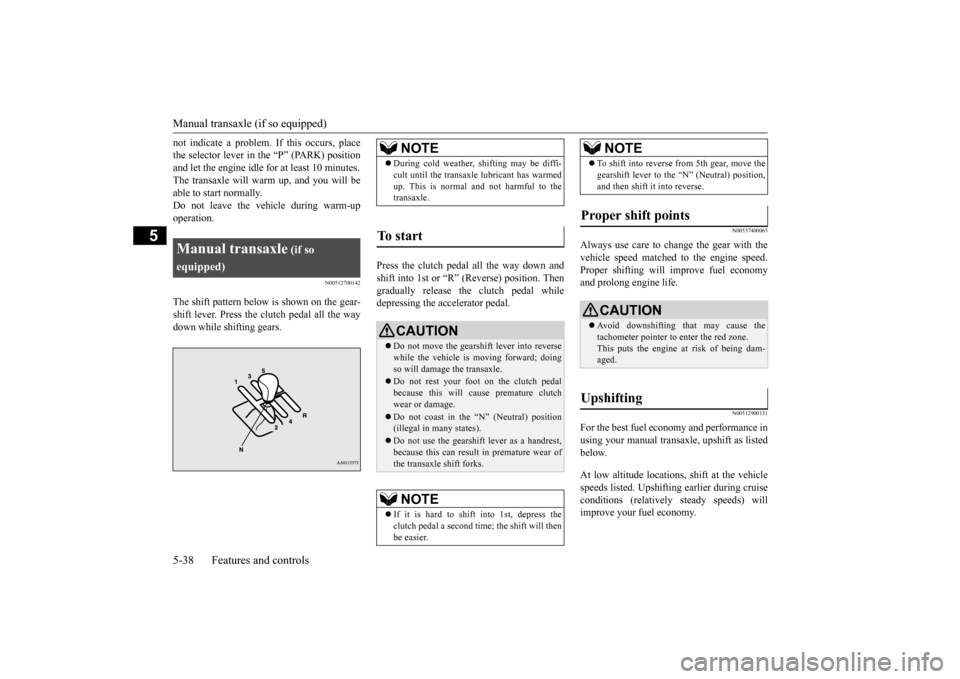
The shift pattern below is shown on the gear- shift lever. Press the clutch pedal all the way down while shifting gears.
Press the clutch pedal all the way down and shift into 1st or “R” (Reverse) position. Then gradually release the
clutch pedal while
depressing the accelerator pedal.
N00537400065
Always use care to change the gear with thevehicle speed matched
to the engine speed.
Proper shifting will improve fuel economy and prolong engine life.
N00512900131
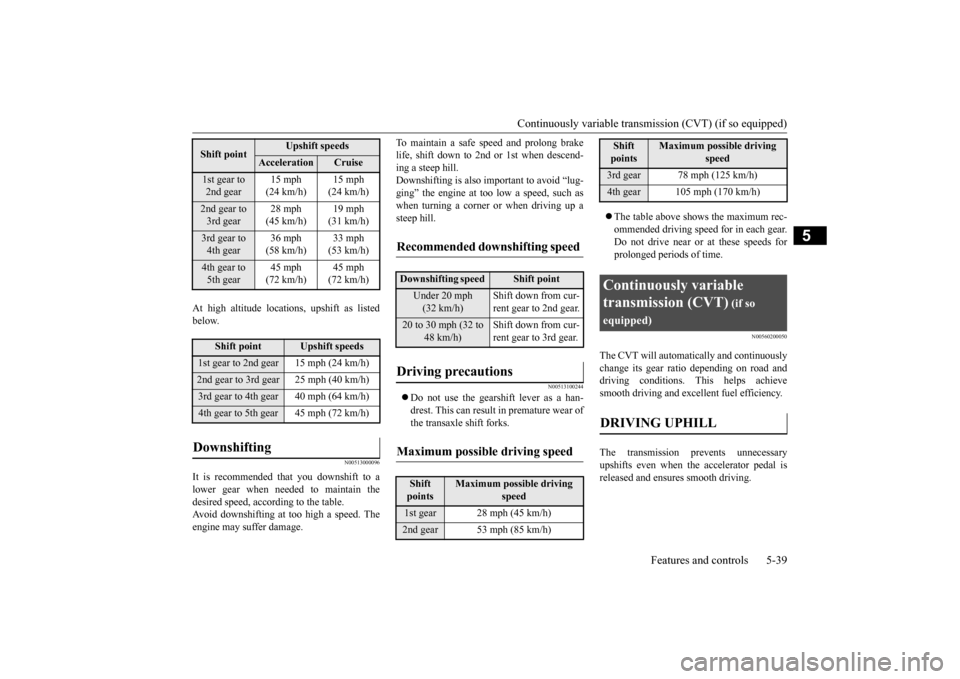
For the best fuel economy and performance in using your manual transaxle, upshift as listed below. At low altitude locations, shift at the vehicle speeds listed. Upshifting earlier during cruise conditions (relatively
steady speeds) will
improve your fuel economy.
Manual transaxle
(if so
equipped)
NOTE
During cold weather, shifting may be diffi- cult until the transaxl
e lubricant has warmed
up. This is normal and not harmful to thetransaxle.
To start
CAUTION Do not move the gearsh
ift lever into reverse
while the vehicle is moving forward; doing so will damage the transaxle. Do not rest your foot on the clutch pedal because this will cause premature clutchwear or damage. Do not coast in the “N” (Neutral) position (illegal in many states). Do not use the gearshift lever as a handrest, because this can result in premature wear ofthe transaxle shift forks.NOTE
If it is hard to shift into 1st, depress the clutch pedal a second tim
e; the shift will then
be easier.
To shift into reverse from 5th gear, move the gearshift lever to the “N” (Neutral) position,and then shift it into reverse.
Proper shift points
CAUTION Avoid downshifting th
at may cause the
tachometer pointer to
enter the red zone.
This puts the engine at
risk of being dam-
aged.
Upshifting
NOTE
BK0212400US.book 38 ページ 2014年4月1日 火曜日 午後2時21分
Page 100 of 300
Continuously variable transmission (CVT) (if so equipped)
Features and controls 5-39
5
At high altitude locati
ons, upshift as listed
below.
N00513000096
It is recommended th
at you downshift to a
lower gear when needed to maintain the desired speed, according to the table. Avoid downshifting at
too high a speed. The
engine may suffer damage.
To maintain a safe speed and prolong brake life, shift down to 2nd or 1st when descend-ing a steep hill. Downshifting is also important to avoid “lug- ging” the engine at t
oo low a speed, such as
when turning a corner or when driving up a steep hill.
N00513100244
Do not use the gearshift lever as a han- drest. This can result
in premature wear of
the transaxle shift forks.
The table above shows the maximum rec- ommended driving speed for in each gear. Do not drive near or at these speeds forprolonged periods of time.
N00560200050
The CVT will automatically and continuously change its gear ratio depending on road and driving conditions. This helps achievesmooth driving and excellent fuel efficiency. The transmission prevents unnecessary upshifts even when the accelerator pedal is released and ensures smooth driving.
Shift point
Upshift speeds
Acceleration
Cruise
1st gear to 2nd gear
15 mph (24 km/h)
15 mph (24 km/h)
2nd gear to 3rd gear
28 mph (45 km/h)
19 mph (31 km/h)
3rd gear to 4th gear
36 mph (58 km/h)
33 mph (53 km/h)
4th gear to 5th gear
45 mph (72 km/h)
45 mph (72 km/h)
Shift point
Upshift speeds
1st gear to 2nd gear 15 mph (24 km/h)2nd gear to 3rd gear 25 mph (40 km/h)3rd gear to 4th gear 40 mph (64 km/h)4th gear to 5th gear 45 mph (72 km/h)Downshifting
Recommended downshifting speed
Downshifting speed
Shift point
Under 20 mph (32 km/h)
Shift down from cur- rent gear to 2nd gear.
20 to 30 mph (32 to
48 km/h)
Shift down from cur- rent gear to 3rd gear.
Driving precautions
Maximum possible driving speed
Shift points
Maximum possible driving
speed
1st gear 28 mph (45 km/h)2nd gear 53 mph (85 km/h)
3rd gear 78 mph (125 km/h)4th gear 105 mph (170 km/h)Continuously variable transmission (CVT)
(if so
equipped)DRIVING UPHILL
Shift points
Maximum possible driving
speed
BK0212400US.book 39 ページ 2014年4月1日 火曜日 午後2時21分
Page 118 of 300
Tire pressure monitoring system (if so equipped)
Features and controls 5-57
5
N00532701347
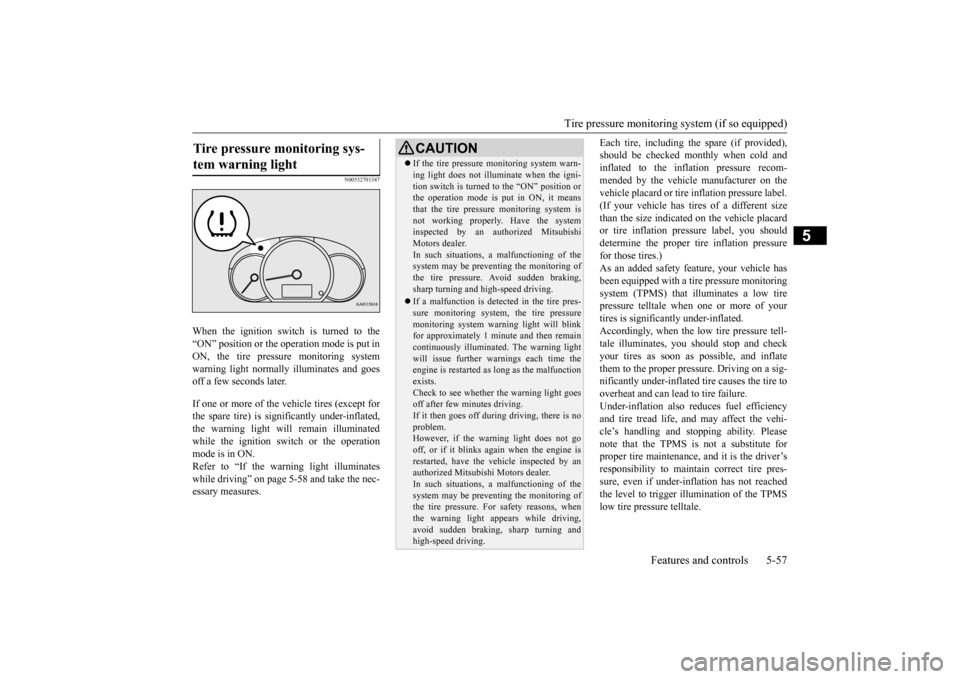
When the ignition switch is turned to the “ON” position or the operation mode is put inON, the tire pressure monitoring system warning light normally
illuminates and goes
off a few seconds later. If one or more of the vehicle tires (except for the spare tire) is significantly under-inflated, the warning light will remain illuminated while the ignition swit
ch or the operation
mode is in ON. Refer to “If the warning light illuminates while driving” on page 5-58 and take the nec-essary measures.
Each tire, including the spare (if provided), should be checked monthly when cold andinflated to the inflation pressure recom- mended by the vehicle manufacturer on the vehicle placard or tire in
flation pressure label.
(If your vehicle has tires of a different size than the size indicate
d on the vehicle placard
or tire inflation pressure label, you shoulddetermine the proper ti
re inflation pressure
for those tires.) As an added safety fe
ature, your vehicle has
been equipped with a tire pressure monitoring system (TPMS) that illuminates a low tirepressure telltale when one or more of your tires is significan
tly under-inflated.
Accordingly, when the low tire pressure tell-tale illuminates, you s
hould stop and check
your tires as soon as
possible, and inflate
them to the proper pressure. Driving on a sig-nificantly under-
inflated tire ca
uses the tire to
overheat and can lead to tire failure. Under-inflation also reduces fuel efficiencyand tire tread life, and may affect the vehi- cle’s handling and stoppi
ng ability. Please
note that the TPMS is
not a substitute for
proper tire maintenance, and it is the driver’s responsibility to
maintain corre
ct tire pres-
sure, even if under-infl
ation has not reached
the level to trigger illumination of the TPMS low tire pressure telltale.
Tire pressure monitoring sys- tem warning light
CAUTION If the tire pressure monitoring system warn- ing light does not illumi
nate when the igni-
tion switch is turned to the “ON” position orthe operation mode is put in ON, it means that the tire pressure monitoring system is not working properly. Have the systeminspected by an authorized Mitsubishi Motors dealer. In such situations, a malfunctioning of thesystem may be preventing the monitoring of the tire pressure. Avoid sudden braking, sharp turning and high-speed driving. If a malfunction is detected in the tire pres- sure monitoring system, the tire pressuremonitoring system warn
ing light will blink
for approximately 1 minute and then remain continuously illuminated. The warning lightwill issue further warnings each time the engine is restarted as
long as the malfunction
exists.Check to see whether
the warning light goes
off after few minutes driving. If it then goes off during driving, there is noproblem. However, if the warning light does not go off, or if it blinks again when the engine isrestarted, have the
vehicle inspected by an
authorized Mitsubishi Motors dealer. In such situations, a malfunctioning of thesystem may be preventing the monitoring of the tire pressure. For safety reasons, when the warning light appears while driving,avoid sudden braking, sharp turning and high-speed driving.
BK0212400US.book 57 ページ 2014年4月1日 火曜日 午後2時21分
Page 123 of 300
Instrument cluster 5-62 Features and controls
5
N00519000391 N00519100262
The speedometer shows the vehicle speed in miles per hour (mph) or kilometers per hour (km/h).
N00519200292
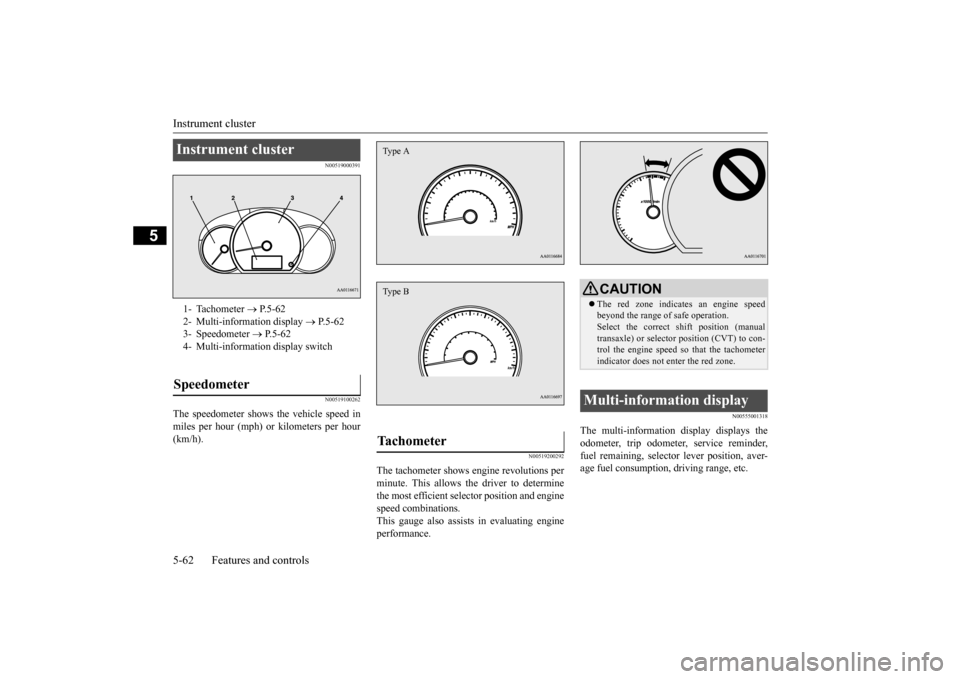
The tachometer shows e
ngine revolutions per
minute. This allows the driver to determine the most efficient sele
ctor position and engine
speed combinations.This gauge also assists in evaluating engine performance.
N00555001318
The multi-information display displays theodometer, trip odometer, service reminder, fuel remaining, selector
lever position, aver-
age fuel consumption, driving range, etc.
Instrument cluster 1- Tachometer
P.5-62
2- Multi-information display
P.5-62
3- Speedometer
P.5-62
4- Multi-informati
on display switch
Speedometer
Tachometer Type AType B
CAUTIONThe red zone indicate
s an engine speed
beyond the range of safe operation.Select the correct shift position (manual transaxle) or selector position (CVT) to con- trol the engine speed so that the tachometerindicator does not enter the red zone.
Multi-information display
BK0212400US.book 62 ページ 2014年4月1日 火曜日 午後2時21分
Page 124 of 300
Multi-information display
Features and controls 5-63
5
N00574800015
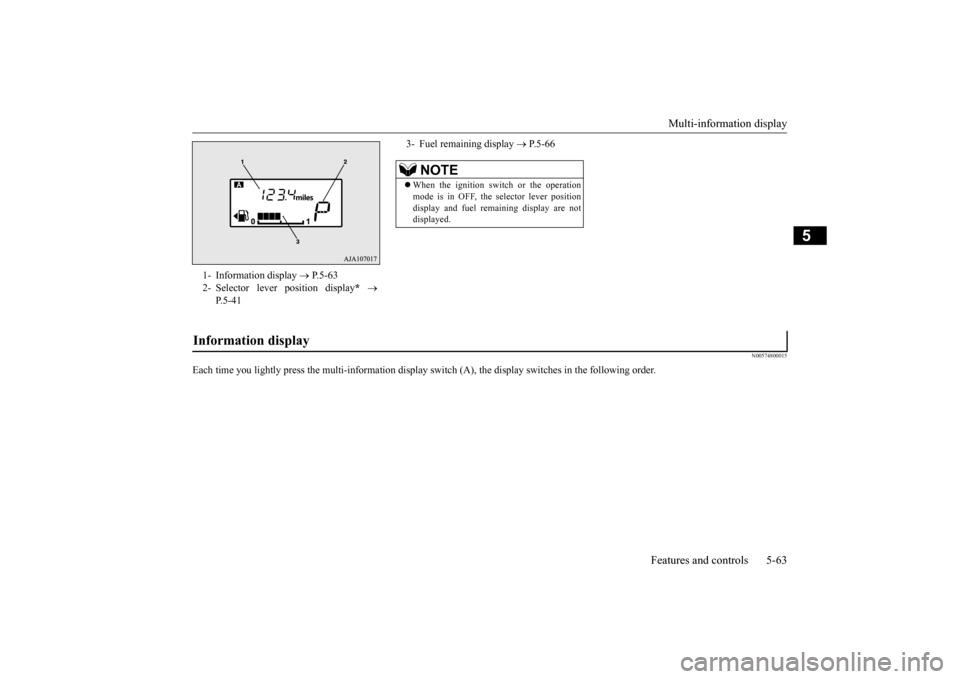
Each time you lightly press the multi-inf
ormation display switch (A), the disp
lay switches in the following order.
1- Information display
P.5-63
2- Selector lever
position display
*
P.5-41
3- Fuel remaining display
P.5-66
NOTE
When the ignition swit
ch or the operation
mode is in OFF, the
selector lever position
display and fuel rema
ining display are not
displayed.
Information display
BK0212400US.book 63 ページ 2014年4月1日 火曜日 午後2時21分
Page 125 of 300
Multi-information display 5-64 Features and controls
5
N00574900016
The odometer indicates the total distance the vehicle has traveled.
N00575000014
The trip odometer indicates the distance trav-eled between two points.
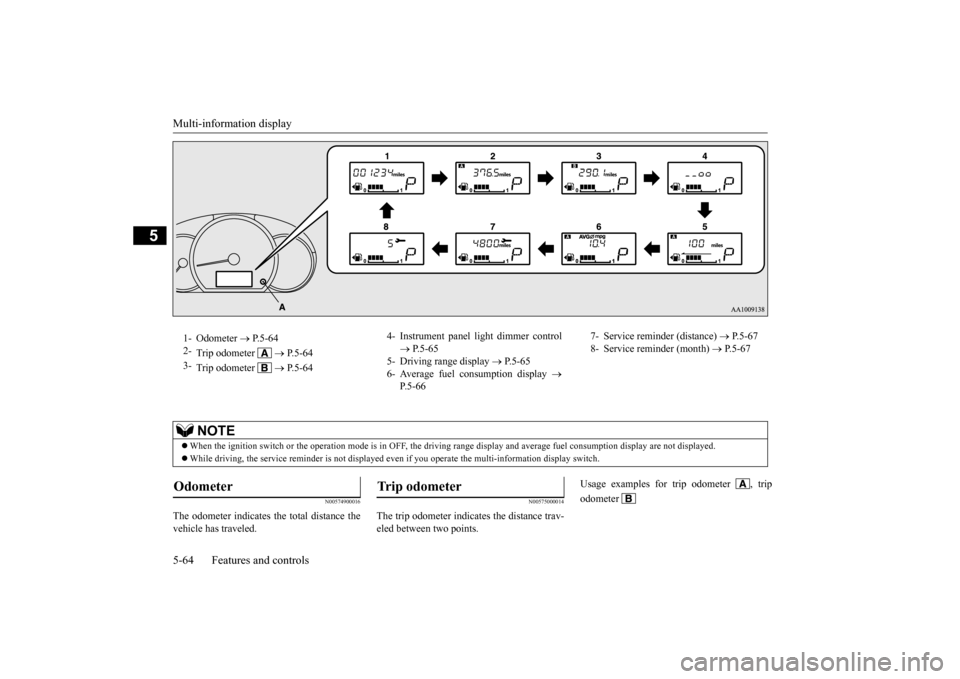
1- Odometer
P.5-64
2-
Trip odometer
P. 5 - 6 4
3-
Trip odometer
P. 5 - 6 4
4- Instrument panel li
ght dimmer control
P.5-65
5- Driving range display
P.5-65
6- Average fuel consumption display
P.5-66
7- Service reminder (distance)
P.5-67
8- Service reminder (month)
P.5-67
NOTE
When the ignition switch or the operation mode
is in OFF, the driving range display a
nd average fuel consumption display are no
t displayed.
While driving, the service reminder is
not displayed even if you operate th
e multi-information display switch.
Odometer
Trip odometer
Usage examples for trip odometer , trip odometer
BK0212400US.book 64 ページ 2014年4月1日 火曜日 午後2時21分
Page 126 of 300
Multi-information display
Features and controls 5-65
5
To return the display to 0, hold down the multi-information display switch for about 1 second or more. Only the currently displayed value will be reset. Example If trip odometer is displayed, only tripodometer will be reset.
N00575100015
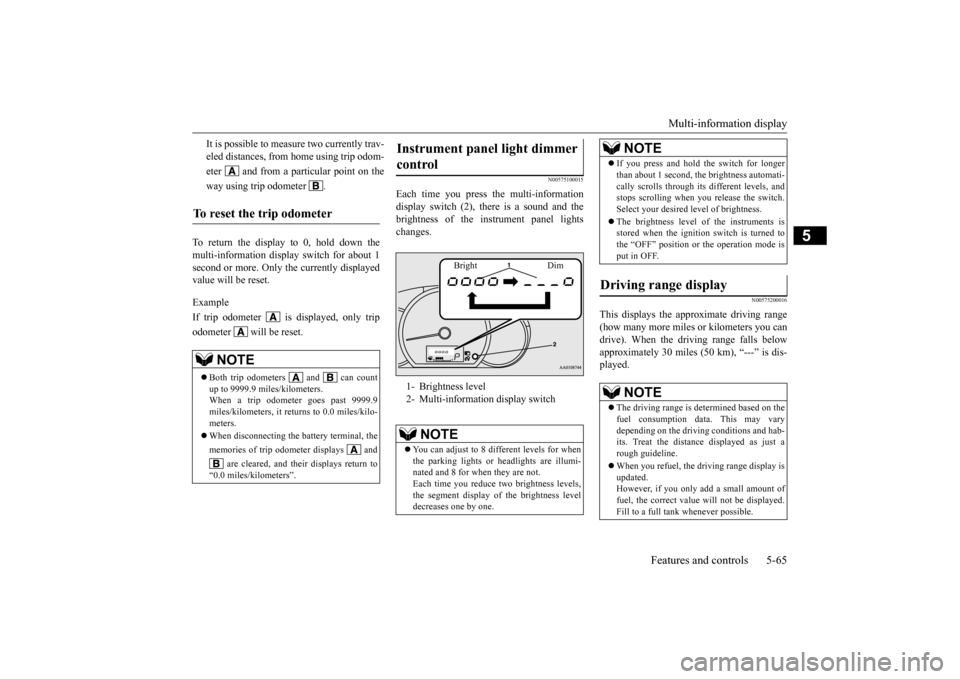
Each time you press
the multi-information
display switch (2), there is a sound and thebrightness of the in
strument panel lights
changes.
N00575200016
This displays the approximate driving range (how many more miles or
kilometers you can
drive). When the driving range falls below approximately 30 miles (
50 km), “---” is dis-
played.
It is possible to measure two currently trav- eled distances, from home using trip odom- eter and from a particular point on theway using trip odometer .
To reset the trip odometer
NOTE
Both trip odometers and can count up to 9999.9 miles/kilometers. When a trip odometer goes past 9999.9 miles/kilometers, it returns to 0.0 miles/kilo-meters. When disconnecting the battery terminal, the memories of trip odom
eter displays and
are cleared, and thei
r displays return to
“0.0 miles/kilometers”.
Instrument panel light dimmer control 1- Brightness level 2- Multi-informati
on display switch
NOTE
You can adjust to 8 different levels for when the parking lights or
headlights are illumi-
nated and 8 for when they are not. Each time you reduce tw
o brightness levels,
the segment display of the brightness leveldecreases one by one.
Bright Dim
If you press and hold the switch for longer than about 1 second, th
e brightness automati-
cally scrolls through its different levels, andstops scrolling when
you release the switch.
Select your desired
level of brightness.
The brightness level of the instruments is stored when the ignition switch is turned to the “OFF” position or the operation mode isput in OFF.
Driving range display
NOTE
The driving range is determined based on the fuel consumption data. This may vary depending on the drivi
ng conditions and hab-
its. Treat the distance displayed as just arough guideline. When you refuel, the driving range display is updated. However, if you only add a small amount of fuel, the correct value
will not be displayed.
Fill to a full tank whenever possible.NOTE
BK0212400US.book 65 ページ 2014年4月1日 火曜日 午後2時21分
Page 127 of 300
Multi-information display 5-66 Features and controls
5
N00575300017
This displays the average fuel consumption from the last reset to the present. The reset mode conditions for the average fuel consumption disp
lay can be switched
between “Auto reset”
and “Manual reset”.
For information on how to change the aver- age fuel consumption display setting, refer to“Changing the function settings” on page 5-68.
N00575400018
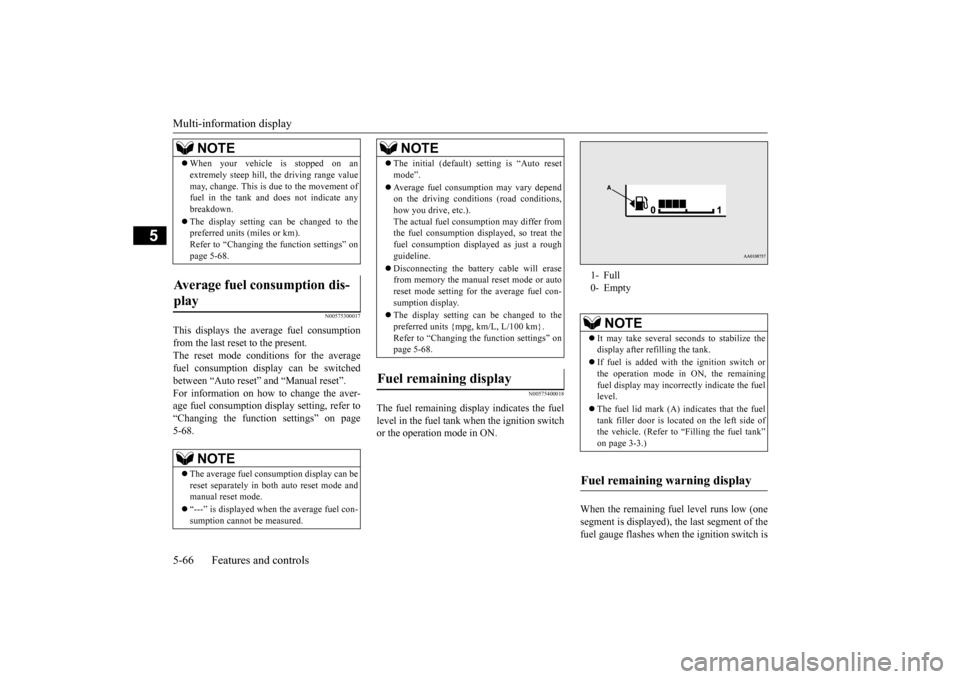
The fuel remain
ing display indicates the fuel
level in the fuel tank when the ignition switch or the operation mode in ON.
When the remaining fuel level runs low (one segment is displayed), th
e last segment of the
fuel gauge flashes when
the ignition switch is
When your vehicle is stopped on an extremely steep hill, th
e driving range value
may, change. This is due to the movement offuel in the tank and does not indicate any breakdown. The display setting can be changed to the preferred units (miles or km). Refer to “Changing th
e function settings” on
page 5-68.
Average fuel consumption dis- play
NOTE
The average fuel cons
umption display can be
reset separately in both auto reset mode and manual reset mode. “---” is displayed when the average fuel con- sumption cannot be measured.NOTE
The initial (default) setting is “Auto reset mode”. Average fuel consumption may vary depend on the driving conditi
ons (road conditions,
how you drive, etc.).The actual fuel consum
ption may differ from
the fuel consumption di
splayed, so treat the
fuel consumption displayed as just a roughguideline. Disconnecting th
e battery cable will erase
from memory the manual reset mode or auto reset mode setting for the average fuel con- sumption display. The display setting can be changed to the preferred units {mpg, km/L, L/100 km}.Refer to “Changing the
function settings” on
page 5-68.
Fuel remaining display
NOTE
1- Full 0- Empty
NOTE
It may take several se
conds to stabilize the
display after refilling the tank. If fuel is added with
the ignition switch or
the operation mode in ON, the remainingfuel display may incorr
ectly indicate the fuel
level. The fuel lid mark (A) indicates that the fuel tank filler door is loca
ted on the left side of
the vehicle. (Refer to “Filling the fuel tank”on page 3-3.)
Fuel remaining warning display
BK0212400US.book 66 ページ 2014年4月1日 火曜日 午後2時21分