warning light MITSUBISHI MIRAGE 2015 6.G User Guide
[x] Cancel search | Manufacturer: MITSUBISHI, Model Year: 2015, Model line: MIRAGE, Model: MITSUBISHI MIRAGE 2015 6.GPages: 300, PDF Size: 43.44 MB
Page 48 of 300
Supplemental Restraint System (SRS) - airbag
Seat and restraint systems 4-23
4
N00407800522
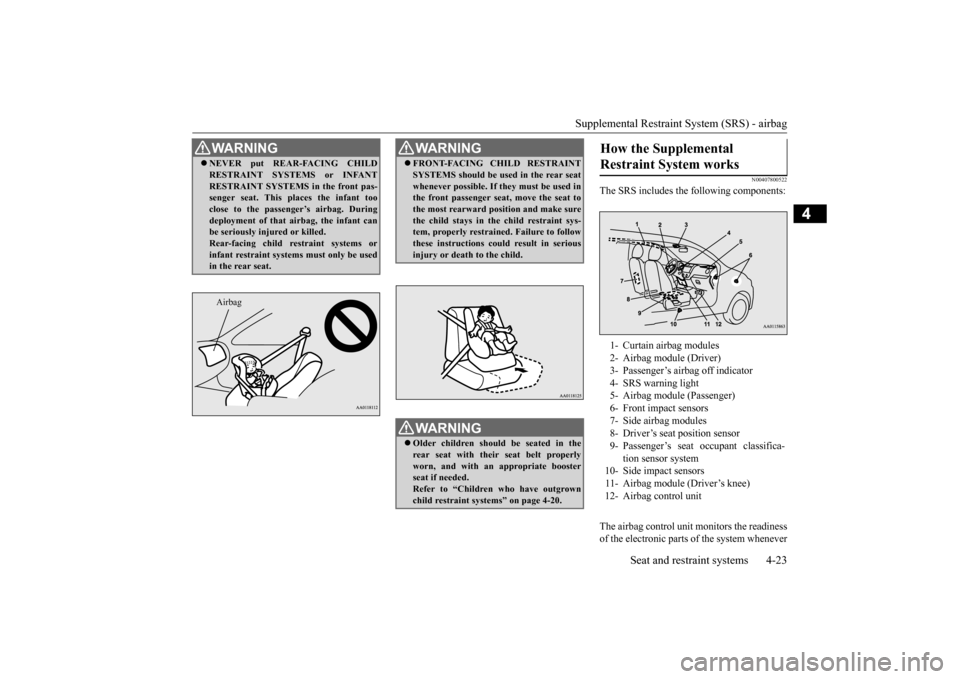
The SRS includes the following components: The airbag control unit monitors the readiness of the electronic parts of the system whenever
WA R N I N G NEVER put REAR-FACING CHILD RESTRAINT SYSTEMS or INFANTRESTRAINT SYSTEMS in the front pas-senger seat. This pl
aces the infant too
close to the passenger’s airbag. During deployment of that airbag, the infant canbe seriously inju
red or killed.
Rear-facing child restraint systems or infant restraint systems must only be usedin the rear seat.Airbag
WA R N I N G FRONT-FACING CHILD RESTRAINT SYSTEMS should be used in the rear seatwhenever possible. If they must be used inthe front passenger seat, move the seat to the most rearward po
sition and make sure
the child stays in the child restraint sys-tem, properly restrained. Failure to follow these instructions could result in serious injury or death to the child.WA R N I N G Older children should be seated in the rear seat with thei
r seat belt properly
worn, and with an
appropriate booster
seat if needed.Refer to “Children
who have outgrown
child restraint systems” on page 4-20.
How the Supplemental Restraint System works 1- Curtain airbag modules 2- Airbag module (Driver) 3- Passenger’s airb
ag off indicator
4- SRS warning light5- Airbag module (Passenger) 6- Front impact sensors 7- Side airbag modules8- Driver’s seat
position sensor
9- Passenger’s seat oc
cupant classifica-
tion sensor system
10- Side impact sensors 11- Airbag module (Driver’s knee) 12- Airbag control unit
BK0212400US.book 23 ページ 2014年4月1日 火曜日 午後2時21分
Page 50 of 300
Supplemental Restraint System (SRS) - airbag
Seat and restraint systems 4-25
4
accordance with the information it receives from this sensor.If there is a problem involving the driver’s seat position sensor, the SRS warning light in the instrument panel will come on. Refer to“SRS warning light” on page 4-27.
N00418000364
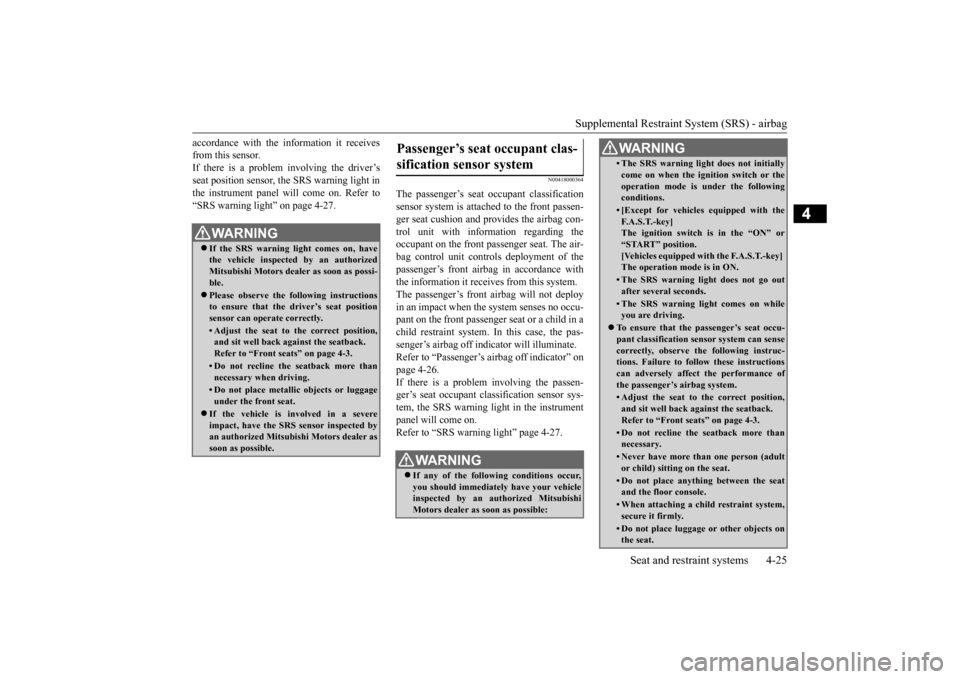
The passenger’s seat oc
cupant classification
sensor system is attached to the front passen-ger seat cushion and provides the airbag con- trol unit with inform
ation regarding the
occupant on the front passenger seat. The air-bag control unit controls deployment of the passenger’s front airbag in accordance with the information it receives from this system. The passenger’s front airbag will not deploy in an impact when the system senses no occu-pant on the front passenger seat or a child in a child restraint system. In this case, the pas- senger’s airbag off indicator will illuminate.Refer to “Passenger’s airbag off indicator” on page 4-26. If there is a problem involving the passen-ger’s seat occupant cl
assification sensor sys-
tem, the SRS warning light in the instrument panel will come on.Refer to “SRS warning light” page 4-27.
WA R N I N G If the SRS warning
light comes on, have
the vehicle inspected by an authorizedMitsubishi Motors dealer as soon as possi- ble. Please observe the following instructions to ensure that the driver’s seat position sensor can operate correctly.• Adjust the seat to the correct position,and sit well back
against the seatback.
Refer to “Front seats” on page 4-3.• Do not recline the seatback more thannecessary when driving.• Do not place metallic objects or luggageunder the front seat.
If the vehicle is involved in a severe impact, have the SRS sensor inspected by an authorized
Mitsubishi Motors dealer as
soon as possible.
Passenger’s seat occupant clas- sification sensor system
WA R N I N G If any of the follow
ing conditions occur,
you should immediatel
y have your vehicle
inspected by an au
thorized Mitsubishi
Motors dealer as soon as possible:
• The SRS warning light does not initiallycome on when the ignition switch or theoperation mode is under the followingconditions.• [Except for vehicles equipped with theF. A . S . T. - k e y ] The ignition switch is in the “ON” or “START” position.[Vehicles equipped with the F.A.S.T.-key] The operation mode is in ON.• The SRS warning light does not go outafter several seconds.• The SRS warning li
ght comes on while
you are driving.
To ensure that the passenger’s seat occu- pant classification sensor system can sense correctly, observe the following instruc-tions. Failure to follow these instructions can adversely affect
the performance of
the passenger’s airbag system.• Adjust the seat to the correct position,and sit well back
against the seatback.
Refer to “Front seats” on page 4-3.• Do not recline the seatback more thannecessary.• Never have more th
an one person (adult
or child) sittin
g on the seat.
• Do not place anything between the seat and the floor console.• When attaching a child restraint system,secure it firmly.• Do not place luggage or other objects onthe seat.WA R N I N G
BK0212400US.book 25 ページ 2014年4月1日 火曜日 午後2時21分
Page 52 of 300
Supplemental Restraint System (SRS) - airbag
Seat and restraint systems 4-27
4
N00408300579
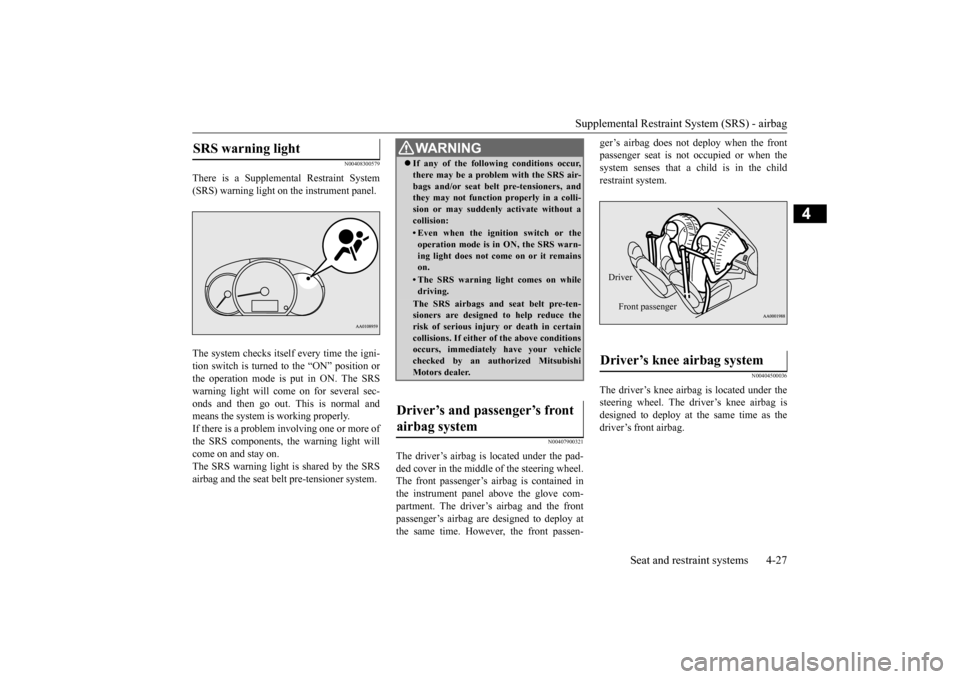
There is a Supplemental Restraint System (SRS) warning light on
the instrument panel.
The system checks itself every time the igni- tion switch is turned
to the “ON” position or
the operation mode is put in ON. The SRS warning light will co
me on for several sec-
onds and then go out. This is normal andmeans the system is working properly. If there is a problem
involving one or more of
the SRS components, the warning light willcome on and stay on. The SRS warning light is shared by the SRS airbag and the seat belt
pre-tensioner system.
N00407900321
The driver’s airbag is located under the pad- ded cover in the middle of the steering wheel. The front passenger’s airbag is contained inthe instrument panel above the glove com- partment. The driver’s airbag and the front passenger’s airbag are designed to deploy atthe same time. However, the front passen-
ger’s airbag does not deploy when the front passenger seat is not
occupied or when the
system senses that a child is in the child restraint system.
N00404500036
The driver’s knee airbag is located under the steering wheel. The driver’s knee airbag is designed to deploy at th
e same time as the
driver’s front airbag.
SRS warning light
WA R N I N G If any of the follow
ing conditions occur,
there may be a proble
m with the SRS air-
bags and/or seat belt pre-tensioners, andthey may not function properly in a colli- sion or may suddenly
activate without a
collision:• Even when the ignition switch or theoperation mode is in ON, the SRS warn-ing light does not come on or it remains on.• The SRS warning li
ght comes on while
driving.The SRS airbags and seat belt pre-ten-sioners are designed to help reduce the risk of serious injury
or death in certain
collisions. If either of the above conditions occurs, immediately
have your vehicle
checked by an authorized MitsubishiMotors dealer.
Driver’s and passenger’s front airbag system
Driver’s knee airbag system Driver Front passenger
BK0212400US.book 27 ページ 2014年4月1日 火曜日 午後2時21分
Page 62 of 300
5
Features and controlsBreak-in recommendations ..............................................................5-2 Keys .................................................................................................5-2 Electronic immobilizer (Anti-theft starting system) ........................5-3Keyless entry system (if so equipped) ..............................................5-6 Free-hand Advanced Security
Transmitter (F.A.S.T.-key)
(if so equipped) ............................................................................5-9Door locks ......................................................................................5-24 Power door locks ......
...........
...........
...........
...........
...........
.........
.....5-26
Child safety locks for rear door ..........
...........
.........
.........
.........
.....5-27
Liftgate ...........................................................................................5-27 Manual window control (if so equipped)........................................5-28 Power window control ...................................................................5-29Parking brake .................................................................................5-31 Steering wheel height adjustment ..................................................5-32 Inside rearview mirror ...................................................................5-32Outside rearview mirrors ...............................................................5-33 Ignition switch ...............................................................................5-35 Starting the engine .........................................................................5-36Manual transaxle (if so equipped) ..................................................5-38 Continuously variable transmission
(CVT) (if so equipped)..........5-39
Service brake .................................................................................5-44Hill start assist (if so equipped) ......................................................5-45 Brake assist system ........................................................................5-46 Anti-lock braking system ...............................................................5-46Electric power steering system (EPS) ............................................5-48 Active stability control (ASC) .......................................................5-49 Cruise control (if so equipped) .......................................................5-52Tire pressure monitoring system (if so equipped) ..........................5-56
Rear-view camera (if so equipped)................................................. 5-60 Instrument cluster .......................................................................... 5-62 Multi-information display ............................................................. 5-62Indicator and warning light package ............................................. 5-70 Indicators ....................................................................................... 5-71 Warning lights ................................................................................ 5-72Combination headlights and dimmer switch ................................. 5-74 Turn signal lever ............................................................................ 5-76 Hazard warning flasher switch ...................................................... 5-77Front fog light switch (if so equipped) .......................................... 5-77 Wiper and washer switch ............................................................... 5-78 Electric rear window defogger switch ....
...........
...........
...........
...... 5-80
Horn switch ................................................................................... 5-81 Link System (if so equipped) ......................................................... 5-81 Bluetooth
® 2.0 interface (if so equipped)....................................... 5-81
USB input terminal (if so
equipped) ....
...........
.........
........
........... 5-101
Sun visors .................................................................................... 5-105 12 V power outlets ....................................................................... 5-106Interior lights ............................................................................... 5-106 Storage spaces .............................................................................. 5-107 Cup holders .................................................................................. 5-108Bottle holders ............................................................................... 5-108 Rear shelf panel (if so equipped) .................................................. 5-109 Convenience hook ............
...........
...........
...........
...........
...........
.... 5-109
Assist grips .................................................................................. 5-110
BK0212400US.book 1 ページ 2014年4月1日 火曜日 午後2時21分
Page 76 of 300
Free-hand Advanced Securi
ty Transmitter (F.A.S.T.-key) (if so equipped)
Features and controls 5-15
5
To enable power after ACC power auto-cut- out function, press the
engine switch while in
ACC.
N00503500216
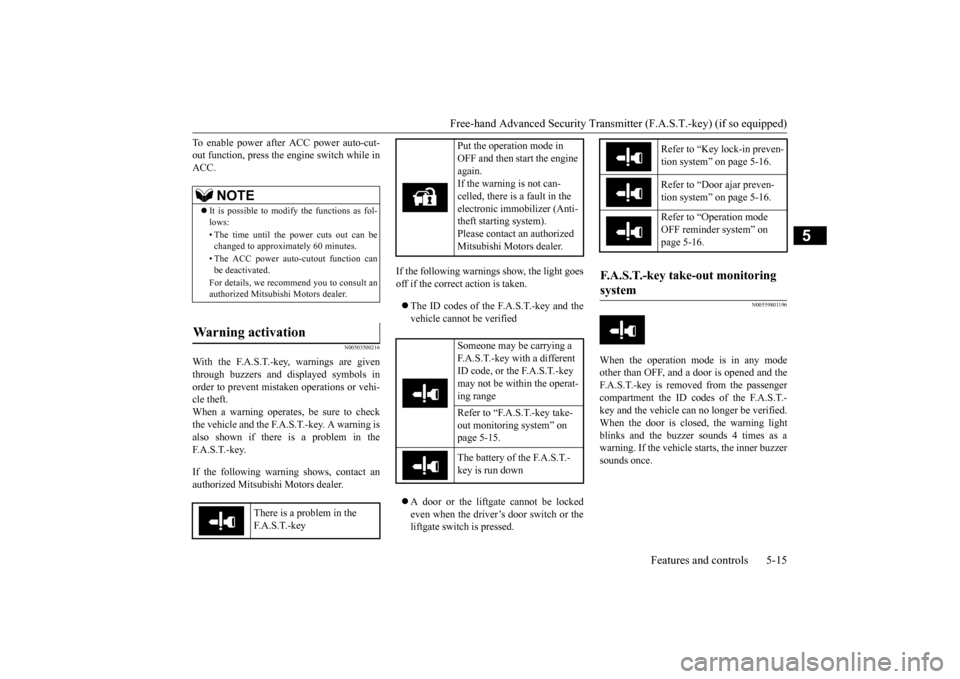
With the F.A.S.T.-key, warnings are given through buzzers and displayed symbols in order to prevent mistaken operations or vehi-cle theft. When a warning operates, be sure to check the vehicle and the F.A.S.T.-key. A warning isalso shown if there is a problem in the F. A . S . T. - k e y. If the following warning shows, contact an authorized Mitsubishi Motors dealer.
If the following warnings show, the light goes off if the correct action is taken. The ID codes of the F.A.S.T.-key and the vehicle cannot be verified A door or the liftgate cannot be locked even when the driver’s door switch or theliftgate switch is pressed.
N00559801196
When the operation mode is in any modeother than OFF, and a door is opened and theF.A.S.T.-key is removed from the passenger compartment the ID codes of the F.A.S.T.- key and the vehicle can
no longer be verified.
When the door is closed, the warning light blinks and the buzzer
sounds 4 times as a
warning. If the vehicle
starts, the inner buzzer
sounds once.
NOTE
It is possible to modify the functions as fol- lows: • The time until the power cuts out can be changed to approxi
mately 60 minutes.
• The ACC power auto-c
utout function can
be deactivated. For details, we reco
mmend you to consult an
authorized Mitsubish
i Motors dealer.
Warning activation
There is a problem in the F. A . S . T. - k e y
Put the operation mode in OFF and then start the engine again. If the warning is not can-celled, there is a fault in the electronic immobilizer (Anti- theft starting system).Please contact an authorized Mitsubishi Motors dealer. Someone may be carrying a F.A.S.T.-key with a different ID code, or the F.A.S.T.-key may not be within the operat- ing range Refer to “F.A.S.T.-key take- out monitoring system” on page 5-15. The battery of the F.A.S.T.- key is run down
Refer to “Key lock-in preven-tion system” on page 5-16. Refer to “Door ajar preven- tion system” on page 5-16. Refer to “Operation mode OFF reminder system” on page 5-16.
F.A.S.T.-key take-out monitoring system
BK0212400US.book 15 ページ 2014年4月1日 火曜日 午後2時21分
Page 77 of 300
Free-hand Advanced
Security Transmitter (F.A.S
.T.-key) (if so equipped)
5-16 Features and controls
5
N00559900158
When the operation mode is in OFF, the F.A.S.T.-key is left in the passenger compart-ment, all the doors and the liftgate are closed, and someone tries to lock the vehicle by pressing the driver’s door switch or the lift-gate switch, the warning light blinks and the buzzer sounds for about
3 seconds as a warn-
ing, and the doors and the liftgate cannot belocked.
N00560000159
When the operation mode is in OFF, andsomeone tries to lock the vehicle by pressingthe driver’s door switch or the liftgate switch while one of the doors or the liftgate is not fully closed, the warning light blinks and thebuzzer sounds for about
3 seconds as a warn-
ing, and the doors and the liftgate cannot be locked.
N00560100150
When the operation m
ode is in any mode
other than OFF, all the doors and the liftgateare closed, and someone tries to lock the vehicle by pressing the driver’s door switch or the liftgate switch,
the warning light blinks
and the buzzer sounds fo
r about 3 seconds as
a warning, and the doors and the liftgate can- not be locked.
N00514601357
The operation mode ca
n be in any mode
to start the engine. The starter motor will be turning for up to approximately 15 seconds if the engine switch is released at once. Pressing the engine switch again while the starter motor is still turning will stop the starter motor. The starter motor will be turningfor up to approximately 30 seconds while the engine swit
ch is pressed.
If the engine does not start, wait for awhile and then attempt to start the engine again. Trying repeatedly with the starter motor still turning will damage the startermechanism. If the engine will not start because the bat- tery is weak or discharged, refer to“Jump-starting the engine” on page 8-2 for instructions. A longer warm up period will only con- sume extra fuel. The engine is warmed up enough for driv- ing when the low coolant temperatureindicator goes out. Refer to “Low coolant temperature indi- cator” on page 5-71.
NOTE
The F.A.S.T.-key take
-out monitoring system
does not function if the F.A.S.T.-key isremoved through a window without openinga door. This setting can be changed. See an authorized Mi
tsubishi Motors dealer
for details. The warning may display even if the F.A.S.T.-key is in the operating range for starting the engine a
nd changing the opera-
tion mode. The surrounding environment orelectromagnetic waves
may make it impossi-
ble to verify the ID codes of the F.A.S.T.-key and vehicle.
Key lock-in prevention system
Door ajar prevention system
Operation mode OFF reminder system
Starting and stopping the engine
Tips for starting
BK0212400US.book 16 ページ 2014年4月1日 火曜日 午後2時21分
Page 80 of 300
Free-hand Advanced Securi
ty Transmitter (F.A.S.T.-key) (if so equipped)
Features and controls 5-19
5
N00568301054
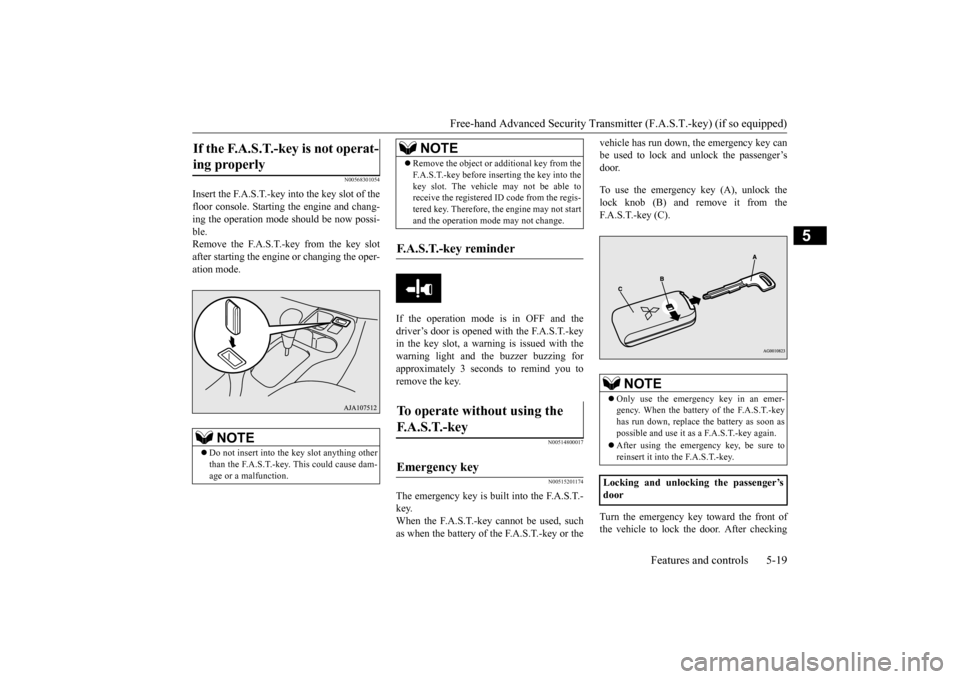
Insert the F.A.S.T.-key into the key slot of the floor console. Starting
the engine and chang-
ing the operation mode should be now possi- ble. Remove the F.A.S.T.-key from the key slotafter starting the engine
or changing the oper-
ation mode.
If the operation mode is in OFF and the driver’s door is opened with the F.A.S.T.-key in the key slot, a warni
ng is issued with the
warning light and the buzzer buzzing for approximately 3 seconds to remind you to remove the key.
N00514800017 N00515201174
The emergency key is built into the F.A.S.T.- key. When the F.A.S.T.-key cannot be used, such as when the battery of the F.A.S.T.-key or the
vehicle has run down,
the emergency key can
be used to lock and unlock the passenger’sdoor. To use the emergency key (A), unlock the lock knob (B) and remove it from the F.A.S.T.-key (C). Turn the emergency key toward the front of the vehicle to lock the door. After checking
If the F.A.S.T.-key is not operat- ing properly
NOTE
Do not insert into the
key slot anything other
than the F.A.S.T.-key. This could cause dam-age or a malfunction.
Remove the object or
additional key from the
F.A.S.T.-key before inserting the key into thekey slot. The vehicle may not be able toreceive the registered ID code from the regis- tered key. Therefore, the engine may not start and the operation mode
may not change.
F.A.S.T.-key reminder
To operate without using the F. A . S . T. - k e y
Emergency key
NOTE
NOTE
Only use the emergency key in an emer- gency. When the battery
of the F.A.S.T.-key
has run down, replace
the battery as soon as
possible and use it as a F.A.S.T.-key again. After using the emergency key, be sure to reinsert it into the F.A.S.T.-key.
Locking and unlocking
the passenger’s
door
BK0212400US.book 19 ページ 2014年4月1日 火曜日 午後2時21分
Page 82 of 300
Free-hand Advanced Securi
ty Transmitter (F.A.S.T.-key) (if so equipped)
Features and controls 5-21
5
3. Insert the new F.A.S.T.-key into the key slot. 4. With the first valid F.A.S.T.-key, press the UNLOCK button for 4 to 10 seconds and press the LOCK button during this time.5. Release in sequence the LOCK and UNLOCK buttons within 10 seconds of pressing the LOCK butt
on in step 4. (Per-
form the following procedure within 30 seconds.) 6. With the second valid F.A.S.T.-key, pressthe UNLOCK button for 4 to 10 seconds and press the LOCK button during this time.7. Release in sequence the LOCK and UNLOCK buttons within 10 seconds of pressing the LOCK button in step 6. Theimmobilizer warni
ng light will blink.
When registration of ID code is complete, the buzzer will sound 3 times and the immobilizer indicator will come on for 30seconds. If an error occurs, F.A.S.T.-key program- ming will be terminated and the buzzerwill sound for 3 seconds. 8. If you wish to register another F.A.S.T.- key, repeat the process from step 1 afterthe operation mode is put in OFF.
N00515500213
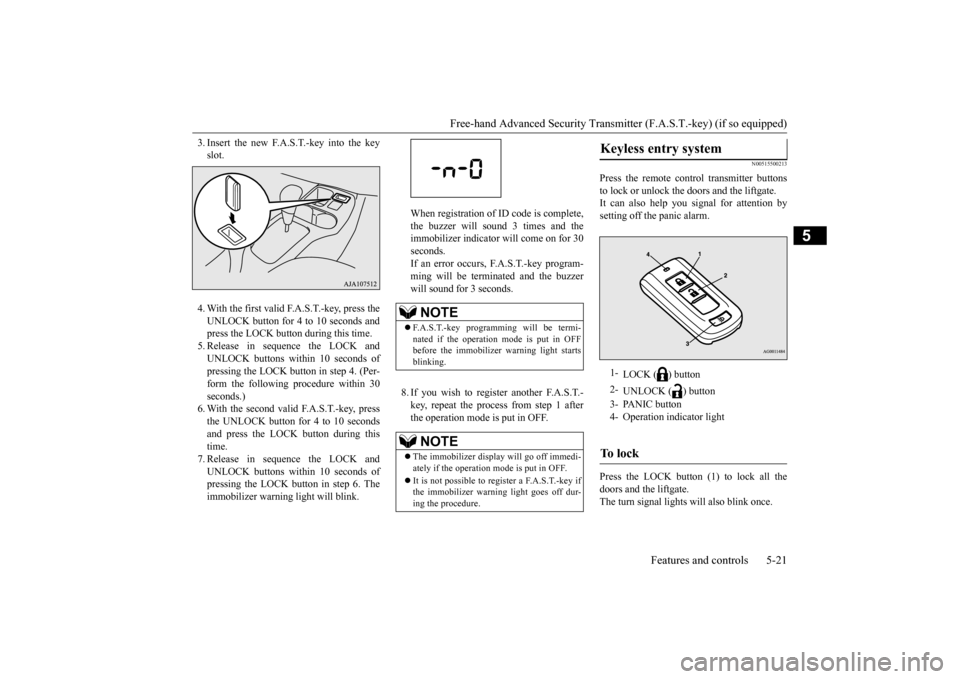
Press the remote control transmitter buttons to lock or unlock the doors and the liftgate. It can also help you signal for attention bysetting off the panic alarm. Press the LOCK button (1) to lock all the doors and the liftgate. The turn signal lights
will also blink once.
NOTE
F.A.S.T.-key programming will be termi- nated if the operation
mode is put in OFF
before the immobilize
r warning light starts
blinking.NOTE
The immobilizer displa
y will go off immedi-
ately if the operation
mode is put in OFF.
It is not possible to register a F.A.S.T.-key if the immobilizer warning light goes off dur- ing the procedure.
Keyless entry system
1-
LOCK ( ) button
2-
UNLOCK ( ) button
3- PANIC button 4- Operation indicator lightTo l o c k
BK0212400US.book 21 ページ 2014年4月1日 火曜日 午後2時21分
Page 93 of 300
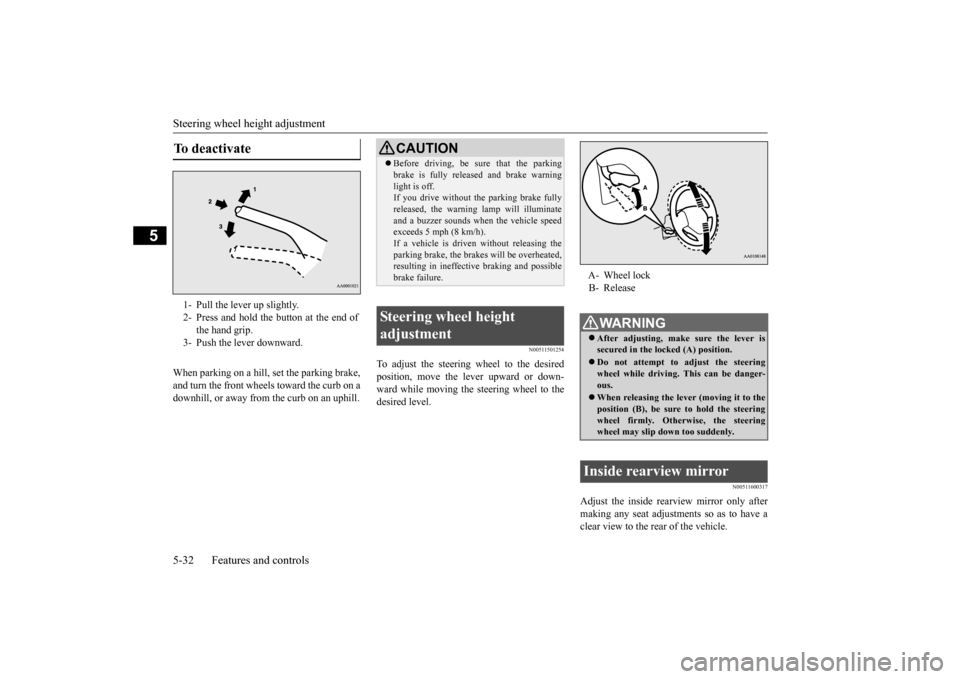
Steering wheel height adjustment 5-32 Features and controls
5
When parking on a hill, set the parking brake, and turn the front wheels toward the curb on a downhill, or away from
the curb on an uphill.
N00511501254
To adjust the steering wheel to the desired position, move the lever upward or down-ward while moving the steering wheel to the desired level.
N00511600317
Adjust the inside rearview mirror only after making any seat adjustme
nts so as to have a
clear view to the rear of the vehicle.
To deactivate 1- Pull the lever up slightly. 2- Press and hold the button at the end of
the hand grip.
3- Push the lever downward.
CAUTION Before driving, be sure that the parking brake is fully released and brake warninglight is off.If you drive without the parking brake fully released, the warning lamp will illuminate and a buzzer sounds when the vehicle speedexceeds 5 mph (8 km/h). If a vehicle is driven without releasing the parking brake, the brak
es will be overheated,
resulting in ineffective braking and possible brake failure.
Steering wheel height adjustment
A- Wheel lock B- ReleaseWA R N I N G After adjusting, make sure the lever is secured in the locked (A) position. Do not attempt to adjust the steering wheel while driving. This can be danger-ous. When releasing the leve
r (moving it to the
position (B), be sure to hold the steering wheel firmly. Otherwise, the steering wheel may slip down too suddenly.
Inside rearview mirror
BK0212400US.book 32 ページ 2014年4月1日 火曜日 午後2時21分
Page 98 of 300

Starting the engine
Features and controls 5-37
5
2. Insert the ignition key. 3. Make sure the parking brake is applied.4. Press and hold the
brake pedal down with
your right foot. 5. Press and hold the clut
ch pedal all the way
down (manual transaxle). 6. On vehicles equipped with manual trans- axle, place the gearshift lever in the “N” (Neutral) position.On vehicles equippe
d with continuously
variable transmission (CVT), make sure the selector lever is in the “P” (PARK)position.
7. Turn the ignition switch to the “ON” posi- tion and make certain that all warninglights are functioning properly before starting the engine. 8. Turn the ignition switch to the “START”position without pre
ssing the accelerator
pedal. Release the key when the engine starts.
After several attempts
, you may experience
that the engine still does not start. 1. Make sure that all electric devices, such as lights, air conditi
oning blower and rear
window defogger, are turned off. 2. While depressing the brake pedal {contin- uously variable transmission (CVT)} orthe clutch pedal (manual transaxle), press the accelerator peda
l halfway and hold it
there, then crank th
e engine. Release the
accelerator pedal, immediately after the engine starts.
3. If the engine still wi
ll not start, the engine
could be flooded with too much gasoline.While depressing the brake pedal (CVT) or the clutch pedal (manual transaxle), push the accelerator pedal all the waydown and hold it there, then crank the engine for 5 to 6 seconds. Return the igni- tion switch to the “OFF” position andrelease the accelerator pedal. Wait a few seconds, and then crank the engine again for 5 to 6 seconds while depressing the brake pedal (CVT) or the clutch pedal (manual transaxle), but do not push theaccelerator pedal. Release the ignition key if the engine starts.
If the engine fails to
start, repeat these procedures. If theengine still will not
start, contact your
local Mitsubishi Motors dealer or a repair facility of your choi
ce for assistance.
When the ambient temperature is -4 °F (-20 °C) or lower, it may not be possible to start from a standstill even with the selector lever in the “D” (DRIVE) or “R” (REVERSE)position. This phenomenon occurs because the trans- axle has not warmed up sufficiently; it does
NOTE
On vehicles equipped
with manual transaxle,
the starter will not ope
rate unless the clutch
pedal is fully depresse
d (Clutch interlock).
NOTE
On vehicles equipped wi
th CVT, the starter
will not operate unless th
e selector lever is in
the “P” (PARK) or “N” (NEUTRAL) posi-tion.For safety reasons, start the engine in the “P” (PARK) position so that the wheels are locked.
NOTE
Minor noises may be he
ard on engine start-
up. These will disappear
as the engine warms
up.
When the engine is hard to start
Startability of CVT vehicle with ambient temperature of -4 °F (-20 °C) or lower
BK0212400US.book 37 ページ 2014年4月1日 火曜日 午後2時21分