warning lights MITSUBISHI MIRAGE 2015 6.G User Guide
[x] Cancel search | Manufacturer: MITSUBISHI, Model Year: 2015, Model line: MIRAGE, Model: MITSUBISHI MIRAGE 2015 6.GPages: 300, PDF Size: 43.44 MB
Page 133 of 300
Warning lights 5-72 Features and controls
5
N00520300147 N00520400526
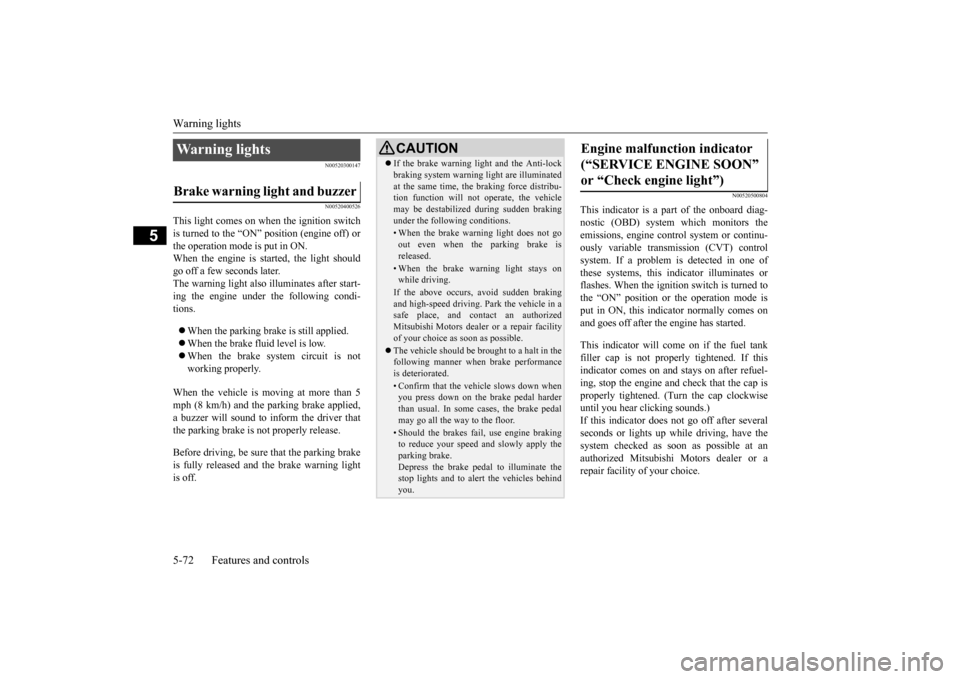
This light comes on when the ignition switch is turned to the “ON” position (engine off) or the operation mode is put in ON.When the engine is started, the light should go off a few seconds later. The warning light also illuminates after start- ing the engine under the following condi- tions. When the parking brake is still applied. When the brake fluid level is low. When the brake system circuit is not working properly.
When the vehicle is moving at more than 5 mph (8 km/h) and the parking brake applied, a buzzer will sound to in
form the driver that
the parking brake is not properly release. Before driving, be sure that the parking brake is fully released and the brake warning light is off.
N00520500804
This indicator is a pa
rt of the onboard diag-
nostic (OBD) system which monitors the emissions, engine control system or continu- ously variable transmission (CVT) controlsystem. If a problem is detected in one of these systems, this indicator illuminates or flashes. When the ignition switch is turned to the “ON” position or the operation mode is put in ON, this indicator normally comes onand goes off after the engine has started. This indicator will come on if the fuel tank filler cap is not properly tightened. If this indicator comes on and stays on after refuel-ing, stop the engine and check that the cap is properly tightened. (Turn the cap clockwise until you hear clicking sounds.)If this indicator does not go off after several seconds or lights up while driving, have the system checked as s
oon as possible at an
authorized Mitsubishi Motors dealer or a repair facility of your choice.
Warning lights Brake warning light and buzzer
CAUTION If the brake warning light and the Anti-lock braking system warning
light are illuminated
at the same time, the braking force distribu-tion function will not
operate, the vehicle
may be destabilized
during sudden braking
under the following conditions.• When the brake warn
ing light does not go
out even when the parking brake isreleased.• When the brake warning light stays onwhile driving.If the above occurs, avoid sudden brakingand high-speed driving. Park the vehicle in a safe place, and c
ontact an authorized
Mitsubishi Motors dealer or a repair facilityof your choice as soon as possible. The vehicle should be bro
ught to a halt in the
following manner when
brake performance
is deteriorated.• Confirm that the vehicle slows down whenyou press down on the brake pedal harder than usual. In some cases, the brake pedalmay go all the way to the floor.• Should the brakes fail, use engine brakingto reduce your speed and slowly apply the parking brake. Depress the brake pedal to illuminate thestop lights and to aler
t the vehicles behind
you.
Engine malfunction indicator (“SERVICE ENGINE SOON” or “Check engine light”)
BK0212400US.book 72 ページ 2014年4月1日 火曜日 午後2時21分
Page 134 of 300
Warning lights
Features and controls 5-73
5
N00520600313
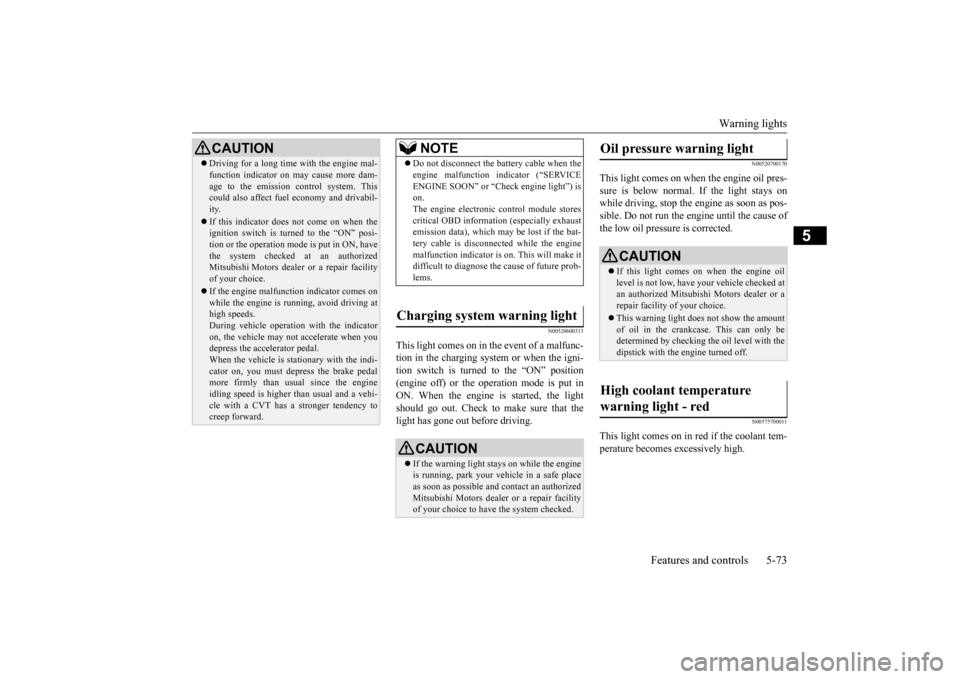
This light comes on in the event of a malfunc- tion in the charging system or when the igni-tion switch is turned to the “ON” position (engine off) or the operation mode is put in ON. When the engine is started, the lightshould go out. Check to make sure that the light has gone out before driving.
N00520700170
This light comes on when the engine oil pres-sure is below normal. If the light stays on while driving, stop the engine as soon as pos-sible. Do not run the engine until the cause of the low oil pressure is corrected.
N00575700011
This light comes on in red if the coolant tem- perature becomes excessively high.
CAUTION Driving for a long time
with the engine mal-
function indicator on may cause more dam-age to the emission control system. Thiscould also affect fuel
economy and drivabil-
ity. If this indicator does not come on when the ignition switch is turned to the “ON” posi- tion or the operation mode is put in ON, havethe system checked at an authorized Mitsubishi Motors dealer or a repair facility of your choice. If the engine malfunction indicator comes on while the engine is running, avoid driving athigh speeds. During vehicle
operation with the indicator
on, the vehicle may not
accelerate when you
depress the accelerator pedal. When the vehicle is stat
ionary with the indi-
cator on, you must depr
ess the brake pedal
more firmly than usual since the engine idling speed is higher th
an usual and a vehi-
cle with a CVT has a stronger tendency tocreep forward.
NOTE
Do not disconnect the ba
ttery cable when the
engine malfunction i
ndicator (“SERVICE
ENGINE SOON” or “Check engine light”) ison. The engine electronic
control module stores
critical OBD informati
on (especially exhaust
emission data), which ma
y be lost if the bat-
tery cable is disconne
cted while the engine
malfunction indicator is
on. This will make it
difficult to diagnose th
e cause of future prob-
lems.
Charging system warning light
CAUTION If the warning light stays on while the engine is running, park your ve
hicle in a safe place
as soon as possible and
contact an authorized
Mitsubishi Motors dealer
or a repair facility
of your choice to have the system checked.
Oil pressure warning light
CAUTION If this light comes on when the engine oil level is not low, have
your vehicle checked at
an authorized Mitsubish
i Motors dealer or a
repair facility of your choice. This warning light does not show the amount of oil in the crankcase. This can only be determined by checking the oil level with the dipstick with the engine turned off.
High coolant temperature warning light - red
BK0212400US.book 73 ページ 2014年4月1日 火曜日 午後2時21分
Page 135 of 300
Combination headlights and dimmer switch 5-74 Features and controls
5
N00520900329
This light comes on when any door or the lift- gate is open or not completely closed. When the vehicle is moving at more than 5 mph (8 km/h) and any door or the liftgate isopen or ajar, a tone will sound 4 times to inform the driver that any door or the liftgate is not properly shut.
N00522500736
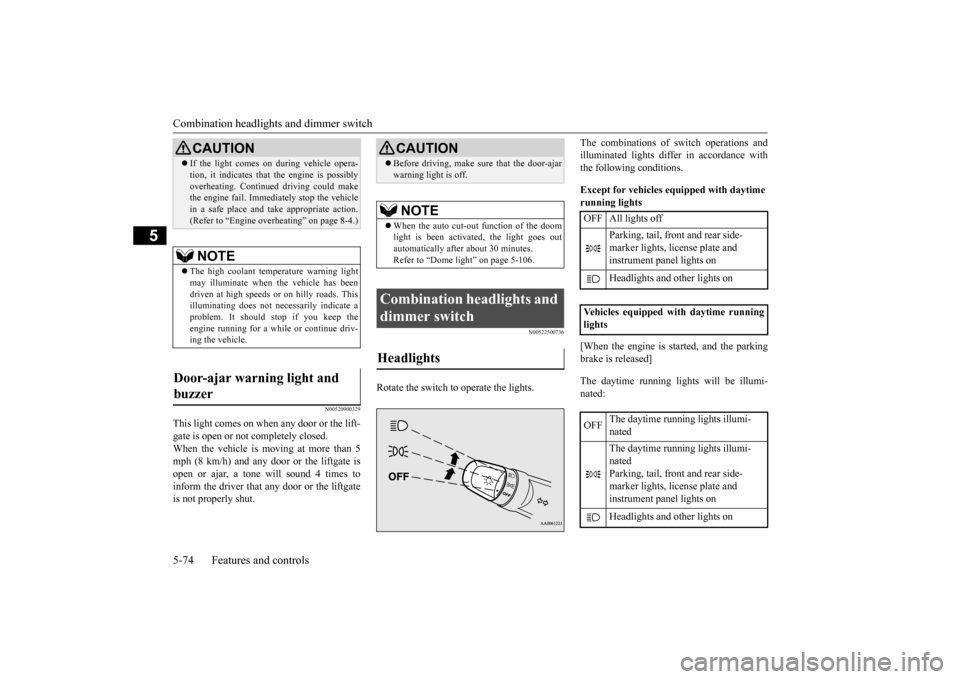
Rotate the switch to operate the lights.
The combinations of
switch operations and
illuminated lights differ in accordance withthe following conditions. Except for vehicles equipped with daytime running lights [When the engine is st
arted, and the parking
brake is released] The daytime running lights will be illumi- nated:
CAUTION If the light comes on
during vehicle opera-
tion, it indicates that
the engine is possibly
overheating. Continued driving could makethe engine fail. Immedi
ately stop the vehicle
in a safe place and ta
ke appropriate action.
(Refer to “Engine overh
eating” on page 8-4.)
NOTE
The high coolant temp
erature warning light
may illuminate when
the vehicle has been
driven at high speeds or on hilly roads. This illuminating does not ne
cessarily indicate a
problem. It should stop if you keep the engine running for a whil
e or continue driv-
ing the vehicle.
Door-ajar warning light and buzzer
CAUTION Before driving, make sure that the door-ajar warning light is off. NOTE
When the auto cut-out function of the doom light is been activa
ted, the light goes out
automatically after about 30 minutes. Refer to “Dome light” on page 5-106.
Combination headlights and dimmer switch Headlights
OFF All lights off
Parking, tail, front and rear side- marker lights, license plate and instrument panel lights on Headlights and
other lights on
Vehicles equipped with daytime running lights OFF
The daytime running lights illumi- nated The daytime running lights illumi- nated Parking, tail, front and rear side- marker lights, license plate and instrument panel lights on Headlights and
other lights on
BK0212400US.book 74 ページ 2014年4月1日 火曜日 午後2時21分
Page 138 of 300
Hazard warning flasher switch Features and controls 5-77
5
See your authorized Mitsubishi Motors dealer for details.
N00522700318
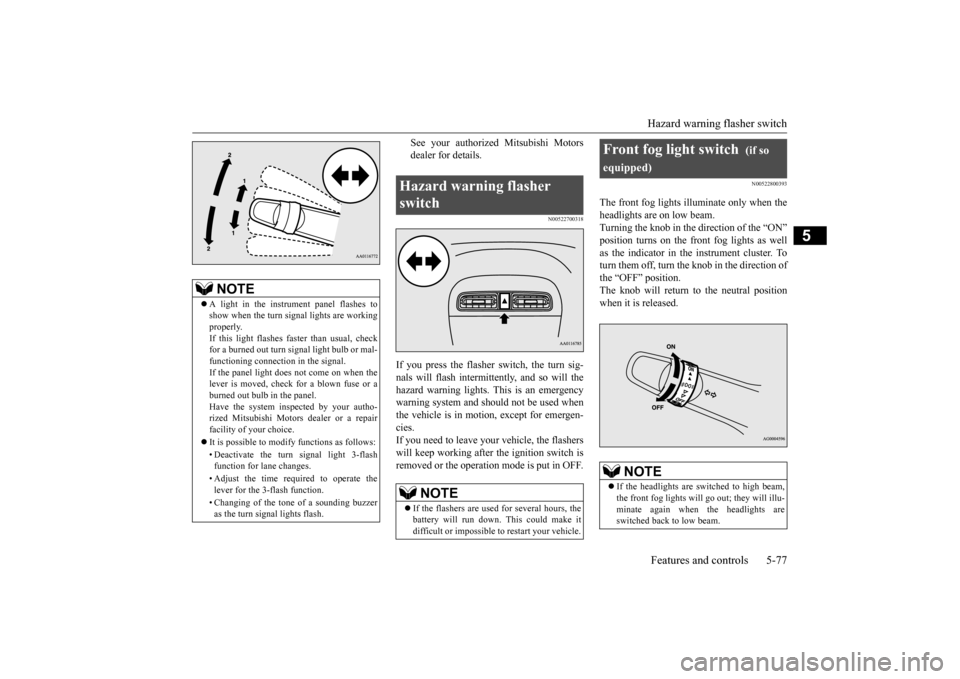
If you press the flasher switch, the turn sig- nals will flash intermittently, and so will the hazard warning lights.
This is an emergency
warning system and should not be used when the vehicle is in motion, except for emergen- cies.If you need to leave your vehicle, the flashers will keep working afte
r the ignition switch is
removed or the operation mode is put in OFF.
N00522800393
The front fog lights illuminate only when theheadlights are on low beam.Turning the knob in the direction of the “ON” position turns on the front fog lights as well as the indicator in the instrument cluster. Toturn them off, turn the knob in the direction of the “OFF” position. The knob will return to the neutral position when it is released.
NOTE
A light in the instrument panel flashes to show when the turn signal lights are workingproperly. If this light flashes fa
ster than usual, check
for a burned out turn signal light bulb or mal-functioning connect
ion in the signal.
If the panel light does not come on when the lever is moved, check for a blown fuse or aburned out bulb in the panel. Have the system inspected by your autho- rized Mitsubishi Motors dealer or a repairfacility of your choice. It is possible to modify functions as follows: • Deactivate the turn signal light 3-flash function for lane changes. • Adjust the time required to operate the lever for the 3-flash function. • Changing of the tone of a sounding buzzer as the turn signal lights flash.
Hazard warning flasher switch
NOTE
If the flashers are used for several hours, the battery will run down.
This could make it
difficult or impossible
to restart your vehicle.
Front fog light switch
(if so
equipped)
NOTE
If the headlights are sw
itched to high beam,
the front fog lights will go out; they will illu- minate again when the headlights are switched back to low beam.
BK0212400US.book 77 ページ 2014年4月1日 火曜日 午後2時21分
Page 227 of 300
If the vehicle breaks down 8-2 For emergencies
8
N00836300233
If your vehicle breaks down on the road, move to the shoulder and turn on the hazard warning flashers. If there is no shoulder, orthe shoulder is not safe, drive in the right lane slowly with the haza
rd lights flashing until
you come to a safe stopping place. Keep theflashers flashing. If the engine stops, there will be no power assist to the steering and brakes, making these difficult to use. The brake booster will not work, so the brakes will not grip well. The brake pedal will be harder to press than usual. Since there is no power steering assist, the steering wheel will be hard to turn.
Get help from your passengers, bystanders, etc. to push the vehicle
and move it to a safe
area.
N00836400768
If the engine cannot be started because the battery is weak or de
ad, you can start it with
the battery from anothe
r vehicle using jumper
cables. 1. Take off any metal jewelry such as watch bands or bracelets th
at might create an
accidental electrical contact. 2. Position the vehi
cles close enough
together so that the jumper cables canreach, but be sure the vehicles aren’t touching each other.
3. You could be injured if the vehicles move. Set the parking brake firmly on each vehi- cle. Put an automatic transaxle or CVT in “P” (PARK) or a manual transaxle in “N”(Neutral). 4. Turn the ignition switch to the “OFF” position or put the operation mode inOFF. 5. Make sure your battery electrolyte is at the proper level. (Refer to “Battery” on page 9-10.)
If the vehicle breaks down If the engine stops/fails When the engine fails at the intersection
Jump-starting the engine
WA R N I N G To reduce the risk of igniting flammable gas that may be emitted from the battery,carefully read this section before jump- starting the vehicle. Do not try to start you
r vehicle by pushing
or towing. This can cause an accident resulting in serious
injury or death and
can damage the vehicle.NOTE
Do not use jumper cables if they have dam- age or corrosion.
CAUTION Check the other vehicle.
It must have a 12-
volt battery. If the other system isn’t 12-volt,both systems can be damaged.NOTE
Turn off all lights, heat
er, and othe
r electrical
loads. This will avoid sparks and help save both batteries.WA R N I N G If the electrolyte fluid is not visible, or looks frozen, DO NOT ATTEMPT JUMPSTARTING!! The battery might spli
t open or explode if
the temperature is below the freezingpoint or if it is not filled to the proper level.
BK0212400US.book 2 ページ 2014年4月1日 火曜日 午後2時21分
Page 269 of 300
Fuses 9-24 Vehicle care and maintenance
9
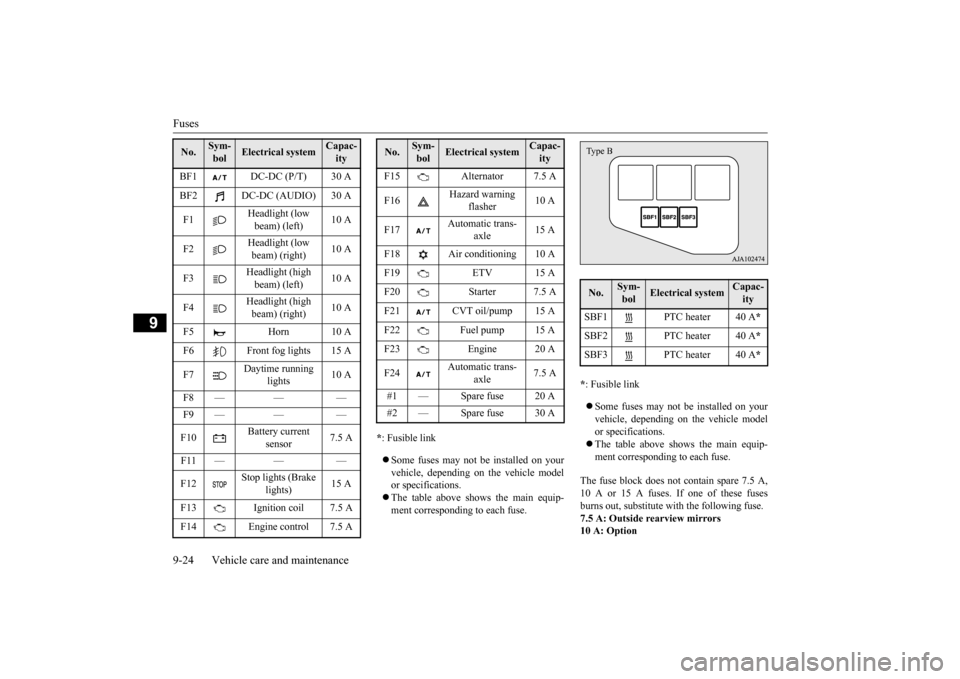
* : Fusible link Some fuses may not be installed on your vehicle, depending on
the vehicle model
or specifications. The table above show
s the main equip-
ment corresponding to each fuse.
* : Fusible link Some fuses may not be installed on your vehicle, depending on the vehicle modelor specifications. The table above shows the main equip- ment corresponding to each fuse.
The fuse block does not contain spare 7.5 A, 10 A or 15 A fuses. If one of these fuses burns out, substitute wi
th the following fuse.
7.5 A: Outside rearview mirrors10 A: Option
BF1 DC-DC (P/T) 30 A BF2 DC-DC (AUDIO) 30 A F1
Headlight (low beam) (left)
10 A
F2
Headlight (low beam) (right)
10 A
F3
Headlight (high beam) (left)
10 A
F4
Headlight (high beam) (right)
10 A
F5 Horn 10 A F6 Front fog lights 15 A F7
Daytime running
lights
10 A
F8 — — — F9 — — — F10
Battery current
sensor
7.5 A
F11 — — —F12
Stop lights (Brake
lights)
15 A
F13 Ignition coil 7.5 A F14 Engine control 7.5 ANo.
Sym- bol
Electrical system
Capac-ity
F15 Alternator 7.5 A F16
Hazard warning
flasher
10 A
F17
Automatic trans-
axle
15 A
F18 Air conditioning 10 A F19 ETV 15 AF20 Starter 7.5 A F21 CVT oil/pump 15 A F22 Fuel pump 15 A F23 Engine 20 A F24
Automatic trans-
axle
7.5 A
#1 — Spare fuse 20 A #2 — Spare fuse 30 ANo.
Sym- bol
Electrical system
Capac-ity
No.
Sym-bol
Electrical system
Capac-ity
SBF1 PTC heater 40 A
*
SBF2 PTC heater 40 A
*
SBF3 PTC heater 40 A
*
Type B
BK0212400US.book 24 ページ 2014年4月1日 火曜日 午後2時21分
Page 294 of 300
Alphabetical index
12-1
12
A
Accessory (installation)
.........................
3-5
Active stability control (ASC)
..............
5-49
Air bag
..............................................
4-21
Air cleaner filter
...................................
9-8
Air conditioning
Automatic air conditioning
..............
7-11
Important air condi
tioning operating tips
..
7-17 Manual air conditioning
....................
7-7
Air purifier
.........................................
7-18
Aluminum wheels
...............................
9-35
Antenna
Roof antenna
..................................
7-41
Anti-lock braking system
.....................
5-46
Assist grip
........................................
5-110
Audio
AM/FM electronically
tuned radio with
CD player
....................................
7-18
Error codes
.....................................
7-38
Handling of compact discs
...............
7-40
Automatic air conditioning
..................
7-11
B
Back-up light
Bulb capacity
.................................
9-26
Ball joint, steering li
nkage seals and drive
shaft boots
.......................................
9-21
Battery
..............................................
9-10
Charging system warning light
........
5-73
Checking battery
electrolyte level
....
9-10
Disconnection and connection
.........
9-11
During cold weather
.......................
9-11
Specification
..................................
11-4
Bluetooth® 2.0 interface
.....................
5-81
Bottle holders
....................................
5-108
Brake
Fluid
.............................................
11-5
Brake assist system
.............................
5-46
Braking
...............................................
6-5
Anti-lock braking system
................
5-46
Hose
.............................................
9-20
Pad wear alarm
..............................
5-45
Parking brake
.................................
5-31
Pedal
.............................................
5-44
Pedal free play
...............................
9-18
Power brakes
.................................
5-44
Service brake
.................................
5-44
Warning lights
...............................
5-72
Break-in recommendations
....................
5-2
Bulb capacity
.....................................
9-26
C
California Perchl
orate Materials
Requirements
.....................................
3-7
Capacities
..........................................
11-5
Card holder
......................................
5-105
Cargo loads
........................................
6-10
Cargo room light
Bulb capacity
.................................
9-27
Catalytic converter
................................
9-3
Certification label
...............................
11-3
Charging system warning light
.............
5-73
Child restraint systems
........................
4-14
Child safety locks for rear door
............
5-27
Cleaning
Inside of your vehicle
......................
9-32
Outside of your vehicle
...................
9-33
Clutch
Pedal free play
................................
9-18
Consumer information
.........................
10-2
Continuously variable transmission (CVT)
...
5-39 Fluid
.......................................
9-9
, 11-5
Selector lever operation
...................
5-40
Selector lever positions
....................
5-41
Convenience hook
.............................
5-109
Coolant (engine)
..........................
9-7
, 11-5
Cruise control
.....................................
5-52
Cup holders
......................................
5-108
BK0212400US.book 1 ページ 2014年4月1日 火曜日 午後2時21分
Page 295 of 300
Alphabetical index 12-2
12
D
Daytime running lights
Bulb capacity
.................................
9-26
Defogger (rear window)
......................
5-80
Defrosting or defogging (windshield, door windows)
................................
7-10
, 7-16
Dimensions
........................................
11-3
Dimmer (high/lo
w beam change)
.........
5-76
Disc brake pads
..................................
9-20
Dome light
Bulb capacity
.................................
9-27
Door-ajar warning buzzer
....................
5-74
Door-ajar warning light
.......................
5-74
Doors
Lock
..............................................
5-24
Power door locks
............................
5-26
Driving during cold weather
..................
6-4
Driving, alcohol and drugs
.....................
6-2
E
Electric power steering system (EPS)
...
5-48
Electric rear win
dow defogger switch
...
5-80
Electronic immobilizer (Anti-theft starting system)
.....................................
5-3
, 5-20
Emission-control sy
stem maintenance
..9-19
Engine
Compartment
...................................
9-5
Coolant
...................................
9-7
, 11-5
High coolant temperature warning light
....
5-73 Hood
...............................................
9-4
Oil and oil filter
.......................
9-5
, 11-5
Overheating
.....................................
8-4
Serial number
.................................
11-2
Specification
...................................
11-4
Engine hood
........................................
9-4
Engine switch
.....................................
5-13
Error codes
.........................................
7-38
Exhaust system
...................................
9-21
F
Floor mat
.............................................
6-2
Fluid
Brake fluid
.....................................
11-5
Continuously variable
transmission (CVT)
fluid
......................................
9-9
, 11-5
Engine coolant
.........................
9-7
, 11-5
Manual transaxle
.............................
11-5
Washer fluid
............................
9-9
, 11-5
Fluid capacities and lubricants
..............
11-5
Free-hand advanced security transmitter (F.A.S.T.-key)
...................................
5-9
Front fog lights
Bulb capacity
..................................
9-26
Indicators
.......................................
5-71
Replacement
..................................
9-29
Switch
...........................................
5-77
Front seat adjustment
............................
4-3
Front side-marker lights
Bulb capacity
.................................
9-26
Replacement
..................................
9-28
Front turn signal light
Bulb capacity
.................................
9-26
Replacement
..................................
9-28
Fuel
Filling the fuel tank
...........................
3-3
Fuel economy
...................................
6-2
Fuel hoses
......................................
9-20
Fuel remaining warning display
.......
5-66
Fuel selection
...................................
3-2
Tank capacity
.................................
11-5
Fuel Pump Shut-off System
.................
8-20
Fuel remaining display
........................
5-66
Fuses
.................................................
9-22
Fusible links
.......................................
9-22
G
General maintenance
Maintenance
...................................
9-20
General vehicle data
............................
11-3
Genuine parts
.......................................
3-6
Glove compartment
...........................
5-108
BK0212400US.book 2 ページ 2014年4月1日 火曜日 午後2時21分
Page 296 of 300
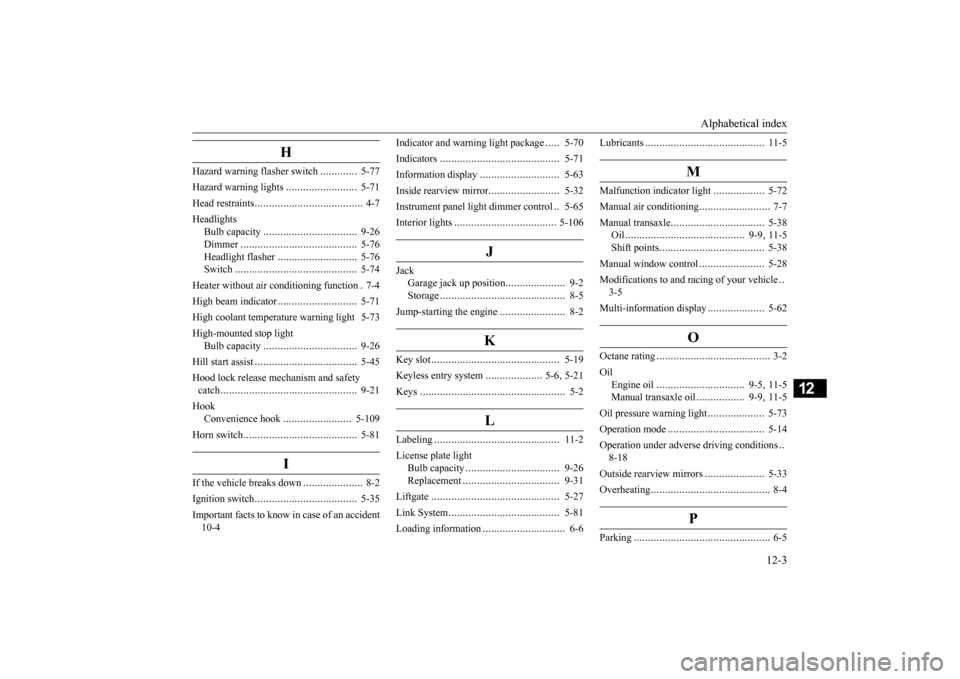
Alphabetical index
12-3
12
H
Hazard warning
flasher switch
.............
5-77
Hazard warning lights
.........................
5-71
Head restraints
......................................
4-7
Headlights
Bulb capacity
.................................
9-26
Dimmer
.........................................
5-76
Headlight flasher
............................
5-76
Switch
...........................................
5-74
Heater without air conditioning function
.7-4
High beam indicator
............................
5-71
High coolant temperature warning light 5-73 High-mounted stop light
Bulb capacity
.................................
9-26
Hill start assist
....................................
5-45
Hood lock release me
chanism and safety
catch
................................................
9-21
Hook
Convenience hook
........................
5-109
Horn switch
........................................
5-81
I
If the vehicle breaks down
.....................
8-2
Ignition switch
....................................
5-35
Important facts to know in
case of an accident
10-4
Indicator and warning light package
.....
5-70
Indicators
..........................................
5-71
Information display
............................
5-63
Inside rearview mirror
.........................
5-32
Instrument panel li
ght dimmer control
..5-65
Interior lights
....................................
5-106
J
Jack
Garage jack up position
.....................
9-2
Storage
............................................
8-5
Jump-starting the engine
.......................
8-2
K
Key slot
.............................................
5-19
Keyless entry system
....................
5-6
, 5-21
Keys
...................................................
5-2
L
Labeling
............................................
11-2
License plate light
Bulb capacity
.................................
9-26
Replacement
..................................
9-31
Liftgate
.............................................
5-27
Link System
.......................................
5-81
Loading information
.............................
6-6
Lubricants
..........................................
11-5
M
Malfunction indicator light
..................
5-72
Manual air conditioning
.........................
7-7
Manual transaxle
.................................
5-38
Oil
..........................................
9-9
, 11-5
Shift points
.....................................
5-38
Manual window control
.......................
5-28
Modifications to and
racing of your vehicle
..
3-5 Multi-information display
....................
5-62
O
Octane rating
........................................
3-2
Oil
Engine oil
...............................
9-5
, 11-5
Manual transaxle oil
.................
9-9
, 11-5
Oil pressure warning light
....................
5-73
Operation mode
..................................
5-14
Operation under adverse driving conditions
..
8-18 Outside rearview mirrors
.....................
5-33
Overheating
..........................................
8-4
P
Parking
................................................
6-5
BK0212400US.book 3 ページ 2014年4月1日 火曜日 午後2時21分
Page 297 of 300
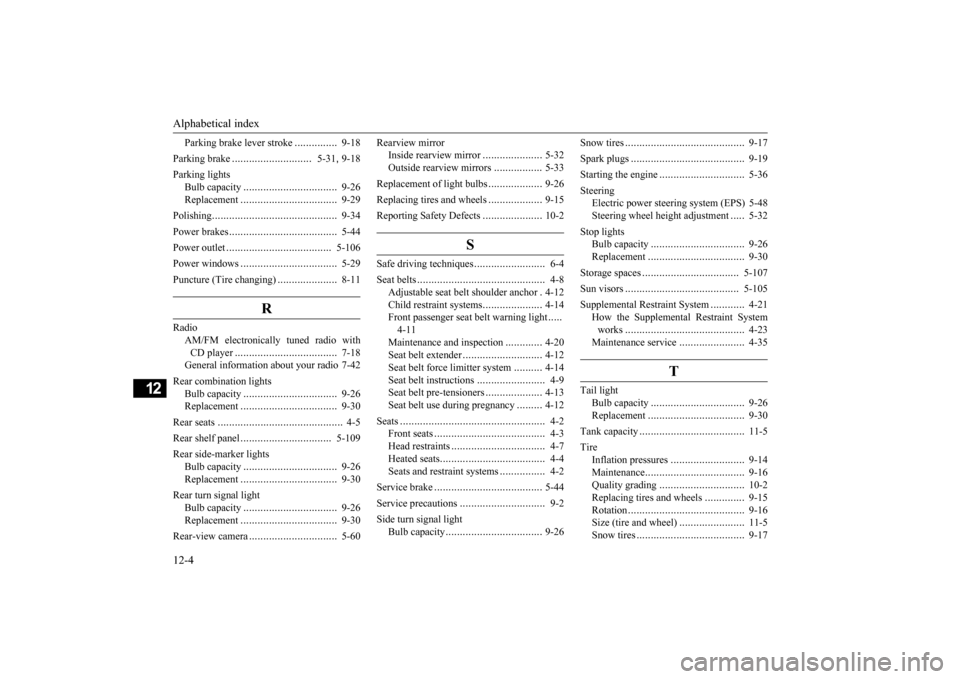
Alphabetical index 12-4
12
Parking brake lever stroke
...............
9-18
Parking brake
............................
5-31
, 9-18
Parking lights
Bulb capacity
.................................
9-26
Replacement
..................................
9-29
Polishing
............................................
9-34
Power brakes
......................................
5-44
Power outlet
.....................................
5-106
Power windows
..................................
5-29
Puncture (Tire changing)
.....................
8-11
R
Radio
AM/FM electronically tuned radio with CD player
....................................
7-18
General information about your radio 7-42
Rear combination lights
Bulb capacity
.................................
9-26
Replacement
..................................
9-30
Rear seats
............................................
4-5
Rear shelf panel
................................
5-109
Rear side-marker lights
Bulb capacity
.................................
9-26
Replacement
..................................
9-30
Rear turn signal light
Bulb capacity
.................................
9-26
Replacement
..................................
9-30
Rear-view camera
...............................
5-60
Rearview mirror
Inside rearview mirror
.....................
5-32
Outside rearview mirrors
.................
5-33
Replacement of light bulbs
...................
9-26
Replacing tires and wheels
...................
9-15
Reporting Safety Defects
.....................
10-2
S
Safe driving techniques
.........................
6-4
Seat belts
.............................................
4-8
Adjustable seat be
lt shoulder anchor
.4-12
Child restraint systems
.....................
4-14
Front passenger seat belt warning light
.....
4-11 Maintenance and inspection
.............
4-20
Seat belt extender
............................
4-12
Seat belt force limitter system
..........
4-14
Seat belt instructions
........................
4-9
Seat belt pre-tensioners
....................
4-13
Seat belt use
during pregnancy
.........
4-12
Seats
...................................................
4-2
Front seats
.......................................
4-3
Head restraints
.................................
4-7
Heated seats
.....................................
4-4
Seats and restraint systems
................
4-2
Service brake
......................................
5-44
Service precautions
..............................
9-2
Side turn signal light
Bulb capacity
..................................
9-26
Snow tires
..........................................
9-17
Spark plugs
........................................
9-19
Starting the engine
..............................
5-36
Steering
Electric power steeri
ng system (EPS) 5-48
Steering wheel he
ight adjustment
.....
5-32
Stop lights
Bulb capacity
.................................
9-26
Replacement
..................................
9-30
Storage spaces
..................................
5-107
Sun visors
........................................
5-105
Supplemental Restraint System
............
4-21
How the Supplementa
l Restraint System
works
..........................................
4-23
Maintenance service
.......................
4-35
T
Tail light
Bulb capacity
.................................
9-26
Replacement
..................................
9-30
Tank capacity
.....................................
11-5
Tire
Inflation pressures
..........................
9-14
Maintenance
...................................
9-16
Quality grading
..............................
10-2
Replacing tires and wheels
..............
9-15
Rotation
.........................................
9-16
Size (tire and wheel)
.......................
11-5
Snow tires
......................................
9-17
BK0212400US.book 4 ページ 2014年4月1日 火曜日 午後2時21分